Recognition: unknown
Training of particle-turbulence sub-grid-scale closures with just particle data
Pith reviewed 2026-05-07 08:30 UTC · model grok-4.3
The pith
Particle kinetic energy data alone trains effective sub-grid-scale stress models for turbulence simulations
A machine-rendered reading of the paper's core claim, the machinery that carries it, and where it could break.
Core claim
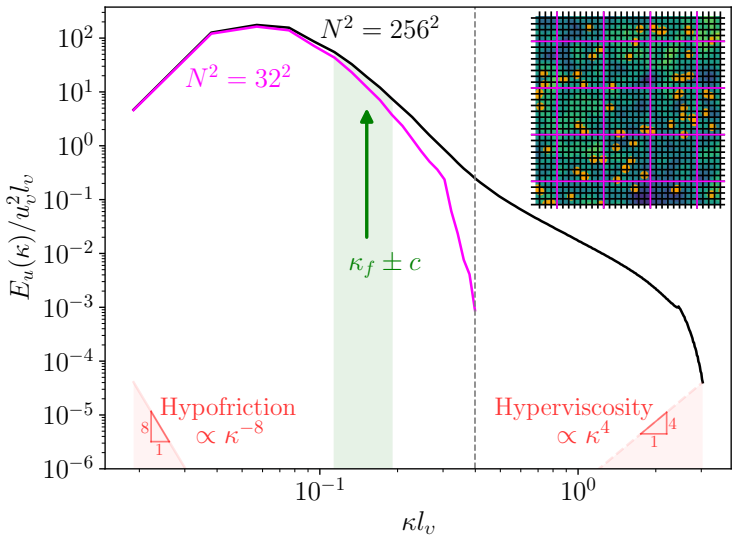
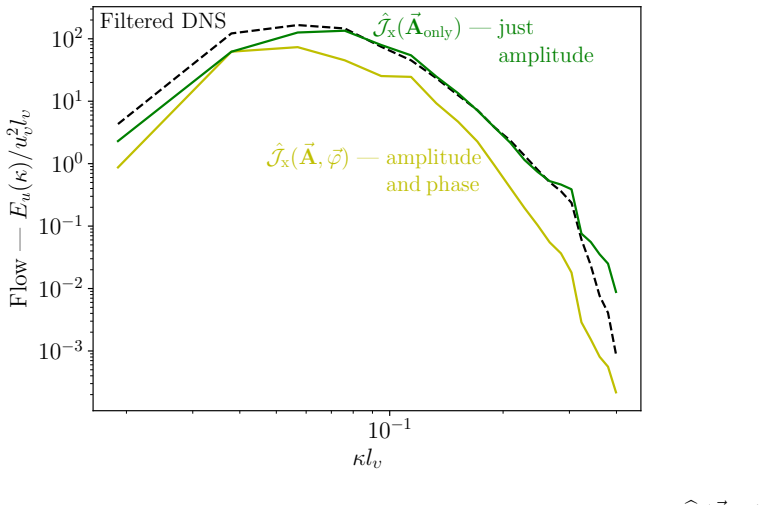
A physics-constrained neural network trained solely to match particle kinetic energy spectra from intentionally degraded simulation data produces sub-grid-scale stress models that improve two-way coupled particle simulations in two-dimensional turbulence. This holds without supplying flow information during training and persists under added noise, reduced particle counts, or single-component velocities. Full space-time training data reduces performance relative to spectral targets, while a separate Langevin-type closure is required for the uncorrectable stochastic component of preferential concentration errors.
What carries the argument
Physics-constrained neural network for sub-grid-scale stress prediction, trained by matching particle kinetic energy spectra with no flow-field input.
If this is right
- Training on spectra alone outperforms training on full space-time particle data.
- A basic Langevin closure is needed to capture the stochastic part of preferential concentration errors on coarse meshes.
- The learned stress models remain effective when particle data contain noise or cover only a fraction of particles.
- Single-component particle velocities suffice for training useful sub-grid-scale stress models.
- Sub-grid-scale physics can be inferred from particle data without simultaneous flow-field measurements.
Where Pith is reading between the lines
- The result suggests that particle kinetic energy statistics alone encode enough information about unresolved flow scales to close the particle equations.
- The method could be tested directly on experimental particle-image-velocimetry data where only particle velocities are recorded.
- Extension to three-dimensional flows would check whether the same data-reduction advantages hold when the turbulence is fully developed.
- The same training strategy might apply to other dispersed-phase systems in which only tracer or particle velocities are observable.
Load-bearing premise
Data degraded from well-resolved simulations accurately represents the errors and missing physics that appear in actual coarse-mesh simulations.
What would settle it
Compare particle concentration statistics and kinetic energy spectra in a coarse-mesh simulation using the trained closure against the same quantities from a reference fine-mesh simulation; mismatch would falsify the claim that the learned model supplies the correct missing physics.
Figures




read the original abstract
If sufficient training data are available, neural networks are attractive for representing missing physics in simulations, such as sub-grid scales in the coarse-mesh particle-turbulence system we consider. Physical constraints are known to both increase performance and reduce the need for data; we use the complete physics represented in the discretized governing equations as a constraint. Two-way coupled particles in two-dimensional turbulence provide a sufficiently complex system to assess effectiveness for various training data, all constructed from well-resolved simulations, in cases intentionally degraded to assess robustness. Surprisingly, using the full space-time data actually hinders model effectiveness. Instead, training that targets only spectra -- hence, neglecting phase information -- provides better closures, which is related to the well-known success of non-dissipative discretizations for simulating turbulence. It is found that some of the missing physics that lead to preferential particle concentration errors are fundamentally stochastic on the coarse mesh and therefore uncorrectable by the basic approach; a learning formulation is introduced for a Langevin-type closure to correct this. Most importantly, training just for particle kinetic energy -- without any direct input from the flow field -- also yields effective sub-grid-scale stress models. This holds true even if noise is added to the particle data, if only a sub-sample of particles are used, or if only one component of the particle velocity is used. In sum, these results show a path for inferring sub-grid-scale physics based just on particle data from experiments.
Editorial analysis
A structured set of objections, weighed in public.
Referee Report
Summary. The manuscript develops a physics-constrained neural-network framework for learning sub-grid-scale (SGS) stress closures in two-way coupled particle-turbulence systems. Training data are generated by intentionally degrading well-resolved two-dimensional simulations; the central results are that (i) targeting only particle kinetic-energy spectra (rather than full space-time fields) produces more effective closures, (ii) training on particle kinetic energy alone, without any direct flow-field input, still yields usable SGS models, and (iii) a Langevin-type stochastic closure is required for the uncorrectable component of preferential-concentration error. The approach is shown to remain effective under added noise, particle subsampling, and use of only one velocity component.
Significance. If the central claims are substantiated, the work provides a concrete route to inferring SGS closures directly from experimental particle data, bypassing the need for simultaneous resolved flow measurements. The finding that full space-time data can degrade performance while spectral targets improve it is consistent with established practices in turbulence numerics and adds practical value. The explicit separation of deterministic and stochastic error components via a Langevin closure is a useful modeling distinction.
major comments (3)
- [Abstract and §3 (data-generation procedure)] The central claim that degraded high-resolution data serve as a faithful proxy for the error statistics of genuine coarse-mesh simulations (especially the stochastic component of preferential concentration) is load-bearing yet unverified. Post-hoc filtering or subsampling of resolved fields does not automatically reproduce the dynamically coupled effect of unresolved scales on particle trajectories; explicit comparison against actual coarse-mesh two-way coupled runs is required to confirm that the joint statistics of unresolved flow fluctuations and particle response are reproduced.
- [Abstract and §4 (particle-only training results)] The assertion that training solely on particle kinetic energy (without flow-field inputs) produces effective SGS stress models must be supported by quantitative metrics on the predicted particle concentration fields and two-way coupling terms, not only on kinetic-energy spectra. The manuscript should report, for example, the L2 error in particle number density and the correlation between modeled and true SGS stress divergence in the coarse-mesh equations.
- [Abstract and §5 (Langevin closure formulation)] The Langevin-type closure introduced to capture the fundamentally stochastic part of preferential-concentration error lacks a precise statement of its stochastic differential equation, the training objective, and the manner in which it is coupled to the deterministic neural-network stress model. Without these details it is impossible to assess whether the closure is parameter-free or whether its parameters are learned jointly with the NN.
minor comments (2)
- [§2] The network architecture (number of layers, neurons per layer, activation functions) and the precise form of the physics constraint (how the discretized governing equations are enforced during training) should be stated explicitly, preferably with a table or pseudocode.
- [Figure captions] Figure captions should include the precise degradation parameters (filter width, subsampling ratio, noise amplitude) used for each panel so that the robustness claims can be reproduced.
Simulated Author's Rebuttal
We thank the referee for their careful reading and constructive feedback on our manuscript. We are pleased that the referee recognizes the potential significance of our approach for inferring SGS closures from particle data. We address each of the major comments below and will incorporate revisions to strengthen the paper.
read point-by-point responses
-
Referee: [Abstract and §3 (data-generation procedure)] The central claim that degraded high-resolution data serve as a faithful proxy for the error statistics of genuine coarse-mesh simulations (especially the stochastic component of preferential concentration) is load-bearing yet unverified. Post-hoc filtering or subsampling of resolved fields does not automatically reproduce the dynamically coupled effect of unresolved scales on particle trajectories; explicit comparison against actual coarse-mesh two-way coupled runs is required to confirm that the joint statistics of unresolved flow fluctuations and particle response are reproduced.
Authors: We agree that verifying the proxy nature of our degraded data against actual coarse-mesh simulations is important for substantiating the central claim. In the revised manuscript, we will perform and report comparisons with direct coarse-mesh two-way coupled simulations to confirm that the joint statistics are adequately reproduced. This will address the concern regarding the stochastic component of preferential concentration errors. revision: yes
-
Referee: [Abstract and §4 (particle-only training results)] The assertion that training solely on particle kinetic energy (without flow-field inputs) produces effective SGS stress models must be supported by quantitative metrics on the predicted particle concentration fields and two-way coupling terms, not only on kinetic-energy spectra. The manuscript should report, for example, the L2 error in particle number density and the correlation between modeled and true SGS stress divergence in the coarse-mesh equations.
Authors: The current manuscript emphasizes spectral targets for training, but we acknowledge the value of additional quantitative metrics for the particle concentration and coupling terms. In the revision, we will add reports of the L2 error in particle number density and the correlation between modeled and true SGS stress divergence to provide a fuller evaluation of the model's effectiveness on the particle fields and two-way interactions. revision: yes
-
Referee: [Abstract and §5 (Langevin closure formulation)] The Langevin-type closure introduced to capture the fundamentally stochastic part of preferential-concentration error lacks a precise statement of its stochastic differential equation, the training objective, and the manner in which it is coupled to the deterministic neural-network stress model. Without these details it is impossible to assess whether the closure is parameter-free or whether its parameters are learned jointly with the NN.
Authors: We thank the referee for pointing out the insufficient detail on the Langevin closure. In the revised version, we will provide the explicit form of the stochastic differential equation, specify the training objective, and describe the coupling to the neural-network model. The parameters are learned jointly with the NN as part of the overall optimization. revision: yes
Circularity Check
No significant circularity; derivation relies on independent data and physical constraints
full rationale
The paper trains neural networks for SGS closures using data from well-resolved two-way coupled simulations that are intentionally degraded to simulate coarse-mesh conditions. Training targets (particle kinetic energy, spectra) are drawn from these independent simulations and evaluated for effectiveness in providing stress models, including under noise or subsampling. The approach anchors in discretized governing equations as an external constraint and introduces a Langevin-type formulation for stochastic components without reducing any central prediction to a fitted input or self-definition by construction. No load-bearing self-citations or ansatz smuggling are evident in the reported chain.
Axiom & Free-Parameter Ledger
axioms (1)
- domain assumption The complete physics is represented in the discretized governing equations and can be used as a hard constraint during neural-network training.
invented entities (1)
-
Langevin-type closure
no independent evidence
Reference graph
Works this paper leans on
-
[1]
Balachandar and J
S. Balachandar and J. K. Eaton. 2010. Turbulent dispersed multiphase flow.Annual Review of Fluid Mechanics, vol. 42, no. 1, pp. 111–133
2010
-
[2]
Elghobashi
S. Elghobashi. 1994. On predicting particle-laden turbulent flows.Applied Scientific Research, vol. 52, no. 4, pp. 309–329
1994
-
[3]
J. G. M. Kuerten and A. W. Vreman. 2016. Collision frequency and radial distribution function in particle-laden turbulent channel flow.International Journal of Multiphase Flow, vol. 87, pp. 66–79
2016
-
[4]
Armenio, U
V. Armenio, U. Piomelli, and V. Fiorotto. 1999. Effect of the subgrid scales on particle motion.Physics of Fluids, vol. 11, no. 10, pp. 3030–3042
1999
-
[5]
M. J. Cernick, S. W. Tullis, and M. F. Lightstone. 2015. Particle subgrid scale modelling in large-eddy simulations of particle-laden turbulence.Journal of Turbulence, vol. 16, no. 2, pp. 101–135
2015
-
[6]
G. He, G. Jin, and Y. Yang. 2017. Space-time correlations and dynamic coupling in turbulent flows.Annual Review of Fluid Mechanics, vol. 49, no. 1, pp. 51–70
2017
-
[7]
Jin, G.-W
G. Jin, G.-W. He, and L.-P. Wang. 2010. Large-eddy simulation of turbulent collision of heavy particles in isotropic turbulence.Physics of Fluids, vol. 22, no. 5, pp. 055106
2010
-
[8]
J. G. M. Kuerten and A. W. Vreman. 2005. Can turbophoresis be predicted by large-eddy simulation?Physics of Fluids, vol. 17, no. 1, pp. 011701–011701–4
2005
-
[9]
Marchioli, M
C. Marchioli, M. V. Salvetti, and A. Soldati. 2008. Some issues concerning large-eddy simulation of inertial particle dispersion in turbulent bounded flows.Physics of Fluids, vol. 20, no. 4, pp. 040603
2008
-
[10]
G. I. Park, M. Bassenne, J. Urzay, and P. Moin. 2017. A simple dynamic subgrid-scale model for LES of particle-laden turbulence.Physical Review Fluids, vol. 2, no. 4, pp. 044301. 28
2017
-
[11]
Ray and L
B. Ray and L. R. Collins. 2011. Preferential concentration and relative velocity statistics of inertial particles in Navier–Stokes turbulence with and without filtering.Journal of Fluid Mechanics, vol. 680, pp. 488–510
2011
-
[12]
Urzay, M
J. Urzay, M. Bassenne, G. I. Park, and P. Moin. 2014. Characteristic regimes of subgrid-scale coupling in LES of particle-laden turbulent flows. InAnnual Research Briefs 2014, pp. 3–13. Center for Turbulence Research, Stanford University, Stanford, CA
2014
-
[13]
A. S. Berrouk, D. Laurence, J. J. Riley, and D. E. Stock. 2007. Stochastic modelling of inertial particle dispersion by subgrid motion for LES of high Reynolds number pipe flow. Journal of Turbulence, vol. 8, pp. N50
2007
-
[14]
Bini and W
M. Bini and W. P. Jones. 2007. Particle acceleration in turbulent flows: A class of nonlinear stochastic models for intermittency.Physics of Fluids, vol. 19, no. 3, pp. 035104
2007
-
[15]
P. Fede, O. Simonin, P. Villedieu, and K. D. Squires. 2006. Stochastic modeling of the turbulent subgrid fluid velocity along inertial particle trajectories. InProceedings of the Summer Program, Center for Turbulence Research, pp. 247–258. Stanford University
2006
-
[16]
Fukagata, S
K. Fukagata, S. Zahrai, and F. H. Bark. 2004. Dynamics of Brownian particles in a turbulent channel flow.Heat and Mass Transfer, vol. 40, no. 9, pp. 715–726
2004
-
[17]
Gorokhovski and R
M. Gorokhovski and R. Zamansky. 2014. Lagrangian simulation of large and small inertial particles in a high Reynolds number flow: Stochastic simulation of subgrid turbulence/particle interactions. InProceedings of the Summer Program, Center for Turbulence Research, pp. 37–46. Stanford University
2014
-
[18]
A. D. Gosman and E. Ioannides. 1983. Aspects of computer simulation of liquid-fueled combustors.Journal of Energy, vol. 7, no. 6, pp. 482–490
1983
-
[19]
Jin and G.-W
G. Jin and G.-W. He. 2013. A nonlinear model for the subgrid timescale experienced by heavy particles in large eddy simulation of isotropic turbulence with a stochastic differential equation.New Journal of Physics, vol. 15, no. 3, pp. 035011
2013
-
[20]
Mallouppas and B
G. Mallouppas and B. van Wachem. 2013. Large eddy simulations of turbulent particle-laden channel flow.International Journal of Multiphase Flow, vol. 54, pp. 65–75
2013
-
[21]
J.-P. Minier. 2015. On Lagrangian stochastic methods for turbulent polydisperse two-phase reactive flows.Progress in Energy and Combustion Science, vol. 50, pp. 1–62
2015
-
[22]
Pozorski and S
J. Pozorski and S. V. Apte. 2009. Filtered particle tracking in isotropic turbulence and stochastic modeling of subgrid-scale dispersion.International Journal of Multiphase Flow, vol. 35, no. 2, pp. 118–128
2009
-
[23]
Shotorban and F
B. Shotorban and F. Mashayek. 2006. A stochastic model for particle motion in large-eddy simulation.Journal of Turbulence, vol. 7, pp. N18
2006
-
[24]
J. G. M. Kuerten. 2006. Subgrid modeling in particle-laden channel flow.Physics of Fluids, vol. 18, no. 2, pp. 025108
2006
-
[25]
Shotorban and F
B. Shotorban and F. Mashayek. 2005. Modeling subgrid-scale effects on particles by approx- imate deconvolution.Physics of Fluids, vol. 17, no. 8, pp. 081701. 29
2005
-
[26]
Gobert and M
C. Gobert and M. Manhart. 2011. Subgrid modelling for particle-LES by spectrally optimised interpolation (SOI).Journal of Computational Physics, vol. 230, no. 21, pp. 7796–7820
2011
-
[27]
Murray, M
S. Murray, M. F. Lightstone, and S. Tullis. 2016. Single-particle Lagrangian and structure statistics in kinematically simulated particle-laden turbulent flows.Physics of Fluids, vol. 28, no. 3, pp. 033302
2016
-
[28]
Ray and L
B. Ray and L. R. Collins. 2014. A subgrid model for clustering of high-inertia particles in large-eddy simulations of turbulence.Journal of Turbulence, vol. 15, no. 6, pp. 366–385
2014
-
[29]
M. P. Brenner, J. D. Eldredge, and J. B. Freund. 2019. Perspective on machine learning for advancing fluid mechanics.Phys. Rev. Fluids, vol. 4, pp. 100501
2019
-
[30]
S. L. Brunton, B. R. Noack, and P. Koumoutsakos. 2020. Machine learning for fluid mechanics. Annual Review of Fluid Mechanics, vol. 52, no. Volume 52, 2020, pp. 477–508
2020
-
[31]
H. Choi, C. Cho, M. Kim, and J. Park. 2025. Perspective on machine-learning-based large- eddy simulation.Physical Review Fluids, vol. 10, pp. 110701
2025
-
[32]
A. Beck, D. Flad, and C.-D. Munz. 2019. Deep neural networks for data-driven LES closure models.Journal of Computational Physics, vol. 398, pp. 108910
2019
-
[33]
C. Cho, J. Park, and H. Choi. 2024. A recursive neural-network-based subgrid-scale model for large eddy simulation: Application to homogeneous isotropic turbulence.Journal of Fluid Mechanics, vol. 1000, pp. A76
2024
-
[34]
Gamahara and Y
M. Gamahara and Y. Hattori. 2017. Searching for turbulence models by artificial neural network.Physical Review Fluids, vol. 2, no. 5, pp. 054604
2017
-
[35]
J. Hu, Z. Lu, and Y. Yang. 2024. Improving prediction of preferential concentration in particle-laden turbulence using the neural-network interpolation.Physical Review Fluids, vol. 9, no. 3, pp. 034606
2024
-
[36]
M. Kim, J. Park, and H. Choi. 2024. Large eddy simulation of flow over a circular cylinder with a neural-network-based subgrid-scale model.Journal of Fluid Mechanics, vol. 984, pp. A6
2024
-
[37]
Maulik, O
R. Maulik, O. San, A. Rasheed, and P. Vedula. 2019. Subgrid modelling for two-dimensional turbulence using neural networks.Journal of Fluid Mechanics, vol. 858, pp. 122–144
2019
-
[38]
X. Ren, D. Xu, J. Wang, and S. Chen. 2025. Artificial-neural-network-based subgrid-scale models in the strain-rate eigenframe for large-eddy simulation of compressible turbulent chan- nel flow.Physical Review Fluids, vol. 10, no. 1, pp. 014603
2025
-
[39]
Q. Wu, Y. Zhao, Y. Shi, and S. Chen. 2022. Large-eddy simulation of particle-laden isotropic turbulence using machine-learned subgrid-scale model.Physics of Fluids, vol. 34, no. 6, pp. 065129
2022
-
[40]
J. A. Langford and R. D. Moser. 1999. Optimal LES formulations for isotropic turbulence. Journal of Fluid Mechanics, vol. 398, pp. 321–346
1999
-
[41]
Sirignano, J
J. Sirignano, J. F. MacArt, and J. B. Freund. 2020. DPM: A deep learning PDE augmentation method with application to large-eddy simulation.Journal of Computational Physics, vol. 423, pp. 109811. 30
2020
-
[42]
J. F. MacArt, J. Sirignano, and J. B. Freund. 2021. Embedded training of neural-network subgrid-scale turbulence models.Physical Review Fluids, vol. 6, no. 5, pp. 050502
2021
-
[43]
Sirignano and J
J. Sirignano and J. F. MacArt. 2023. Deep learning closure models for large-eddy simulation of flows around bluff bodies.Journal of Fluid Mechanics, vol. 966, pp. A26
2023
-
[44]
J. R. Holland, J. D. Baeder, and K. Duraisamy. 2019. Field inversion and machine learn- ing with embedded neural networks: Physics-consistent neural network training. InAIAA Aviation 2019 Forum, Dallas, Texas. American Institute of Aeronautics and Astronautics
2019
-
[45]
Coscia, A
D. Coscia, A. Ivagnes, N. Demo, and G. Rozza. 2023. Physics-informed neural networks for advanced modeling.Journal of Open Source Software, vol. 8, no. 87, pp. 5352
2023
-
[46]
G. E. Karniadakis, I. G. Kevrekidis, L. Lu, P. Perdikaris, S. Wang, and L. Yang. 2021. Physics-informed machine learning.Nature Reviews Physics, vol. 3, no. 6, pp. 422–440
2021
-
[47]
A. S. Krishnapriyan, A. Gholami, S. Zhe, R. M. Kirby, and M. W. Mahoney. 2021. Charac- terizing possible failure modes in physics-informed neural networks. InAdvances in Neural Information Processing Systems, volume 34, pp. 26548–26560. Curran Associates, Inc
2021
-
[48]
Raissi, P
M. Raissi, P. Perdikaris, and G. E. Karniadakis. 2019. Physics-informed neural networks: A deep learning framework for solving forward and inverse problems involving nonlinear partial differential equations.Journal of Computational Physics, vol. 378, pp. 686–707
2019
-
[49]
G. J. F. van Heijst and H. J. H. Clercx. 2009. Laboratory modeling of geophysical vortices. Annual Review of Fluid Mechanics, vol. 41, no. Volume 41, 2009, pp. 143–164
2009
-
[50]
Kellay and W
H. Kellay and W. I. Goldburg. 2002. Two-dimensional turbulence: A review of some recent experiments.Reports on Progress in Physics, vol. 65, no. 5, pp. 845
2002
-
[51]
R. H. Kraichnan. 1967. Inertial ranges in two-dimensional turbulence.Physics of Fluids, vol. 10, no. 7, pp. 1417–1423
1967
-
[52]
R. H. Kraichnan and D. Montgomery. 1980. Two-dimensional turbulence.Reports on Progress in Physics, vol. 43, no. 5, pp. 547
1980
-
[53]
Tabeling, S
P. Tabeling, S. Burkhart, O. Cardoso, and H. Willaime. 1991. Experimental study of freely decaying two-dimensional turbulence.Physical Review Letters, vol. 67, no. 27, pp. 3772–3775
1991
-
[54]
Boffetta, F
G. Boffetta, F. De Lillo, and A. Gamba. 2004. Large scale inhomogeneity of inertial particles in turbulent flows.Physics of Fluids, vol. 16, no. 4, pp. L20–L23
2004
-
[55]
Onishi and J
R. Onishi and J. C. Vassilicos. 2014. Collision statistics of inertial particles in two-dimensional homogeneous isotropic turbulence with an inverse cascade.Journal of Fluid Mechanics, vol. 745, pp. 279–299
2014
-
[56]
Pandey, P
V. Pandey, P. Perlekar, and D. Mitra. 2019. Clustering and energy spectra in two-dimensional dusty gas turbulence.Physical Review E, vol. 100, no. 1, pp. 013114
2019
-
[57]
Boffetta and R
G. Boffetta and R. E. Ecke. 2012. Two-dimensional turbulence.Annual Review of Fluid Mechanics, vol. 44, pp. 427–451
2012
-
[58]
San and A
O. San and A. E. Staples. 2013. Stationary two-dimensional turbulence statistics using a Markovian forcing scheme.Computers & Fluids, vol. 71, pp. 1–18. 31
2013
-
[59]
Babiano, C
A. Babiano, C. Basdevant, B. Legras, and R. Sadourny. 1987. Vorticity and passive-scalar dynamics in two-dimensional turbulence.Journal of Fluid Mechanics, vol. 183, pp. 379–397
1987
-
[60]
S. Kida, M. Yamada, and K. Ohkitani. 1989. A route to chaos and turbulence.Physica D: Nonlinear Phenomena, vol. 37, no. 1-3, pp. 116–125
1989
-
[61]
Ohkitani
K. Ohkitani. 1991. Wave number space dynamics of enstrophy cascade in a forced two- dimensional turbulence.Physics of Fluids A: Fluid Dynamics, vol. 3, no. 6, pp. 1598–1611
1991
-
[62]
Gatignol
R. Gatignol. 1983. The Fax´ en formulæ for a rigid particle in an unsteady non-uniform stokes flow.Journal de M´ ecanique Th´ eorique et Appliqu´ ee, vol. 1, pp. 143–160
1983
-
[63]
M. R. Maxey and J. J. Riley. 1983. Equation of motion for a small rigid sphere in a nonuniform flow.Physics of Fluids, vol. 26, no. 4, pp. 883–889
1983
-
[64]
A. J. Chorin. 1968. Numerical solution of the Navier-Stokes equations.Mathematics of Computation, vol. 22, no. 104, pp. 745–762
1968
-
[65]
F. K. Chow and P. Moin. 2003. A further study of numerical errors in large-eddy simulations. Journal of Computational Physics, vol. 184, no. 2, pp. 366–380
2003
-
[66]
S. Ghosal. 1996. An analysis of numerical errors in large-eddy simulations of turbulence. Journal of Computational Physics, vol. 125, no. 1, pp. 187–206
1996
-
[67]
Vishnampet, D
R. Vishnampet, D. J. Bodony, and J. B. Freund. 2015. A practical discrete-adjoint method for high-fidelity compressible turbulence simulations.Journal of Computational Physics, vol. 285, pp. 173–192
2015
-
[68]
Antil and D
H. Antil and D. Leykekhman. 2018. A brief introduction to PDE-constrained optimization. InFrontiers in PDE-Constrained Optimization, volume 163, pp. 3–40. Springer New York, New York, NY
2018
-
[69]
R. S. Rogallo. 1981. Numerical experiments in homogeneous turbulence. NASA Technical Memorandum TM-81315, NASA Ames Research Center
1981
-
[70]
Goto and J
S. Goto and J. C. Vassilicos. 2006. Self-similar clustering of inertial particles and zero- acceleration points in fully developed two-dimensional turbulence.Physics of Fluids, vol. 18, no. 11, pp. 115103
2006
-
[71]
A. G. Lamorgese, D. A. Caughey, and S. B. Pope. 2004. Direct numerical simulation of homogeneous turbulence with hyperviscosity.Physics of Fluids, vol. 17, no. 1, pp. 015106
2004
-
[72]
Bracco and J
A. Bracco and J. C. McWilliams. 2010. Reynolds-number dependency in homogeneous, stationary two-dimensional turbulence.Journal of Fluid Mechanics, vol. 646, pp. 517–526
2010
-
[73]
M. P. Allen and D. J. Tildesley. 2017.Computer Simulation of Liquids. Oxford University Press
2017
-
[74]
S. C. Harvey, R. K.-Z. Tan, and T. E. Cheatham. 1998. The flying ice cube: Velocity rescaling in molecular dynamics leads to violation of energy equipartition.Journal of Computational Chemistry, vol. 19, no. 7, pp. 726–740. 32
1998
-
[75]
Glorot and Y
X. Glorot and Y. Bengio. 2010. Understanding the difficulty of training deep feedforward neural networks. InProceedings of the Thirteenth International Conference on Artificial Intelligence and Statistics, pp. 249–256. JMLR Workshop and Conference Proceedings
2010
-
[76]
D. P. Kingma and J. Ba. 2015. Adam: A method for stochastic optimization. InInternational Conference on Learning Representations (ICLR)
2015
-
[77]
S. W. Chung and J. B. Freund. 2022. An optimization method for chaotic turbulent flow. Journal of Computational Physics, vol. 457, pp. 111077
2022
-
[78]
G. Beylkin. 1995. On the fast fourier transform of functions with singularities.Applied and Computational Harmonic Analysis, vol. 2, no. 4, pp. 363–381
1995
-
[79]
Carbone and M
M. Carbone and M. Iovieno. 2018. Application of the nonuniform fast Fourier transform to the direct numerical simulation of two-way coupled particle laden flows. pp. 237–248, Ljubljana, Slovenia
2018
-
[80]
J. Tom, M. Carbone, and A. D. Bragg. 2022. How does two-way coupling modify particle settling and the role of multiscale preferential sweeping?Journal of Fluid Mechanics, vol. 947, pp. A7
2022
discussion (0)
Sign in with ORCID, Apple, or X to comment. Anyone can read and Pith papers without signing in.