Recognition: unknown
Planar master integrals for two-loop NLO electroweak light-fermion contributions to g g rightarrow Z H
Pith reviewed 2026-05-07 09:53 UTC · model grok-4.3
The pith
Analytic expressions for the four planar master integrals in two-loop light-fermion electroweak corrections to gg to ZH production are obtained via canonical differential equations.
A machine-rendered reading of the paper's core claim, the machinery that carries it, and where it could break.
Core claim
Using the canonical differential-equations method with bases obtained from the Magnus expansion, the master integrals associated with the four planar topologies are computed analytically. The symbol alphabets involve algebraic letters containing nontrivial radicals; these are identified and grouped into subsystems that permit representation as Goncharov polylogarithms up to O(epsilon^4) for the majority of cases, with only a few integrals at O(epsilon^3) and O(epsilon^4) expressed as one-fold integrals over Goncharov polylogarithms because nested square roots prevent full rationalization.
What carries the argument
Canonical differential equations whose bases are constructed by the Magnus expansion, together with a systematic framework that identifies radical structures in the symbol letters and organizes them into subsystems for Goncharov polylogarithm or one-fold integral representation.
If this is right
- The analytic master integrals supply the building blocks needed to assemble the full two-loop electroweak light-fermion correction to the gg to ZH cross section.
- The same canonical differential-equation approach and radical-organization framework can be applied to the remaining four non-planar topologies.
- The Goncharov polylogarithm and one-fold integral expressions provide high-precision analytic results that serve as benchmarks for numerical integrators.
- The epsilon expansions up to order four furnish the finite parts and higher-order terms required for renormalization and infrared subtraction in the complete amplitude.
Where Pith is reading between the lines
- The explicit analytic forms reduce the computational cost of evaluating the gg to ZH process at next-to-leading order electroweak accuracy in collider phenomenology codes.
- The method for handling nested square roots in symbol alphabets may extend to master integrals appearing in other two-loop processes with similar kinematic structures, such as associated Higgs production with other bosons.
- Once the non-planar topologies are treated analogously, the complete set of eight topologies would enable a fully analytic two-loop light-fermion contribution, allowing direct comparison with existing numerical results.
Load-bearing premise
The nontrivial radicals appearing in the symbol letters can be systematically identified and grouped into subsystems that allow complete representation in Goncharov polylogarithms or one-fold integrals without omitting contributions.
What would settle it
Independent numerical evaluation of the master integrals at a chosen kinematic point using sector decomposition or Monte Carlo integration, then direct comparison to the analytic expressions at the same point.
Figures



read the original abstract
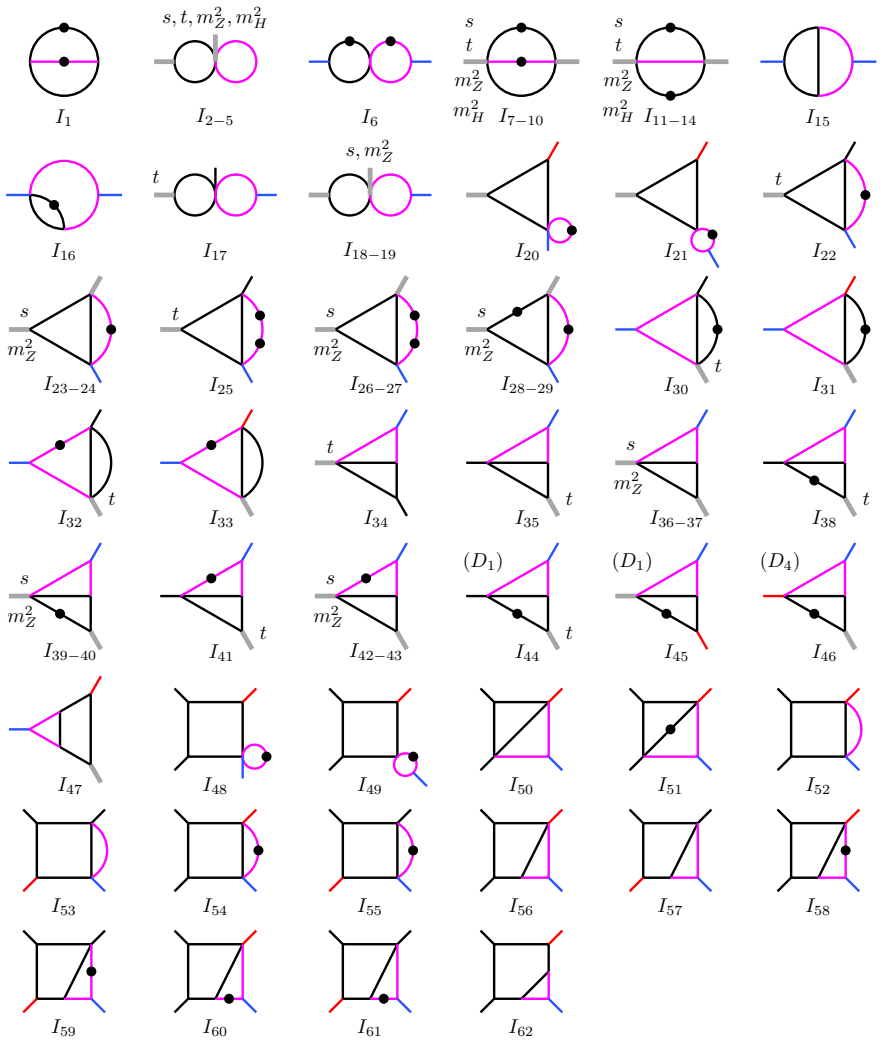
For the two-loop next-to-leading-order electroweak (NLO EW) corrections to $gg \rightarrow ZH$, the light-fermion contributions can be classified into eight distinct topologies. Using the canonical differential-equations method, we perform an analytic computation of the master integrals (MIs) associated with the four planar topologies. Canonical bases are constructed using the Magnus-expansion method, and the resulting alphabets consist of algebraic symbol letters involving nontrivial radicals. We develop a systematic framework for identifying the radical structures of the canonical MIs, enabling their organization into suitable subsystems and, whenever possible, their representation in terms of Goncharov polylogarithms (GPLs) up to $\mathcal{O}(\epsilon^4)$. Only a few MIs at $\mathcal{O}(\epsilon^3)$ and $\mathcal{O}(\epsilon^4)$ are instead represented as one-fold integrals over GPLs, due to the presence of nested square roots that obstruct the simultaneous rationalization of all radicals.
Editorial analysis
A structured set of objections, weighed in public.
Referee Report
Summary. The paper claims to have performed an analytic computation of the master integrals associated with the four planar topologies for the two-loop NLO electroweak light-fermion contributions to gg → ZH. Canonical bases are constructed using the Magnus-expansion method, yielding alphabets with algebraic symbol letters involving nontrivial radicals. A systematic framework organizes these radicals into subsystems, allowing representation in Goncharov polylogarithms up to O(ε^4) for most cases, while a few MIs at O(ε^3) and O(ε^4) are expressed as one-fold integrals over GPLs when nested square roots obstruct full rationalization.
Significance. If correct, the results supply the analytic planar master integrals required to advance the NLO EW light-fermion corrections to gg → ZH, a process of direct phenomenological interest for Higgs studies. The explicit development of a framework for identifying and subsystem-organizing algebraic letters with radicals constitutes a methodological contribution that can be reused in other two-loop calculations involving similar alphabets. The transparent handling of cases requiring one-fold integrals rather than claiming full polylogarithmic form is a positive feature.
major comments (1)
- The description of the analytic computation (abstract and method outline) does not include explicit expressions for any of the master integrals, the full set of differential equations, or numerical cross-checks against independent evaluations (e.g., sector decomposition or known limits at special kinematic points). This absence is load-bearing for substantiating the central claim that the MIs have been computed analytically to the stated orders.
minor comments (2)
- The abstract would benefit from stating the total number of master integrals obtained and briefly identifying the four planar topologies (e.g., by their propagator structures or diagram labels).
- When presenting the one-fold integral representations, it would be helpful to indicate explicitly which MIs require this form and at which orders, perhaps in a summary table.
Simulated Author's Rebuttal
We thank the referee for the positive evaluation of the significance of our work and for the detailed feedback. We address the major comment below and will revise the manuscript to strengthen the presentation of our analytic results.
read point-by-point responses
-
Referee: The description of the analytic computation (abstract and method outline) does not include explicit expressions for any of the master integrals, the full set of differential equations, or numerical cross-checks against independent evaluations (e.g., sector decomposition or known limits at special kinematic points). This absence is load-bearing for substantiating the central claim that the MIs have been computed analytically to the stated orders.
Authors: We agree that the current abstract and method outline emphasize the overall framework and the handling of algebraic letters rather than displaying concrete results. While the full set of differential equations and all master-integral expressions are too voluminous for the main text, we will revise the manuscript to include: (i) explicit Goncharov-polylogarithm expressions for a representative subset of master integrals from each planar topology (at least one per topology up to the required order in ε), (ii) the canonical differential equations for the simplest topology as an illustrative example, and (iii) numerical cross-checks at special kinematic points (threshold, high-energy limit, and a few generic phase-space points) against independent sector-decomposition evaluations. These additions will directly substantiate the analytic computation without compromising readability. revision: yes
Circularity Check
No significant circularity detected
full rationale
The paper's central claim is an analytic computation of four planar master integrals for gg→ZH via the canonical differential-equations method. Canonical bases are obtained by Magnus expansion, alphabets are constructed with algebraic letters containing radicals, and a systematic framework organizes the radicals into subsystems expressible as Goncharov polylogarithms up to O(ε^4) or one-fold integrals over GPLs where nested square roots obstruct full rationalization. This procedure is self-contained: it applies standard, externally validated techniques (DE method, Magnus expansion, symbol calculus) without fitted parameters, self-referential definitions, or load-bearing self-citations that reduce the result to its own inputs. The authors explicitly acknowledge the obstruction for certain higher-order terms and adopt the one-fold integral representation without claiming a fully polylogarithmic form, so no reduction by construction occurs.
Axiom & Free-Parameter Ledger
axioms (2)
- domain assumption The differential equations satisfied by the master integrals admit a canonical form that can be constructed via the Magnus expansion.
- domain assumption The algebraic symbol letters containing nontrivial radicals can be organized into subsystems permitting representation in Goncharov polylogarithms or one-fold integrals.
Reference graph
Works this paper leans on
-
[1]
Family F1: D1 = l2 1 D2 = (l1 + p1)2 D3 = (l1 − p3 − p4)2 D4 = (l1 − p4)2 D5 = (l2 − p4)2 − m2 W D6 = l2 2 − m2 W (5) D7 = (l1 − l2)2 D8 = (l1 − l2 − p3)2 D9 = (l2 + p1)2 two topologies ⊂ F 1: S1 ≡ S F1(1, 1, 1, 1, 1, 1, 1, 0, 0) , S1N ≡ S F1(1, 1, 1, 0, 1, 1, 1, 1, 0) (6)
-
[2]
Family F2: D1 = l2 1 D2 = (l1 + p1)2 D3 = (l1 − p2 − p4)2 5 D4 = (l1 − p4)2 D5 = (l2 − p4)2 − m2 W D6 = l2 2 − m2 W (7) D7 = (l1 − l2)2 D8 = (l1 − l2 + p1)2 D9 = (l2 + p2)2 two topologies ⊂ F 2: S2 ≡ S F2(1, 1, 1, 1, 1, 1, 1, 0, 0) , S2N ≡ S F2(0, 1, 1, 1, 1, 1, 1, 1, 0) (8) Here, S1 and S2 correspond to the planar topologies shown in Fig.1, which are eva...
-
[3]
M. Aaboud et al. (ATLAS), Phys. Lett. B 786, 59 (2018), arXiv:1808.08238 [hep-ex]
- [4]
- [5]
- [6]
- [7]
- [8]
- [9]
- [10]
-
[11]
M. Ciccolini, S. Dittmaier, and M. Kramer, Phys. Rev. D 68, 073003 (2003), arXiv:hep- ph/0306234
- [12]
- [13]
-
[14]
F. Granata, J. M. Lindert, C. Oleari, and S. Pozzorini, JHEP 09, 012 (2017), arXiv:1706.03522 [hep-ph]
- [15]
-
[16]
G. Ferrera, M. Grazzini, and F. Tramontano, Phys. Rev. Lett. 107, 152003 (2011), arXiv:1107.1164 [hep-ph]
-
[17]
G. Ferrera, M. Grazzini, and F. Tramontano, Phys. Lett. B 740, 51 (2014), arXiv:1407.4747 [hep-ph]
- [18]
- [19]
- [20]
- [21]
- [22]
- [23]
-
[24]
C. Englert, M. McCullough, and M. Spannowsky, Phys. Rev. D 89, 013013 (2014), arXiv:1310.4828 [hep-ph]
-
[25]
D. A. Dicus and C. Kao, Phys. Rev. D 38, 1008 (1988)
1988
-
[26]
B. A. Kniehl, Phys. Rev. D 42, 2253 (1990)
1990
-
[27]
L. Altenkamp, S. Dittmaier, R. V. Harlander, H. Rzehak, and T. J. Zirke, JHEP 02, 078 (2013), arXiv:1211.5015 [hep-ph]
-
[28]
A. Hasselhuhn, T. Luthe, and M. Steinhauser, JHEP 01, 073 (2017), arXiv:1611.05881 [hep- ph]
-
[29]
L. Alasfar, G. Degrassi, P. P. Giardino, R. Gr¨ ober, and M. Vitti, JHEP 05, 168 (2021), arXiv:2103.06225 [hep-ph]
- [30]
- [31]
- [32]
- [33]
-
[34]
G. Degrassi, R. Gr¨ ober, M. Vitti, and X. Zhao, JHEP 08, 009 (2022), arXiv:2205.02769 [hep-ph]
-
[35]
L. Bellafronte, G. Degrassi, P. P. Giardino, R. Gr¨ ober, and M. Vitti, JHEP 07, 069 (2022), arXiv:2202.12157 [hep-ph]
-
[36]
Electroweak loop corrections to gg → gH at the LHC,
H.-Y. Bi, Y.-Q. Ma, and D.-M. Mu, “Electroweak loop corrections to gg → gH at the LHC,” (2025), arXiv:2508.02588 [hep-ph]
-
[37]
Tkachov, Phys
F. Tkachov, Phys. Lett. B 100, 65 (1981)
1981
-
[38]
Chetyrkin and F
K. Chetyrkin and F. Tkachov, Nucl. Phys. B 192, 159 (1981)
1981
-
[39]
A. Smirnov and A. Petukhov, Lett. Math. Phys. 97, 37 (2011), arXiv:1004.4199 [hep-th]. 39
-
[40]
P. Maierh¨ ofer, J. Usovitsch, and P. Uwer, Comput. Phys. Commun. 230, 99 (2018), arXiv:1705.05610 [hep-ph]
-
[41]
J. Klappert, F. Lange, P. Maierh¨ ofer, and J. Usovitsch, Comput. Phys. Commun.266, 108024 (2021), arXiv:2008.06494 [hep-ph]
-
[42]
Laporta,High-precision calculation of multiloop Feynman integrals by difference equations,Int
S. Laporta, Int. J. Mod. Phys. A 15, 5087 (2000), arXiv:hep-ph/0102033
-
[43]
Presenting LiteRed: a tool for the Loop InTEgrals REDuction
R. N. Lee, “Presenting LiteRed: a tool for the Loop InTEgrals REDuction,” (2012), arXiv:1212.2685 [hep-ph]
work page Pith review arXiv 2012
- [44]
-
[45]
Chen, Bull
K.-T. Chen, Bull. Am. Math. Soc. 83, 831 (1977)
1977
- [46]
-
[47]
Magnus, Commun
W. Magnus, Commun. Pure Appl. Math. 7, 649 (1954)
1954
- [48]
- [49]
- [50]
-
[51]
P. Mastrolia and S. Mizera, JHEP 02, 139 (2019), arXiv:1810.03818 [hep-th]
- [52]
- [53]
-
[54]
Matijaˇ si´ c,Singularity structure of Feynman integrals with applications to six-particle scat- tering processes, Ph.D
A. Matijaˇ si´ c,Singularity structure of Feynman integrals with applications to six-particle scat- tering processes, Ph.D. thesis, Ludwig-Maximilians-Universit¨ at M¨ unchen (2024)
2024
- [55]
-
[56]
M. Beneke and V. A. Smirnov, Nucl. Phys. B 522, 321 (1998), arXiv:hep-ph/9711391
-
[57]
Ferguson, D
H. Ferguson, D. Bailey, and S. Arno, Math. Comp. 68, 351 (1999)
1999
- [58]
-
[59]
Jantzen, JHEP 12, 076 (2011), arXiv:1111.2589 [hep-ph]
B. Jantzen, JHEP 12, 076 (2011), arXiv:1111.2589 [hep-ph]
-
[60]
B. Jantzen, A. V. Smirnov, and V. A. Smirnov, Eur. Phys. J. C 72, 2139 (2012), arXiv:1206.0546 [hep-ph]
-
[61]
E. Panzer, Comput. Phys. Commun. 188, 148 (2015), arXiv:1403.3385 [hep-th]. 40
-
[62]
X. Liu and Y.-Q. Ma, Comput. Phys. Commun. 283, 108565 (2023), arXiv:2201.11669 [hep- ph]
-
[63]
J. Vollinga and S. Weinzierl, Comput. Phys. Commun.167, 177 (2005), arXiv:hep-ph/0410259
-
[64]
munuxi/Multiple-Polylogarithm,
Z. Li, “munuxi/Multiple-Polylogarithm,” (2025). 41
2025
discussion (0)
Sign in with ORCID, Apple, or X to comment. Anyone can read and Pith papers without signing in.