Recognition: unknown
Improved n=1 Empirical Error Field Penetration Threshold Scaling with Ohmic and L-Mode Conventional Tokamak Plasma Discharges
Pith reviewed 2026-05-07 09:38 UTC · model grok-4.3
The pith
An updated n=1 error field penetration threshold scaling derived solely from Ohmic and L-mode conventional tokamak data improves fit quality and lowers uncertainty in projections to future devices.
A machine-rendered reading of the paper's core claim, the machinery that carries it, and where it could break.
Core claim
By compiling data exclusively from Ohmic and L-mode conventional tokamak plasmas and incorporating new J-TEXT and JET measurements, the authors obtain an n=1 error field penetration threshold scaling that demonstrates higher fit quality and reduced projection uncertainty relative to earlier empirical laws. Because H-mode plasmas exhibit greater resilience to error field penetration, the resulting relation is presented as the most dangerous regime for new device design.
What carries the argument
The n=1 error field penetration threshold scaling, an empirical multi-parameter fit that relates plasma current, density, toroidal field and other quantities to the critical error field strength required for mode penetration.
If this is right
- Future conventional tokamaks can adopt tighter yet more reliable error field correction requirements based on the reduced projection uncertainty.
- Device design teams gain a clearer basis for setting allowable error field amplitudes during the most vulnerable plasma phases.
- The improved fit quality enables more accurate interpolation of thresholds across varying plasma conditions within the Ohmic and L-mode domain.
- Engineering margins for error field coils and vessel alignment can be optimized with greater statistical confidence.
Where Pith is reading between the lines
- The same database-expansion and regime-restriction approach could be applied to derive separate scalings for H-mode or for higher-n error fields.
- Real-time plasma control systems might incorporate this threshold to adjust error field correction coil currents dynamically during Ohmic or L-mode phases.
- The scaling could inform cost-benefit analyses for correction coil power supplies by quantifying how much margin is truly required.
Load-bearing premise
That Ohmic and L-mode discharges exhibit the lowest penetration thresholds and therefore supply the appropriate conservative bound for new tokamak engineering tolerances.
What would settle it
A new conventional tokamak experiment that measures a lower n=1 penetration threshold in an Ohmic or L-mode plasma than the scaling predicts, or that finds H-mode thresholds falling below the Ohmic/L-mode values.
Figures



read the original abstract
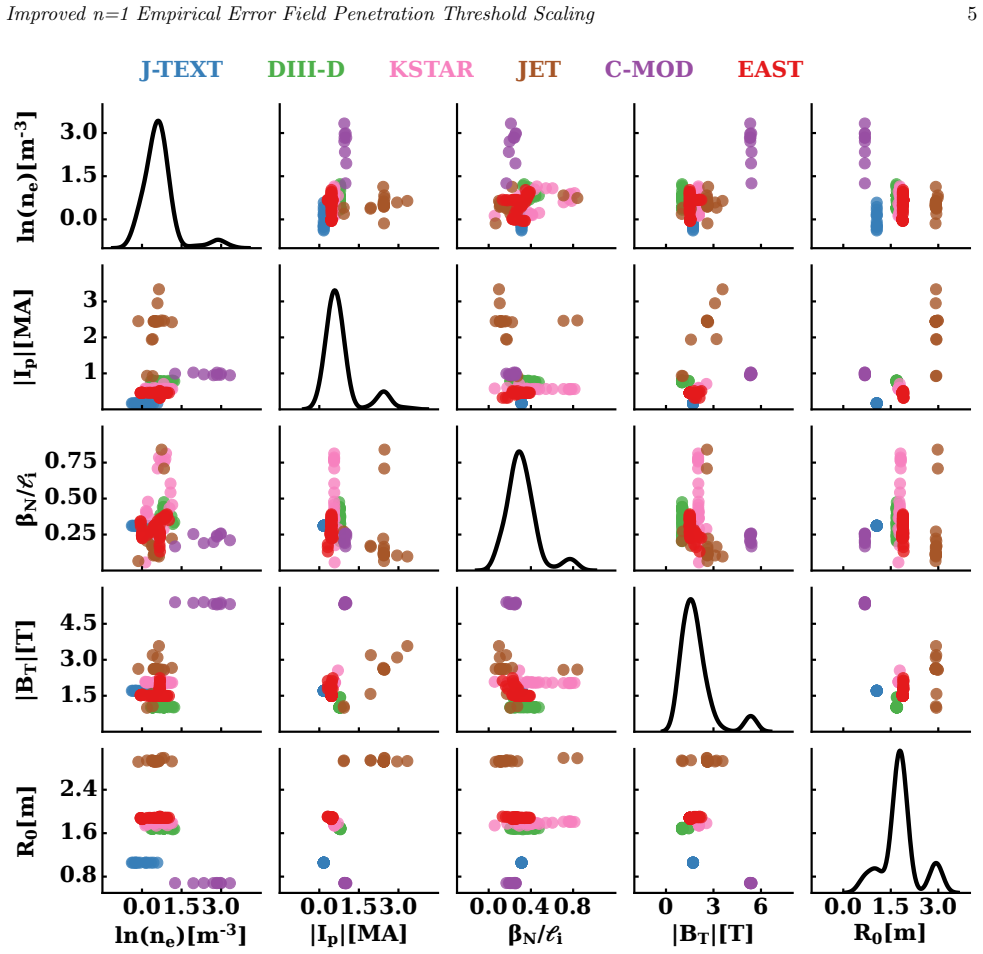
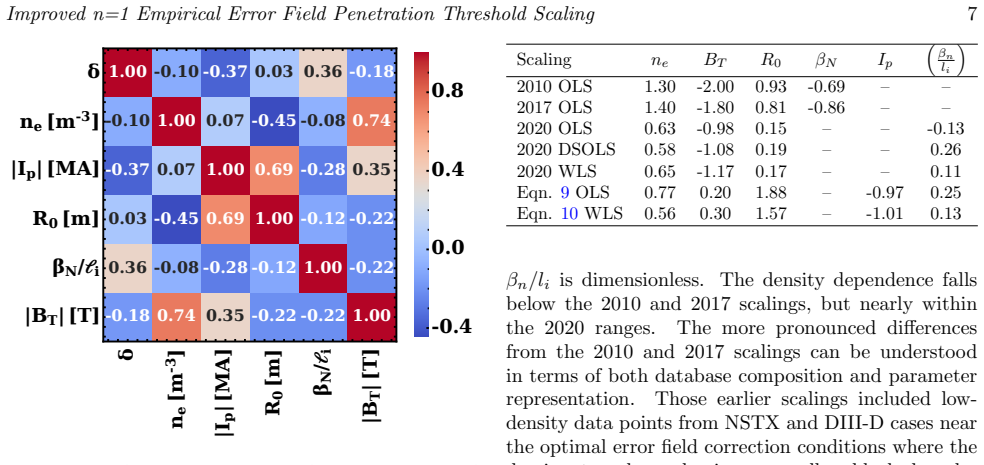
This paper presents an updated n=1 error field penetration threshold scaling, which increases fit quality compared to previous error field scaling laws, is produced from an expanded database, and exhibits reduced uncertainty in projections to future conventional tokamaks. It improves confidence in tokamak engineering tolerances, which are a significant driver of cost and time constraints on device construction. We add J-TEXT data, new JET data, and create the scaling using only conventional tokamak Ohmic and L-mode experiments. Since H-mode plasmas are more resilient to error field penetration, this scaling predicts what is likely the most dangerous regime of error field penetration for new tokamak designs. These decisions improve confidence in the error field penetration threshold scaling and its application in the construction and design decisions of any future conventional tokamak or FPP.
Editorial analysis
A structured set of objections, weighed in public.
Referee Report
Summary. The manuscript presents an updated empirical scaling law for the n=1 error field penetration threshold in conventional tokamaks. It is derived from an expanded database restricted to Ohmic and L-mode discharges (including new J-TEXT and JET data), claims higher fit quality and lower projection uncertainty than prior scalings, and argues that the restriction yields the most conservative (lowest) threshold because H-mode plasmas are more resilient to error field penetration.
Significance. If the scaling derivation is robust and the conservative justification holds, the result would strengthen engineering tolerances for error fields in future conventional tokamaks and FPPs, directly addressing a major cost and schedule driver. The expanded conventional-tokamak database is a clear strength for applicability.
major comments (3)
- [Abstract and scaling derivation section] Abstract and § on scaling derivation: the claims of 'increased fit quality' and 'reduced uncertainty' are stated without the explicit functional form of the scaling, the numerical fit coefficients, goodness-of-fit metrics (R², reduced χ², or residual analysis), data-selection criteria, or any cross-validation procedure. These omissions make the improvement over previous laws unverifiable and load-bearing for the central claim.
- [Abstract and database section] Abstract and database section: the assertion that 'H-mode plasmas are more resilient' and therefore the Ohmic/L-mode scaling 'predicts what is likely the most dangerous regime' is presented without any direct threshold comparison, cited H-mode data points, or quantitative demonstration that H-mode thresholds exceed the new fit across the relevant parameter space. This leaves the conservative-bound justification unsupported.
- [Projections section] Projections section: the reduced-uncertainty projections to future devices rest on the empirical fit to the chosen database; without explicit uncertainty propagation (including extrapolation range and covariance of coefficients), the claimed improvement in engineering confidence cannot be assessed.
minor comments (2)
- [Notation and equations] Notation for the scaling variables (e.g., definitions of normalized quantities) should be collected in a single table or equation block for clarity.
- [Figures] Figures showing the new scaling would benefit from overlaying the previous scaling laws for immediate visual comparison of fit quality.
Simulated Author's Rebuttal
We thank the referee for the constructive feedback and the recommendation for major revision. We agree that the manuscript requires additional explicit details to make the central claims verifiable. We will revise the paper to include the functional form and fit metrics for the scaling, supporting citations and discussion for the conservative justification, and explicit uncertainty propagation for the projections. Our point-by-point responses follow.
read point-by-point responses
-
Referee: [Abstract and scaling derivation section] Abstract and § on scaling derivation: the claims of 'increased fit quality' and 'reduced uncertainty' are stated without the explicit functional form of the scaling, the numerical fit coefficients, goodness-of-fit metrics (R², reduced χ², or residual analysis), data-selection criteria, or any cross-validation procedure. These omissions make the improvement over previous laws unverifiable and load-bearing for the central claim.
Authors: We agree that these elements are required for independent verification. The revised manuscript will explicitly state the functional form of the n=1 error field penetration threshold scaling, report the numerical coefficients with uncertainties, include goodness-of-fit metrics (R², reduced χ², and residual analysis), detail the data-selection criteria (Ohmic and L-mode conventional tokamak discharges from the expanded database including J-TEXT and JET), and describe any cross-validation performed. This will enable direct quantitative comparison to prior scalings and substantiate the claimed improvements in fit quality and projection uncertainty. revision: yes
-
Referee: [Abstract and database section] Abstract and database section: the assertion that 'H-mode plasmas are more resilient' and therefore the Ohmic/L-mode scaling 'predicts what is likely the most dangerous regime' is presented without any direct threshold comparison, cited H-mode data points, or quantitative demonstration that H-mode thresholds exceed the new fit across the relevant parameter space. This leaves the conservative-bound justification unsupported.
Authors: We acknowledge that a more quantitative demonstration would strengthen the conservative-bound argument. The database was deliberately restricted to Ohmic and L-mode discharges to focus on the most vulnerable regime, but the revised manuscript will add citations to published H-mode error field penetration threshold studies (from devices such as DIII-D and ASDEX Upgrade) that report higher thresholds than the corresponding L-mode values at similar parameters. We will also include a brief discussion or supplementary comparison illustrating that the new scaling lies below reported H-mode thresholds in the relevant parameter space, thereby supporting its use as a conservative engineering bound. revision: partial
-
Referee: [Projections section] Projections section: the reduced-uncertainty projections to future devices rest on the empirical fit to the chosen database; without explicit uncertainty propagation (including extrapolation range and covariance of coefficients), the claimed improvement in engineering confidence cannot be assessed.
Authors: We agree that explicit uncertainty propagation details are necessary to assess the claimed reduction in projection uncertainty. The revised manuscript will describe the uncertainty propagation procedure, including the treatment of coefficient covariances from the fit, the extrapolation ranges for future conventional tokamaks and FPPs, and the resulting uncertainty bands on the projected thresholds. This will allow readers to evaluate the improvement in engineering confidence relative to previous scalings. revision: yes
Circularity Check
No circularity: empirical scaling update from expanded database
full rationale
The paper updates an empirical n=1 error field penetration threshold scaling by fitting coefficients to an expanded database of conventional tokamak Ohmic and L-mode discharges. The resulting scaling law and its projections to future devices are direct outputs of this fit, with no first-principles derivation claimed. No equations or steps reduce by construction to prior inputs, no self-citations are used for load-bearing uniqueness or ansatz justification, and the H-mode resilience statement is presented as background justification for database choice rather than a derived result. This matches standard empirical scaling work that remains self-contained against external benchmarks.
Axiom & Free-Parameter Ledger
free parameters (1)
- scaling law coefficients
axioms (1)
- domain assumption H-mode plasmas are more resilient to error field penetration than Ohmic and L-mode plasmas
Reference graph
Works this paper leans on
-
[1]
Anomalies in the applied magnetic fields in DIII-D and their implications for the understanding of stability experiments
1J. Luxon, M. Schaffer, G. Jackson, J. Leuer, A. Nagy, J. Scoville, and E. Strait, “Anomalies in the applied magnetic fields in DIII-D and their implications for the understanding of stability experiments”, Nuclear Fusion43, 1813–1828 (2003). 2N. Ferraro, J.-K. Park, C. Myers, A. Brooks, S. Gerhardt, J. Menard, S. Munaretto, and M. Reinke, “Error field im...
2003
-
[2]
Measurement of 2/1 intrinsic error field of joint text tokamak
(Oct. 2003). 17B. Rao, Y. H. Ding, K. X. Yu, W. Jin, Q. M. Hu, B. Yi, J. Y. Nan, N. C. Wang, M. Zhang, and G. Zhuang, “Measurement of 2/1 intrinsic error field of joint text tokamak”, Review of Scientific Instruments 84, 043504 (2013). 18Y. In, J. Park, J. Jeon, J. Kim, and M. Okabayashi, “Extremely low intrinsic non-axisymmetric field in KSTAR and its im...
2003
discussion (0)
Sign in with ORCID, Apple, or X to comment. Anyone can read and Pith papers without signing in.