Recognition: unknown
Electroweak Baryogenesis from Collapsing Domain Walls
Pith reviewed 2026-05-07 08:49 UTC · model grok-4.3
The pith
Collapsing domain walls from an axion-like field can generate the observed baryon asymmetry without needing a strong first-order electroweak phase transition.
A machine-rendered reading of the paper's core claim, the machinery that carries it, and where it could break.
Core claim
The authors show that collapsing electroweak domain walls formed by an axion-like particle, which separate regions of distinct electroweak phases and are biased to collapse by the crossover, generate the baryon asymmetry when their motion acts through the coupling to the topological term as an effective chemical potential for baryons, with the asymmetry arising from electroweak sphalerons either via late-time entropy injection or sphaleron suppression.
What carries the argument
Collapsing domain walls of an axion-like particle that couple to the Higgs mass term and the electroweak topological term, separating phases and converting wall motion into a baryon chemical potential.
If this is right
- The observed baryon asymmetry arises from either late-time entropy injection or sphaleron suppression within weakly broken electroweak domains.
- The wall collapse produces a stochastic gravitational-wave background whose frequency spectrum and amplitude differ from those of standard electroweak first-order phase transitions.
- Baryogenesis occurs at the electroweak scale without requiring a strong first-order phase transition with bubble walls.
- The mechanism links the generation of matter asymmetry to the dynamics of an axion-like field and its potential bias during the electroweak crossover.
Where Pith is reading between the lines
- Future gravitational-wave detectors could distinguish this signal from other early-universe sources by its characteristic collapse-induced features.
- The scenario may connect to searches for light axion-like particles through their effects on Higgs phenomenology or cosmological observables.
- It offers a way to test baryogenesis models in regimes where the electroweak transition is a crossover rather than a first-order jump.
Load-bearing premise
An axion-like particle must exist that couples to the Higgs mass term strongly enough to form domain walls separating distinct electroweak phases while also coupling to the topological term.
What would settle it
A search that finds no stochastic gravitational-wave background with the predicted peak frequency and shape from wall collapse, or direct evidence that such domain walls never form in the early universe.
Figures

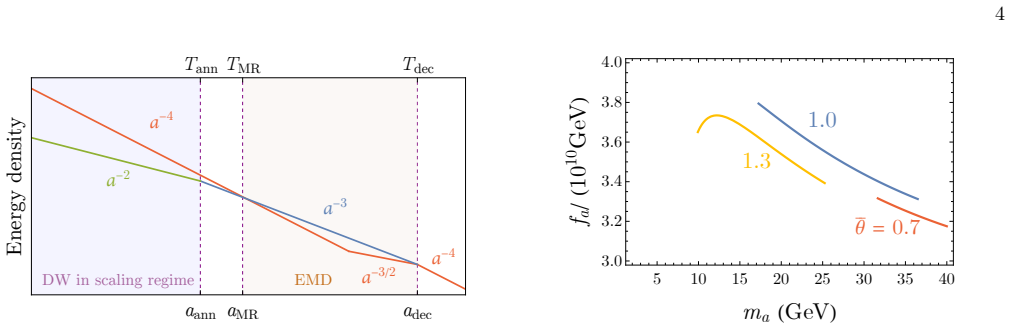
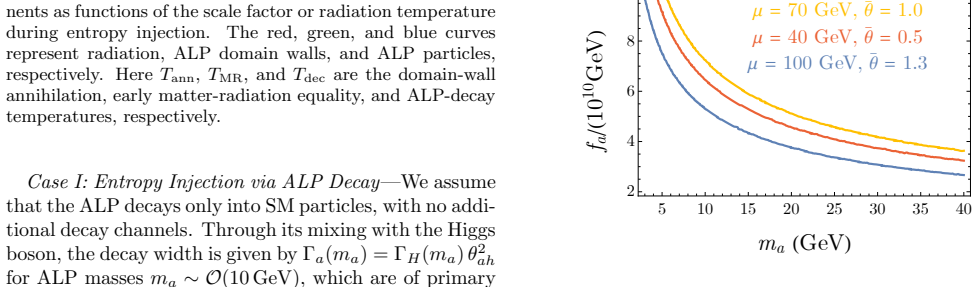

read the original abstract
We propose a novel mechanism for electroweak baryogenesis in which collapsing domain walls formed by an axion-like field replace the bubble walls in a strong first-order electroweak phase transition. The axion-like particle coupling to the Higgs mass term allows domain walls to separate regions with distinct electroweak phases, while the electroweak crossover induces a potential-energy bias that triggers their collapse. The directed wall motion, through the axion-like particle coupling to the electroweak topological term, acts as an effective baryon chemical potential and generates an asymmetry via electroweak sphaleron processes. We show that the observed baryon asymmetry can be obtained from either late-time entropy injection or sphaleron suppression in a weakly broken electroweak domain. The wall collapse also produces a stochastic gravitational-wave background with features distinct from standard electroweak-scale first-order-transition spectra.
Editorial analysis
A structured set of objections, weighed in public.
Referee Report
Summary. The manuscript proposes a mechanism for electroweak baryogenesis in which domain walls of an axion-like scalar, coupled to the Higgs mass term and the electroweak topological density, separate regions of differing Higgs vevs. The electroweak crossover supplies a potential bias that drives wall collapse; the resulting directed motion generates an effective baryon chemical potential, producing the observed asymmetry either via late-time entropy injection or sphaleron suppression in a weakly broken phase. The collapse is also claimed to yield a stochastic gravitational-wave background with spectral features distinct from those of standard first-order electroweak phase transitions.
Significance. If the central construction holds, the work supplies a concrete alternative to conventional electroweak baryogenesis that does not require a strong first-order transition. It links domain-wall dynamics to both the baryon asymmetry and a potentially observable gravitational-wave signal, thereby connecting two active areas of beyond-Standard-Model cosmology.
major comments (3)
- [effective potential and domain-wall construction] The effective-potential analysis (section describing the axion-like coupling to the Higgs mass term) asserts that domain walls can stably bound regions with vev = 0 and vev = v while the crossover supplies a small bias. Because the electroweak crossover is smooth, the free-energy difference is only O(few GeV^4) near T ~ 100 GeV; an explicit domain-wall solution or numerical profile demonstrating that this bias is simultaneously large enough to overcome Hubble friction yet small enough to permit slow collapse (necessary for sphaleron equilibration) is required to support the mechanism.
- [baryon asymmetry generation] The baryon-asymmetry calculation (section claiming the observed value is obtained) states that the asymmetry can be matched either by entropy injection or sphaleron suppression, but supplies neither the explicit expression relating wall velocity, sphaleron rate, and dilution factor to the final η_B nor a parameter scan demonstrating that η_B reaches ~6 × 10^{-10} for any choice of couplings. Without this quantitative step the central claim remains unverified.
- [gravitational-wave background] The gravitational-wave section asserts that the collapse spectrum is distinguishable from standard electroweak first-order-transition spectra, yet provides no concrete peak frequency, amplitude, or spectral index derived from the wall tension, velocity, and collapse time scale. A minimal calculation or plot comparing the two classes of spectra is needed to substantiate the claim.
minor comments (1)
- The notation for the axion-like field and its two couplings is introduced only in the abstract and would benefit from an early dedicated paragraph defining the Lagrangian terms and field normalizations.
Simulated Author's Rebuttal
We thank the referee for the careful reading and constructive comments on our manuscript. We address each major comment below and will revise the paper to incorporate additional details where appropriate.
read point-by-point responses
-
Referee: The effective-potential analysis (section describing the axion-like coupling to the Higgs mass term) asserts that domain walls can stably bound regions with vev = 0 and vev = v while the crossover supplies a small bias. Because the electroweak crossover is smooth, the free-energy difference is only O(few GeV^4) near T ~ 100 GeV; an explicit domain-wall solution or numerical profile demonstrating that this bias is simultaneously large enough to overcome Hubble friction yet small enough to permit slow collapse (necessary for sphaleron equilibration) is required to support the mechanism.
Authors: We agree that an explicit numerical profile strengthens the argument. The manuscript already contains an analytical estimate of the bias energy density relative to the wall tension and Hubble friction, showing that suitable choices of the axion-like coupling allow slow collapse. In the revised version we will add a numerical solution of the domain-wall equation of motion that explicitly demonstrates the required balance between the O(few GeV^4) bias, wall tension, and Hubble damping at T ~ 100 GeV. revision: yes
-
Referee: The baryon-asymmetry calculation (section claiming the observed value is obtained) states that the asymmetry can be matched either by entropy injection or sphaleron suppression, but supplies neither the explicit expression relating wall velocity, sphaleron rate, and dilution factor to the final η_B nor a parameter scan demonstrating that η_B reaches ~6 × 10^{-10} for any choice of couplings. Without this quantitative step the central claim remains unverified.
Authors: We acknowledge that the present text gives order-of-magnitude estimates rather than a full scan. In the revision we will insert the explicit formula η_B = (n_B/s) = (Γ_sph / H) × (v_w / T) × Δθ × (dilution factor), where Δθ is the effective chemical potential generated by the collapsing wall. We will also add a parameter scan over the axion-like mass, coupling to the topological term, and wall tension, showing the region where η_B reaches the observed value for both the entropy-injection and sphaleron-suppression channels. revision: yes
-
Referee: The gravitational-wave section asserts that the collapse spectrum is distinguishable from standard electroweak first-order-transition spectra, yet provides no concrete peak frequency, amplitude, or spectral index derived from the wall tension, velocity, and collapse time scale. A minimal calculation or plot comparing the two classes of spectra is needed to substantiate the claim.
Authors: We agree that concrete numbers and a comparison are needed. The revised manuscript will derive the peak frequency f_peak ≈ 1/τ_collapse and the amplitude h²Ω_GW from the wall tension σ, velocity v_w, and collapse timescale, using the standard quadrupole formula adapted to collapsing walls. We will include a plot contrasting this spectrum with a typical first-order electroweak transition spectrum, highlighting the steeper high-frequency fall-off and the absence of a low-frequency tail characteristic of bubble collisions. revision: yes
Circularity Check
No significant circularity; new mechanism with independent dynamics
full rationale
The paper proposes a novel electroweak baryogenesis scenario based on collapsing axion-like domain walls that separate regions of differing Higgs vev, with the SM crossover providing a bias and the axion-topological coupling sourcing an effective chemical potential for sphaleron-driven asymmetry. No load-bearing step reduces by construction to a fitted input, self-definition, or self-citation chain; the asymmetry is generated from the wall dynamics and sphaleron processes rather than being presupposed. The derivation remains self-contained, relying on physically motivated new couplings and the standard electroweak crossover properties without tautological renaming or imported uniqueness theorems.
Axiom & Free-Parameter Ledger
axioms (2)
- domain assumption An axion-like field exists with couplings to the Higgs mass term and the electroweak topological charge that allow domain walls to separate distinct electroweak phases.
- domain assumption The electroweak crossover produces a potential bias sufficient to trigger directed collapse of the domain walls.
invented entities (1)
-
Axion-like field with Higgs and topological couplings
no independent evidence
Reference graph
Works this paper leans on
-
[1]
Planck 2018 results. VI. Cosmological parameters
N. Aghanimet al.(Planck), Astron. Astrophys.641, A6 (2020), [Erratum: Astron.Astrophys. 652, C4 (2021)], arXiv:1807.06209 [astro-ph.CO]
work page internal anchor Pith review arXiv 2020
-
[2]
V. A. Kuzmin, V. A. Rubakov, and M. E. Shaposhnikov, Phys. Lett. B155, 36 (1985)
1985
-
[3]
A. G. Cohen, D. B. Kaplan, and A. E. Nelson, Ann. Rev. Nucl. Part. Sci.43, 27 (1993), arXiv:hep-ph/9302210
work page Pith review arXiv 1993
- [4]
-
[5]
Recent Progress in Baryogenesis
A. Riotto and M. Trodden, Ann. Rev. Nucl. Part. Sci. 49, 35 (1999), arXiv:hep-ph/9901362
work page Pith review arXiv 1999
- [6]
-
[7]
The origin of the matter-antimatter asymmetry
M. Dine and A. Kusenko, Rev. Mod. Phys.76, 1 (2003), arXiv:hep-ph/0303065
work page Pith review arXiv 2003
- [8]
-
[9]
D. E. Morrissey and M. J. Ramsey-Musolf, New J. Phys. 14, 125003 (2012), arXiv:1206.2942 [hep-ph]
work page Pith review arXiv 2012
-
[10]
P. Huet and E. Sather, Phys. Rev. D51, 379 (1995), arXiv:hep-ph/9404302
-
[11]
M. B. Gavela, P. Hernandez, J. Orloff, and O. Pene, Mod. Phys. Lett. A9, 795 (1994), arXiv:hep-ph/9312215
work page Pith review arXiv 1994
- [12]
- [13]
- [14]
-
[15]
K. Jansen, Nucl. Phys. B Proc. Suppl.47, 196 (1996), arXiv:hep-lat/9509018
-
[16]
K. Kajantie, M. Laine, K. Rummukainen, and M. E. Shaposhnikov, Nucl. Phys. B466, 189 (1996), arXiv:hep- lat/9510020
-
[17]
K. Rummukainen, Nucl. Phys. B Proc. Suppl.53, 30 (1997), arXiv:hep-lat/9608079
-
[18]
Is There a Hot Electroweak Phase Transition at $m_H\gsim m_W$?
K. Kajantie, M. Laine, K. Rummukainen, and M. E. Shaposhnikov, Phys. Rev. Lett.77, 2887 (1996), arXiv:hep-ph/9605288
work page Pith review arXiv 1996
-
[19]
M. Gurtler, E.-M. Ilgenfritz, and A. Schiller, Phys. Rev. D56, 3888 (1997), arXiv:hep-lat/9704013
- [20]
-
[21]
M. Laine and K. Rummukainen, Phys. Rev. Lett.80, 5259 (1998), arXiv:hep-ph/9804255
-
[22]
M. Laine and K. Rummukainen, Nucl. Phys. B535, 423 (1998), arXiv:hep-lat/9804019
-
[23]
K. Rummukainen, M. Tsypin, K. Kajantie, M. Laine, and M. E. Shaposhnikov, Nucl. Phys. B532, 283 (1998), arXiv:hep-lat/9805013
-
[24]
N. S. Manton, Phys. Rev. D28, 2019 (1983)
2019
-
[25]
F. R. Klinkhamer and N. S. Manton, Phys. Rev. D30, 2212 (1984)
1984
-
[26]
Andreevet al.(ACME), Nature562, 355 (2018)
V. Andreevet al.(ACME), Nature562, 355 (2018)
2018
- [27]
- [28]
-
[29]
A. Tumasyanet al.(CMS), Nature607, 60 (2022), [Er- ratum: Nature 623, (2023)], arXiv:2207.00043 [hep-ex]
- [30]
- [31]
- [32]
-
[33]
A. Mariotti, X. Nagels, A. Rase, and M. Vanvlasselaer, JHEP03, 199 (2025), arXiv:2411.13494 [hep-ph]
-
[34]
Baryon Asymmetry from Electroweak-Symmetric Domain Walls
J. Azzola, O. Matsedonskyi, and A. Weiler, (2026), arXiv:2604.16603 [hep-ph]
work page internal anchor Pith review Pith/arXiv arXiv 2026
- [35]
- [36]
- [37]
-
[38]
D. Bhandari, S. K. Manna, and A. Sil, (2025), arXiv:2512.09760 [hep-ph]
- [39]
- [40]
- [41]
-
[42]
Y. B. Zeldovich, I. Y. Kobzarev, and L. B. Okun, Zh. Eksp. Teor. Fiz.67, 3 (1974)
1974
-
[43]
T. W. B. Kibble, J. Phys. A9, 1387 (1976)
1976
-
[44]
Vilenkin, Phys
A. Vilenkin, Phys. Rept.121, 263 (1985)
1985
-
[45]
P. Sikivie, Lect. Notes Phys.741, 19 (2008), arXiv:astro- ph/0610440
-
[46]
Sikivie, Phys
P. Sikivie, Phys. Rev. Lett.48, 1156 (1982)
1982
-
[47]
A. G. Cohen and D. B. Kaplan, Nucl. Phys. B308, 913 (1988)
1988
-
[48]
A. G. Cohen, D. B. Kaplan, and A. E. Nelson, Phys. Lett. B263, 86 (1991)
1991
-
[49]
W. H. Press, B. S. Ryden, and D. N. Spergel, Astrophys. J.347, 590 (1989)
1989
-
[50]
T. Garagounis and M. Hindmarsh, Phys. Rev. D68, 103506 (2003), arXiv:hep-ph/0212359
- [51]
- [52]
- [53]
-
[54]
The Standard Model cross-over on the lattice
M. D’Onofrio and K. Rummukainen, Phys. Rev. D93, 025003 (2016), arXiv:1508.07161 [hep-ph]
work page Pith review arXiv 2016
- [55]
-
[56]
M. Dine, P. Huet, R. L. Singleton, Jr, and L. Susskind, Phys. Lett. B257, 351 (1991)
1991
- [57]
- [58]
- [59]
-
[60]
M. D’Onofrio, K. Rummukainen, and A. Tranberg, Phys. Rev. Lett.113, 141602 (2014), arXiv:1404.3565 [hep-ph]
-
[61]
G. Krnjaic, Phys. Rev. D94, 073009 (2016), arXiv:1512.04119 [hep-ph]
- [62]
-
[63]
R. J. Scherrer and M. S. Turner, Phys. Rev. D31, 681 (1985)
1985
-
[64]
Quiros, inICTP Summer School in High-Energy Physics and Cosmology(1999) pp
M. Quiros, inICTP Summer School in High-Energy Physics and Cosmology(1999) pp. 187–259, arXiv:hep- ph/9901312. 8
-
[65]
Konstandin, JCAP03, 047 (2018), arXiv:1712.06869 [astro-ph.CO]
T. Konstandin, JCAP03, 047 (2018), arXiv:1712.06869 [astro-ph.CO]
-
[66]
M. Gleiser and R. Roberts, Phys. Rev. Lett.81, 5497 (1998), arXiv:astro-ph/9807260
-
[67]
T. Hiramatsu, M. Kawasaki, and K. Saikawa, JCAP02, 031 (2014), arXiv:1309.5001 [astro-ph.CO]
-
[68]
Saikawa,A review of gravitational waves from cosmic domain walls,Universe3(2017) 40 [1703.02576]
K. Saikawa, Universe3, 40 (2017), arXiv:1703.02576 [hep-ph]
-
[69]
T. Hiramatsu, M. Kawasaki, K. Saikawa, and T. Sekiguchi, JCAP01, 001 (2013), arXiv:1207.3166 [hep-ph]
- [70]
-
[71]
J. Crowder and N. J. Cornish, Phys. Rev. D72, 083005 (2005), arXiv:gr-qc/0506015
-
[72]
Satoet al., J
S. Satoet al., J. Phys. Conf. Ser.840, 012010 (2017)
2017
-
[73]
Laser Interferometer Space Antenna
P. Amaro-Seoaneet al.(LISA), (2017), arXiv:1702.00786 [astro-ph.IM]
work page internal anchor Pith review arXiv 2017
-
[74]
W.-H. Ruan, Z.-K. Guo, R.-G. Cai, and Y.-Z. Zhang, Int. J. Mod. Phys. A35, 2050075 (2020), arXiv:1807.09495 [gr-qc]
-
[75]
TianQin: a space-borne gravitational wave detector
J. Luoet al.(TianQin), Class. Quant. Grav.33, 035010 (2016), arXiv:1512.02076 [astro-ph.IM]
work page Pith review arXiv 2016
-
[76]
Meiet al.(TianQin), The TianQin project: current progress on science and technology, Prog
J. Meiet al.(TianQin), PTEP2021, 05A107 (2021), arXiv:2008.10332 [gr-qc]
-
[77]
H. Bagherian, M. Ekhterachian, and S. Stelzl, JHEP01, 068 (2026), arXiv:2505.15904 [hep-ph]
-
[78]
Bounds from D/H on baryogenesis models
A. Azatov and B. Missoni, (2026), arXiv:2604.11203 [hep-ph]
work page internal anchor Pith review Pith/arXiv arXiv 2026
-
[79]
M. Hindmarsh, S. J. Huber, K. Rummukainen, and D. J. Weir, Phys. Rev. Lett.112, 041301 (2014), arXiv:1304.2433 [hep-ph]
-
[80]
M. Hindmarsh, S. J. Huber, K. Rummukainen, and D. J. Weir, Phys. Rev. D92, 123009 (2015), arXiv:1504.03291 [astro-ph.CO]
discussion (0)
Sign in with ORCID, Apple, or X to comment. Anyone can read and Pith papers without signing in.