Recognition: unknown
Asymmetric freezing of a sliding droplet on an inclined surface
Pith reviewed 2026-05-07 09:48 UTC · model grok-4.3
The pith
Sliding prior to and during early freezing governs the asymmetry of frozen droplets on inclined cold surfaces.
A machine-rendered reading of the paper's core claim, the machinery that carries it, and where it could break.
Core claim
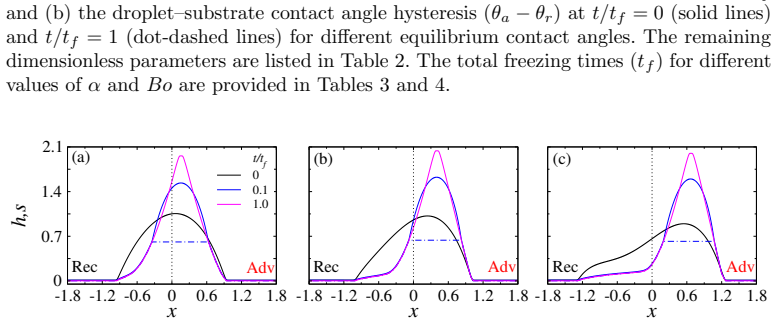
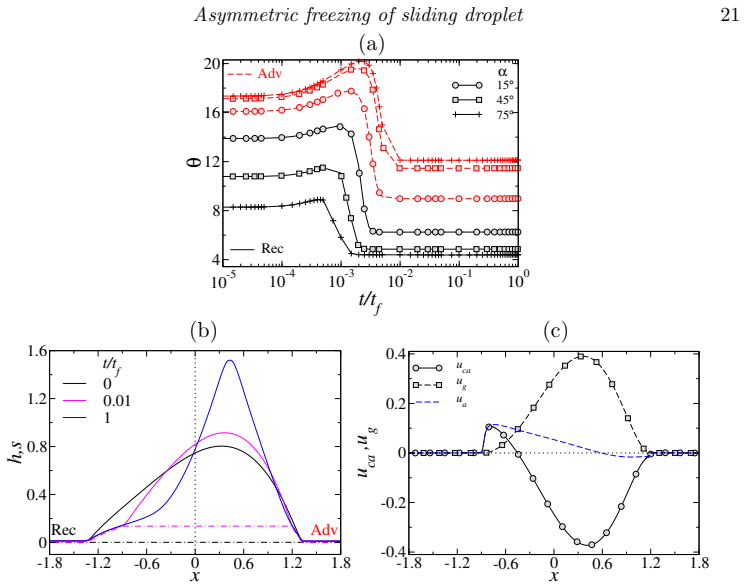
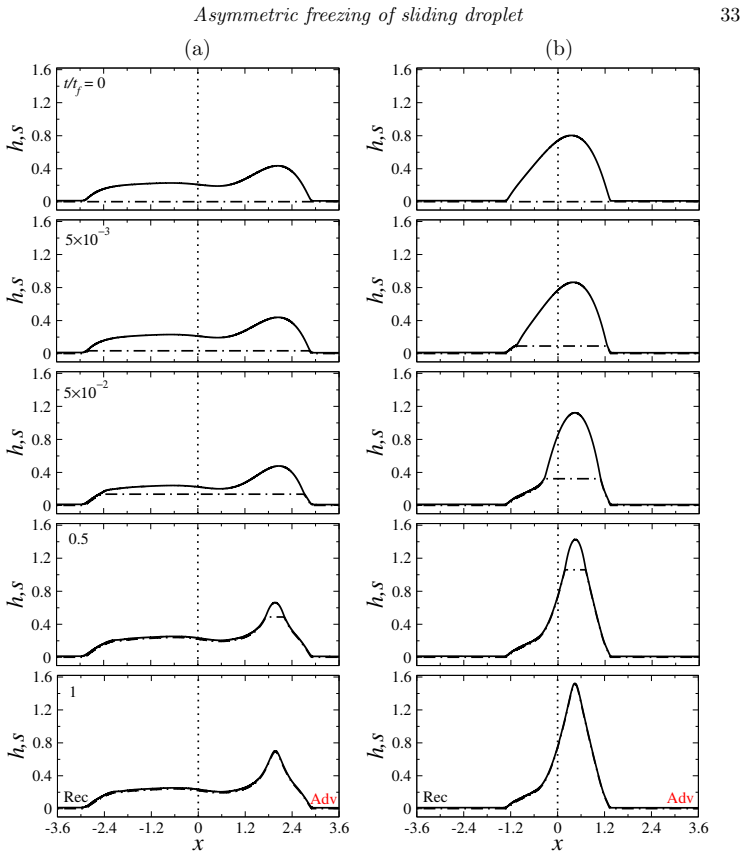
The central claim is that sliding prior to and during the early stages of freezing plays a dominant role in governing the asymmetry of the frozen droplet. A tilted ice cusp forms at the droplet tip due to the competition between gravitational forces and capillary resistance, with its orientation and magnitude strongly dependent on substrate wettability and inclination. Greater inclination and increased wettability enhance asymmetry in droplet morphology. Further, highly wetting substrates favor capillary-driven retraction and induce transient liquid motion opposite to gravity during freezing. The evolution of contact-angle hysteresis at both the solid surface and the liquid-ice interface and
What carries the argument
The lubrication approximation model that couples gravity, capillarity, solidification kinetics, and contact-angle hysteresis to track sliding-induced deformation and interface evolution before and during freezing.
If this is right
- Greater substrate inclination or wettability produces larger tilted cusps and stronger post-freezing contact-angle contrasts.
- Higher Stefan numbers shorten the time liquid remains mobile, thereby reducing sliding-induced deformation and cusp size.
- Highly wetting surfaces trigger capillary retraction that can drive transient uphill liquid motion while freezing proceeds.
- Decomposition of flow shows gravity contributions control receding-edge thinning while capillary forces govern pinning at the advancing side.
- The framework predicts that contact-line hysteresis at both solid-liquid and liquid-ice interfaces is fixed mostly by early-time dynamics.
Where Pith is reading between the lines
- Surface designs that pin droplets within the first seconds of contact could reduce unwanted asymmetry in practical ice accretion.
- Sudden changes in surface tilt after nucleation but before full freezing offer a direct experimental test of the early-motion hypothesis.
- The same competition between gravity and capillarity during early freezing may govern asymmetric ice on other inclined or moving substrates, such as turbine blades.
- Relaxing the lubrication assumption in targeted regions near the cusp could reveal whether three-dimensional effects alter the predicted cusp angle.
Load-bearing premise
The lubrication approximation remains valid throughout the sliding and freezing process and the chosen solidification kinetics and contact-angle hysteresis models sufficiently capture the real physics without requiring full three-dimensional flow resolution.
What would settle it
High-resolution experiments in which sliding is mechanically suppressed only during the first moments of freezing yet the final cusp angle and asymmetry still match the sliding case would falsify the claim that early sliding dominates morphology.
Figures




read the original abstract
We investigate the asymmetric freezing of a liquid droplet sliding on an inclined cold surface using numerical simulations based on the lubrication approximation. The combined effects of gravity, capillarity, and solidification kinetics on droplet motion, interfacial deformation, and the resulting frozen morphology are examined through systematic variations in substrate inclination, wettability, effective Bond number, and Stefan number. Our results show that sliding prior to and during the early stages of freezing plays a dominant role in governing the asymmetry of the frozen droplet. A tilted ice cusp forms at the droplet tip due to the competition between gravitational forces and capillary resistance, with its orientation and magnitude strongly dependent on substrate wettability and inclination. Greater inclination and increased wettability enhance asymmetry in droplet morphology. Further, highly wetting substrates favor capillary-driven retraction and induce transient liquid motion opposite to gravity during freezing. The evolution of contact-angle hysteresis at both the solid surface and the liquid-ice interface underscores the importance of early-time dynamics, when the unfrozen liquid remains mobile and gravitational effects are most pronounced. Decomposition of the liquid motion into capillary and gravity-driven contributions provides physical insight into contact-line pinning, receding-edge thinning, and the development of asymmetric liquid-ice contact angles. Increasing the Stefan number accelerates freezing, limits sliding-induced deformation, and reduces both the cusp angle and the post-freezing contact-angle contrast. Overall, this study establishes a physical framework for understanding the morphology of frozen droplets on inclined substrates.
Editorial analysis
A structured set of objections, weighed in public.
Referee Report
Summary. The paper uses lubrication-approximation simulations to examine the asymmetric freezing of a droplet sliding on an inclined cold surface. Systematic parameter sweeps in inclination angle, wettability, effective Bond number, and Stefan number are performed, with the central claim that sliding prior to and during early freezing dominates the resulting frozen asymmetry. Key reported features include formation of a tilted ice cusp at the advancing tip, wettability-dependent capillary retraction opposite gravity, contact-angle hysteresis evolution at both substrate and liquid-ice interfaces, and force decomposition separating capillary and gravitational contributions to contact-line motion.
Significance. If the lubrication reduction remains accurate, the work supplies a physically interpretable framework for how gravity-capillary competition and early-time mobility shape frozen morphologies on inclined substrates. The explicit decomposition of liquid velocity into capillary and gravity-driven parts, together with the parametric dependence on Stefan number, offers testable predictions for cusp angle and post-freezing contact-angle contrast that could inform anti-icing design. The absence of any grid-convergence data, 3D benchmark, or experimental comparison, however, keeps the quantitative significance provisional.
major comments (3)
- [§2] §2 (Governing equations and lubrication reduction): The lubrication approximation is invoked for the entire sliding-plus-freezing process, yet no a-priori estimate or post-hoc check is given for the slope or Reynolds-number limits at the receding contact line and during cusp formation, where the reported thinning and transient retraction occur. This assumption is load-bearing for the claim that sliding dominates asymmetry.
- [Results] Results (parametric sweeps and asymmetry metrics): No grid-convergence study, mesh-refinement test, or comparison against full Navier-Stokes or phase-field simulations is reported for the cusp angle, contact-angle contrast, or asymmetry index. Without these, it is impossible to separate the physical effect of early sliding from possible numerical artifacts in the lubrication model.
- [§4] §4 (Force decomposition): The decomposition of liquid motion into capillary and gravity-driven components is used to explain pinning and retraction, but the manuscript does not quantify the relative magnitudes or show that the neglected inertial terms remain small throughout the early-time window emphasized in the abstract.
minor comments (3)
- [Methods] The definition of the effective Bond number and its relation to the classical Bond number should be stated explicitly in the methods section rather than only in the abstract.
- [Figures] Figure captions for the morphology snapshots should include the specific values of inclination, wettability, Bo, and Ste used in each panel to allow direct comparison with the text.
- [§2] A brief statement on the numerical treatment of the moving liquid-ice interface (e.g., whether a sharp or diffuse interface is employed) would clarify the solidification kinetics implementation.
Simulated Author's Rebuttal
We thank the referee for the careful and constructive review. The comments highlight important aspects of numerical validation and model assumptions that we will address in the revised manuscript. We respond point by point to the major comments below.
read point-by-point responses
-
Referee: §2 (Governing equations and lubrication reduction): The lubrication approximation is invoked for the entire sliding-plus-freezing process, yet no a-priori estimate or post-hoc check is given for the slope or Reynolds-number limits at the receding contact line and during cusp formation, where the reported thinning and transient retraction occur. This assumption is load-bearing for the claim that sliding dominates asymmetry.
Authors: We agree that explicit checks are needed to support the lubrication approximation, especially near the receding contact line. In the revised manuscript we will add a-priori estimates of the maximum interface slope and local Reynolds numbers evaluated at the receding contact line and during early cusp formation. Post-hoc verification of these quantities throughout the early-time window will also be included to confirm that the assumptions remain valid and that sliding indeed dominates the observed asymmetry. revision: yes
-
Referee: Results (parametric sweeps and asymmetry metrics): No grid-convergence study, mesh-refinement test, or comparison against full Navier-Stokes or phase-field simulations is reported for the cusp angle, contact-angle contrast, or asymmetry index. Without these, it is impossible to separate the physical effect of early sliding from possible numerical artifacts in the lubrication model.
Authors: We acknowledge that a grid-convergence study is essential. We will include mesh-refinement tests in the revised manuscript and demonstrate convergence of the cusp angle, contact-angle contrast, and asymmetry index with respect to spatial resolution. These tests will help confirm that the reported features arise from the physics rather than numerical artifacts. Direct comparisons with full Navier-Stokes or phase-field simulations lie outside the scope of the present lubrication study but can be considered in future work. revision: yes
-
Referee: §4 (Force decomposition): The decomposition of liquid motion into capillary and gravity-driven components is used to explain pinning and retraction, but the manuscript does not quantify the relative magnitudes or show that the neglected inertial terms remain small throughout the early-time window emphasized in the abstract.
Authors: We will revise §4 to quantify the relative magnitudes of the capillary and gravitational contributions to the liquid velocity during the early-time regime. We will also provide estimates of the inertial terms (via local Reynolds numbers) to demonstrate that they remain small compared with the retained terms, thereby justifying the quasi-steady force decomposition and supporting the physical interpretation of contact-line pinning and retraction. revision: yes
Circularity Check
No circularity: results emerge from independent numerical solution of lubrication model
full rationale
The paper reports outcomes of direct numerical simulations of the lubrication equations with explicit parametric sweeps over inclination angle, wettability, Bond number, and Stefan number. The central claim—that pre- and early-freezing sliding governs frozen asymmetry—is obtained by solving the time-dependent evolution equations rather than by any redefinition of inputs, by fitting a parameter and relabeling its output as a prediction, or by a self-citation chain that closes on itself. No equation is shown to be equivalent to its own inputs by construction, and the model assumptions (lubrication reduction, contact-angle hysteresis, solidification kinetics) are stated independently of the reported morphologies. The derivation chain therefore remains self-contained against external benchmarks.
Axiom & Free-Parameter Ledger
free parameters (2)
- effective Bond number
- Stefan number
axioms (2)
- domain assumption Lubrication approximation is valid for the droplet thickness and velocity scales considered
- domain assumption Contact-angle hysteresis can be modeled with fixed advancing and receding angles at both solid-liquid and liquid-ice interfaces
Reference graph
Works this paper leans on
-
[1]
M., Worster, M
Anderson, D. M., Worster, M. G. & Davis, S. H.1996 The case for a dynamic contact angle in containerless solidification.J. Cryst. Growth.163(3), 329–338
1996
-
[2]
& Gallegos, C.2019 The importance of understanding the freezing step and its impact on freeze-drying process performance.J
Assegehegn, G., Brito-de la Fuente, E., Franco, J. & Gallegos, C.2019 The importance of understanding the freezing step and its impact on freeze-drying process performance.J. Pharm. Sci.108(4), 1378–1395
2019
-
[3]
Benilov, E. S. & Benilov, M. S.2015 A thin drop sliding down an inclined plate.J. Fluid Mech.773, 75–102
2015
-
[4]
& Xu, Z.2015 Aircraft flight characteristics in icing conditions.Prog
Cao, Y., Wu, Z., Su, Y. & Xu, Z.2015 Aircraft flight characteristics in icing conditions.Prog. Aerosp. Sci.74, 62–80
2015
-
[5]
B., Ghanem, A
Celli, G. B., Ghanem, A. & Su-Ling, B. M.2016 Influence of freezing process and frozen storage on the quality of fruits and fruit products.Food Rev. Int.32(3), 280–304
2016
-
[6]
& Kumar, S.2020 A thin-film model for droplet spreading on soft solid substrates.Soft Matter16(35), 8284–8298
Charitatos, V. & Kumar, S.2020 A thin-film model for droplet spreading on soft solid substrates.Soft Matter16(35), 8284–8298
2020
-
[7]
M., Naletova, N
Chuvilin, E. M., Naletova, N. S., Miklyaeva, E. C., Kozlova, E. V. & Instanes, A. 2001 Factors affecting spreadability and transportation of oil in regions of frozen ground. Polar Rec.37(202), 229–238
2001
-
[8]
& Hosseini, S
Dang, Q., Song, M., Zhang, X., Pekavr, L. & Hosseini, S. H.2022 Modelling study on freezing process of water droplet on inclined cold plate surface with droplet dynamic behavior considered.Int. J. Heat Mass Transf.197, 123327
2022
-
[9]
& Bonn, D.2025 Partial wetting of water on ice.Phys
Demmenie, M., Gorin, B., Kolpakov, P., Smith, S., Kellay, H. & Bonn, D.2025 Partial wetting of water on ice.Phys. Rev. Fluid10(5), 054002
2025
-
[10]
& Shahidzadeh, N
Demmenie, M., Reus, L., Kolpakov, P., Woutersen, S., Bonn, D. & Shahidzadeh, N. 2023 Growth and form of rippled icicles.Phys. Rev. Appl.19(2), 024005. Esp´ın, L. & Kumar, S.2015 Droplet spreading and absorption on rough, permeable substrates. J. Fluid Mech.784, 465–486
2023
-
[11]
& Szaniawski, A.1995 Freezing of a subcooled liquid droplet.J
Feuillebois, F., Lasek, A., Creismeas, P., Pigeonneau, F. & Szaniawski, A.1995 Freezing of a subcooled liquid droplet.J. Colloid Interface Sci.169(1), 90–102
1995
-
[12]
Franks, F.1998 Freeze-drying of bioproducts: putting principles into practice.Eur. J. Pharm. Biopharm.45(3), 221–229
1998
-
[13]
& Pitchumani, R.2024 Analysis of freezing of a sessile water droplet on surfaces over a range of wettability.J
Fuller, A., Kant, K. & Pitchumani, R.2024 Analysis of freezing of a sessile water droplet on surfaces over a range of wettability.J. Colloid Interface Sci.653, 960–970
2024
-
[14]
C.1939 An analysis of the problem of ice on airplanes.J
Geer, W. C.1939 An analysis of the problem of ice on airplanes.J. Astronaut. Sci.6(11), 451–459
1939
-
[15]
W., Dart, N
Gent, R. W., Dart, N. P. & Cansdale, J. T.2000 Aircraft icing.Philos. Trans. R. Soc
2000
-
[16]
W., Schultz, D
Hanna, J. W., Schultz, D. M. & Irving, A. R.2008 Cloud-top temperatures for precipitating winter clouds.J. Appl. Meteorol. Climatol.47(1), 351–359
2008
-
[17]
& Zhang, X.2014 Freezing of sessile water droplets on surfaces with various roughness and wettability.Appl
Hao, P., Lv, C. & Zhang, X.2014 Freezing of sessile water droplets on surfaces with various roughness and wettability.Appl. Phys. Lett.104(16), 161609
2014
-
[18]
P., Russell, A
Hindmarsh, J. P., Russell, A. B. & Chen, X. D.2003 Experimental and numerical analysis of the temperature transition of a suspended freezing water droplet.Int. J. Heat Mass Transf.46(7), 1199–1213
2003
-
[19]
& Jin, Z.2010 An icing physics study by using lifetime-based molecular tagging thermometry technique.Int
Hu, H. & Jin, Z.2010 An icing physics study by using lifetime-based molecular tagging thermometry technique.Int. J. Multiph. Flow36(8), 672–681
2010
-
[20]
& S´eon, T.2025 Freezing and capillarity.Annu
Huerre, A., Josserand, C. & S´eon, T.2025 Freezing and capillarity.Annu. Rev. Fluid Mech. 57, 257–284
2025
-
[21]
& James, S
James, C., Purnell, G. & James, S. J.2015 A review of novel and innovative food freezing technologies.Food Bioprocess Technol.8, 1616–1634
2015
-
[22]
& Yang, Z.2016 The impact and freezing processes of a water droplet on different inclined cold surfaces.Int
Jin, Z., Wang, Z., Sui, D. & Yang, Z.2016 The impact and freezing processes of a water droplet on different inclined cold surfaces.Int. J. Heat Mass Transf.97, 211–223
2016
-
[23]
Karapetsas, G., Sahu, K. C. & Matar, O. K.2013 Effect of contact line dynamics on the thermocapillary motion of a droplet on an inclined plate.Langmuir29(28), 8892–8906
2013
-
[24]
Karapetsas, G., Sahu, K. C. & Matar, O. K.2016 Evaporation of sessile droplets laden with particles and insoluble surfactants.Langmuir32(27), 6871–6881
2016
-
[25]
Kavuri, S., Karapetsas, G., Sharma, C. S. & Sahu, K. C.2023 Freezing of sessile droplet and frost halo formation.Phys. Rev. Fluid8(12), 124003
2023
-
[26]
Kavuri, S., Karapetsas, G., Sharma, C. S. & Sahu, K. C.2025 Evaporation-driven coalescence of two droplets undergoing freezing.J. Fluid Mech.1006, A21
2025
-
[27]
Kim, H., Lee, H. J. & Kang, B. H.2002 Sliding of liquid drops down an inclined solid surface. J. Colloid Interface Sci.247(2), 372–380
2002
-
[28]
A.1967 The contact angle of water on ice.J
Knight, C. A.1967 The contact angle of water on ice.J. Colloid Interface Sci.25(2), 280–284
1967
-
[29]
Kraj, A. G. & Bibeau, E. L.2010 Phases of icing on wind turbine blades characterized by ice accumulation.Renew. Energy35(5), 966–972
2010
-
[30]
& Das, A
Kumar, P., Subudhi, S. & Das, A. K.2025 Understanding interfacial dynamics during freezing and melting of deposited and sessile water droplets.Chem. Eng. Sci.307, 121368. Le Grand, N., Daerr, A. & Limat, L.2005 Shape and motion of drops sliding down an inclined plane.J. Fluid Mech.541, 293–315
2025
-
[31]
L., Lu, K
Li, W. L., Lu, K. & Walz, J. Y.2012 Freeze casting of porous materials: review of critical factors in microstructure evolution.Int. Mater. Rev.57(1), 37–60
2012
-
[32]
& Sun, C.2023 Liquid encapsulation in a freezing sessile drop.Droplet2(4), e90
Lyu, S., Zhu, X., Legendre, D. & Sun, C.2023 Liquid encapsulation in a freezing sessile drop.Droplet2(4), e90
2023
-
[33]
G.2026 The key physics of ice premelting.J
MacDowell, L. G.2026 The key physics of ice premelting.J. Chem. Phys.164(3), 030901
2026
-
[34]
Res.46(1-2), 131–142
Makkonen, L.1998 Modeling power line icing in freezing precipitation.Atmos. Res.46(1-2), 131–142
1998
-
[35]
G., Enriquez, O
Marin, A. G., Enriquez, O. R., Brunet, P., Colinet, P. & Snoeijer, J. H.2014 Universality of tip singularity formation in freezing water drops.Phys. Rev. Lett.113(5), 054301
2014
-
[36]
Mazur, P.1970 Cryobiology: The freezing of biological systems: The responses of living cells to ice formation are of theoretical interest and practical concern.Science168(3934), 939–949
1970
-
[37]
& Choi, J
Mensah, K. & Choi, J. M.2015 Review of technologies for snow melting systems.J. Mech. Sci. Technol.29(12), 5507–5521
2015
-
[38]
Myers, T. G. & Thompson, C. P.1998 Modeling the flow of water on aircraft in icing conditions.AIAA J.36(6), 1010–1013
1998
-
[39]
& Kumar, S.2017 Droplet sliding on an inclined substrate with a topographical defect.Langmuir33(29), 7352–7363
Park, J. & Kumar, S.2017 Droplet sliding on an inclined substrate with a topographical defect.Langmuir33(29), 7352–7363
2017
-
[40]
& Kumar, S.2019 Imbibition and evaporation of droplets of colloidal suspensions on permeable substrates.Phys
Pham, T. & Kumar, S.2019 Imbibition and evaporation of droplets of colloidal suspensions on permeable substrates.Phys. Rev. Fluid4(3), 034004
2019
-
[41]
Podgorski, T., Flesselles, J. M. & Limat, L.2001 Corners, cusps, and pearls in running drops.Phys. Rev. Lett.87(3), 036102
2001
-
[42]
Pruppacher, H. R. & Klett, J. D.1980 Microphysics of clouds and precipitation.Nature 284(5751), 88–88
1980
-
[43]
A., Senthilkumar, V
Puthenveettil, B. A., Senthilkumar, V. K. & Hopfinger, E. J.2013 Motion of drops on inclined surfaces in the inertial regime.J. Fluid Mech.726, 26–61
2013
-
[44]
& Zhang, H.2011 Controlled freezing and freeze drying: a versatile route for porous and micro-/nano-structured materials.J
Qian, L. & Zhang, H.2011 Controlled freezing and freeze drying: a versatile route for porous and micro-/nano-structured materials.J. Chem. Technol. Biotechnol.86(2), 172–184. Qu´er´e, D., Azzopardi, M. & Delattre, L.1998 Drops at rest on a tilted plane.Langmuir 14(8), 2213–2216
2011
-
[45]
& Mayo, L.1987 The influence of gravity on the solidification of a drop.J
Sanz, A., Meseguer, J. & Mayo, L.1987 The influence of gravity on the solidification of a drop.J. Cryst. Growth.82(1-2), 81–88
1987
-
[46]
V., Grivet, R., Rosenbaum, A., Huerre, A., S´eon, T
Sarlin, W., Papa, D. V., Grivet, R., Rosenbaum, A., Huerre, A., S´eon, T. & Josserand, C.2025 The macroscopic contact angle of water on ice.J. Fluid Mech.1019, A31
2025
-
[47]
& Kalliadasis, S.2013 Droplet motion on inclined heterogeneous substrates.J
Savva, N. & Kalliadasis, S.2013 Droplet motion on inclined heterogeneous substrates.J. Fluid Mech.725, 462–491
2013
-
[48]
Schwartz, L. W. & Eley, R. R.1998 Simulation of droplet motion on low-energy and heterogeneous surfaces.J. Colloid Interface Sci.202(1), 173–188. 36S, Kavuri, G. Karapetsas, C. S. Sharma and K. C. Sahu
1998
-
[49]
& Legendre, D.2021 Air humidity effects on water-drop icing.Phys
Sebilleau, J., Ablonet, E., Tordjeman, P. & Legendre, D.2021 Air humidity effects on water-drop icing.Phys. Rev. E104(3), L032802
2021
-
[50]
& Hardik, B
Sharma, A., Parth, P., Shobhana, S., Bobin, M. & Hardik, B. K.2022 Numerical study of ice freezing process on fin aided thermal energy storage system.Int. Commun. Heat Mass Transfer130, 105792
2022
-
[51]
Colloid Interface Sci
Bormashenko, E.2022 On the universality of shapes of the freezing water droplets. Colloid Interface Sci. Commun.47, 100590
2022
-
[52]
Innovations12(1-2), 54–61
Bormashenko, E.2023 Effects of asymmetric cooling and surface wettability on the orientation of the freezing tip.Surf. Innovations12(1-2), 54–61
2023
-
[53]
Okada, K.2007 Hydrophobicity and freezing of a water droplet on fluoroalkylsilane coatings with different roughnesses.Langmuir23(17), 8674–8677
2007
-
[54]
Tavakoli, F., Davis, S. H. & Kavehpour, H. P.2015 Freezing of supercooled water drops on cold solid substrates: initiation and mechanism.J. Coat. Technol. Res.12(5), 869–875
2015
-
[55]
& Dolatabadi, A.2019 A comprehensive model for predicting droplet freezing features on a cold substrate.J
Tembely, M. & Dolatabadi, A.2019 A comprehensive model for predicting droplet freezing features on a cold substrate.J. Fluid Mech.859, 566–585
2019
-
[56]
P., Adhikari, R
Thampi, S. P., Adhikari, R. & Govindarajan, R.2013 Do liquid drops roll or slide on inclined surfaces?Langmuir29(10), 3339–3346
2013
-
[57]
& Velarde, M
Thiele, U., Neuffer, K., Bestehorn, M., Pomeau, Y. & Velarde, M. G.2002 Sliding drops on an inclined plane.Colloids Surf. A: Physicochem. Eng. Asp.206(1-3), 87–104. Thi´evenaz, V., Josserand, C. & S ´eon, T.2020aRetraction and freezing of a water film on ice.Phys. Rev. Fluid5(4), 041601. Thi´evenaz, V., S´eon, T. & Josserand, C.2019 Solidification dynamic...
2002
-
[58]
& Sun, H.2023 Freezing characters study of the sessile seawater drop on a cold substrate.AIP Adv.13(3), 035021
Wan, L., Liu, X., Chu, S., Wang, M., Wang, Z., Wang, Y. & Sun, H.2023 Freezing characters study of the sessile seawater drop on a cold substrate.AIP Adv.13(3), 035021
2023
-
[59]
& Zhang, X.2022 A new freezing model of sessile droplets considering ice fraction and ice distribution after recalescence
Wang, C., Xu, Z., Zhang, H., Zheng, J., Hao, P., He, F. & Zhang, X.2022 A new freezing model of sessile droplets considering ice fraction and ice distribution after recalescence. Phys. Fluids34(9), 092115
2022
-
[60]
& Inoue, C.2024 Role of volatility and thermal properties in droplet spreading: a generalisation to tanner’s law.J
Wang, Z., Karapetsas, G., Valluri, P. & Inoue, C.2024 Role of volatility and thermal properties in droplet spreading: a generalisation to tanner’s law.J. Fluid Mech.987, A15
2024
-
[61]
& Takata, Y.2021 Dynamics of hygroscopic aqueous solution droplets undergoing evaporation or vapour absorption.J
Wang, Z., Karapetsas, G., Valluri, P., Sefiane, K., Williams, A. & Takata, Y.2021 Dynamics of hygroscopic aqueous solution droplets undergoing evaporation or vapour absorption.J. Fluid Mech.912, A2
2021
-
[62]
& Valluri, P
Williams, A., Karapetsas, G., Mamalis, D., Sefiane, K., Matar, O. & Valluri, P. 2021 Spreading and retraction dynamics of sessile evaporating droplets comprising volatile binary mixtures.J. Fluid Mech.907(A22)
2021
-
[63]
& Matar, O
Zadravzil, A., Stepanek, F. & Matar, O. K.2006 Droplet spreading, imbibition and solidification on porous media.J. Fluid Mech.562, 1–33
2006
-
[64]
& Sun, C.2022 Influence of gravity on the freezing dynamics of drops on a solid surface.Phys
Zeng, H., Lyu, S., Legendre, D. & Sun, C.2022 Influence of gravity on the freezing dynamics of drops on a solid surface.Phys. Rev. Fluids7(10), 103605
2022
-
[65]
J.1997 Freezing rain: An observational and theoretical study.J
Zerr, R. J.1997 Freezing rain: An observational and theoretical study.J. Appl. Meteorol. 36(12), 1647–1661
1997
-
[66]
& Yang, C.2016 Freezing of sessile water droplet for various contact angles.Int J Therm Sci101, 59–67
Zhang, H., Zhao, Y., Lv, R. & Yang, C.2016 Freezing of sessile water droplet for various contact angles.Int J Therm Sci101, 59–67
2016
-
[67]
& Wu, X.2019 Shape variation and unique tip formation of a sessile water droplet during freezing.Appl
Zhang, X., Liu, X., Min, J. & Wu, X.2019 Shape variation and unique tip formation of a sessile water droplet during freezing.Appl. Therm. Eng.147, 927–934
2019
-
[68]
& Min, J.2017 Freezing and melting of a sessile water droplet on a horizontal cold plate.Exp
Zhang, X., Wu, X. & Min, J.2017 Freezing and melting of a sessile water droplet on a horizontal cold plate.Exp. Therm. Fluid Sci.88, 1–7
2017
-
[69]
& Takhar, P
Zhao, Y. & Takhar, P. S.2017 Freezing of foods: Mathematical and experimental aspects. Food Eng. Rev.9(1), 1–12
2017
-
[70]
Zhu, Z., Zhang, Y. & Sun, D.2021 Biomimetic modification of freezing facility surfaces to Asymmetric freezing of sliding droplet37 prevent icing and frosting during freezing for the food industry.Trends Food Sci. Technol. 111, 581–594
2021
discussion (0)
Sign in with ORCID, Apple, or X to comment. Anyone can read and Pith papers without signing in.