Recognition: unknown
Optical effects in Gaseous Electron Multipliers (GEMs)
Pith reviewed 2026-05-07 08:43 UTC · model grok-4.3
The pith
Scintillation light spreads through glass GEM substrates, increasing observed track intensity and width by up to 26% and 31%.
A machine-rendered reading of the paper's core claim, the machinery that carries it, and where it could break.
Core claim
Scintillation light produced inside a GEM hole during the avalanche propagates through the GEM substrate and exits neighboring holes. This optical broadening effect is strongest in glass GEMs. Lab measurements quantify this, and Geant4 simulations show that applying glass GEM effects to simulated tracks increases intensity by up to 26% and widths by 31%. This may explain the larger than expected intensity and track widths observed in the MIGDAL OTPC and is expected to be an observed effect in all GEM-based OTPCs.
What carries the argument
Optical propagation of scintillation light through the GEM substrate material, allowing photons to exit from neighboring holes and broaden the apparent track.
If this is right
- Glass GEMs show the largest optical broadening among tested substrates.
- The effect explains the systematic excess in intensity and width seen in MIGDAL's optical readout compared to charge simulations.
- Similar optical effects are likely present in any GEM-based OTPC using glass substrates.
- Simulations that include this propagation can better match experimental observations of track properties.
Where Pith is reading between the lines
- Future designs of high-resolution OTPCs may benefit from using GEM materials with lower light transmission to reduce track broadening.
- Experiments relying on optical readout from GEMs should calibrate their simulations against lab measurements of light propagation.
- Choosing ceramic or FR4 GEMs could minimize this effect if optical fidelity is prioritized over other properties.
Load-bearing premise
The light propagation measured using controlled external light sources matches the spectrum and directions of light actually produced by electron avalanches inside the GEM holes.
What would settle it
A direct measurement of light intensity in holes adjacent to a single active avalanche hole in a real GEM operating in the detector gas, compared to the lab propagation fractions.
Figures





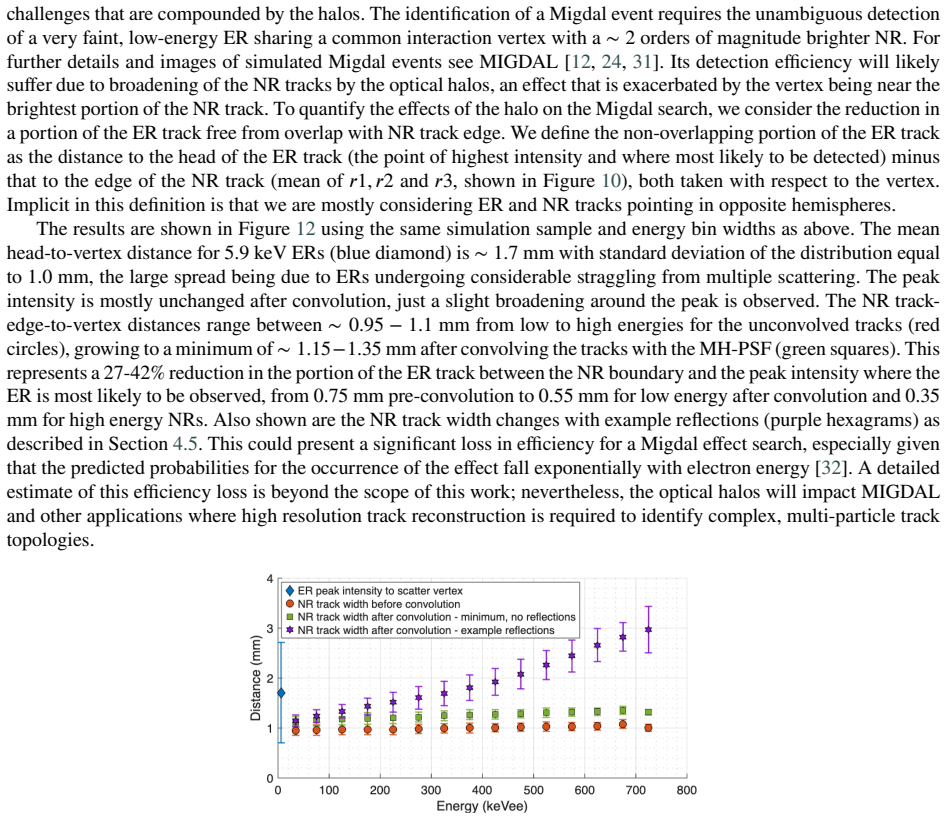
read the original abstract
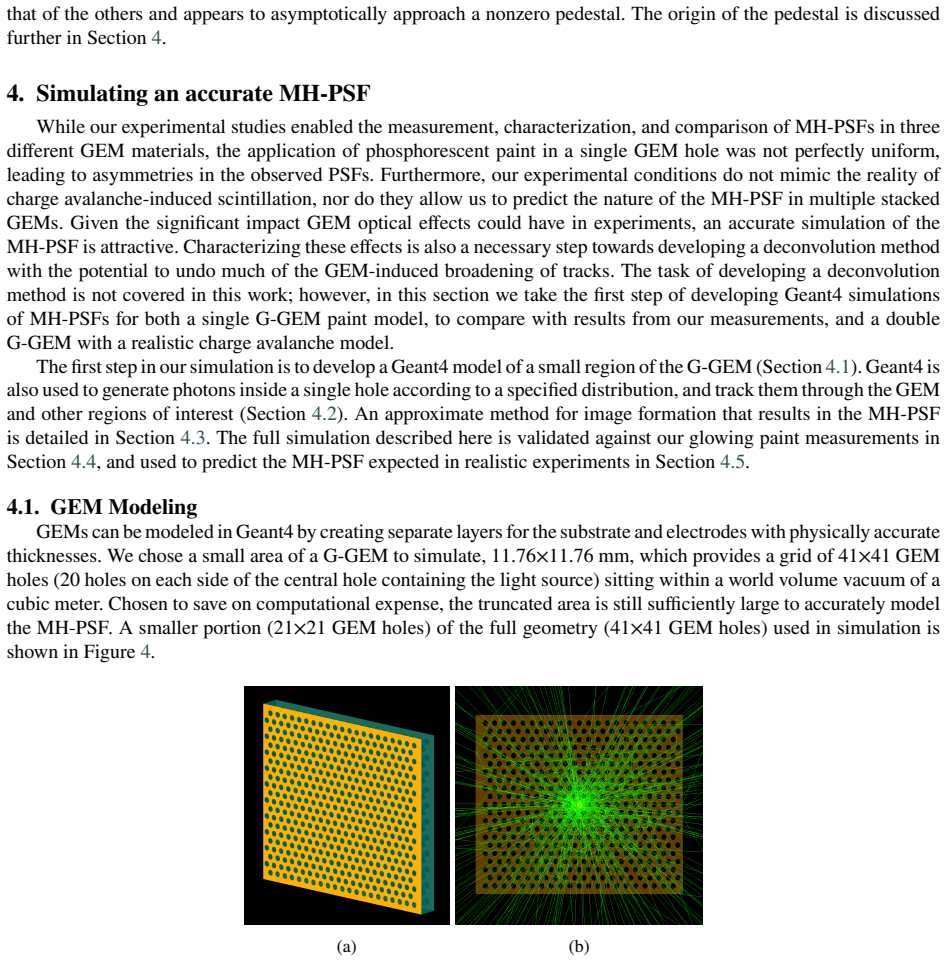
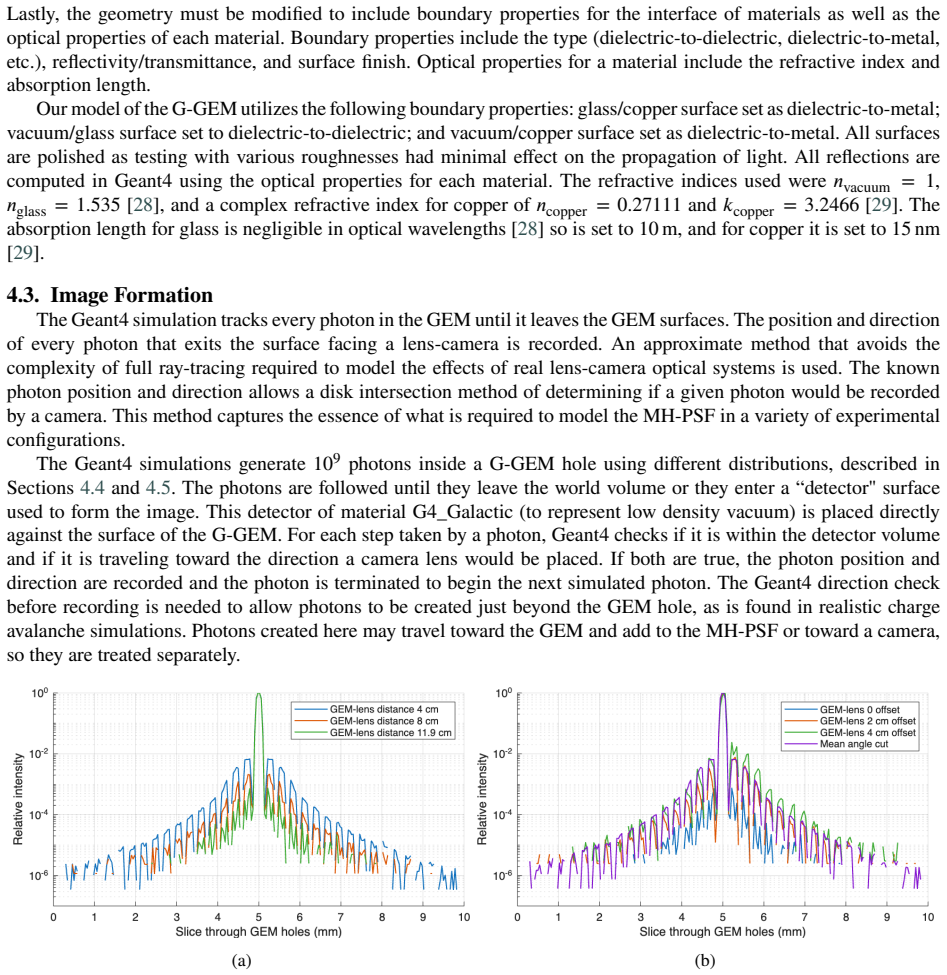
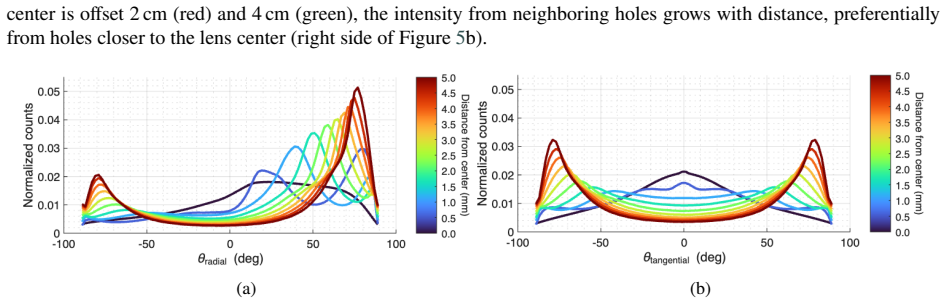
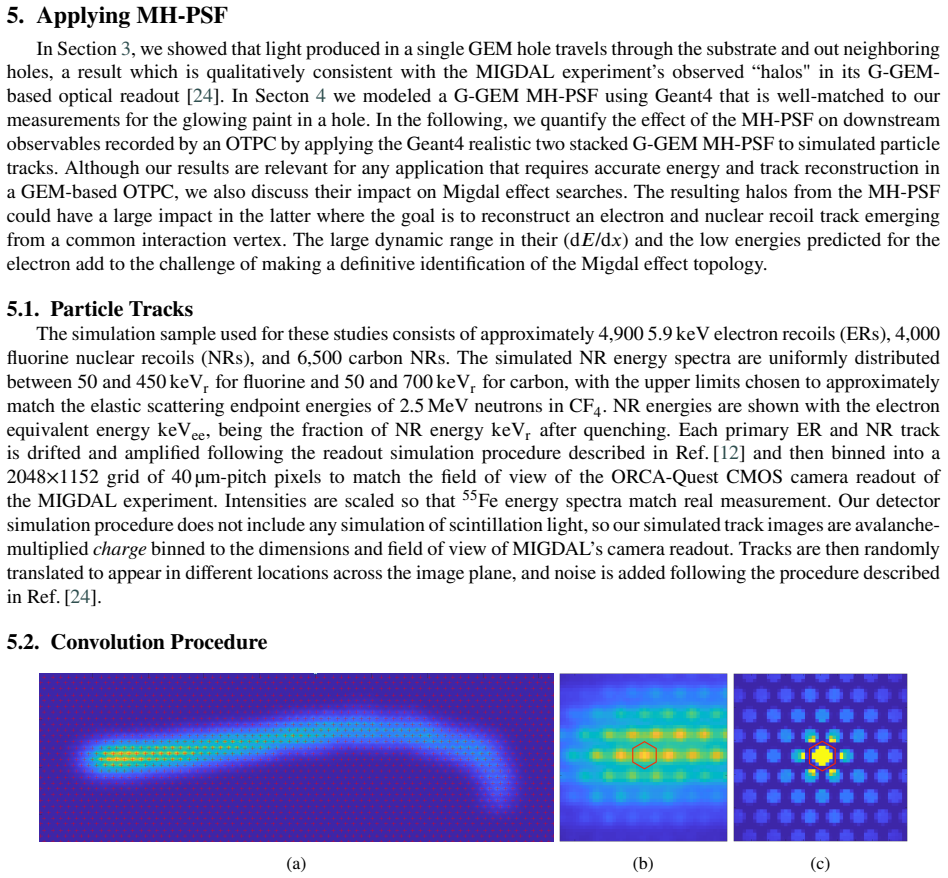
Optical time projection chambers (OTPCs) are well suited for applications that require the highest spatial resolution for particle track reconstruction. The MIGDAL experiment uses a glass GEM-based OTPC and observes a systematic excess in both the intensity and width of particle tracks in its optical readout, when compared with charge readout simulations. One hypothesis is that scintillation light produced inside a GEM hole during the avalanche propagates through the GEM substrate and exits neighboring holes. We present lab measurements testing this hypothesized optical broadening effect in three types of GEM substrates: glass, ceramic, and FR4. Our observations quantify this optical broadening and demonstrate it to be strongest in glass GEMs. Additionally, we use Geant4 simulations to both reproduce our observations and quantify optical broadening effects in realistic charge avalanches. Applying our glass GEM effects to simulated particle tracks yields increases of track intensity and widths by up to around 26% and 31%, respectively. This may explain the larger than expected intensity and track widths observed in the MIGDAL OTPC and is expected to be an observed effect in all GEM-based OTPCs.
Editorial analysis
A structured set of objections, weighed in public.
Referee Report
Summary. The manuscript investigates hypothesized optical broadening in GEM-based OTPCs, where scintillation light from avalanches in one GEM hole propagates through the substrate and exits neighboring holes. It reports laboratory measurements of this effect in glass, ceramic, and FR4 GEM substrates using controlled external light sources, complemented by Geant4 simulations that reproduce the lab data and extend the analysis to realistic charge avalanches. The central quantitative result is that applying the glass-GEM optical effects to simulated particle tracks increases track intensity by up to ~26% and widths by up to ~31%, which the authors suggest may explain the excess intensity and width observed in the MIGDAL OTPC relative to charge-readout simulations.
Significance. If the extrapolation from controlled-source lab data to operating avalanches is valid, the result identifies a measurable systematic that affects track reconstruction in all GEM-based optical TPCs. The multi-substrate comparison and use of Geant4 to propagate measured broadening into track-level predictions constitute a concrete, falsifiable contribution that could improve agreement between optical and charge readouts in MIGDAL and guide future detector design.
major comments (2)
- [Application to simulated tracks / Geant4 extension] The 26% intensity and 31% width increases (final paragraph of the abstract and the corresponding application section) are obtained by feeding lab-measured optical transmission into Geant4 and applying the result to simulated tracks. This procedure assumes that the spectrum, angular distribution, and wavelength-dependent propagation of light from the external controlled source match those of actual scintillation produced inside GEM holes during avalanches. No direct measurement of light emission from operating avalanches (same gas, gain, and hole geometry as MIGDAL) is reported; any mismatch scales directly into the quoted correction factors and their explanatory power for the MIGDAL excesses.
- [Geant4 simulations and validation] The manuscript states that Geant4 reproduces the laboratory light distributions, yet provides no quantitative metrics (e.g., goodness-of-fit, residual distributions, or uncertainty on optical material parameters) for that agreement, nor a sensitivity study varying the scintillation spectrum or isotropy. Because the free parameters in the optical model directly determine the propagated 26%/31% figures, the absence of these checks leaves the robustness of the central claim unquantified.
minor comments (2)
- The abstract and results sections should report the number of GEM samples tested, number of repetitions per configuration, data-exclusion criteria, and explicit uncertainties (including systematic contributions) on the quoted 26% and 31% values.
- Clarify the precise definitions of 'track intensity' and 'track width' used when applying the optical correction to simulated tracks, and state whether these definitions match the MIGDAL analysis pipeline.
Simulated Author's Rebuttal
We thank the referee for their careful and constructive review of our manuscript. We address each major comment below, indicating revisions that will be incorporated to improve clarity and robustness.
read point-by-point responses
-
Referee: [Application to simulated tracks / Geant4 extension] The 26% intensity and 31% width increases (final paragraph of the abstract and the corresponding application section) are obtained by feeding lab-measured optical transmission into Geant4 and applying the result to simulated tracks. This procedure assumes that the spectrum, angular distribution, and wavelength-dependent propagation of light from the external controlled source match those of actual scintillation produced inside GEM holes during avalanches. No direct measurement of light emission from operating avalanches (same gas, gain, and hole geometry as MIGDAL) is reported; any mismatch scales directly into the quoted correction factors and their explanatory power for the MIGDAL excesses.
Authors: We acknowledge that our laboratory setup employs an external light source rather than direct scintillation from operating avalanches, and that the spectrum and angular distribution are therefore matched by design rather than measured in situ. The source wavelength range was selected to overlap with the expected scintillation spectrum of the MIGDAL gas mixture, and the Geant4 model uses the measured wavelength-dependent transmission through each substrate. We agree this introduces an assumption whose impact is not fully quantified in the current text. In the revised manuscript we will add an explicit discussion of these assumptions, including a qualitative assessment of possible mismatches, and we will flag the need for future in-situ optical measurements during avalanche operation as a limitation. The reported 26% and 31% figures will be presented as estimates under the stated conditions rather than as definitive corrections. revision: partial
-
Referee: [Geant4 simulations and validation] The manuscript states that Geant4 reproduces the laboratory light distributions, yet provides no quantitative metrics (e.g., goodness-of-fit, residual distributions, or uncertainty on optical material parameters) for that agreement, nor a sensitivity study varying the scintillation spectrum or isotropy. Because the free parameters in the optical model directly determine the propagated 26%/31% figures, the absence of these checks leaves the robustness of the central claim unquantified.
Authors: We thank the referee for highlighting this gap. The current manuscript demonstrates agreement primarily through visual overlay of measured and simulated light profiles. In the revised version we will add quantitative validation metrics, including chi-squared per degree of freedom for the light-distribution comparisons and example residual plots. We will also perform and report a sensitivity study in which the scintillation spectrum, isotropy, and key optical parameters (refractive index, absorption length) are varied within physically motivated ranges; the resulting spread in the derived track intensity and width increases will be quoted. These additions will directly address the robustness of the central quantitative results. revision: yes
Circularity Check
No significant circularity; central results derive from independent lab measurements
full rationale
The paper's derivation begins with direct laboratory measurements of optical propagation through physical GEM samples (glass, ceramic, FR4) using controlled external light sources. These empirical broadening factors are then fed into Geant4 simulations that first reproduce the lab data and subsequently apply the same propagation model to separate simulated charge avalanches and particle tracks. The reported 26% intensity and 31% width increases are therefore outputs of this forward propagation, not parameters fitted to the MIGDAL OTPC observations themselves. No equation or step in the chain defines a quantity in terms of the target excess or renames a fit as a prediction; the MIGDAL comparison remains a post-hoc consistency check rather than an input. The chain is self-contained against external benchmarks.
Axiom & Free-Parameter Ledger
free parameters (1)
- Geant4 optical material parameters
axioms (2)
- domain assumption Scintillation light is produced inside GEM holes during electron avalanche
- standard math Light propagation through the GEM substrate can be modeled by standard optical transport in Geant4
Reference graph
Works this paper leans on
-
[1]
J. N. Marx, D. R. Nygren, The Time Projection Chamber, Physics Today 31 (10) (1978) 46–53.doi:10.1063/1.2994775
-
[2]
S.E.Vahsen,C.A.O’Hare,D.Loomba,DirectionalRecoilDetection,AnnualReviewofNuclearandParticleScience71(Volume71,2021) (2021) 189–224.doi:10.1146/annurev-nucl-020821-035016
-
[3]
B. Morgan, DRIFT: a directionally sensitive dark matter detector, Nuclear Instruments and Methods in Physics Research Section A: Accelerators, Spectrometers, Detectors and Associated Equipment 513 (1) (2003) 226–230, proceedings of the 6th International Conference on Position-Sensitive Detectors.doi:10.1016/j.nima.2003.08.037
-
[4]
J. B. R. Battat, S. Allien, T. Caldwell, et al., DMTPC: A dark matter detector with directional sensitivity, in: M. L. Marshak (Ed.), 10th ConferenceontheIntersectionsofParticleandNuclearPhysics,Vol.1182ofAmericanInstituteofPhysicsConferenceSeries,AIP,2009,pp. 276–279.doi:10.1063/1.3293799. Page 15 of 16
-
[5]
T. Shimada, S. Higashino, T. Ikeda, et al., Direction-sensitive dark matter search with 3D-vector-type tracking in NEWAGE, Progress of Theoretical and Experimental Physics 2023 (10) (2023) 103F01.doi:10.1093/ptep/ptad120
-
[6]
D. Santos, J. Billard, G. Bosson, et al., MIMAC: A micro-tpc matrix for directional detection of dark matter, Journal of Physics: Conference Series 309 (2011) 012014.doi:10.1088/1742-6596/309/1/012014
-
[7]
F. D. Amaro, E. Baracchini, L. Benussi, et al., The CYGNO experiment, a directional detector for direct Dark Matter searches, Nuclear Instruments and Methods in Physics Research Section A: Accelerators, Spectrometers, Detectors and Associated Equipment 1054 (2023) 168325.doi:10.1016/j.nima.2023.168325
-
[8]
S. Wang, PandaX-III high pressure xenon TPC for Neutrinoless Double Beta Decay search, Nuclear Instruments and Methods in Physics Research Section A: Accelerators, Spectrometers, Detectors and Associated Equipment 958 (2020) 162439, proceedings of the Vienna Conference on Instrumentation 2019.doi:10.1016/j.nima.2019.162439
-
[9]
N. Sokołowska, V. Guadilla, C. Mazzocchi, et al., Decay study of11Bewith an optical time-projection chamber, Phys. Rev. C 110 (2024) 034328.doi:10.1103/PhysRevC.110.034328
-
[10]
J. K. Black, R. G. Baker, P. Deines-Jones, et al., X-ray polarimetry with a micropattern TPC, Nuclear Instruments and Methods in Physics Research A 581 (3) (2007) 755–760.doi:10.1016/j.nima.2007.08.144
-
[11]
D. Fiorina, E. Baracchini, G. Dho, et al., HypeX: high yield polarimetry experiment in x-rays, in: A. D. Holland, K. Minoglou (Eds.), X-Ray, Optical, and Infrared Detectors for Astronomy XI, Vol. 13103 of Society of Photo-Optical Instrumentation Engineers (SPIE) Conference Series, 2024, p. 1310318.doi:10.1117/12.3021559
-
[12]
H. Araújo, S. Balashov, J. Borg, et al., The MIGDAL experiment: Measuring a rare atomic process to aid the search for dark matter, Astroparticle Physics 151 (2023) 102853.doi:10.1016/j.astropartphys.2023.102853
-
[13]
J. Xu, D. Adams, B. G. Lenardo, et al., Search for the Migdal effect in liquid xenon with keV-level nuclear recoils, Phys. Rev. D 109 (2024) L051101.doi:10.1103/PhysRevD.109.L051101
-
[14]
J.Alme,Y.Andres,H.Appelshäuser,etal.,TheALICETPC,alarge3-dimensionaltrackingdevicewithfastreadoutforultra-highmultiplicity events, Nuclear Instruments and Methods in Physics Research Section A: Accelerators, Spectrometers, Detectors and Associated Equipment 622 (1) (2010) 316–367.doi:10.1016/j.nima.2010.04.042
-
[15]
F.Fraga,L.Margato,S.Fetal,etal.,OpticalreadoutofGEMs,NuclearInstrumentsandMethodsinPhysicsResearchSectionA:Accelerators, Spectrometers, Detectors and Associated Equipment 471 (1) (2001) 125–130, imaging 2000.doi:10.1016/S0168-9002(01)00972-X
-
[16]
D.Pinci,E.Baracchini,G.Cavoto,E.DiMarco,etal.,HighresolutionTPCbasedonopticallyreadoutGEM,NuclearInstrumentsandMethods inPhysicsResearchSectionA:Accelerators,Spectrometers,DetectorsandAssociatedEquipment936(2019)453–455,frontierDetectorsfor Frontier Physics: 14th Pisa Meeting on Advanced Detectors.doi:10.1016/j.nima.2018.11.085
-
[17]
F.M.Brunbauer,M.Lupberger,E.Oliveri,etal.,RadiationimagingwithopticallyreadoutGEM-baseddetectors,JournalofInstrumentation 13 (02) (2018) T02006.doi:10.1088/1748-0221/13/02/T02006
-
[18]
F.M.Brunbauer,F.Garcia,T.Korkalainen,etal.,CombinedOpticalandElectronicReadoutforEventReconstructioninaGEM-BasedTPC, IEEE Transactions on Nuclear Science 65 (3) (2018) 913–918.doi:10.1109/TNS.2018.2800775
-
[19]
N. Phan, E. Lee, D. Loomba, Imaging 55Fe electron tracks in a GEM-based TPC using a CCD readout, Journal of Instrumentation 15 (05) (2020) P05012.doi:10.1088/1748-0221/15/05/P05012
-
[20]
F. M. Brunbauer, et al., High-speed optical GEM readout, RD51 Collaboration Meeting and the "MPGD Stability" workshop, Munich, Germany, 2018,https://indico.cern.ch/event/709670/contributions/3036126/attachments/1671185/2680963/Fa stTiming_3DPrinting_Brunbauer.pdf(accessed April 2026)
-
[21]
K. Abe, N. Abgrall, H. Aihara, et al., The T2K experiment, Nuclear Instruments and Methods in Physics Research Section A: Accelerators, Spectrometers, Detectors and Associated Equipment 659 (1) (2011) 106–135.doi:10.1016/j.nima.2011.06.067
-
[22]
H.Takahashi,Y.Mitsuya,T.Fujiwara,T.Fushie,DevelopmentofaglassGEM,NuclearInstrumentsandMethodsinPhysicsResearchSection A: Accelerators, Spectrometers, Detectors and Associated Equipment 724 (2013) 1–4.doi:10.1016/j.nima.2013.04.089
-
[23]
EHDImagingGmbH,EHDF0.85Lenses,EHDImagingGmbH,ZumRennplatz15,D-49401Damme,Germany,https://www.ehd.de/w p-content/uploads/2024/05/EHD-F085-Lenses.pdf(accessed April 2026) (March 2020)
2024
-
[24]
J. Schueler, H. M. Araújo, S. N. Balashov, et al., Transforming a rare event search into a not-so-rare event search in real-time with deep learning-based object detection, Phys. Rev. D 111 (2025) 072004.doi:10.1103/PhysRevD.111.072004
-
[25]
Agostinelli, et al., GEANT4 - A Simulation Toolkit, Nucl
S. Agostinelli, et al., GEANT4 - A Simulation Toolkit, Nucl. Instrum. Meth. A 506 (2003) 250–303.doi:10.1016/S0168-9002(03)013 68-8
-
[26]
F.M.Brunbauer,P.Amedo,K.J.Flöthner,etal.,PrimaryandsecondaryscintillationofCF4-basedmixturesinlow-pressuregaseousdetectors, Frontiers in Detector Science and Technology Volume 3 - 2025.doi:10.3389/fdest.2025.1561739
-
[27]
Allison, et al., Recent developments in Geant4, Nucl
J. Allison, K. Amako, J. Apostolakis, et al., Recent developments in Geant4, Nuclear Instruments and Methods in Physics Research Section A: Accelerators, Spectrometers, Detectors and Associated Equipment 835 (2016) 186–225.doi:10.1016/j.nima.2016.06.125
-
[28]
Hatsuda, Y
M. Hatsuda, Y. Motomura, K. Hashimoto, Micro-Fabrication Process and Products of Photosensitive Etching Glass PEG 3,https: //www.newglass.jp/mag/TITL/maghtml/84-pdf/+84-p075.pdf(accessed April 2026)
2026
-
[29]
M. N. Polyanskiy, Refractive index database,https://refractiveindex.info(accessed April 2026)
2026
-
[30]
Schindler, Garfield++ User Guide,https://garfieldpp.web.cern.ch/(accessed April 2026) (2022)
H. Schindler, Garfield++ User Guide,https://garfieldpp.web.cern.ch/(accessed April 2026) (2022)
2026
-
[31]
J. Schueler, H. M. Araújo, S. N. Balashov, et al., Overlap-aware segmentation for topological reconstruction of obscured objects, arXiv preprintArXiv:2510.06194 [hep-ex]. URLhttps://arxiv.org/abs/2510.06194
-
[32]
M. Ibe, W. Nakano, Y. Shoji, K. Suzuki, Migdal effect in dark matter direct detection experiments, Journal of High Energy Physics 2018 (3). doi:10.1007/jhep03(2018)194. Page 16 of 16
discussion (0)
Sign in with ORCID, Apple, or X to comment. Anyone can read and Pith papers without signing in.