REVIEW 4 minor 84 references
A Geometric Perspective on Polynomially Solvable Convex Maximization
T0 review · 0 major / 4 minor · reviewed 2026-05-07 · grok-4.3
Pith's one-line read Comonotonicity of the feasible region makes fixed-rank convex maximization polynomially solvable.
desk verdict The paper defines comonotonicity as a geometric property on feasible regions and uses it to give one enumerative algorithm that solves fixed-rank convex maximization in polynomial time while recovering SPCA and matroid cases as special instances. read the letter →
The pith
A machine-rendered reading of the paper's core claim, the machinery that carries it, and where it could break.
The reading
What carries the argument
comonotonicity, a structural property of the feasible region that enables an enumerative polynomial-time algorithm for fixed-rank convex objectives
What would settle it
A concrete feasible region that meets the comonotonicity definition but for which no polynomial-time algorithm exists for some fixed-rank convex maximization instance would disprove the central claim.
Extended reading notes
Core claim
Under the comonotonicity property of the feasible region together with mild additional assumptions, fixed-rank convex maximization admits a unified enumerative algorithm that runs in polynomial time. This framework recovers known results such as fixed-rank convex matroid maximization and sparse principal component analysis without needing separate proofs. For standard comonotone regions, a lifting technique yields a square-root improvement in the running time.
Load-bearing premise
The feasible region must satisfy the comonotonicity property in addition to the mild assumptions needed for the enumerative framework to run in polynomial time.
Editorial extensions
If this is right
- Fixed-rank convex maximization becomes polynomially solvable over any comonotone feasible region.
- A single enumerative framework recovers and unifies prior separate proofs for matroid maximization and SPCA.
- A lifting technique gives a square-root improvement in complexity for standard comonotone regions.
- The framework applies directly to SPCA and its variants with demonstrated effectiveness.
Reading between the lines
- Comonotonicity may identify tractable cases in other families of nonconvex optimization beyond convex maximization.
- Algorithms for real-world problems could first test for comonotonicity to decide whether the enumerative method is guaranteed to succeed.
- Similar geometric properties on feasible sets might extend polynomial solvability results to objectives of higher rank.
Signed reviews
Editorial analysis
A structured set of objections, weighed in public.
Referee Report
Summary. The paper claims that convex maximization, generally NP-hard even for low-rank objectives, becomes polynomially solvable under a newly introduced geometric property called comonotonicity of the feasible region, along with mild additional assumptions. It provides mathematical characterizations of comonotonicity and develops a unified enumerative framework for fixed-rank convex maximization. This framework recovers known tractable cases such as fixed-rank convex matroid maximization and sparse principal component analysis (SPCA). For standard comonotone feasible regions, a lifting technique achieves a square-root improvement in the complexity bound. Applications to SPCA and its variants are presented to illustrate the framework.
Significance. If the characterizations and enumerative framework hold, this work offers a significant unified geometric perspective on polynomially solvable convex maximization problems. The recovery of disparate known results (matroid maximization, SPCA) as special instances within a single framework is a notable strength, as is the explicit complexity analysis of the enumeration and the lifting technique for improved bounds. The paper provides mathematical characterizations, a complexity analysis, and a falsifiable structural property (comonotonicity) that could guide further research in optimization.
minor comments (4)
- [Abstract and Introduction] The abstract and introduction refer to 'mild additional assumptions' without a concise summary or pointer to their precise statement in the main theorems; adding this would improve accessibility for readers.
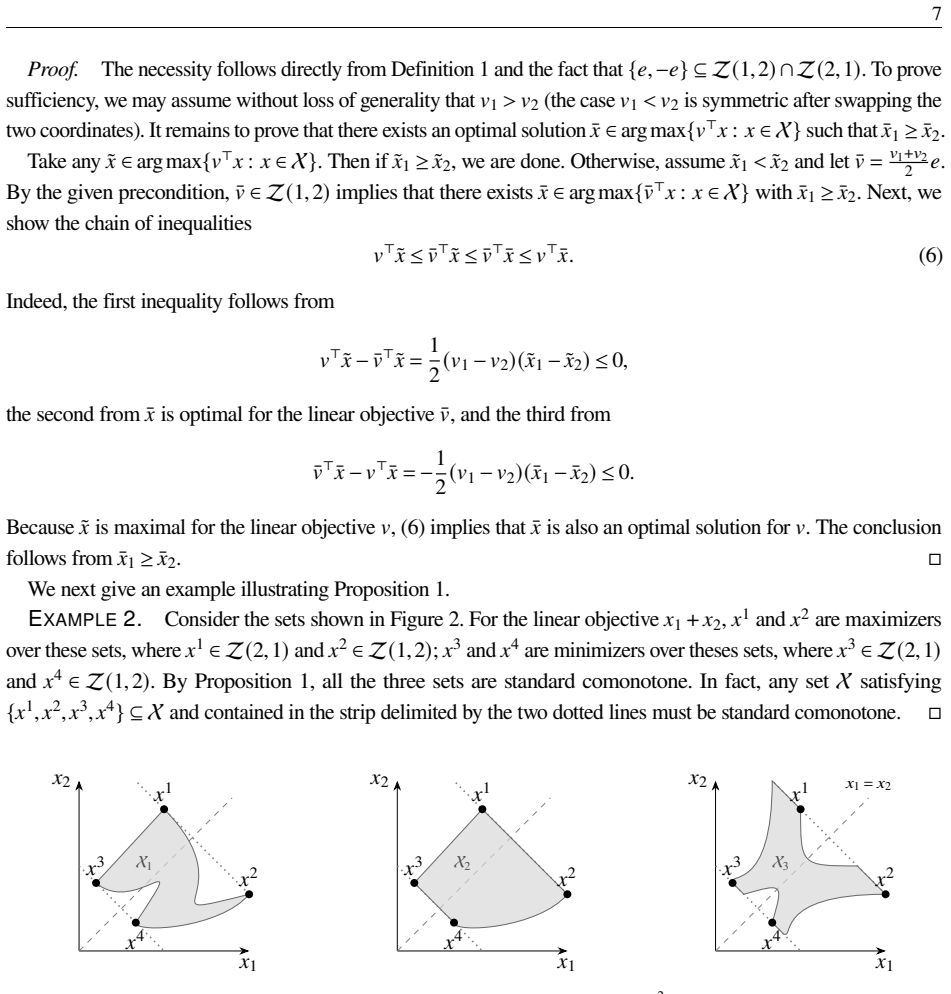
- [Section on characterizations of comonotonicity] The characterizations of comonotonicity would benefit from an illustrative low-dimensional example or diagram showing how the geometric property manifests in a simple feasible region.
- [Applications section] In the applications to SPCA, the discussion of effectiveness would be strengthened by including a brief complexity comparison between the proposed enumerative framework and existing specialized SPCA solvers.
- [Throughout the manuscript] Notation for the rank parameter and the enumeration size should be consistently defined early and used uniformly across theorems and complexity statements.
Simulated Author's Rebuttal
We thank the referee for their positive and constructive report, including the favorable assessment of the significance of the comonotonicity framework and its ability to unify results on matroid maximization and SPCA. The recommendation for minor revision is noted. No specific major comments were provided in the report, so we have no points requiring rebuttal or substantive revision at this time. Any minor editorial or typographical issues will be addressed in the revised manuscript.
Circularity Check
No significant circularity detected
full rationale
The paper defines a new geometric property (comonotonicity) of the feasible region, supplies explicit mathematical characterizations of it, and then proves that fixed-rank convex maximization is polynomially solvable via an enumerative procedure under this property together with mild additional assumptions. The framework is shown to subsume known tractable cases (fixed-rank convex matroid maximization, SPCA) as special instances rather than using those cases to justify the general claim. No parameter fitting, self-definitional loops, load-bearing self-citations, or renaming of prior results as new derivations appear; the derivation chain consists of independent definitions followed by complexity analysis and recovery of special cases.
Assumptions & free parameters
assumptions (1)
- domain assumption Standard assumptions of convex optimization (convex objective, convex feasible set) hold.
invented entities (1)
-
comonotonicity
Cite this review
Pith. "Pith review of A Geometric Perspective on Polynomially Solvable Convex Maximization." pith.science (2026). https://pith.science/paper/2604.27427
@misc{pith2026260427427,
  author       = {Pith},
  title        = {Pith review of: A Geometric Perspective on Polynomially Solvable Convex Maximization},
  year         = {2026},
  howpublished = {\url{https://pith.science/paper/2604.27427}},
  note         = {Machine review of arXiv:2604.27427}
}
read the original abstract
Convex maximization encompasses a broad class of optimization problems and is generally NP-hard, even for low-rank objectives. This paper investigates structural conditions under which convex maximization becomes polynomially solvable. From a geometric perspective, we introduce comonotonicity, a structural property of the feasible region crucial for problem tractability, and establish mathematical characterizations of this property. Under comonotonicity and mild additional assumptions, we develop a unified enumerative framework showing that fixed-rank convex maximization is polynomially solvable. This viewpoint recovers several known tractability results that previously required separate analyses, such as fixed-rank convex matroid maximization and sparse principal component analysis (SPCA). Furthermore, for the more structured class of standard comonotone feasible regions, we refine the analysis via a lifting technique to achieve a square-root improvement in the complexity bound. Finally, applications to SPCA and its variants illustrate the broad applicability and effectiveness of the proposed framework.
Figures


Figures from the paper (2 more)


Reference graph
Works this paper leans on
-
[1]
Bioinformatics27(21):3029–3035
Allen GI, Maleti´c-Savati´c M (2011) Sparse non-negative generalized PCA with applications to metabolomics. Bioinformatics27(21):3029–3035
work page 2011
-
[2]
Asteris M, Papailiopoulos D, Dimakis A (2014) Nonnegative sparse PCA with provable guarantees.International Conference on Machine Learning, 1728–1736 (PMLR)
work page 2014
-
[3]
Asteris M, Papailiopoulos D, Kyrillidis A, Dimakis AG (2015) Sparse PCA via bipartite matchings.Advances in Neural Information Processing Systems28
work page 2015
-
[4]
Asteris M, Papailiopoulos DS, Karystinos GN (2014) The sparse principal component of a constant-rank matrix.IEEE Transactions on Information Theory60(4):2281–2290
work page 2014
-
[5]
Atamt¨ urk A, Narayanan V (2009) The submodular knapsack polytope.Discrete Optimization6(4):333–344
work page 2009
-
[6]
Balas E (2018)Disjunctive programming(Springer)
work page 2018
-
[7]
Bector C (1970) Some aspects of quasi-convex programming.ZAMM-Journal of Applied Mathematics and Mechanics/Zeitschrift f¨ur Angewandte Mathematik und Mechanik50(7-9):495–497
work page 1970
-
[8]
Benson HP (1985) A finite algorithm for concave minimization over a polyhedron.Naval Research Logistics Quarterly 32(1):165–177
work page 1985
Show all 84 references
-
[9]
Benson HP (1995) Concave minimization: theory, applications and algorithms.Handbook of global optimization, 43–148 (Springer)
1995
-
[10]
Revue franc ¸aise d’automatique informatique recherche op´erationnelle
Bereanu B (1972) Quasi-convexity, strictly quasi-convexity and pseudo-convexity of composite objective functions. Revue franc ¸aise d’automatique informatique recherche op´erationnelle. Math´ematique6(R1):15–26
1972
-
[11]
Calinescu G, Chekuri C, Pal M, Vondr´ak J (2011) Maximizing a monotone submodular function subject to a matroid constraint.SIAM Journal on Computing40(6):1740–1766
2011
-
[12]
Chandrasekaran R, Aneja Y, Nair K (1981) Minimal cost-reliability ratio spanning tree.North-Holland Mathematics Studies, volume 59, 53–60 (Elsevier)
1981
-
[13]
Conforti M, Cornu´ejols G, Zambelli G (2010) Extended formulations in combinatorial optimization.4OR8(1):1–48
2010
-
[14]
Journal of Pure and Applied Algebra213(8):1569–1577
De Loera JA, Hemmecke R, Onn S, Rothblum U, Weismantel R (2009) Convex integer maximization via graver bases. Journal of Pure and Applied Algebra213(8):1569–1577
2009
-
[15]
De Loera JA, Hemmecke R, Onn S, Weismantel R (2008) N-fold integer programming.Discrete Optimization 5(2):231–241
2008
-
[16]
Del Pia A (2023) Sparse PCA on fixed-rank matrices.Mathematical Programming198(1):139–157. 32
2023
-
[17]
Dey SS, Molinaro M, Wang G (2023) Solving sparse principal component analysis with global support.Mathematical Programming199(1):421–459
2023
-
[18]
Deza A, Manoussakis G, Onn S (2018) Primitive zonotopes.Discrete & Computational Geometry60(1):27–39
2018
-
[19]
Deza A, Pournin L, Rakotonarivo R (2021) The vertices of primitive zonotopes.Contemporary Mathematics764:71–81
2021
-
[20]
Edelman PH, Jamison RE (1985) The theory of convex geometries.Geometriae Dedicata19(3):247–270
1985
-
[21]
Edelsbrunner H (1987)Algorithms in combinatorial geometry, volume 10 (Springer Science & Business Media)
1987
-
[22]
SIAM Journal on Computing15(2):341–363
Edelsbrunner H, O’Rourke J, Seidel R (1986) Constructing arrangements of lines and hyperplanes with applications. SIAM Journal on Computing15(2):341–363
1986
-
[23]
Edelsbrunner H, Seidel R, Sharir M (1993) On the zone theorem for hyperplane arrangements.SIAM Journal on Computing22(2):418–429
1993
-
[24]
Edmonds J (1970) Submodular functions, matroids, and certain polyhedra.Combinatorial Structures and Their Applications, 69–87 (Gordon and Breach)
1970
-
[25]
Edmonds J (1971) Matroids and the greedy algorithm.Mathematical programming1(1):127–136
1971
-
[26]
Giannessi F, Niccolucci F (1976) Connections between nonlinear and integer programming problems.Symposia Mathematica, volume 19, 161–176 (Academic Press New Y ork)
1976
-
[27]
Goemans MX (2015) Smallest compact formulation for the permutahedron.Mathematical Programming153(1):5–11
2015
-
[28]
G´omez A, Neto J (2025) Outlier detection in regression: conic quadratic formulations.INFORMS Journal on Computing
2025
-
[29]
Operations Research Letters41(2):191–196
Goyal V , Ravi R (2013) An FPTAS for minimizing a class of low-rank quasi-concave functions over a convex set. Operations Research Letters41(2):191–196
2013
-
[30]
Gretton A, Borgwardt KM, Rasch MJ, Sch¨olkopf B, Smola A (2012) A kernel two-sample test.Journal of Machine Learning Research13(1):723–773
2012
-
[31]
Han S, G ´omez A (2025) Compact extended formulations for low-rank functions with indicator variables.Mathematics of Operations Research50(3):1992–2016
2025
-
[32]
Mathematical Programming202:95–134
Han S, G´omez A, Atamt¨ urk A (2023) 2×2-convexifications for convex quadratic optimization with indicator variables. Mathematical Programming202:95–134
2023
-
[33]
(1952)Inequalities(Cambridge University Press)
Hardy GH, Littlewood JE, P´olya G, P´olya G, et al. (1952)Inequalities(Cambridge University Press)
1952
-
[34]
Hare WL, Lewis AS (2004) Identifying active constraints via partial smoothness and prox-regularity.Journal of Convex Analysis11(2):251–266
2004
-
[35]
Hashizume S, Fukushima M, Katoh N, Ibaraki T (1987) Approximation algorithms for combinatorial fractional programming problems.Mathematical programming37(3):255–267
1987
-
[36]
Hassin R, Tamir A (1989) Maximizing classes of two-parameter objectives over matroids.Mathematics of Operations Research14(2):362–375
1989
-
[37]
Helman P, Moret BM, Shapiro HD (1993) An exact characterization of greedy structures.SIAM Journal on Discrete Mathematics6(2):274–283
1993
-
[38]
Horst R, T uy H (2013)Global optimization: Deterministic approaches(Springer Science & Business Media)
2013
-
[39]
H¨ossjer O (1995) Exact computation of the least trimmed squares estimate in simple linear regression.Computational Statistics & Data Analysis19(3):265–282
1995
-
[40]
Hotelling H (1933) Analysis of a complex of statistical variables into principal components.Journal of educational psychology24(6):417. 33
1933
-
[41]
Jeffers JN (1967) T wo case studies in the application of principal component analysis.Journal of the Royal Statistical Society: Series C (Applied Statistics)16(3):225–236
1967
-
[42]
Kalra S, Adnan M, Taylor G, Tizhoosh HR (2020) Learning permutation invariant representations using memory networks.European conference on computer vision, 677–693 (Springer)
2020
-
[43]
Kim J, Tawarmalani M, Richard JPP (2022) Convexification of permutation-invariant sets and an application to sparse principal component analysis.Mathematics of Operations Research47(4):2547–2584
2022
-
[44]
Klouda K (2015) An exact polynomial time algorithm for computing the least trimmed squares estimate.Computational Statistics & Data Analysis84:27–40
2015
-
[45]
Korte B, Lov´asz L (1984) Greedoids-a structural framework for the greedy algorithm.Progress in combinatorial optimization, 221–243 (Elsevier)
1984
-
[46]
Lee J, Lee Y, Kim J, Kosiorek A, Choi S, Teh YW (2019) Set transformer: A framework for attention-based permutation-invariant neural networks.International conference on machine learning, 3744–3753 (PMLR)
2019
-
[47]
Li Y , Xie W (2024) Beyond symmetry: Best submatrix selection for the sparse truncated svd.Mathematical Programming 208(1):1–50
2024
-
[48]
Li Y , Xie W (2025) Exact and approximation algorithms for sparse principal component analysis.INFORMS Journal on Computing37(3):582–602
2025
-
[49]
Mathematical Programming1–58
Li Y, Xie W (2025) On the partial convexification for low-rank spectral optimization: rank bounds and algorithms. Mathematical Programming1–58
2025
-
[50]
Lov ´asz L (1980) Matroid matching and some applications.Journal of Combinatorial Theory, Series B28(2):208–236
1980
-
[51]
Magdon-Ismail M (2017) NP-hardness and inapproximability of sparse PCA.Information Processing Letters126:35–38
2017
-
[52]
Mangasarian OL (1994)Nonlinear programming(SIAM)
1994
-
[53]
Martin RK, Rardin RL, Campbell BA (1990) Polyhedral characterization of discrete dynamic programming.Operations research38(1):127–138
1990
-
[54]
Megiddo N (1978) Combinatorial optimization with rational objective functions.Proceedings of the tenth annual ACM symposium on Theory of computing, 1–12
1978
-
[55]
Mittal S, Schulz AS (2013) An FPTAS for optimizing a class of low-rank functions over a polytope.Mathematical Programming141(1):103–120
2013
-
[56]
Moghaddam B, Weiss Y , Avidan S (2005) Spectral bounds for sparse PCA: Exact and greedy algorithms.Advances in neural information processing systems18
2005
-
[57]
Montanari A, Richard E (2015) Non-negative principal component analysis: Message passing algorithms and sharp asymptotics.IEEE Transactions on Information Theory62(3):1458–1484
2015
-
[58]
Mor´e JJ, Sorensen DC (1983) Computing a trust region step.SIAM Journal on scientific and statistical computing 4(3):553–572
1983
-
[59]
Algorithmica69(1):148–183
Mount DM, Netanyahu NS, Piatko CD, Silverman R, Wu AY (2014) On the least trimmed squares estimator. Algorithmica69(1):148–183
2014
-
[60]
Murota K (2003)Discrete Convex Analysis(SIAM)
2003
-
[61]
Murty KG, Kabadi SN (1987) Some NP-complete problems in quadratic and nonlinear programming.Mathematical programming39(2):117–129
1987
-
[62]
Nocedal J, Wright SJ (2006)Numerical Optimization(New Y ork: Springer), 2nd edition. 34
2006
-
[63]
Oberlin C, Wright SJ (2006) Active set identification in nonlinear programming.SIAM Journal on Optimization 17(2):577–605
2006
-
[64]
Onn S (2003) Convex matroid optimization.SIAM Journal on Discrete Mathematics17(2):249–253
2003
-
[65]
Onn S (2010) Nonlinear discrete optimization.Zurich Lectures in Advanced Mathematics, European Mathematical Society75
2010
-
[66]
Onn S, Rothblum UG (2004) Convex combinatorial optimization.Discrete & Computational Geometry32:549–566
2004
-
[67]
Onn S, Schulman LJ (2001) The vector partition problem for convex objective functions.Mathematics of Operations Research26(3):583–590
2001
-
[68]
Pardalos PM, Vavasis SA (1991) Quadratic programming with one negative eigenvalue is NP-hard.Journal of Global optimization1(1):15–22
1991
-
[69]
Raghavachari M (1969) On connections between zero-one integer programming and concave programming under linear constraints.Operations Research17(4):680–684
1969
-
[70]
Rockafellar RT (1970)Convex analysis(Princeton university press)
1970
-
[71]
Rousseeuw PJ (1985) Multivariate estimation with high breakdown point.Mathematical statistics and applications 8(283-297):37
1985
-
[72]
(2003)Combinatorial optimization: polyhedra and efficiency, volume 24 (Springer)
Schrijver A, et al. (2003)Combinatorial optimization: polyhedra and efficiency, volume 24 (Springer)
2003
-
[73]
Scott JR, Geunes J (2025) A normal fan projection algorithm for low-rank optimization.Mathematical Programming 209(1):681–702
2025
-
[74]
Shigeno M, Saruwatari Y, Matsui T (1995) An algorithm for fractional assignment problems.Discrete Applied Mathematics56(2-3):333–343
1995
-
[75]
Shishkin SL, Shalaginov A, Bopardikar SD (2019) Fast approximate truncated SVD.Numerical Linear Algebra with Applications26(4)
2019
-
[76]
Sigg CD, Buhmann JM (2008) Expectation-maximization for sparse and non-negative PCA.Proceedings of the 25th international conference on Machine learning, 960–967
2008
-
[77]
Stein C (1945) A two-sample test for a linear hypothesis whose power is independent of the variance.The Annals of Mathematical Statistics16(3):243–258
1945
-
[78]
Vu V , Lei J (2012) Minimax rates of estimation for sparse PCA in high dimensions.Artificial intelligence and statistics, 1278–1286 (PMLR)
2012
-
[79]
Wang J, Dey SS, Xie Y (2023) Variable selection for kernel two-sample tests.arXiv preprint arXiv:2302.07415
2023
-
[80]
White N (1992)Matroid applications(Cambridge University Press)
1992
-
[81]
Whitney H (1935) On the abstract properties of linear dependence.American Journal of Mathematics57(3):509–533
1935
-
[82]
Y annakakis M (1988) Expressing combinatorial optimization problems by linear programs.Proceedings of the twentieth annual ACM symposium on Theory of computing, 223–228
1988
-
[83]
Yu Q, K¨ uc ¸¨ ukyavuz S (2023) Strong valid inequalities for a class of concave submodular minimization problems under cardinality constraints.Mathematical Programming201(1):803–861
2023
-
[84]
Sch¨olkopf B, Platt J, Hoffman T, eds.,Advances in Neural Information Processing Systems, volume 19 (MIT Press)
Zass R, Shashua A (2006) Nonnegative sparse PCA. Sch¨olkopf B, Platt J, Hoffman T, eds.,Advances in Neural Information Processing Systems, volume 19 (MIT Press)
2006
Reviewed May 7, 2026 · model on record in the stance chip above.
Discussion (0). Continue with ORCID to comment.