Recognition: unknown
A benchmark for binary star interaction with a supermassive black hole in general relativity
Pith reviewed 2026-05-07 08:02 UTC · model grok-4.3
The pith
Different numerical schemes for stellar binaries near supermassive black holes agree for million-solar-mass cases but diverge for billion-solar-mass ones, with the pairwise post-Newtonian method always reducing binary separation.
A machine-rendered reading of the paper's core claim, the machinery that carries it, and where it could break.
Core claim
We solve the three-body problem of a stellar binary with a supermassive black hole using the Einstein-Infeld-Hoffmann equations, pairwise two-body PN terms, the Arnowitt-Deser-Misner Hamiltonian, and a scalar perturbation to a background metric. For encounters with a 10^6 solar-mass black hole the higher-order PN formulation matches the metric-perturbation scheme statistically. For a 10^9 solar-mass black hole the schemes produce differences in binary separation and eccentricity that disappear only when the binary is far or widely separated. The pairwise PN method decreases separation at pericentre in all cases, making it the least reliable. The work shows the need for caution when using any
What carries the argument
The three-body problem of a stellar binary interacting with a supermassive black hole, solved by comparing three post-Newtonian expansions (Einstein-Infeld-Hoffmann, pairwise PN terms, ADM Hamiltonian) to a scalar perturbation scheme on a background metric, with consistency judged by changes in binary separation and eccentricity at pericentre.
If this is right
- Higher-order PN and perturbation methods can be used interchangeably for stellar binaries around million-solar-mass black holes with statistical confidence.
- Around billion-solar-mass black holes the predicted separation and eccentricity depend on the chosen scheme.
- The pairwise PN formulation is unsuitable for any distance or black-hole mass because it systematically reduces separation at pericentre.
- Simulations of extreme mass ratio inspirals involving binaries must select formulations carefully near the black hole to avoid spurious orbital decay.
- Results from different approximations around supermassive black holes cannot be interpreted without cross-checks.
Where Pith is reading between the lines
- Full general-relativistic or higher-order simulations will be needed when the black hole mass reaches a billion solar masses or when the binary reaches small separations.
- Future stellar-dynamics observations near galactic centers could distinguish which scheme better matches real orbital evolution, though precision may be limited.
- The method-dependent orbital changes imply that gravitational-wave signals or merger rates estimated from binary-EMRI simulations could shift with the numerical scheme chosen.
- Adding black-hole spin or higher multipoles to the comparison would likely expose further differences between the approximations.
Load-bearing premise
That the tested post-Newtonian expansions and scalar perturbation scheme remain sufficiently accurate in the strong-field regime near the supermassive black hole, especially for the billion-solar-mass case.
What would settle it
A direct numerical integration of the Einstein equations for one specific binary encounter at pericentre with either a million- or billion-solar-mass black hole, showing whether separation decreases as predicted by the pairwise method or stays stable as in the other schemes.
Figures




read the original abstract
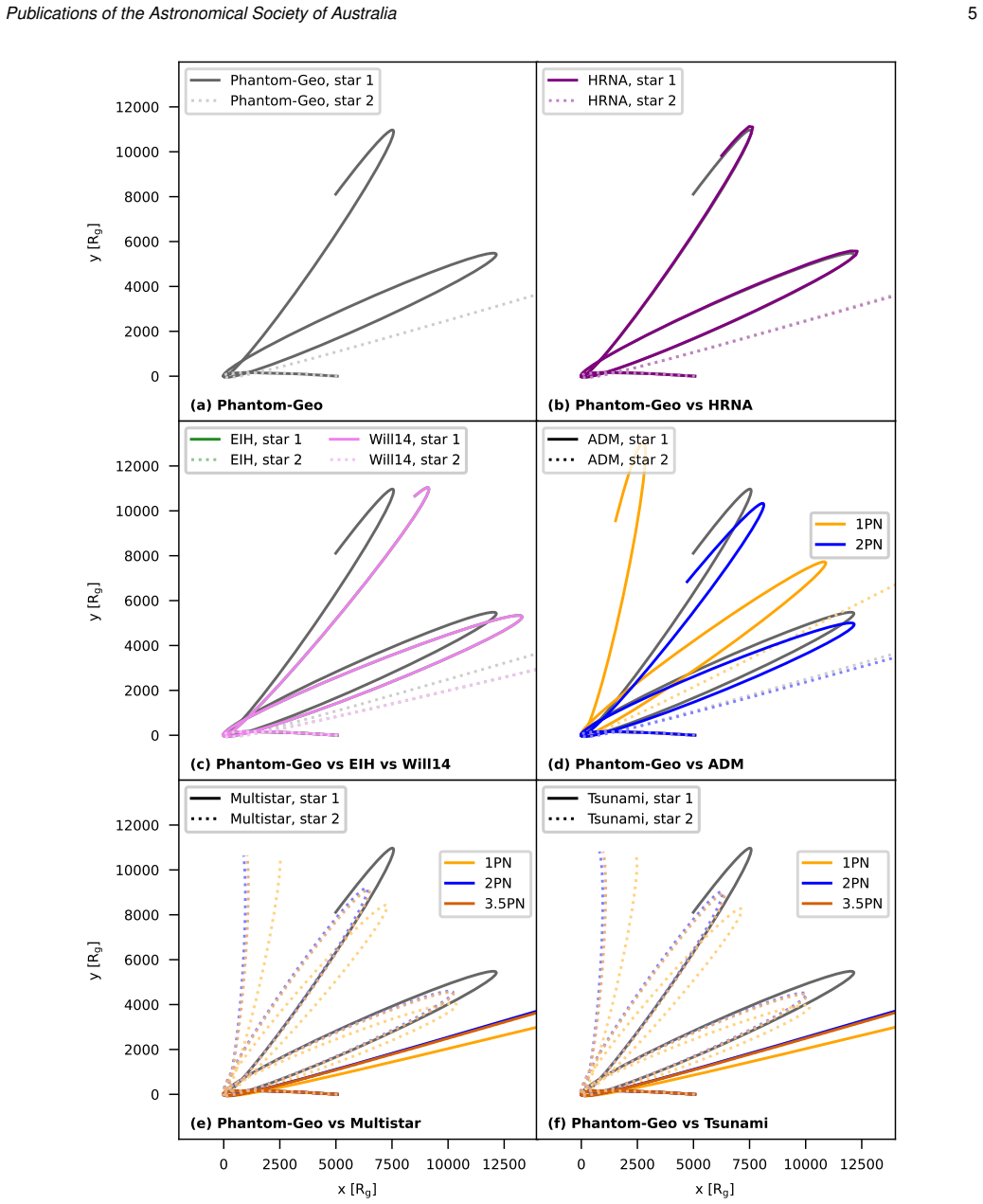
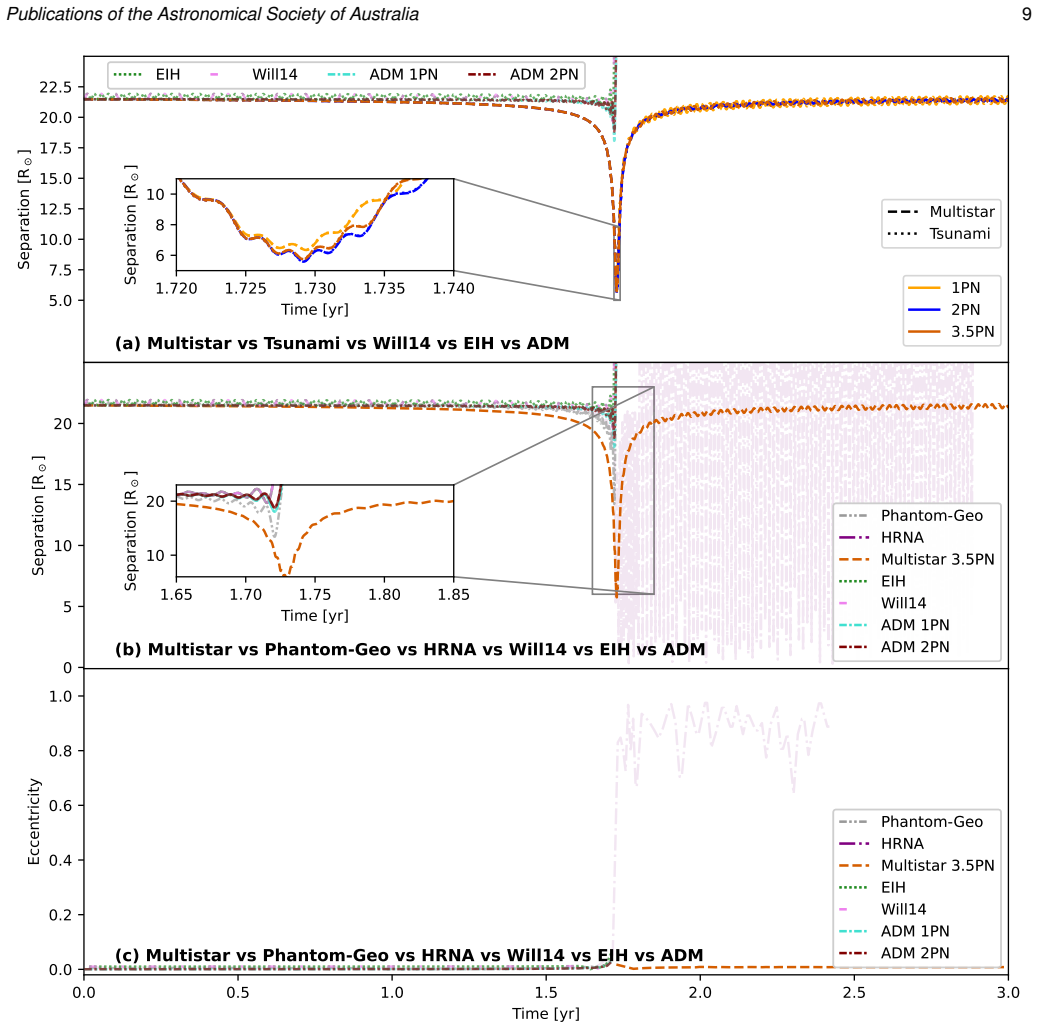
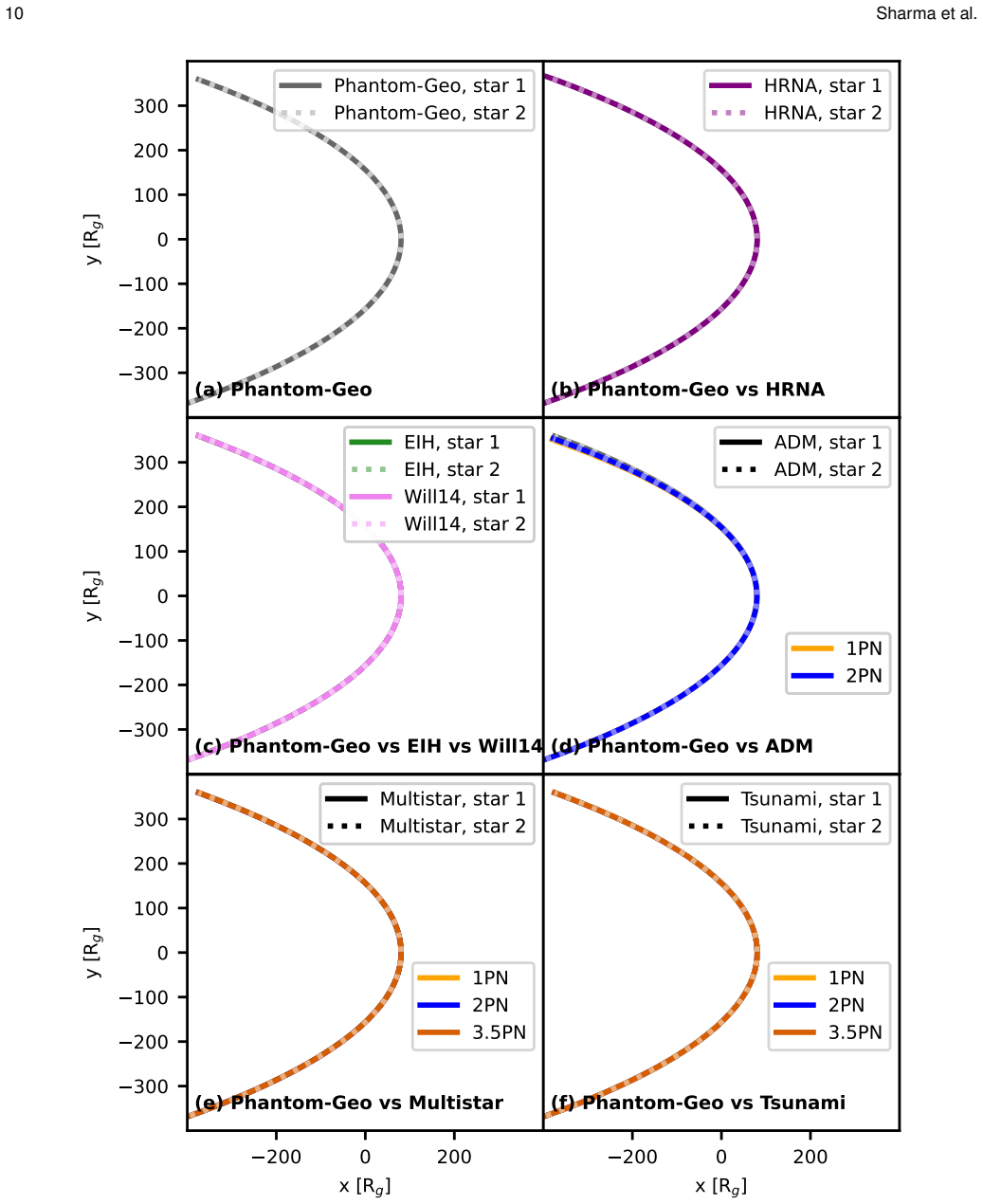
Most galaxies have supermassive black holes (SMBH) at their centres, surrounded by stars with binary systems also present in this environment. We use two schemes - post-Newtonian (PN) and a scalar perturbation to a background metric to numerically solve the three-body problem of a binary with a SMBH. We test three different PN formulations for the PN scheme: The Einstein-Infeld-Hoffman equation, pair-wise implementation of two-body PN-terms for three bodies and the Arnowitt-Deser-Misner Hamiltonian. We compare these approaches for one million solar mass and one billion solar mass black holes, and find a statistical match between the two approximations for stellar mass binary interacting with a million solar mass black hole. We also perform a statistical study for encounters with this black hole, and find that the higher order PN formulation matches with metric-with-perturbation scheme. However, we find a decrease in separation of the binary, and eccentricity variations between different schemes around the billion solar mass black hole. This behaviour is not present if binary has a large separation or is further away from the black hole due to decreased general-relativistic effects. We find that the pair-wise PN method results in a decrease in separation at pericentre in all test cases irrespective of the distance from the black hole or mass of the black hole, making this the least reliable method for solving this problem. Our work highlights the need for caution when interpreting the results in different formulations around SMBHs. This also shows that when understanding extreme mass ratio inspirals (EMRIs) using simulations, one should beware as the binary gets closer to the black hole.
Editorial analysis
A structured set of objections, weighed in public.
Referee Report
Summary. The manuscript numerically compares three post-Newtonian (PN) formulations—Einstein-Infeld-Hoffmann equations, pair-wise PN terms, and Arnowitt-Deser-Misner Hamiltonian—with a scalar perturbation scheme applied to a background metric for modeling the three-body interaction between a stellar-mass binary and a supermassive black hole (SMBH). For a 10^6 solar mass SMBH, the authors report a statistical match between the higher-order PN method and the perturbation scheme, while for a 10^9 solar mass SMBH, discrepancies in binary separation and eccentricity are observed, leading to the conclusion that the pair-wise PN method is the least reliable due to consistent decreases in separation at pericenter across all cases.
Significance. This work is significant in highlighting the limitations and reliabilities of different approximation methods in the strong gravitational field near SMBHs, which is crucial for accurate modeling of extreme mass ratio inspirals (EMRIs) and binary dynamics in galactic centers. By providing direct comparisons between independent schemes, it offers a benchmark that could guide the choice of numerical schemes in future astrophysical simulations, emphasizing caution in interpreting results from different formulations.
major comments (2)
- The abstract reports a 'statistical match' and 'statistical study' for the 10^6 M_sun case and discrepancies for the 10^9 M_sun case, but provides no details on integration accuracy, error bars, convergence tests, or the exact statistical methodology employed. This omission is load-bearing for the central claim, as it prevents assessment of whether the agreements and discrepancies are robust or influenced by numerical artifacts or post-hoc choices.
- The scalar perturbation scheme is implicitly treated as the reference benchmark against which PN methods are evaluated, particularly for identifying discrepancies around the 10^9 M_sun black hole. However, no validation of this linear approximation's accuracy in the strong-field regime is provided, such as convergence with higher-order metric perturbations or comparisons to known EMRI waveforms. This is a concern because the domain of validity of the perturbation scheme shrinks near the SMBH where the paper notes stronger relativistic effects and discrepancies.
minor comments (2)
- The abstract mentions 'stellar mass binary' but does not specify the masses of the stars in the binary or the initial orbital parameters, which would aid in reproducing the results and assessing the regime of validity.
- Consider adding a table or section summarizing the key parameters (SMBH mass, binary separation, distance from SMBH, number of test cases) for the different encounters to improve clarity and allow readers to evaluate the scope of the statistical study.
Simulated Author's Rebuttal
We thank the referee for their careful reading of our manuscript and for providing constructive comments that help improve the clarity of our work. We respond to each major comment below and indicate the revisions we plan to make.
read point-by-point responses
-
Referee: The abstract reports a 'statistical match' and 'statistical study' for the 10^6 M_sun case and discrepancies for the 10^9 M_sun case, but provides no details on integration accuracy, error bars, convergence tests, or the exact statistical methodology employed. This omission is load-bearing for the central claim, as it prevents assessment of whether the agreements and discrepancies are robust or influenced by numerical artifacts or post-hoc choices.
Authors: We agree that the abstract, being concise, does not detail these aspects. However, the manuscript describes the numerical setup in detail, including the use of high-accuracy integrators with specified tolerances and convergence checks by halving the time step. The statistical study involves averaging over an ensemble of initial conditions, with results presented as means accompanied by standard deviations to indicate variability. To ensure the robustness is clear from the outset, we will revise the abstract to incorporate a brief description of the integration accuracy and the statistical methodology employed. revision: yes
-
Referee: The scalar perturbation scheme is implicitly treated as the reference benchmark against which PN methods are evaluated, particularly for identifying discrepancies around the 10^9 M_sun black hole. However, no validation of this linear approximation's accuracy in the strong-field regime is provided, such as convergence with higher-order metric perturbations or comparisons to known EMRI waveforms. This is a concern because the domain of validity of the perturbation scheme shrinks near the SMBH where the paper notes stronger relativistic effects and discrepancies.
Authors: Our study is a comparative benchmark between different approximation schemes rather than a validation exercise using one as the ground truth. The scalar perturbation scheme is a standard approach in the literature for such systems, and we compare the PN methods to it to identify where they agree or diverge. We note in the manuscript that for the 10^9 M_sun case, stronger relativistic effects lead to differences, and we conclude that the pairwise PN is the least reliable based on its consistent unphysical behavior across all tested cases. We will revise the manuscript to explicitly state that both methods are approximations and to discuss the expected domain of validity of the linear perturbation scheme, emphasizing that discrepancies near the SMBH are anticipated. revision: yes
Circularity Check
Numerical comparisons of independent GR approximation schemes exhibit no circularity
full rationale
The paper conducts direct numerical integrations of the three-body problem using distinct approximation methods: three variants of post-Newtonian expansions (Einstein-Infeld-Hoffman, pair-wise, ADM Hamiltonian) and a scalar perturbation scheme on a background metric. Results such as statistical matches for 10^6 solar mass SMBH and discrepancies for 10^9 solar mass are generated by running these simulations and comparing outputs. No parameters are fitted within the paper to then predict related quantities, no self-definitional loops exist in the equations, and no uniqueness theorems or ansatzes are imported via self-citation to force the conclusions. The central claims are falsifiable through the numerical experiments themselves and do not reduce to the inputs by construction.
Axiom & Free-Parameter Ledger
axioms (2)
- domain assumption Post-Newtonian expansions of the chosen orders remain valid for the velocities and separations encountered in the simulated binary-SMBH systems.
- domain assumption The scalar perturbation to the background metric sufficiently captures the gravitational influence of the stellar binary on the SMBH spacetime for the purpose of comparison.
Reference graph
Works this paper leans on
-
[1]
Arnowitt, R., Deser, S., & Misner, C. W. 1959,. Dynamical Structure and Definition of Energy in General Relativity.Physical Review, volume 116, pp. 1322–1330. Arnowitt, R., Deser, S., & Misner, C. W. 2008,. Republication of: The dynam- ics of general relativity.General Relativity and Gravitation, volume 40, pp. 1997–2027. Bahcall, J. N. & Wolf, R. A. 1976...
1959
-
[2]
Blanchet, L. 2024,. Post-Newtonian theory for gravitational waves.Living Reviews in Relativity, volume 27,
2024
-
[3]
Blanchet, L., Damour, T., & Esposito-Far`ese, G. 2004,. Dimensional regular- ization of the third post-Newtonian dynamics of point particles in harmonic coordinates. Phys. Rev. D, volume 69, 124007. Blanchet, L. & Faye, G. 2001,. General relativistic dynamics of compact binaries at the third post-Newtonian order. Phys. Rev. D, volume 63, 062005. Blanchet,...
2004
-
[4]
& Jacobson, R
Brozovi´c, M. & Jacobson, R. A. 2022,. Orbits of the Irregular Satellites of Uranus and Neptune.AJ, volume 163,
2022
-
[5]
Bulirsch, R. & Stoer, J. 1966,. Numerical treatment of ordinary differential equations by extrapolation methods.Numerische Mathematik, volume 8, pp. 1–13. Butcher, J. 1996,. A history of runge-kutta methods.Applied Numerical Mathematics, volume 20, pp. 247–260. Carroll, S. M. 1997,. Lecture Notes on General Relativity.arXiv e-prints, pp. gr–qc/9712019. Ca...
-
[6]
Corichi, A. & N ´u˜nez, D. 2022,. Introduction to the ADM formalism.arXiv e-prints, arXiv:2210.10103. ´Cuk, M. & Burns, J. A. 2004,. On the Secular Behavior of Irregular Satellites. AJ, volume 128, pp. 2518–2541. Damour, T. & Deruelle, N. 1985,. General relativistic celestial mechanics of binary systems. I. The post-Newtonian motion.Annales de L’Institut ...
-
[7]
Genzel, R., Eisenhauer, F., & Gillessen, S. 2010,. The Galactic Center massive black hole and nuclear star cluster.Reviews of Modern Physics, volume 82, pp. 3121–3195. Ghez, A. M., Klein, B. L., Morris, M., & Becklin, E. E. 1998,. High Proper- Motion Stars in the Vicinity of Sagittarius A*: Evidence for a Supermassive Black Hole at the Center of Our Galax...
-
[8]
Leimkuhler, B. & Reich, S. 2005,.Simulating Hamiltonian Dynamics. Liptai, D. & Price, D. J. 2019,. General relativistic smoothed particle hydrodynamics.MNRAS, volume 485, pp. 819–842. Lousto, C. O. & Nakano, H. 2008,. Three-body equations of motion in suc- cessive post-Newtonian approximations.Classical and Quantum Gravity, volume 25, 195019. Mandel, I. &...
-
[9]
Perets, H. B. Evolution of triple stars. InEncyclopedia of Astrophysics, Volume 22026,, volume 2, pp. 279–297. Portegies Zwart, S. F., Boekholt, T. C. N., Por, E. H., Hamers, A. S., & McMillan, S. L. W. 2022,. Chaos in self-gravitating many-body systems. Lyapunov time dependence of N and the influence of general relativity. A&A, volume 659, A86. Sari, R.,...
2022
-
[10]
Sersante, B., Penoyre, Z., & Rossi, E. M. 2025,. Dynamics of recaptures, ejec- tions, and mergers of stellar mass binaries over multiple encounters with Sgr A*.MNRAS, volume 544, pp. 1688–1709. Sharpe, C., Ginat, Y . B., Spieksma, T. F. M., & Kocsis, B. 2026,. The Depletion of Collisionless Dark Matter Spikes.arXiv e-prints, arXiv:2603.28866. Stephan, A. ...
-
[11]
Stone, N. C. & Leigh, N. W. C. 2019,. A statistical solution to the chaotic, non-hierarchical three-body problem.Nature, volume 576, pp. 406–410. Tejeda, E., Gafton, E., Rosswog, S., & Miller, J. C. 2017,. Tidal disruptions by rotating black holes: relativistic hydrodynamics with Newtonian codes. MNRAS, volume 469, pp. 4483–4503. Trani, A. A. & Spera, M. ...
2019
discussion (0)
Sign in with ORCID, Apple, or X to comment. Anyone can read and Pith papers without signing in.