Recognition: unknown
Electrothermal Dynamics of Cold Front in Impure Tokamak Plasmas
Pith reviewed 2026-05-07 09:17 UTC · model grok-4.3
The pith
Resistivity derivatives produce sharp current density disturbances at the cold front in impure tokamak plasmas.
A machine-rendered reading of the paper's core claim, the machinery that carries it, and where it could break.
Core claim
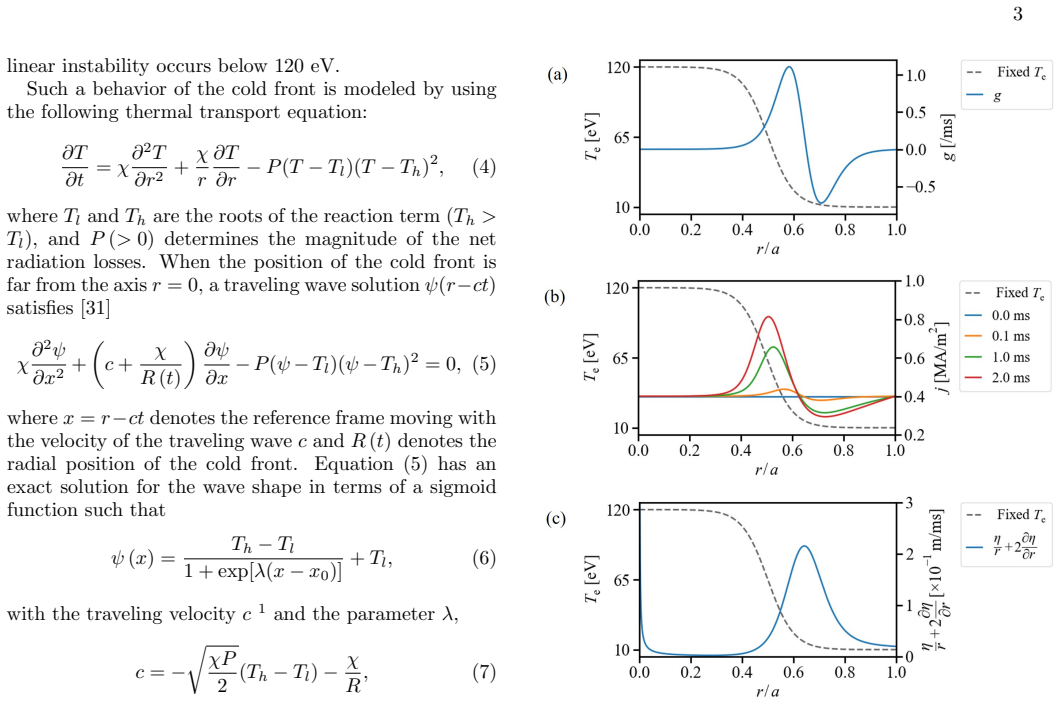
The reaction term of the current diffusion equation, which depends on the first and second radial derivatives of the electrical resistivity profile, produces a strong disturbance in the current density profile in a narrow layer of the cold front. While the current density locally increases in the region where the electron temperature gradient is steep, it decreases behind the cold front in the region where the electron temperature profile exhibits a pronounced concave-down curvature. The electrothermal dynamics driven by such a shape of the current density perturbation and the competition between Ohmic heating and impurity radiation are simulated by the tokamak transport code INDEX.
What carries the argument
The reaction term of the current diffusion equation that depends on the first and second radial derivatives of the electrical resistivity profile.
If this is right
- Current density rises locally where the electron temperature gradient is steep at the cold front.
- Current density falls behind the cold front where the temperature profile has strong concave-down curvature.
- The resulting current density shape drives electrothermal dynamics through Ohmic heating and impurity radiation competition.
- These narrow-layer disturbances arise specifically from the resistivity derivatives in the reaction term.
Where Pith is reading between the lines
- The same resistivity-derivative mechanism may appear in other cooling fronts where resistivity varies radially, such as in stellarator or reversed-field-pinch devices.
- If the predicted current perturbations hold, they could be used as a diagnostic signature to confirm the onset of radiative collapse before full disruption.
- Extending the model to time-varying impurity profiles might reveal how the disturbance layer width changes with different impurity species.
Load-bearing premise
The current diffusion equation can be cast as a reaction-diffusion system whose reaction term is fully fixed by the radial derivatives of the resistivity profile, and the simulation code captures the essential balance between Ohmic heating and impurity radiation at the cold front.
What would settle it
Direct measurement of the current density profile across a radiative cold front showing neither a local increase in steep temperature-gradient regions nor a decrease in concave-down curvature regions behind the front.
Figures



read the original abstract
Current density perturbations induced by radiative collapse, which is a possible mechanism governing tokamak plasma disruptions, have been investigated using a reaction-diffusion model. The reaction term of the current diffusion equation, which depends on the first and second radial derivatives of the electrical resistivity profile, produces a strong disturbance in the current density profile in a narrow layer of the cold front. While the current density locally increases in the region where the electron temperature gradient is steep, it decreases behind the cold front in the region where the electron temperature profile exhibits a pronounced concave-down curvature. The electrothermal dynamics driven by such a shape of the current density perturbation and the competition between Ohmic heating and impurity radiation are simulated by the tokamak transport code INDEX.
Editorial analysis
A structured set of objections, weighed in public.
Referee Report
Summary. The manuscript investigates current density perturbations induced by radiative collapse in impure tokamak plasmas via a reaction-diffusion formulation of the current diffusion equation. The reaction term, which depends on the first and second radial derivatives of the electrical resistivity profile, is claimed to generate a strong localized disturbance: current density increases where the electron temperature gradient is steep and decreases behind the cold front where the temperature profile shows pronounced concave-down curvature. The resulting electrothermal dynamics, including competition between Ohmic heating and impurity radiation, are simulated with the INDEX tokamak transport code.
Significance. If the central algebraic result and simulations hold, the work provides a direct mechanistic link between resistivity profile shape and current perturbations at cold fronts, which could help explain aspects of tokamak disruption dynamics. The approach benefits from a parameter-light rewriting of the diffusion equation that follows immediately from Spitzer resistivity scaling, offering a clear, falsifiable prediction for the sign of the perturbation. However, the absence of quantitative outputs, error bars, or comparisons limits immediate significance for the field.
major comments (1)
- Abstract and simulation description: the manuscript states the model outcome and INDEX code approach but supplies no quantitative validation, error estimates, comparison to experiment, or sensitivity tests on resistivity profiles or impurity levels. This is load-bearing for the central claim that the disturbance is produced by the reaction term rather than an artifact of the chosen setup.
minor comments (2)
- The abstract refers to 'the reaction term of the current diffusion equation' without an explicit equation or derivation step; adding the rewritten form (with the explicit dependence on dη/dr and d²η/dr²) in the main text would improve clarity.
- Notation for the cold-front layer and curvature regions could be standardized with a single figure or table summarizing the signs of the current-density perturbation.
Simulated Author's Rebuttal
We thank the referee for their constructive comments on our manuscript. We address the major comment below and have made revisions to strengthen the quantitative support for our claims while preserving the theoretical focus of the work.
read point-by-point responses
-
Referee: [—] Abstract and simulation description: the manuscript states the model outcome and INDEX code approach but supplies no quantitative validation, error estimates, comparison to experiment, or sensitivity tests on resistivity profiles or impurity levels. This is load-bearing for the central claim that the disturbance is produced by the reaction term rather than an artifact of the chosen setup.
Authors: The central claim rests on an analytical derivation: the current diffusion equation is rewritten using Spitzer resistivity scaling to isolate a reaction term proportional to the first and second radial derivatives of the resistivity profile. This term predicts a localized current density increase where the electron temperature gradient is steep and a decrease where the profile has concave-down curvature, independent of any specific numerical scheme. The INDEX simulations then demonstrate the resulting electrothermal dynamics under Ohmic heating versus impurity radiation. To address the referee's concern, we have revised the manuscript to include quantitative outputs (perturbation amplitudes normalized to the background current density), sensitivity tests across a range of impurity concentrations and temperature gradient steepnesses (showing consistent sign and localization of the disturbance), and numerical convergence checks to estimate discretization errors. Direct experimental comparisons lie outside the scope of this theoretical study, but we have added a discussion of observable signatures for future validation. These additions confirm the effect originates from the reaction term rather than setup artifacts. revision: partial
Circularity Check
No significant circularity; derivation is algebraic rewriting of standard diffusion equation
full rationale
The central claim follows from rewriting the magnetic diffusion equation into reaction-diffusion form, where the reaction term is algebraically proportional to the first and second radial derivatives of resistivity (and thus Te via Spitzer scaling). The signs of the current-density perturbations—increase where |dTe/dr| is steep, decrease where d²Te/dr² < 0—are direct consequences of that structure once the temperature dependence is inserted. No parameters are fitted to the target perturbation, no self-citation supplies a uniqueness theorem or ansatz, and the INDEX code is used only for numerical integration of the resulting system. The derivation chain is therefore self-contained against external benchmarks and does not reduce to its own inputs by construction.
Axiom & Free-Parameter Ledger
Reference graph
Works this paper leans on
-
[1]
The inward propagation of growing current perturba- tion causes a steep rise in the internal inductance
The same overall trends are also observed atρ= 0.6 andρ= 0.8 following the inward propagation of the cold front. The inward propagation of growing current perturba- tion causes a steep rise in the internal inductance. The dependence of thel i rise on the thermal diffusivity is thus of interest. Figure 10 shows the temporal evolution of (a) the internal in...
-
[2]
Lehnen, K
M. Lehnen, K. Aleynikova, P. B. Aleynikov, D. J. Camp- bell, P. Drewelow, N. W. Eidietis, Yu. Gasparyan, R. S. Granetz, Y. Gribov, N. Hartmann, E. M. Hollmann, V. A. Izzo, S. Jachmich, S. -H. Kim, M. Koˇ can, H. R. Koslowski, D. Kovalenko, U. Kruezi, A. Loarte, S. Maruyama, G. F. Matthews, P. B. Parks, G. Pautasso, R. A. Pitts, C. Reux, V. Riccardo, R. Ro...
2015
-
[3]
T. C. Hender, J. C. Wesley, J. Bialek, A. Bondeson, A. H. Boozer, R. J. Buttery, A. Garofalo, T. P. Goodman, R. S. Granetz, Y. Gribov, O. Gruber, M. Gryaznevich, G. Giruzzi, S. G¨ unter, N. Hayashi, P. Helander, C. C. Hegna, D. F. Howell, D. A. Humphreys, G. T. A. Huysmans, A. W. Hyatt, A. Isayama, S. C. Jardin, Y. Kawano, A. Kell- man, C. Kessel, H. R. K...
2007
-
[4]
Bakhtiari, G
M. Bakhtiari, G. Olynyk, R. Granetz, D. G. Whyte, M. L. Reinke, K. Zhurovich, and V. Izzo,Nucl. Fusion51, 063007 (2011)
2011
-
[5]
Commaux, D
N. Commaux, D. Shiraki, L. R. Baylor, E. M. Hollmann, N. W. Eidietis, C. J. Lasnier, R. A. Moyer, T. C. Jerni- gan, S. J. Meitner, S. K. Combs, and C. R. Foust,Nucl. Fusion56, 046007 (2016)
2016
-
[6]
Heinrich, G
P. Heinrich, G. Papp, S. Jachmich, J. Artola, M. Bernert, P. de Marn´ e, M. Dibon, R. Dux, T. Eberl, J. Hobirk, M. Lehnen, T. Peherstorfer, N. Schwarz, U. Sheikh, B. Sieglin, J. Svoboda, the ASDEX Upgrade Teama, and the EUROfusion Tokamak Exploitation Team,Nucl. Fusion 65, 056036 (2025)
2025
-
[7]
R. G. Kleva and J. F. Drake,Phys. Fluids B3, 372 (1991)
1991
-
[8]
D. Kh. Morozov, E. I. Yurchenko, V. E. Lukash, E. O. Baronova, Yu. I. Pozdnyakov, V. A. Rozhansky, I. Yu. Senichenkov, I. Yu. Veselova, and R. Schneider,Nucl. Fusion45, 882 (2005)
2005
-
[9]
V. A. Izzo, D. G. Whyte, R. S. Granetz, P. B. Parks, E. M. Hollmann, L. L. Lao, and J. C. Wesley,Phys. plasmas 15, 056109 (2008)
2008
-
[10]
R. B. White, D. A. Gates, D. P. Brennan,Phys. Plasmas 22, 022514 (2015)
2015
-
[11]
Q. Teng, N. Ferraro, D.A. Gates and R.B. White,Nucl. Fusion58, 106024 (2018)
2018
-
[12]
H. P. Furth, M. N. Rosenbluth, P. H. Rutherford, and W. Stodiek,Phys. Fluids13, 3020 (1970)
1970
-
[13]
D. D. Ryutov, M. S. Derzon, and M. K. Matzen,Rev. Mod. Phys72, 167 (2000)
2000
-
[14]
Fable, G
E. Fable, G. Pautasso, M. Lehnen, R. Dux, M. Bernert, A. Mlynek, and the ASDEX Upgrade Team,Nucl. Fusion 56, 026012 (2016)
2016
-
[15]
Linder, E
O. Linder, E. Fable, F. Jenko, G. Papp, G. Pautasso, the ASDEX Upgrade team, and the EUROfusion MST1 team,Nucl. Fusion60, 096031 (2020)
2020
-
[16]
Bodner, N
G. Bodner, N. Eidietis, Z. Chen, P. Heinrich, J. Herfindal, S. Jachmich, G. Papp, J. Kim, M. Lehnen, U. Sheikh, I. Coffey, O. Ficker, S. Gerasimov, V. Kachkanov, C. Reux, S. Silburn, H. Sun, the ASDEX Upgrade Team, JET Contributors, and the EUROfusion Tokamak Exploita- tion Team,Nucl. Fusion65, 066010 (2025)
2025
-
[17]
M. F. Turner and J. A. Wesson,Nucl. Fusion22, 1069 (1982)
1982
-
[18]
Matsuyama, D
A. Matsuyama, D. Hu, M. Lehnen, E. Nardon, and J. Artola,Plasma Phys. Control. Fusion64, 105018 (2022)
2022
-
[19]
Vallhagen, L
O. Vallhagen, L. Antonsson, P. Halldestam, G. Papp, P. Heinrich, A. Patel, M. Hoppe, L. Votta, the ASDEX Up- grade Team, and the EUROfusion Tokamak Exploitation Team,Plasma Phys. Control. Fusion67, 105034 (2025)
2025
-
[20]
Yokoyama, A
T. Yokoyama, A. Matsuyama, Y. Shibata, S. Inoue, S. Kojima, T. Wakatsuki, and M. Yoshida,APS-DPP, BP.11.122 (2023)
2023
-
[21]
Yokoyama, S
T. Yokoyama, S. Inoue, S. Kojima, T. Wakatsuki, H. Urano, R. Sano, Y. Ohtani, S. Sumida, T. Nakano, M. Takechi, T. Szepesi, M. Yoshida, and the JT-60SA Inte- grated Project Team,Nucl. Fusion64, 126031 (2024)
2024
-
[22]
Shibata, A
Y. Shibata, A. Isayama, S. Miyamoto, S. Kawakami, K. Y. Watanabe, G. Matsunaga, and Y. Kawano,Plasma Phys. Control. Fusion56, 045008 (2014)
2014
-
[23]
Aranson, B
I. Aranson, B. Meerson, and P. V. Sasorov,Phys. Rev. E 47, 4337 (1993)
1993
-
[24]
Volperta and S
V. Volperta and S. Petrovskiib,Phys. Life. Rev.6, 267 (2009)
2009
-
[25]
H. P. Summers, W. J. Dickson, M. G. O’Mullane, N. R. Badnell, A. D. Whiteford, D. H. Brooks, J. Lang, S. D. Loch, and D. C. Griffin,Plasma Phys. Control. Fusion 48, 263 (2006)
2006
-
[26]
E. N. Parker,Astrophys. J.117, 431 (1953)
1953
-
[27]
G. B. Field,Astrophys. J.142, 531 (1965)
1965
-
[28]
Ohayabu,Nucl
N. Ohayabu,Nucl. Fusion19, 1491 (1979)
1979
-
[29]
W. M. Stacey,Physics Plasmas4, 1069 (1997)
1997
-
[30]
Neuhauser, W
J. Neuhauser, W. Schneider, and R. Wunderlich,Nucl. Fusion26, 1679 (1986)
1986
-
[31]
J. F. Drake,Phys. Fluids30, 2429 (1987)
1987
-
[32]
T. P. Witelski, K. Ono, and T. J. Kaper,Nat. Resour. Model.13, 339 (2000)
2000
-
[33]
Putvinski, N
S. Putvinski, N. Fujisawa, D. Post, N. Putvinskaya, M.N. Rosenbluth, J. Wesley,J. Nucl. Mater241-243, 316 (1997)
1997
-
[34]
Feh´ er, H
T. Feh´ er, H. M. Smith, T. F¨ ul¨ op, and K. G´ al,Plasma Phys. Control. Fusion53, 035014 (2011). 12
2011
-
[35]
Pusztai,J
I. Pusztai,J. Plasma Phys.88, 905880409 (2022)
2022
-
[36]
Honda and A
M. Honda and A. Fukuyama,J. Comput. Phys.227, 2808 (2006)
2006
-
[37]
A. B. Rechester and M. N. Rosenbluth,Phys. Rev. Lett. 40, 38 (1978)
1978
-
[38]
D. J. Ward and S. C. Jardin,Nucl. Fusion29, 905 (1989)
1989
-
[39]
Nardon, K
E. Nardon, K. S¨ arkim¨ aki, F. J. Artola, S. Sadouni, and the JOREK team and JET Contributors,Nucl. Fusion 63, 056011 (2023)
2023
-
[40]
Hesslow, O
L. Hesslow, O. Embr´ eus, O. Vallhagen, and T. F¨ ul¨ op, Nucl. Fusion59, 084004 (2019)
2019
-
[41]
Nardon, D
E. Nardon, D. Hu, M. Hoelzl, D. Bonfiglio, and the JOREK team,Nucl. Fusion60, 126040 (2020)
2020
discussion (0)
Sign in with ORCID, Apple, or X to comment. Anyone can read and Pith papers without signing in.