Recognition: unknown
Topological antiqued mechanical toy
Pith reviewed 2026-05-07 07:59 UTC · model grok-4.3
The pith
Jacob's ladder toy produces topological kink waves that can annihilate in pairs due to gravity-induced bistability and symmetric string connections.
A machine-rendered reading of the paper's core claim, the machinery that carries it, and where it could break.
Core claim
The toy is bistable under gravity, which implies that its kink waves form a class of topological solitons. Although the waves appear similar to those in the Kane-Lubensky topological chain because gravity pretension stiffens zero modes, the index theorem shows that the floppiness permits kink and antikink coexistence, which is forbidden in that chain. The symmetric string connection renders the toy topologically singular, resulting in amusing motions, including the experimentally observed dramatic pair annihilation of kink and antikink waves.
What carries the argument
Gravity-induced bistability of the toy together with the index theorem analysis of its floppy zero modes in the symmetric string connection.
If this is right
- The flipping waves qualify as topological solitons due to the bistability under gravity.
- Kink and antikink waves can coexist because of the toy's floppiness, unlike in rigid topological chains.
- The symmetric string connections create a topological singularity that enables pair annihilation events.
- The design combines gravity pretension, zero-mode stiffening, and index theorem properties to produce the observed unidirectional motions.
Where Pith is reading between the lines
- Other string-connected mechanical systems under gravity might be engineered to support or suppress specific kink wave behaviors by adjusting symmetry.
- The principle could extend to soft robotic designs where floppy elements and gravity create controlled wave propagation without rigid topological constraints.
- Varying the connection asymmetry in generalized versions might allow tunable control over wave directionality or annihilation rates.
- The exclusion of domino mechanisms suggests testing similar toys in different environments to isolate topological contributions from other effects.
Load-bearing premise
The water-tank experiment fully excludes any domino-like mechanism and the analytical bistability proof captures the dominant physics without needing detailed string elasticity, friction, or 3D effects that might alter the topological classification.
What would settle it
Observing whether the flipping waves still occur when the toy is placed in free fall or microgravity, where gravity-induced bistability should vanish, would test the central claim.
Figures


read the original abstract
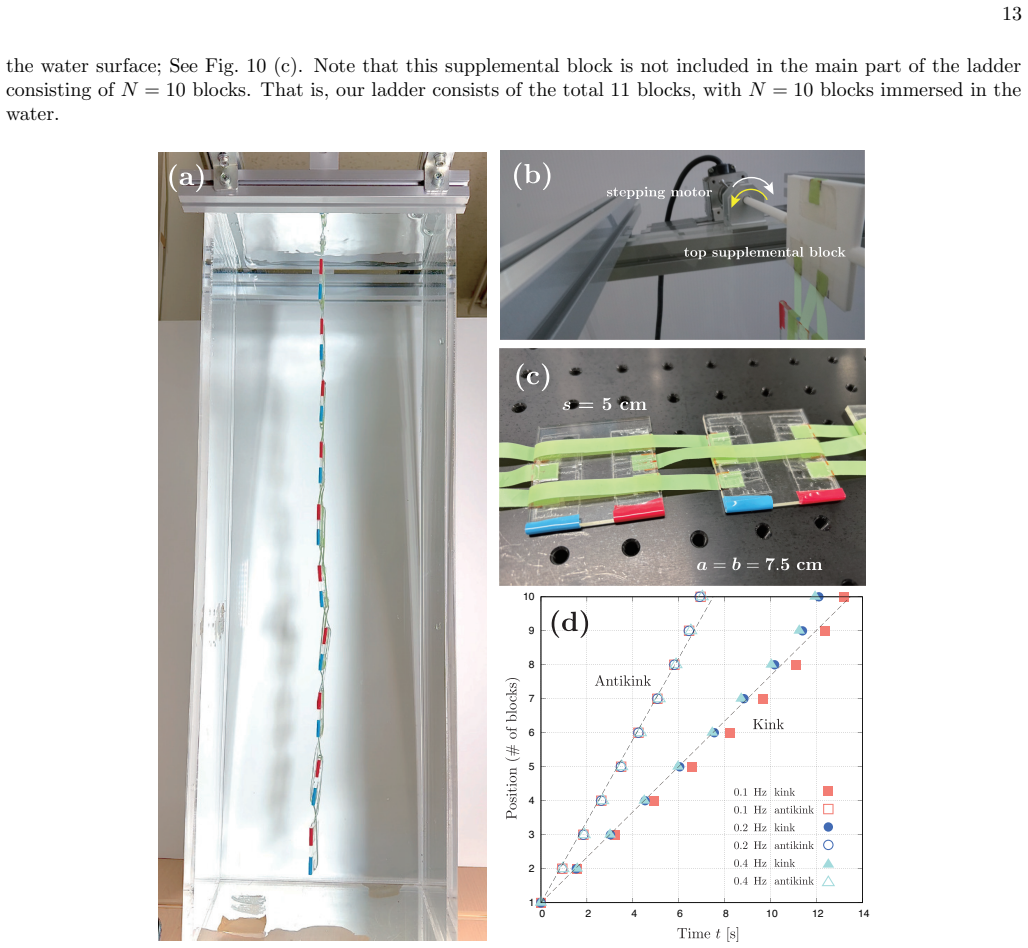
{\it Jacob's ladder} -- a classic children's toy -- is a simple mechanical frame comprising rigid blocks connected by strings that shows curious unidirectional flipping waves. Nonetheless, its physical origin remains elusive. By combining experiment, numeral simulation, and theory, we show that understanding the underlying design principle of this toy requires diverse physical ideas. First, we conduct a water-tank experiment that excludes the domino-like mechanism, thus defying widespread expectations. Subsequently, we analytically demonstrate that the toy is bistable under gravity, thus implying its kink wave as a class of topological solitons. The waves are surprisingly reminiscent -- both experimentally and theoretically -- to those in the Kane--Lubensky topological chain, owing to the stiffening of zero modes by the pretension under gravity. However, a close examination based on the index theorem reveals that the similarity remains superficial and that the floppiness of the toy underlies the kink and antikink coexistence -- a forbidden mode in the topological chain. By analyzing a generalized asymmetric toy, we reveal that its symmetric connection renders it topologically singular, thus resulting in amusing motions. We demonstrate these ideas by experimentally observing a dramatic pair annihilation of kink and antikink waves.
Editorial analysis
A structured set of objections, weighed in public.
Referee Report
Summary. The manuscript analyzes Jacob's ladder, a toy of rigid blocks linked by strings exhibiting unidirectional flipping waves. It uses a water-tank experiment to exclude domino-like mechanisms, provides an analytical proof of gravitational bistability implying kink waves as topological solitons, compares the system to the Kane-Lubensky topological chain via the index theorem to highlight the role of floppiness in permitting kink-antikink coexistence (forbidden in standard chains), analyzes a generalized asymmetric version to show that symmetric connections create topological singularity, and reports experimental observation of dramatic kink-antikink pair annihilation.
Significance. If the central claims hold, the work identifies a distinct class of topological solitons in floppy mechanical systems, distinct from Kane-Lubensky chains due to symmetry-induced singularity and floppiness. Strengths include the water-tank control experiment, the analytical bistability argument, application of the index theorem, and direct experimental demonstration of pair annihilation, which together bridge classical toys with topological mechanics and could inform metamaterial design.
major comments (3)
- [Analytical bistability argument] The analytical bistability proof (theory section deriving the gravitational potential) assumes rigid blocks and inextensible strings. This idealization is load-bearing for equating bistability with topological soliton protection, yet the manuscript provides no robustness check against string elasticity, friction, or 3D block compliance that could shift the potential landscape and alter the zero-mode stiffening or index.
- [Index theorem and generalized toy analysis] The index theorem application (section comparing to Kane-Lubensky and analyzing the generalized asymmetric toy) claims the symmetric connection renders the system topologically singular, allowing kink-antikink coexistence. However, the explicit index calculation or zero-mode count for the symmetric vs. asymmetric cases is not shown in sufficient detail to confirm the classification remains unchanged once realistic compliance is restored.
- [Water-tank experiment] The water-tank experiment (experimental section) excludes pure domino cascades but does not test whether the observed kink waves and pair annihilation persist when the rigid/inextensible idealization is relaxed (e.g., via elastic strings or varied block rigidity). This leaves open whether the annihilation is protected by the claimed topology or could arise from other mechanisms.
minor comments (3)
- [Abstract] Abstract: 'numeral simulation' should read 'numerical simulation'.
- [Generalized asymmetric toy section] The notation and diagrams for the generalized asymmetric toy could be clarified, e.g., by explicitly defining the asymmetry parameter and showing how it breaks the topological singularity.
- [References] Consider adding references to recent literature on mechanical solitons and floppy metamaterials to better situate the distinction from Kane-Lubensky chains.
Simulated Author's Rebuttal
We thank the referee for their careful reading of the manuscript and for the constructive comments, which help clarify the presentation of our results. We address each major comment below and indicate the revisions planned for the next version of the manuscript.
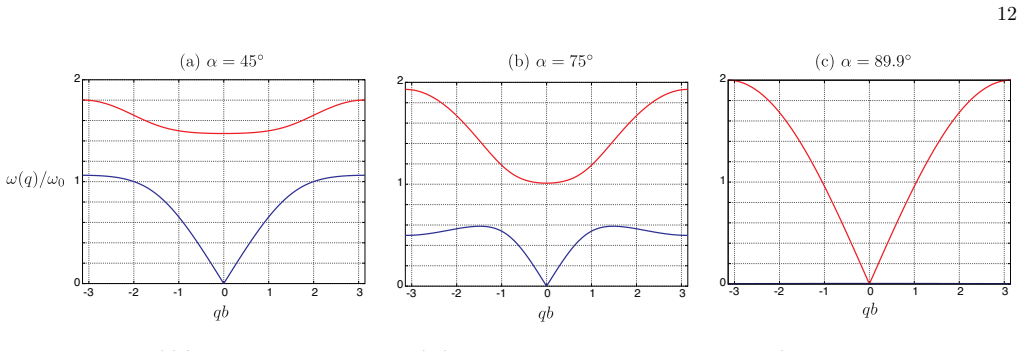
read point-by-point responses
-
Referee: [Analytical bistability argument] The analytical bistability proof (theory section deriving the gravitational potential) assumes rigid blocks and inextensible strings. This idealization is load-bearing for equating bistability with topological soliton protection, yet the manuscript provides no robustness check against string elasticity, friction, or 3D block compliance that could shift the potential landscape and alter the zero-mode stiffening or index.
Authors: We agree that the derivation of gravitational bistability relies on the idealization of rigid blocks and inextensible strings, which isolates the essential mechanism and permits an exact analytical treatment. This is a standard modeling choice for mechanical systems of this type. The numerical simulations in the manuscript already incorporate a discrete model that reproduces the experimental observations, including the stiffening of zero modes. In the revised manuscript we will add a dedicated paragraph in the theory section discussing the robustness of the bistability to small perturbations: we argue that modest string elasticity or block compliance preserves the double-well potential provided the strings remain taut under gravity, and we will cite supporting numerical checks with weakly elastic links that leave the topological features intact. revision: partial
-
Referee: [Index theorem and generalized toy analysis] The index theorem application (section comparing to Kane-Lubensky and analyzing the generalized asymmetric toy) claims the symmetric connection renders the system topologically singular, allowing kink-antikink coexistence. However, the explicit index calculation or zero-mode count for the symmetric vs. asymmetric cases is not shown in sufficient detail to confirm the classification remains unchanged once realistic compliance is restored.
Authors: The referee is correct that the manuscript presents the index-theorem argument at a conceptual level without displaying the explicit zero-mode counting for the symmetric and asymmetric cases. We will revise the relevant section to include the full calculation: for the symmetric toy the index evaluates to zero at the singular point, permitting kink-antikink pair creation and annihilation, while the asymmetric generalization yields a nonzero index that forbids such pairs. We will also add a short argument that the topological classification is stable against small compliance, because the underlying symmetry (or its breaking) is preserved under weak elastic deformations; the zero-mode count therefore remains unchanged to leading order. revision: yes
-
Referee: [Water-tank experiment] The water-tank experiment (experimental section) excludes pure domino cascades but does not test whether the observed kink waves and pair annihilation persist when the rigid/inextensible idealization is relaxed (e.g., via elastic strings or varied block rigidity). This leaves open whether the annihilation is protected by the claimed topology or could arise from other mechanisms.
Authors: The water-tank experiment was constructed to isolate the role of gravity by suppressing sequential falling, thereby ruling out a pure domino cascade. We acknowledge that the experiment uses the standard (nearly inextensible) toy and does not directly probe elastic strings or compliant blocks. The observed pair annihilation is, however, reproduced quantitatively by the ideal-model simulations whose topological origin is established analytically. In the revision we will expand the discussion of the experimental results to explain why non-topological mechanisms are unlikely to produce the dramatic, unidirectional annihilation seen in both experiment and simulation. A systematic experimental survey with deliberately elastic strings or compliant blocks lies outside the scope of the present study. revision: partial
- Additional experiments that deliberately relax the rigid/inextensible idealization (elastic strings, compliant blocks) to test persistence of kink waves and pair annihilation.
Circularity Check
No significant circularity; derivation relies on external index theorem, Kane-Lubensky comparison, and independent experiment
full rationale
The abstract and available text show an analytical bistability demonstration under gravity, water-tank experiment excluding domino mechanism, comparison to Kane-Lubensky chain via zero-mode stiffening, and application of the index theorem to distinguish floppiness effects and symmetric-connection singularity. No quoted equations reduce a prediction to a fitted input by construction, no self-citation is load-bearing for the central topological claim, and the index theorem is invoked as an external mathematical tool rather than an author-derived uniqueness result. The chain is therefore self-contained against external benchmarks.
Axiom & Free-Parameter Ledger
axioms (2)
- domain assumption Gravity induces bistability in the toy structure, stiffening zero modes via pretension in a manner analogous to the Kane-Lubensky chain.
- domain assumption The index theorem can be applied to reveal that the toy's floppiness permits kink-antikink coexistence forbidden in the reference topological chain.
Reference graph
Works this paper leans on
-
[1]
2 (c) and Ref
= 2 p 2k/m(s/a) sin(2α) [11] is larger forα= 50 ◦, while the energy barrier of the criss-cross configuration is lower for smallerα(see Fig. 2 (c) and Ref. [11]), the an- tikink does not propagate into the bulk, and the domain wall remains immobile, as shown in Fig. 3 (b2). The above numerical results suggest that kink and an- tikink coexist for largerα, p...
-
[2]
Pe- riodic Tangle
long-wavelength deformations after annihilation. (b)Spin wavepropagating down a dual ring chain constraint. ZM ini- tially localized at the top edge migrates helically toward the bottom. See also Supplemental Movies 10–12 [11]. is designed essentially floppy. However, because the toy functioned as intended in gravity, it became stiff owing to gravity-indu...
2025
-
[3]
Klein and A
F. Klein and A. Sommerfeld,The Theory of the Top. Volume II: Development of the Theory in the Case of the Heavy Symmetric Top(Birkh¨ auser, Boston, MA, 2010)
2010
-
[4]
Bondi, The rigid body dynamics of unidirectional spin, Proc
H. Bondi, The rigid body dynamics of unidirectional spin, Proc. R. Soc. Lond. A405, 265 (1986)
1986
-
[5]
Kondo and H
Y. Kondo and H. Nakanishi, Rattleback dynamics and its reversal time of rotation, Phys. Rev. E95, 062207 (2017)
2017
-
[6]
H. K. Moffatt, Euler’s disk and its finite-time singularity, Nature404, 833 (2000)
2000
-
[7]
Sekimoto, Y
K. Sekimoto, Y. M. Benane, K. E. Alloubia, R. Arteil, and A. Fruleux, A mechanism of macroscopic rigid-body behavior through evanescent mode, Euro. Phys. J. B94, 106 (2021)
2021
-
[8]
Edge, Solitons, Phys
R. Edge, Solitons, Phys. Teach.36, 483 (1998)
1998
-
[9]
Dickens, A Christmas Tree, inHousehold Words, Vol
C. Dickens, A Christmas Tree, inHousehold Words, Vol. II (Bradbury & Evans, 1850)
-
[10]
A. Immel, The Jacob’s Ladder Toy and Its Mys- terious History (2026),Cotsen Children ’s Li- brary (Princeton University), Available from https://cotsen.blogs.princeton.edu/2019/01/the-jacobs- ladder-toy-and-its-mysterious-history/, [Accessed March 21, 2026]
2026
-
[11]
Am.61, 227 (1889)
Jacob’s Ladder, Sci. Am.61, 227 (1889)
-
[12]
Ohta and S
N. Ohta and S. Kitao,Edo Nishiki(Yoneyama Doh, Tokyo, 1931)
1931
-
[13]
See Supplemental Material at ***** for further details of the experiments and extended theoretical analysis, which includes Ref
-
[14]
J. C. Maxwell, On the calculation of the equilibrium and stiffness of frames, Philos. Mag.27, 294 (1864)
-
[15]
C. R. Calladine, Buckminster Fuller’s ”Tensegrity” struc- tures and Clerk Maxwell’s rules for the construction of stiff frames, Int. J. Solid Struct.14, 161 (1978)
1978
-
[16]
W. J. Stronge, The domino effect: a wave of destabilizing collisions in a periodic array, Proc. R. Soc. Lond. A409, 199 (1987)
1987
-
[17]
The Japanese name of Jacob’s ladder,Kata kataorPata pata, was named after its unique sound
-
[18]
C. L. Kane and T. C. Lubensky, Topological boundary modes in isostatic lattices, Nat. Phys.10, 39 (2014)
2014
-
[19]
Lubensky, C
T. Lubensky, C. Kane, X. Mao, A. Souslov, and K. Sun, Phonons and elasticity in critically coordinated lattices, Rep. Prog. Phys.78, 073901 (2015)
2015
-
[20]
Pellegrino and C
S. Pellegrino and C. R. Calladine, Matrix analysis of stat- ically and kinematically indeterminate frameworks, Int. J. Solid Struct.22, 409 (1986)
1986
-
[21]
Pellegrino, Analysis of prestressed mechanisms, Int
S. Pellegrino, Analysis of prestressed mechanisms, Int. J. Solid Struct.26, 1329 (1990)
1990
-
[22]
Guest, The stiffness of prestressed frameworks: A uni- fying approach, Int
S. Guest, The stiffness of prestressed frameworks: A uni- fying approach, Int. J. Solid Struct.43, 842 (2006)
2006
-
[23]
B. G. ge Chen, N. Upadhyaya, and V. Vitelli, Nonlin- ear conduction via solitons in a topological mechanical insulator, Proc. Nat. Acad. Sci. USA111, 13004 (2014)
2014
-
[24]
However, from the symmetry (a= b), the two speeds must be equal, i.e.,c kink =c antikink
For this phenomenon to occur, the antikink must move faster than the kink. However, from the symmetry (a= b), the two speeds must be equal, i.e.,c kink =c antikink. We experimentally confirm thatc antikink/cikink >1 is not due to the kink-antikink interaction. We created a kink and antikink separately to findc antikink/ckink = 1.75. See the Supplemental M...
-
[25]
A. R. Klotz, C. J. Anderson, and M. S. Dimitriyev, Chi- rality effects in molecular chainmail, Soft Matter20, 7044 (2024)
2024
-
[26]
S. Ueno, T. Yoneda, and H. Wada, Topological waves in chainmail metasheets (2026), to be published
2026
-
[27]
B. Deng, J. R. Raney, K. Bertoldi, and V. Tournat, Nonlinear waves in flexible mechanical metamaterials, J. Appl. Phys.130, 040901 (2021)
2021
-
[28]
Yasuda, Y
H. Yasuda, Y. Miyazawa, E. G. Charalampidis, C. Chong, P. G. Kevrekidis, and J. Yang, Origami-based impact mitigation via rarefaction solitary wave creation, Sci. Adv.5, eaau2835 (2019)
2019
-
[29]
B. Deng, J. R. Raney, V. Tournat, and K. Bertoldi, Elas- tic Vector Solitons in Soft Architeched Materials, Phys. Rev. Lett.118, 204102 (2017)
2017
-
[30]
Nadkarni, A
N. Nadkarni, A. F. Arrieta, C. Chong, D. M. Kochmann, and C. Daraio, Unidirectional Transition Waves in Bistable Lattices, Phys. Rev. Lett.116, 244501 (2016)
2016
-
[31]
Veenstra, O
J. Veenstra, O. Gamayun, X. Guo, A. Sarvi, C. V. Mein- ersen, and C. Coulais, Non-reciprocal topological solitons in active metamaterials, Nature627, 528 (2024)
2024
-
[32]
A. C. Scott, A Nonlinear Klein-Gordon Equation, Am. J. Phys.37, 52 (1969)
1969
-
[33]
Toda,Theory of Nonlinear Lattices(Springer-Verlag, Heidelberg, 1989)
M. Toda,Theory of Nonlinear Lattices(Springer-Verlag, Heidelberg, 1989)
1989
-
[34]
G. P. Berman and F. M. Izrailev, The Fermi-Pasta- Ulam problem: Fifty-years of progress, Chaos15, 015104 (2005). 6
2005
-
[35]
Kawasaki and T
K. Kawasaki and T. Ohta, Kink Dynamics in One- dimensional Nonlinear Systems, Physica116A, 573 (1982)
1982
-
[36]
Sekimoto, Allosteric propagation of curvature along filament, EPL147, 60001 (2024)
K. Sekimoto, Allosteric propagation of curvature along filament, EPL147, 60001 (2024)
2024
-
[37]
R. E. Goldstein, A. Goriely, G. Huber, and C. W. Wolge- muth, Bistable Helices, Phys. Rev. Lett.84, 1631 (2000)
2000
-
[38]
J. W. Shaevitz, J. Y. Lee, and D. A. Fletcher,Spiro- plasmaSwim by a Processive Change in Body Helicity, Cell122, 941 (2005)
2005
-
[39]
Nakane, T
D. Nakane, T. Ito, and T. Nishizaka, Coexistence of Two Chiral Helices Produces Kink Translation inSpiroplasma Swimming, J. Bacteriol.202, e00735 (2020)
2020
-
[40]
Sasajima and M
Y. Sasajima and M. Miyata, Prospects for the Mechanism ofSpiroplasmaSwimming, Front. Microbiol.12, 706426 (2021)
2021
-
[41]
Kamada and M
M. Kamada and M. Yasuda,Let’s Make Antiqued Me- chanical Toys (in Japanese)(Kawade Shobo Shinsha, 1998). Supplemental Materials JACOB’S LADDER TOY The toy known as Jacob’s Ladder has numerous alternative names—Aaron’s Bell, Chinese Block, Click-Clack Toy, Magic Tablet, and Tumbling Block—and much about its origins and history remains unclear. According to...
1998
-
[42]
On the other hand, the translation of the blocks shows the acoustic mode characterized by ω−(q→0) = 0
Applying the standard eigenvalue analysis to this, we obtain the dispersion relations given by ω2 ±(q) = ω2 0 2 d11 +d 22 ± q (d11 −d 22)2 + 4d2 12 ,(42) where d11(q) = 1 + b2 a2 (1−cos(qb)),(43) d22(q) = 8s2 a2 sin2(2α) + 1 + b2 a2 cos2 α− 4s2 a2 sin2(2α) (1−cos(qb)),(44) d2 12(q) = 1− b2 a2 2 cos2 α(1−cos(qb)) 2 + 4b2s2 a4 sin2(2α) sin2(qb).(45) Specifi...
discussion (0)
Sign in with ORCID, Apple, or X to comment. Anyone can read and Pith papers without signing in.