Recognition: unknown
Thermal instability and rocky planetesimal formation in the inner regions of protoplanetary disks
Pith reviewed 2026-05-07 10:03 UTC · model grok-4.3
The pith
Thermal instability drives cyclic MRI activation and deactivation that lets dust accumulate into planetesimals near 1 au.
A machine-rendered reading of the paper's core claim, the machinery that carries it, and where it could break.
Core claim
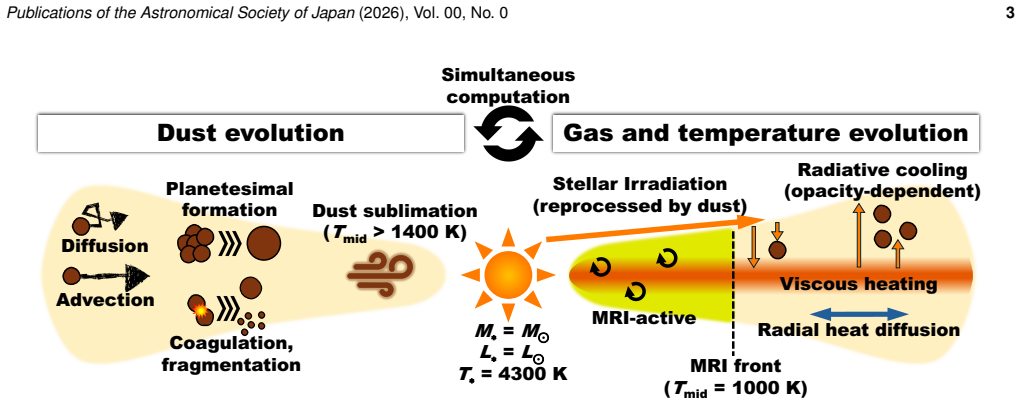
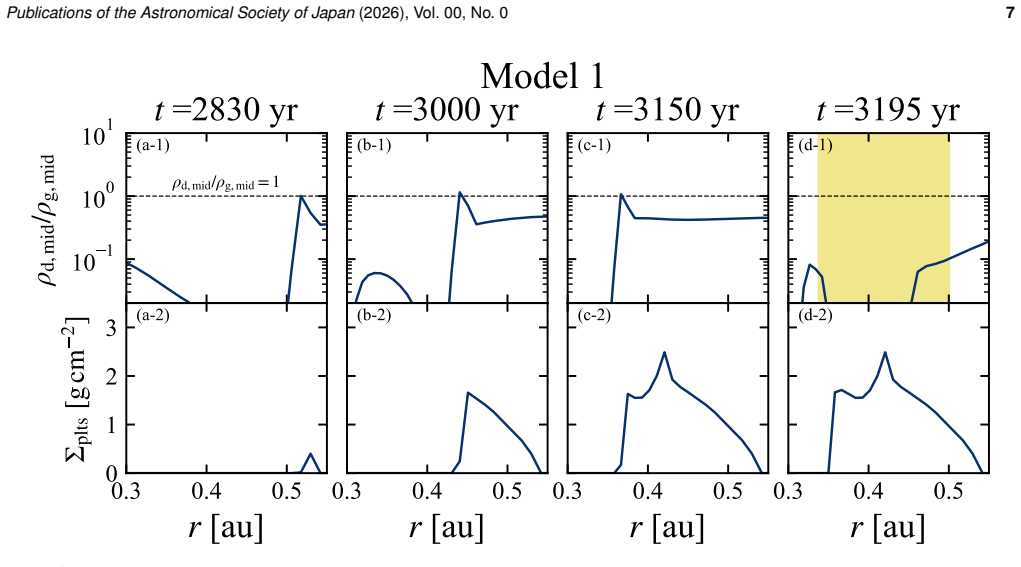
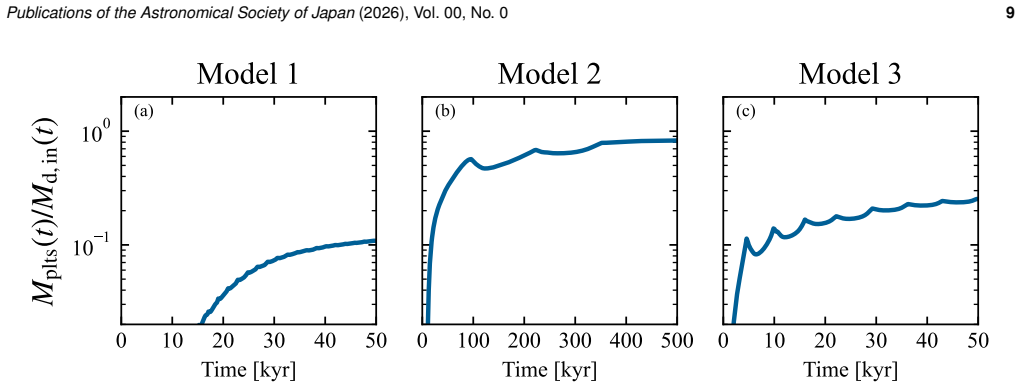
Thermal instability triggers cyclic MRI activation and deactivation, during which planetesimals are formed. The MRI is activated in the inner disk, and driven by thermal instability, the active region expands outward and then reverts to an inactive state. Triggered by a local enhancement in the dust surface density, dust undergoes self-accumulation while migrating inward in the MRI-inactive phase, causing planetesimal formation. Once the MRI is reactivated at a smaller radius, the cycle restarts. For a typical accretion rate of 10^{-8} M_sun yr^{-1}, a planetesimal belt forms near 1 au. This mechanism can produce sufficient planetesimal mass to form multiple super-Earths.
What carries the argument
Cyclic expansion and contraction of the MRI-active region driven by thermal instability, which periodically enables dust self-accumulation during inactive phases.
If this is right
- A planetesimal belt forms near 1 au for a typical accretion rate of 10^{-8} solar masses per year.
- The process yields enough total planetesimal mass to assemble multiple super-Earths.
- Planetesimal formation arises from the coevolution of dust surface density and disk temperature rather than a fixed pressure maximum.
- The resulting planetesimal distribution can serve directly as the starting condition for later-stage planet formation models.
Where Pith is reading between the lines
- The cyclic behavior may produce observable time-variable accretion or temperature signatures in young inner disks.
- Similar dust-trapping cycles could operate at other radii or in disks with different accretion rates.
- The framework suggests planetesimal formation in the inner disk is more robust and widespread than scenarios relying on a static MRI boundary.
- Incorporating additional processes such as radial drift variations or external heating could be tested by extending the same coupled dust-temperature simulation.
Load-bearing premise
Dust self-accumulation occurs effectively during the MRI-inactive phase without being disrupted by other processes, and the thermal instability model accurately represents the non-equilibrium evolution of the inner disk.
What would settle it
A simulation or observation in which dust fails to accumulate to planetesimal-forming densities during MRI-inactive intervals, or in which thermal instability does not produce repeated MRI activation cycles, would disprove the proposed mechanism.
Figures






read the original abstract
The inner regions of protoplanetary disks are promising formation sites of rocky planetesimals. Theoretical studies have proposed a scenario in which thermal ionization activates the magnetorotational instability (MRI) in the hot inner disk, and the resulting pressure maximum at the MRI activation boundary accumulates dust and promotes planetesimal formation. However, the inner disk may be thermally unstable, and the activation boundary can vary in time, potentially preventing the maintenance of a dust trap sustained by a steady pressure maximum. We propose an alternative scenario in which planetesimals form in a thermally unstable inner disk through dust self-accumulation driven by the coevolution of dust and disk temperature. To this end, we perform simulations that simultaneously calculate the non-equilibrium thermal evolution, the gas and dust surface density evolution, dust growth, and planetesimal formation. Our results show that thermal instability triggers cyclic MRI activation and deactivation, during which planetesimals are formed. The MRI is activated in the inner disk, and driven by thermal instability, the active region expands outward and then reverts to an inactive state. Triggered by a local enhancement in the dust surface density, dust undergoes self-accumulation while migrating inward in the MRI-inactive phase, causing planetesimal formation. Once the MRI is reactivated at a smaller radius, the cycle restarts. For a typical accretion rate of $10^{-8}M_{\odot}~{\rm yr^{-1}}$, a planetesimal belt forms near 1 au. This mechanism can produce sufficient planetesimal mass to form multiple super-Earths. This work provides a framework for a self-consistent model of planetesimal formation based on the coevolution of dust and disk temperature, serving as an initial condition for subsequent planet formation simulations.
Editorial analysis
A structured set of objections, weighed in public.
Referee Report
Summary. The manuscript proposes an alternative scenario for rocky planetesimal formation in the inner protoplanetary disk, where thermal instability drives cyclic MRI activation and deactivation. Simulations simultaneously evolve non-equilibrium thermal structure, gas and dust surface densities, dust growth, and planetesimal formation. The results indicate that during MRI-inactive phases, local dust enhancements trigger self-accumulation while dust migrates inward, leading to planetesimal formation; the cycle restarts upon reactivation at smaller radii. For a fiducial accretion rate of 10^{-8} M_⊙ yr^{-1}, a planetesimal belt forms near 1 au with sufficient mass to assemble multiple super-Earths.
Significance. If the central mechanism is robust, the work supplies a self-consistent, time-dependent framework for planetesimal formation that does not rely on a fixed pressure maximum at a steady MRI boundary. The coevolution of temperature and dust dynamics addresses a known limitation of earlier steady-state models and directly yields initial conditions for subsequent N-body or pebble-accretion calculations. The forward-simulation approach (no fitted parameters beyond the accretion rate) is a methodological strength.
major comments (2)
- [Results section on MRI-inactive phase and dust self-accumulation] The central claim that dust reaches the planetesimal-formation threshold via self-accumulation in the MRI-inactive phase (abstract and results describing the inactive-phase evolution) rests on the assumption of zero residual turbulence. No sensitivity experiments with even modest residual viscosity (e.g., α ≳ 10^{-5}) or radial diffusion are reported; such mixing would lengthen the accumulation timescale and could prevent the local dust-to-gas ratio from exceeding the threshold before MRI reactivation, directly undermining the cyclic formation mechanism.
- [Results and discussion of parameter dependence] The thermal-instability cycle and the radial location of the planetesimal belt are shown only for the single fiducial accretion rate 10^{-8} M_⊙ yr^{-1}. Because accretion rate is the sole free parameter controlling the thermal structure and the width of the active region, the reported planetesimal mass and its sufficiency for multiple super-Earths cannot be assessed for the plausible range of inner-disk accretion rates without additional runs.
minor comments (2)
- [Abstract and results summary] The abstract states that 'a planetesimal belt forms near 1 au' but does not quote the precise radial range or surface-density profile; these quantities should be stated explicitly and shown in a dedicated figure panel.
- [Methods and results] Notation for the MRI activation temperature threshold and the dust-to-gas ratio criterion for planetesimal formation should be defined once in the methods and used consistently; the current text introduces them only in the results narrative.
Simulated Author's Rebuttal
We thank the referee for the constructive and positive review of our manuscript. We address each major comment in detail below, explaining our position and the revisions we will implement.
read point-by-point responses
-
Referee: [Results section on MRI-inactive phase and dust self-accumulation] The central claim that dust reaches the planetesimal-formation threshold via self-accumulation in the MRI-inactive phase (abstract and results describing the inactive-phase evolution) rests on the assumption of zero residual turbulence. No sensitivity experiments with even modest residual viscosity (e.g., α ≳ 10^{-5}) or radial diffusion are reported; such mixing would lengthen the accumulation timescale and could prevent the local dust-to-gas ratio from exceeding the threshold before MRI reactivation, directly undermining the cyclic formation mechanism.
Authors: We agree that the assumption of zero residual turbulence is central to the reported self-accumulation and that the lack of sensitivity tests represents a limitation. Our model defines the MRI-inactive phase by the thermal ionization threshold, setting α = 0 to reflect the suppression of MRI. We will revise the manuscript by adding a new paragraph in the discussion section that explicitly addresses this point. There, we will estimate the effect of modest residual α (∼10^{-5}) on the accumulation timescale using the diffusion and drift equations already implemented in the code, showing that for values below ∼3×10^{-5} the dust-to-gas ratio can still exceed the planetesimal-formation threshold within the inactive-phase duration. We will also note the absence of full sensitivity runs as a caveat and recommend such explorations for future work. This is a partial revision. revision: partial
-
Referee: [Results and discussion of parameter dependence] The thermal-instability cycle and the radial location of the planetesimal belt are shown only for the single fiducial accretion rate 10^{-8} M_⊙ yr^{-1}. Because accretion rate is the sole free parameter controlling the thermal structure and the width of the active region, the reported planetesimal mass and its sufficiency for multiple super-Earths cannot be assessed for the plausible range of inner-disk accretion rates without additional runs.
Authors: The fiducial rate of 10^{-8} M_⊙ yr^{-1} was chosen because it is a standard value for the inner disk of T Tauri stars and produces a planetesimal belt near 1 au. We acknowledge that a broader parameter study would strengthen the claim of sufficiency for multiple super-Earths across the observed range of accretion rates. Performing additional full time-dependent simulations is beyond the scope of the present work, but we will revise the discussion section to include a qualitative scaling analysis: the location of the planetesimal belt scales with the radius at which the midplane temperature reaches the thermal-ionization threshold, which depends on accretion rate through the viscous heating term. We will show that for rates between 5×10^{-9} and 2×10^{-8} M_⊙ yr^{-1} the belt remains within 0.7–1.5 au and the integrated planetesimal mass stays above the minimum required for several super-Earths. This scaling is derived directly from the existing thermal-structure equations without new runs. We mark this as a partial revision. revision: partial
Circularity Check
No significant circularity; results emerge from forward simulations
full rationale
The paper's central claims rest on numerical simulations that simultaneously evolve non-equilibrium thermal structure, gas/dust surface densities, dust growth, and planetesimal formation. The cyclic MRI activation/deactivation and dust self-accumulation are emergent behaviors of the coupled physical equations rather than redefinitions of inputs, fitted parameters renamed as predictions, or load-bearing self-citations. No step reduces by construction to prior fitted values or author-specific uniqueness theorems; the derivation chain is self-contained and externally falsifiable via the simulation outputs.
Axiom & Free-Parameter Ledger
free parameters (1)
- accretion rate =
10^{-8} M_sun yr^{-1}
axioms (2)
- domain assumption Thermal ionization activates the MRI in hot inner disks
- domain assumption Dust growth and migration are governed by standard coagulation and drift equations
Reference graph
Works this paper leans on
-
[1]
1976, Progress of Theoretical Physics, 56, 1756
Adachi, I., Hayashi, C., & Nakazawa, K. 1976, Progress of Theoretical Physics, 56, 1756
1976
- [2]
-
[3]
2015, A&A, 577, A42
Baraffe, I., Homeier, D., Allard, F., & Chabrier, G. 2015, A&A, 577, A42
2015
-
[4]
2023, Nature Astronomy, 7, 330
Batygin, K., & Morbidelli, A. 2023, Nature Astronomy, 7, 330
2023
-
[5]
P., & Brauer, F
Birnstiel, T., Dullemond, C. P., & Brauer, F. 2009, A&A, 503, L5 —. 2010, A&A, 513, A79
2009
-
[6]
Brauer, F., Henning, T., & Dullemond, C. P. 2008, A&A, 487, L1
2008
-
[7]
2006, MNRAS, 373, 1633
Carballido, A., Fromang, S., & Papaloizou, J. 2006, MNRAS, 373, 1633
2006
-
[8]
2024, A&A, 692, A171
Cecil, M., & Flock, M. 2024, A&A, 692, A171
2024
-
[9]
G., et al
Cecil, M., Flock, M., Malygin, M. G., et al. 2026, A&A, 707, A296
2026
-
[10]
2020, ApJ, 891, 132
Chen, K., & Lin, M.-K. 2020, ApJ, 891, 132
2020
-
[11]
I., & Goldreich, P
Chiang, E. I., & Goldreich, P. 1997, The Astrophysical Journal, 490, 368
1997
-
[12]
I., Joung, M
Chiang, E. I., Joung, M. K., Creech-Eakman, M. J., et al. 2001, ApJ, 547, 1077
2001
-
[13]
J., & Turner, N
Desch, S. J., & Turner, N. J. 2015, ApJ, 811, 156
2015
-
[14]
D., & Charbonneau, D
Dressing, C. D., & Charbonneau, D. 2015, ApJ, 807, 45 Dr ˛ a˙zkowska, J., Alibert, Y ., & Moore, B. 2016, A&A, 594, A105 Dr ˛ a˙zkowska, J., Windmark, F., & Dullemond, C. P. 2013, A&A, 556, A37
2015
-
[15]
1995, ICARUS, 114, 237
Dubrulle, B., Morfill, G., & Sterzik, M. 1995, ICARUS, 114, 237
1995
-
[16]
P., Dominik, C., & Natta, A
Dullemond, C. P., Dominik, C., & Natta, A. 2001, ApJ, 560, 957
2001
-
[17]
P., Birnstiel, T., Huang, J., et al
Dullemond, C. P., Birnstiel, T., Huang, J., et al. 2018, ApJL, 869, L46
2018
-
[18]
J., Klahr, H., & Henning, T
Dzyurkevich, N., Flock, M., Turner, N. J., Klahr, H., & Henning, T. 2010, A&A, 515, A70
2010
-
[19]
S., & Gail, H.-P
Ferrarotti, A. S., & Gail, H.-P. 2001, A&A, 371, 133
2001
-
[20]
Fleming, T., & Stone, J. M. 2003, ApJ, 585, 908
2003
-
[21]
J., & Benisty, M
Flock, M., Fromang, S., Turner, N. J., & Benisty, M. 2016, ApJ, 827, 144 —. 2017, ApJ, 835, 230
2016
-
[22]
1999, A&A, 347, 594
Gail, H.-P., & Sedlmayr, E. 1999, A&A, 347, 594
1999
-
[23]
2013, A&A, 555, A119
Gail, H.-P., Wetzel, S., Pucci, A., & Tamanai, A. 2013, A&A, 555, A119
2013
-
[24]
Gammie, C. F. 1996, ApJ, 462, 725
1996
-
[25]
Goldreich, P., & Ward, W. R. 1973, ApJ, 183, 1051
1973
-
[26]
P., Kreuzig, C., et al
Gundlach, B., Schmidt, K. P., Kreuzig, C., et al. 2018, MNRAS, 479, 1273
2018
-
[27]
Hansen, B. M. S. 2009, ApJ, 703, 1131
2009
-
[28]
2016, A&A, 591, A72
Ida, S., Guillot, T., & Morbidelli, A. 2016, A&A, 591, A72
2016
-
[29]
N., et al
Izidoro, A., Dasgupta, R., Raymond, S. N., et al. 2022, Nature Astronomy, 6, 357
2022
-
[30]
2022, A&A, 662, A19
Johansen, A., & Dorn, C. 2022, A&A, 662, A19
2022
-
[31]
2007, ApJ, 662, 627
Johansen, A., & Youdin, A. 2007, ApJ, 662, 627
2007
-
[32]
D., Ueda, T., Muto, T., & Okuzumi, S
Kanagawa, K. D., Ueda, T., Muto, T., & Okuzumi, S. 2017, ApJ, 844, 142
2017
-
[33]
2025, PASJ, 77, 718
Kato, R., Ueda, T., & Okuzumi, S. 2025, PASJ, 77, 718
2025
-
[34]
A., Lin, D
Kretke, K. A., Lin, D. N. C., Garaud, P., & Turner, N. J. 2009, ApJ, 690, 407
2009
-
[35]
1970, Progress of Theoretical Physics, 44, 1580
Kusaka, T., Nakano, T., & Hayashi, C. 1970, Progress of Theoretical Physics, 44, 1580
1970
-
[36]
Li, R., & Youdin, A. N. 2021, ApJ, 919, 107
2021
-
[37]
B., Li, R., et al
Lim, J., Simon, J. B., Li, R., et al. 2025, ApJ, 981, 160
2025
-
[38]
Lynden-Bell, D., & Pringle, J. E. 1974, MNRAS, 168, 603
1974
-
[39]
2023, A&A, 673, A17
Mah, J., & Bitsch, B. 2023, A&A, 673, A17
2023
-
[40]
F., Ansdell, M., Rosotti, G
Manara, C. F., Ansdell, M., Rosotti, G. P., et al. 2023, in Astronomical Society of the Pacific Conference Series, V ol. 534, Protostars and Planets VII, ed. S. Inutsuka, Y . Aikawa, T. Muto, K. Tomida, & M. Tamura, 539
2023
-
[41]
W., Isaacson, H., Howard, A
Marcy, G. W., Isaacson, H., Howard, A. W., et al. 2014, ApJS, 210, 20
2014
-
[42]
2025, A&A, 695, A158
Matthijsse, J., Aly, H., & Paardekooper, S.-J. 2025, A&A, 695, A158
2025
-
[43]
2019, ApJ, 873, 58
Musiolik, G., & Wurm, G. 2019, ApJ, 873, 58
2019
-
[44]
2022, ApJ, 936, 188
Notsu, S., Ohno, K., Ueda, T., et al. 2022, ApJ, 936, 188
2022
-
[45]
2021, A&A, 651, L2
Ohno, K., & Ueda, T. 2021, A&A, 651, L2
2021
-
[46]
2011, ApJ, 738, 141
Oka, A., Nakamoto, T., & Ida, S. 2011, ApJ, 738, 141
2011
-
[47]
2011, ApJ, 742, 65 —
Okuzumi, S., & Hirose, S. 2011, ApJ, 742, 65 —. 2012, ApJL, 753, L8
2011
-
[48]
2019, ApJ, 878, 132
Okuzumi, S., & Tazaki, R. 2019, ApJ, 878, 132
2019
-
[49]
Okuzumi, S., Ueda, T., & Turner, N. J. 2022, PASJ, 74, 828
2022
-
[50]
W., & Cuzzi, J
Ormel, C. W., & Cuzzi, J. N. 2007, A&A, 466, 413
2007
-
[51]
2012, A&A, 545, A81
Pinilla, P., Benisty, M., & Birnstiel, T. 2012, A&A, 545, A81
2012
-
[52]
J., et al
Santerne, A., Brugger, B., Armstrong, D. J., et al. 2018, Nature Astronomy, 2, 393
2018
-
[53]
2016, A&A, 589, A15
Sato, T., Okuzumi, S., & Ida, S. 2016, A&A, 589, A15
2016
-
[54]
1998, ICARUS, 133, 298
Sekiya, M. 1998, ICARUS, 133, 298
1998
-
[55]
I., & Sunyaev, R
Shakura, N. I., & Sunyaev, R. A. 1973, A&A, 24, 337
1973
-
[56]
2025, ApJL, 979, L23
Shibata, S., & Izidoro, A. 2025, ApJL, 979, L23
2025
-
[57]
B., Armitage, P
Simon, J. B., Armitage, P. J., Li, R., & Youdin, A. N. 2016, ApJ, 822, 55
2016
-
[58]
C., et al
Tajer, H., Wang, J., Childs, A. C., et al. 2026, ApJ, 998, 46
2026
-
[59]
2019, ApJ, 871, 10
Ueda, T., Flock, M., & Okuzumi, S. 2019, ApJ, 871, 10
2019
-
[60]
Watanabe, S.-i., & Lin, D. N. C. 2008, ApJ, 672, 1183
2008
-
[61]
1990, ApJ, 358, 282
Watanabe, S.-I., Nakagawa, Y ., & Nakazawa, K. 1990, ApJ, 358, 282
1990
-
[62]
Weidenschilling, S. J. 1977, MNRAS, 180, 57
1977
-
[63]
M., & Marcy, G
Weiss, L. M., & Marcy, G. W. 2014, ApJL, 783, L6
2014
-
[64]
Whipple, F. L. 1972, in From Plasma to Planet, ed. A. Elvius, 211
1972
-
[65]
2021, ApJ, 923, 123
Wu, Y ., & Lithwick, Y . 2021, ApJ, 923, 123
2021
-
[66]
1977, Progress of Theoretical Physics, 58, 816
Yamamoto, T., & Hasegawa, H. 1977, Progress of Theoretical Physics, 58, 816
1977
-
[67]
N., & Goodman, J
Youdin, A. N., & Goodman, J. 2005, ApJ, 620, 459
2005
-
[68]
N., & Lithwick, Y
Youdin, A. N., & Lithwick, Y . 2007, ICARUS, 192, 588
2007
-
[69]
N., & Shu, F
Youdin, A. N., & Shu, F. H. 2002, ApJ, 580, 494
2002
-
[70]
Ziampras, A., Birnstiel, T., Kaufmann, N., Cecil, M., & Pfeil, T. 2026, arXiv e-prints, arXiv:2602.20283
work page internal anchor Pith review Pith/arXiv arXiv 2026
discussion (0)
Sign in with ORCID, Apple, or X to comment. Anyone can read and Pith papers without signing in.