Recognition: unknown
Hyperfine-resolved laser excitation and detection of nuclear isomer in trapped ²²⁹Th³⁺ ions
Pith reviewed 2026-05-07 05:43 UTC · model grok-4.3
The pith
Laser excitation schemes allow efficient detection of the nuclear isomer in trapped thorium-3+ ions.
A machine-rendered reading of the paper's core claim, the machinery that carries it, and where it could break.
Core claim
A quantum master equation analysis reveals that proper alignment of laser linewidth, detuning, and irradiation time enables efficient population of the nuclear isomeric state in Th-229 3+ ions. Detection schemes using hyperfine-resolved electronic fluorescence channels at 690 nm, 984 nm, and 1088 nm produce measurable photon rates of order 10^4 s^{-1} for the first two wavelengths and 10^5 s^{-1} for 1088 nm. Trade-offs between irradiation time and frequency scan steps indicate that the nuclear transition can be located within one month for a 100 MHz uncertainty range with available VUV laser technology.
What carries the argument
Quantum master equation for hyperfine-resolved laser excitation and fluorescence detection of the nuclear isomer in trapped Th^{3+} ions.
If this is right
- The 1088-nm detection scheme achieves higher photon rates of about 10^5 s^{-1} per ion compared to 10^4 s^{-1} for 690-nm and 984-nm schemes.
- Matching laser linewidth, detuning, and irradiation time is essential for efficient isomeric state population.
- The nuclear transition can be located within one month using a 100-MHz scan uncertainty with current VUV lasers.
- These results provide practical guidance for trapped-ion Th-229 spectroscopy and nuclear clock development.
Where Pith is reading between the lines
- Successful detection would enable precision measurements of the isomer energy for nuclear clock applications.
- The modeled rates suggest single-ion detection is feasible, potentially scalable to few-ion clocks.
- Future work could test the schemes in actual ion traps to validate the assumed parameters.
- Similar modeling approaches might apply to other nuclear isomers in trapped ions.
Load-bearing premise
The model relies on accurate prior values for decoherence rates, hyperfine splittings, and transition matrix elements, assuming no significant unmodeled effects such as stray fields in the trap.
What would settle it
Observing photon rates below 10^4 per second per ion or requiring more than one month to locate the transition under the described laser conditions would indicate the schemes are less practical than modeled.
Figures



read the original abstract
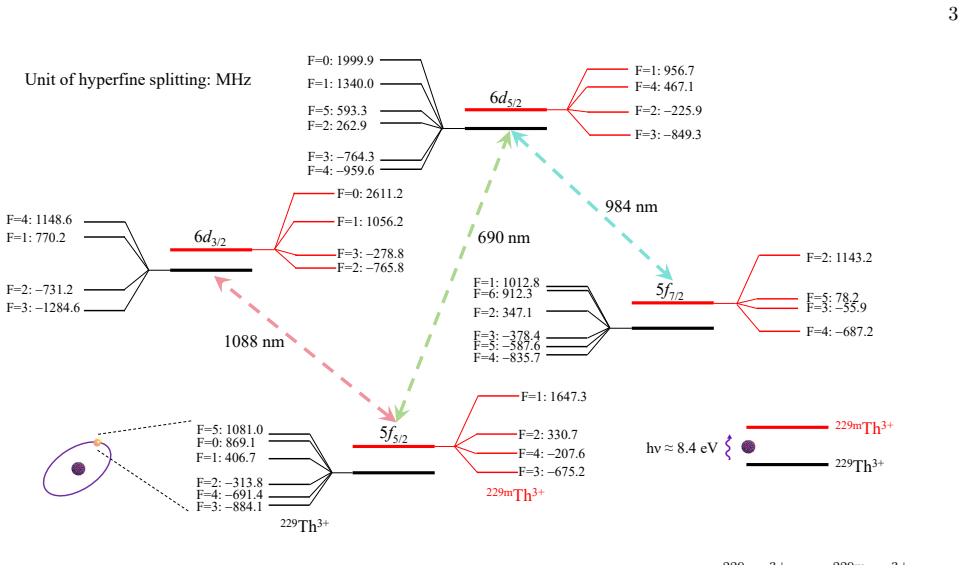
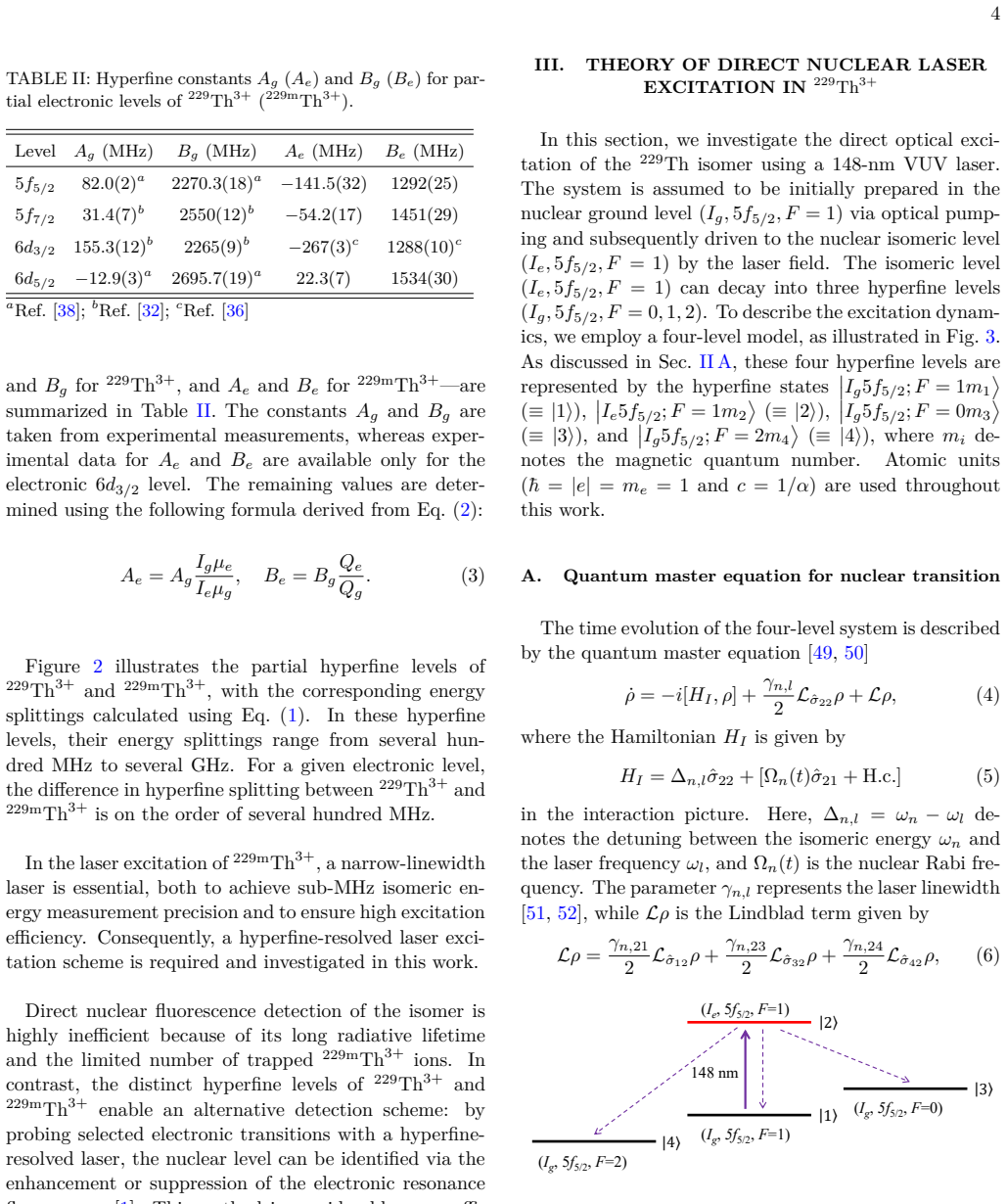
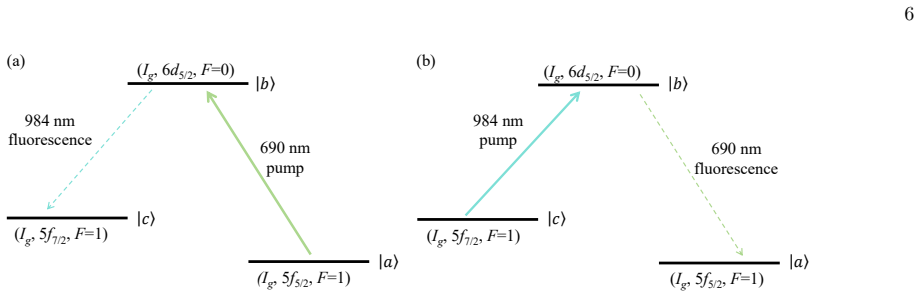
We present a comprehensive theoretical investigation of hyperfine-resolved excitation and detection of the low-energy isomeric state of $^{229}$Th in trapped $^{229}\mathrm{Th}^{3+}$ ions. Using a quantum master equation approach, we analyze the dependence of the isomeric population on laser linewidth, detuning, and irradiation time, showing that their proper matching is essential for efficient excitation. We further propose two nuclear-state detection schemes based on three hyperfine-resolved electronic fluorescence channels at 690, 984, and 1088 nm. Our analysis shows that the 690-nm and 984-nm scheme yields detectable photon rates on the order of $10^4~\mathrm{s}^{-1}$ per ion for each wavelength, whereas the 1088-nm scheme achieves a higher rate on the order of $10^5~\mathrm{s}^{-1}$ per ion. By quantifying the trade-off between irradiation time and scan-step size, we show that the nuclear transition can be located within one month for a 100-MHz uncertainty using currently available vacuum-ultraviolet laser technology. These results provide practical guidance for trapped-ion $^{229}\mathrm{Th}$ spectroscopy and the development of nuclear clocks.
Editorial analysis
A structured set of objections, weighed in public.
Referee Report
Summary. The manuscript presents a theoretical investigation of hyperfine-resolved laser excitation and detection of the nuclear isomer in trapped ^{229}Th^{3+} ions. Using a quantum master equation, the authors analyze the dependence of isomeric population on laser linewidth, detuning, and irradiation time, and propose two detection schemes based on electronic fluorescence channels at 690 nm, 984 nm, and 1088 nm. They report photon rates of order 10^4 s^{-1} per ion for the 690/984 nm scheme and 10^5 s^{-1} per ion for the 1088 nm scheme, and conclude that the nuclear transition can be located within one month for a 100 MHz uncertainty using current VUV laser technology.
Significance. If the modeling assumptions hold, this work supplies practical quantitative guidance for experimental searches of the ^{229}Th nuclear clock transition in trapped ions, addressing key challenges in excitation efficiency and fluorescence detection. The application of the standard quantum master equation framework to hyperfine structure is appropriate and the trade-off analysis between irradiation time and scan-step size is a useful contribution for planning experiments.
major comments (2)
- [Quantum master equation analysis and results on photon rates] The quantum master equation model (described in the methods and results sections) takes hyperfine splittings, transition matrix elements, and decoherence rates directly from prior literature without any sensitivity analysis, error propagation, or comparison to alternative models. Because the claimed steady-state populations and fluorescence rates (10^4–10^5 photons s^{-1} per ion) and the one-month search timeline are computed from these inputs, even moderate deviations (e.g., factor of two) would change the excitation efficiency and required scan duration.
- [Detection schemes and search-time estimation] The population-dynamics and search-time calculations omit known experimental effects in surface-electrode traps, including stray electric-field gradients, micromotion-induced broadening, and higher-order magnetic interactions. These terms would alter the effective decoherence rates and reduce the fluorescence yields, directly impacting the feasibility claim that the nuclear transition can be located within one month for a 100 MHz window.
minor comments (2)
- [Abstract] The abstract refers to 'two nuclear-state detection schemes based on three hyperfine-resolved electronic fluorescence channels'; explicitly stating which wavelengths belong to each scheme would improve immediate clarity.
- [Throughout the manuscript] Notation for laser linewidth, detuning, and irradiation time should be defined consistently at first use and cross-referenced to the master-equation equations.
Simulated Author's Rebuttal
We thank the referee for their careful reading of our manuscript and for providing constructive comments that help improve its clarity and robustness. We address the major comments point by point below and have made revisions to the manuscript accordingly.
read point-by-point responses
-
Referee: The quantum master equation model (described in the methods and results sections) takes hyperfine splittings, transition matrix elements, and decoherence rates directly from prior literature without any sensitivity analysis, error propagation, or comparison to alternative models. Because the claimed steady-state populations and fluorescence rates (10^4–10^5 photons s^{-1} per ion) and the one-month search timeline are computed from these inputs, even moderate deviations (e.g., factor of two) would change the excitation efficiency and required scan duration.
Authors: We agree with the referee that a sensitivity analysis is valuable given the reliance on literature values. In the revised manuscript, we have included a new figure and accompanying text in the Results section showing the variation of isomeric population and photon rates when the input parameters are varied within their reported uncertainties (hyperfine splittings ±5 MHz, matrix elements ±15%, decoherence rates ×0.5-2). The results confirm that the photon rates stay within 5×10^3 to 2×10^5 s^{-1}, preserving the order-of-magnitude estimates and the one-month search feasibility for the 100 MHz window. We also added a short comparison to a three-level rate equation model to validate the master equation approach. A complete Monte Carlo error propagation is not feasible without more precise experimental error bars from the source references, which we now cite explicitly. revision: partial
-
Referee: The population-dynamics and search-time calculations omit known experimental effects in surface-electrode traps, including stray electric-field gradients, micromotion-induced broadening, and higher-order magnetic interactions. These terms would alter the effective decoherence rates and reduce the fluorescence yields, directly impacting the feasibility claim that the nuclear transition can be located within one month for a 100 MHz window.
Authors: We thank the referee for pointing out these important experimental considerations. Our model is intentionally focused on the fundamental laser excitation and detection physics and assumes an ideal ion trap environment. In the revised Discussion, we have added estimates of the impact of stray electric-field gradients (typically causing ~10 kHz broadening in surface traps), micromotion (up to 100 kHz if not compensated), and higher-order Zeeman shifts. These would increase the effective decoherence, potentially reducing the peak photon rates by a factor of 1.5-3. Even in this conservative scenario, the 1088 nm scheme still yields ~3×10^4 photons s^{-1}, allowing the search to be completed in under two months. We emphasize that these effects can be minimized through trap design, and our work provides the baseline for such optimizations. A full integration of trap dynamics is outside the current scope but is noted as future work. revision: partial
Circularity Check
No significant circularity; results are independent model outputs from external literature inputs.
full rationale
The paper solves a quantum master equation to compute isomeric populations, photon rates (10^4–10^5 s^{-1} per ion), and search times (one month for 100 MHz window) using hyperfine splittings, transition matrix elements, and decoherence rates taken from prior literature. These are standard forward calculations with stated external inputs and no internal fitting of parameters to the paper's own data or outputs. No self-definitional loops, fitted-input-as-prediction, load-bearing self-citations, or ansatz smuggling are present. The derivation chain is self-contained against external benchmarks and does not reduce to its own inputs by construction.
Axiom & Free-Parameter Ledger
axioms (2)
- domain assumption The quantum master equation in the Lindblad form accurately captures the coherent and incoherent dynamics of the laser-driven Th3+ ion including hyperfine levels.
- domain assumption Hyperfine splittings and electronic transition rates for 229Th3+ are known to sufficient accuracy from prior spectroscopic data.
Reference graph
Works this paper leans on
-
[1]
Peik and C
E. Peik and C. Tamm, Europhys. Lett. 61, 181 (2003)
2003
-
[2]
W. G. Rellergert, D. DeMille, R. R. Greco, M. P. Hehlen, J. R. Torgerson, and E. R. Hudson, Phys. Rev. Lett. 104, 200802 (2010)
2010
-
[3]
C. J. Campbell, A. G. Radnaev, A. Kuzmich, V. A. Dzuba, V. V. Flambaum, and A. Derevianko, Phys. Rev. Lett. 108, 120802 (2012)
2012
-
[4]
G. A. Kazakov, A. N. Litvinov, V. I. Romanenko, L. P. Yatsenko, A. V. Romanenko, M. Schreitl, G. Winkler, and T. Schumm, New J. Phys. 14, 083019 (2012)
2012
-
[5]
V. V. Flambaum, Phys. Rev. Lett. 97, 092502 (2006)
2006
-
[6]
Hayes and J
A. Hayes and J. Friar, Phys. Lett. B 650, 229 (2007)
2007
-
[7]
He and Z
X. He and Z. Ren, Nucl. Phys. A 806, 117 (2008)
2008
-
[8]
Fadeev, J
P. Fadeev, J. C. Berengut, and V. V. Flambaum, Phys. Rev. A 102, 052833 (2020)
2020
-
[9]
E. Peik, T. Schumm, M. S. Safronova, A. Pálffy, J. Weit- enberg, and P. G. Thirolf, Quantum Sci. Technol. 6, 034002 (2021)
2021
-
[10]
W. Wang, S. Fritzsche, and Y. Li, Phys. Rev. A 112, 022811 (2025)
2025
-
[11]
Beeks et al ., Nat
K. Beeks et al ., Nat. Commun. 16, 9147 (2025)
2025
-
[12]
Y. Luo, X. Shao, Z. Wei, J. Zhao, and H. Han, Photonics 13, 141 (2026)
2026
-
[13]
Xu, H.-Y
Y.-L. Xu, H.-Y. Zheng, X.-C. Yu, Y.-H. Zhang, T.-Y. Shi, and L.-Y. Tang, Chinese Phys. B 35, 023101 (2026)
2026
-
[14]
W.-T. Gan, Z. Li, C. Wang, X. Hua, and X. Tong, Chi- nese Phys. B 35, 023703 (2026)
2026
-
[15]
P. G. Thirolf, S. Kraemer, D. Moritz, and K. Scharl, Eur. Phys. J. Spec. Top. 233, 1113 (2024)
2024
-
[16]
Tiedau et al ., Phys
J. Tiedau et al ., Phys. Rev. Lett. 132, 182501 (2024)
2024
-
[17]
Elwell, C
R. Elwell, C. Schneider, J. Jeet, J. E. S. Terhune, H. W. T. Morgan, A. N. Alexandrova, H. B. Tran Tan, A. Derevianko, and E. R. Hudson, Phys. Rev. Lett. 133, 013201 (2024)
2024
-
[18]
Zhang et al ., Nature 633, 63 (2024)
C. Zhang et al ., Nature 633, 63 (2024)
2024
-
[19]
Schaden et al ., Phys
F. Schaden et al ., Phys. Rev. Res. 7, L022036 (2025)
2025
-
[20]
J. E. S. Terhune, R. Elwell, H. B. T. Tan, U. C. Perera, H. W. T. Morgan, A. N. Alexandrova, A. Derevianko, and E. R. Hudson, Phys. Rev. Res. 7, L022062 (2025)
2025
-
[21]
Zhang et al ., Nature 636, 603 (2024)
C. Zhang et al ., Nature 636, 603 (2024)
2024
-
[22]
Elwell et al ., Nature 648, 300 (2025)
R. Elwell et al ., Nature 648, 300 (2025)
2025
-
[23]
U. I. Safronova, W. R. Johnson, and M. S. Safronova, Phys. Rev. A 74, 042511 (2006)
2006
-
[24]
S. G. Porsev and V. V. Flambaum, Phys. Rev. A 81, 032504 (2010)
2010
-
[25]
M. S. Safronova, U. I. Safronova, A. G. Radnaev, C. J. Campbell, and A. Kuzmich, Phys. Rev. A 88, 060501 (2013)
2013
-
[26]
Beloy, Phys
K. Beloy, Phys. Rev. Lett. 112, 062503 (2014)
2014
-
[27]
Li, H.-X
F.-C. Li, H.-X. Qiao, Y.-B. Tang, and T.-Y. Shi, Phys. Rev. A 104, 062808 (2021)
2021
-
[28]
Beloy, Phys
K. Beloy, Phys. Rev. Lett. 130, 103201 (2023)
2023
-
[29]
W. Wang, F. Zou, S. Fritzsche, and Y. Li, Phys. Rev. Lett. 133, 223001 (2024)
2024
-
[30]
Zhou and X
J. Zhou and X. Wang, Phys. Rev. Lett. 136, 092503 (2026)
2026
-
[31]
C. J. Campbell, A. V. Steele, L. R. Churchill, M. V. De- Palatis, D. E. Naylor, D. N. Matsukevich, A. Kuzmich, and M. S. Chapman, Phys. Rev. Lett. 102, 233004 (2009)
2009
-
[32]
C. J. Campbell, A. G. Radnaev, and A. Kuzmich, Phys. Rev. Lett. 106, 223001 (2011)
2011
-
[33]
Thielking, M
J. Thielking, M. V. Okhapkin, P. Głowacki, D. M. Meier, L. von der Wense, B. Seiferle, C. E. Düllmann, P. G. Thirolf, and E. Peik, Nature 556, 321 (2018)
2018
-
[34]
Scharl et al ., Atoms 11, 108 (2023)
K. Scharl et al ., Atoms 11, 108 (2023) . 12
2023
-
[35]
Zitzer, J
G. Zitzer, J. Tiedau, M. V. Okhapkin, K. Zhang, C. Mokry, J. Runke, C. E. Düllmann, and E. Peik, Phys. Rev. A 109, 033116 (2024)
2024
-
[36]
Yamaguchi, Y
A. Yamaguchi, Y. Shigekawa, H. Haba, H. Kikunaga, K. Shirasaki, M. Wada, and H. Katori, Nature 629, 62 (2024)
2024
-
[37]
Moritz et al ., Eur
D. Moritz et al ., Eur. Phys. J. D 79, 127 (2025)
2025
-
[38]
Zitzer, J
G. Zitzer, J. Tiedau, C. E. Düllmann, M. V. Okhapkin, and E. Peik, Phys. Rev. A 111, L050802 (2025)
2025
-
[39]
Li, W.-T
Z. Li, W.-T. Gan, C. Wang, L. Li, X. Hua, and X. Tong, J. Appl. Phys. 138, 224901 (2025)
2025
-
[40]
V. A. Dzuba and V. V. Flambaum, Phys. Rev. Lett. 131, 263002 (2023)
2023
-
[41]
U. C. Perera, H. W. T. Morgan, E. R. Hudson, and A. Derevianko, Phys. Rev. Lett. 135, 123001 (2025)
2025
-
[42]
R. Si, C. Shi, N. Xue, X. Kong, C. Chen, B. Tu, and Y.-G. Ma, Sci. China Phys. Mech. Astron. 68, 272011 (2025)
2025
-
[43]
Xiao et al ., Nature 650, 852 (2026)
Q. Xiao et al ., Nature 650, 852 (2026)
2026
-
[44]
V. Lal, M. V. Okhapkin, J. Tiedau, N. Irwin, V. Petrov, and E. Peik, Optica 12, 1971 (2025)
1971
-
[45]
W. Wang, Y. Li, and X. Wang, Atoms 13, 2 (2025)
2025
-
[46]
Fritzsche, Comput
S. Fritzsche, Comput. Phys. Commun. 183, 1525 (2012)
2012
-
[47]
R. A. Müller et al ., Phys. Rev. A 98, 020503 (2018)
2018
-
[48]
Wang and X
W. Wang and X. Wang, Phys. Rev. Res. 5, 043232 (2023)
2023
-
[49]
A. A. Budini, Phys. Rev. A 63, 012106 (2000)
2000
-
[50]
Kiely, Europhys
A. Kiely, Europhys. Lett. 134, 10001 (2021)
2021
-
[51]
von der Wense, P
L. von der Wense, P. V. Bilous, B. Seiferle, S. Stellmer, J. Weitenberg, P. G. Thirolf, A. Pálffy, and G. Kazakov, Eur. Phys. J. A 56, 176 (2020)
2020
-
[52]
von der Wense and C
L. von der Wense and C. Zhang, Eur. Phys. J. D 74, 146 (2020)
2020
-
[53]
M. O. Scully and M. S. Zubairy, Quantum Optics (Cam- bridge University Press, 1997)
1997
-
[54]
H. C. Torrey, Phys. Rev. 76, 1059 (1949)
1949
-
[55]
D. A. Steck, Quantum and Atom Optics , available on- line at http://steck.us/teaching (revision 0.16.7, 13 March 2026)
2026
-
[56]
L. Bo, W. Wang, and Y. Li, Chinese Phys. B 10.1088/1674-1056/ae39ce (2026), accepted for publica- tion
-
[57]
Schwartz, Phys
C. Schwartz, Phys. Rev. 97, 380 (1955)
1955
-
[58]
W. R. Johnson, Atomic Structure Theory: Lectures on Atomic Physics (Springer, Berlin, 2007)
2007
discussion (0)
Sign in with ORCID, Apple, or X to comment. Anyone can read and Pith papers without signing in.