Recognition: unknown
Long-range states in collisions of ultracold molecules
Pith reviewed 2026-05-07 07:49 UTC · model grok-4.3
The pith
Long-range bound states persist near thresholds in ultracold Rb+KRb collisions and remain weakly coupled to chaotic short-range states.
A machine-rendered reading of the paper's core claim, the machinery that carries it, and where it could break.
Core claim
In a simplified model of Rb+KRb that exhibits strong short-range coupling and chaotic behavior for short-range states, coupled-channel calculations identify bound states with strong long-range character that exist close to dissociation thresholds. These states persist to depths of at least 100 GHz below each threshold, remain only weakly coupled to the short-range chaotic manifold, and therefore spend little time at short range. As a result they are relatively insensitive to laser destruction, can possess long lifetimes unrelated to the density of states, and produce narrow Feshbach resonances when shifted across thresholds by external fields.
What carries the argument
Coupled-channel calculations in a simplified Rb+KRb model that separate long-range character from short-range chaotic mixing.
If this is right
- Narrow Feshbach resonances form when the long-range states are tuned across thresholds by magnetic or electric fields.
- Lifetimes of these states are set by weak short-range coupling and remain independent of the high density of chaotic states.
- The states resist laser-induced destruction because they spend little time in the short-range region.
- Comparable long-range states are expected in other ultracold atom-molecule systems that display strong short-range chaotic coupling.
Where Pith is reading between the lines
- Tuning these states with fields could selectively control reaction rates in ultracold chemistry while leaving the chaotic background largely unaffected.
- The weak coupling and laser insensitivity suggest the states remain observable in dense spectra, providing a spectroscopic window onto long-range potentials.
- Varying laser intensity in experiment would distinguish these states from short-range ones and test the predicted lifetime independence from state density.
Load-bearing premise
The simplified model of Rb+KRb accurately captures the essential short-range coupling and chaotic behavior while allowing reliable extraction of long-range states down to 100 GHz below threshold.
What would settle it
Observation of narrow Feshbach resonances at binding energies near 100 GHz below threshold whose widths remain independent of laser intensity and do not broaden into the chaotic background would confirm the states; broadening or loss of narrow character with depth or laser power would falsify persistence of the long-range states.
Figures





read the original abstract
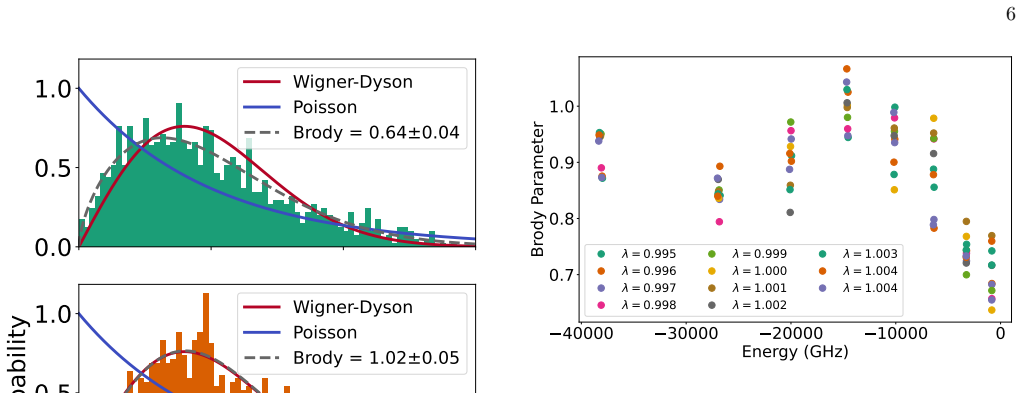
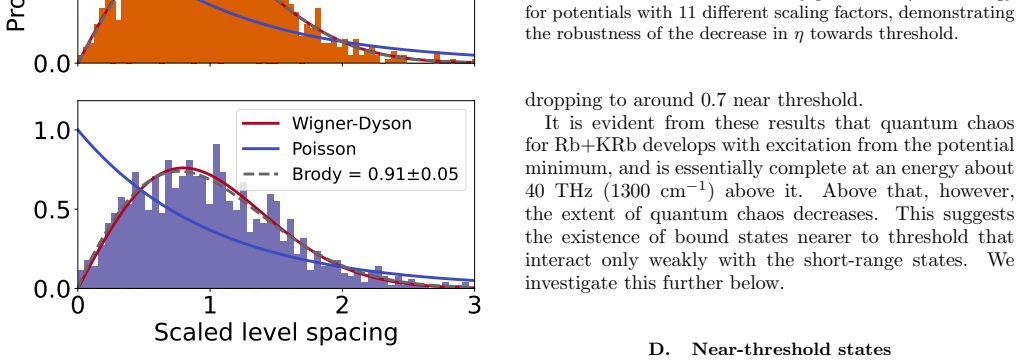
We use coupled-channel calculations to explore the nature of near-threshold bound states in a simplified model of Rb+KRb. This is a prototype for systems with very strong coupling at short range and chaotic behavior for the short-range states. We find that there are states with strong long-range character that exist close to threshold and probably persist to depths at least 100 GHz below each threshold. These states are only weakly coupled to the short-range states and do not form part of the chaotic manifold. Since they spend little time at short range, they are relatively insensitive to destruction by laser light. They can thus have long lifetimes that are unrelated to the density of states and can cause narrow Feshbach resonances when the states are shifted across thresholds by external fields.
Editorial analysis
A structured set of objections, weighed in public.
Referee Report
Summary. The manuscript uses coupled-channel calculations in a simplified model of Rb + KRb collisions to identify near-threshold bound states with strong long-range character. These states are weakly coupled to the short-range chaotic manifold, do not participate in the chaotic behavior, and are argued to persist to depths of at least 100 GHz below threshold. Because of their limited short-range probability, they are predicted to be relatively insensitive to laser light and to produce narrow Feshbach resonances when shifted by external fields.
Significance. If the reported separation between long-range and chaotic short-range states holds under more complete potentials, the result would be significant for ultracold molecular physics. It offers a concrete mechanism by which long-lived states can exist despite high state densities, with direct implications for Feshbach resonance widths and laser-induced loss rates. The direct numerical solution of the Schrödinger equation in the model, rather than fitting to prior parameters, is a methodological strength that avoids circularity.
major comments (3)
- [Results and discussion of state persistence] The central claim that long-range states 'probably persist to depths at least 100 GHz below each threshold' (abstract and results) rests on near-threshold calculations plus a weak-coupling argument. No direct coupled-channel spectra are shown at binding energies of tens to 100 GHz, where the short-range state density is substantially higher; the possibility of additional avoided crossings or effective mixing at greater depth is therefore not quantitatively tested.
- [Model and numerical methods] The simplified Rb+KRb model is stated to capture the essential short-range coupling and chaotic behavior, yet the manuscript provides no systematic variation of the short-range parameters or convergence tests with respect to the number of channels. This leaves open whether the reported weak coupling and long-range character are robust or artifacts of the particular parametrization and basis truncation.
- [Numerical methods] No basis-set sizes, energy cutoffs, or error estimates are reported for the coupled-channel solutions. Without these, it is difficult to assess the reliability of the extracted short-range probability densities that underpin the claim of decoupling from the chaotic manifold.
minor comments (2)
- [Abstract] The abstract uses 'probably' for the 100 GHz persistence; the main text should state the quantitative criterion (e.g., a maximum short-range probability or minimum avoided-crossing gap) used to arrive at this estimate.
- [Figures] Figure captions and axis labels should explicitly indicate the energy range shown relative to the relevant thresholds and whether the plotted quantities are probabilities or wave-function amplitudes.
Simulated Author's Rebuttal
We thank the referee for their careful reading of our manuscript and for the constructive comments, which have helped us improve the presentation and strengthen the supporting evidence. We address each major comment below and have revised the manuscript accordingly, including additional calculations, convergence tests, and technical details.
read point-by-point responses
-
Referee: The central claim that long-range states 'probably persist to depths at least 100 GHz below each threshold' (abstract and results) rests on near-threshold calculations plus a weak-coupling argument. No direct coupled-channel spectra are shown at binding energies of tens to 100 GHz, where the short-range state density is substantially higher; the possibility of additional avoided crossings or effective mixing at greater depth is therefore not quantitatively tested.
Authors: We agree that direct spectra at greater depths would provide stronger support and acknowledge that our original claim relied primarily on the near-threshold results combined with the weak-coupling argument. Full spectra at 100 GHz are computationally intensive due to the high state density, but we have added new coupled-channel calculations for representative long-range states at binding energies of 20 GHz and 50 GHz. These confirm that the short-range probability density remains below 0.5% and the states retain their long-range character without mixing into the chaotic manifold. We have revised the abstract and results section to state that the states 'persist to depths of at least several tens of GHz below threshold, with the weak-coupling argument indicating they are likely to remain decoupled at greater depths.' A new paragraph discusses why additional avoided crossings are not expected, as the coupling matrix elements are determined by the short-range overlap, which stays small. revision: partial
-
Referee: The simplified Rb+KRb model is stated to capture the essential short-range coupling and chaotic behavior, yet the manuscript provides no systematic variation of the short-range parameters or convergence tests with respect to the number of channels. This leaves open whether the reported weak coupling and long-range character are robust or artifacts of the particular parametrization and basis truncation.
Authors: We accept that systematic tests are necessary to establish robustness. In the revised manuscript we have added a new subsection in the Methods describing variations of the short-range potential (scaling its depth by factors of 0.9 and 1.1 while preserving the chaotic short-range spectrum). In all cases the long-range states persist with short-range probabilities below 1% and remain decoupled. We also report convergence tests increasing the channel basis from 25 to 40 channels; the extracted short-range probability densities for the long-range states change by less than 8%, confirming that the weak-coupling results are not sensitive to basis truncation within the range explored. revision: yes
-
Referee: No basis-set sizes, energy cutoffs, or error estimates are reported for the coupled-channel solutions. Without these, it is difficult to assess the reliability of the extracted short-range probability densities that underpin the claim of decoupling from the chaotic manifold.
Authors: We thank the referee for noting this omission. The revised Methods section now specifies the basis-set sizes (30 channels for the dominant partial waves, with additional partial waves up to L=4), the short-range energy cutoff (500 cm^{-1}), and the propagation parameters. Convergence studies show that the short-range probability densities are stable to within 0.1% with respect to further increases in basis size or cutoff. We have added a short error analysis stating that the reported probabilities are accurate to better than 5%, sufficient to support the decoupling conclusion. revision: yes
Circularity Check
Direct numerical coupled-channel calculations yield independent results on long-range states
full rationale
The paper's findings derive from direct numerical solution of the Schrödinger equation using coupled-channel methods in a simplified model potential for Rb+KRb. The identification of long-range states near threshold and the inference of their persistence are based on computed wavefunctions and coupling strengths, without fitting parameters to the reported quantities or reducing via self-citation to unverified premises. The 'probably' qualifier on persistence to 100 GHz acknowledges the extrapolation from near-threshold results, but this does not constitute circularity as it is not equivalent to the inputs by construction. The central claims are independent of any self-referential definitions or fitted predictions.
Axiom & Free-Parameter Ledger
free parameters (1)
- short-range coupling parameters
axioms (1)
- domain assumption Coupled-channel calculations with a finite basis accurately locate and characterize near-threshold bound states.
Reference graph
Works this paper leans on
-
[1]
top bin” between 0 and 39.2 ¯Ebelow threshold, a second in “bin 2
has discussed the hyperfine couplings that are present in these systems, together with issues of angular momen- tum couplings and selection rules. A particularly interesting system is 40K+Na40K. In this case tunable Feshbach resonances have been ob- served, superimposed on fast loss [37, 38]. Scattering resonances occur due to the interference of incoming...
-
[2]
Across the three panels, a single slowly-varying state that is mostly in the lowest channel,n= 0, descends through the bin asλincreases by about 0.016
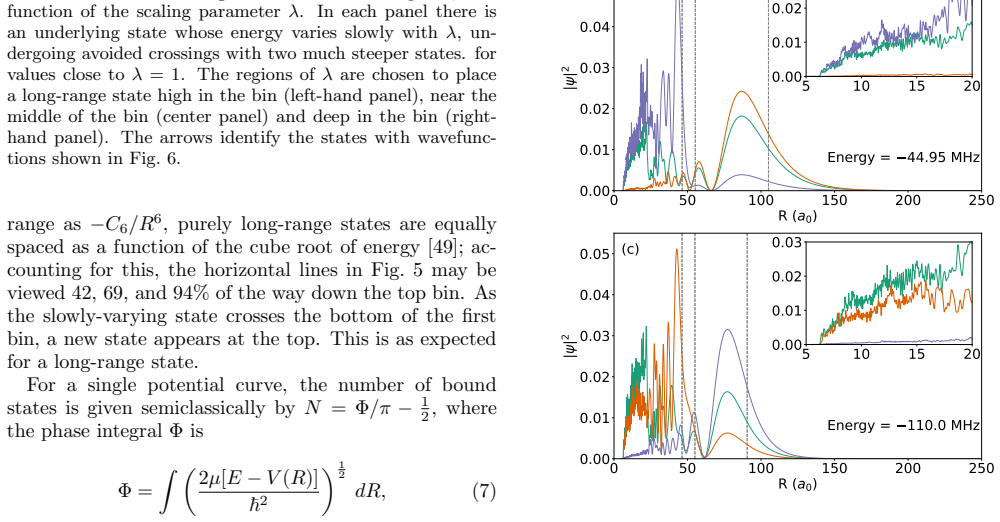
States in the top bin Figure 5 show the energies of the bound states in the top bin as a function of the scaling factorλ. Across the three panels, a single slowly-varying state that is mostly in the lowest channel,n= 0, descends through the bin asλincreases by about 0.016. The slowly-varying bound state is crossed by many faster-moving states that are sup...
-
[3]
We calculate Φ/π= 147 for the lowest adiabat by numerical integration of Eq. 7. The difference between these two values indicates that the long-range states do not sample the entire phase space accessible to the lowest adiabat. This is probably due to nonadiabatic effects that prevent the long-range states following the lowest adiabat all the way to its i...
-
[4]
States in deeper bins An important question is whether the states with long- range character appear at similar positions in successive bins. This is the behavior expected for the long-range states in a single-channel problem [49, 71], where the short-range part of the wavefunction varies very little with energy across the width of the top few bins. How- e...
-
[5]
Quantum-state controlled chemical reactions of ultracold KRb molecules
S. Ospelkaus, K.-K. Ni, D. Wang, M. H. G. de Miranda, B. Neyenhuis, G. Qu´ em´ ener, P. S. Julienne, J. L. Bohn, D. S. Jin, and J. Ye. “Quantum-state controlled chemical reactions of ultracold KRb molecules.” Science,327, 853 (2010)
2010
-
[6]
Ultracold dense samples of dipo- lar RbCs molecules in the rovibrational and hyperfine ground state
T. Takekoshi, L. Reichs¨ ollner, A. Schindewolf, J. M. Hut- son, C. R. Le Sueur, O. Dulieu, F. Ferlaino, R. Grimm, and H.-C. N¨ agerl. “Ultracold dense samples of dipo- lar RbCs molecules in the rovibrational and hyperfine ground state.” Phys. Rev. Lett.,113, 205301 (2014)
2014
-
[7]
Ultra- cold dipolar gas of fermionic 23Na40K molecules in their absolute ground state
J. W. Park, S. A. Will, and M. W. Zwierlein. “Ultra- cold dipolar gas of fermionic 23Na40K molecules in their absolute ground state.” Phys. Rev. Lett.,114, 205302 (2015)
2015
-
[8]
High-resolution internal state control of ultracold 23Na87Rb molecules
M. Guo, X. Ye, J. He, G. Qu´ em´ ener, and D. Wang. “High-resolution internal state control of ultracold 23Na87Rb molecules.” Phys. Rev. A,97, 020501(R) (2018)
2018
-
[9]
Bimolecular chemistry in the ul- tracold regime
Y. Liu and K.-K. Ni. “Bimolecular chemistry in the ul- tracold regime.” Ann. Rev. Phys. Chem.,73, 73 (2022)
2022
-
[10]
Quantum control of reactions and collisions at ultralow temperatures
B. Zhao and J.-W. Pan. “Quantum control of reactions and collisions at ultralow temperatures.” Chem. Soc. Rev.,51, 1685 (2022)
2022
-
[11]
A high phase-space-density gas of polar molecules in the rovibrational ground state
K.-K. Ni, S. Ospelkaus, M. H. G. de Miranda, A. Pe’er, B. Neyenhuis, J. J. Zirbel, S. Kotochigova, P. S. Juli- enne, D. S. Jin, and J. Ye. “A high phase-space-density gas of polar molecules in the rovibrational ground state.” Science,322, 231 (2008)
2008
-
[12]
An ultracold, high-density sample of rovibronic ground- state molecules in an optical lattice
J. G. Danzl, M. J. Mark, E. Haller, M. Gustavsson, R. Hart, J. Aldegunde, J. M. Hutson, and H.-C. N¨ agerl. “An ultracold, high-density sample of rovibronic ground- state molecules in an optical lattice.” Nat. Phys.,6, 265 (2010)
2010
-
[13]
Quantum state manipulation and cooling of ultracold molecules
T. Langen, G. Valtolina, D. Wang, and J. Ye. “Quantum state manipulation and cooling of ultracold molecules.” Nature Physics,20, 702 (2024)
2024
-
[14]
Controlling the hyperfine state of rovibronic ground-state polar molecules
S. Ospelkaus, K.-K. Ni, G. Qu´ em´ ener, B. Neyenhuis, D. Wang, M. H. G. de Miranda, J. L. Bohn, J. Ye, and D. S. Jin. “Controlling the hyperfine state of rovibronic ground-state polar molecules.” Phys. Rev. Lett.,104, 030402 (2010)
2010
-
[15]
Controlling the rotational and hyperfine state of ultracold 87Rb133Cs molecules
P. D. Gregory, J. Aldegunde, J. M. Hutson, and S. L. Cornish. “Controlling the rotational and hyperfine state of ultracold 87Rb133Cs molecules.” Phys. Rev. A,94, 041403(R) (2016)
2016
-
[16]
Quantum computation and quantum simulation with ultracold molecules
S. L. Cornish, M. R. Tarbutt, and K. R. A. Hazzard. “Quantum computation and quantum simulation with ultracold molecules.” Nat. Phys.,20, 730 (2024)
2024
-
[17]
Statistical as- pects of ultracold resonant scattering
M. Mayle, B. P. Ruzic, and J. L. Bohn. “Statistical as- pects of ultracold resonant scattering.” Phys. Rev. A, 85, 062712 (2012)
2012
-
[18]
Scattering of ultracold molecules in the highly resonant regime
M. Mayle, G. Qu´ em´ ener, B. P. Ruzic, and J. L. Bohn. “Scattering of ultracold molecules in the highly resonant regime.” Phys. Rev. A,87, 012709 (2013)
2013
-
[19]
Collisions of ultracold 23Na87Rb molecules with controlled chemical reactivities
X. Ye, M. Guo, M. L. Gonz´ alez-Mart´ ınez, G. Qu´ em´ ener, and D. Wang. “Collisions of ultracold 23Na87Rb molecules with controlled chemical reactivities.” Sci. Adv.,4, eaaq0083 (2018)
2018
-
[20]
Sticky collisions of ultracold RbCs molecules
P. D. Gregory, M. D. Frye, J. A. Blackmore, E. M. Bridge, R. Sawant, J. M. Hutson, and S. L. Cornish. “Sticky collisions of ultracold RbCs molecules.” Nature Comm., 10, 3104 (2019)
2019
-
[21]
Ultracold sticky collisions: Theoretical and experimental status
R. Bause, A. Christianen, A. Schindewolf, I. Bloch, and X.-Y. Luo. “Ultracold sticky collisions: Theoretical and experimental status.” J. Phys. Chem. A,127, 729 (2023)
2023
-
[22]
Direct observation of bi- molecular reactions of ultracold KRb molecules
M.-G. Hu, Y. Liu, D. D. Grimes, Y.-W. Lin, A. H. Gheorghe, R. Vexiau, N. Bouloufa-Maafa, O. Dulieu, T. Rosenband, and K.-K. Ni. “Direct observation of bi- molecular reactions of ultracold KRb molecules.” Sci- ence,366, 1111 (2019)
2019
-
[23]
Photoinduced two-body loss of ultra- cold molecules
A. Christianen, M. W. Zwierlein, G. C. Groenenboom, and T. Karman. “Photoinduced two-body loss of ultra- cold molecules.” Phys. Rev. Lett.,123, 123402 (2019). 12
2019
-
[24]
Photo-excitation of long- lived transient intermediates in ultracold reactions
Y. Liu, M.-G. Hu, M. A. Nichols, D. D. Grimes, T. Kar- man, H. Guo, and K.-K. Ni. “Photo-excitation of long- lived transient intermediates in ultracold reactions.” Nat. Phys.,16, 1132 (2020)
2020
-
[25]
Long-lived complexes and signatures of chaos in ultra- cold K2+Rb collisions
J. F. E. Croft, N. Balakrishnan, and B. K. Kendrick. “Long-lived complexes and signatures of chaos in ultra- cold K2+Rb collisions.” Phys. Rev. A,96, 062707 (2017)
2017
-
[26]
A quasiclassical method for calculating the density of states of ultracold collision complexes
A. Christianen, T. Karman, and G. C. Groenenboom. “A quasiclassical method for calculating the density of states of ultracold collision complexes.” Phys. Rev. A, 100, 032708 (2019)
2019
-
[27]
Complexes formed in col- lisions between ultracold alkali-metal diatomic molecules and atoms
M. D. Frye and J. M. Hutson. “Complexes formed in col- lisions between ultracold alkali-metal diatomic molecules and atoms.” New J. Phys.,23, 125008 (2021)
2021
-
[28]
Anoma- lous lifetimes of ultracold complexes decaying into a sin- gle channel
J. F. E. Croft, J. L. Bohn, and G. Qu´ em´ ener. “Anoma- lous lifetimes of ultracold complexes decaying into a sin- gle channel.” Phys. Rev. A,107, 023304 (2023)
2023
-
[29]
Colli- sional losses of ultracold molecules due to intermediate complex formation
K. Jachymski, M. Gronowski, and M. Tomza. “Colli- sional losses of ultracold molecules due to intermediate complex formation.” Phys. Rev. A,106, L041301 (2022)
2022
-
[30]
Sym- metry breaking in sticky collisions between ultracold molecules
M. P. Man, G. C. Groenenboom, and T. Karman. “Sym- metry breaking in sticky collisions between ultracold molecules.” Phys. Rev. Lett.,129, 243401 (2022)
2022
-
[31]
Loss of ultracold 87Rb133Cs molecules via optical excitation of long-lived two-body collision com- plexes
P. D. Gregory, J. A. Blackmore, S. L. Bromley, and S. L. Cornish. “Loss of ultracold 87Rb133Cs molecules via optical excitation of long-lived two-body collision com- plexes.” Phys. Rev. Lett.,124, 163402 (2020)
2020
-
[32]
Collisions of ultracold molecules in bright and dark optical dipole traps
R. Bause, A. Schindewolf, R. Tao, M. Duda, X.-Y. Chen, G. Qu´ em´ ener, T. Karman, A. Christianen, I. Bloch, and X.-Y. Luo. “Collisions of ultracold molecules in bright and dark optical dipole traps.” Phys. Rev. Res.,3, 033013 (2021)
2021
-
[33]
Probing photoinduced two-body loss of ultracold nonreactive bosonic 23Na87Rb and 23Na39K molecules
P. Gersema, K. K. Voges, M. Meyer zum Alten Bor- gloh, L. Koch, T. Hartmann, A. Zenesini, S. Ospelkaus, J. Lin, J. He, and D. Wang. “Probing photoinduced two-body loss of ultracold nonreactive bosonic 23Na87Rb and 23Na39K molecules.” Phys. Rev. Lett.,127, 163401 (2021)
2021
-
[34]
Dipolar collisions of ultracold ground-state bosonic molecules
M. Guo, X. Ye, J. He, M. L. Gonz´ alez-Mart´ ınez, R. Vex- iau, G. Qu´ em´ ener, and D. Wang. “Dipolar collisions of ultracold ground-state bosonic molecules.” Phys. Rev. X,8, 041044 (2018)
2018
-
[35]
Universal rate constants for reactive collisions of ultracold molecules
Z. Idziaszek and P. S. Julienne. “Universal rate constants for reactive collisions of ultracold molecules.” Phys. Rev. Lett.,104, 113202 (2010)
2010
-
[36]
Simple quantum model of ultracold polar molecule collisions
Z. Idziaszek, G. Qu´ em´ ener, J. L. Bohn, and P. S. Juli- enne. “Simple quantum model of ultracold polar molecule collisions.” Phys. Rev. A,82, 020703 (2010)
2010
-
[37]
Molecule-molecule and atom-molecule collisions with ul- tracold RbCs molecules
P. D. Gregory, J. A. Blackmore, M. D. Frye, L. Fern- ley, S. L. Bromley, J. M. Hutson, and S. L. Cornish. “Molecule-molecule and atom-molecule collisions with ul- tracold RbCs molecules.” New J. Phys.,23, 125004 (2021)
2021
-
[38]
Hyperfine dependent atom-molecule loss analyzed by the analytic solution of few-body loss equations
K. K. Voges, P. Gersema, T. Hartmann, S. Ospelkaus, and A. Zenesini. “Hyperfine dependent atom-molecule loss analyzed by the analytic solution of few-body loss equations.” Phys. Rev. Res.,4, 023184 (2022)
2022
-
[39]
Detection of long-lived complexes in ultra- cold atom-molecule collisions
M. A. Nichols, Y.-X. Liu, L. Zhu, M.-G. Hu, Y. Liu, and K.-K. Ni. “Detection of long-lived complexes in ultra- cold atom-molecule collisions.” Phys. Rev. X,12, 011049 (2022)
2022
-
[40]
Hyperfine-to-rotational energy transfer in ultracold atom–molecule collisions of Rb and KRb
Y.-X. Liu, L. Zhu, J. Luke, M. C. Babin, M. Gronowski, H. Ladjimi, M. Tomza, J. L. Bohn, T. V. Tscherbul, and K.-K. Ni. “Hyperfine-to-rotational energy transfer in ultracold atom–molecule collisions of Rb and KRb.” Nature Chemistry,17, 688 (2025)
2025
-
[41]
Observation of magnetically tunable Feshbach resonances in ultracold 23Na40K + 40K colli- sions
H. Yang, D.-C. Zhang, L. Liu, Y.-X. Liu, J. Nan, B. Zhao, and J.-W. Pan. “Observation of magnetically tunable Feshbach resonances in ultracold 23Na40K + 40K colli- sions.” Science,363, 261 (2019)
2019
-
[42]
Magnetic Feshbach resonances in collisions of 23Na40K with 40K
X.-Y. Wang, M. D. Frye, Z. Su, J. Cao, L. Liu, D.-C. Zhang, H. Yang, J. M. Hutson, B. Zhao, C.-L. Bai, and J.-W. Pan. “Magnetic Feshbach resonances in collisions of 23Na40K with 40K.” New J. Phys.,23, 115010 (2021)
2021
-
[43]
Cold atomic and molecular collisions: approaching the univer- sal loss regime
M. D. Frye, P. S. Julienne, and J. M. Hutson. “Cold atomic and molecular collisions: approaching the univer- sal loss regime.” New J. Phys.,17, 045019 (2015)
2015
-
[44]
Long-range states and Feshbach resonances in collisions between ultracold alkali-metal diatomic molecules and atoms
M. D. Frye and J. M. Hutson. “Long-range states and Feshbach resonances in collisions between ultracold alkali-metal diatomic molecules and atoms.” Phys. Rev. Res.,5, 023001 (2023)
2023
-
[45]
Resonant control of elastic collisions between 23Na40K molecules and 40K atoms
Z. Su, H. Yang, J. Cao, X.-Y. Wang, J. Rui, B. Zhao, and J.-W. Pan. “Resonant control of elastic collisions between 23Na40K molecules and 40K atoms.” Phys. Rev. Lett.,129, 033401 (2022)
2022
-
[46]
Creation of an ultracold gas of triatomic molecules from an atom–diatomic molecule mixture
H. Yang, J. Cao, Z. Su, J. Rui, B. Zhao, and J.-W. Pan. “Creation of an ultracold gas of triatomic molecules from an atom–diatomic molecule mixture.” Science,378, 1009 (2022)
2022
-
[47]
Observation of photoassoci- ation resonances in ultracold atom-molecule collisions
J. Cao, B.-Y. Wang, H. Yang, Z.-J. Fan, Z. Su, J. Rui, B. Zhao, and J.-W. Pan. “Observation of photoassoci- ation resonances in ultracold atom-molecule collisions.” Phys. Rev. Lett.,132, 093403 (2024)
2024
-
[48]
Electric-field control of atom-molecule Feshbach reso- nances
M. Meyer zum Alten Borgloh, J. Heier, F. von Gierke, B. Shammout, E. Tiemann, L. Karpa, and S. Ospelkaus. “Electric-field control of atom-molecule Feshbach reso- nances.” arXiv:2602.23929 (2026)
-
[49]
Rotational predissociation of the Ar-HCl van der Waals complex: close-coupled scattering calculations
C. J. Ashton, M. S. Child, and J. M. Hutson. “Rotational predissociation of the Ar-HCl van der Waals complex: close-coupled scattering calculations.” J. Chem. Phys., 78, 4025 (1983)
1983
-
[50]
Long-lived complexes and chaos in ultracold molecular collisions
J. F. E. Croft and J. L. Bohn. “Long-lived complexes and chaos in ultracold molecular collisions.” Phys. Rev. A,89, 012714 (2014)
2014
-
[51]
Roaming pathways and survival probability in real-time collisional dynamics of cold and controlled bialkali molecules
J. K los, Q. Guan, H. Li, M. Li, E. Tiesinga, and S. Ko- tochigova. “Roaming pathways and survival probability in real-time collisional dynamics of cold and controlled bialkali molecules.” Sci. Rep.,11, 10598 (2021)
2021
-
[52]
Uni- versality and chaoticity in ultracold K+KRb chemical reactions
J. F. E. Croft, C. Makrides, M. Li, A. Petrov, B. K. Kendrick, N. Balakrishnan, and S. Kotochigova. “Uni- versality and chaoticity in ultracold K+KRb chemical reactions.” Nature Communications,8, 15897 (2017)
2017
-
[53]
Dissociation energy and long-range potential of diatomic molecules from vi- brational spacings of higher levels
R. J. Le Roy and R. B. Bernstein. “Dissociation energy and long-range potential of diatomic molecules from vi- brational spacings of higher levels.” J. Chem. Phys.,52, 3869 (1970)
1970
-
[54]
Solutions of the Schr¨ odinger equation for an attractive 1/r6 potential
B. Gao. “Solutions of the Schr¨ odinger equation for an attractive 1/r6 potential.” Phys. Rev. A,58, 1728 (1998)
1998
-
[55]
Calculation of the scattering length in atomic collisions using the semi- classical approximation
G. F. Gribakin and V. V. Flambaum. “Calculation of the scattering length in atomic collisions using the semi- classical approximation.” Phys. Rev. A,48, 546 (1993)
1993
-
[56]
Non- adiabatic quantum interference and complex formation in ultracold collisions of Rb with KRb
B. K. Kendrick, H. Li, J. K los, and S. Kotochigova. “Non- adiabatic quantum interference and complex formation in ultracold collisions of Rb with KRb.” Phys. Chem. Chem. Phys.,28, 9223 (2026)
2026
-
[57]
Quantum reactive scat- tering in three dimensions using hyperspherical (APH) coordinates. theory
R. T Pack and G. A. Parker. “Quantum reactive scat- tering in three dimensions using hyperspherical (APH) coordinates. theory.” J. Chem. Phys.,87, 3888 (1987). 13
1987
-
[58]
Hyperspherical surface functions for nonzero to- tal angular momentum. I. Eckart singularities
B. K. Kendrick, R. T Pack, R. B. Walker, and E. F. Hayes. “Hyperspherical surface functions for nonzero to- tal angular momentum. I. Eckart singularities.” J. Chem. Phys.,110, 6673 (1999)
1999
-
[59]
BOUND computer program, version 1
J. M. Hutson. “BOUND computer program, version 1.” Distributed by Collaborative Computational Project No. 6 of the UK Engineering and Physical Sciences Research Council (1984)
1984
-
[60]
boundandfield: programs for calculating bound states of interacting pairs of atoms and molecules
J. M. Hutson and C. R. Le Sueur. “boundandfield: programs for calculating bound states of interacting pairs of atoms and molecules.” Comp. Phys. Comm.,241, 1 (2019)
2019
-
[61]
molscat,boundand field, version 2023.0
J. M. Hutson and C. R. Le Sueur. “molscat,boundand field, version 2023.0.”https://github.com/molscat/ molscat(2023)
2023
-
[62]
An improved log-derivative method for inelastic scattering
D. E. Manolopoulos. “An improved log-derivative method for inelastic scattering.” J. Chem. Phys.,85, 6425 (1986)
1986
-
[63]
A stable linear reference potential algorithm for solution of the quantum close-coupled equations in molecular scattering theory
M. H. Alexander and D. E. Manolopoulos. “A stable linear reference potential algorithm for solution of the quantum close-coupled equations in molecular scattering theory.” J. Chem. Phys.,86, 2044 (1987)
2044
-
[64]
Bound-state wave- functions from coupled-channel calculations using log- derivative propagators – application to spectroscopic in- tensities in Ar-HF
A. E. Thornley and J. M. Hutson. “Bound-state wave- functions from coupled-channel calculations using log- derivative propagators – application to spectroscopic in- tensities in Ar-HF.” J. Chem. Phys.,101, 5578 (1994)
1994
-
[65]
Geometric phase effects in the resonance spectrum, state-to-state transition proba- bilities and bound state spectrum of HO 2
B. Kendrick and R. T Pack. “Geometric phase effects in the resonance spectrum, state-to-state transition proba- bilities and bound state spectrum of HO 2.” J. Chem. Phys.,106, 3519 (1997)
1997
-
[66]
The renormalized Numerov method ap- plied to calculating bound states of the coupled-channel Schr¨ odinger equation
B. R. Johnson. “The renormalized Numerov method ap- plied to calculating bound states of the coupled-channel Schr¨ odinger equation.” J. Chem. Phys.,69, 4678 (1978)
1978
-
[67]
Coupled-channel methods for solving the bound-state Schr¨ odinger equation
J. M. Hutson. “Coupled-channel methods for solving the bound-state Schr¨ odinger equation.” Comput. Phys. Commun.,84, 1 (1994)
1994
-
[68]
On the statistical distribution of the widths and spacings of nuclear resonance levels
E. P. Wigner. “On the statistical distribution of the widths and spacings of nuclear resonance levels.” Math. Proc. Cambridge,47, 790 (1951)
1951
-
[69]
Statistical theory of the energy levels of complex systems. I
F. J. Dyson. “Statistical theory of the energy levels of complex systems. I.” J. Math. Phys.,3, 140 (1962)
1962
-
[70]
Level clustering in the reg- ular spectrum
M. V. Berry and M. Tabor. “Level clustering in the reg- ular spectrum.” Proc. R. Soc. A,356, 375 (1977)
1977
-
[71]
A statistical measure for the repulsion of energy levels
T. Brody. “A statistical measure for the repulsion of energy levels.” Lett. Nuovo Cimento,7, 482 (1973)
1973
-
[72]
Random-matrix physics: spectrum and strength fluctuations
T. A. Brody, J. Flores, J. B. French, P. A. Mellow, A. Pandey, and S. S. M. Wong. “Random-matrix physics: spectrum and strength fluctuations.” Rev. Mod. Phys., 53, 385 (1981)
1981
-
[73]
Semiclassical level spacings when regular and chaotic orbits coexist
M. V. Berry and M. Robnik. “Semiclassical level spacings when regular and chaotic orbits coexist.” J. Phys. A,17, 2413 (1984)
1984
-
[74]
Random matrix theories in quantum physics: common concepts
T. Guhr, A. M¨ uller-Groeling, and H. A. Weidem¨ uller. “Random matrix theories in quantum physics: common concepts.” Phys. Rep.,299, 189 (1998)
1998
-
[75]
Zero-energy bound or quasibound states and their implications for diatomic systems with an asymp- totic van der Waals interaction
B. Gao. “Zero-energy bound or quasibound states and their implications for diatomic systems with an asymp- totic van der Waals interaction.” Phys. Rev. A,62, 050702(R) (2000)
2000
-
[76]
Prospects of forming molecules in 2Σ states by magnetoassociation of alkali- metal atoms with Yb
D. A. Brue and J. M. Hutson. “Prospects of forming molecules in 2Σ states by magnetoassociation of alkali- metal atoms with Yb.” Phys. Rev. A,87, 052709 (2013)
2013
discussion (0)
Sign in with ORCID, Apple, or X to comment. Anyone can read and Pith papers without signing in.