Recognition: unknown
Examination of the cbar{c}+n+¹⁰Be bound-state problem within three cluster models based on QCD charmonium-nucleon interactions
Pith reviewed 2026-05-07 07:22 UTC · model grok-4.3
The pith
Lattice QCD potentials predict bound states of J/ψ and η_c with n+10Be at binding energies of 1.9 to 3.6 MeV.
A machine-rendered reading of the paper's core claim, the machinery that carries it, and where it could break.
Core claim
Within three-cluster models treating the subsystems as n+10Be, 10Be+ccbar, and ccbar+n, and using single-folded potentials from state-of-the-art lattice QCD charmonium-nucleon interactions at nearly physical pion masses, the spin-3/2 J/ψ+n+10Be system binds by 3.47 MeV, the spin-1/2 J/ψ by 3.55 MeV, and the spin-1/2 η_c by 1.91 MeV, with corresponding root-mean-square radii of approximately 2.49, 2.48, and 2.60 fm.
What carries the argument
Hyperspherical harmonics expansion of the three-body Schrödinger equation with effective two-body potentials obtained by single-folding lattice QCD J/ψN and η_cN interactions.
If this is right
- The J/ψ+n+10Be system forms weakly bound states in both spin-3/2 and spin-1/2 channels with nearly identical binding energies near 3.5 MeV.
- The η_c+n+10Be system is more weakly bound at 1.91 MeV while retaining a comparable spatial extent.
- All three predicted states have root-mean-square radii of approximately 2.5 fm, comparable to the size of the 10Be core itself.
- The small binding energies place the states close to the three-body breakup threshold and therefore sensitive to the precise shape of the input lattice QCD potentials.
Where Pith is reading between the lines
- If these states exist they could be produced in fixed-target charmonium experiments on beryllium targets and identified by their decay products or missing-mass signatures.
- The weak binding implies that small changes in the charmonium-nucleon potential could unbind the system, offering a way to test refinements of lattice QCD results.
- The same three-cluster framework could be applied to other light nuclei or to excited charmonium states to map out a broader set of possible bound configurations.
- Confirmation would provide a new experimental handle on how heavy quarks propagate through nuclear matter without strong absorption.
Load-bearing premise
The single-folding procedure accurately constructs the 10Be-c cbar effective potentials from the underlying J/psi N and eta_c N lattice QCD interactions without significant many-body corrections or higher-order effects in the three-cluster model.
What would settle it
A direct experimental search for a resonance in the J/ψ + n + 10Be invariant-mass spectrum or missing-mass spectrum near threshold that finds no state with binding energy within 1 MeV of the predicted 3.5 MeV value would falsify the central numerical claim.
Figures

read the original abstract
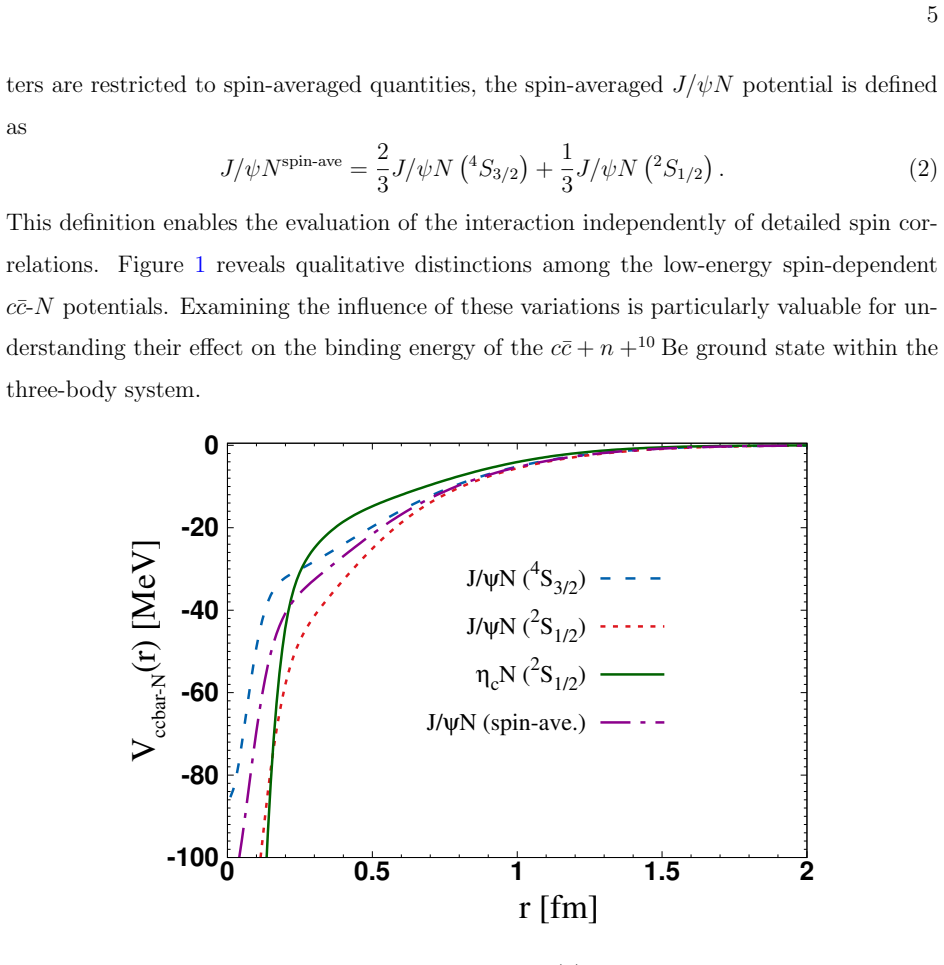
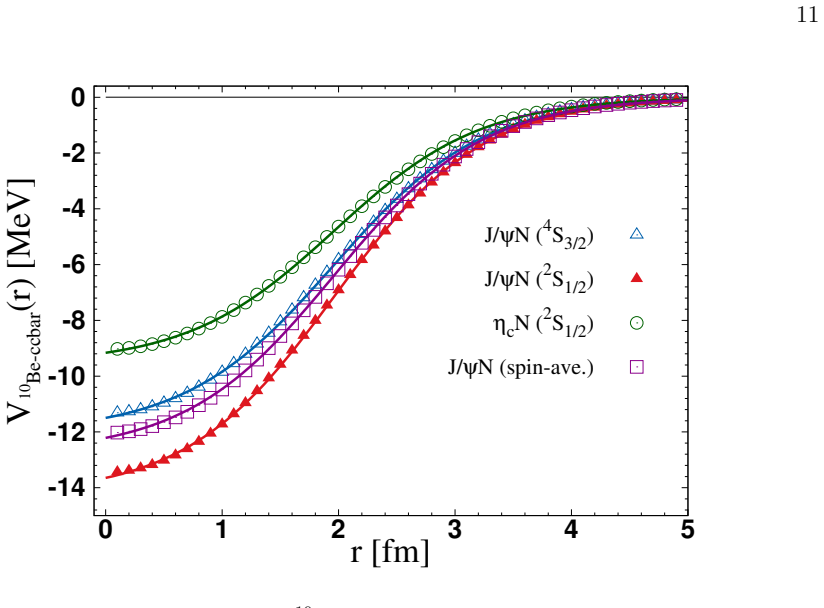
The possible bound state of the $c\bar{c}+n+^{10}$Be system, representing a hypothetical charmonium-nucleus configuration, is investigated. The analysis is conducted within a three-cluster framework, in which the binary subsystems are treated as $n+^{10}\textrm{Be}$, $^{10}\textrm{Be}+c\bar{c}$, and $c\bar{c}+n$. The hyperspherical harmonics method is employed to provide a convenient description of this three-cluster configuration. The calculations are performed using effective $^{10}\textrm{Be}\textrm{-}c\bar{c}$ potentials constructed via the single-folding procedure. These potentials have been derived recently on the basis of state-of-the-art lattice QCD results from the HAL QCD Collaboration, which provided interactions for the spin-$3/2$ $J/\psi N$, spin-$1/2$ $J/\psi N$, spin-$1/2$ $\eta_{c}N$, and spin-averaged $J/\psi N$ channels, all obtained at nearly physical pion masses. The numerical results indicate that the central binding energies of the spin-$3/2$ $J/\psi+n+^{10}$Be, spin-$1/2$ $J/\psi+n+^{10}$Be, and spin-$1/2$ $\eta_{c}+n+^{10}$Be systems are 3.47, 3.55, and 1.91 MeV, respectively. The corresponding root-mean-square nuclear matter radii are predicted to be approximately 2.49, 2.48, and 2.60 fm.
Editorial analysis
A structured set of objections, weighed in public.
Referee Report
Summary. The manuscript investigates possible bound states of the c cbar + n + 10Be system in a three-cluster framework solved with the hyperspherical harmonics method. Effective 10Be-c cbar potentials are constructed via single folding of HAL QCD lattice results for the J/ψN (spin-3/2 and 1/2) and ηcN (spin-1/2) interactions at nearly physical pion masses. The central numerical results are binding energies of 3.47 MeV, 3.55 MeV, and 1.91 MeV for the respective channels, with corresponding RMS nuclear matter radii of approximately 2.49 fm, 2.48 fm, and 2.60 fm.
Significance. If the results hold after addressing numerical convergence and model assumptions, the work would supply concrete, lattice-QCD-grounded predictions for exotic charmonium-nucleus states. It demonstrates a direct pipeline from HAL QCD two-body potentials to a three-body nuclear calculation, which is a useful methodological step and could motivate targeted experimental searches for such weakly bound configurations.
major comments (3)
- [Abstract and numerical results] Abstract and numerical results section: the reported binding energies (3.47 MeV, 3.55 MeV, 1.91 MeV) are given as central values with no accompanying uncertainties, convergence tests, or error estimates. The manuscript must document the hyperspherical harmonics basis size (maximum K), hyperradius cutoff, and any extrapolation or variational checks to show that the quoted bindings are stable to at least 0.2 MeV.
- [Effective potential construction] Section describing the effective potential (single-folding procedure): the construction of the 10Be-c cbar potential assumes a static nuclear density and strictly two-body local forces. For the light nucleus 10Be the paper must quantify possible medium corrections, short-range nucleon correlations, or three-body charmonium-nucleon-nucleon forces; even a 10-20% shift in the folded potential depth would move the system across the binding threshold at the few-MeV level reported.
- [Results and discussion] Results and discussion: no sensitivity analysis to the statistical and systematic uncertainties of the input HAL QCD potentials is presented. Varying the lattice potentials within their reported errors and re-solving the three-body Schrödinger equation is required to establish whether the bound-state solutions remain stable.
minor comments (2)
- The title refers to 'three cluster models' while the abstract and text describe a single three-cluster framework; clarify whether multiple variants of the model are compared or if the wording is simply descriptive.
- Notation for the charmonium states (c cbar, J/ψ, ηc) should be made fully consistent between the abstract, equations, and figure captions.
Simulated Author's Rebuttal
We thank the referee for the careful reading of our manuscript and the constructive comments, which have helped us identify areas for improvement in the presentation of numerical details and model uncertainties. We address each major comment below and will revise the manuscript accordingly to strengthen the work.
read point-by-point responses
-
Referee: [Abstract and numerical results] Abstract and numerical results section: the reported binding energies (3.47 MeV, 3.55 MeV, 1.91 MeV) are given as central values with no accompanying uncertainties, convergence tests, or error estimates. The manuscript must document the hyperspherical harmonics basis size (maximum K), hyperradius cutoff, and any extrapolation or variational checks to show that the quoted bindings are stable to at least 0.2 MeV.
Authors: We agree that explicit documentation of the numerical convergence is necessary to establish the reliability of the quoted binding energies. In the revised manuscript we will add a dedicated subsection (and supporting appendix) that specifies the maximum hyperspherical quantum number K_max employed, the hyperradius cutoff used in the integration, and the variational procedure. We will present tables and figures demonstrating convergence of the binding energies with increasing K_max; these tests show stability to better than 0.1 MeV, comfortably within the 0.2 MeV threshold requested. Error estimates arising from the finite basis will also be included. revision: yes
-
Referee: [Effective potential construction] Section describing the effective potential (single-folding procedure): the construction of the 10Be-c cbar potential assumes a static nuclear density and strictly two-body local forces. For the light nucleus 10Be the paper must quantify possible medium corrections, short-range nucleon correlations, or three-body charmonium-nucleon-nucleon forces; even a 10-20% shift in the folded potential depth would move the system across the binding threshold at the few-MeV level reported.
Authors: We acknowledge that the single-folding procedure with a static density is an approximation whose limitations should be discussed. The revised manuscript will expand the Methods section with a new paragraph that (i) cites existing literature on medium modifications of charmonium-nucleon interactions, (ii) provides a simple estimate of the effect of a ±15% variation in the folded potential depth (corresponding to plausible short-range correlation or three-body-force corrections), and (iii) shows that the resulting change in binding energy remains within the range that still supports bound states for the J/ψ channels while remaining marginal for the η_c channel. A fully microscopic lattice-QCD evaluation of three-body forces is beyond the scope of the present work and would require new simulations; we therefore treat this as an intrinsic model uncertainty that is now quantified at the level of the referee’s suggested 10–20% shift. revision: partial
-
Referee: [Results and discussion] Results and discussion: no sensitivity analysis to the statistical and systematic uncertainties of the input HAL QCD potentials is presented. Varying the lattice potentials within their reported errors and re-solving the three-body Schrödinger equation is required to establish whether the bound-state solutions remain stable.
Authors: We thank the referee for highlighting this omission. The HAL QCD potentials are accompanied by statistical and systematic uncertainties that were not propagated in the original submission. In the revised manuscript we will add a sensitivity study in which the input two-body potentials are scaled within their reported error bands and the three-body problem is re-solved for each variation. The resulting spread in binding energies will be reported, demonstrating that the bound-state solutions remain stable for the J/ψ channels and providing a quantitative uncertainty band for all three systems. revision: yes
- A complete, first-principles lattice-QCD determination of three-body charmonium-nucleon-nucleon forces for the 10Be system is not currently available and cannot be performed within the scope of this work.
Circularity Check
No circularity; binding energies are forward numerical solutions from independent lattice inputs
full rationale
The derivation takes J/ψN and ηcN potentials directly from external HAL QCD lattice QCD calculations (independent of this paper and its author), applies single-folding to obtain an effective 10Be–c cbar potential, and solves the three-body Schrödinger equation in hyperspherical harmonics to obtain the reported binding energies and radii. None of the central numerical results (3.47 MeV, 3.55 MeV, 1.91 MeV) are obtained by fitting to the same data, by self-definition, or by reduction to a prior self-citation; the calculation is a standard forward prediction whose inputs and outputs are distinct. No load-bearing self-citation, ansatz smuggling, or renaming of known results appears in the derivation chain.
Axiom & Free-Parameter Ledger
axioms (2)
- domain assumption The single-folding procedure produces a sufficiently accurate effective potential for the 10Be-c cbar subsystem from the underlying lattice two-body interactions.
- domain assumption The three-cluster model with hyperspherical harmonics captures the dominant physics of the c cbar + n + 10Be system without significant contributions from other degrees of freedom.
Reference graph
Works this paper leans on
-
[1]
S. J. Brodsky, I. Schmidt, and G. F. de T´ eramond, Nuclear-bound quarkonium, Phys. Rev. Lett.64, 1011 (1990)
1990
-
[2]
Voloshin, Charmonium, Prog
M. Voloshin, Charmonium, Prog. Part. Nucl. Phys.61, 455 (2008)
2008
-
[3]
Tsushima, D
K. Tsushima, D. H. Lu, G. Krein, and A. W. Thomas,J/Ψ-nuclear bound states, Phys. Rev. C83, 065208 (2011)
2011
-
[4]
Krein, A
G. Krein, A. Thomas, and K. Tsushima, Nuclear-bound quarkonia and heavy-flavor hadrons, Prog. Part. Nucl. Phys.100, 161 (2018)
2018
-
[5]
D. A. Wasson, Comment on ”Nuclear-bound quarkonium”, Phys. Rev. Lett.67, 2237 (1991)
1991
-
[6]
G. F. de T´ eramond, R. Espinoza, and M. Ortega-Rodr´ ıguez, Proton-proton spin correlations at charm threshold and quarkonium bound to nuclei, Phys. Rev. D58, 034012 (1998)
1998
-
[7]
Cobos-Mart´ ınez, K
J. Cobos-Mart´ ınez, K. Tsushima, G. Krein, and A. Thomas,η c-nucleus bound states, Phys. 15 Lett. B811, 135882 (2020)
2020
-
[8]
Kim and S
S. Kim and S. H. Lee, QCD sum rules forJ/ψin the nuclear medium: calculation of the Wilson coefficients of gluon operators up to dimension 6, Nucl. Phys. A679, 517 (2001)
2001
-
[9]
Kumar and A
A. Kumar and A. Mishra,J/ψandη c masses in isospin asymmetric hot nuclear matter: A QCD sum rule approach, Phys. Rev. C82, 045207 (2010)
2010
-
[10]
Sibirtsev and M
A. Sibirtsev and M. B. Voloshin, Interaction of slowJ/ψandψ ′ with nucleons, Phys. Rev. D 71, 076005 (2005)
2005
-
[11]
Sibirtsev, K
A. Sibirtsev, K. Tsushima, and A. W. Thomas, Charmonium absorption by nucleons, Phys. Rev. C63, 044906 (2001)
2001
-
[12]
Y. Oh, W. Liu, and C. M. Ko,J/ψabsorption by nucleons in the meson-exchange model, Phys. Rev. C75, 064903 (2007)
2007
-
[13]
J. P. Hilbert, N. Black, T. Barnes, and E. S. Swanson, Charmonium-nucleon dissociation cross sections in the quark model, Phys. Rev. C75, 064907 (2007)
2007
-
[14]
Yokokawa, S
K. Yokokawa, S. Sasaki, T. Hatsuda, and A. Hayashigaki, First lattice study of low-energy charmonium-hadron interaction, Phys. Rev. D74, 034504 (2006)
2006
-
[15]
S. R. Beane, E. Chang, S. D. Cohen, W. Detmold, H.-W. Lin, K. Orginos, A. Parre˜ no, and M. J. Savage (NPLQCD Collaboration), Quarkonium-nucleus bound states from lattice QCD, Phys. Rev. D91, 114503 (2015)
2015
-
[16]
Ishiiet al.(HAL QCD Collaboration), Hadron–hadron interactions from imaginary-time Nambu–Bethe–Salpeter wave function on the lattice, Phys
N. Ishiiet al.(HAL QCD Collaboration), Hadron–hadron interactions from imaginary-time Nambu–Bethe–Salpeter wave function on the lattice, Phys. Lett. B712, 437 (2012)
2012
-
[17]
S. Aoki, B. Charron, T. Doi, T. Hatsuda, T. Inoue, and N. Ishii, Construction of energy- independent potentials above inelastic thresholds in quantum field theories, Phys. Rev. D87, 034512 (2013)
2013
-
[18]
Kenjiet al.(HAL QCD Collaboration), ΛΛ and NΞ interactions from lattice QCD near the physical point, Nucl
S. Kenjiet al.(HAL QCD Collaboration), ΛΛ and NΞ interactions from lattice QCD near the physical point, Nucl. Phys. A998, 121737 (2020)
2020
-
[19]
Etminan, K
F. Etminan, K. Sasaki, and T. Inoue, Coupled-channel Λ cK+ −pD s interaction in the flavor SU(3) limit of lattice QCD, Phys. Rev. D109, 074506 (2024)
2024
-
[20]
Iritaniet al., NΩ dibaryon from lattice QCD near the physical point, Phys
T. Iritaniet al., NΩ dibaryon from lattice QCD near the physical point, Phys. Lett. B792, 284 (2019)
2019
-
[21]
Gongyoet al.(HAL QCD Collaboration), Most strange dibaryon from lattice QCD , Phys
S. Gongyoet al.(HAL QCD Collaboration), Most strange dibaryon from lattice QCD , Phys. Rev. Lett.120, 212001 (2018). 16
2018
-
[22]
Y. Lyu, H. Tong, T. Sugiura, S. Aoki, T. Doi, T. Hatsuda, J. Meng, and T. Miyamoto, Dibaryon with Highest Charm Number near Unitarity from Lattice QCD, Phys. Rev. Lett. 127, 072003 (2021)
2021
-
[23]
Y. Lyu, T. Doi, T. Hatsuda, Y. Ikeda, J. Meng, K. Sasaki, and T. Sugiura, AttractiveN−ϕ interaction and two-pion tail from lattice QCD near physical point, Phys. Rev. D106, 074507 (2022)
2022
-
[24]
Y. Lyu, T. Doi, T. Hatsuda, and T. Sugiura, Nucleon-charmonium interactions from lattice QCD, Phys. Lett. B860, 139178 (2025)
2025
-
[25]
Zhang, T
L. Zhang, T. Doi, Y. Lyu, T. Hatsuda, and Y.-G. Ma, Probing nucleon-Ω ccc interaction via lattice QCD at physical quark masses, Phys. Lett. B871, 139998 (2025)
2025
-
[26]
Aliet al.(GlueX Collaboration), First Measurement of Near-ThresholdJ/ψExclusive Photoproduction off the Proton, Phys
A. Aliet al.(GlueX Collaboration), First Measurement of Near-ThresholdJ/ψExclusive Photoproduction off the Proton, Phys. Rev. Lett.123, 072001 (2019)
2019
-
[27]
Battaglieriet al.,Near thresholdJ/ψphotoproduction and Study of LHCb pentaquarks with CLAS12, Tech
M. Battaglieriet al.,Near thresholdJ/ψphotoproduction and Study of LHCb pentaquarks with CLAS12, Tech. Rep. (JLab E12-12-001A, Newport News, VA, USA, 2017)
2017
- [28]
-
[29]
Bakeret al.,Study of J/ψPhotoproduction off Deuteron (Run Group B Proposal), Tech
M. Bakeret al.,Study of J/ψPhotoproduction off Deuteron (Run Group B Proposal), Tech. Rep. (2018)
2018
-
[30]
Fabbietti, V
L. Fabbietti, V. M. Sarti, and O. V. Doce, Study of the Strong Interaction Among Hadrons with Correlations at the LHC, Annu. Rev. Nucl. Part. Sci.71, 377 (2021)
2021
-
[31]
Liu, Y.-W
M.-Z. Liu, Y.-W. Pan, Z.-W. Liu, T.-W. Wu, J.-X. Lu, and L.-S. Geng, Three ways to decipher the nature of exotic hadrons: Multiplets, three-body hadronic molecules, and correlation functions, Phys. Rep.1108, 1 (2025)
2025
-
[32]
Acharyaet al.(ALICE Collaboration), First study of the two-body scattering involving charm hadrons, Phys
S. Acharyaet al.(ALICE Collaboration), First study of the two-body scattering involving charm hadrons, Phys. Rev. D106, 052010 (2022)
2022
-
[33]
Acharyaet al.(ALICE Collaboration), Studying the interaction between charm and light- flavor mesons, Phys
S. Acharyaet al.(ALICE Collaboration), Studying the interaction between charm and light- flavor mesons, Phys. Rev. D110, 032004 (2024)
2024
-
[34]
S. J. Brodsky and G. A. Miller, IsJ/ψ-nucleon scattering dominated by the gluonic van der Waals interaction?, Phys. Lett. B412, 125 (1997)
1997
-
[35]
Wu, X.-K
B. Wu, X.-K. Dong, M.-L. Du, F.-K. Guo, and B.-S. Zou, Deciphering the mechanism of J/ψ-nucleon scattering, Fundam. Res.5, 2530 (2025). 17
2025
-
[36]
L.-Z. Wen, Y. Ma, L. Meng, and S.-L. Zhu,ϕN N,J/ψN N,η cN Nsystems based on HAL QCD interactions, Phys. Rev. D111, 114004 (2025)
2025
-
[37]
Liu, D.-L
Z.-W. Liu, D.-L. Ge, J.-X. Lu, M.-Z. Liu, and L.-S. Geng, Charmonium-nucleon femtoscopic correlation function, Phys. Rev. D112, 054019 (2025)
2025
-
[38]
Krein and T
G. Krein and T. Peixoto, Femtoscopy of the Origin of the Nucleon Mass, Few-Body Syst.61, 49 (2020)
2020
-
[39]
Krein, Gast˜ ao, Femtoscopy of the J/ψ-nucleon interaction, EPJ Web Conf.274, 04003 (2022)
2022
-
[40]
Krein, Femtoscopy of the matter distribution in the proton, Few-Body Syst.64, 42 (2023)
G. Krein, Femtoscopy of the matter distribution in the proton, Few-Body Syst.64, 42 (2023)
2023
-
[41]
Etminan, Bound states of 9 ccBe withinc c+α+αcluster models based on state-of-the-art QCD charmonium-nucleon interactions, Phys
F. Etminan, Bound states of 9 ccBe withinc c+α+αcluster models based on state-of-the-art QCD charmonium-nucleon interactions, Phys. Rev. C112, 064001 (2025)
2025
-
[42]
Zhou and X
H. Zhou and X. Liu, Three-body resonances ofααMclusters (M=ϕ,J/ψ,η c) in 8 MBe nuclei, Phys. Rev. D113, 014031 (2026)
2026
-
[43]
Zhukovet al., Bound state properties of Borromean halo nuclei: 6He and 11Li, Phys
M. Zhukovet al., Bound state properties of Borromean halo nuclei: 6He and 11Li, Phys. Rep. 231, 151 (1993)
1993
-
[44]
Casal, J
J. Casal, J. Singh, L. Fortunato, W. Horiuchi, and A. Vitturi, Electric dipole response of low-lying excitations in the two-neutron halo nucleus 29F, Phys. Rev. C102, 064627 (2020)
2020
-
[45]
Etminan, Z
F. Etminan, Z. Sanchuli, and M. M. Firoozabadi, Geometrical properties of ΩN Nthree-body states by realisticN Nand first principles Lattice QCD ΩNpotentials, Nucl. Phys. A1033, 122639 (2023)
2023
-
[46]
Brambilla, G
N. Brambilla, G. a. Krein, J. Tarr´ us Castell` a, and A. Vairo, Long-range properties of 1S bottomonium states, Phys. Rev. D93, 054002 (2016)
2016
-
[47]
Tarr´ us Castell` a and G
J. Tarr´ us Castell` a and G. a. Krein, Effective field theory for the nucleon-quarkonium interac- tion, Phys. Rev. D98, 014029 (2018)
2018
-
[48]
Satchler and W
G. Satchler and W. Love, Folding model potentials from realistic interactions for heavy-ion scattering, Phys. Rep.55, 183 (1979)
1979
-
[49]
Etminan and M
F. Etminan and M. M. Firoozabadi, Simple Woods-Saxon type form for Ωαand Ξαinterac- tions using folding model, Chin. Phys. C44, 054106 (2020)
2020
-
[50]
Gross, The friction model for deep-inelastic and fusion reactions, inComputational Nuclear Physics 2: Nuclear Reactions, edited by K
D. Gross, The friction model for deep-inelastic and fusion reactions, inComputational Nuclear Physics 2: Nuclear Reactions, edited by K. Langanke, J. A. Maruhn, and S. E. Koonin (Springer New York, New York, NY, 1993) pp. 148–154
1993
-
[51]
Filikhin, V
I. Filikhin, V. M. Suslov, and B. Vlahovic, A new prediction for the binding energy of the 18 7 ΛHe hypernucleus, Phys. G: Nucl. Part. Phys.31, 389 (2005)
2005
-
[52]
Hiyama, M
E. Hiyama, M. Isaka, T. Doi, and T. Hatsuda, Probing the ΞNinteraction through inversion of spin-doublets in ΞN ααnuclei, Phys. Rev. C106, 064318 (2022)
2022
-
[53]
Filikhin, R
I. Filikhin, R. Y. Kezerashvili, and B. Vlahovic, Bound states of 9 ϕBe and 6 ϕϕHe withinϕ+α+α andϕ+ϕ+αcluster models, Phys. Rev. C110, 065202 (2024)
2024
-
[54]
Etminan, Exploring theϕ−αinteraction via femtoscopic study, Phys
F. Etminan, Exploring theϕ−αinteraction via femtoscopic study, Phys. Lett. B866, 139564 (2025)
2025
-
[55]
Etminan, ProbingϕNinteraction through bound states of theϕN−αsystem, Phys
F. Etminan, ProbingϕNinteraction through bound states of theϕN−αsystem, Phys. Rev. C112, 044003 (2025)
2025
-
[56]
Filikhin,α 8Be cluster model for the 0 + 2 resonance in the 12C nucleus, Phys
I. Filikhin,α 8Be cluster model for the 0 + 2 resonance in the 12C nucleus, Phys. At. Nucl.63, 1527 (2000)
2000
-
[57]
Dover and A
C. Dover and A. Gal, Ξ Hypernuclei, Ann. Phys.146, 309 (1983)
1983
-
[58]
Nunes, J
F. Nunes, J. Christley, I. Thompson, R. Johnson, and V. Efros, Core excitation in three-body systems: Application to 12Be, Nucl. Phys. A609, 43 (1996)
1996
-
[59]
Nunes, I
F. Nunes, I. Thompson, and J. Tostevin, Core excitation in 12Be, Nucl. Phys. A703, 593 (2002)
2002
-
[60]
Thompson, F
I. Thompson, F. Nunes, and B. Danilin, FaCE: a tool for three body Faddeev calculations with core excitation, Comput. Phys. Commun161, 87 (2004)
2004
-
[61]
I. J. Thompson, B. V. Danilin, V. D. Efros, J. S. Vaagen, J. M. Bang, and M. V. Zhukov, Pauli blocking in three-body models of halo nuclei, Phys. Rev. C61, 024318 (2000)
2000
-
[62]
Baye, Phase-equivalent potentials from supersymmetry, Jour
D. Baye, Phase-equivalent potentials from supersymmetry, Jour. Phys. A20, 5529 (1987)
1987
-
[63]
Frederico, A
T. Frederico, A. Delfino, L. Tomio, and M. Yamashita, Universal aspects of light halo nuclei, Prog. Part. Nucl. Phys.67, 939 (2012)
2012
-
[64]
Higa, H.-W
R. Higa, H.-W. Hammer, and U. van Kolck,ααscattering in halo effective field theory, Nucl. Phys. A809, 171 (2008)
2008
-
[65]
S. Shen, S. Elhatisari, D. Lee, U.-G. Meißner, and Z. Ren, Ab Initio Study of the Beryllium Isotopes 7Be to 12Be, Phys. Rev. Lett.134, 162503 (2025)
2025
- [66]
-
[67]
Raynal and J
J. Raynal and J. Revai, Transformation coefficients in the hyperspherical approach to the three-body problem, Il Nuovo Cimento A (1965-1970)68, 612 (1970). 19
1965
-
[68]
Etminan and A
F. Etminan and A. Aalimi, Examination of theϕ−N Nbound-state problem with lattice QCD N−ϕpotentials, Phys. Rev. C109, 054002 (2024)
2024
-
[69]
Tanihata, T
I. Tanihata, T. Kobayashi, O. Yamakawa, S. Shimoura, K. Ekuni, K. Sugimoto, N. Takahashi, T. Shimoda, and H. Sato, Measurement of interaction cross sections using isotope beams of Be and B and isospin dependence of the nuclear radii, Phys. Lett. B206, 592 (1988)
1988
-
[70]
Povh and J
B. Povh and J. H¨ ufner, Systematics of strong interaction radii for hadrons, Phys. Lett. B245, 653 (1990)
1990
-
[71]
Hosaka, T
A. Hosaka, T. Hyodo, K. Sudoh, Y. Yamaguchi, and S. Yasui, Heavy hadrons in nuclear matter, Prog. Part. Nucl. Phys.96, 88 (2017)
2017
-
[72]
Krein, A
G. Krein, A. Thomas, and K. Tsushima,J/Ψ mass shift in nuclear matter, Phys. Lett. B697, 136 (2011)
2011
-
[73]
Bazinet al., Perspectives on few-body cluster structures in exotic nuclei, Few-Body Syst
D. Bazinet al., Perspectives on few-body cluster structures in exotic nuclei, Few-Body Syst. 64, 25 (2023)
2023
-
[74]
Bradtet al., Commissioning of the Active-Target Time Projection Chamber, Nucl
J. Bradtet al., Commissioning of the Active-Target Time Projection Chamber, Nucl. Instrum. Methods Phys. Res. A875, 65 (2017)
2017
-
[75]
B. R. Barrett, P. Navr´ atil, and J. P. Vary, Ab initio no core shell model, Prog. Part. Nucl. Phys.69, 131 (2013)
2013
-
[76]
Hiyama, Y
E. Hiyama, Y. Kino, and M. Kamimura, Gaussian expansion method for few-body systems, Prog. Part. Nucl. Phys.51, 223 (2003)
2003
-
[77]
Aoyama, T
T. Aoyama, T. M. Doi, T. Doi, E. Itou, Y. Lyu, K. Murakami, and T. Sugiura (HAL QCD collaboration), Scale setting and hadronic properties in the light quark sector with (2+1)-flavor Wilson fermions at the physical point, Phys. Rev. D110, 094502 (2024)
2024
discussion (0)
Sign in with ORCID, Apple, or X to comment. Anyone can read and Pith papers without signing in.