Recognition: unknown
Proton and kaon production in Au+Au collisions at sqrt{s_{rm NN}}=3 GeV
Pith reviewed 2026-05-07 07:18 UTC · model grok-4.3
The pith
Momentum-dependent nuclear mean field with K0=230 MeV reproduces STAR data on protons and kaons at 3 GeV while momentum-independent versions do not.
A machine-rendered reading of the paper's core claim, the machinery that carries it, and where it could break.
Core claim
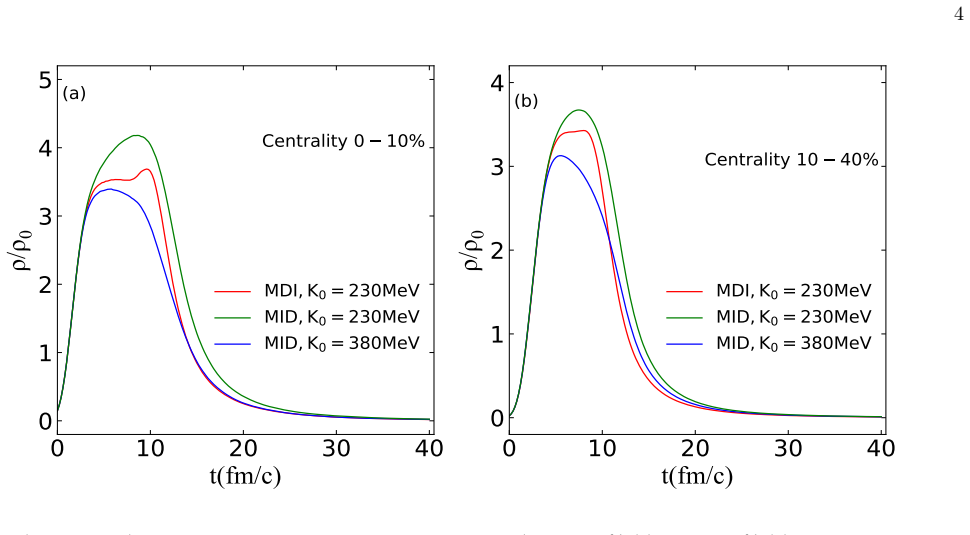
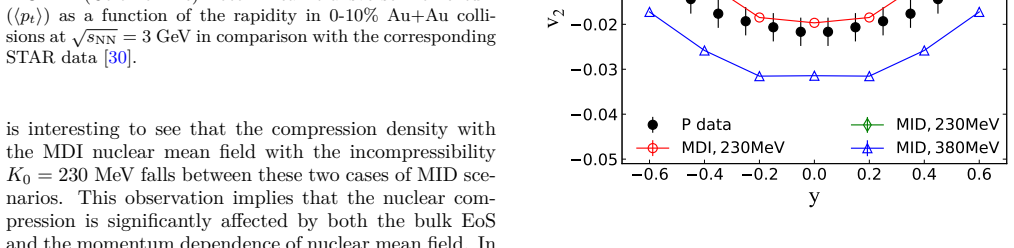
Within the extended isospin- and momentum-dependent Boltzmann-Uehling-Uhlenbeck transport model, the momentum-dependent nuclear mean field with incompressibility K0=230 MeV reproduces the measured transverse-momentum spectra, mean transverse momenta, directed flows, and elliptic flows of protons, K+ mesons, and Lambda hyperons in Au+Au collisions at √s_NN=3 GeV, whereas the corresponding momentum-independent mean fields with K0=230 MeV and K0=380 MeV describe the same observables only partially.
What carries the argument
The parametrization of the momentum-dependent nuclear mean field inside the extended isospin- and momentum-dependent BUU transport model, which supplies both the potential energy and the momentum-dependent forces that govern particle propagation and scattering.
If this is right
- Nuclear equation-of-state studies at low beam energies must incorporate momentum dependence to be consistent with measured collective flows.
- Proton and kaon directed and elliptic flows at 3 GeV become direct probes of the momentum structure of the nuclear potential.
- Lambda hyperon flow data supply an independent check that the same momentum-dependent mean field also governs strange-particle dynamics.
- The soft incompressibility K0=230 MeV paired with momentum dependence is favored over the stiff K0=380 MeV option for this energy regime.
Where Pith is reading between the lines
- Similar momentum dependence may be needed when the same transport framework is applied to slightly higher or lower beam energies to maintain consistency across the low-energy domain.
- If the momentum-dependent mean field alters the effective stiffness felt by nucleons, it could shift the inferred pressure at densities relevant to the cores of neutron stars.
- Future precision measurements of higher-order flow harmonics or of K- mesons could test whether the same parametrization remains valid once more channels are included.
Load-bearing premise
The chosen parametrization of the momentum-dependent mean field inside the BUU code already contains all the essential nuclear physics that governs the observables, with no large missing contributions from three-body forces or in-medium changes omitted by the model.
What would settle it
A new transport calculation or a re-analysis of the same STAR data that includes three-body forces or different in-medium modifications and finds that a momentum-independent mean field then fits the spectra and flows equally well would show that momentum dependence is not required.
Figures





read the original abstract
Within an extended isospin- and momentum-dependent Boltzmann-Uehling-Uhlenbeck transport model, we study the protons, $K^+$ mesons and $\Lambda$ hyperons production in Au+Au collisions at $\sqrt{s_{\rm NN}}=3$ GeV. For the collision in 0-10% centrality, we study the transverse momentum spectra and rapidity dependent mean transverse momentum for protons. For the collision in 10-40% centrality, we study the directed and elliptic flows for protons and $K^+$ mesons. The results show that the momentum-dependent nuclear mean field with an incompressibility $K_0=230$ MeV can fit fairly the STAR experimental data, while the momentum-independent nuclear mean field with both $K_0=230$ MeV and $K_0=380$ MeV can only partially describe the experimental results. In addition, we also study the directed and elliptic flows for the associated $\Lambda$, observations reveal the same conclusions as for kaons. These findings indicate that the momentum dependence of nuclear mean field plays a significant role in understanding nuclear matter properties in heavy-ion collisions at $\sqrt{s_{\rm NN}}=3$ GeV.
Editorial analysis
A structured set of objections, weighed in public.
Referee Report
Summary. The manuscript applies an extended isospin- and momentum-dependent BUU transport model to Au+Au collisions at √s_NN=3 GeV. For 0-10% centrality it computes proton pT spectra and rapidity-dependent <pT>; for 10-40% centrality it computes directed and elliptic flows of protons, K+ mesons, and Λ hyperons. The central claim is that the momentum-dependent mean field with K0=230 MeV reproduces the STAR data reasonably well, while the momentum-independent mean field with K0=230 MeV and K0=380 MeV only partially describes the same observables, implying that momentum dependence of the nuclear mean field is essential for understanding nuclear matter properties at this energy.
Significance. If the comparison holds after addressing parameter isolation, the work would strengthen the case for momentum-dependent potentials in transport models at low beam energies, where moderate densities are probed and collective flows are sensitive to the mean field. The multi-observable test (spectra plus flows for several species) is a positive feature. However, because K0 is tuned to data and only two MI cases are shown, the result is more of a consistency check than a strong constraint on the EOS; its broader significance for nuclear physics therefore remains moderate.
major comments (2)
- [Abstract and results section] Abstract and results comparison: K0=230 MeV is selected for the momentum-dependent case specifically to achieve fair agreement with STAR data. This choice makes the reported improvement partly by construction. To substantiate that momentum dependence itself (rather than the particular stiffness at high density) drives the better description, the manuscript must either vary K0 systematically in the momentum-independent case or demonstrate that no reasonable K0 value in the independent parametrization can reach the same fit quality.
- [Model and results sections] Model and results sections: Only two discrete K0 values (230 MeV and 380 MeV) are tested for the momentum-independent mean field. This limited sampling does not isolate momentum dependence from possible differences in the high-density equation of state. A broader scan or explicit comparison of the density dependence of the mean field (e.g., via the effective mass or pressure at 2–3 ρ0) is required to rule out that the observed differences in pT spectra and flows arise from stiffness variations rather than the momentum-dependent term.
minor comments (3)
- The manuscript would benefit from a quantitative table (or text summary) of fit quality metrics such as χ² per degree of freedom for each observable and each mean-field scenario.
- [Model section] Clarify in the model section whether the same collision term, resonance dynamics, and in-medium kaon potentials are used identically across all three mean-field variants; any compensating differences would affect the attribution of improvement to momentum dependence.
- [Model section] Add a brief discussion of how the chosen Skyrme-type parametrization for the momentum-dependent field compares to other common forms in the literature (e.g., different effective-mass values or three-body force implementations).
Simulated Author's Rebuttal
We thank the referee for the careful reading of our manuscript and the constructive comments. We respond to each major comment point by point below, and indicate the revisions we will make to address the concerns.
read point-by-point responses
-
Referee: [Abstract and results section] Abstract and results comparison: K0=230 MeV is selected for the momentum-dependent case specifically to achieve fair agreement with STAR data. This choice makes the reported improvement partly by construction. To substantiate that momentum dependence itself (rather than the particular stiffness at high density) drives the better description, the manuscript must either vary K0 systematically in the momentum-independent case or demonstrate that no reasonable K0 value in the independent parametrization can reach the same fit quality.
Authors: The value of K0 = 230 MeV corresponds to the well-established incompressibility of nuclear matter at saturation density and is commonly adopted in transport calculations. Our primary goal was to compare the momentum-dependent (MD) and momentum-independent (MI) mean fields using this standard value, supplemented by a stiffer MI case with K0 = 380 MeV. The fact that the MD model with K0 = 230 MeV describes the data better than both MI cases suggests that the momentum dependence is crucial. Nevertheless, to directly address the referee's concern, we will perform additional simulations in the revised manuscript using the MI mean field with an intermediate K0 value of 300 MeV. This will allow us to show that varying the stiffness within the MI framework does not achieve the same level of agreement with the STAR data as the MD model. revision: yes
-
Referee: [Model and results sections] Model and results sections: Only two discrete K0 values (230 MeV and 380 MeV) are tested for the momentum-independent mean field. This limited sampling does not isolate momentum dependence from possible differences in the high-density equation of state. A broader scan or explicit comparison of the density dependence of the mean field (e.g., via the effective mass or pressure at 2–3 ρ0) is required to rule out that the observed differences in pT spectra and flows arise from stiffness variations rather than the momentum-dependent term.
Authors: We acknowledge that testing only two K0 values for the MI case limits the ability to fully disentangle the effects. A complete scan of K0 would be computationally demanding given the nature of the transport simulations. As an alternative that directly addresses the referee's suggestion, we will include in the revised manuscript an explicit comparison of the density-dependent mean field potential, effective mass, and pressure for the MD and MI cases at K0 = 230 MeV, evaluated at densities up to 3ρ0. This comparison will illustrate the distinct high-density behavior introduced by the momentum dependence, which cannot be reproduced by adjusting K0 in the MI parametrization alone. We believe this will clarify that the improved description arises from the momentum-dependent term. revision: yes
Circularity Check
No significant circularity; model comparison to external data is self-contained.
full rationale
The paper's central chain consists of running an extended isospin- and momentum-dependent BUU transport model (with standard parametrizations for the mean field) to compute pT spectra, <pT>(y), and flows for protons, K+, and Λ in Au+Au at 3 GeV, then comparing those outputs directly to STAR experimental data. The three cases (momentum-dependent with K0=230 MeV, momentum-independent with K0=230 MeV, and momentum-independent with K0=380 MeV) are standard choices drawn from the nuclear EOS literature rather than fitted to the present dataset. No equation or section reduces a claimed result to a parameter fit by construction, nor does any load-bearing premise rest solely on self-citation whose content is unverified. The conclusion that momentum dependence improves agreement is therefore an empirical comparison against an external benchmark, not a tautology.
Axiom & Free-Parameter Ledger
free parameters (1)
- K0 =
230 MeV
axioms (1)
- domain assumption The isospin- and momentum-dependent BUU transport model accurately describes the dynamics of heavy-ion collisions at 3 GeV.
Reference graph
Works this paper leans on
-
[2]
Y. Lim, J.W. Holt, Neutron Star Tidal Deformabili- ties Constrained by Nuclear Theory and Experiment. Phys. Rev. Lett. 121, 062701(2018). https://doi.org/ 10.1103/PhysRevLett.121.062701
-
[3]
A.W. Steiner, M. Prakash, J.M. Lattimer et al ., Isospin asymmetry in nuclei and neutron stars. Phys. Rep. 411, 325(2005). https://doi.org/10.1016/j.physrep. 2005.02.004
-
[4]
B.A. Li, L.W. Chen, C.M. Ko, Recent progress and new challenges in isospin physics with heavy-ion reactions. Phys. Rep. 464, 113(2008). https://doi.org/10.1016/ j.physrep.2008.04.005
2008
-
[5]
I. Tews, J. Margueron, S. Reddy, Critical examination of constraints on the equation of state of dense matter ob- tained from GW170817. Phys. Rev. C 98, 045804(2018). https://doi.org/10.1103/PhysRevC.98.045804
-
[6]
Properties of hot and dense matter from relativistic heavy ion collisions,
P. Braun-Munzinger, V. Koch, T. Schäfer et al ., Proper- ties of hot and dense matter from relativistic heavy ion collisions. Phys. Rep. 621, 76(2016). https://doi.org/ 10.1016/j.physrep.2015.12.003
-
[7]
H. Yu, D.Q. Fang, Y.G. Ma, Investigation of the symmetry energy of nuclear matter us- 8 ing isospin-dependent quantum molecular dy- namics. Nucl. Sci. Tech. 31, 61(2020). https: //doi.org/10.1007/s41365-020-00766-x
-
[8]
Poskanzer, S.A
A.M. Poskanzer, S.A. Voloshin, Methods for analyz- ing anisotropic flow in relativistic nuclear collisions. Phys. Rev. C 58, 1671(1998). https://doi.org/10. 1103/PhysRevC.58.1671
1998
-
[9]
Y. Nara, A. Ohnishi, Mean-field update in the JAM mi- croscopic transport model: Mean-field effects on collec- tive flow in high-energy heavy-ion collisions at √sN N = 2 − 20 GeV. Phys. Rev. C 105, 014911(2022). https: //doi.org/10.1103/PhysRevC.105.014911
-
[10]
P. Danielewicz, Roy A. Lacey, P.B. Gossiaux et al ., Dis- appearance of Elliptic Flow: A New Probe for the Nu- clear Equation of State. Phys. Rev. Lett. 81, 2438(1998). https://doi.org/10.1103/PhysRevLett.81.2438
-
[11]
V. N. Russkikh, Yu. B. Ivanov, Collective flow in heavy- ion collisions for Elab = 1 − 160 GeV/nucleon. Phys. Rev. C 74, 034904(2006). https://doi.org/10.1103/ PhysRevC.74.034904
2006
-
[12]
Y.J. Zhou, S. Gläßel, Y.H. Leung et al ., Probing the nuclear equation of state with clusters and hypernuclei. Phys. Rev. C 113,014909(2026). https://doi.org/10. 1103/3msm-wrxd
2026
-
[13]
Heinz, R
U. Heinz, R. Snellings, Collective Flow and Viscos- ity in Relativistic Heavy-Ion Collisions. Rev. Nucl. Part. Sci 63, 123(2013). https://doi.org/10.1146/ annurev-nucl-102212-170540
2013
-
[14]
Danielewicz, R
P. Danielewicz, R. Lacey, and W. G. Lynch, Science 298, 1952 (2002)
1952
-
[15]
H. Stöcker, W. Greiner, High energy heavy ion collisions- probing the equation of state of highly excited hardronic matter. Phys. Rep. 137, 277(1986). https://doi.org/ 10.1016/0370-1573(86)90131-6
-
[16]
Q. Pan, P. Danielewicz, From sideward flow to nuclear compressibility. Phys. Rev. Lett. 70, 3523(1993). https: //doi.org/10.1103/PhysRevLett.70.2062
-
[17]
J.M. Zhang, S.D. Gupta, C. Gale, Momentum-dependent nuclear mean fields and collective flow in heavy-ion col- lisions. Phys. Rev. C 50, 1617(1994). https://doi.org/ 10.1103/PhysRevC.50.1617
-
[18]
K. Aamodt, B. Abelev, A. Abrahantes Quintana et al. (ALICE Collaboration), Elliptic Flow of Charged Particles in Pb-Pb Collisions at √sN N = 2 .76 TeV. Phys. Rev. lett. 105, 252302(2010). https://doi.org/ 10.1103/PhysRevLett.105.252302
-
[19]
L. Adamczyk, J.K. Adkins, G. Agakishiev et al . (STAR Collaboration), Beam-Energy Dependence of the Di- rected Flow of Protons, Antiprotons, and Pions in Au+Au Collisions. Phys. Rev. Lett. 112, 162301(2014). https://doi.org/10.1103/PhysRevLett.112.162301
-
[20]
A. Andronic, V. Barret, Z. Basrak et al . (FOPI Collab- oration), Excitation function of elliptic flow in Au + Au collisions and the nuclear matter equation of state. Phys. Lett. B 612, 173(2005). https://doi.org/10.1016/j. physletb.2005.02.060
work page doi:10.1016/j 2005
-
[21]
J. Chance, S. Albergo, F. Bieser et al . (The EOS Collab- oration), The Energy Dependence of Flow in Ni Induced Collisions from 400A to 197A MeV. Phys. Rev. lett. 78, 2535 (1997). https://doi.org/10.1103/PhysRevLett. 78.2535
-
[22]
L.P. Csernai, D. Röhrich, Third flow component as QGP signal. Phys. Lett. B 458, 454(1999). https://doi.org/ 10.1016/S0370-2693(99)00615-2
-
[23]
A. Li, G.C. Yong, Y.X. Zhang, Testing the phase tran- sition parameters inside neutron stars with the produc- tion of protons and lambdas in relativistic heavy-ion col- lisions. Phy. Rev. D, 107, 043005(2023). https://doi. org/10.1103/PhysRevD.107.043005
-
[24]
S.N. Wei, Z.Q. Feng, Properties of collective flow and pion production in intermediate-energy heavy-ion colli- sions with a relativistic quantum molecular dynamics model. Nucl. Sci. Tech. 35, 15(2024). https://doi.org/ 10.1007/s41365-024-01380-x
-
[25]
C. Gale, G. Bertsch, S.D. Gupta, Heavy-ion collision theory with momentum-dependent interactions. Phys. Rev. C 35, 1666(1987). https://doi.org/10.1103/ PhysRevC.35.1666
1987
-
[26]
M. Isse, A. Ohnishi, N. Otuka et al ., Mean-field effects on collective flow in high-energy heavy-ion collisions at 2 − 158A GeV energies. Phys. Rev. C 72, 064908(2005). https://doi.org/10.1103/PhysRevC.72.064908
-
[27]
Y. Nara, N. Otuka, A. Ohnishi et al ., Relativistic nuclear collisions at 10A GeV energies from p+Be to Au+Au with the hadronic cascade model. Phys. Rev. C 61, 024901(1999). https://doi.org/10.1103/ PhysRevC.61.024901
1999
-
[28]
J. Weil, V. Steinberg, J. Staudenmaier et al ., Parti- cle production and equilibrium properties within a new hadron transport approach for heavy-ion collisions. Phys. Rev. C 94, 054905(2016). https://doi.org/10.1103/ PhysRevC.94.054905
2016
-
[29]
M.S. Abdallah, B.E. Aboona, J. Adam et al . (STAR Collaboration), Disappearance of partonic collectivity in √sNN = 3 GeV Au+Au collisions at RHIC. Phys. Lett. B 827, 137003(2022). https://doi.org/10.1016/ j.physletb.2022.137003
-
[30]
M.I. Abdulhamid, B.E. Aboona, J. Adam et al . (STAR Collaboration), Production of protons and light nuclei in Au + Au collisions at √sN N = 3 GeV with the STAR detector. Phys. Rev. C 110, 054911(2024). https://doi. org/10.1103/PhysRevC.110.054911
-
[31]
M. Kozhevnikova, Yu.B. Ivanov, Light-nuclei produc- tion in Au+Au collisions at √sN N = 3 GeV within a thermodynamical approach: Bulk properties and col- lective flow. Phys. Rev. C 109, 014913(2024). https: //doi.org/10.1103/PhysRevC.109.014913
-
[32]
Das, S.D
C.B. Das, S.D. Gupta, C. Gale et al ., Momentum dependence of symmetry potential in asymmetric nu- clear matter for transport model calculations. Phys. Rev. C 67, 034611(2003). https://doi.org/10.1103/ PhysRevC.67.034611
2003
-
[33]
B.A. Li, C.B. Das, S.D. Gupta et al ., Momentum de- pendence of the symmetry potential and nuclear re- actions induced by neutron-rich nuclei at RIA. Phys. Rev. C 69, 011603(2004). https://doi.org/10.1103/ PhysRevC.69.011603
2004
-
[34]
L.W. Chen, C.M. Ko, B.A. Li, Determination of the Stiffness of the Nuclear Symmetry Energy from Isospin Diffusion. Phys. Rev. Lett. 94, 032701(2005). https: //doi.org/10.1103/PhysRevLett.94.032701
-
[35]
Wei, Y.L
G.F. Wei, Y.L. Zhao, Kaon production in the HADES experiment in Au+Au collisions at √sN N = 2 .4 GeV. Phys. Rev. C 110, 054615(2024). https://doi.org/10. 1103/PhysRevC.110.054615
2024
-
[36]
Bertsch, S.D
G.F. Bertsch, S.D. Gupta, A guide to microscopic models for intermediate energy heavy ion collisions. Phys. Rep. 160, 189(1988). https://doi.org/10.1016/ 9 0370-1573(88)90170-6
1988
-
[37]
V. Baran, M. Colonna, V. Greco et al ., Reaction dy- namics with exotic nuclei. Phys. Rep. 410, 335(2005). https://doi.org/10.1016/j.physrep.2004.12.004
-
[38]
B.A. Li, Andrew T. Sustich, M. Tilley et al., Probing me- chanical and chemical instabilities in neutron-rich mat- ter. Nucl. Phys. A 699, 493(2002). https://doi.org/ 10.1016/S0375-9474(01)01291-X
-
[40]
B.A. Li, C.M. Ko, Formation of superdense hadronic matter in high energy heavy-ion collisions. Phys. Rev. C 52, 2037(1995). https://doi.org/10.1103/PhysRevC. 52.2037
-
[41]
Gy. Wolf, W. Cassing, U. Mosel, Eta and dilepton production in heavy-ion reactions. Nucl. Phys. A 552, 549(1993). https://doi.org/10.1016/0375-9474(93) 90285-6
-
[42]
Baldini, V
Total Cross sections for Reactions of High Energy Parti- cles, edited by A. Baldini, V. Flaminio, W.G. Moorhead et al .,(Springer-Verlag, Berlin, 1988)
1988
-
[43]
Effects of the formation time of parton shower on jet quenching in heavy-ion collisions.Chin
K.A. Olive, Review of Particle Physics. Chin. Phys. C 38, 090001(2014). https://doi.org/10.1088/1674-1137/ 38/9/090001
-
[44]
V. Kireyeu, V. Voronyuk, M. Winn et al ., Constraints on the equation-of-state from low energy heavy-ion col- lisions within the PHQMD microscopic approach with momentum-dependent potential. arXiv: 2411.04969. https://doi.org/10.48550/arXiv.2411.04969
work page internal anchor Pith review Pith/arXiv arXiv doi:10.48550/arxiv.2411.04969
-
[45]
Hillmann, J
P. Hillmann, J. Steinheimer, T. Reichert et al ., First, second, third and fourth flow harmonics of deuterons and protons in Au+Au reactions at 1.23A GeV. Nucl. Part. Phys. 47, 055101(2020). https://doi.org/10. 1088/1361-6471/ab6fcf
2020
-
[46]
Chen, C.M
L.W. Chen, C.M. Ko, B.A. Li, Light clusters produc- tion as a probe to nuclear symmetry energy. Phys. Rev. C 68, 017601(2003). https://doi.org/10.1103/ PhysRevC.68.017601
2003
-
[47]
Fang, Y.G
L.M. Fang, Y.G. Ma, S. Zhang, Simulation of col- lective flow of protons and deuterons in Au + Au collisions at Ebeam = 1 .23A GeV with the isospin- dependent quantum molecular dynamics model. Phys. Rev. C 107, 044904(2023). https://doi.org/10.1103/ PhysRevC.107.044904
2023
-
[48]
Chen, X.F
J. Chen, X.F. Luo, F. Liu et al., Effects of mean-field and softening of equation of state on elliptic flow in Au+Au collisions at √sNN = 5 GeV from the JAM model. Chin. Phys. C 42, 024001(2018). https://doi.org/10.1088/ 1674-1137/42/2/024001
2018
-
[49]
C. Zhang, J. Chen, X.F. Luo et al ., Beam energy de- pendence of the squeeze-out effect on the directed and elliptic flow in Au+ Au collisions in the high baryon density region. Phys. Rev. C 97, 064913(2018). https: //doi.org/10.1103/PhysRevC.97.064913
-
[50]
Aichelin, C
J. Aichelin, C. M. Ko, Subthreshold Kaon Production as a Probe of the Nuclear Equation of State. Phys. Rev. Lett. 55, 2661(1985). https://doi.org/10.1103/ PhysRevLett.55.2661
1985
-
[51]
C. Fuchs, A. Faessler, E. Zabrodin et al ., Probing the Nuclear Equation of State by K + Production in Heavy- Ion Collisions. Phys. Rev. Lett. 86, 1974(2001). https: //doi.org/10.1103/PhysRevLett.86.1974
-
[52]
C. Hartnack, H. Oeschler, Y. Leifels et al ., Strangeness production close to the threshold in proton-nucleus and heavy-ion collisions. Phys. Rep. 510, 119(2012). https: //doi.org/10.1016/j.physrep.2011.08.004
-
[53]
Moszkowski, Energy of neutron-star matter
S.A. Moszkowski, Energy of neutron-star matter. Phys. Rev. D 9, 1613(1974). https://doi.org/10.1103/ PhysRevD.9.1613
1974
-
[54]
Chung, N.N
P. Chung, N.N. Ajitanand, J.M. Alexander et al ., Directed Flow of Λ Hyperons in (2-6) A GeV. Phys. Rev. Lett. 86, 2533(2001). https://doi.org/10.1103/ PhysRevLett.86.2533
2001
-
[55]
Yong, B.A
G.C. Yong, B.A. Li, Z.G. Xiao et al ., Probing the high- density nuclear symmetry energy with the Ξ−/Ξ0 ra- tio in heavy-ion collisions at √sN N ≈ 3 GeV. Phys. Rev. C 106, 024902(2022). https://doi.org/10.1103/ PhysRevC.106.024902
2022
discussion (0)
Sign in with ORCID, Apple, or X to comment. Anyone can read and Pith papers without signing in.