Recognition: unknown
To stall-cell or not to stall-cell: Variational data assimilation of 3D mean flow past a stalled airfoil
Pith reviewed 2026-05-07 07:01 UTC · model grok-4.3
The pith
Sparse planar measurements suffice to reconstruct three-dimensional stall cells on a stalled airfoil.
A machine-rendered reading of the paper's core claim, the machinery that carries it, and where it could break.
Core claim
The authors establish that three-dimensional variational data assimilation within the field inversion framework, driven by the Spalart-Allmaras Reynolds-averaged Navier-Stokes model as background, reconstructs the full three-dimensional mean flow past a stalled NACA 0012 airfoil at 14 degrees angle of attack from two-component mean velocity data on one or two spanwise planes. A single plane recovers the essential stall-cell features including counter-rotating vortices around focal points on the suction surface. The lowest error occurs when two nearby planes that exhibit different separation extents are assimilated, with data placement and boundary conditions together determining the inferred
What carries the argument
Three-dimensional variational (3DVar) data assimilation in the field inversion framework that augments the Spalart-Allmaras RANS model with sparse planar PIV data to infer the unobserved three-dimensional stall-cell structures.
Load-bearing premise
The Spalart-Allmaras RANS turbulence model supplies a sufficiently accurate prior for the mean flow in the massively separated post-stall regime so that the variational assimilation can correctly infer the unobserved three-dimensional stall-cell structure from the sparse planar measurements.
What would settle it
Independent three-dimensional velocity measurements or high-fidelity simulations of the identical configuration that show the reconstructed stall cell lacks counter-rotating vortices around the focal points on the suction surface would falsify the central claim.
Figures







read the original abstract
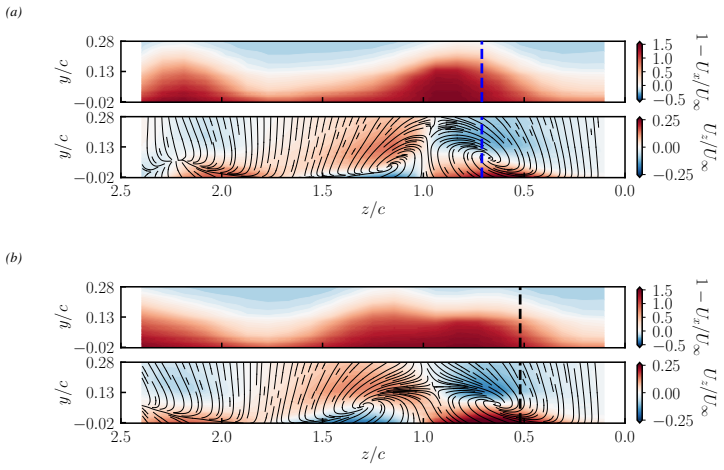
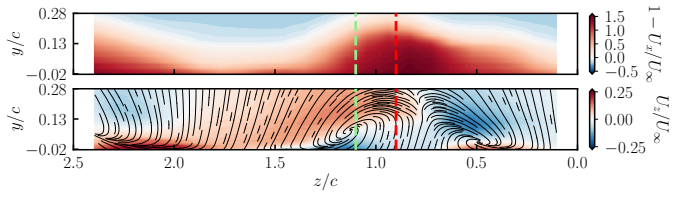
The full-field reconstruction of three-dimensional (3D) turbulent flows from sparse experimental measurements remains a significant challenge, particularly for flows exhibiting complex 3D flow separation. In this work, we address this challenge for the case of stall cells - spanwise coherent structures that form on the suction surface of wings at post-stall conditions. Planar particle image velocimetry (PIV) experiments are performed on a NACA 0012 wing at a chord-based Reynolds number of $Re_c \approx 450{,}000$ and angle of attack $\alpha = 14^\circ$, acquiring two-component mean velocity data on four spanwise planes. The experimental data show clear spanwise variation in the extent of the separation and flow dynamics, consistent with the presence of stall cells. Three-dimensional variational (3DVar) data assimilation (DA) within the field inversion framework is then employed to reconstruct the full 3D mean flow field by augmenting these sparse planar measurements with the Spalart--Allmaras (SA) Reynolds-averaged Navier--Stokes (RANS) turbulence model. The performance of the reconstruction is assessed on planes not used in the assimilation. It is shown that a single plane of sparse experimental data is sufficient to recover the essential features of a stall cell, including counter-rotating vortices around focal points on the suction surface. The lowest reconstruction error is obtained when two planes of data that are close together but exhibit markedly different separation extents are used, and the complementary roles of the reference data placement and the computational boundary conditions in shaping the reconstructed stall cell structure are explained. These results demonstrate the capability of 3DVar DA to reconstruct the full 3D physics of stall cells from two-component velocity data acquired on select spanwise planes.
Editorial analysis
A structured set of objections, weighed in public.
Referee Report
Summary. The manuscript applies 3D variational data assimilation (3DVar) in a field-inversion framework to reconstruct the full three-dimensional mean flow around a NACA 0012 airfoil at Re_c ≈ 450,000 and α = 14° from two-component planar PIV data acquired on one or more spanwise planes. The reconstruction augments the sparse experimental velocity measurements with the Spalart–Allmaras RANS model as background. The central claim is that a single assimilation plane suffices to recover the essential stall-cell features (counter-rotating vortices around focal points on the suction surface), that two closely spaced planes with differing separation extents yield the lowest reconstruction error, and that validation on held-out planes confirms recovery of these structures. The roles of data placement and computational boundary conditions are discussed.
Significance. If the reconstruction is demonstrably data-dominated rather than prior-dominated, the work would show that standard RANS-based 3DVar can usefully infer three-dimensional separated-flow topology from minimal planar measurements, a capability of practical value for experimental aerodynamics. The approach is non-circular: assimilation uses independent PIV planes and a standard external RANS model, with validation performed on held-out planes. No machine-checked proofs or parameter-free derivations are present, but the study supplies a concrete, falsifiable test (held-out-plane recovery of stall-cell vortices) that can be assessed quantitatively.
major comments (2)
- [Abstract and §4] Abstract and §4 (validation results): the claim that a single plane recovers 'essential features of a stall cell' and that two-plane assimilation yields 'lowest error' is presented without any quantitative error metrics (L2 velocity norms, correlation coefficients, or separation-line error) on the held-out planes. Only qualitative statements about recovered focal points and vortices are given, so the strength of the central claim cannot be evaluated.
- [Methods (§2) and Discussion] Methods (§2, 3DVar formulation) and Discussion: the Spalart–Allmaras RANS model is adopted as the background without any assessment of its documented deficiencies in massively separated post-stall flow (incorrect chordwise separation location and inability to sustain spanwise-coherent stall cells in the absence of forcing). Because the optimizer can therefore produce counter-rotating vortices on distant planes that are dictated by the RANS closure and boundary conditions rather than by the data, the assertion that 'a single plane of sparse experimental data is sufficient' to recover the true 3D stall-cell structure remains unproven.
minor comments (2)
- [Abstract] The abstract states that 'two-plane assimilation yields lowest error' but does not define the error metric or report its numerical values.
- [Methods] The free parameters (data-assimilation weighting coefficients) are mentioned but their specific values and sensitivity are not tabulated or discussed in the results.
Simulated Author's Rebuttal
We thank the referee for the thorough and constructive review. The comments identify key areas where the manuscript can be strengthened through additional quantitative analysis and explicit discussion of the background model limitations. We address each major comment below and will revise the manuscript accordingly.
read point-by-point responses
-
Referee: [Abstract and §4] Abstract and §4 (validation results): the claim that a single plane recovers 'essential features of a stall cell' and that two-plane assimilation yields 'lowest error' is presented without any quantitative error metrics (L2 velocity norms, correlation coefficients, or separation-line error) on the held-out planes. Only qualitative statements about recovered focal points and vortices are given, so the strength of the central claim cannot be evaluated.
Authors: We agree that quantitative metrics are required to rigorously support the central claims. In the revised manuscript we will add L2 velocity norms, Pearson correlation coefficients, and separation-line location errors evaluated on all held-out planes for the single-plane and two-plane assimilation cases. These metrics will be presented alongside the existing qualitative descriptions of focal points and counter-rotating vortices, allowing direct assessment of reconstruction accuracy and confirmation that two closely spaced planes with differing separation extents produce the lowest error. revision: yes
-
Referee: [Methods (§2) and Discussion] Methods (§2, 3DVar formulation) and Discussion: the Spalart–Allmaras RANS model is adopted as the background without any assessment of its documented deficiencies in massively separated post-stall flow (incorrect chordwise separation location and inability to sustain spanwise-coherent stall cells in the absence of forcing). Because the optimizer can therefore produce counter-rotating vortices on distant planes that are dictated by the RANS closure and boundary conditions rather than by the data, the assertion that 'a single plane of sparse experimental data is sufficient' to recover the true 3D stall-cell structure remains unproven.
Authors: We acknowledge the well-documented limitations of the Spalart–Allmaras model in massively separated post-stall regimes, including premature separation and difficulty sustaining three-dimensional stall cells without external forcing. The revised manuscript will include an explicit assessment of these deficiencies in §2 together with an expanded Discussion section. To demonstrate that the reconstructions are data-dominated rather than prior-dominated, we will add a direct comparison of the baseline (unassimilated) RANS solution against the 3DVar results, showing that stall-cell structures are absent or markedly weaker without data. The held-out-plane validation results already indicate that information from the assimilation planes propagates to recover experimentally observed features on distant planes; we will emphasize the complementary roles of data placement and computational boundary conditions in this propagation. We will also revise the abstract and conclusions to present a more qualified statement on the sufficiency of a single plane. revision: partial
Circularity Check
No circularity: reconstruction driven by independent held-out validation planes
full rationale
The paper performs 3DVar assimilation of sparse planar PIV velocity data into the SA RANS equations on selected spanwise planes, then evaluates the resulting 3D mean-flow field on separate held-out planes that were never included in the cost functional. Because the validation metric is computed on data withheld from the optimization, agreement on those planes is an out-of-sample test rather than a tautology. No step equates a fitted parameter to a claimed prediction, renames a known result, or reduces the central claim to a self-citation chain; the SA RANS prior and the experimental measurements remain distinct inputs whose combination is assessed externally.
Axiom & Free-Parameter Ledger
free parameters (1)
- Data-assimilation weighting parameters
axioms (2)
- domain assumption The time-averaged flow satisfies the steady incompressible RANS equations closed by the Spalart-Allmaras turbulence model.
- domain assumption The planar PIV measurements accurately represent the true mean velocity components on those planes.
Reference graph
Works this paper leans on
-
[1]
An open-source adjoint-based field inversion tool for data-driven RANS modelling, in: AIAA aviation 2022 forum, p
2022
-
[2]
Turbulent flows. Meas. Sci. Technol. 12, 2020–2021. Sagebaum, M., Albring, T., Gauger, N.,
2020
-
[3]
Effects of integral length scale variations on the stall characteristics of a wing at high free-stream turbulence conditions. J. Fluid Mech. 974, A9. doi:10.1017/jfm.2023.789. Thompson, C., Cadambi Padmanaban, U., Ganapathisubramani, B., Symon, S.,
-
[4]
Mixed data-source transfer learning for a turbulence model augmented physics-informed neural network.arXiv:2601.04921. Weihs, D., Katz, J.,
discussion (0)
Sign in with ORCID, Apple, or X to comment. Anyone can read and Pith papers without signing in.