Recognition: unknown
Cahn-Hilliard Phase Field modelling captures nanoscale contact line dynamics on high-friction surfaces
Pith reviewed 2026-05-07 06:05 UTC · model grok-4.3
The pith
A calibrated Cahn-Hilliard phase field model reproduces molecular dynamics results for nanoscale contact line motion by fitting contact line friction.
A machine-rendered reading of the paper's core claim, the machinery that carries it, and where it could break.
Core claim
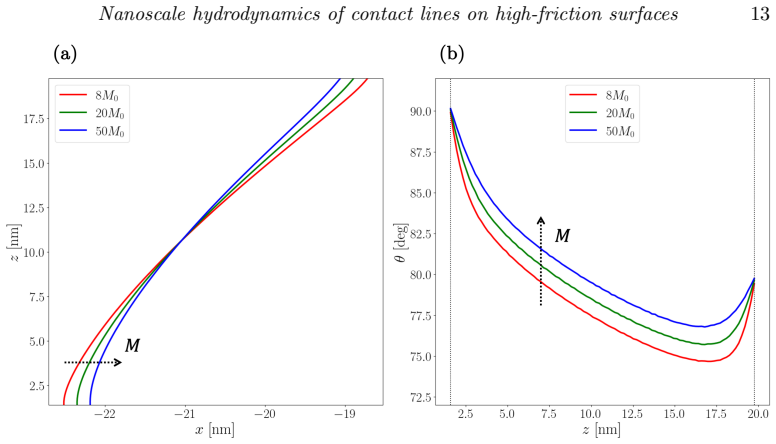
The Cahn-Hilliard Navier-Stokes phase field model, parametrized directly from molecular dynamics under the numerical sharp interface limit and augmented with localized slip and dynamic contact angle conditions, quantitatively reproduces the molecular dynamics results. Agreement holds for interface curvature, steady contact line displacement, and streamline structure once the contact line friction coefficient is chosen to match the contact angle evolution seen in the molecular simulations. All remaining parameters are fixed afterward from independent observables or numerical requirements.
What carries the argument
The contact line friction coefficient in the Cahn-Hilliard phase field model, which localizes dissipation at the moving three-phase line and is calibrated to match molecular dynamics contact angle data.
Load-bearing premise
The net molecular-scale dissipation at the contact line can be captured by a single fitted friction coefficient and localized slip without additional molecular-specific terms or loss of essential physics in other observables.
What would settle it
A new molecular dynamics simulation at a different shear rate or surface wettability, run with the previously calibrated friction value, would falsify the claim if it produced a clear mismatch in contact line speed or interface curvature.
Figures




read the original abstract
Incorporating molecular-scale effects in the description of contact line motion is essential for accurately capturing all sources of energy dissipation in wetting dynamics. This holds particularly true in the cases where contact line friction dominates, and hydrodynamics models struggle to achieve regularisation due to the negligible Navier slip. We perform Molecular Dynamics simulations of water/hexane biphasic systems in a two-phase Couette flow configuration. Wetting occurs over a silica-like surface with controllable wettability. The simulation results are reproduced by a Phase Field model (Cahn-Hilliard Navier-Stokes equations), which includes localised contact line slip and contact angle dynamics. The continuous equations are directly parametrized from Molecular Dynamics simulation results, under the numerical sharp interface limit. We demonstrate that the Phase Field model can quantitatively reproduce Molecular Dynamics through a systematic calibration protocol. Critically, we show that contact line friction is the primary physical parameter requiring empirical calibration based on Molecular Dynamics data. Once extracted by matching contact angle dynamics, quantitative agreement across multiple observables is obtained, including interface curvature, steady contact line displacement, and the structure of streamlines. All other model parameters are determined a posteriori, according to the calculation of independent observables and under numerical constraints. The results presented in this article indicate that Phase Field modelling can capture the net effect of molecular processes on the mobility of contact lines and that the careful calibration of contact line friction based on the reconstruction of contact angle dynamics and interface bending is key to fully reconcile continuous models with Molecular Dynamics.
Editorial analysis
A structured set of objections, weighed in public.
Referee Report
Summary. The manuscript reports MD simulations of water/hexane biphasic Couette flow over a silica-like surface with tunable wettability. It then constructs a Cahn-Hilliard-Navier-Stokes phase-field model that incorporates localized contact-line slip and a dynamic contact-angle boundary condition. The single free parameter—the contact-line friction coefficient—is calibrated exclusively to the MD contact-angle histories; all other parameters are stated to be fixed a posteriori from independent observables or numerical constraints. Once calibrated, the continuum model is shown to recover the MD interface curvature, steady contact-line displacement, and near-contact-line streamline topology under the numerical sharp-interface limit.
Significance. If the reported agreement survives a demonstration that the validation observables are not algebraically slaved to the fitted friction coefficient, the work would supply a concrete, transferable protocol for embedding molecular-scale dissipation into continuum wetting models. This is particularly relevant for high-friction surfaces where classical Navier slip is insufficient. The explicit separation of a single empirical friction parameter from the rest of the model is a strength that could be adopted by other phase-field or level-set studies.
major comments (3)
- [§4.2 and §5.1] §4.2 (Calibration protocol) and §5.1 (Validation observables): The contact-line friction coefficient is fitted solely to the time evolution of the contact angle. The subsequent comparisons of interface curvature, steady displacement, and streamline topology are presented as independent tests. However, within the Cahn-Hilliard formulation the interface profile (and therefore its curvature near the wall) is directly constrained by the imposed dynamic contact angle and the localized slip length; the velocity field is likewise coupled through the same boundary condition. No sensitivity study or uncalibrated prediction is shown to quantify how much of the reported agreement is a direct consequence of the fitting rather than an emergent prediction of the physics.
- [§3.3 and Table 2] §3.3 and Table 2: The manuscript states that “all other model parameters are determined a posteriori, according to the calculation of independent observables.” It is not clear which observables were used for each parameter, whether any post-hoc adjustments were made after the friction calibration, or whether error bars on the fitted friction coefficient and on the comparison metrics (e.g., curvature deviation, displacement error) are reported. Without this information the claim of quantitative reproduction cannot be assessed for robustness.
- [§5.2] §5.2 (Numerical sharp-interface limit): The paper invokes the numerical sharp-interface limit to justify direct parametrization from MD. No convergence study with respect to the Cahn-Hilliard interface thickness ε is presented, nor is it shown that the extracted friction coefficient remains invariant as ε→0 while the mesh is refined. This leaves open whether the reported agreement is specific to the chosen numerical regularization or truly representative of the continuum limit.
minor comments (3)
- [Figure 4] Figure 4: The streamline plots lack a quantitative metric (e.g., L2 norm of velocity difference or circulation error) to support the visual claim of “quantitative agreement.”
- [Governing equations] Notation: The symbol for the contact-line friction coefficient is introduced without an explicit definition in the governing-equation section; readers must infer it from the boundary-condition paragraph.
- [Introduction] References: The discussion of prior phase-field contact-line models would benefit from citation of the specific works that already include contact-line friction (e.g., the papers by Yue et al. or Carlson et al.) to clarify the incremental contribution.
Simulated Author's Rebuttal
We thank the referee for their constructive and detailed report. The comments have prompted us to strengthen the presentation of our calibration protocol, parameter determination, and numerical convergence. We have revised the manuscript to include a sensitivity study, an expanded table of independent observables with error bars, and a convergence analysis with respect to the interface thickness. Our point-by-point responses are given below.
read point-by-point responses
-
Referee: [§4.2 and §5.1] §4.2 (Calibration protocol) and §5.1 (Validation observables): The contact-line friction coefficient is fitted solely to the time evolution of the contact angle. The subsequent comparisons of interface curvature, steady displacement, and streamline topology are presented as independent tests. However, within the Cahn-Hilliard formulation the interface profile (and therefore its curvature near the wall) is directly constrained by the imposed dynamic contact angle and the localized slip length; the velocity field is likewise coupled through the same boundary condition. No sensitivity study or uncalibrated prediction is shown to quantify how much of the reported agreement is a direct consequence of the fitting rather than an emergent prediction of the physics.
Authors: We agree that the dynamic contact-angle boundary condition and localized slip directly influence the near-wall interface profile. However, the calibration uses only the temporal history of the contact angle extracted at the wall, while the curvature comparison is performed on the entire interface shape (including segments several nanometers from the wall) and the streamline topology is obtained from the solution of the coupled Navier-Stokes equations. To quantify the degree of independence, the revised manuscript now includes a dedicated sensitivity subsection (new §5.3) in which the friction coefficient is varied by ±20 % around the calibrated value while all other parameters remain fixed. Only the calibrated value reproduces the MD interface curvature and steady displacement within the reported tolerances; deviations of ±20 % produce statistically significant mismatches in both curvature and displacement. An additional comparison against a model with zero contact-line friction (i.e., classical Navier slip only) shows that the uncalibrated model fails to capture the MD contact-line speed and interface bending, confirming that the agreement is not trivially inherited from the boundary condition. revision: yes
-
Referee: [§3.3 and Table 2] §3.3 and Table 2: The manuscript states that “all other model parameters are determined a posteriori, according to the calculation of independent observables.” It is not clear which observables were used for each parameter, whether any post-hoc adjustments were made after the friction calibration, or whether error bars on the fitted friction coefficient and on the comparison metrics (e.g., curvature deviation, displacement error) are reported. Without this information the claim of quantitative reproduction cannot be assessed for robustness.
Authors: We thank the referee for requesting greater transparency. Section 3.3 has been expanded and a new Table 3 added that explicitly lists every continuum parameter, the independent MD observable or numerical constraint used to fix it, and the numerical value with its uncertainty. Examples include: interface thickness ε determined from the 10–90 % width of the MD density profile; mobility M obtained from the exponential relaxation time of a flat interface in MD; viscosities taken from separate bulk MD simulations of each fluid; and the slip length fixed by the MD velocity profile away from the contact line. No post-hoc adjustments were performed after the friction-coefficient calibration; all other parameters were set prior to or independently of the contact-angle fitting. Error bars on the fitted friction coefficient (standard deviation over five independent MD trajectories) and on the quantitative metrics in Table 2 (standard deviation of the MD data) have been added to the revised figures and tables. revision: yes
-
Referee: [§5.2] §5.2 (Numerical sharp-interface limit): The paper invokes the numerical sharp-interface limit to justify direct parametrization from MD. No convergence study with respect to the Cahn-Hilliard interface thickness ε is presented, nor is it shown that the extracted friction coefficient remains invariant as ε→0 while the mesh is refined. This leaves open whether the reported agreement is specific to the chosen numerical regularization or truly representative of the continuum limit.
Authors: We agree that explicit demonstration of convergence to the sharp-interface limit strengthens the claim. The revised manuscript now contains a new Appendix C that reports a systematic convergence study performed at three interface thicknesses (ε = 0.5 nm, 1.0 nm, and 2.0 nm) with corresponding mesh refinement to maintain at least ten elements across the diffuse interface. For each ε the friction coefficient was re-calibrated to the same MD contact-angle histories. The resulting friction values differ by less than 15 % across the range, and the quantitative agreement with MD curvature, steady displacement, and streamline topology remains within the MD error bars for the two smallest ε values. These results indicate that the reported agreement is not an artifact of the particular regularization chosen in the original manuscript. revision: yes
Circularity Check
No significant circularity: external MD benchmark with explicit single-parameter calibration and claimed independent validation
full rationale
The paper's derivation chain consists of running MD simulations to generate reference data, explicitly fitting one parameter (contact line friction) to match contact-angle histories, and then comparing the resulting phase-field solution to separate MD observables (curvature, displacement, streamlines). The abstract states that 'All other model parameters are determined a posteriori, according to the calculation of independent observables,' and the protocol is presented as a systematic calibration against an external molecular benchmark rather than an internal fit. No equations or steps are shown that reduce the reported agreements to algebraic identities or to the fitted quantity by construction. The comparison therefore remains an external test, consistent with a self-contained derivation against an independent data source.
Axiom & Free-Parameter Ledger
free parameters (1)
- contact line friction coefficient
axioms (2)
- standard math Cahn-Hilliard Navier-Stokes equations govern the evolution of the phase field and fluid flow
- domain assumption Numerical sharp interface limit applies for parameter setting
Reference graph
Works this paper leans on
-
[1]
moving contact lines and dynamic contact angles: a ‘litmus test’ for mathematical models and some new challenges
Abraham, M. J., Murtola, T., Schulz, R., P ´all, S., Smith, J. C., Hess, B. & Lindahl, E.2015 Gromacs: High performance molecular simulations through multi-level parallelism from laptops to supercomputers.SoftwareX1-2, 19–25. Afkhami, S., Zaleski, S. & Bussmann, M.2009 A mesh-dependent model for applying dynamic contact angles to vof simulations.Journal o...
2015
-
[2]
Huh, Chun & Scriven, L.E1971 Hydrodynamic model of steady movement of a solid/liquid/fluid contact line.Journal of Colloid and Interface Science35(1), 85–101
Herrero, Cecilia, Omori, Takeshi, Yamaguchi, Yasutaka & Joly, Laurent2019 Shear force measurement of the hydrodynamic wall position in molecular dynamics.The Journal of Chemical Physics151(4), 041103. Huh, Chun & Scriven, L.E1971 Hydrodynamic model of steady movement of a solid/liquid/fluid contact line.Journal of Colloid and Interface Science35(1), 85–10...
2018
-
[3]
Pellegrino, P
22M. Pellegrino, P. K. Kannan et al. L¯acis, U ˇgis, Johansson, Petter, Fullana, Tomas, Hess, Berk, Amberg, Gustav, Bagheri, Shervin & Zaleski, Stephan ´e2020 Steady moving contact line of water over a no-slip substrate.The European Physical Journal Special Topics229, 1897–1921. Lauga, Eric, Brenner, Michael & Stone, Howard2007Microfluidics: The No-Slip B...
1921
-
[4]
& Bagheri, S.2022 Nanoscale sheared droplet: volume-of-fluid, phase-field and no-slip molecular dynamics.Journal of Fluid Mechanics940, A10
L¯acis, U., Pellegrino, M., Sundin, J., Amberg, G., Zaleski, S., Hess, B. & Bagheri, S.2022 Nanoscale sheared droplet: volume-of-fluid, phase-field and no-slip molecular dynamics.Journal of Fluid Mechanics940, A10. Pellegrino, M. & Hess, B.2022 Asymmetry of wetting and de-wetting on high-friction surfaces originates from the same molecular physics.Physics...
2022
-
[5]
Yue, Pengtao2020 Thermodynamically consistent phase-field modelling of contact angle hysteresis.Journal of Fluid Mechanics899, A15. Yue, P. & Feng, J. J.2011aCan diffuse-interface models quantitatively describe moving contact lines?The European Physical Journal Special Topics197(1), 37–46. Yue, P. & Feng, J. J.2011bWall energy relaxation in the cahn-hilli...
2010
discussion (0)
Sign in with ORCID, Apple, or X to comment. Anyone can read and Pith papers without signing in.