The second altermagnet candidate in organic conductors: kappa-(BEDT-TTF)₂m-HOOCC₆H₄SO₃
Pith reviewed 2026-05-07 04:52 UTC · model grok-4.3
The pith
A newly synthesized κ-type BEDT-TTF salt, κ-m-SBA, qualifies as the second altermagnet candidate in organic conductors through its near-equilateral triangular spin lattice and canted antiferromagnetic order.
A machine-rendered reading of the paper's core claim, the machinery that carries it, and where it could break.
Core claim
We have developed a novel BEDT-TTF-based organic conductor, κ-(BEDT-TTF)₂ m-HOOCC₆H₄SO₃ (κ-m-SBA), and propose it as a candidate for altermagnet. Tight-binding band calculations of κ-m-SBA provide a t'/t of 1.01 at 100 K, indicating that the spin structure is closely aligned to an equilateral triangle (t'/t=1). While most κ-type BEDT-TTF-based salts become spin liquids due to the spin frustration caused by the triangular lattice, κ-m-SBA surprisingly shows a weak ferromagnetic transition at T_N=14 K due to a canted antiferromagnetic (AFM) spin structure. Until recently, κ-(BEDT-TTF)₂Cu[N(CN)₂]Cl (κ-Cl) was the only κ-type organic conductor known to exhibit this order, and it is also the only
What carries the argument
The transfer-integral ratio t'/t in the tight-binding model of the κ-type BEDT-TTF layer, which when close to unity places the spins on a nearly equilateral triangle and permits a canted antiferromagnetic order whose symmetry produces spin splitting of the electronic bands.
If this is right
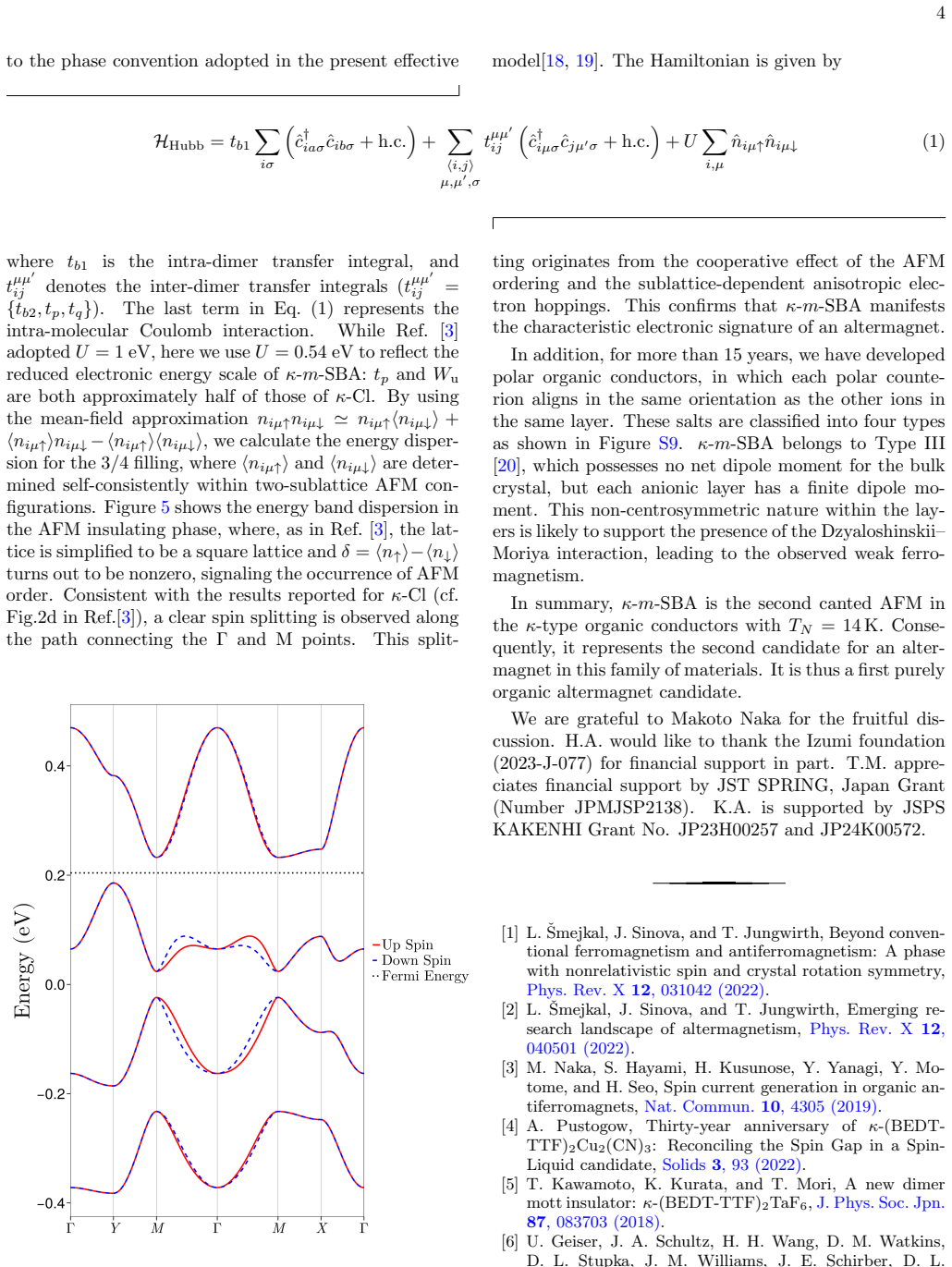
- κ-m-SBA displays spin splitting of its energy bands, a direct numerical signature of altermagnetism.
- Any other κ-type organic conductor that combines t'/t near 1 with canted antiferromagnetic order at low temperature is expected to show the same band splitting.
- The replacement of the Cu[N(CN)₂]Cl anion by m-HOOCC₆H₄SO₃⁻ supplies a second chemically distinct platform for studying altermagnetism in molecular conductors.
- The transition from spin-liquid to canted antiferromagnetic behavior when t'/t is tuned close to 1 offers a route to stabilize altermagnetic order in triangular-lattice organics.
Where Pith is reading between the lines
- Direct experimental confirmation of the predicted spin splitting, for example by angle-resolved photoemission, would move the claim from numerical to observed.
- Systematic chemical substitution around the m-SBA anion could vary t'/t continuously and map the boundary between spin-liquid and altermagnetic phases.
- The same symmetry argument used for κ-Cl and κ-m-SBA may apply to other families of frustrated organic magnets once their spin structures are known.
Load-bearing premise
The observed weak ferromagnetic transition at 14 K must arise from a canted antiferromagnetic spin structure that satisfies the altermagnetism symmetry criterion for κ-type salts with t'/t approximately equal to 1, and the tight-binding calculations must correctly predict the accompanying spin splitting.
What would settle it
A neutron-diffraction or muon-spin-rotation determination that the 14 K order is not the required canted antiferromagnetic arrangement, or a spectroscopic measurement that shows no spin splitting of the bands near the Fermi level.
Figures


read the original abstract
We have developed a novel BEDT-TTF-based organic conductor, $\kappa$-(BEDT-TTF)$_2 m$-HOOCC$_6$H$_4$SO$_3$ ($\kappa$-$m$-SBA), and propose it as a candidate for altermagnet. Tight-binding band calculations of $\kappa$-$m$-SBA provide a $t'/t$ of 1.01 at 100 K, indicating that the spin structure is closely aligned to an equilateral triangle ($t'/t= 1$). While most $\kappa$-type BEDT-TTF-based salts become spin liquids due to the spin frustration caused by the triangular lattice, $\kappa$-$m$-SBA surprisingly shows a weak ferromagnetic transition at $T_\mathrm{N} = 14$ K due to a canted antiferromagnetic (AFM) spin structure. Until recently, $\kappa$-(BEDT-TTF)$_2$Cu[N(CN)$_2$]Cl ($\kappa$-Cl) was the only $\kappa$-type organic conductor known to exhibit this order, and it is also recognized as the first candidate for altermagnetism in organic conductors. This was theoretically predicted by Naka et al. in 2019, who demonstrated that $\kappa$-type organic conductors can be candidates for altermagnetism if they display such order. Consequently, $\kappa$-$m$-SBA can be considered the second candidate for altermagnetism in organic conductors. Furthermore, numerical calculations demonstrate a characteristic of altermagnets in $\kappa$-$m$-SBA, namely spin splitting of energy bands.
Editorial analysis
A structured set of objections, weighed in public.
Referee Report
Summary. The manuscript reports the synthesis of a new κ-type BEDT-TTF organic conductor, κ-(BEDT-TTF)₂ m-HOOCC₆H₄SO₃ (κ-m-SBA). Tight-binding band calculations on its crystal structure yield t'/t = 1.01 at 100 K, close to the equilateral-triangle limit. The material exhibits a weak ferromagnetic transition at T_N = 14 K, interpreted as arising from a canted antiferromagnetic spin structure. Building on the 2019 Naka et al. framework previously applied to κ-Cl, the authors perform numerical calculations that demonstrate spin splitting of the energy bands and conclude that κ-m-SBA is the second altermagnet candidate among organic conductors.
Significance. If the canted-AFM interpretation and the associated symmetry are confirmed, the work would supply a second, chemically distinct platform for altermagnetism in κ-type organics, with a near-ideal t'/t ratio that may simplify comparison to theory. The explicit computation of spin-split bands constitutes a falsifiable prediction that could be tested by ARPES or other spectroscopies, strengthening the case for organic altermagnets as tunable spintronic materials.
major comments (3)
- [Magnetic properties section (discussion of T_N = 14 K transition)] The candidacy claim rests on the assertion that the weak ferromagnetic transition at 14 K signals a canted AFM order whose symmetry (for t'/t ≈ 1) produces altermagnetic band splitting. The manuscript provides only bulk susceptibility data for this interpretation; no neutron diffraction, μSR, or other local probe is cited to establish the ordering wavevector, spin directions, or canting angle. Without such confirmation, the link to the Naka et al. altermagnet criterion remains an untested analogy rather than a demonstrated symmetry match.
- [Crystal structure and tight-binding calculations] The tight-binding t'/t = 1.01 value is obtained from calculations performed at 100 K, well above T_N. The paper does not report low-temperature lattice parameters or recompute the ratio below 14 K; thermal contraction or anion ordering could alter t'/t in the ordered phase, directly affecting whether the symmetry condition for altermagnetism is satisfied.
- [Numerical band-structure calculations] The numerical demonstration of spin splitting presupposes the canted AFM structure. The manuscript should specify the exact magnetic configuration (propagation vector, canting angle, spin orientation relative to the lattice) used as input and show how the splitting changes or vanishes for alternative orders, so that the computed bands can be unambiguously tied to the altermagnetic mechanism.
minor comments (1)
- [Abstract] The abstract states that 'numerical calculations demonstrate a characteristic of altermagnets... spin splitting' without noting that the result assumes the canted-AFM order; a brief qualifier would improve clarity for readers unfamiliar with the Naka framework.
Simulated Author's Rebuttal
We thank the referee for the detailed and constructive review of our manuscript. We address each major comment below, indicating where revisions will be made to the next version of the paper. Our responses aim to clarify the current evidence while acknowledging limitations in the available data.
read point-by-point responses
-
Referee: The candidacy claim rests on the assertion that the weak ferromagnetic transition at 14 K signals a canted AFM order whose symmetry (for t'/t ≈ 1) produces altermagnetic band splitting. The manuscript provides only bulk susceptibility data for this interpretation; no neutron diffraction, μSR, or other local probe is cited to establish the ordering wavevector, spin directions, or canting angle. Without such confirmation, the link to the Naka et al. altermagnet criterion remains an untested analogy rather than a demonstrated symmetry match.
Authors: We agree that local probes would provide stronger direct evidence for the canted AFM structure and its symmetry. Our interpretation relies on the weak ferromagnetic moment observed in bulk susceptibility, which matches the signature previously established for canted AFM in κ-Cl (where μSR and other data support the order). We will revise the magnetic properties section to expand the discussion of the susceptibility data, including temperature and field dependence, and to explicitly reference the Naka et al. symmetry criteria. We will also note the challenges of local-probe experiments on small organic crystals. However, new measurements are outside the scope of the present study. revision: partial
-
Referee: The tight-binding t'/t = 1.01 value is obtained from calculations performed at 100 K, well above T_N. The paper does not report low-temperature lattice parameters or recompute the ratio below 14 K; thermal contraction or anion ordering could alter t'/t in the ordered phase, directly affecting whether the symmetry condition for altermagnetism is satisfied.
Authors: We acknowledge that low-temperature structural parameters would be preferable. We do not currently possess low-T X-ray data for this salt. In κ-type BEDT-TTF conductors, lattice contraction upon cooling is typically modest (a few percent), and the t'/t ratio near unity is relatively insensitive to small changes. We will add a dedicated paragraph in the crystal-structure and tight-binding section discussing the expected temperature dependence of the transfer integrals and arguing that the near-equilateral geometry remains valid below T_N. We will also suggest low-T diffraction as a worthwhile future measurement. revision: partial
-
Referee: The numerical demonstration of spin splitting presupposes the canted AFM structure. The manuscript should specify the exact magnetic configuration (propagation vector, canting angle, spin orientation relative to the lattice) used as input and show how the splitting changes or vanishes for alternative orders, so that the computed bands can be unambiguously tied to the altermagnetic mechanism.
Authors: We will revise the numerical band-structure section to state the precise magnetic configuration employed: a canted AFM order with propagation vector consistent with the κ-lattice, canting angle estimated from the observed weak moment, and spin directions aligned with the molecular planes as in the Naka et al. model. We will additionally present band calculations for alternative orders (e.g., collinear AFM without canting and ferromagnetic alignment) to illustrate that the characteristic spin splitting appears only for the altermagnetic symmetry. These additions will make the link to the altermagnetic mechanism explicit and falsifiable. revision: yes
- Direct experimental confirmation of the canted AFM order and its wavevector via neutron diffraction or μSR (requires new measurements on larger crystals).
- Low-temperature crystal-structure determination to recompute t'/t below T_N (currently unavailable).
Circularity Check
No significant circularity; derivation applies standard methods to new material and literature framework without reduction to inputs
full rationale
The paper's chain proceeds from measured crystal structure (yielding t'/t = 1.01 via tight-binding at 100 K) to experimental observation of weak ferromagnetism at 14 K (interpreted as canted AFM by analogy to κ-Cl), then to band calculations that assume this order to exhibit spin splitting. These steps are forward computations and observations, not tautological. The citation to Naka et al. (2019) supplies external theoretical context for why canted AFM in κ-type salts can produce altermagnetism, but does not create a self-referential loop or load-bearing self-citation within the present work. No parameter is fitted to the altermagnetic property itself, no ansatz is smuggled, and no result is renamed or defined in terms of itself. The candidacy claim rests on independent structural data and the untested but explicitly stated assumption of magnetic order, which is a matter of evidence strength rather than circular derivation.
Axiom & Free-Parameter Ledger
free parameters (1)
- t'/t ratio
axioms (1)
- domain assumption κ-type BEDT-TTF salts with t'/t close to 1 can exhibit altermagnetism when they display canted antiferromagnetic order instead of spin-liquid behavior
Reference graph
Works this paper leans on
-
[1]
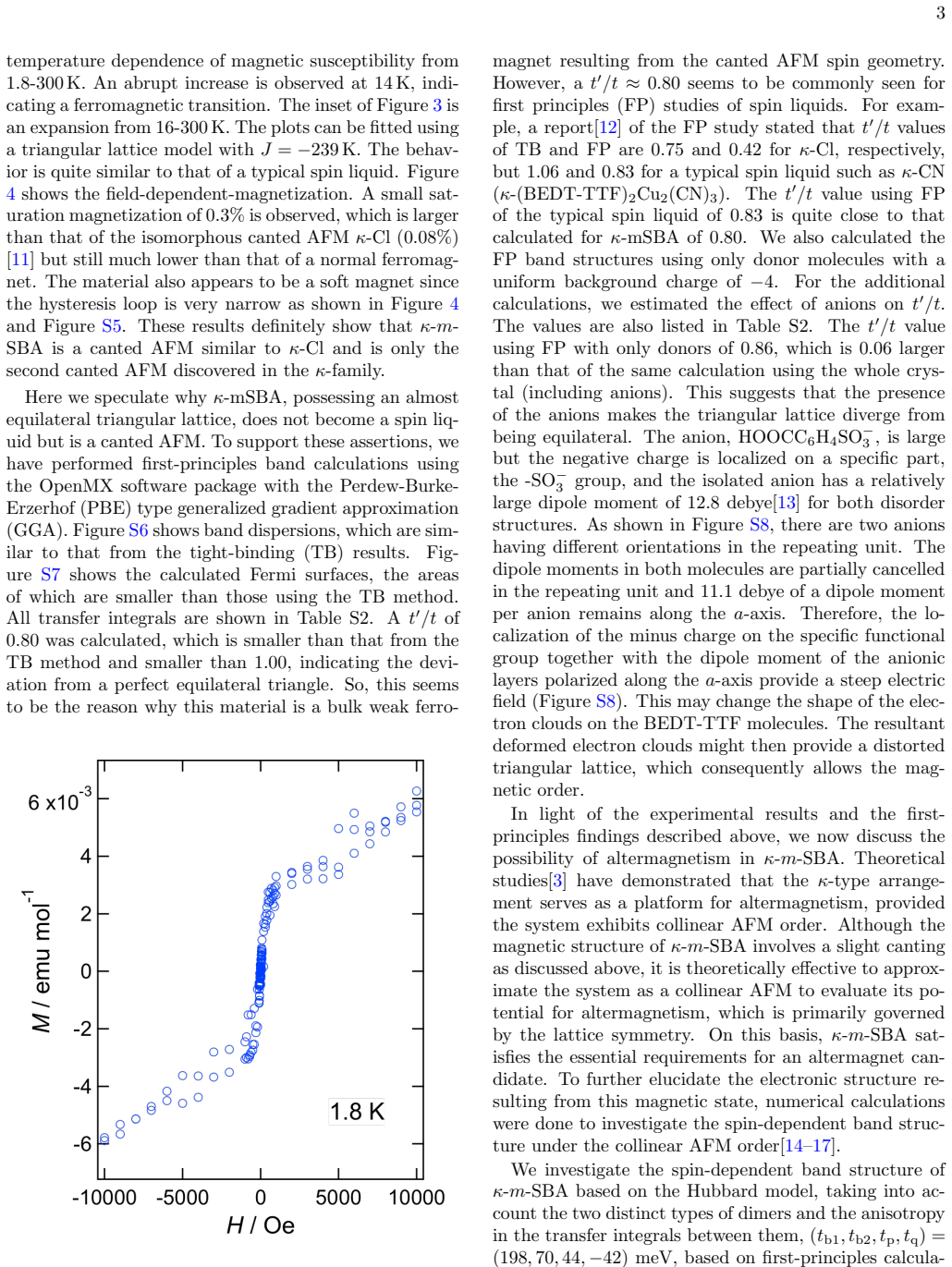
but still much lower than that of a normal ferromag- net. The material also appears to be a soft magnet since the hysteresis loop is very narrow as shown in Figure 4 and Figure S5. These results definitely show thatκ-m- SBA is a canted AFM similar toκ-Cl and is only the second canted AFM discovered in theκ-family. Here we speculate whyκ-mSBA, possessing a...
work page 2023
-
[2]
L. ˇSmejkal, J. Sinova, and T. Jungwirth, Beyond conven- tional ferromagnetism and antiferromagnetism: A phase with nonrelativistic spin and crystal rotation symmetry, Phys. Rev. X12, 031042 (2022)
work page 2022
-
[3]
L. ˇSmejkal, J. Sinova, and T. Jungwirth, Emerging re- search landscape of altermagnetism, Phys. Rev. X12, 040501 (2022)
work page 2022
-
[4]
M. Naka, S. Hayami, H. Kusunose, Y. Yanagi, Y. Mo- tome, and H. Seo, Spin current generation in organic an- tiferromagnets, Nat. Commun.10, 4305 (2019)
work page 2019
-
[5]
A. Pustogow, Thirty-year anniversary ofκ-(BEDT- TTF)2Cu2(CN)3: Reconciling the Spin Gap in a Spin- Liquid candidate, Solids3, 93 (2022)
work page 2022
-
[6]
T. Kawamoto, K. Kurata, and T. Mori, A new dimer mott insulator:κ-(BEDT-TTF) 2TaF6, J. Phys. Soc. Jpn. 87, 083703 (2018)
work page 2018
-
[7]
U. Geiser, J. A. Schultz, H. H. Wang, D. M. Watkins, D. L. Stupka, J. M. Williams, J. E. Schirber, D. L. Overmyer, D. Jung, J. J. Novoa, and M.-H. Whangbo, 5 Strain index, lattice softness and superconductivity of organic donor-molecule salts: Crystal and elec- tronic structures of three isostructural saltsκ-(BEDT- TTF)2Cu[N(CN)2]X (X=Cl, Br, I), Physica ...
work page 1991
-
[8]
T. Mori, A. Kobayashi, Y. Sasaki, H. Kobayashi, G. Saito, and H. Inokuchi, The intermolec- ular interaction of tetrathiafulvalene and bis(ethylenedithio)tetrathiafulvalene in organic met- als. calculation of orbital overlaps and models of energy-band structures, Bull. Chem. Soc. Jpn.57, 627 (1984)
work page 1984
-
[9]
T. Mori, H. Mori, and S. Tanaka, Structural geneal- ogy of BEDT-TTF-based organic conductors ii. inclined molecules:θ,α, andκphases, Bull. Chem. Soc. Jpn.72, 179 (1999)
work page 1999
-
[10]
H. Weng, T. Ozaki, and K. Terakura, Revisiting mag- netic coupling in transition-metal-benzene complexes with maximally localized wannier functions, Phys. Rev. B79, 235118 (2009)
work page 2009
-
[11]
J. M. Williams, A. M. Kini, H. H. Wang, K. D. Carl- son, U. Geiser, L. K. Montgomery, G. J. Pyrka, D. M. Watkins, J. M. Kommers, S. J. Boryschuk, A. V. S. Crouch, W. K. Kwok, J. E. Schirber, D. L. Overmyer, D. Jung, and M.-H. Whangbo, From semiconductor- semiconductor transition (42 K) to the highest-Tc organic superconductor,κ-(ET) 2Cu[N(CN)2]Cl (T c = 1...
work page 1990
-
[12]
U. Welp, S. Fleshier, W. K. Kwok, G. W. Crab- tree, K. D. Carlson, H. H. Wang, U. Geiser, J. M. Williams, and V. M. Hitsman, Weak ferromagnetism inκ-(ET) 2Cu[N(CN)2]Cl, Physica B186–188, 1065 (1993)
work page 1993
-
[13]
H. C. Kandpal, I. Opahle, Y.-Z. Zhang, H. O. Jeschke, and R. Valent´ ı, Revision of model parameters forκ-type charge transfer salts: An ab initio study, Phys. Rev. Lett. 103, 067004 (2009)
work page 2009
-
[14]
J. J. P. Stewart, Mopac2012 (2016), Stewart Compu- tational Chemistry, Colorado Springs, CO, USA,http: //OpenMOPAC.net
work page 2016
-
[15]
Y. Noda, K. Ohno, and S. Nakamura, Momentum- dependent band spin splitting in semiconducting mno2: a density functional calculation, Phys. Chem. Chem. Phys. 18, 13294 (2016)
work page 2016
-
[16]
T. Okugawa, K. Ohno, Y. Noda, and S. Nakamura, Weakly spin-dependent band structures of antiferro- magnetic perovskite lamo3 (m=cr, mn, fe), Journal of Physics: Condensed Matter30, 075502 (2018)
work page 2018
- [17]
-
[18]
L.-D. Yuan, Z. Wang, J.-W. Luo, E. I. Rashba, and A. Zunger, Giant momentum-dependent spin splitting in centrosymmetric low-zantiferromagnets, Phys. Rev. B 102, 014422 (2020)
work page 2020
-
[19]
H. Seo, C. Hotta, and H. Fukuyama, Toward system- atic understanding of diversity of electronic properties in low-dimensional molecular solids, Chem. Rev.104, 5005 (2004)
work page 2004
-
[20]
T. Koretsune and C. Hotta, Evaluating model parame- ters of theκ- andβ ′ -type mott insulating organic solids, Phys. Rev. B89, 045102 (2014)
work page 2014
- [21]
-
[22]
Ozaki, Variationally optimized atomic orbitals for large-scale electronic structures, Phys
T. Ozaki, Variationally optimized atomic orbitals for large-scale electronic structures, Phys. Rev. B67, 155108 (2003). 6 SUPPOR TING INFORMA TION TABLE S1. X-ray crystallographic data ofκ-mSBA at 100 and 293 K together withκ-Cl at 127 K [6]. κ-mSBAκ-Cl Composition C 27H21O5S17 C22H19S16ClCu T/ K 293 100 127 Space groupP nma Pnma Pnma a/ ˚A 10.6268(3) 10....
work page 2003
discussion (0)
Sign in with ORCID, Apple, or X to comment. Anyone can read and Pith papers without signing in.