Recognition: unknown
Data-Efficient Indentation Size Effect Correction in Steels Using Machine Learning and Physics-Guided Augmentation
Pith reviewed 2026-05-07 07:36 UTC · model grok-4.3
The pith
Machine learning with physics-guided augmentation enables accurate indentation size effect correction in steels from small experimental datasets.
A machine-rendered reading of the paper's core claim, the machinery that carries it, and where it could break.
Core claim
The authors establish that the relationship between measured indentation parameters and true hardness is nonlinear and can be learned from limited experimental data when augmented with representations of instrumental noise, session drift, and local multiphase blending. By training on features including the area-invariant proxy P_max/S² and energy-based terms, the constrained neural network produces stable hardness estimates across load ranges, including shallow regimes where traditional Nix-Gao analysis becomes unreliable.
What carries the argument
Physics-guided augmentation of nanoindentation data combined with a constrained neural network that uses Oliver-Pharr values and mechanics descriptors to map to reference hardness.
If this is right
- Ridge regression fails while nonlinear models succeed, indicating the hardness mapping is nonlinear.
- The neural network yields stable estimates in the shallow indentation regime.
- SHAP analysis reveals reliance on area-invariant and energy-based descriptors.
- The workflow demonstrates feasibility for data-efficient characterization of volume-constrained materials.
Where Pith is reading between the lines
- Extending the augmentation strategy to account for tip geometry variations could broaden applicability to different indenters.
- Treating the indentation size effect as a supervised learning task rather than assuming a fixed functional form like in Nix-Gao could lead to more flexible corrections.
- Similar physics-guided augmentation approaches might improve machine learning models in other materials characterization techniques that suffer from limited data.
- If validated across a wider range of materials, this could enable reliable mechanical testing of thin films and small volumes without requiring deep indentations.
Load-bearing premise
The physically motivated augmentations accurately capture the statistical variations present in real experimental sessions on steels.
What would settle it
Applying the trained model to shallow indentations performed on an additional independent steel specimen and finding that the predicted hardness deviates substantially from the reference value obtained from deep indents or other independent methods.
Figures




read the original abstract
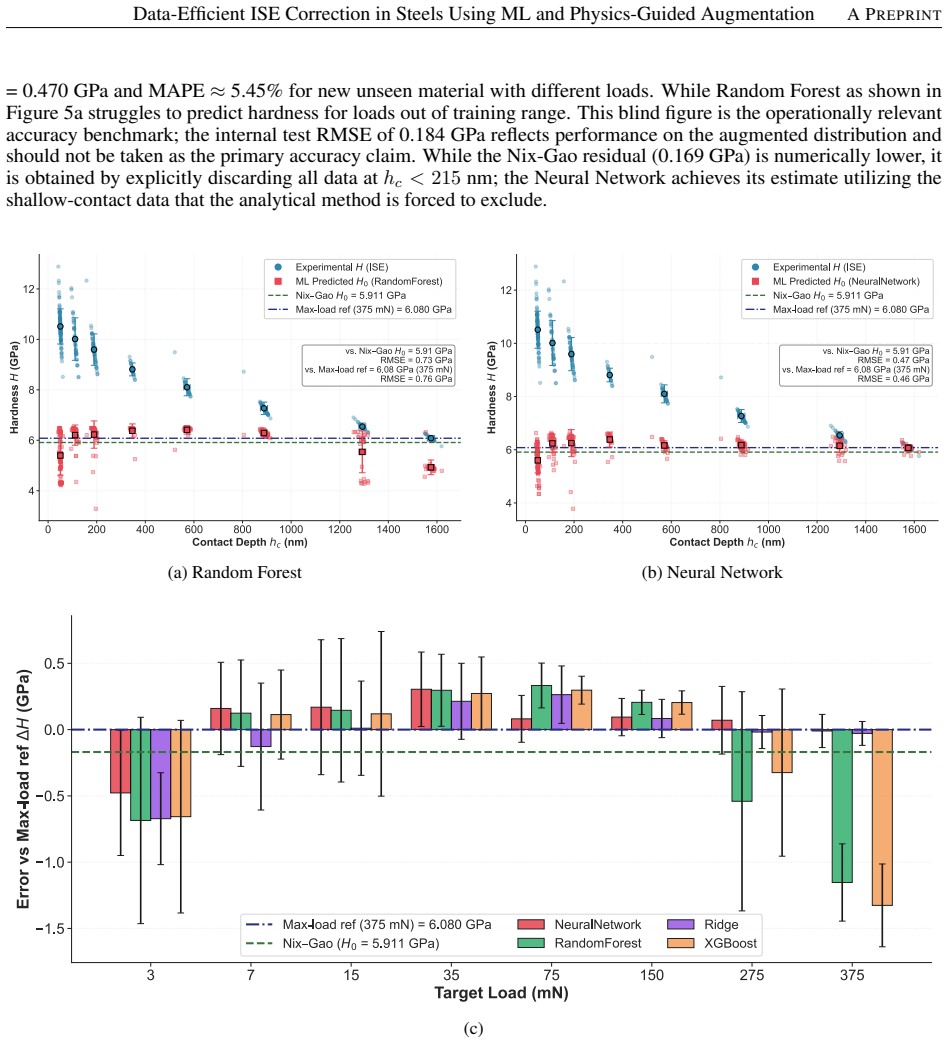
Shallow nanoindentation enables mechanical characterization of thin films, individual phases and other volume-constrained materials, but measured hardness is often inflated by the indentation size effect (ISE), contact-area errors and tip-geometry artifacts. Classical ISE corrections such as the Nix-Gao require a deep linear regime and are unreliable when only shallow measurements are used. This study investigates how a small experimental dataset can be used to predict a reference hardness with physics-guided feature engineering and augmentation. Approximately 700 experimental indentations were collected from three steel reference specimens covering a hardness range of 2-6.5 GPa and augmented using physically motivated variations representing instrumental noise, session-level drift, and local multiphase boundary blending. The input space combined Oliver-Pharr values with mechanics descriptors, including indentation work partitioning, ($H\text{/}E_{r}$), and the area-invariant compliance proxy ($P_{\max}\text{/}S^{2}$). Ridge Regression (RR), Random Forest, XGBoost, and Neural Networks (NN) were evaluated using a quarantined fourth steel specimen tested at staggered loads. The hardness mapping was nonlinear: RR failed, whereas nonlinear models achieved ($R^2 > 0.98$) internally. A constrained (64-8-64) NN gave the best results, reaching RMSE = 0.470 GPa, MAPE = 5.4% on the quarantined steel. Unlike Nix-Gao analysis, the NN produced stable estimates in the shallow regime. SHAP and latent-space analysis showed reliance on area-invariant and energy-based descriptors. The results demonstrate the feasibility of a this workflow for ISE correction in steels using small datasets and suggest a pathway toward data-efficient characterization of any volume constrained materials.
Editorial analysis
A structured set of objections, weighed in public.
Referee Report
Summary. The manuscript proposes a machine learning workflow for correcting the indentation size effect (ISE) in nanoindentation of steels using a small experimental dataset augmented with physics-motivated variations. Approximately 700 indents from three specimens are augmented for instrumental noise, session-level drift, and local multiphase boundary blending. Models (ridge regression, random forest, XGBoost, and neural networks) are trained to predict reference hardness from Oliver-Pharr values combined with mechanics descriptors such as indentation work partitioning, H/E_r, and P_max/S^2. A constrained (64-8-64) neural network achieves the best held-out performance on a quarantined fourth specimen (RMSE = 0.470 GPa, MAPE = 5.4%), with R^2 > 0.98 internally, and produces stable estimates in the shallow regime unlike Nix-Gao analysis. SHAP and latent-space analysis highlight reliance on area-invariant and energy-based features.
Significance. If the augmentations accurately capture real session-to-session variability, the work demonstrates a data-efficient pathway for reliable ISE correction in volume-constrained materials without requiring a deep linear regime. Strengths include the use of a quarantined specimen for external validation, physics-guided rather than purely statistical augmentation, and interpretability via SHAP. This could be particularly useful for thin films and multiphase systems where classical Nix-Gao methods fail at shallow depths.
major comments (3)
- [Methods] Methods (augmentation procedure): No direct statistical comparison (e.g., distribution matching, Kolmogorov-Smirnov tests, or variance decomposition) is reported between the augmented training features and the actual feature distributions in the quarantined hold-out specimen. This is load-bearing for the generalization claim, as the reported RMSE/MAPE on the fourth specimen assumes the synthetic variations (noise, drift, blending) match real experimental session variability.
- [Results] Results (reference hardness targets): The procedure for obtaining the reference hardness values used as training targets is not specified in sufficient detail. It is unclear whether these are derived from deep indents on the same specimens, literature values, or other means; without this, the mapping learned by the NN cannot be fully assessed for physical consistency or potential bias.
- [Results] Results (Nix-Gao comparison): The claim of superior stability in the shallow regime is central but lacks quantitative detail on the specific load ranges or indentation depths where the NN remains stable while Nix-Gao diverges, including error bars or per-depth RMSE values on the hold-out data.
minor comments (2)
- [Abstract] Abstract: The notation (H/E_r) and (P_max/S^2) should be defined at first use, and E_r should be explicitly identified as reduced modulus.
- [Methods] The manuscript would benefit from a sensitivity analysis on the augmentation magnitudes (noise, drift, blending parameters) to show robustness of the reported performance.
Simulated Author's Rebuttal
We thank the referee for the thoughtful and detailed review of our manuscript. The comments have identified areas where additional clarity and quantitative support will strengthen our claims. We provide point-by-point responses to the major comments and commit to the indicated revisions in the updated version.
read point-by-point responses
-
Referee: [Methods] Methods (augmentation procedure): No direct statistical comparison (e.g., distribution matching, Kolmogorov-Smirnov tests, or variance decomposition) is reported between the augmented training features and the actual feature distributions in the quarantined hold-out specimen. This is load-bearing for the generalization claim, as the reported RMSE/MAPE on the fourth specimen assumes the synthetic variations (noise, drift, blending) match real experimental session variability.
Authors: We agree that a direct statistical comparison would strengthen the evidence supporting the augmentation procedure. In the revised manuscript we will add Kolmogorov-Smirnov tests, quantile-quantile plots, and a variance decomposition for the principal input features (Oliver-Pharr hardness and modulus, work partitioning ratios, H/E_r, and P_max/S^2) comparing the augmented training distribution to the quarantined specimen. These analyses will be placed in the Methods section immediately following the description of the augmentation pipeline. revision: yes
-
Referee: [Results] Results (reference hardness targets): The procedure for obtaining the reference hardness values used as training targets is not specified in sufficient detail. It is unclear whether these are derived from deep indents on the same specimens, literature values, or other means; without this, the mapping learned by the NN cannot be fully assessed for physical consistency or potential bias.
Authors: The reference hardness targets for the three training specimens were obtained from deep indentation measurements (depths > 2 μm) performed on the same specimens, where the indentation size effect is negligible; values were averaged over at least 20 indents per specimen across two independent sessions. We will expand the Methods and Results sections to state the exact depth threshold, the number of indents and sessions used for averaging, and any consistency checks against published hardness values for the steel grades. This added detail will permit readers to evaluate the physical consistency of the learned mapping. revision: yes
-
Referee: [Results] Results (Nix-Gao comparison): The claim of superior stability in the shallow regime is central but lacks quantitative detail on the specific load ranges or indentation depths where the NN remains stable while Nix-Gao diverges, including error bars or per-depth RMSE values on the hold-out data.
Authors: We agree that quantitative, depth-resolved metrics would make the stability comparison more rigorous. In the revision we will add a table (or supplementary figure) reporting per-depth RMSE and MAPE for both the neural network and the Nix-Gao model on the quarantined specimen, binned in 50 nm increments from 50 nm to 1000 nm, together with error bars representing the standard deviation across indents at each depth. The table will also indicate the load ranges corresponding to each depth bin. This material will be placed in the Results section alongside the existing Nix-Gao comparison. revision: yes
Circularity Check
No significant circularity: hold-out evaluation on independent specimen prevents reduction to fitted inputs.
full rationale
The paper's workflow collects ~700 experimental indentations from three steel specimens, applies physics-motivated augmentations (instrumental noise, session drift, multiphase blending) that are not fitted to the target hardness, trains ML models (RR, RF, XGBoost, NN) on the augmented feature space (Oliver-Pharr plus H/Er and Pmax/S² descriptors), and reports RMSE/MAPE on a quarantined fourth specimen tested at staggered loads. The central performance numbers are computed on unseen experimental data rather than on training or self-generated targets. No equations or self-citations are invoked that would make the reported hardness predictions equivalent to the model's own inputs by construction; the augmentations are externally motivated and the test set is drawn from a distinct experimental session. This satisfies the self-contained criterion against external benchmarks.
Axiom & Free-Parameter Ledger
free parameters (2)
- Neural network architecture and hyperparameters
- Augmentation magnitudes for noise, drift, and blending
axioms (2)
- domain assumption Physically motivated augmentations accurately represent real experimental variations in noise, drift, and multiphase blending.
- domain assumption The target hardness values used for training represent the true reference hardness free of ISE.
Reference graph
Works this paper leans on
-
[1]
Jaroslav Menˇcík. Determination of mechanical properties by instrumented indentation.Meccanica, 42(1):19–29, February 2007. ISSN 0025-6455, 1572-9648. doi:10.1007/s11012-006-9018-6
-
[2]
W.C. Oliver and G.M. Pharr. An improved technique for determining hardness and elastic modulus using load and displacement sensing indentation experiments.Journal of Materials Research, 7(6):1564–1583, June 1992. ISSN 0884-2914, 2044-5326. doi:10.1557/JMR.1992.1564
-
[3]
Hervé Pelletier, Joël Krier, and Pierre Mille. Characterization of mechanical properties of thin films us- ing nanoindentation test.Mechanics of Materials, 38(12):1182–1198, December 2006. ISSN 01676636. doi:10.1016/j.mechmat.2006.02.011
-
[4]
Hossein Besharatloo and Jeffrey M. Wheeler. Influence of indentation size and spacing on statistical phase analysis via high-speed nanoindentation mapping of metal alloys.Journal of Materials Research, 36(11):2198–2212, June
-
[5]
doi:10.1557/s43578-021-00214-5
ISSN 0884-2914, 2044-5326. doi:10.1557/s43578-021-00214-5
-
[6]
Luyao Mei, Xun Guo, and Ke Jin. Characterization of Mechanical Property Degradation of Ion-Irradiated Materials.Frontiers in Materials, 9:849209, April 2022. ISSN 2296-8016. doi:10.3389/fmats.2022.849209
-
[7]
Peina Wang, Yu Gao, and Peihuan Wang. A comparative study of indentation size effect models for different materials.Scientific Reports, 14(1):20010, August 2024. ISSN 2045-2322. doi:10.1038/s41598-024-71136-5
-
[8]
William D. Nix and Huajian Gao. Indentation size effects in crystalline materials: A law for strain gradient plasticity.Journal of the Mechanics and Physics of Solids, 46(3):411–425, March 1998. ISSN 00225096. doi:10.1016/S0022-5096(97)00086-0
-
[9]
George V oyiadjis and Mohammadreza Yaghoobi. Review of Nanoindentation Size Effect: Experiments and Atomistic Simulation.Crystals, 7(10):321, October 2017. ISSN 2073-4352. doi:10.3390/cryst7100321
-
[10]
A.A. Elmustafa and D.S. Stone. Nanoindentation and the indentation size effect: Kinetics of deformation and strain gradient plasticity.Journal of the Mechanics and Physics of Solids, 51(2):357–381, February 2003. ISSN 00225096. doi:10.1016/S0022-5096(02)00033-9
-
[11]
Katerina E. Aifantis and A.H.W. Ngan. Modeling dislocation—grain boundary interactions through gradient plasticity and nanoindentation.Materials Science and Engineering: A, 459(1-2):251–261, June 2007. ISSN 09215093. doi:10.1016/j.msea.2007.01.028. 16 Data-Efficient ISE Correction in Steels Using ML and Physics-Guided AugmentationA PREPRINT
-
[12]
D. Wu, J.S.C. Jang, and T.G. Nieh. Elastic and plastic deformations in a high entropy alloy inves- tigated using a nanoindentation method.Intermetallics, 68:118–127, January 2016. ISSN 09669795. doi:10.1016/j.intermet.2015.10.002
-
[13]
Osman Sahin, Orhan Uzun, Malgorzata Sopicka-Lizer, Hasan Gocmez, and U ˘gur Kölemen. Analysis of load- penetration depth data using Oliver–Pharr and Cheng–Cheng methods of SiAlON–ZrO2 ceramics.Journal of Physics D: Applied Physics, 41(3):035305, February 2008. ISSN 0022-3727, 1361-6463. doi:10.1088/0022- 3727/41/3/035305
-
[14]
George M. Pharr, Erik G. Herbert, and Yanfei Gao. The Indentation Size Effect: A Critical Examination of Experimental Observations and Mechanistic Interpretations.Annual Review of Materials Research, 40(1):271–292, June 2010. ISSN 1531-7331, 1545-4118. doi:10.1146/annurev-matsci-070909-104456
-
[15]
S. Qu, Y . Huang, W.D. Nix, H. Jiang, F. Zhang, and K.C. Hwang. Indenter tip radius effect on the Nix–Gao relation in micro- and nanoindentation hardness experiments.Journal of Materials Research, 19(11):3423–3434, November 2004. ISSN 0884-2914, 2044-5326. doi:10.1557/JMR.2004.0441
-
[16]
Rashid K. Abu Al-Rub and George Z. V oyiadjis. Analytical and experimental determination of the material intrinsic length scale of strain gradient plasticity theory from micro- and nano-indentation experiments.International Journal of Plasticity, 20(6):1139–1182, June 2004. ISSN 07496419. doi:10.1016/j.ijplas.2003.10.007
-
[17]
M. Dao, N. Chollacoop, K.J. Van Vliet, T.A. Venkatesh, and S. Suresh. Computational modeling of the forward and reverse problems in instrumented sharp indentation.Acta Materialia, 49(19):3899–3918, November 2001. ISSN 13596454. doi:10.1016/S1359-6454(01)00295-6
-
[18]
J.J. Kang, A.A. Becker, and W. Sun. Determining elastic–plastic properties from indentation data obtained from finite element simulations and experimental results.International Journal of Mechanical Sciences, 62(1):34–46, September 2012. ISSN 00207403. doi:10.1016/j.ijmecsci.2012.05.011
-
[19]
K.K. Tho, S. Swaddiwudhipong, Z.S. Liu, K. Zeng, and J. Hua. Uniqueness of reverse analysis from conical indentation tests.Journal of Materials Research, 19(8):2498–2502, August 2004. ISSN 0884-2914, 2044-5326. doi:10.1557/JMR.2004.0306
-
[20]
Xi Chen, Nagahisa Ogasawara, Manhong Zhao, and Norimasa Chiba. On the uniqueness of measuring elastoplastic properties from indentation: The indistinguishable mystical materials.Journal of the Mechanics and Physics of Solids, 55(8):1618–1660, August 2007. ISSN 00225096. doi:10.1016/j.jmps.2007.01.010
-
[21]
Frederic E. Bock, Roland C. Aydin, Christian J. Cyron, Norbert Huber, Surya R. Kalidindi, and Benjamin Klusemann. A Review of the Application of Machine Learning and Data Mining Approaches in Continuum Materials Mechanics.Frontiers in Materials, 6:110, May 2019. ISSN 2296-8016. doi:10.3389/fmats.2019.00110
-
[22]
N. Huber and Ch. Tsakmakis. Determination of constitutive properties fromspherical indentation data using neural networks. Part i:the case of pure kinematic hardening in plasticity laws.Journal of the Mechanics and Physics of Solids, 47(7):1569–1588, June 1999. ISSN 00225096. doi:10.1016/S0022-5096(98)00109-4
-
[23]
K Genel. Application of artificial neural network for predicting strain-life fatigue properties of steels on the basis of tensile tests.International Journal of Fatigue, 26(10):1027–1035, October 2004. ISSN 01421123. doi:10.1016/j.ijfatigue.2004.03.009
-
[24]
Haijie Wang, Bo Li, Jianguo Gong, and Fu-Zhen Xuan. Machine learning-based fatigue life prediction of metal materials: Perspectives of physics-informed and data-driven hybrid methods.Engineering Fracture Mechanics, 284:109242, May 2023. ISSN 00137944. doi:10.1016/j.engfracmech.2023.109242
-
[25]
Radmir Karamov, Iskander Akhatov, and Ivan V . Sergeichev. Prediction of Fracture Toughness of Pultruded Composites Based on Supervised Machine Learning.Polymers, 14(17):3619, September 2022. ISSN 2073-4360. doi:10.3390/polym14173619
-
[26]
Shiyu He, Yanming Wang, Zhengyang Zhang, Fei Xiao, Shungui Zuo, Ying Zhou, Xiaorong Cai, and Xuejun Jin. Interpretable machine learning workflow for evaluation of the transformation temperatures of TiZrHfNiC- oCu high entropy shape memory alloys.Materials & Design, 225:111513, January 2023. ISSN 02641275. doi:10.1016/j.matdes.2022.111513
-
[27]
Machine learning framework for determination of elastic modulus without contact model fitting.International Journal of Solids and Structures, 256:111976, December
Linh Thi Phuong Nguyen and Bernard Haochih Liu. Machine learning framework for determination of elastic modulus without contact model fitting.International Journal of Solids and Structures, 256:111976, December
-
[28]
doi:10.1016/j.ijsolstr.2022.111976
ISSN 00207683. doi:10.1016/j.ijsolstr.2022.111976
-
[29]
Artificial neural network model for material characterization by indentation.Modelling and Simulation in Materials Science and Engineering, 12(5):1055–1062, September
K K Tho, S Swaddiwudhipong, Z S Liu, and J Hua. Artificial neural network model for material characterization by indentation.Modelling and Simulation in Materials Science and Engineering, 12(5):1055–1062, September
-
[30]
doi:10.1088/0965-0393/12/5/019
ISSN 0965-0393, 1361-651X. doi:10.1088/0965-0393/12/5/019. 17 Data-Efficient ISE Correction in Steels Using ML and Physics-Guided AugmentationA PREPRINT
-
[31]
Quan Jiao, Yongchao Chen, Jong-hyoung Kim, Chang-Fu Han, Chia-Hua Chang, and Joost J. Vlassak. A machine learning perspective on the inverse indentation problem: Uniqueness, surrogate modeling, and learning elasto-plastic properties from pile-up.Journal of the Mechanics and Physics of Solids, 185:105557, April 2024. ISSN 00225096. doi:10.1016/j.jmps.2024.105557
-
[32]
Lu Lu, Ming Dao, Punit Kumar, Upadrasta Ramamurty, George Em Karniadakis, and Subra Suresh. Extrac- tion of mechanical properties of materials through deep learning from instrumented indentation.Proceed- ings of the National Academy of Sciences, 117(13):7052–7062, March 2020. ISSN 0027-8424, 1091-6490. doi:10.1073/pnas.1922210117
-
[33]
Small data machine learning in materials science
Pengcheng Xu, Xiaobo Ji, Minjie Li, and Wencong Lu. Small data machine learning in materials science.npj Computational Materials, 9(1):42, March 2023. ISSN 2057-3960. doi:10.1038/s41524-023-01000-z
-
[34]
Anke Stoll and Peter Benner. Machine learning for material characterization with an application for predicting mechanical properties.GAMM-Mitteilungen, 44(1):e202100003, March 2021. ISSN 0936-7195, 1522-2608. doi:10.1002/gamm.202100003
-
[35]
Chen Wang, You-quan He, Hong-ming Lu, Jian-guo Nie, and Jian-sheng Fan. Physics-informed few-shot deep learning for elastoplastic constitutive relationships.Engineering Applications of Artificial Intelligence, 126: 106907, November 2023. ISSN 09521976. doi:10.1016/j.engappai.2023.106907
-
[36]
Narendra Kumar, Padmini Rajagopalan, Praveen Pankajakshan, Arnab Bhattacharyya, Suchismita Sanyal, Janaki- raman Balachandran, and Umesh V . Waghmare. Machine Learning Constrained with Dimensional Analysis and Scaling Laws: Simple, Transferable, and Interpretable Models of Materials from Small Datasets.Chemistry of Materials, 31(2):314–321, January 2019. ...
-
[37]
W.C. Oliver and G.M. Pharr. Measurement of hardness and elastic modulus by instrumented indentation: Advances in understanding and refinements to methodology.Journal of Materials Research, 19(1):3–20, January 2004. ISSN 0884-2914, 2044-5326. doi:10.1557/jmr.2004.19.1.3
-
[38]
Zehua Wu, Gang Li, Yong Jia, Qipeng Lv, Songwen Deng, and Yuqi Jin. Investigation on morphology and chemistry of the Beilby layer on polished fused silica.Ceramics International, 49(11):17116–17122, June 2023. ISSN 02728842. doi:10.1016/j.ceramint.2023.02.074
-
[39]
G. Feng and A. H. W. Ngan. Effects of Creep and Thermal Drift on Modulus Measurement Using Depth- sensing Indentation.Journal of Materials Research, 17(3):660–668, March 2002. ISSN 0884-2914, 2044-5326. doi:10.1557/JMR.2002.0094
-
[40]
Yang-Tse Cheng and Che-Min Cheng. Relationships between hardness, elastic modulus, and the work of indenta- tion.Applied Physics Letters, 73(5):614–616, August 1998. ISSN 0003-6951, 1077-3118. doi:10.1063/1.121873
-
[41]
A. Bolshakov and G. M. Pharr. Influences of pileup on the measurement of mechanical properties by load and depth sensing indentation techniques.Journal of Materials Research, 13(4):1049–1058, April 1998. ISSN 0884-2914, 2044-5326. doi:10.1557/JMR.1998.0146
-
[42]
D. L. Joslin and W. C. Oliver. A new method for analyzing data from continuous depth-sensing microin- dentation tests.Journal of Materials Research, 5(1):123–126, January 1990. ISSN 0884-2914, 2044-5326. doi:10.1557/JMR.1990.0123
-
[43]
Dane Morgan and Ryan Jacobs. Opportunities and Challenges for Machine Learning in Materials Science.Annual Review of Materials Research, 50(1):71–103, July 2020. ISSN 1531-7331, 1545-4118. doi:10.1146/annurev- matsci-070218-010015
-
[44]
Elnaz Lashgari, Dehua Liang, and Uri Maoz. Data augmentation for deep-learning-based electroen- cephalography.Journal of Neuroscience Methods, 346:108885, December 2020. ISSN 01650270. doi:10.1016/j.jneumeth.2020.108885
-
[45]
K Herrmann, N.M Jennett, W Wegener, J Meneve, K Hasche, and R Seemann. Progress in determination of the area function of indenters used for nanoindentation.Thin Solid Films, 377–378:394–400, December 2000. ISSN 00406090. doi:10.1016/S0040-6090(00)01367-5
-
[46]
Dauphin, and David Lopez-Paz
Hongyi Zhang, Moustapha Cisse, Yann N. Dauphin, and David Lopez-Paz. Mixup: Beyond Empirical Risk Minimization, April 2018
2018
-
[47]
G. Constantinides, K.S. Ravi Chandran, F.-J. Ulm, and K.J. Van Vliet. Grid indentation analysis of composite microstructure and mechanics: Principles and validation.Materials Science and Engineering: A, 430(1-2): 189–202, August 2006. ISSN 09215093. doi:10.1016/j.msea.2006.05.125
-
[48]
Arthur E. Hoerl and Robert W. Kennard. Ridge Regression: Biased Estimation for Nonorthogonal Problems. Technometrics, 12(1):55–67, February 1970. ISSN 0040-1706, 1537-2723. doi:10.1080/00401706.1970.10488634. 18 Data-Efficient ISE Correction in Steels Using ML and Physics-Guided AugmentationA PREPRINT
-
[49]
Leo Breiman. Random Forests.Machine Learning, 45(1):5–32, October 2001. ISSN 0885-6125, 1573-0565. doi:10.1023/A:1010933404324
-
[50]
XGBoost: A Scalable Tree Boosting System
Tianqi Chen and Carlos Guestrin. XGBoost: A Scalable Tree Boosting System. InProceedings of the 22nd ACM SIGKDD International Conference on Knowledge Discovery and Data Mining, pages 785–794, San Francisco California USA, August 2016. ACM. ISBN 978-1-4503-4232-2. doi:10.1145/2939672.2939785
-
[51]
Kingma and Jimmy Ba
Diederik P. Kingma and Jimmy Ba. Adam: A Method for Stochastic Optimization, January 2017
2017
-
[52]
G. E. Hinton and R. R. Salakhutdinov. Reducing the Dimensionality of Data with Neural Networks.Science, 313 (5786):504–507, July 2006. ISSN 0036-8075, 1095-9203. doi:10.1126/science.1127647
-
[53]
A Unified Approach to Interpreting Model Predictions, 2017
Scott Lundberg and Su-In Lee. A Unified Approach to Interpreting Model Predictions, 2017
2017
-
[54]
Andrea Cristina McGlinchey and Peter J
Scott M. Lundberg, Gabriel Erion, Hugh Chen, Alex DeGrave, Jordan M. Prutkin, Bala Nair, Ronit Katz, Jonathan Himmelfarb, Nisha Bansal, and Su-In Lee. From local explanations to global understanding with explainable AI for trees.Nature Machine Intelligence, 2(1):56–67, January 2020. ISSN 2522-5839. doi:10.1038/s42256-019-0138-9
-
[55]
Hervé Abdi and Lynne J. Williams. Principal component analysis.WIREs Computational Statistics, 2(4):433–459, July 2010. ISSN 1939-5108, 1939-0068. doi:10.1002/wics.101
-
[56]
Dale E. Newbury* and Nicholas W. M. Ritchie. Is Scanning Electron Microscopy/Energy Dispersive X-ray Spectrometry (SEM/EDS) Quantitative?Scanning, 35(3):141–168, May 2013. ISSN 0161-0457, 1932-8745. doi:10.1002/sca.21041
-
[57]
ASM International, Materials Park, 2nd ed edition, 2015
George Krauss, editor.Steels: Processing, Structure, and Performance. ASM International, Materials Park, 2nd ed edition, 2015. ISBN 978-1-62708-084-2
2015
-
[58]
Christopher D. Hardie, Steve G. Roberts, and Andy J. Bushby. Understanding the effects of ion irradiation using nanoindentation techniques.Journal of Nuclear Materials, 462:391–401, July 2015. ISSN 00223115. doi:10.1016/j.jnucmat.2014.11.066
-
[59]
B. Yang and H. Vehoff. Dependence of nanohardness upon indentation size and grain size – A local examination of the interaction between dislocations and grain boundaries.Acta Materialia, 55(3):849–856, February 2007. ISSN 13596454. doi:10.1016/j.actamat.2006.09.004
-
[60]
Jason R. Trelewicz and Christopher A. Schuh. The Hall–Petch breakdown in nanocrystalline metals: A crossover to glass-like deformation.Acta Materialia, 55(17):5948–5958, October 2007. ISSN 13596454. doi:10.1016/j.actamat.2007.07.020. 19
discussion (0)
Sign in with ORCID, Apple, or X to comment. Anyone can read and Pith papers without signing in.