Recognition: unknown
Search for light charged Higgs bosons decaying to charm and strange quarks in mathrm{tbar{t}} events in proton-proton collisions at sqrt{s} = 13 TeV
Pith reviewed 2026-05-07 05:19 UTC · model grok-4.3
The pith
No excess is observed in the search for light charged Higgs bosons decaying to charm and strange quarks in top quark pair events.
A machine-rendered reading of the paper's core claim, the machinery that carries it, and where it could break.
Core claim
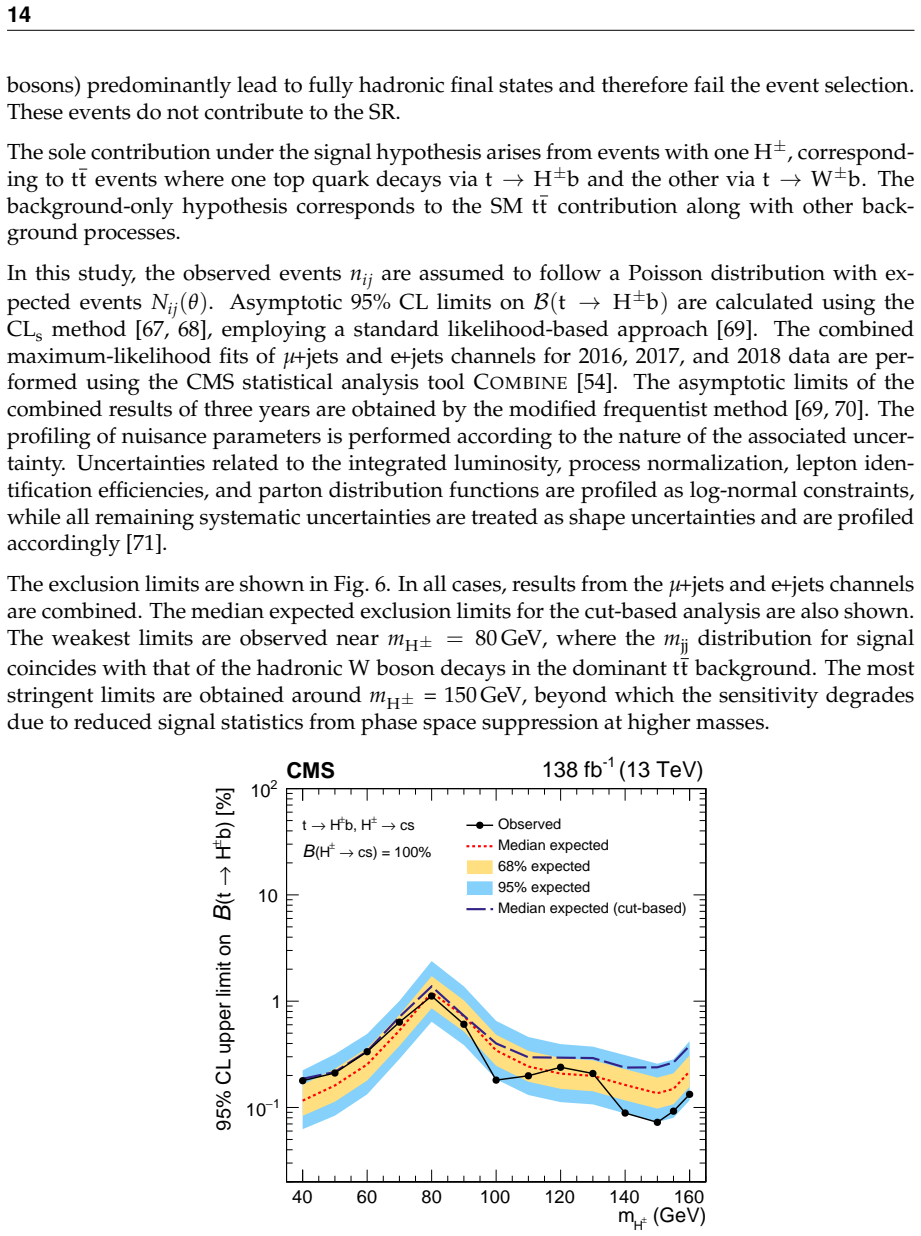
The central discovery is that the data is consistent with standard model predictions, with no evidence for a charged Higgs boson signal. This allows the placement of 95% confidence level upper limits on the branching fraction B(t → H± b) in the range 0.07-1.12% for H± masses between 40 and 160 GeV, under the assumption that the Higgs decays exclusively to charm and strange quarks. These limits are the first direct ones for the lowest mass range and the most stringent for the intermediate masses.
What carries the argument
The invariant mass of the pair of light jets, defined as jets not passing b-tagging criteria, serves as the discriminating variable to search for a peak from H± → cs decays in semi-leptonic ttbar events.
If this is right
- Charged Higgs bosons with masses 40-160 GeV and dominant decay to cs are excluded from having branching fractions above the quoted limits in top quark decays.
- The standard model description of top quark pair production and decay is confirmed in this specific final state.
- These results can be interpreted within two-Higgs-doublet models to limit the parameter space for light charged Higgs particles.
Where Pith is reading between the lines
- Reinterpretation in specific beyond-standard-model scenarios could yield more model-dependent constraints on Higgs sector parameters.
- Future improvements in charm jet tagging could allow direct searches for the cs decay mode without relying on the 100% assumption.
- Similar techniques might be used to search for other light new particles in top decays.
Load-bearing premise
The assumption that the charged Higgs boson decays 100 percent of the time into a charm and a strange quark, combined with the accurate modeling of all backgrounds and signal efficiencies by the Monte Carlo simulations and data-driven methods.
What would settle it
Observing a clear peak or statistically significant excess in the light dijet invariant mass spectrum at the tested Higgs mass value, after subtracting the expected background, would falsify the no-signal hypothesis and support the existence of the charged Higgs boson.
Figures



read the original abstract
A search is presented for a light charged Higgs boson H$^\pm$ in top quark pair production ($\mathrm{t\bar{t}}$), where one of the top quarks decays to an H$^\pm$ and a bottom quark, while the other decays to a W$^\mp$ boson and a bottom quark. The H$^\pm$ is assumed to decay into a charm and a strange quark, whereas the W$^\mp$ boson decays into a charged lepton (electron or muon) and a neutrino. Results are reported based on proton-proton collision data at $\sqrt{s}$ = 13 TeV, corresponding to an integrated luminosity of 138 fb$^{-1}$. The analysis probes H$^\pm$ masses in the range 40 to 160 GeV using the invariant mass spectrum of the two light jets, where light jets are defined as jets that do not satisfy the bottom quark tagging requirement. The observed yield is found to be consistent with standard model predictions. Upper limits are set on the branching fraction $\mathcal{B}$(t $\to$ H$^\pm$ b), with values in the range of 0.07$-$1.12% at 95% confidence level, under the assumption that $\mathcal{B}$(H$^\pm$ $\to$ cs) = 100%. These are the first direct limits on charged Higgs bosons produced in top quark decays for masses between 40 and 50 GeV, and the most stringent limits to date in the 70$-$110 GeV range.
Editorial analysis
A structured set of objections, weighed in public.
Referee Report
Summary. The manuscript presents a search for light charged Higgs bosons H± (masses 40–160 GeV) produced in top-quark decays within ttbar events using 138 fb⁻¹ of 13 TeV pp collision data recorded by CMS. One top decays as t → H± b with H± → cs (assumed 100% branching fraction), while the other decays as t → W b with W → ℓν. The analysis selects the lepton + jets + single b-tag final state and extracts limits from a fit to the dijet invariant-mass spectrum of the two non-b-tagged jets. No significant excess above standard-model expectations is observed, yielding 95% CL upper limits on B(t → H± b) in the range 0.07–1.12%. The paper claims these are the first direct limits in the 40–50 GeV interval and the most stringent to date in the 70–110 GeV interval.
Significance. If the background modeling and systematic uncertainties are robustly validated, the result supplies competitive constraints on two-Higgs-doublet models containing light charged Higgs bosons, extending coverage to previously unprobed low-mass values with the full Run-2 dataset. The analysis employs a standard invariant-mass fit and limit-setting procedure typical of CMS searches; the central claim of consistency with the Standard Model is plausible given the described methodology. The explicit assumption B(H± → cs) = 100% is clearly stated, and the limits are presented as a function of mass, allowing straightforward reinterpretation.
major comments (1)
- [Section 5] Section 5 (background estimation): The dominant ttbar background shape in the dijet mass spectrum is taken from simulation. Because the signal appears as a peak on the combinatorial + W → qq' continuum, any mismatch in the modeling of light-quark fragmentation, parton-shower, or detector response for c/s jets versus u/d/g jets (or in the b-tagging mistag rate) directly biases the background template in the 40–160 GeV window. This modeling uncertainty is load-bearing for the claimed first limits at 40–50 GeV and most stringent limits at 70–110 GeV; the manuscript must quantify the residual shape uncertainty after any data-driven corrections and demonstrate that it does not inflate the reported sensitivity.
minor comments (2)
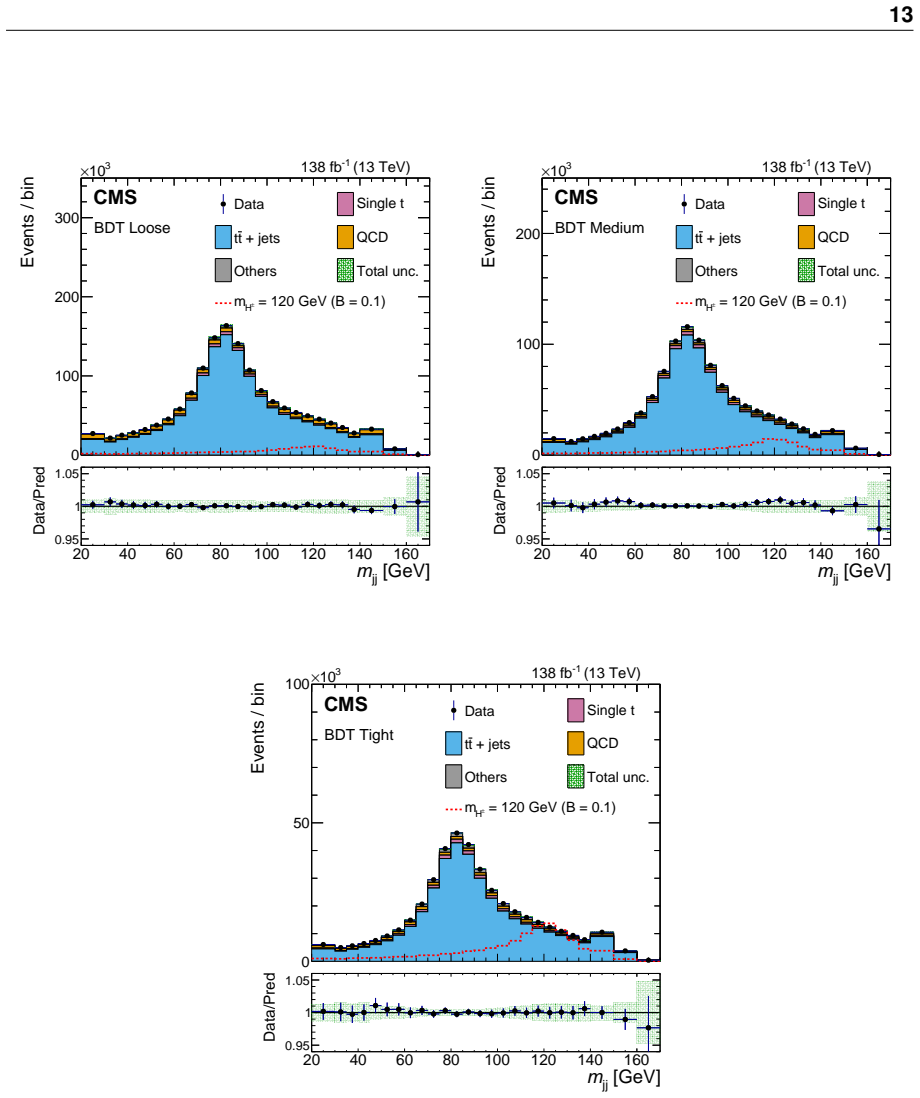
- [Figure 3] Figure 3 (dijet mass distributions): The ratio panels should explicitly label the total uncertainty band and indicate which mass hypotheses are overlaid; the current presentation makes it difficult to assess the goodness of fit in the low-mass region.
- [Table 2] Table 2 (systematic uncertainties): The table lists individual sources but does not show the quadrature sum or the impact on the final limit; adding a column with the total systematic uncertainty per mass point would improve clarity.
Simulated Author's Rebuttal
We thank the referee for their positive evaluation of our manuscript and for the insightful comments on the background estimation. We have prepared a detailed response to the major comment and will update the manuscript to incorporate additional documentation and quantification of the relevant uncertainties as outlined below.
read point-by-point responses
-
Referee: [Section 5] Section 5 (background estimation): The dominant ttbar background shape in the dijet mass spectrum is taken from simulation. Because the signal appears as a peak on the combinatorial + W → qq' continuum, any mismatch in the modeling of light-quark fragmentation, parton-shower, or detector response for c/s jets versus u/d/g jets (or in the b-tagging mistag rate) directly biases the background template in the 40–160 GeV window. This modeling uncertainty is load-bearing for the claimed first limits at 40–50 GeV and most stringent limits at 70–110 GeV; the manuscript must quantify the residual shape uncertainty after any data-driven corrections and demonstrate that it does not inflate the reported sensitivity.
Authors: We agree with the referee that the modeling of the ttbar background shape is critical to the analysis, especially given the signal's appearance as a peak in the dijet mass spectrum. The manuscript employs simulated ttbar events for the background template, with systematic uncertainties included for jet energy corrections, parton shower variations, and b-tagging efficiencies. Data-driven validation is performed in control regions where the dijet mass distribution shows consistency between data and simulation within uncertainties. To further quantify the residual shape uncertainty due to light-quark fragmentation and differences in c/s versus u/d/g jets, we will add a new systematic variation by comparing simulations with different hadronization models and by applying dedicated reweighting for charm and strange quark fragmentation. The resulting shape uncertainty will be incorporated into the likelihood fit, and its impact on the limits will be explicitly shown. A revised version of Section 5 will include this discussion, along with an additional figure illustrating the background shape variations. This ensures that the reported limits account for these effects and do not overstate the sensitivity. revision: yes
Circularity Check
No circularity: experimental limit extraction from collision data
full rationale
This is a standard CMS experimental search paper that selects events in lepton+jets final states from 138 fb^{-1} of 13 TeV data, reconstructs the dijet mass of non-b-tagged jets, and extracts 95% CL upper limits on B(t→H±b) via a statistical fit to the observed spectrum under the explicit assumption B(H±→cs)=100%. The background model (primarily ttbar) is taken from simulation normalized in control regions, with no derivation step that reduces by construction to a fitted parameter or self-citation chain. The central result (observed limits 0.07–1.12%) is directly falsifiable against the recorded data and is not equivalent to any input by definition. Minor self-citations to prior CMS detector performance papers exist but are not load-bearing for the limit values themselves.
Axiom & Free-Parameter Ledger
axioms (2)
- domain assumption Standard model predictions accurately describe the background processes in ttbar events with one leptonic W decay.
- domain assumption Jet reconstruction, b-tagging, and light-jet identification efficiencies are correctly modeled in simulation.
Reference graph
Works this paper leans on
-
[1]
ATLAS Collaboration, “Observation of a new particle in the search for the standard model Higgs boson with the ATLAS detector at the LHC”,Phys. Lett. B716(2012) 1, doi:10.1016/j.physletb.2012.08.020,arXiv:1207.7214
work page internal anchor Pith review doi:10.1016/j.physletb.2012.08.020 2012
-
[2]
CMS Collaboration, “Observation of a new boson at a mass of 125 GeV with the CMS experiment at the LHC”,Phys. Lett. B716(2012) 30, doi:10.1016/j.physletb.2012.08.021,arXiv:1207.7235
-
[3]
ATLAS and CMS Collaborations, “Measurements of the Higgs boson production and decay rates and constraints on its couplings from a combined ATLAS and CMS analysis References 17 of the LHC pp collision data at √s=7 and 8 TeV”,JHEP08(2016) 045, doi:10.1007/JHEP08(2016)045,arXiv:1606.02266
-
[4]
A Theory of Spontaneous T Violation
T. D. Lee, “A Theory of Spontaneous T Violation”,Phys. Rev. D8(1973) 1226, doi:10.1103/PhysRevD.8.1226,arXiv:10.1103/PhysRevD.8.1226
-
[5]
Models of Yukawa interaction in the two Higgs doublet model, and their collider phenomenology
M. Aoki, S. Kanemura, K. Tsumura, and K. Yagyu, “Models of Yukawa interaction in the two Higgs doublet model, and their collider phenomenology”,Phys. Rev. D80(2009) 015017,doi:10.1103/PhysRevD.80.015017,arXiv:0902.4665
-
[6]
Collider signatures of flavorful Higgs bosons
W. Altmannshofer et al., “Collider signatures of flavorful Higgs bosons”,Phys. Rev. D 94(2016) 115032,doi:10.1103/PhysRevD.94.115032,arXiv:1610.02398
-
[7]
Search for the Standard Model Higgs boson at LEP
LEP Working Group for Higgs boson searches, ALEPH, DELPHI, L3 and OPAL Collaborations, “Search for the standard model Higgs boson at LEP”,Phys. Lett. B565 (2003) 61,doi:10.1016/S0370-2693(03)00614-2,arXiv:hep-ex/0306033
-
[8]
Search for charged Higgs bosons in e +e− collisions at energies up to √s=209 GeV
ALEPH Collaboration, “Search for charged Higgs bosons in e +e− collisions at energies up to √s=209 GeV”,Phys. Lett. B543(2002) 1, doi:10.1016/S0370-2693(02)02380-8,arXiv:hep-ex/0207054
-
[9]
Search for charged Higgs bosons at LEP
L3 Collaboration, “Search for charged Higgs bosons at LEP”,Phys. Lett. B575(2003) 208, doi:10.1016/j.physletb.2003.09.057,arXiv:hep-ex/0309056
-
[10]
Search for charged Higgs bosons at LEP in general two Higgs doublet models
DELPHI Collaboration, “Search for charged Higgs bosons at LEP in general two Higgs doublet models”,Eur. Phys. J. C34(2004) 399,doi:10.1140/epjc/s2004-01732-6, arXiv:hep-ex/0404012
-
[11]
Search for charged Higgs bosons in e +e− collisions at√s=189–209 GeV
OPAL Collaboration, “Search for charged Higgs bosons in e +e− collisions at√s=189–209 GeV”,Eur. Phys. J. C72(2012) 2076, doi:10.1140/epjc/s10052-012-2076-0,arXiv:0812.0267
-
[12]
Search for charged Higgs bosons: Combined results using LEP data
ALEPH, DELPHI, L3, and OPAL Collaborations and LEP working group on Higgs boson searches, “Search for charged Higgs bosons: Combined results using LEP data”,Eur. Phys. J. C73(2013) 2463,doi:10.1140/epjc/s10052-013-2463-1, arXiv:1301.6065
-
[13]
Search for charged Higgs bosons in top quark decays
D0 Collaboration, “Search for charged Higgs bosons in top quark decays”,Phys. Lett. B 682(2009) 278,doi:10.1016/j.physletb.2009.11.016,arXiv:0908.1811
-
[14]
Search for charged Higgs bosons in decays of top quarks in p p collisions at √s= 1.96 TeV
CDF Collaboration, “Search for charged Higgs bosons in decays of top quarks in p p collisions at √s= 1.96 TeV”,Phys. Rev. Lett.103(2009) 101803, doi:10.1103/PhysRevLett.103.101803,arXiv:0907.1269
-
[15]
LHC Higgs Cross Section Working Group Collaboration, “Handbook of LHC Higgs Cross Sections: 4. Deciphering the Nature of the Higgs Sector”, 10, 2016. arXiv:1610.07922. CERN Yellow Report,doi:10.23731/CYRM-2017-002
-
[16]
ATLAS Collaboration, “Search for a light charged Higgs boson in the decay channel H+ →c s in t t events using pp collisions at √s=7 TeV with the ATLAS detector”,Eur. Phys. J. C73(2013) 2465,doi:10.1140/epjc/s10052-013-2465-z, arXiv:1302.3694. 18
-
[17]
ATLAS Collaboration, “Search for charged Higgs bosons decaying viaH ± →τ ±νin fully hadronic final states using pp collision data at √s=8 TeV with the ATLAS detector”, JHEP03(2015) 088,doi:10.1007/JHEP03(2015)088,arXiv:1412.6663
-
[18]
Search for a light charged Higgs boson decaying to c s in pp collisions at √s=8 TeV
CMS Collaboration, “Search for a light charged Higgs boson decaying to c s in pp collisions at √s=8 TeV”,JHEP12(2015) 178,doi:10.1007/JHEP12(2015)178, arXiv:1510.04252
-
[19]
CMS Collaboration, “Search for a light charged Higgs boson in the H ± →cs channel in proton-proton collisions at √s=13 TeV”,Phys. Rev. D102(2020) 072001, doi:10.1103/PhysRevD.102.072001,arXiv:2005.08900
-
[20]
ATLAS Collaboration, “Search for a light charged Higgs boson in t→H ±b decays, with H± →cs, in pp collisions at √s=13 TeV with the ATLAS detector”,Eur. Phys. J. C85 (2025) 112,doi:10.1140/epjc/s10052-024-13715-4,arXiv:2407.10096
-
[21]
HEPData record for this analysis, 2026.doi:10.17182/hepdata.167415
-
[22]
The CMS experiment at the CERN LHC
CMS Collaboration, “The CMS experiment at the CERN LHC”,JINST3(2003) S08004, doi:10.1088/1748-0221/3/08/S08004,arXiv:0803.2024
-
[23]
Development of the CMS detector for the CERN LHC Run 3
CMS Collaboration, “Development of the CMS detector for the CERN LHC Run 3”, JINST19(2024) P05064,doi:10.1088/1748-0221/19/05/P05064
-
[24]
Performance of the CMS Level-1 trigger in proton-proton collisions at √s=13 TeV
CMS Collaboration, “Performance of the CMS Level-1 trigger in proton-proton collisions at √s=13 TeV”,JINST15(2020) P10017, doi:10.1088/1748-0221/15/10/P10017,arXiv:2006.10165
-
[25]
CMS Collaboration, “The CMS trigger system”,JINST12(2017) P01020, doi:10.1088/1748-0221/12/01/P01020,arXiv:1609.02366
-
[26]
Performance of the CMS high-level trigger during LHC Run 2
CMS Collaboration, “Performance of the CMS high-level trigger during LHC Run 2”, JINST19(2024) P11021,doi:10.1088/1748-0221/19/11/P11021, arXiv:2410.17038
-
[27]
Electron and photon reconstruction and identification with the CMS experiment at the CERN LHC
CMS Collaboration, “Electron and photon reconstruction and identification with the CMS experiment at the CERN LHC”,JINST16(2021) P05014, doi:10.1088/1748-0221/16/05/P05014,arXiv:2012.06888
-
[28]
CMS Collaboration, “Performance of the CMS muon detector and muon reconstruction with proton-proton collisions at √s=13 TeV”,JINST13(2018) P06015, doi:10.1088/1748-0221/13/06/P06015,arXiv:1804.04528
work page internal anchor Pith review doi:10.1088/1748-0221/13/06/p06015 2018
-
[29]
Description and performance of track and primary-vertex reconstruction with the CMS tracker
CMS Collaboration, “Description and performance of track and primary-vertex reconstruction with the CMS tracker”,JINST9(2014) P10009, doi:10.1088/1748-0221/9/10/P10009,arXiv:1405.6569
-
[30]
J. Alwall et al., “The automated computation of tree-level and next-to-leading order differential cross sections, and their matching to parton shower simulations”,JHEP07 (2014) 079,doi:10.1007/JHEP07(2014)079,arXiv:1405.0301
-
[31]
Particle Data Group Collaboration, “Review of Particle Physics”,PTEP2024(2024) 083C01,doi:10.1093/ptep/ptae084. References 19
-
[32]
Matching NLO QCD computations with Parton Shower simulations: the POWHEG method
S. Frixione, P . Nason, and C. Oleari, “Matching NLO QCD computations with parton shower simulations: the POWHEG method”,JHEP11(2007) 070, doi:10.1088/1126-6708/2007/11/070,arXiv:0709.2092
work page internal anchor Pith review doi:10.1088/1126-6708/2007/11/070 2007
-
[33]
A general framework for implementing NLO calculations in shower Monte Carlo programs: the POWHEG BOX
S. Alioli, P . Nason, C. Oleari, and E. Re, “A general framework for implementing NLO calculations in shower Monte Carlo programs: the POWHEG BOX”,JHEP06(2010) 043, doi:10.1007/JHEP06(2010)043,arXiv:1002.2581
work page internal anchor Pith review doi:10.1007/jhep06(2010)043 2010
-
[34]
A New Method for Combining NLO QCD with Shower Monte Carlo Algorithms
P . Nason, “A new method for combining NLO QCD with shower Monte Carlo algorithms”,JHEP11(2004) 040,doi:10.1088/1126-6708/2004/11/040, arXiv:hep-ph/0409146
work page internal anchor Pith review doi:10.1088/1126-6708/2004/11/040 2004
-
[35]
CMS Collaboration, “Measurement of the inclusive and differential t tγcross sections in the single-lepton channel and EFT interpretation at √s=13 TeV”,JHEP12(2021) 180, doi:10.1007/JHEP12(2021)180,arXiv:2107.01508
-
[36]
T. Sj ¨ostrand et al., “An introduction to PYTHIA 8.2”,Comput. Phys. Commun.191(2015) 159,doi:10.1016/j.cpc.2015.01.024,arXiv:1410.3012
-
[37]
Extraction and validation of a new set of CMS PYTHIA8 tunes from underlying-event measurements
CMS Collaboration, “Extraction and validation of a new set of CMS PYTHIA8 tunes from underlying-event measurements”,Eur. Phys. J. C80(2020) 4, doi:10.1140/epjc/s10052-019-7499-4,arXiv:1903.12179
-
[38]
Matching matrix elements and shower evolution for top-quark production in hadronic collisions
M. L. Mangano, M. Moretti, F. Piccinini, and M. Treccani, “Matching matrix elements and shower evolution for top-quark production in hadronic collisions”,JHEP01(2007) 013, doi:10.1088/1126-6708/2007/01/013,arXiv:hep-ph/0611129
-
[39]
R. Frederix and S. Frixione, “Merging meets matching in MC@NLO”,JHEP12(2012) 061,doi:10.1007/JHEP12(2012)061,arXiv:1209.6215
-
[40]
Parton distributions from high-precision collider data
NNPDF Collaboration, “Parton distributions from high-precision collider data”,Eur. Phys. J. C77(2017) 663,doi:10.1140/epjc/s10052-017-5199-5, arXiv:1706.00428
work page Pith review doi:10.1140/epjc/s10052-017-5199-5 2017
-
[41]
GEANT4 Collaboration, “GEANT4—a simulation toolkit”,Nucl. Instrum. Meth. A506 (2003) 250,doi:10.1016/S0168-9002(03)01368-8
-
[42]
Measurement of the inelastic proton-proton cross section at√s=13 TeV
CMS Collaboration, “Measurement of the inelastic proton-proton cross section at √s=13 TeV”,JHEP07(2018) 161,doi:10.1007/JHEP07(2018)161,arXiv:1802.02613
-
[43]
Technical proposal for the Phase-II upgrade of the Compact Muon Solenoid
CMS Collaboration, “Technical proposal for the Phase-II upgrade of the Compact Muon Solenoid”, CMS Technical Proposal CERN-LHCC-2015-010, CMS-TDR-15-02, 2015
2015
-
[44]
Particle-flow reconstruction and global event description with the CMS detector
CMS Collaboration, “Particle-flow reconstruction and global event description with the CMS detector”,JINST12(2017) P10003,doi:10.1088/1748-0221/12/10/P10003, arXiv:1706.04965
work page internal anchor Pith review doi:10.1088/1748-0221/12/10/p10003 2017
-
[45]
Reconstruction of electrons with the Gaussian-sum filter in the CMS tracker at the LHC
W. Adam, R. Fr ¨uhwirth, A. Strandlie, and T. Todorov, “Reconstruction of Electrons with the Gaussian-Sum Filter in the CMS Tracker at the LHC”,J. Phys. G31(2005) N9, doi:10.1088/0954-3899/31/9/N01,arXiv:physics/0301087
-
[46]
M. Cacciari, G. P . Salam, and G. Soyez, “The anti-kT jet clustering algorithm”,JHEP04 (2008) 063,doi:10.1088/1126-6708/2008/04/063,arXiv:0802.1189. 20
-
[47]
M. Cacciari, G. P . Salam, and G. Soyez, “FastJet user manual”,Eur. Phys. J. C72(2012) 1896,doi:10.1140/epjc/s10052-012-1896-2,arXiv:1111.6097
-
[48]
Pileup mitigation at CMS in 13 TeV data
CMS Collaboration, “Pileup mitigation at CMS in 13 TeV data”,JINST15(2020) P09018, doi:10.1088/1748-0221/15/09/P09018,arXiv:2003.00503
-
[49]
Jet energy scale and resolution in the CMS experiment in pp collisions at 8 TeV
CMS Collaboration, “Jet energy scale and resolution in the CMS experiment in pp collisions at 8 TeV”,JINST12(2017) P02014, doi:10.1088/1748-0221/12/02/P02014,arXiv:1607.03663
-
[50]
CMS Collaboration, “Performance of missing transverse momentum reconstruction in proton-proton collisions at √s=13 TeV using the CMS detector”,JINST14(2019) P07004,doi:10.1088/1748-0221/14/07/P07004,arXiv:1903.06078
-
[51]
Jet flavour classification using DeepJet
E. Bols et al., “Jet flavour classification using DeepJet”,JINST15(2020) P12012, doi:10.1088/1748-0221/15/12/P12012,arXiv:2008.10519
-
[52]
CMS Collaboration, “A new calibration method for charm jet identification validated with proton-proton collision events at √s= 13 TeV”,JINST17(2022) P03014, doi:10.1088/1748-0221/17/03/P03014,arXiv:2111.03027
-
[53]
Muon Reconstruction and Identification Performance with Run-2 data
CMS Collaboration, “Muon Reconstruction and Identification Performance with Run-2 data”, CMS Detector Performance Summary CMS-DP-2020-040, 2020
2020
-
[54]
The CMS statistical analysis and combination tool: COMBINE
CMS Collaboration, “The CMS statistical analysis and combination tool: COMBINE”, Comput. Softw. Big Sci.8(2024) 19,doi:10.1007/s41781-024-00121-4, arXiv:2404.06614
-
[55]
BaBar Collaboration, “Measurement of the inclusive charmless semileptonic branching ratio ofBmesons and determination of|V ub|”,Phys. Rev. Lett.92(2004) 071802, doi:10.1103/PhysRevLett.92.071802,arXiv:hep-ex/0307062
-
[56]
BaBar Collaboration, “Determination of the branching fraction forB→X cℓνdecays and of|V cb|from hadronic mass and lepton energy moments”,Phys. Rev. Lett.93(2004) 011803,doi:10.1103/PhysRevLett.93.011803,arXiv:hep-ex/0404017
-
[57]
Fitting of event topologies with external kinematic constraints in CMS
J. D’Hondt et al., “Fitting of event topologies with external kinematic constraints in CMS”, CMS Note 2006/023, 2006
2006
-
[58]
Scikit-learn: Machine Learning in Python
F. Pedregosa et al., “Scikit-learn: Machine Learning in Python”,J. Machine Learning Res. 12(2011) 2825,doi:10.48550/arXiv.1201.0490,arXiv:1201.0490
-
[59]
A Study of Cross-Validation and Bootstrap for Accuracy Estimation and Model Selection
R. Kohavi, “A Study of Cross-Validation and Bootstrap for Accuracy Estimation and Model Selection”, inProceedings of the 14th International Joint Conference on Artificial Intelligence, p. 1137. 1995
1995
-
[60]
Precision luminosity measurement in proton-proton collisions at√s=13 TeV in 2015 and 2016 at CMS
CMS Collaboration, “Precision luminosity measurement in proton-proton collisions at√s=13 TeV in 2015 and 2016 at CMS”,Eur. Phys. J. C81(2021) 800, doi:10.1140/epjc/s10052-021-09538-2,arXiv:2104.01927
-
[61]
CMS luminosity measurement for the 2017 data-taking period at√s= 13 TeV
CMS Collaboration, “CMS luminosity measurement for the 2017 data-taking period at√s= 13 TeV”, CMS Physics Analysis Summary CMS-PAS-LUM-17-004, 2018
2017
-
[62]
CMS luminosity measurement for the 2018 data-taking period at√s= 13 TeV
CMS Collaboration, “CMS luminosity measurement for the 2018 data-taking period at√s= 13 TeV”, CMS Physics Analysis Summary CMS-PAS-LUM-18-002, 2019. References 21
2018
-
[63]
J. Butterworth et al., “PDF4LHC recommendations for LHC Run II”,J. Phys. G43(2016) 023001,doi:10.1088/0954-3899/43/2/023001,arXiv:1510.03865
-
[64]
Tuning PYTHIA 8.1: the Monash 2013 Tune
P . Skands, S. Carrazza, and J. Rojo, “Tuning PYTHIA 8.1: the Monash 2013 Tune”,Eur. Phys. J. C74(2014) 3024,doi:10.1140/epjc/s10052-014-3024-y, arXiv:1404.5630
-
[65]
Investigations of the impact of the parton shower tuning in PYTHIA 8 in the modelling of tt at √s=8 and 13 TeV
CMS Collaboration, “Investigations of the impact of the parton shower tuning in PYTHIA 8 in the modelling of tt at √s=8 and 13 TeV”, CMS Physics Analysis Summary CMS-PAS-TOP-16-021, 2016
2016
-
[66]
Fitting using finite Monte Carlo samples
R. J. Barlow and C. Beeston, “Fitting using finite Monte Carlo samples”,Comput. Phys. Commun.77(1993) 219,doi:10.1016/0010-4655(93)90005-W
-
[67]
Confidence Level Computation for Combining Searches with Small Statistics
T. Junk, “Confidence level computation for combining searches with small statistics”, Nucl. Instrum. Meth. A434(1999) 435,doi:10.1016/S0168-9002(99)00498-2, arXiv:hep-ex/9902006
work page Pith review doi:10.1016/s0168-9002(99)00498-2 1999
-
[68]
Presentation of search results: the CL s technique
A. L. Read, “Presentation of search results: TheCL s technique”,J. Phys. G28(2002) 2693, doi:10.1088/0954-3899/28/10/313
-
[69]
Asymptotic formulae for likelihood-based tests of new physics
G. Cowan, K. Cranmer, E. Gross, and O. Vitells, “Asymptotic formulae for likelihood-based tests of new physics”,Eur. Phys. J. C71(2011) 1554, doi:10.1140/epjc/s10052-011-1554-0,arXiv:1007.1727. [Erratum: doi:10.1140/epjc/s10052-013-2501-z]
work page internal anchor Pith review doi:10.1140/epjc/s10052-011-1554-0 2011
-
[70]
Procedure for the LHC Higgs boson search combination in Summer 2011
ATLAS and CMS Collaborations, “Procedure for the LHC Higgs boson search combination in Summer 2011”, Technical Report ATL-PHYS-PUB-2011-011, CMS NOTE 2011/005, 2011
2011
-
[71]
Incorporating nuisance parameters in likelihoods for multisource spectra
J. S. Conway, “Incorporating Nuisance Parameters in Likelihoods for Multisource Spectra”, inProceedings of the PHYSTAT 2011 Workshop, p. 115. 2011. arXiv:1103.0354.doi:10.5170/CERN-2011-006.115. 22 23 A The CMS Collaboration Yerevan Physics Institute, Yerevan, Armenia A. Hayrapetyan, V . Makarenko , A. Tumasyan1 Institut f ¨ ur Hochenergiephysik, Vienna, ...
discussion (0)
Sign in with ORCID, Apple, or X to comment. Anyone can read and Pith papers without signing in.