Recognition: unknown
Magnetic reconnection in five-dimensional Kerr black hole
Pith reviewed 2026-05-07 07:50 UTC · model grok-4.3
The pith
Magnetic reconnection enables more efficient energy extraction from five-dimensional Kerr black holes in single-rotation setups.
A machine-rendered reading of the paper's core claim, the machinery that carries it, and where it could break.
Core claim
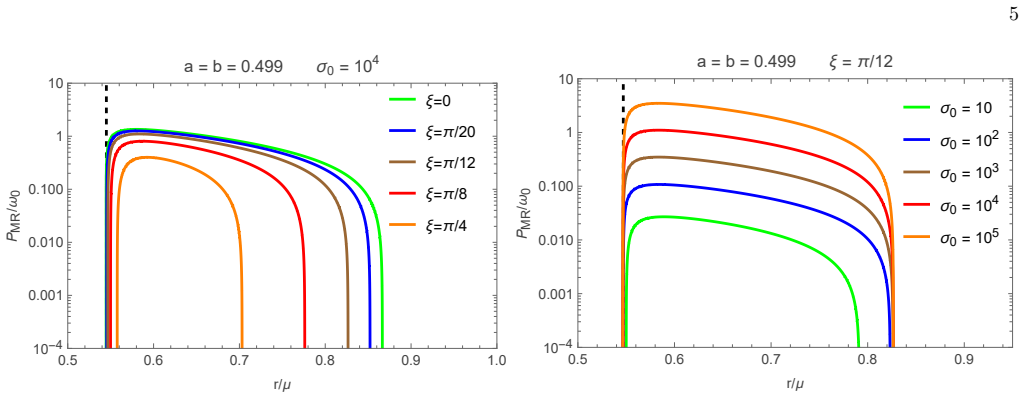
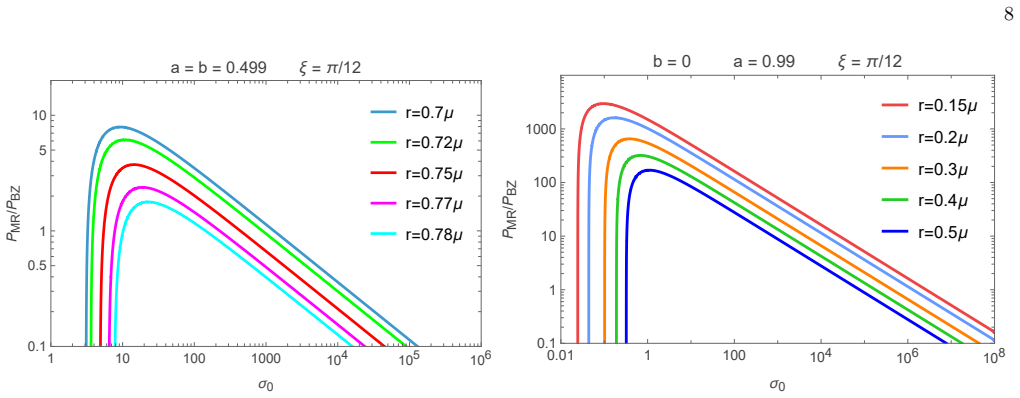
We employ the Comisso-Asenjo magnetic reconnection mechanism to investigate energy extraction from a rapidly rotating five-dimensional Kerr black hole with single- and two-rotation configurations. We analyze the efficiency, phase-space structure of accelerated and decelerated plasma energies, and the extracted power as functions of the spin parameter, reconnection location, plasma magnetization, and magnetic field orientation. We show that MR significantly enhances energy extraction from a five-dimensional BH with a single rotation and that the extraction efficiency is higher in the single rotation configuration than in the two-rotation case. We also evaluate the extraction rate and compare
What carries the argument
The Comisso-Asenjo magnetic reconnection mechanism applied within the five-dimensional Kerr spacetime, which accelerates plasma by releasing magnetic energy near the event horizon.
If this is right
- The extraction efficiency is higher in the single-rotation configuration than in the two-rotation case.
- The extracted power can exceed that of the Blandford-Znajek process in the single-rotation configuration.
- Efficiency and power vary with spin parameter, reconnection location, plasma magnetization, and magnetic field orientation.
- Five-dimensional Kerr black holes with single rotation are promising candidates for powering high-energy astrophysical phenomena.
Where Pith is reading between the lines
- If extra dimensions are present, single-rotation black holes may serve as more efficient energy sources than in four dimensions.
- This could influence models of high-energy astrophysical sources in higher-dimensional theories.
- Applying the mechanism to other higher-dimensional spacetimes might yield similar enhancements in energy extraction.
Load-bearing premise
The magnetic reconnection process as formulated in four-dimensional spacetime applies directly to the five-dimensional Kerr black hole geometry and the surrounding plasma and magnetic fields without essential modifications.
What would settle it
Finding through numerical simulations or analytical calculations that the energy extraction rate from magnetic reconnection in five-dimensional Kerr black holes is lower than the Blandford-Znajek rate across the relevant parameter space would falsify the claim of significant improvement.
Figures




read the original abstract
In this paper, we employ the Comisso-Asenjo magnetic reconnection (MR) mechanism to investigate energy extraction from a rapidly rotating five-dimensional Kerr black hole (BH) with single- and two-rotation configurations. We analyze the efficiency, phase-space structure of accelerated and decelerated plasma energies, and the extracted power as functions of the spin parameter, reconnection location, plasma magnetization, and magnetic field orientation. We show that MR significantly enhances energy extraction from a five-dimensional BH with a single rotation and that the extraction efficiency is higher in the single rotation configuration than in the two-rotation case. We also evaluate the extraction rate and compare it with the Blandford-Znajek (BZ) mechanism, showing that the extracted power can exceed that of the BZ process in the single-rotation configuration. Our analysis shows that MR can significantly improve energy extraction in five-dimensional Kerr BHs with a single rotation, making them promising candidates for powering high-energy astrophysical phenomena.
Editorial analysis
A structured set of objections, weighed in public.
Referee Report
Summary. The paper applies the Comisso-Asenjo magnetic reconnection (MR) mechanism to energy extraction from five-dimensional Kerr black holes with single- and two-rotation configurations. It computes efficiency, the phase-space structure of accelerated and decelerated plasma energies, and extracted power as functions of spin parameter, reconnection location, plasma magnetization, and magnetic-field orientation. The central claims are that MR significantly enhances extraction in the single-rotation case, that efficiency is higher for single rotation than for two rotations, and that the extracted power can exceed the Blandford-Znajek (BZ) power in the single-rotation configuration.
Significance. If the quantitative results survive scrutiny, the work would indicate that single-rotation five-dimensional Kerr black holes can be more efficient energy extractors via magnetic reconnection than either their two-rotation counterparts or the BZ process, thereby identifying a class of higher-dimensional spacetimes as plausible engines for high-energy astrophysical phenomena. The comparative study of rotation parameters in 5D supplies a concrete illustration of how dimensionality and the number of independent rotations affect extraction efficiency.
major comments (2)
- [§3 and §4] §3 (reconnection formalism) and §4 (energy and power expressions): the manuscript inserts the five-dimensional Kerr metric components (g_tt, g_tφ, ergosphere radius) directly into the four-dimensional Comisso-Asenjo formulas for pre- and post-reconnection energies E_in/out, Lorentz factors, magnetization σ, and power P ∝ σ B² v_rec A. No re-derivation of the electromagnetic invariants F_μν F^μν, the stress-energy tensor, or the local reconnection rate v_rec is provided for the 5D manifold. Because the Maxwell tensor and the Killing vectors now involve an extra coordinate and a second rotation parameter, the phase-space boundaries and the numerical advantage claimed for single-rotation configurations may receive O(1) corrections that are not quantified.
- [§4.2] §4.2 (power comparison with BZ): the statement that MR power exceeds BZ power for single-rotation 5D Kerr relies on the same unsubstantiated substitution. Without an explicit 5D calculation of the reconnection rate and the extracted ΔE, the claimed superiority cannot be regarded as established.
minor comments (2)
- [Abstract and §1] The abstract and introduction should state the numerical ranges explored for spin a, magnetization σ, and reconnection radius r_rec so that readers can assess the domain of the reported trends.
- [§2] Notation: clarify whether Greek indices run over 0–4 and whether the extra-dimensional coordinate is treated as ignorable; this affects the definition of conserved quantities along Killing vectors.
Simulated Author's Rebuttal
We thank the referee for the careful reading and constructive criticism of our manuscript. We address each major comment below and will revise the paper to incorporate clarifications and caveats.
read point-by-point responses
-
Referee: [§3 and §4] §3 (reconnection formalism) and §4 (energy and power expressions): the manuscript inserts the five-dimensional Kerr metric components (g_tt, g_tφ, ergosphere radius) directly into the four-dimensional Comisso-Asenjo formulas for pre- and post-reconnection energies E_in/out, Lorentz factors, magnetization σ, and power P ∝ σ B² v_rec A. No re-derivation of the electromagnetic invariants F_μν F^μν, the stress-energy tensor, or the local reconnection rate v_rec is provided for the 5D manifold. Because the Maxwell tensor and the Killing vectors now involve an extra coordinate and a second rotation parameter, the phase-space boundaries and the numerical advantage claimed for single-rotation configurations may receive O(1) corrections that are not quantified.
Authors: We agree that the original Comisso-Asenjo analysis was performed in four dimensions and that a complete re-derivation of the reconnection dynamics from the 5D Einstein-Maxwell equations would be desirable. In the present work we generalize the conserved energies E_in/out by contracting the four-velocity with the timelike and azimuthal Killing vectors of the 5D Kerr metric, using the explicit 5D line element to evaluate the normalization and the ergosphere boundary. The electromagnetic invariants are computed with the 5D metric for an asymptotically uniform magnetic field. However, the local reconnection rate v_rec is adopted from the 4D literature as an order-of-magnitude estimate. We will add a new paragraph in §3 that explicitly lists these assumptions, notes that O(1) corrections to the quantitative efficiencies and power ratios may arise from a full 5D MHD treatment, and states that the qualitative ordering between single- and double-rotation cases is driven by the metric components in the ergoregion, which are correctly incorporated. revision: partial
-
Referee: [§4.2] §4.2 (power comparison with BZ): the statement that MR power exceeds BZ power for single-rotation 5D Kerr relies on the same unsubstantiated substitution. Without an explicit 5D calculation of the reconnection rate and the extracted ΔE, the claimed superiority cannot be regarded as established.
Authors: We accept that the comparison with the Blandford-Znajek process must be qualified. The BZ power is evaluated using the standard 5D expressions for horizon area and angular velocity available in the higher-dimensional literature. The MR power employs the same approximate v_rec and area scaling. In the revised manuscript we will add an explicit statement that both mechanisms are treated at the same level of approximation, that a self-consistent 5D calculation of the reconnection rate is not performed, and that the claim of MR exceeding BZ holds only under the adopted approximations for the single-rotation case. revision: partial
- A complete first-principles derivation of the reconnection rate v_rec and the electromagnetic stress-energy tensor from the five-dimensional Maxwell equations and relativistic MHD.
Circularity Check
No significant circularity detected
full rationale
The paper applies the established Comisso-Asenjo 4D reconnection formulas to the 5D Kerr metric by direct substitution of metric components (g_tt, g_tφ, ergosphere radius) into expressions for pre/post-reconnection energies E_in/out, Lorentz factors, and power P ∝ σ B² v_rec A. This constitutes a model application rather than a self-definitional loop, a fitted parameter renamed as prediction, or a load-bearing self-citation chain. No equations reduce by construction to their inputs; the efficiency and power comparisons to BZ emerge from the substituted 5D geometry under the stated assumptions. The derivation remains self-contained as an extension of prior external results, with no ansatz smuggling or renaming of known patterns presented as new unification.
Axiom & Free-Parameter Ledger
axioms (2)
- domain assumption The Comisso-Asenjo magnetic reconnection mechanism applies directly to five-dimensional Kerr spacetime without modification
- domain assumption Plasma magnetization, magnetic-field orientation, and reconnection location can be treated as independent parameters in the five-dimensional geometry
Reference graph
Works this paper leans on
-
[1]
B. P. Abbott and et al. (Virgo and LIGO Scientific Collaborations), Phys. Rev. Lett.116, 061102 (2016), arXiv:1602.03837 [gr-qc]
work page internal anchor Pith review arXiv 2016
- [2]
-
[3]
First M87 Event Horizon Telescope Results. I. The Shadow of the Supermassive Black Hole
K. Akiyama and et al. (Event Horizon Telescope Collab- oration), Astrophys. J.875, L1 (2019), arXiv:1906.11238 [astro-ph.GA]
work page internal anchor Pith review arXiv 2019
-
[4]
First M87 Event Horizon Telescope Results. VI. The Shadow and Mass of the Central Black Hole
K. Akiyama and et al. (Event Horizon Telescope Collab- oration), Astrophys. J.875, L6 (2019), arXiv:1906.11243 [astro-ph.GA]
work page Pith review arXiv 2019
- [5]
-
[6]
B. M. Peterson,An Introduction to Active Galactic Nu- clei(1997)
1997
-
[7]
P. Meszaros, Rept. Prog. Phys.69, 2259 (2006), arXiv:astro-ph/0605208
-
[8]
R. P. Fender, T. M. Belloni, and E. Gallo, Mon. Not. R. Astron. Soc.355, 1105 (2004), arXiv:astro-ph/0409360 [astro-ph]
work page Pith review arXiv 2004
-
[9]
K. Auchettl, J. Guillochon, and E. Ramirez-Ruiz, As- trophys. J.838, 149 (2017), arXiv:1611.02291 [astro- ph.HE]
- [10]
-
[11]
Penrose, Riv
R. Penrose, Riv. Nuovo Cim.1, 252 (1969)
1969
-
[12]
M. Bhat, S. Dhurandhar, and N. Dadhich, Journal of Astrophysics and Astronomy6, 85 (1985)
1985
-
[13]
Parthasarathy, S
S. Parthasarathy, S. M. Wagh, S. V. Dhurandhar, and N. Dadhich, Atrophys. J.307, 38 (1986)
1986
-
[14]
R. D. Blandford and R. L. Znajek, Mon. Not. Roy. As- tron. Soc.179, 433 (1977)
1977
-
[15]
M. J. Rees, Ann. Rev. Astron. Astrophys.22, 471 (1984)
1984
- [16]
- [17]
-
[18]
S. V. Dhurandhar and N. Dadhich, Phys. Rev. D29, 2712 (1984)
1984
-
[19]
S. V. Dhurandhar and N. Dadhich, Phys. Rev. D30, 1625 (1984)
1984
-
[20]
S. M. Wagh, S. V. Dhurandhar, and N. Dadhich, Astro- phys. J.290, 12 (1985)
1985
-
[21]
A. Tursunov and N. Dadhich, Universe5, 125 (2019), arXiv:1905.05321 [astro-ph.HE]
-
[22]
S. Shaymatov, Phys. Rev. D110, 044042 (2024), arXiv:2402.02471 [gr-qc]
-
[23]
T. Xamidov, S. Shaymatov, P. Sheoran, and B. Ahme- dov, Eur. Phys. J. C84, 1300 (2024), arXiv:2407.19800 [gr-qc]
-
[24]
N. Dadhich, A. Tursunov, B. Ahmedov, and Z. Stuchl´ ık, Mon. Not. Roy. Astron. Soc.478, L89 (2018), arXiv:1804.09679 [astro-ph.HE]
-
[25]
S. Shaymatov, N. Dadhich, and A. Tursunov, Eur. Phys. J. C84, 1015 (2024), arXiv:2404.06870 [gr-qc]
-
[26]
Shaymatov, P
S. Shaymatov, P. Sheoran, R. Becerril, U. Nucamendi, and B. Ahmedov, Phys. Rev. D106, 024039 (2022)
2022
-
[27]
T. Xamidov, P. Sheoran, S. Shaymatov, and T. Zhu, J. Cosmol. Astropart. Phys.2025, 053 (2025), arXiv:2412.03885 [gr-qc]
-
[28]
S. Koide and K. Arai, Astrophys. J.682, 1124 (2008), arXiv:0805.0044 [astro-ph]
-
[29]
K. Parfrey, A. Philippov, and B. Cerutti, Phys. Rev. Lett.122, 035101 (2019), arXiv:1810.03613 [astro- ph.HE]
-
[30]
Brito, V
R. Brito, V. Cardoso, and P. Pani,Superradiance. New Frontiers in Black Hole Physics, Vol. 971 (2020)
2020
-
[31]
R. D. Blandford and D. G. Payne, Mon. Not. Roy. As- tron. Soc.199, 883 (1982)
1982
-
[32]
A. P. Marscheret al., Nature452, 966 (2008)
2008
-
[33]
The Astrophysics of Ultrahigh Energy Cosmic Rays
K. Kotera and A. V. Olinto, Annual Reviews49, 119 (2011), arXiv:1101.4256 [astro-ph.HE]
work page Pith review arXiv 2011
- [34]
-
[35]
L. Comisso and F. A. Asenjo, Phys. Rev. D103, 023014 (2021), arXiv:2012.00879 [astro-ph.HE]
-
[36]
W. Liu, Astrophys. J.925, 149 (2022), arXiv:2204.07338 [astro-ph.HE]
- [37]
- [38]
-
[39]
M. Khodadi, Phys. Rev. D105, 023025 (2022), arXiv:2201.02765 [gr-qc]
-
[40]
C.-H. Wang, C.-Q. Pang, and S.-W. Wei, Phys. Rev. D 106, 124050 (2022), arXiv:2209.08837 [gr-qc]
-
[41]
Khodadi, D
M. Khodadi, D. F. Mota, and A. Sheykhi, J. Cosmol. Astropart. Phys.2023, 034 (2023)
2023
-
[42]
S. Shaymatov, M. Alloqulov, B. Ahmedov, and A. Wang, Phys. Rev. D110, 044005 (2024), arXiv:2307.03012 [gr- qc]
- [43]
- [44]
-
[45]
Y. Shen and H.-Y. YuChih, Phys. Rev. D111, 023003 (2025), arXiv:2412.03010 [astro-ph.HE]
- [46]
-
[47]
S. Rodriguez, A. Sidler, L. Rodriguez, and L. R. Ram-Mohan, Phys. Dark Universe48, 101961 (2025), arXiv:2407.15347 [gr-qc]
-
[48]
Energy extraction from a rotating black hole via magnetic reconnection: Bumblebee gravity
H.-Y. YuChih and Y. Shen, Phys. Rev. D112, 104016 (2025), arXiv:2510.23292 [gr-qc]
work page internal anchor Pith review arXiv 2025
-
[49]
K. Wang and X.-X. Zeng, J. Cosmol. Astropart. Phys. 2025, 026 (2025), arXiv:2508.11934 [gr-qc]
-
[50]
X.-X. Zeng and K. Wang, Phys. Rev. D112, 064032 (2025), arXiv:2507.21777 [gr-qc]
-
[51]
Zeng and K
X.-X. Zeng and K. Wang, Phys. Rev. D112, 064080 (2025)
2025
- [52]
-
[53]
I. Eshtursunov and S. Shaymatov, (2026), arXiv:2603.17928 [gr-qc]
-
[54]
R. C. Myers and M. J. Perry, Ann. Phys. (N.Y.)172, 304 (1986)
1986
- [55]
-
[56]
M. Nozawa and K.-I. Maeda, Phys. Rev. D71, 084028 (2005), hep-th/0502166
-
[57]
K. Prabhu and N. Dadhich, Phys. Rev. D81, 024011 (2010), arXiv:0902.3079 [hep-th]
-
[58]
A. Abdujabbarov, N. Dadhich, B. Ahmedov, and H. Eshkuvatov, Phys. Rev. D88, 084036 (2013), arXiv:1310.4494 [gr-qc]
-
[59]
N. Dadhich and S. Shaymatov, Phys. Dark Universe35, 100986 (2022), arXiv:2104.00427 [gr-qc]
- [60]
-
[61]
S. Shaymatov, N. Dadhich, and B. Ahmedov, Eur. Phys. J. C79, 585 (2019), arXiv:1809.10457 [gr-qc]
-
[62]
S. Shaymatov, N. Dadhich, and B. Ahmedov, Phys. Rev. D101, 044028 (2020), arXiv:1908.07799 [gr-qc]
-
[63]
S. Shaymatov, N. Dadhich, B. Ahmedov, and M. Jamil, Eur. Phys. J. C80, 481 (2020), arXiv:1908.01195 [gr-qc]
-
[64]
Dadhich and S
N. Dadhich and S. Shaymatov, Int. J. Mod. Phys. D.31, 2150120 (2022)
2022
-
[65]
S. Shaymatov and N. Dadhich, Phys. Dark Universe31, 100758 (2021), arXiv:2004.09242 [gr-qc]
- [66]
-
[67]
Black Hole Spin and the Radio Loud/Quiet Dichotomy of Active Galactic Nuclei
A. Tchekhovskoy, R. Narayan, and J. C. McKinney, Astrophys. J.711, 50 (2010), arXiv:0911.2228 [astro- ph.HE]
work page Pith review arXiv 2010
discussion (0)
Sign in with ORCID, Apple, or X to comment. Anyone can read and Pith papers without signing in.