Recognition: unknown
Chirp-controlled plasma wake excitation by an exponential laser pulse in underdense plasma
Pith reviewed 2026-05-07 07:34 UTC · model grok-4.3
The pith
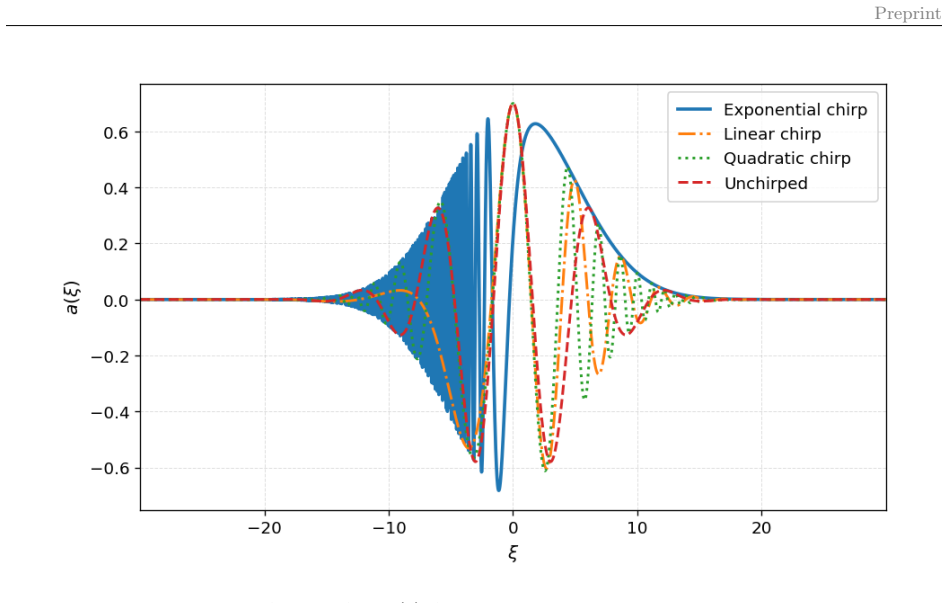
Exponential chirping of laser pulses produces stronger plasma wakefields than polynomial or unchirped pulses through nonlinear phase variation.
A machine-rendered reading of the paper's core claim, the machinery that carries it, and where it could break.
Core claim
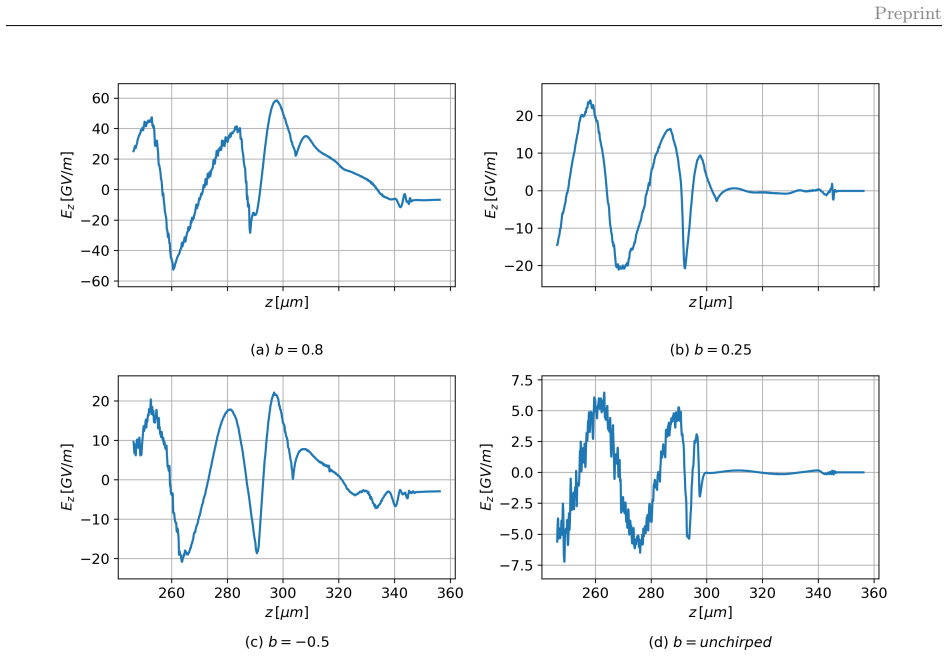
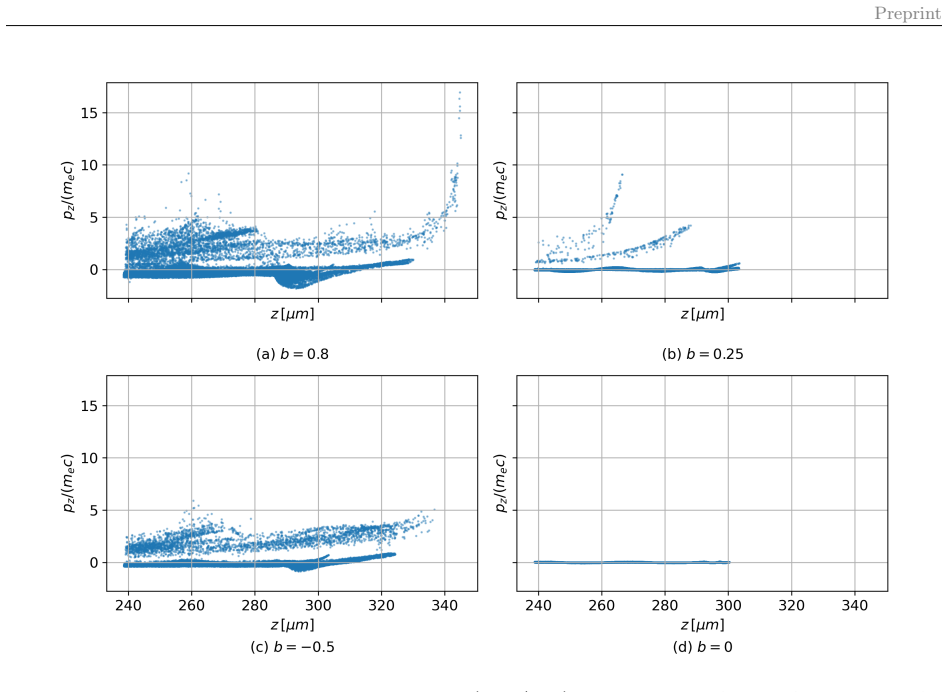
The central claim is that exponential chirping produces enhanced wakefield amplitudes compared to polynomial and unchirped cases due to nonlinear phase variation across the pulse envelope. The reduced relativistic fluid Poisson model predicts this enhancement, which is then validated by fully relativistic particle-in-cell simulations performed with identical parameters. The simulations reveal strong chirp-dependent wakefield modification, with positively chirped pulses generating peak accelerating fields exceeding 58 GV per m, accompanied by pronounced density compression and enhanced electron momentum gain.
What carries the argument
Nonlinear phase variation across the envelope of an exponentially chirped laser pulse, which drives stronger wakefield excitation in the reduced relativistic fluid Poisson model.
If this is right
- Positively chirped exponential pulses generate peak accelerating fields exceeding 58 GV per m.
- Wakefield strength and electron momentum gain increase with positive exponential chirping while density compression becomes more pronounced.
- Exponential chirping offers a controllable mechanism to raise wakefield amplitude beyond what linear or quadratic chirps achieve.
- The fluid-model predictions match quasi-cylindrical PIC results for the chosen underdense regime and laser parameters.
Where Pith is reading between the lines
- Tuning the chirp shape could let experimentalists reach target wakefield strengths at lower laser intensities than required with unchirped pulses.
- The same nonlinear-phase mechanism may appear in other laser-plasma processes such as Raman amplification or harmonic generation when phase modulation is introduced.
- Extending the comparison to longer propagation distances or tapered plasma profiles would test whether the exponential-chirp advantage persists before wave breaking occurs.
- If confirmed in experiments, the method could reduce the required laser power for GeV-scale acceleration stages in staged plasma accelerators.
Load-bearing premise
The reduced relativistic fluid Poisson model accurately captures the dominant physics of chirped laser-plasma interaction for the chosen underdense parameters without missing higher-order nonlinear or kinetic effects.
What would settle it
Full kinetic particle-in-cell simulations or an experiment that shows the wakefield amplitude for an exponential chirp is not larger than for a linear chirp under matched laser energy, duration, and plasma density would falsify the claimed enhancement.
Figures



read the original abstract
The excitation of plasma wakefields driven by chirped laser pulses is investigated using a reduced relativistic fluid Poisson model supported by fully relativistic particle in cell (PIC) simulations. The study considers exponential, linear, quadratic, and unchirped phase-modulated laser drivers propagating in an underdense plasma. Numerical solutions of the governing equations demonstrate that exponential chirping produces enhanced wakefield amplitudes compared to polynomial and unchirped cases due to nonlinear phase variation across the pulse envelope. The analytical predictions are validated using quasi cylindrical PIC simulations performed under identical plasma and laser parameters. The simulations reveal strong chirp dependent wakefield modification, with positively chirped pulses generating peak accelerating fields exceeding 58 GV per m, accompanied by pronounced density compression and enhanced electron momentum gain. These results demonstrate that exponential chirping provides an effective mechanism for controlling wakefield strength and improving plasma based particle acceleration.
Editorial analysis
A structured set of objections, weighed in public.
Referee Report
Summary. The manuscript investigates chirp-controlled plasma wakefield excitation in underdense plasma driven by an exponential laser pulse. It solves a reduced relativistic fluid Poisson model numerically for exponential, linear, quadratic, and unchirped phase modulations, claiming enhanced wake amplitudes for the exponential case due to nonlinear phase variation across the pulse envelope. These results are validated by quasi-cylindrical fully relativistic PIC simulations under matching parameters, which report strong chirp-dependent modifications including peak accelerating fields exceeding 58 GV/m, pronounced density compression, and enhanced electron momentum gain for positively chirped pulses.
Significance. If the central claim holds, the work identifies exponential chirping as an effective control mechanism for increasing wakefield strength in laser-plasma accelerators, with potential benefits for plasma-based particle acceleration. The combination of a reduced fluid model for mechanistic insight into phase variation effects and independent PIC validation is a methodological strength. The reported field amplitudes are notable, though the absence of sensitivity analysis and error bars limits quantitative assessment of robustness across the free parameters (chirp rate, density, intensity).
major comments (2)
- [§2] §2 (reduced relativistic fluid Poisson model): The model is presented without a complete derivation from the underlying relativistic fluid equations or explicit statement of the key approximations (e.g., how the Poisson form is obtained and how nonlinear phase variation enters the envelope). Because the enhancement is attributed specifically to this nonlinear phase effect captured in the reduced model, the missing derivation is load-bearing for evaluating whether the numerical solutions genuinely isolate the claimed mechanism.
- [§4] §4 (PIC simulations and validation): The quasi-cylindrical PIC runs reproduce the chirp-dependent wake modification and the >58 GV/m peak field, but no grid resolution, particles-per-cell count, or convergence tests are reported. Without these, it is unclear whether the observed density compression and momentum gain are numerically converged, which directly affects the strength of the validation for the fluid model's prediction of exponential-chirp superiority.
minor comments (4)
- [Abstract] The abstract refers to 'analytical predictions' that are validated by PIC, yet the text emphasizes numerical solutions of the governing equations; clarify whether a closed-form analytical expression exists or revise the wording for consistency.
- [Figures] Figure legends and captions (e.g., those comparing wakefield amplitudes for different chirps): Axes units, normalization conventions, and the specific values of the exponential chirp rate parameter should be stated explicitly to allow quantitative reproduction.
- [Results] No error bars or ensemble statistics are provided for the reported peak fields or density profiles; adding these would improve the presentation of the numerical results.
- [Discussion] A brief parameter-sensitivity scan around the chosen plasma density and laser intensity (listed as free parameters) would be useful even if placed in supplementary material.
Simulated Author's Rebuttal
We thank the referee for their careful reading of our manuscript and for the constructive comments, which have helped us improve the clarity and robustness of the presentation. We address each major comment below and have revised the manuscript to incorporate the requested details.
read point-by-point responses
-
Referee: [§2] §2 (reduced relativistic fluid Poisson model): The model is presented without a complete derivation from the underlying relativistic fluid equations or explicit statement of the key approximations (e.g., how the Poisson form is obtained and how nonlinear phase variation enters the envelope). Because the enhancement is attributed specifically to this nonlinear phase effect captured in the reduced model, the missing derivation is load-bearing for evaluating whether the numerical solutions genuinely isolate the claimed mechanism.
Authors: We agree that a self-contained derivation strengthens the manuscript. The reduced relativistic fluid Poisson model is obtained from the cold relativistic fluid equations for the electrons (continuity, momentum, and Maxwell's equations) under the quasi-static approximation for a laser pulse with slowly varying envelope. The Poisson form for the wake potential follows from combining the fluid equations with the wave equation in the 1D limit, neglecting ion motion and assuming propagation along the laser axis. The nonlinear phase variation enters the envelope through the chirped vector potential A = a0 exp(-ξ²/2σ²) exp(i ϕ(ξ)), where ϕ(ξ) is the phase modulation; this modifies the ponderomotive force term and leads to the enhanced wake amplitude for the exponential case. In the revised manuscript we have expanded Section 2 with a step-by-step derivation (now including an explicit list of approximations) and added a new Appendix A that isolates the contribution of the nonlinear phase term. These additions confirm that the numerical solutions of the reduced model capture the claimed mechanism. revision: yes
-
Referee: [§4] §4 (PIC simulations and validation): The quasi-cylindrical PIC runs reproduce the chirp-dependent wake modification and the >58 GV/m peak field, but no grid resolution, particles-per-cell count, or convergence tests are reported. Without these, it is unclear whether the observed density compression and momentum gain are numerically converged, which directly affects the strength of the validation for the fluid model's prediction of exponential-chirp superiority.
Authors: We acknowledge that explicit numerical parameters and convergence information are necessary for assessing the reliability of the PIC results. In the revised manuscript we have added to Section 4 the simulation parameters used (grid spacing Δz = 0.05 c/ω_pe, Δr = 0.1 c/ω_pe, and 25 particles per cell) together with the results of convergence tests performed by doubling both the spatial resolution and the particle count. These tests show that the peak accelerating field changes by less than 4 % and that the density compression and electron momentum gain profiles remain qualitatively and quantitatively consistent. The added information directly supports the validation of the fluid-model predictions. revision: yes
Circularity Check
No significant circularity detected
full rationale
The paper derives its central results by numerically solving the reduced relativistic fluid Poisson equations for the laser-plasma interaction and then validating those solutions against independent, fully relativistic quasi-cylindrical PIC simulations performed at identical parameters. The reported wakefield enhancement for exponential chirping arises directly from the nonlinear phase variation produced by integrating the governing equations; it is not imposed by definition, obtained by fitting a parameter to a subset of the same data, or justified solely by a self-citation chain. The PIC runs constitute an external, higher-fidelity check that reproduces the chirp-dependent density compression and momentum gain, confirming that the fluid-model predictions are not tautological. No load-bearing step reduces to a renaming of inputs or to an ansatz smuggled in via prior work by the same authors.
Axiom & Free-Parameter Ledger
free parameters (2)
- exponential chirp rate parameter
- plasma density and laser intensity parameters
axioms (1)
- domain assumption The reduced relativistic fluid Poisson model is a sufficient approximation for the laser-plasma interaction under the studied conditions.
Reference graph
Works this paper leans on
-
[1]
Tajima T and Dawson J M 1979 Laser electron acceleratorPhys. Rev. Lett.43267
1979
-
[2]
Plasmas22573
Andreev N E, Kirsanov V I and Gorbunov L M 1995 Stimulated processes and self-modulation of a short intense laser pulse in the laser wakefield acceleratorPhys. Plasmas22573
1995
-
[3]
Antonsen T M Jr and Mora P 1992 Self-focusing and Raman scattering of laser pulses in tenuous plasmas Phys. Rev. Lett.692204
1992
-
[4]
Max C E, Arons J and Langdon A B 1974 Self-modulation and self-focusing of electromagnetic waves in plasmasPhys. Rev. Lett.33209
1974
-
[5]
Fluids30526
Sun G Z, Ott E, Lee Y C and Guzdar P 1987 Self-focusing of short intense pulses in plasmasPhys. Fluids30526
1987
-
[6]
Plasma Sci.15145
Sprangle P, Tang C M and Esarey E 1987 Relativistic self-focusing of short-pulse radiation beams in plasmasIEEE Trans. Plasma Sci.15145
1987
-
[7]
Plasmas113259
Jha P, Wadhwani N, Upadhyaya A K and Raj G 2004 Self-focusing and channel-coupling effects on short laser pulses propagating in a plasma channelPhys. Plasmas113259
2004
-
[8]
Fluids17778
Drake J F, Kaw P K, Lee Y C, Schmidt G, Liu C S and Rosenbluth M N 1974 Parametric instabilities of electromagnetic waves in plasmasPhys. Fluids17778
1974
-
[9]
Fluids B32356
Kruer W L 1991Intense laser plasma interactions: From Janus to Nova Phys. Fluids B32356
-
[10]
Plasma Sci.24252
Esarey E, Sprangle P, Krall J and Ting A 1996 Overview of plasma-based accelerator conceptsIEEE Trans. Plasma Sci.24252
1996
-
[12]
Plasmas22103105
Chen Z Y and Pukhov A 2015 High field terahertz emission from relativistic laser-driven plasma wakefields Phys. Plasmas22103105
2015
-
[13]
Express3025002
Mishra D, Sharma P, Singh S, Kumar B and Jha P 2021 Generation of terahertz radiation by short laser pulses propagating in obliquely magnetized plasmaPlasma Res. Express3025002
2021
-
[14]
Beams34378
Verma N K and Jha P 2016 Enhanced terahertz radiation generation by two-color laser pulses propagating in plasmaLaser Part. Beams34378
2016
-
[15]
Plasmas24013102
Sharma P, Wadhwani N and Jha P 2017 Terahertz radiation generation by propagation of circularly polarized laser pulses in axially magnetized plasmaPhys. Plasmas24013102
2017
-
[16]
2014 Multiple-beam laser–plasma interactions in inertial confinement fusionPhys
Myatt J Fet al. 2014 Multiple-beam laser–plasma interactions in inertial confinement fusionPhys. Plasmas21055501
2014
-
[17]
Jha P, Saroch A, Mishra R K and Upadhyaya A K 2012 Laser wakefield acceleration in magnetized plasmaPhys. Rev. ST Accel. Beams15081301 10 Preprint
2012
-
[18]
Beams31583
Jha P, Saroch A and Mishra R K 2013 Wakefield generation and electron acceleration by intense super-Gaussian laser pulses propagating in plasmaLaser Part. Beams31583
2013
-
[19]
McPherson A, Gibson G, Jara H, Johann U, Luk T S, McIntyre I A, Boyer K and Rhodes C K 1987 Studies of multiphoton production of vacuum-ultraviolet radiation in the rare gasesJ. Opt. Soc. Am. B 4595
1987
-
[20]
Liu X and Umstadter D 1992 Competition between ponderomotive and thermal forces in short-scale-length laser plasmasPhys. Rev. Lett.691935
1992
-
[21]
Quantum Electron.331915
Gibbon P 1997 High-order harmonic generation in plasmasIEEE J. Quantum Electron.331915
1997
-
[22]
Plasma Sci.2190
Liu X, Umstadter D, Esarey E and Ting A 1993 Harmonic generation by an intense laser pulse in neutral and ionized gasesIEEE Trans. Plasma Sci.2190
1993
-
[23]
Aggarwal S, Mishra D, Singh S, Kumar B and Jha P 2025 Second harmonic generation by radially polarized laser beam propagating in homogeneous plasmaEPL35045401
2025
-
[24]
Plasmas111834
Jha P, Wadhwani N, Raj G and Upadhyaya A K 2004 Relativistic and ponderomotive effects on laser plasma interaction dynamicsPhys. Plasmas111834
2004
-
[25]
Perry M D and Mourou G 1994 Terawatt to petawatt subpicosecond lasersScience264917
1994
-
[26]
Grigoriadis A, Andrianaki G, Tatarakis M, Benis E P and Papadogiannis N A 2023 The role of laser chirp in relativistic electron acceleration using multi-electron gas targetsPlasma Phys. Control. Fusion 65044001
2023
-
[27]
Afhami S and Eslami E 2014 Effect of nonlinear chirped Gaussian laser pulse on plasma wake field generationAIP Adv.4087142
2014
-
[28]
Scr.98075504
Singh S, Mishra D, Kumar B and Jha P 2023 Electron acceleration by wakefield generated by the propagation of chirped laser pulse in plasmaPhys. Scr.98075504
2023
-
[29]
Ghotra H S 2022 Optimizing chirped laser pulse parameters for enhancing electron energy in a preformed ion channelEur. Phys. J. D76111
2022
-
[30]
2012 Effect of pulse profile and chirp on a laser wakefield generationPhys
Zhang X, Shen B, Ji L, Wang W, Xu Jet al. 2012 Effect of pulse profile and chirp on a laser wakefield generationPhys. Plasmas19053103 11
2012
discussion (0)
Sign in with ORCID, Apple, or X to comment. Anyone can read and Pith papers without signing in.