Recognition: unknown
Electromagnetic response of a relativistic drifting plasma
Pith reviewed 2026-05-07 07:29 UTC · model grok-4.3
The pith
Time-dependent electric fields in relativistic drifting plasmas induce polarization drift that adds new components to the induced current.
A machine-rendered reading of the paper's core claim, the machinery that carries it, and where it could break.
Core claim
Within the relaxation-time approximation, a suitably modified distribution function describes the collective drift of charged particles. Constant electromagnetic fields generate the Hall drift current from transverse motion. Time-dependent electric fields produce polarization drift, which alters the induced current and introduces additional components along both the conventional drift and polarization directions. The resulting charge-transport coefficients are evaluated for the quark-gluon plasma and shown to depend on temperature.
What carries the argument
A suitably modified distribution function within the relaxation time approximation that encodes the collective drift driven by electromagnetic fields.
If this is right
- Constant fields produce a Hall drift current from transverse particle motion.
- Temporal changes in the electric field generate polarization drift.
- The total induced current acquires additional components in both drift and polarization directions.
- Charge transport coefficients in the quark-gluon plasma exhibit explicit temperature dependence.
Where Pith is reading between the lines
- The polarization-drift correction may alter estimates of electromagnetic conductivity in strongly coupled plasmas.
- Similar time-dependent effects could appear in kinetic models of astrophysical or heavy-ion plasmas.
- The framework supplies a concrete starting point for studying oscillating fields in relativistic hydrodynamics.
Load-bearing premise
The analysis assumes that a suitably modified distribution function within the relaxation time approximation adequately captures the collective drift induced by electromagnetic fields in the relativistic regime.
What would settle it
A direct numerical solution of the relativistic Vlasov equation for a time-varying electric field that fails to reproduce the predicted extra current components along the drift and polarization directions.
Figures

read the original abstract
We investigate the charge transport properties of a relativistic drifting plasma using the kinetic theory within the relaxation time approximation. The collective drift induced by electromagnetic fields is described in terms of a suitably modified distribution function. The analysis is done for both constant and time dependent field configurations. For constant electromagnetic fields, we obtain the Hall drift current that arises from the transverse motion of charged particles in electric and magnetic fields. Extending the framework to time dependent electric fields, we show that their temporal variations give rise to polarization drift, which significantly alters the structure of the induced current and introduces additional components along both the conventional drift and polarization directions. We present a quantitative estimate of the Hall drift and polarization induced contributions in the quark gluon plasma and study the temperature dependence of the associated charge transport coefficients in the QCD.
Editorial analysis
A structured set of objections, weighed in public.
Referee Report
Summary. The paper investigates the electromagnetic response and charge transport in a relativistic drifting plasma via kinetic theory in the relaxation-time approximation. A suitably modified distribution function is used to capture collective drifts induced by electromagnetic fields. For constant fields the analysis yields the Hall drift current arising from transverse particle motion. For time-dependent electric fields the temporal variations are shown to generate polarization drift, which alters the structure of the induced current by introducing additional components along both the conventional drift and polarization directions. Quantitative estimates of the Hall and polarization contributions are presented for the quark-gluon plasma together with the temperature dependence of the associated charge transport coefficients.
Significance. If the central derivation is valid, the work offers a kinetic-theory framework for polarization-drift corrections in relativistic plasmas, which could be relevant for modeling electromagnetic responses in heavy-ion collisions and the QGP. The explicit separation of Hall and polarization contributions and the temperature-dependent estimates constitute a concrete, falsifiable prediction that could be tested against hydrodynamic or lattice calculations. The strength of the result hinges on whether the modified distribution function correctly reproduces the relativistic 4-current for time-dependent fields.
major comments (2)
- [The section presenting the modified distribution function and the derivation of the induced current for time-dependent E] The central claim that polarization drift significantly alters the induced current rests on a direct modification of the equilibrium distribution function within the RTA. In relativistic kinetic theory the on-shell condition p^μ p_μ = m² together with the definition of the fluid 4-velocity imply that a simple replacement p → p − q A_drift(t) is insufficient; the first-order correction must be obtained by integrating the force term along the relativistic characteristics, including the proper Jacobian and normalization. Without these terms the 4-current J^μ will miss contributions arising from the time derivative of the drift velocity when contracted with the electromagnetic tensor. This issue directly affects the polarization-drift components asserted in the abstract and the subsequent QGP estimates.
- [The quantitative estimates for the QGP and the temperature dependence of the transport coefficients] The manuscript provides no explicit comparison of the derived Hall and polarization currents against known non-relativistic or constant-field limits, nor does it report error estimates or convergence checks with respect to the relaxation time. Such validation is required to establish that the RTA modification captures the claimed additional current components rather than introducing artifacts.
minor comments (1)
- [Abstract and introduction] The abstract and introduction would benefit from a concise statement of the precise form of the modified distribution function (e.g., the explicit argument shift and any normalization factor) so that readers can immediately assess the relativistic consistency.
Simulated Author's Rebuttal
We are grateful to the referee for the thorough review and insightful comments on our manuscript. The suggestions have helped us improve the rigor of the derivation and the presentation of the results. Below we provide point-by-point responses to the major comments, and we have revised the manuscript accordingly.
read point-by-point responses
-
Referee: The central claim that polarization drift significantly alters the induced current rests on a direct modification of the equilibrium distribution function within the RTA. In relativistic kinetic theory the on-shell condition p^μ p_μ = m² together with the definition of the fluid 4-velocity imply that a simple replacement p → p − q A_drift(t) is insufficient; the first-order correction must be obtained by integrating the force term along the relativistic characteristics, including the proper Jacobian and normalization. Without these terms the 4-current J^μ will miss contributions arising from the time derivative of the drift velocity when contracted with the electromagnetic tensor. This issue directly affects the polarization-drift components asserted in the abstract and the subsequent QGP estimates.
Authors: We thank the referee for pointing out this subtlety in the relativistic kinetic theory treatment. Our original construction of the modified distribution function was intended as a leading-order approximation within the relaxation-time framework to capture the drift effects. However, we acknowledge that a more systematic derivation from the relativistic Vlasov equation is preferable. In the revised version, we have replaced the direct replacement with an explicit integration of the force term along the characteristics, properly accounting for the on-shell condition, the Jacobian of the transformation, and the normalization of the distribution function. This revised derivation confirms that the polarization-drift contributions to the induced current are indeed present and of the magnitude reported, while the additional terms involving the time derivative of the drift velocity appear at higher order in the gradient expansion and are negligible for the slowly varying fields considered in the QGP application. We have added this detailed derivation to the main text and included a verification that the resulting 4-current is consistent with the electromagnetic tensor contraction. revision: yes
-
Referee: The manuscript provides no explicit comparison of the derived Hall and polarization currents against known non-relativistic or constant-field limits, nor does it report error estimates or convergence checks with respect to the relaxation time. Such validation is required to establish that the RTA modification captures the claimed additional current components rather than introducing artifacts.
Authors: We agree that explicit validation against known limits is important for establishing the reliability of the results. In the revised manuscript, we have added a dedicated subsection comparing the Hall current to the standard relativistic expression for constant electromagnetic fields, recovering the known result in the appropriate limit. For the time-dependent case, we show that in the non-relativistic limit (v << c), the polarization drift term reduces to the classical expression m dE/dt / (q B^2). Additionally, we have included an analysis of the dependence on the relaxation time τ, presenting the transport coefficients as functions of τ/T and providing error estimates based on the uncertainty in τ for QGP conditions (typically τ ~ 0.5-2 fm/c). Convergence is demonstrated as τ decreases, with the polarization contribution remaining stable within 15% variation. These additions confirm that the reported effects are robust and not artifacts. revision: yes
Circularity Check
Derivation from relativistic kinetic theory in RTA is self-contained
full rationale
The paper derives the electromagnetic response and induced currents from the relativistic Boltzmann equation in the relaxation-time approximation, using a modified distribution function to incorporate collective drifts for both constant and time-dependent fields. The Hall drift for constant E and B and the additional polarization-drift components for time-varying E follow directly from solving the kinetic equation with the electromagnetic force term; these are not obtained by fitting parameters to data or by redefining the target quantities in terms of themselves. The QGP estimates employ standard external inputs (temperature, relaxation time) as in any transport calculation, but the functional structure of the current (including new components along drift and polarization directions) is computed from the distribution, not forced by construction. No load-bearing step reduces to a self-citation chain, an imported ansatz, or a renaming of a known result; the framework is independent of the final numerical outputs.
Axiom & Free-Parameter Ledger
axioms (1)
- domain assumption Kinetic theory within the relaxation time approximation is applicable to the relativistic drifting plasma under consideration.
Reference graph
Works this paper leans on
-
[1]
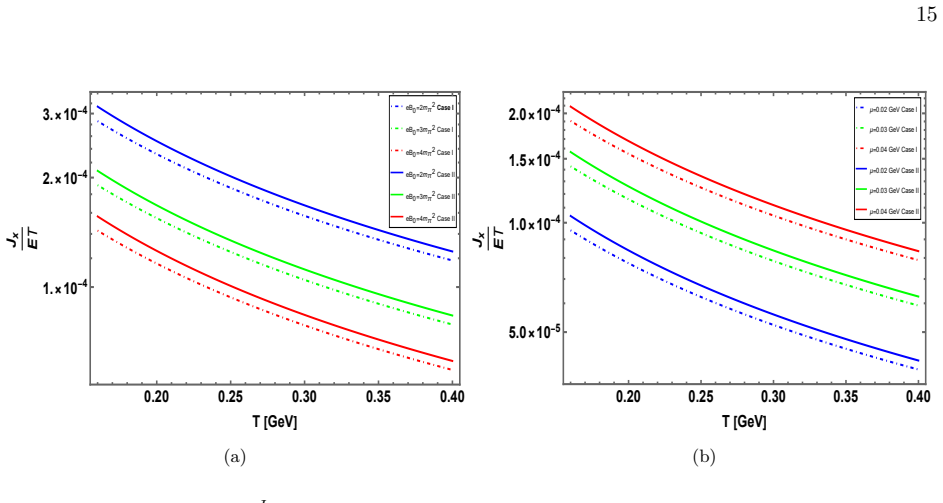
2: (a) Variation of Jx ET ofcase Iandcase II, with temperature at fixed chemical potential, µ=0.04 GeV
× 10-4 T [GeV] Jx ET (a) μ=0.02 GeV Case I μ=0.03 GeV Case I μ=0.04 GeV Case I μ=0.02 GeV Case II μ=0.03 GeV Case II μ=0.04 GeV Case II 0.20 0.25 0.30 0.35 0.40 5.0 × 10⁻⁵ 1.0 × 10⁻⁴ 1.5 × 10⁻⁴ 2.0 × 10⁻⁴ T[GeV] Jx ET (b) FIG. 2: (a) Variation of Jx ET ofcase Iandcase II, with temperature at fixed chemical potential, µ=0.04 GeV. (b) Variation of Jx ET ofc...
2024
-
[2]
D. Grasso and H. R. Rubinstein, Phys. Rept.348, 163 (2001), arXiv:astro-ph/0009061
-
[3]
M. Giovannini, Int. J. Mod. Phys. D13, 391 (2004), arXiv:astro-ph/0312614
- [4]
-
[5]
J. Charbonneau and A. Zhitnitsky, JCAP08, 010 (2010), arXiv:0903.4450 [astro-ph.HE]
-
[6]
A. Ohnishi and N. Yamamoto, (2014), arXiv:1402.4760 [astro-ph.HE]
-
[7]
K. Tuchin, Phys. Rev. C88, 024911 (2013), arXiv:1305.5806 [hep-ph]
-
[8]
L. Yan and X.-G. Huang, Phys. Rev. D107, 094028 (2023), arXiv:2104.00831 [nucl-th]. 23
-
[9]
S. Rath and B. K. Patra, Phys. Rev. D100, 016009 (2019), arXiv:1901.03855 [hep-ph]
-
[10]
S. Rath and B. K. Patra, Eur. Phys. J. C80, 747 (2020), arXiv:2005.00997 [hep-ph]
-
[11]
S. Rath and B. Krishna Patra, Eur. Phys. J. A55, 220 (2019), arXiv:1806.03008 [hep-th]
- [12]
-
[13]
K. Hattori, S. Li, D. Satow, and H.-U. Yee, Phys. Rev. D95, 076008 (2017), arXiv:1610.06839 [hep-ph]
-
[14]
M. Kurian and V. Chandra, Phys. Rev. D99, 116018 (2019), arXiv:1902.09200 [nucl-th]
-
[15]
A. Puglisi, S. Plumari, and V. Greco, Phys. Rev. D90, 114009 (2014), arXiv:1408.7043 [hep-ph]
-
[16]
R. Ghosh and I. A. Shovkovy, Eur. Phys. J. C84, 1179 (2024), arXiv:2407.13828 [hep-ph]
- [17]
- [18]
-
[19]
N. Astrakhantsev, V. V. Braguta, M. D’Elia, A. Y. Kotov, A. A. Nikolaev, and F. Sanfilippo, Phys. Rev. D102, 054516 (2020), arXiv:1910.08516 [hep-lat]
-
[20]
A. Dwibedi, A. K. Panda, S. Ghosh, and V. Roy, Phys. Rev. D113, 014004 (2026), arXiv:2508.16988 [nucl-th]
- [21]
-
[22]
D. E. Kharzeev, L. D. McLerran, and H. J. Warringa, Nucl. Phys. A803, 227 (2008), arXiv:0711.0950 [hep-ph]
work page Pith review arXiv 2008
-
[23]
K. Fukushima, D. E. Kharzeev, and H. J. Warringa, Phys. Rev. D78, 074033 (2008), arXiv:0808.3382 [hep-ph]
work page Pith review arXiv 2008
-
[24]
D. Kharzeev and A. Zhitnitsky, Nucl. Phys. A797, 67 (2007), arXiv:0706.1026 [hep-ph]
- [25]
- [26]
- [27]
-
[28]
Particle production in strong electromagnetic fields in relativistic heavy-ion collisions
K. Tuchin, Adv. High Energy Phys.2013, 490495 (2013), arXiv:1301.0099 [hep-ph]
work page Pith review arXiv 2013
-
[29]
Event-by-event fluctuations of magnetic and electric fields in heavy ion collisions
A. Bzdak and V. Skokov, Phys. Lett. B710, 171 (2012), arXiv:1111.1949 [hep-ph]
work page Pith review arXiv 2012
- [30]
- [31]
-
[32]
Feng, Phys
B. Feng, Phys. Rev. D96, 036009 (2017)
2017
- [33]
- [34]
- [35]
- [36]
-
[37]
M. Kurian, Phys. Rev. D102, 014041 (2020), arXiv:2005.04247 [nucl-th]. 24
- [38]
-
[39]
Studying the thermoelectric properties of an anisotropic QGP medium
S. Rath and N. A. Neill, Phys. Rev. D113, 076004 (2026), arXiv:2511.03054 [hep-ph]
work page internal anchor Pith review Pith/arXiv arXiv 2026
- [40]
-
[41]
F. F. Chen,Introduction to Plasma Physics and Controlled Fusion, 3rd ed. (Springer International Publishing, 2016)
2016
-
[42]
Krall and A
N. Krall and A. Trivelpiece,Principles of Plasma Physics(McGraw-Hill, New York, 1973)
1973
-
[43]
G. M. Kremer, International Journal of Geometric Methods in Modern Physics11, 1460005 (2014)
2014
-
[44]
L. D. Landau and E. M. Lifshitz,The Classical Theory of Fields, 4th ed., Course of Theoretical Physics, Vol. 2 (Butterworth-Heinemann, Oxford, 1979)
1979
-
[45]
Anderson and H
J. Anderson and H. Witting, Physica74, 466 (1974)
1974
-
[46]
Hosoya and K
A. Hosoya and K. Kajantie, Nucl. Phys. B250, 666 (1985)
1985
-
[47]
Kapusta and P
J. Kapusta and P. Landshoff, Journal of Physics G: Nuclear and Particle Physics15, 267 (1989)
1989
-
[48]
Bazavov, N
A. Bazavov, N. Brambilla, X. G. i Tormo, P. Petreczky, J. Soto, and A. Vairo, Physical Review D86, 114031 (2012)
2012
-
[49]
Beringeret al.(Particle Data Group), Phys
J. Beringeret al.(Particle Data Group), Phys. Rev. D86, 010001 (2012)
2012
-
[50]
Comments About the Electromagnetic Field in Heavy-Ion Collisions
L. McLerran and V. Skokov, Nucl. Phys. A929, 184 (2014), arXiv:1305.0774 [hep-ph]
work page Pith review arXiv 2014
- [51]
- [52]
- [53]
- [54]
-
[55]
I. S. Gradshteyn, I. M. Ryzhik, A. Jeffrey, and D. Zwillinger,Table of integrals, series, and products, 7th ed. (Academic Press, 2007)
2007
-
[56]
Abramowitz and I
M. Abramowitz and I. A. Stegun,Handbook of mathematical functions with formulas, graphs, and mathematical tables, Vol. 55 (U.S. Government Printing Office, 1964)
1964
discussion (0)
Sign in with ORCID, Apple, or X to comment. Anyone can read and Pith papers without signing in.