Recognition: unknown
Mixing and spreading of gravity currents in heterogeneous porous media
Pith reviewed 2026-05-07 07:21 UTC · model grok-4.3
The pith
Heterogeneity increases gravity current speed proportionally to Rayleigh number but reduces dissolution in porous media
A machine-rendered reading of the paper's core claim, the machinery that carries it, and where it could break.
Core claim
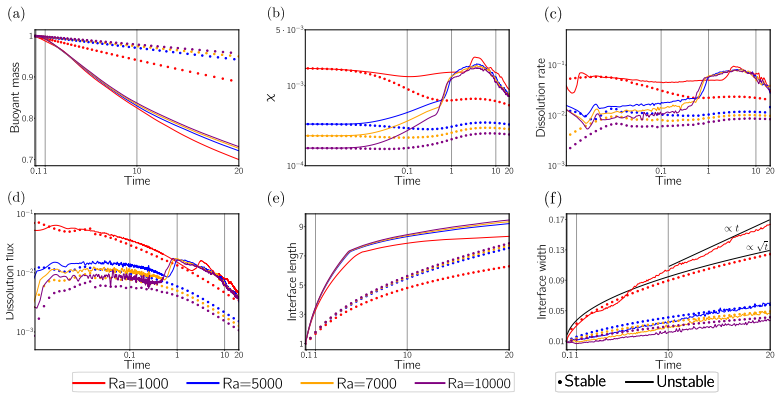
Heterogeneity reduces dissolution and increases the speed of the gravity current proportionally to the Rayleigh number. In the unstable case, heterogeneity accelerates the onset of convection. Convection-driven dissolution slows down the gravity current and counteracts the dispersive effect of heterogeneity resulting in a narrower interface and higher dissolution than in the stable case. Permeability anisotropy reduces dissolution because of the barrier effect of low permeability regions, except when blobs of buoyant fluid are trapped in low permeability structures and rapidly dissolve. The variance of the log-permeability field enhances dissolution. However, the homogeneous case outperforms
What carries the argument
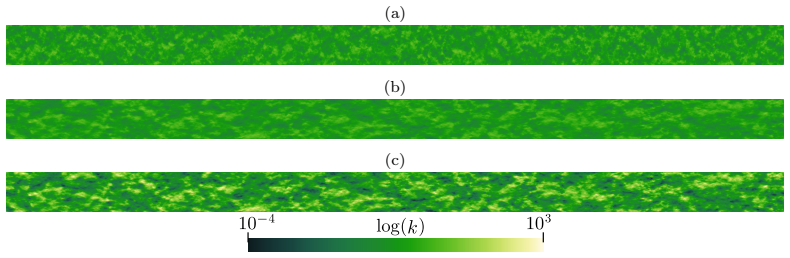
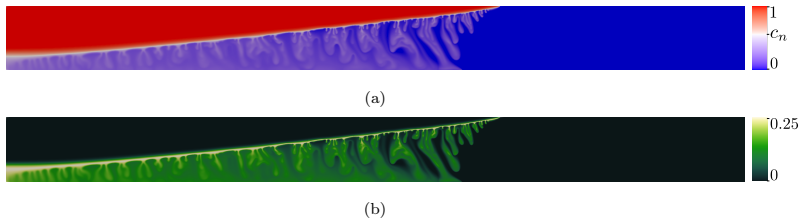
High-fidelity numerical simulations of gravity currents in log-normal permeability fields with different correlation lengths and variances, under linear and non-monotonic density laws for stable and unstable stratification.
If this is right
- The speed of the gravity current increases with heterogeneity proportionally to the Rayleigh number.
- In the unstable case, heterogeneity accelerates the onset of convection.
- Convection-driven dissolution results in a narrower interface and higher dissolution than in the stable case.
- Permeability anisotropy reduces dissolution due to barrier effects of low permeability regions, except for trapped blobs that dissolve rapidly.
- The variance of the log-permeability field enhances dissolution, but homogeneous cases outperform heterogeneous ones except at small Rayleigh numbers.
Where Pith is reading between the lines
- Models of fluid transport in natural porous media such as aquifers may need to include heterogeneity to correctly predict dissolution rates at high Rayleigh numbers.
- The interaction between instability size and permeability correlation length suggests an optimal scale for maximum dissolution efficiency.
- At low Rayleigh numbers, heterogeneous media could lead to higher dissolution than homogeneous ones, useful for certain engineering applications.
- Three-dimensional simulations or inclusion of additional effects like capillarity could further refine understanding of interface dynamics.
Load-bearing premise
The log-normal permeability fields with varying correlation lengths and variance accurately represent natural heterogeneous porous media.
What would settle it
Direct experimental measurements of gravity current speed and dissolution rates in a lab-scale heterogeneous porous medium with known permeability statistics that fail to show the proportional speed increase with Rayleigh number or the reduced dissolution would falsify the central claims.
Figures





read the original abstract
We analyze the mixing, migration and spreading of a gravity current in a heterogeneous porous medium using high-fidelity numerical simulations. Heterogeneity is represented by log-normal permeability fields of varying correlation lengths and variance. Stable and unstable density stratification scenarios are considered through linear and non-monotonic density laws, respectively. Heterogeneity reduces dissolution and increases the speed of the gravity current proportionally to the Rayleigh number. In the unstable case, heterogeneity accelerates the onset of convection. Convection-driven dissolution slows down the gravity current and counteracts the dispersive effect of heterogeneity resulting in a narrower interface and higher dissolution than in the stable case. Permeability anisotropy reduces dissolution because of the barrier effect of low permeability regions, except when blobs of buoyant fluid are trapped in low permeability structures and rapidly dissolve. The variance of the log-permeability field enhances dissolution. However, the homogeneous case outperforms heterogeneous cases except when Rayleigh number is small. This suggest an interaction between the size of the instabilities, the correlation length of the permeability field and the dispersive and barrier effects of the permeability field that controls dissolution efficiency.
Editorial analysis
A structured set of objections, weighed in public.
Referee Report
Summary. The paper uses high-fidelity numerical simulations to examine the migration, spreading, and dissolution of gravity currents in porous media with log-normal permeability heterogeneity (varying correlation length and variance). Stable (linear density) and unstable (non-monotonic density) stratifications are considered. Key claims are that heterogeneity reduces dissolution while increasing current speed proportionally to Rayleigh number, accelerates convection onset in the unstable case, and interacts with convection to produce narrower interfaces and higher dissolution than in the stable case; anisotropy generally reduces dissolution except when buoyant blobs are trapped, variance enhances dissolution, and the homogeneous case outperforms heterogeneous ones except at small Ra, pointing to an interplay between instability scale, correlation length, and permeability effects.
Significance. If the numerical results are robust, the work would contribute to understanding how heterogeneity modulates convective mixing and gravity-current dynamics in subsurface flows, with relevance to CO2 sequestration and contaminant transport. The distinction between stable/unstable cases and the reported counteracting effect of convection on heterogeneity-induced dispersion are potentially useful. Credit is due for exploring a range of permeability statistics and both density laws in a single study. However, the absence of reported validation against experiments or homogeneous analytical limits reduces the immediate significance of the quantitative trends.
major comments (3)
- [§2] §2 (Numerical model and setup): No grid-convergence studies, resolution details relative to correlation lengths, or error bars from ensemble sampling of permeability realizations are provided. This is load-bearing for the central claims because the reported proportionality of speed to Ra, interface narrowing, and dissolution rates could be sensitive to under-resolved small-scale features or artificial diffusion, as noted in the absence of any discretization or boundary-condition validation.
- [§3] §3 (Results, stable and unstable cases): The manuscript presents no direct comparison of the homogeneous limit to known analytical or experimental gravity-current scalings (e.g., speed ~ Ra or dissolution rates), nor any laboratory benchmarks for heterogeneous cases. Without these, the claims that heterogeneity reduces dissolution, accelerates onset, and that homogeneous media outperform except at low Ra cannot be assessed for numerical accuracy or physical fidelity.
- [§4] §4 (Discussion of anisotropy and variance effects): The statement that permeability anisotropy reduces dissolution except when blobs are trapped lacks quantitative metrics (e.g., trapped volume fractions or dissolution time scales) across the reported Ra range and correlation lengths; this interaction is central to the conclusion about barrier vs. trapping effects but is presented without supporting statistics or sensitivity tests.
minor comments (3)
- [Abstract] Abstract: 'This suggest an interaction' should read 'This suggests an interaction'.
- [Figures] Figure captions and axis labels in the results section should explicitly state the number of permeability realizations averaged and whether error bars represent standard deviation or standard error.
- [§2] Notation for the non-monotonic density law and the definition of the Rayleigh number should be cross-referenced to the governing equations in §2 for clarity.
Simulated Author's Rebuttal
We thank the referee for their constructive and detailed comments on our manuscript. We have addressed each major point below, indicating revisions where the manuscript will be updated to strengthen the numerical validation and quantitative support for our claims.
read point-by-point responses
-
Referee: [§2] §2 (Numerical model and setup): No grid-convergence studies, resolution details relative to correlation lengths, or error bars from ensemble sampling of permeability realizations are provided. This is load-bearing for the central claims because the reported proportionality of speed to Ra, interface narrowing, and dissolution rates could be sensitive to under-resolved small-scale features or artificial diffusion, as noted in the absence of any discretization or boundary-condition validation.
Authors: We agree that explicit documentation of numerical convergence and resolution is essential to support the quantitative claims. Although our simulations were designed with resolutions sufficient to capture the correlation lengths (typically 10-20 grid points per correlation length), we did not include these details or convergence tests in the original submission. In the revised manuscript, we will add a new subsection to §2 describing the grid resolution strategy, results of grid-convergence studies for key quantities (e.g., front speed and dissolution rate), and statistical error bars from ensembles of 5-10 permeability realizations per parameter set. This will confirm that the reported trends, including speed proportionality to Ra, are robust and not artifacts of under-resolution or artificial diffusion. revision: yes
-
Referee: [§3] §3 (Results, stable and unstable cases): The manuscript presents no direct comparison of the homogeneous limit to known analytical or experimental gravity-current scalings (e.g., speed ~ Ra or dissolution rates), nor any laboratory benchmarks for heterogeneous cases. Without these, the claims that heterogeneity reduces dissolution, accelerates onset, and that homogeneous media outperform except at low Ra cannot be assessed for numerical accuracy or physical fidelity.
Authors: We acknowledge the importance of validating against known limits. For the homogeneous case, we will incorporate direct comparisons to analytical scalings for gravity current propagation (speed proportional to Ra) and dissolution rates in the revised results section. This will be added as a benchmark subsection. Regarding laboratory benchmarks for heterogeneous cases, while specific experiments matching our parameter space (log-normal permeability with given variances and correlation lengths) are not available in the literature, we will expand the discussion to reference and compare with existing experimental studies on gravity currents in heterogeneous porous media (e.g., those involving layered or random permeability fields). We cannot conduct new laboratory experiments as part of this revision, but the numerical validation against homogeneous analytics will provide a baseline for assessing fidelity. revision: partial
-
Referee: [§4] §4 (Discussion of anisotropy and variance effects): The statement that permeability anisotropy reduces dissolution except when blobs are trapped lacks quantitative metrics (e.g., trapped volume fractions or dissolution time scales) across the reported Ra range and correlation lengths; this interaction is central to the conclusion about barrier vs. trapping effects but is presented without supporting statistics or sensitivity tests.
Authors: We appreciate this suggestion to strengthen the quantitative support for our conclusions on anisotropy. In the revised manuscript, we will add quantitative metrics, including plots and tables of trapped buoyant fluid volume fractions and average dissolution time scales as functions of anisotropy ratio, Ra, and correlation length. These will be derived from additional post-processing of our simulation data and included in §4 to clearly demonstrate the barrier effect versus trapping mechanism, along with sensitivity to the parameters. revision: yes
- Providing new laboratory benchmarks for heterogeneous gravity currents, as this would require additional experimental work outside the scope of the current numerical study.
Circularity Check
Numerical simulations of standard Darcy equations with prescribed log-normal permeability fields show no circular derivation chain
full rationale
The paper reports outcomes from high-fidelity numerical integration of the standard porous-media flow equations (Darcy's law with buoyancy, advection-diffusion for concentration) on synthetically generated log-normal permeability fields whose statistics are chosen a priori. All central claims—hetereogeneity effects on current speed proportional to Ra, accelerated onset in unstable cases, convection counteracting dispersion, anisotropy barrier effects—are direct simulation outputs rather than quantities fitted to the same outputs and then re-labeled as predictions. No self-definitional steps, no uniqueness theorems imported from the authors' prior work, and no ansatz smuggled via citation appear in the derivation. The study is therefore self-contained against external benchmarks in the sense that its governing equations and heterogeneity generation procedure are independent of the reported trends; any concerns about grid resolution or field-data fidelity are questions of numerical validity, not circularity.
Axiom & Free-Parameter Ledger
Reference graph
Works this paper leans on
-
[1]
Benhammadi, R., De Wit, A., Hidalgo, J.J., 2025a
URL:http://dx.doi.org/10.1017/jfm.2022.922, doi:10.1017/ jfm.2022.922. Benhammadi, R., De Wit, A., Hidalgo, J.J., 2025a. Effect of permeability heterogeneity on reactive convective dissolution. Physical Review Flu- ids 10, 123501. URL:https://link.aps.org/doi/10.1103/jpmc-tcfd, doi:10.1103/jpmc-tcfd. Benhammadi, R., Meunier, P., Hidalgo, J.J., 2025b. Expe...
-
[2]
Hidalgo, J.J., MacMinn, C.W., Juanes, R., 2013
URL:http://dx.doi.org/10.3390/fluids3030058, doi:10.3390/ fluids3030058. Hidalgo, J.J., MacMinn, C.W., Juanes, R., 2013. Dynamics of convective dissolution from a migrating current of carbon dioxide. Advances in Water Resources 62, 511–519. doi:10.1016/j.advwatres.2013.06.013. Hinton, E.M., Woods, A.W., 2018. Buoyancy-drivenflowinaconfinedaquifer with a v...
-
[3]
Water Resources Research 56, e2019WR026452
Assessment and Prediction of Pore-Scale Reactive Mixing From Experimental Conservative Transport Data. Water Resources Research 56, e2019WR026452. doi:10.1029/2019WR026452. Pool, M., Post, V.E.A., Simmons, C.T., 2015. Effectsoftidalfluctuationsand spatial heterogeneity on mixing and spreading in spatially heterogeneous coastal aquifers. Water Resources Re...
discussion (0)
Sign in with ORCID, Apple, or X to comment. Anyone can read and Pith papers without signing in.