Recognition: unknown
Shift of the maxima of the critical currents of different polarity relative to the zero magnetic flux along the flux axis in a superconducting asymmetric aluminum ring
Pith reviewed 2026-05-07 07:40 UTC · model grok-4.3
The pith
In asymmetric aluminum rings, a temperature-dependent phase shift equal to the difference in dimensionless kinetic inductances of wide and narrow semirings explains the observed displacement of critical current maxima for opposite current,
A machine-rendered reading of the paper's core claim, the machinery that carries it, and where it could break.
Core claim
The central claim is that the temperature-dependent shift of the maxima of the critical currents of different polarity relative to zero magnetic flux equals the difference between the dimensionless kinetic inductances of the wide and narrow semirings. This difference is nonzero only when the critical current densities in the two semirings are unequal, which requires different critical temperatures in those semirings. The model reproduces the measured temperature dependence of the shift and removes the contradiction between results obtained by different measurement methods on circularly asymmetric aluminum structures.
What carries the argument
Difference between dimensionless kinetic inductances of wide and narrow semirings of equal length and thickness, serving as a temperature-dependent phase shift when critical temperatures differ.
If this is right
- Rectification of AC voltage appears in series arrays of such rings because the critical-current maxima for opposite current directions move in opposite directions along the flux axis.
- The magnitude of the shift increases with decreasing temperature in the manner expected from the temperature dependence of the kinetic inductances.
- The shift vanishes at temperatures where the critical temperatures of the two semirings coincide or where kinetic inductances become equal.
- Accounting for this inductance difference reconciles previously contradictory reports of flux shifts in asymmetric aluminum rings measured by different techniques.
Where Pith is reading between the lines
- The same inductance-difference mechanism could be tested in asymmetric rings made from other superconductors to check whether the required critical-temperature mismatch can be engineered by geometry alone.
- If the model holds, deliberate variation of film thickness or material composition between halves could be used to tune the rectification amplitude for flux-sensitive superconducting devices.
- A direct test would be to fabricate rings in which the wide and narrow parts are made from the same material but with controlled local Tc differences and measure whether the shift scales exactly with the calculated kinetic-inductance difference.
- The resolution of prior contradictions implies that earlier experiments may have inadvertently sampled rings with small but undetected Tc gradients.
Load-bearing premise
Different critical current densities in the wide and narrow semirings can arise only from different critical temperatures in those semirings.
What would settle it
Observation of a nonzero temperature-dependent shift in a ring where the wide and narrow semirings have been fabricated to have identical critical temperatures would falsify the model.
Figures




read the original abstract
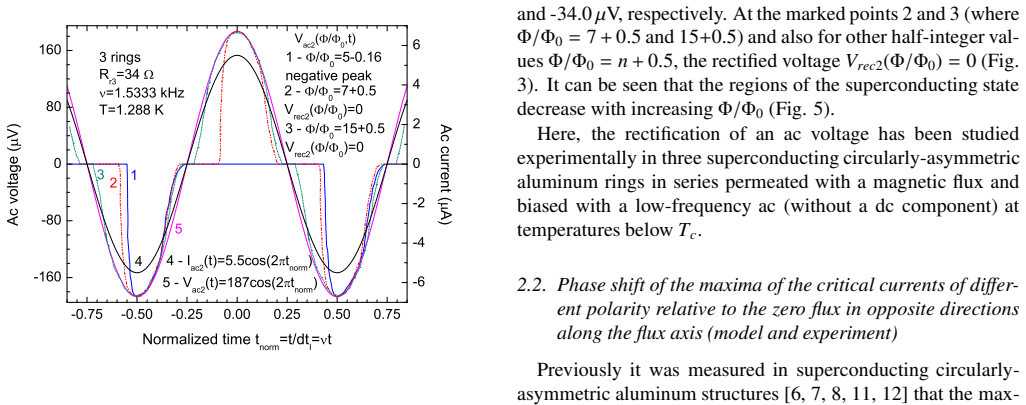
We measured the rectification of an ac voltage in a structure of superconducting circularly-asymmetric aluminum rings in series, permeated with a magnetic flux and biased with a low-frequency alternating current (without a dc component). This rectification is due to the shift of the maxima of the critical currents of different polarity relative to the zero flux in opposite directions along the flux axis in the asymmetric ring. For the first time, we propose a model for a temperature-dependent phase shift equal to difference between dimensionless kinetic inductances of wide and narrow semirings having the same length and thickness. The shift is not zero in the case of different critical currents densities in both semirings. This is possible only in a situation of different critical temperatures of both semirings. The model describes well the temperature-dependent shift of the maxima of the critical currents, answers the long-standing mysterious challenge of the shift and removes extremely strange contradiction between the results of different measurements, previously found in circularly-asymmetric aluminum structures.
Editorial analysis
A structured set of objections, weighed in public.
Referee Report
Summary. The manuscript reports measurements of AC voltage rectification in series-connected circularly asymmetric superconducting aluminum rings under applied magnetic flux and low-frequency AC bias without DC component. The rectification is attributed to a shift of the critical-current maxima for opposite polarities in opposite directions along the flux axis. The authors propose a model in which this temperature-dependent phase shift equals the difference between the dimensionless kinetic inductances of the wide and narrow semirings (same length and thickness). The shift is nonzero only when the critical current densities differ, which the authors state occurs only when the semirings have different critical temperatures. The model is claimed to describe the observed temperature dependence well and to resolve contradictions in prior measurements on similar structures.
Significance. If the central assumption holds and the derivation is sound, the work would offer a concrete physical mechanism for the long-standing flux-axis shift in asymmetric superconducting rings, linking it to kinetic-inductance differences that arise from material variations. The experimental observation of polarity-dependent rectification adds useful data to the study of superconducting flux devices. The attempt to provide a temperature-dependent model is a positive step toward explaining previously puzzling results. However, the significance is limited by the load-bearing nature of the un-justified premise that J_c differences require T_c differences.
major comments (2)
- [Abstract] Abstract: The statement that different critical current densities in the wide and narrow semirings 'is possible only in a situation of different critical temperatures of both semirings' is presented without derivation, reference, or experimental support. Critical current density can differ for geometric reasons (current crowding in thin films of unequal width), fabrication-induced variations in mean free path, or pinning, none of which require a T_c shift. Because the temperature dependence of the predicted shift is carried entirely by the T_c dependence of the kinetic inductance (L_k ∝ λ²(T)), this assumption is load-bearing for the claim that the model 'describes well' the T-dependent data.
- [Abstract] Abstract (model proposal): The model equates the observed flux-axis shift directly to the difference in dimensionless kinetic inductances of the two semirings. No explicit equations or derivation are supplied in the abstract showing how this difference produces the polarity-dependent displacement of the I_c maxima. It is also unclear whether the difference in critical temperatures is fixed by independent measurement or introduced as a free parameter to match the data; the latter would render the model descriptive rather than predictive.
minor comments (1)
- [Abstract] The abstract is a single dense paragraph; splitting it would improve readability while preserving all technical content.
Simulated Author's Rebuttal
We thank the referee for the careful reading and constructive comments. We address the major comments point by point below, clarifying the model and its assumptions while indicating revisions to improve justification and presentation.
read point-by-point responses
-
Referee: [Abstract] Abstract: The statement that different critical current densities in the wide and narrow semirings 'is possible only in a situation of different critical temperatures of both semirings' is presented without derivation, reference, or experimental support. Critical current density can differ for geometric reasons (current crowding in thin films of unequal width), fabrication-induced variations in mean free path, or pinning, none of which require a T_c shift. Because the temperature dependence of the predicted shift is carried entirely by the T_c dependence of the kinetic inductance (L_k ∝ λ²(T)), this assumption is load-bearing for the claim that the model 'describes well' the T-dependent data.
Authors: We agree that the abstract statement is stated concisely without derivation, reference, or support, which limits its clarity. In the full manuscript we argue that, for our uniformly deposited aluminum thin-film rings of identical thickness, geometric contributions such as current crowding are already incorporated into the separate calculations of kinetic inductance and critical current for each semiring; no additional J_c variation arises from width alone under our conditions. Fabrication-induced mean-free-path variations and pinning are not detected in our samples, as evidenced by reproducible I_c(T) behavior across devices. The observed J_c difference is therefore attributed to small local T_c variations inherent to the film. To strengthen the presentation we will add a brief justification with supporting references in the introduction and revise the abstract wording to indicate that differing J_c occurs primarily (rather than exclusively) via T_c differences in this geometry. This constitutes a partial revision; the model itself is unchanged. revision: partial
-
Referee: [Abstract] Abstract (model proposal): The model equates the observed flux-axis shift directly to the difference in dimensionless kinetic inductances of the two semirings. No explicit equations or derivation are supplied in the abstract showing how this difference produces the polarity-dependent displacement of the I_c maxima. It is also unclear whether the difference in critical temperatures is fixed by independent measurement or introduced as a free parameter to match the data; the latter would render the model descriptive rather than predictive.
Authors: The abstract is a concise summary and therefore omits the explicit derivation, which appears in full in the main text with equations showing that the flux-axis shift equals the difference in dimensionless kinetic inductances (ΔL_k) between the wide and narrow semirings; this ΔL_k produces opposite displacements of the I_c maxima for opposite current polarities when combined with the measured J_c asymmetry. The critical temperatures are fixed by independent extraction from the measured I_c(T) curves of the wide and narrow semirings (using the standard aluminum-film relation), not introduced as free parameters to fit the shift data; once these T_c values are set, the model predicts the observed temperature dependence of the shift without further adjustment. We will revise the abstract to include a one-sentence indication of the derivation basis and to state that the T_c difference is obtained from separate I_c(T) measurements, thereby clarifying the predictive character of the model. revision: yes
Circularity Check
Observed flux-axis shift of I_c maxima set equal to difference in dimensionless kinetic inductances, with differing T_c fitted to reproduce the T-dependence
specific steps
-
fitted input called prediction
[Abstract]
"For the first time, we propose a model for a temperature-dependent phase shift equal to difference between dimensionless kinetic inductances of wide and narrow semirings having the same length and thickness. The shift is not zero in the case of different critical currents densities in both semirings. This is possible only in a situation of different critical temperatures of both semirings. The model describes well the temperature-dependent shift of the maxima of the critical currents"
The phase shift is defined to be identical to the difference in dimensionless kinetic inductances. That difference is made temperature-dependent only by positing different T_c (hence different J_c(T) and lambda(T)) for the two semirings. The T_c values are chosen so that the resulting curve reproduces the measured shift-versus-temperature data; the claimed description is therefore a fit to the very quantity being modeled rather than an independent derivation.
full rationale
The paper's central model equates the measured temperature-dependent shift of the critical-current maxima directly to the difference in dimensionless kinetic inductances of the wide and narrow semirings. This difference is stated to vanish unless the critical-current densities differ, which the authors assert occurs only when the semirings have different critical temperatures. Because the functional form of the temperature dependence is carried entirely by the London penetration depth (and thus by the chosen T_c values), the agreement with data is obtained by selecting those T_c to match the observed shift versus temperature. No independent measurement or first-principles calculation of the T_c difference is supplied; the match is therefore achieved by construction once the parameters are adjusted to the same dataset the model is claimed to describe.
Axiom & Free-Parameter Ledger
free parameters (1)
- difference in critical temperatures of the semirings
axioms (2)
- domain assumption The phase shift equals the difference between dimensionless kinetic inductances of the wide and narrow semirings.
- ad hoc to paper Different critical current densities in the semirings arise only from different critical temperatures.
Reference graph
Works this paper leans on
-
[1]
Tinkham, Introduction to Superconductivity, McGraw- Hill Book Co., New Y ork, 2nd edition, 1996
M. Tinkham, Introduction to Superconductivity, McGraw- Hill Book Co., New Y ork, 2nd edition, 1996
1996
-
[2]
W . A. Little and R. D. Parks, Phys. Rev. Lett. 9, 9 (1962)
1962
-
[3]
S. V . Dubonos, V . I. Kuznetsov, I. N. Zhilyaev, A. V . Nikulov, A. A. Firsov, JETP Letters 77, 371 (2003) (orig- inal Russian text: S. V . Dubonos, V . I. Kuznetsov, I. N. Zhilyaev, A. V . Nikulov, A. A. Firsov, Pis’ma v Zhur- nal Eksperimental’noi i Teoreticheskoi Fiziki 77, 439 (2003)), https: //doi.org/10.1134/1.1581963, arXiv:cond- mat/0303538
-
[4]
V . I. Kuznetsov, A. A. Firsov, S. V . Dubonos, Phys. Rev. B 77, 094521 (2008), https://doi.org/10.1103/PhysRevB.77.094521
-
[5]
V . I. Kuznetsov, A. A. Firsov, Physica C: Super- conductivity and its applications 492, 11 (2013), https://doi.org/10.1016/j.physc.2013.05.003
-
[6]
V . L. Gurtovoi, S. V . Dubonos, S. V . Karpii, A. V . Nikulov, V . A. Tulin, JETP105, 262 (2007) (original Russian text: V . L. Gurtovoi, S. V . Dubonos, S. V . Karpii, A. V . Nikulov, V . A. Tulin, Zhurnal Eksperimental’noi i Teoreticheskoi Fiziki 132, 297 (2007)). 12
2007
-
[7]
V . L. Gurtovoi, S. V . Dubonos, A. V . Nikulov, N. N. Os- ipov, V . A. Tulin, JETP 105, 1157 (2007) (original Rus- sian text: V . L. Gurtovoi, S. V . Dubonos, A. V . Nikulov, N. N. Osipov, V . A. Tulin, Zhurnal Eksperimental’noi i Teoreticheskoi Fiziki 132, 1320 (2007))
2007
-
[8]
V . L. Gurtovoi, M. Exarchos, R. Shaikhaidarov, V . N. Antonov, A. V . Nikulov, V . A. Tulin, "Quantum oscilla- tions of the critical current of asymmetric superconduct- ing rings and systems of the rings", arXiv:0910.5188
-
[9]
Barone and G
A. Barone and G. Paterno, Physics and Application of the Josephson Effect, John Willey and Sons, New Y ork, 1982
1982
-
[10]
Braginski (Eds.), The SQUID Handbook: V ol
John Clarke and Alex I. Braginski (Eds.), The SQUID Handbook: V ol. 1 Fundamentals and T echnology of SQUIDs and SQUID Systems , WILEY -VCH V erlag GmbH and Co. KGaA, Weinheim, 2004
2004
-
[11]
Could two degenerate energy states be observed for a superconducting ring at Φ0/ 2?
A. A. Burlakov, V . L. Gurtovoi, S. V . Dubonos, A. V . Nikulov, V . A. Tulin, "Could two degenerate energy states be observed for a superconducting ring at Φ0/ 2?", arXiv:cond-mat/0603005
-
[12]
Investigation of possibility of cre- ation of a superconductor quantum register
A. A. Burlakov, V . L. Gurtovoi, S. V . Dubonos, A. V . Nikulov, V . A. Tulin, "Investigation of possibility of cre- ation of a superconductor quantum register", arXiv:cond- mat/0609345
-
[13]
N. W . Ashcroft, N. D. Mermin, Solid State Physics , Holt, Rinehart and Winston, New Y ork, 1976
1976
-
[14]
V . V . Schmidt, The Physics of Superconductors (Eds. P . Muller and A. V . Ustinov, Springer-V erlag, Berlin- Heidelberg, 1997)
1997
-
[15]
V . I. Kuznetsov, O. V . Trofimov, Physica C: Supercon- ductivity and its applications 581, 1353811 (2021), https://doi.org/10.1016/j.physc.2020.1353811
-
[16]
K. K. Likharev, Rev. Mod. Phys. 51, 101 (1979)
1979
-
[17]
Gershenson, and W
M. Gershenson, and W . L. McLean, J. Low Temp. Phys. 47, 123 (1982)
1982
-
[18]
V . I. Kuznetsov, O. V . Trofimov, JETP Lett. 110, 54 (2019) (original Russian text: V . I. Kuznetsov, O. V . Trofimov, Pis’ma v Zhurnal Eksperimen- tal’noi i Teoreticheskoi Fiziki 110, 47 (2019)), https://doi.org/10.1134/S0021364019130113. 13
discussion (0)
Sign in with ORCID, Apple, or X to comment. Anyone can read and Pith papers without signing in.