Recognition: unknown
Acoustic modulation of shear thickening transition in dense adhesive suspensions
Pith reviewed 2026-05-07 07:17 UTC · model grok-4.3
The pith
Ultrasound shifts the shear thickening transition to higher shear rates rather than directly reducing viscosity in dense adhesive suspensions.
A machine-rendered reading of the paper's core claim, the machinery that carries it, and where it could break.
Core claim
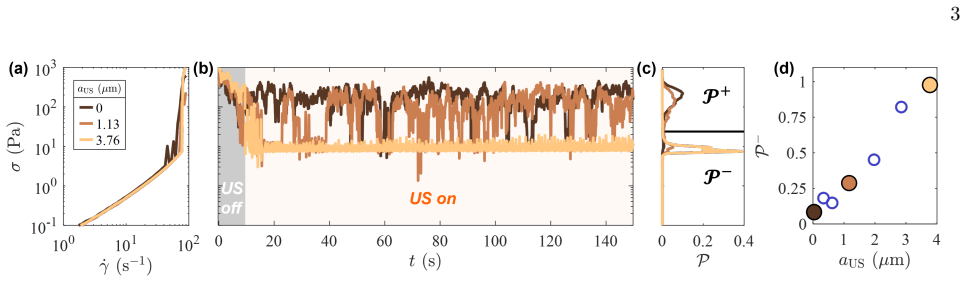
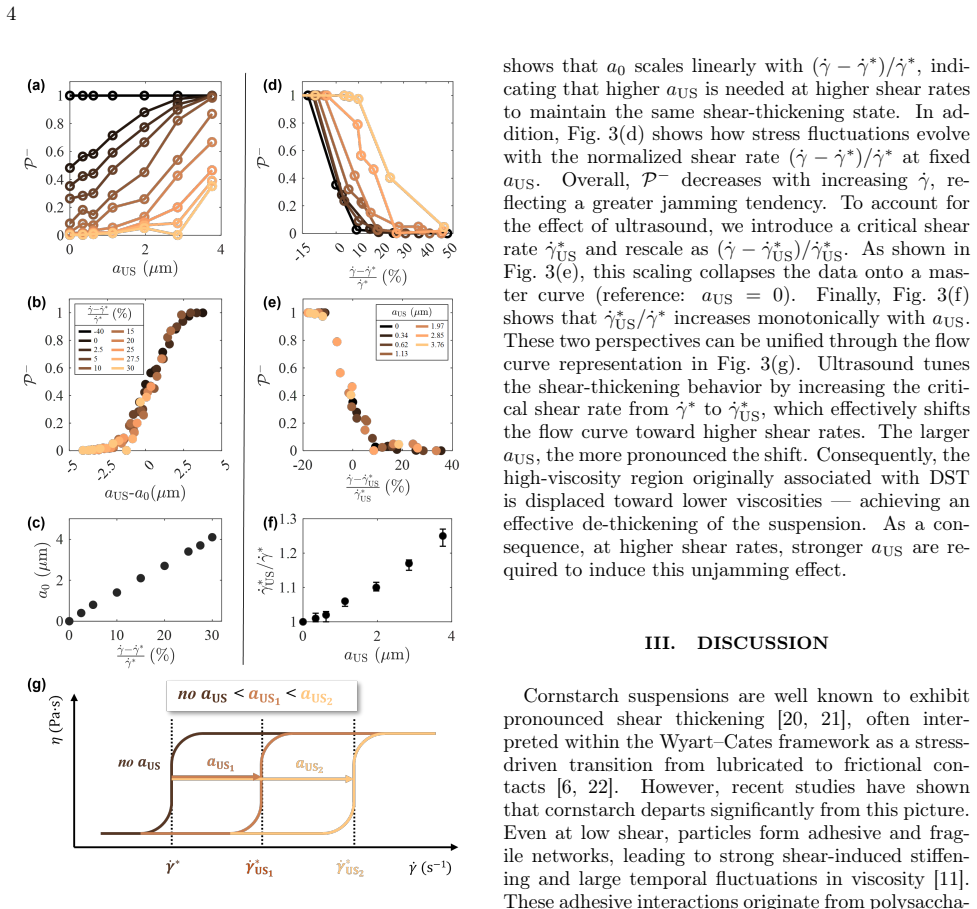
Shear thickening in these suspensions stems from fragile, load-bearing force networks within heterogeneous density-wave structures. Ultrasound does not reduce viscosity directly but shifts the transition to higher shear rates through a separation of time scales, where the material acts as a porous medium experiencing high-frequency interstitial flows. This leads to fluidization via boundary slip, drag-force fluctuations destabilizing networks, and acoustic streaming, continuously renormalizing the transition so that larger stresses are needed to maintain jammed states.
What carries the argument
Time-scale separation treating the suspension as an immobile porous medium under high-frequency interstitial flows that introduce fluctuating hydrodynamic forces at the pore scale to destabilize force networks.
If this is right
- Stress probability distributions collapse onto master curves revealing continuous evolution to fluid-like states.
- Larger stresses or shear rates are required to sustain jammed states.
- Ultrasound provides control over discontinuous shear thickening in confined flows.
- Fluidization results from boundary slip, bulk destabilization by drag fluctuations, and localized acoustic streaming.
Where Pith is reading between the lines
- This acoustic modulation could extend to non-adhesive suspensions if similar force networks form under shear.
- Industrial applications might use tunable ultrasound to prevent jamming in pipelines or mixers without altering formulation.
- Testing at different ultrasound frequencies could reveal the pore-scale resonance that maximizes the shift.
Load-bearing premise
The suspension can be treated as an effectively immobile porous medium with a clean separation between shear and ultrasound time scales so that interstitial flows dominate the destabilization.
What would settle it
If local measurements showed that ultrasound directly moves particles or reduces interparticle forces without the predicted pore-scale drag fluctuations, or if stress distributions failed to collapse onto master curves with increasing ultrasound intensity.
Figures


read the original abstract
Discontinuous shear thickening (DST) in dense suspensions leads to flow instabilities that limit processing in many systems. While high-power ultrasound has been reported to reduce the apparent viscosity of such materials, the origin of this effect remains unclear. Here, we investigate dense adhesive cornstarch suspensions, where shear thickening arises from fragile, load-bearing force networks embedded in heterogeneous density-wave structures. Using a rheo-ultrasound setup, we show that ultrasound does not directly reduce viscosity but instead shifts the shear-thickening transition toward higher shear rates. This is evidenced by the collapse of stress probability distributions onto master curves, revealing a continuous evolution toward more fluid-like states without a sharp threshold. We interpret these results through a separation of time scales, in which the suspension behaves as an effectively immobile porous medium subjected to high-frequency interstitial flows. Fluidization then arises from a combination of boundary slip, bulk destabilization of force networks by drag-force fluctuations, and localized acoustic streaming. Beyond these mechanisms, we propose that ultrasound modifies the stability of force networks by introducing fluctuating hydrodynamic forces at the pore scale. As a result, larger stresses or shear rates are required to sustain jammed states, leading to a continuous renormalization of the DST transition. These findings provide a consistent physical picture of acoustic fluidization in adhesive suspensions and establish ultrasound as a powerful tool to control discontinuous shear thickening in confined flows.
Editorial analysis
A structured set of objections, weighed in public.
Referee Report
Summary. The manuscript reports rheo-ultrasound experiments on dense adhesive cornstarch suspensions. It claims that ultrasound does not directly reduce viscosity but instead shifts the discontinuous shear thickening (DST) transition to higher shear rates. This is evidenced by the collapse of stress probability distributions onto master curves, which the authors interpret as a continuous evolution toward fluid-like states. The proposed mechanism invokes a separation of time scales in which the suspension acts as an immobile porous medium, with fluidization arising from boundary slip, drag-force fluctuations at the pore scale, and localized acoustic streaming that renormalizes force-network stability.
Significance. If the central claim holds, the work provides a practical acoustic route to suppress DST instabilities in confined flows of adhesive suspensions, with potential processing applications. The rheo-ultrasound setup and the use of stress-PDF collapse as a diagnostic are strengths, and the experimental data appear clearly presented. The significance is limited by the absence of direct tests that would confirm the proposed mechanisms dominate and by the ambiguity in interpreting the PDF collapse as a unique signature of a shifted critical point.
major comments (2)
- [Results section on stress probability distributions and master-curve collapse] The central claim that ultrasound shifts the DST transition (rather than directly lowering viscosity) rests on the reported collapse of stress probability distributions onto master curves. This collapse is taken to indicate that the system moves continuously farther from the transition. However, the same mechanisms invoked (drag-force fluctuations, acoustic streaming, boundary slip) necessarily inject additional stress fluctuations whose statistics are independent of any change in the underlying critical shear rate. No quantitative comparison of distribution moments, skewness, or tail exponents with and without ultrasound is provided to distinguish a horizontal shift in the control parameter from an orthogonal change in fluctuation spectrum. This issue is load-bearing for the interpretation stated in the abstract and results.
- [Discussion section on time-scale separation and fluidization mechanisms] The mechanistic interpretation assumes a clean separation of time scales in which the acoustic period is much shorter than the force-network relaxation time, allowing the suspension to be treated as an effectively immobile porous medium subjected to high-frequency interstitial flows. No measured or estimated ratio of these time scales is reported, nor are direct local measurements (e.g., particle imaging or pore-scale velocimetry) presented to confirm that boundary slip, bulk destabilization by drag fluctuations, and acoustic streaming dominate over other possible effects such as local heating or direct acoustic radiation forces. This assumption underpins the entire physical picture offered in the discussion.
minor comments (3)
- [Abstract] The abstract states that 'larger stresses or shear rates are required to sustain jammed states' but does not specify the ultrasound frequency range, power levels, or the precise definition of the reduced variables used for the master-curve collapse; these details should be added for reproducibility.
- [Figure captions (stress PDF figures)] Figure captions for the stress-PDF plots should explicitly state the number of independent realizations, the binning procedure, and whether error bands represent standard error or standard deviation.
- [Introduction] The manuscript would benefit from a brief comparison to prior acoustic-fluidization studies in non-adhesive suspensions to clarify what is new about the adhesive case.
Simulated Author's Rebuttal
We thank the referee for their careful reading of the manuscript and for the constructive comments, which have helped us clarify the interpretation of our results. We provide point-by-point responses to the major comments below and have revised the manuscript to address the concerns raised.
read point-by-point responses
-
Referee: [Results section on stress probability distributions and master-curve collapse] The central claim that ultrasound shifts the DST transition (rather than directly lowering viscosity) rests on the reported collapse of stress probability distributions onto master curves. This collapse is taken to indicate that the system moves continuously farther from the transition. However, the same mechanisms invoked (drag-force fluctuations, acoustic streaming, boundary slip) necessarily inject additional stress fluctuations whose statistics are independent of any change in the underlying critical shear rate. No quantitative comparison of distribution moments, skewness, or tail exponents with and without ultrasound is provided to distinguish a horizontal shift in the control parameter from an orthogonal change in fluctuation spectrum. This issue is load-bearing for the interpretation stated in the abst
Authors: We agree that a quantitative distinction between a shift in the critical shear rate and an independent change in the fluctuation spectrum is essential to support our interpretation. The master-curve collapse was intended to demonstrate that the system evolves continuously away from the transition, but we acknowledge that additional analysis of the distribution statistics strengthens this claim. In the revised manuscript we have added a comparison of the first three moments (mean, variance, skewness) and the power-law tail exponents of the stress PDFs with and without ultrasound. These quantities collapse when plotted against the distance to the ultrasound-shifted transition, consistent with a horizontal shift in the control parameter rather than an orthogonal modification of the noise spectrum. This analysis is now included in the Results section. revision: yes
-
Referee: [Discussion section on time-scale separation and fluidization mechanisms] The mechanistic interpretation assumes a clean separation of time scales in which the acoustic period is much shorter than the force-network relaxation time, allowing the suspension to be treated as an effectively immobile porous medium subjected to high-frequency interstitial flows. No measured or estimated ratio of these time scales is reported, nor are direct local measurements (e.g., particle imaging or pore-scale velocimetry) presented to confirm that boundary slip, bulk destabilization by drag fluctuations, and acoustic streaming dominate over other possible effects such as local heating or direct acoustic radiation forces. This assumption underpins the entire physical picture offered in the discussion.
Authors: We thank the referee for identifying the need for explicit support of the time-scale separation. Direct pore-scale imaging is outside the capabilities of the present rheo-ultrasound apparatus, which is designed for simultaneous global rheology and stress-fluctuation measurements. However, we have added an order-of-magnitude estimate of the time-scale ratio in the revised Discussion, using the applied acoustic frequency (~30 kHz) and the force-network relaxation time obtained from stress autocorrelation functions (~0.1–1 s), yielding a ratio >10^3. We have also included a short paragraph addressing alternative mechanisms: temperature monitoring shows rises below 0.5 °C, rendering thermal effects negligible, while order-of-magnitude estimates indicate that acoustic radiation forces remain subdominant to the pore-scale hydrodynamic drag fluctuations. These additions clarify the physical picture while acknowledging that local velocimetry would provide further direct confirmation. revision: partial
Circularity Check
No circularity: experimental collapse of stress PDFs provides independent evidence for DST shift
full rationale
The paper is primarily experimental, reporting rheo-ultrasound measurements on dense adhesive cornstarch suspensions. The central claim—that ultrasound shifts the shear-thickening transition to higher shear rates rather than directly lowering viscosity—is evidenced by the observed collapse of stress probability distributions onto master curves. This is an empirical finding from direct data, not a mathematical derivation that reduces by construction to fitted parameters, self-definitions, or self-citations. The interpretation invokes standard separation-of-time-scales arguments and mechanisms from suspension rheology and acoustics without any load-bearing self-referential steps or ansatz smuggling. No equations are presented that would allow a reduction of the claimed prediction to its inputs; the result remains self-contained against external benchmarks.
Axiom & Free-Parameter Ledger
axioms (1)
- domain assumption The suspension behaves as an effectively immobile porous medium under high-frequency ultrasound due to separation of time scales between particle rearrangement and acoustic oscillation.
Reference graph
Works this paper leans on
-
[1]
Sztucki, A
T.Gibaud, N.Dagès, P.Lidon, G.Jung, L.C.Ahouré, M. Sztucki, A. Poulesquen, N. Hengl, F. Pignon, and S. Manneville, Physical Review X10, 011028 (2020)
2020
-
[2]
Gibaud, Journal of Rheology65, 477 (2021)
N.Dagès, P.Lidon, G.Jung, F.Pignon, S.Manneville, and T. Gibaud, Journal of Rheology65, 477 (2021)
2021
-
[3]
Barnes, Journal of rheology33, 329 (1989)
H. Barnes, Journal of rheology33, 329 (1989)
1989
-
[4]
N. J. Wagner and J. F. Brady, Physics Today62, 27 (2009)
2009
-
[5]
R. Mari, R. Seto, J. F. Morris, and M. M. Denn, Journal of rheology58, 1693 (2014)
2014
-
[6]
Wyart and M
M. Wyart and M. E. Cates, Physical review letters 112, 098302 (2014)
2014
-
[7]
Gürgen, M
S. Gürgen, M. C. Kuşhan, and W. Li, Progress in Polymer Science75, 48 (2017)
2017
-
[8]
Sehgal, M
P. Sehgal, M. Ramaswamy, I. Cohen, and B. J. Kirby, Physical review letters123, 128001 (2019)
2019
-
[9]
Lootens, H
D. Lootens, H. Van Damme, and P. Hébraud, Phys. Rev. Lett.90, 178301 (2003)
2003
-
[10]
Saint-Michel, T
B. Saint-Michel, T. Gibaud, and S. Manneville, Phys- ical Review X8, 031006 (2018)
2018
-
[11]
Gauthier, G
A. Gauthier, G. Ovarlez, and A. Colin, Journal of Colloid and Interface Science650, 1105 (2023)
2023
-
[12]
Brown and H
E. Brown and H. M. Jaeger, Reports on Progress in Physics77, 046602 (2014)
2014
-
[13]
Oyarte Gálvez, S
L. Oyarte Gálvez, S. de Beer, D. van der Meer, and A. Pons, Physical Review E95, 030602 (2017)
2017
-
[14]
Sehgal, M
P. Sehgal, M. Ramaswamy, E. Y. Ong, C. Ness, I. Co- hen, and B. J. Kirby, Physical Review Research6, 043107 (2024)
2024
-
[15]
E. Y. Ong, A. R. Barth, N. Singh, M. Ramaswamy, A.Shetty, B.Chakraborty, J.P.Sethna, andI.Cohen, Physical Review X14, 021027 (2024)
2024
-
[16]
D. Feys, R. Verhoeven, and G. De Schutter, Cement and Concrete Research38, 920 (2008)
2008
-
[17]
D. Feys, R. Verhoeven, and G. De Schutter, Cement and Concrete Research39, 510 (2009)
2009
-
[18]
E. Han, I. R. Peters, and H. M. Jaeger, Nature com- munications7, 12243 (2016)
2016
-
[19]
See Supplemental Material atURL_will_be_ inserted_by_publisher, we provide additional details about a) Cornstarch volume fraction; b) Corn- starch particles; c) the Rheo-Ultrasound apparatus; d) critical shear rate and normal forces; e) acoustic streaming; f) relaxation of the shear thickening state; g) velocity profile of the interstitial fluid; h) summa...
-
[20]
Hermes, B
M. Hermes, B. M. Guy, W. C. K. Poon, G. Poy, M. E. Cates, and M. Wyart, Journal of rheology60, 905 (2016)
2016
-
[21]
M. M. Denn, J. F. Morris, and D. Bonn, Soft Matter 14, 170 (2018)
2018
-
[22]
J. A. Richards, B. M. Guy, E. Blanco, M. Hermes, G. Poy, and W. C. K. Poon, Journal of Rheology64, 405 (2020)
2020
-
[23]
Ovarlez, A
G. Ovarlez, A. Vu Nguyen Le, W. J. Smit, A. Fall, R. Mari, G. Chatté, and A. Colin, Science advances 6, eaay5589 (2020)
2020
-
[24]
Maharjan and E
R. Maharjan and E. Brown, Phys. Rev. Fluids2, 123301 (2017)
2017
-
[25]
Rathee, J
V. Rathee, J. Miller, D. L. Blair, and J. S. Urbach, Proceedings of the National Academy of Sciences119, e2203795119 (2022)
2022
-
[26]
Rehman, M
M. Rehman, M. B. Hafeez, and M. Krawczuk, Archives of Computational Methods in Engineering 31, 3843 (2024)
2024
-
[27]
Zarembo, inHigh-intensity ultrasonic fields (Springer, 1971) pp
L. Zarembo, inHigh-intensity ultrasonic fields (Springer, 1971) pp. 135–199
1971
-
[28]
Pignon, E
F. Pignon, E. Guilbert, S. Mandin, N. Hengl, M. Kar- rouch, B. Jean, J.-L. Putaux, T. Gibaud, S. Man- neville, and T. Narayanan, Journal of Colloid and Interface Science659, 914 (2024)
2024
-
[29]
Bosson, M
F. Bosson, M. Karrouch, D. Blésès, W. Chèvremont, T. Gibaud, L. Michot, B. Jean, V. Delplace, N. Hengl, and F. Pignon, Nanoscale17, 19625 (2025)
2025
-
[30]
A. R. Barth, N. Singh, S. J. Thornton, P. Kakhandiki, E. Y. Ong, M. Ramaswamy, A. M. Shetty, B. Chakraborty, J. P. Sethna, and I. Cohen, Jour- nal of Rheology70, 419 (2026)
2026
-
[31]
P. B. Muller, M. Rossi, A. Marin, R. Barnkob, P. Au- gustsson, T. Laurell, C. J. Kaehler, and H. Bruus, Physical Review E—Statistical, Nonlinear, and Soft Matter Physics88, 023006 (2013)
2013
-
[32]
J. T. Karlsen and H. Bruus, Physical Review E92, 043010 (2015)
2015
-
[33]
Happel and H
J. Happel and H. Brenner,Low Reynolds number hy- drodynamics: with special applications to particulate media, Vol. 1 (Springer Science & Business Media, 2012)
2012
-
[34]
B. D. Wood, X. He, and S. V. Apte, Annual Review of Fluid Mechanics52, 171 (2020)
2020
-
[35]
J.Lang, L.Wang, andQ.Wu,TribologyInternational 162, 107110 (2021)
2021
-
[36]
Lang and Q
J. Lang and Q. Wang, Tribology International191, 109086 (2024)
2024
-
[37]
S. S. Datta, H. Chiang, T. S. Ramakrishnan, and D. A. Weitz, Physical Review Letters111, 064501 8 (2013)
2013
-
[38]
R. J. Hill and D. L. Koch, Journal of Fluid Mechanics 453, 315 (2002)
2002
-
[39]
X. Lu, Y. Zhao, and D. J. Dennis, Physical Review Fluids3, 104202 (2018)
2018
-
[40]
Arthur, Journal of Applied Fluid Mechanics11, 297 (2018)
J. Arthur, Journal of Applied Fluid Mechanics11, 297 (2018)
2018
-
[41]
Dukhan, Ö
N. Dukhan, Ö. Bağcı, and M. Özdemir, Experimental Thermal and Fluid Science57, 425 (2014)
2014
-
[42]
Sharma, A
S. Sharma, A. Sharma, and A. Singh, Newton2 (2026)
2026
-
[43]
N. Y. Lin, C. Ness, M. E. Cates, J. Sun, and I. Cohen, Proceedings of the National Academy of Sciences113, 10774 (2016)
2016
-
[44]
Acous- tic modulation of shear thickening transition in dense adhesive suspensions
C. Ness, R. Mari, and M. E. Cates, Science advances 4, eaar3296 (2018). 9 SUPPLEMENTAL MATERIAL Supplementalmaterialsforthearticletitled"Acous- tic modulation of shear thickening transition in dense adhesive suspensions", authored by Aoxuan Wang, Fabrice Toussaint and Thomas Gibaud, we detail the following: A) Cornstarch volume fraction; B) Corn- starch p...
2018
discussion (0)
Sign in with ORCID, Apple, or X to comment. Anyone can read and Pith papers without signing in.