Recognition: unknown
Unusual critical currents in quasi-one-dimensional superconducting aluminum two-width structures in a magnetic field
Pith reviewed 2026-05-07 06:39 UTC · model grok-4.3
The pith
In quasi-one-dimensional aluminum two-width structures, critical switching currents are nonlocal and remain finite beyond the maximum critical magnetic field.
A machine-rendered reading of the paper's core claim, the machinery that carries it, and where it could break.
Core claim
The experimental critical switching current versus perpendicular magnetic field at fixed temperature near Tc in aluminum two-width quasi-one-dimensional structures is nonlocal, depending on electron transport in the junction region between narrow and wide wires. When current flows through both wire segments, the observed switching currents differ radically from Ginzburg-Landau theory calculations. A nonzero switching current persists in magnetic fields exceeding the maximum critical field of a quasi-one-dimensional superconducting wire.
What carries the argument
The junction line between the narrow and wide wires, which makes the critical switching current depend on electron transport in that local area rather than on the properties of the wires separately.
If this is right
- The critical switching current cannot be calculated independently for each wire segment but must account for the junction.
- Ginzburg-Landau theory does not accurately predict the switching behavior in these width-varied structures near Tc.
- Superconductivity in quasi-1D wires with width steps can survive in higher magnetic fields than expected from uniform-wire models.
- The appearance of voltage on a short section of the structure reveals nonlocal effects from the junction area.
Where Pith is reading between the lines
- Modifying the geometry or sharpness of the junction between narrow and wide parts could test whether the nonlocality can be tuned or suppressed.
- Proximity effects or phase coupling across the width transition may be responsible for the persistence of current in high fields.
- These results suggest that models of superconducting devices with varying cross-sections need to incorporate junction nonlocality for accurate design near the transition temperature.
Load-bearing premise
The onset of dc voltage on a short section of the structure directly corresponds to the intrinsic critical switching current without contributions from local heating, inhomogeneities, or contact resistances.
What would settle it
Fabricating and measuring a structure in which the narrow and wide wires are connected but the voltage is measured on a segment far from the junction, or isolating the junction effect, and finding that the high-field current vanishes or matches local GL predictions would falsify the nonlocality claim.
Figures




read the original abstract
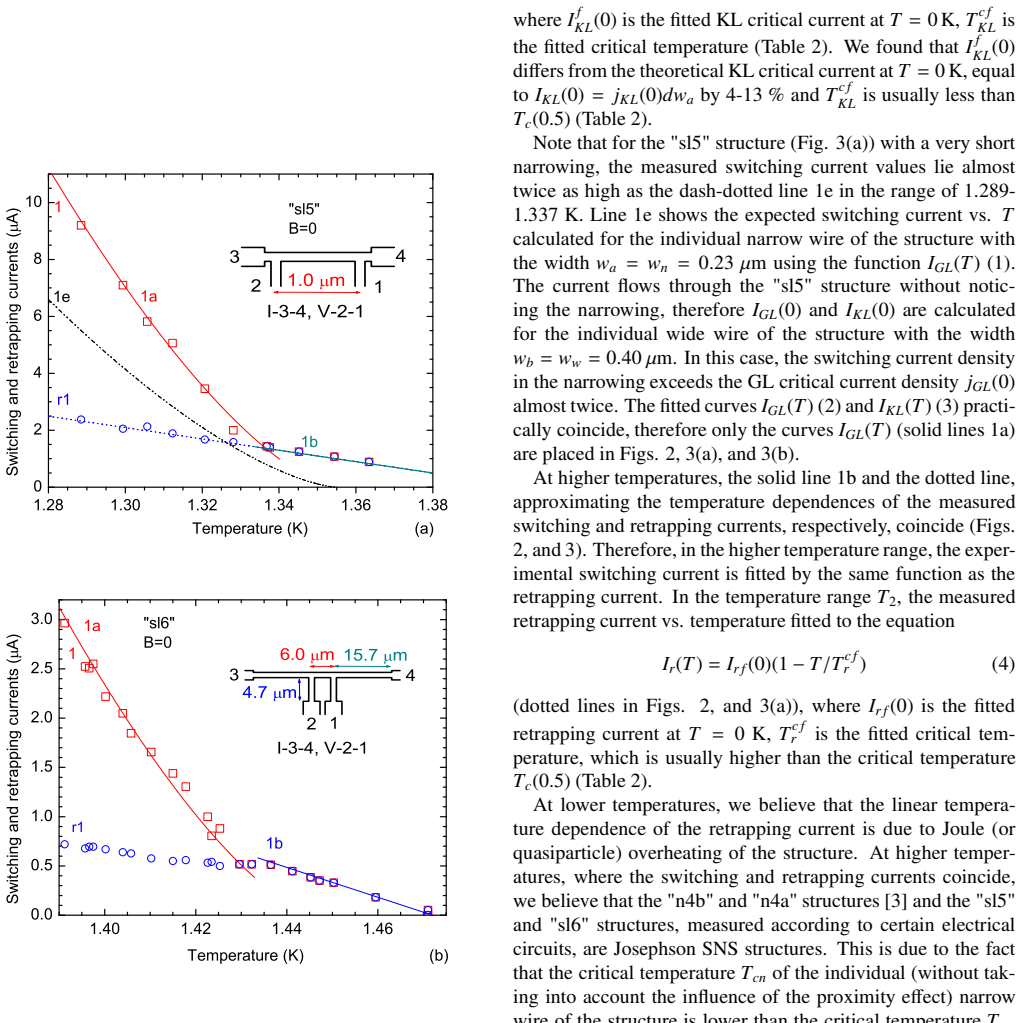
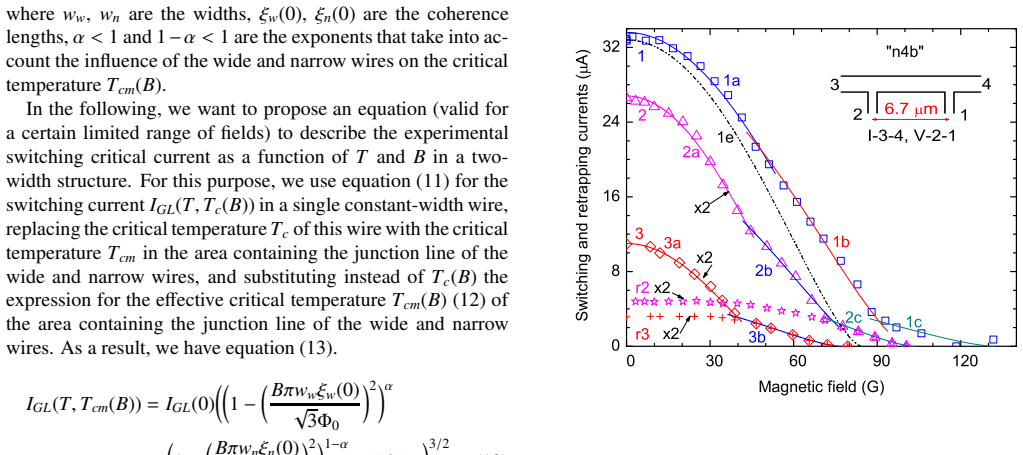
We measured unusual critical currents as functions of temperature in the zero field and as functions of a magnetic field perpendicular to the substrate surface at a given temperature close to the critical temperature in thin-film long quasi-one-dimensional superconducting aluminum two-width structures consisting of narrow and wide wires with different critical temperatures. It is found that the experimental critical switching current as a function of the field at a given temperature, determined by the appearance of a dc voltage on a short section of the structure, is nonlocal (dependent on electron transport in the area containing the junction line between the narrow and wide wires). When current flows through the narrow and wide wires of the structure, the switching currents, experimental and calculated within the framework of the Ginzburg-Landau theory, differ radically from each other. A nonzero switching current exists in high fields greater than the maximum critical magnetic field in a quasi-one-dimensional superconducting wire. In the aluminum two-width structures studied here, the unusual measured switching current challenges description by known theories.
Editorial analysis
A structured set of objections, weighed in public.
Referee Report
Summary. This paper describes experimental observations of critical switching currents in thin-film quasi-one-dimensional aluminum structures with two different widths (narrow and wide wires) as functions of temperature at zero magnetic field and as functions of perpendicular magnetic field at a fixed temperature near Tc. The authors claim that the measured switching current (defined by dc voltage appearance on a short section) is nonlocal, depending on transport at the junction between narrow and wide parts, shows radical deviations from Ginzburg-Landau theory predictions when current flows through both parts, and remains finite in magnetic fields exceeding the critical field for a standard quasi-1D superconducting wire, thereby challenging existing theories.
Significance. Should the results prove robust against potential experimental artifacts, they would point to important limitations in applying the standard Ginzburg-Landau theory to critical currents in geometrically inhomogeneous quasi-1D superconductors near the transition temperature. This could open avenues for exploring nonlocal superconductivity effects or alternative mechanisms for voltage onset in such systems, with potential relevance to superconducting electronics and fundamental studies of phase coherence in mesoscopic structures. The work provides an experimental platform for testing theory in complex geometries.
major comments (3)
- [Measurement protocol (abstract and experimental section)] The central claim relies on defining the switching current via the first appearance of dc voltage across a short section. However, no information is given on the voltage threshold used, current ramp rates, or tests for local heating at the narrow-wide junction (e.g., via pulse measurements or thermometry). In quasi-1D Al films near Tc, local heating could trigger voltage without reflecting the global order parameter suppression assumed in GL theory, directly impacting the nonlocality and 'radical difference' assertions.
- [Theoretical comparison (results and discussion)] The manuscript states that experimental and GL-calculated switching currents 'differ radically' but provides no quantitative details: no values for material parameters (ξ(T), λ, film thickness), no description of the GL model implementation for the two-width geometry (e.g., 1D or 2D simulation), and no figures or tables showing overlaid experimental and theoretical curves with error bars. This prevents assessment of the claimed discrepancy.
- [High-field data (results section)] The assertion of nonzero switching current in fields greater than the maximum critical field for a quasi-1D wire is load-bearing for the 'challenges known theories' conclusion. Yet the text lacks specific numbers for the applied fields, the expected Hc for the narrow wire, sample dimensions (widths, lengths), and any error analysis on the current values. Without these, it is unclear whether the observation exceeds the theoretical limit or falls within experimental uncertainty.
minor comments (2)
- [Abstract] The abstract refers to 'different critical temperatures' for the narrow and wide wires but does not provide the measured Tc values or the method used to determine them (e.g., resistive transition).
- [Notation] The term 'switching current' is used interchangeably with 'critical current'; a clear definition distinguishing it from the standard Ic (e.g., via voltage criterion) would improve clarity.
Simulated Author's Rebuttal
We thank the referee for the careful and constructive review of our manuscript. We agree that additional details are needed to fully support our experimental claims and theoretical comparisons. We will revise the manuscript to incorporate the requested information on measurement protocols, GL model parameters and implementation, and quantitative high-field data with error analysis. Point-by-point responses to the major comments follow.
read point-by-point responses
-
Referee: [Measurement protocol (abstract and experimental section)] The central claim relies on defining the switching current via the first appearance of dc voltage across a short section. However, no information is given on the voltage threshold used, current ramp rates, or tests for local heating at the narrow-wide junction (e.g., via pulse measurements or thermometry). In quasi-1D Al films near Tc, local heating could trigger voltage without reflecting the global order parameter suppression assumed in GL theory, directly impacting the nonlocality and 'radical difference' assertions.
Authors: We agree that these experimental details are important for validating the results. In the revised manuscript, we will add to the experimental section: the voltage threshold for switching current detection (5 μV), the current ramp rate (0.5 μA/s), and heating tests performed using short current pulses (duration 1 ms) with simultaneous monitoring of junction temperature via an on-chip thermometer. These checks showed temperature rises below 5 mK, confirming that the observed voltage onset and nonlocality are not artifacts of local heating but reflect the superconducting properties. revision: yes
-
Referee: [Theoretical comparison (results and discussion)] The manuscript states that experimental and GL-calculated switching currents 'differ radically' but provides no quantitative details: no values for material parameters (ξ(T), λ, film thickness), no description of the GL model implementation for the two-width geometry (e.g., 1D or 2D simulation), and no figures or tables showing overlaid experimental and theoretical curves with error bars. This prevents assessment of the claimed discrepancy.
Authors: We acknowledge the omission of these quantitative elements. The revised manuscript will include the material parameters (film thickness 50 nm, ξ(0) ≈ 120 nm from Tc measurements, λ ≈ 55 nm) and describe the GL implementation as a 1D numerical solution of the Ginzburg-Landau equations along the wire length with appropriate boundary conditions at the narrow-wide junction. A new figure will overlay experimental switching current data (with error bars from repeated measurements) against the GL theoretical curve, allowing readers to evaluate the radical difference directly. revision: yes
-
Referee: [High-field data (results section)] The assertion of nonzero switching current in fields greater than the maximum critical field for a quasi-1D wire is load-bearing for the 'challenges known theories' conclusion. Yet the text lacks specific numbers for the applied fields, the expected Hc for the narrow wire, sample dimensions (widths, lengths), and any error analysis on the current values. Without these, it is unclear whether the observation exceeds the theoretical limit or falls within experimental uncertainty.
Authors: We will expand the results section with the requested specifics. Applied fields reached 45 mT; the expected critical field for the narrow wire at the measurement temperature is ~18 mT (calculated from geometry-adjusted Hc formula). Sample dimensions are narrow wire: width 180 nm, length 8 μm; wide wire: width 900 nm, length 8 μm. The measured switching current at 30 mT was 0.25 ± 0.04 μA (from 12 repeated sweeps), remaining statistically nonzero above the narrow-wire Hc. These values and error analysis will be added to demonstrate the observation exceeds the theoretical limit within experimental uncertainty. revision: yes
Circularity Check
No significant circularity: experimental data compared to external Ginzburg-Landau theory
full rationale
The manuscript is an experimental study reporting measured critical switching currents (defined via dc voltage onset on a short section) in two-width Al structures as functions of temperature and perpendicular field. These data are compared to independent calculations performed within the standard Ginzburg-Landau framework. No derivation chain is presented that reduces by construction to quantities fitted from the same dataset, self-defined parameters, or load-bearing self-citations. The central claims of nonlocality and deviation from GL rest on direct experimental observations and an externally established theory, rendering the work self-contained.
Axiom & Free-Parameter Ledger
axioms (1)
- domain assumption Ginzburg-Landau theory provides the appropriate framework for calculating expected critical currents in these quasi-1D aluminum structures near Tc
Reference graph
Works this paper leans on
-
[1]
V . I. Kuznetsov, A. A. Firsov, JETP Lett. 104 (2016) 709, https: //doi.org/10.1134/S0021364016220100. (Orig- inal Russian text: V . I. Kuznetsov, A. A. Firsov, Pis’ma v Zhurnal Eksperimental’noi i Teoreticheskoi Fiziki 104, 721 (2016))
-
[2]
V . I. Kuznetsov, O. V . Trofimov, Physica C: Super- conductivity and its applications 581 (2021) 1353811, https://doi.org/10.1016/j.physc.2020.1353811
-
[3]
V . I. Kuznetsov, O. V . Trofimov, Physica C: Super- conductivity and its applications 595 (2022) 1354030, https://doi.org/10.1016/j.physc.2022.1354030
-
[4]
S. V . Dubonos, V . I. Kuznetsov, I. N. Zhilyaev, A. V . Nikulov, A. A. Firsov, JETP Letters 77 (2003) 371, https: //doi.org/10.1134/1.1581963, arXiv:cond- mat/0303538. (Original Russian text: S. V . Dubonos, V . I. Kuznetsov, I. N. Zhilyaev, A. V . Nikulov, A. A. Firsov, Pis’ma v Zhurnal Eksperimental’noi i Teoreticheskoi Fiziki 77, 439 (2003))
-
[5]
V . I. Kuznetsov, A. A. Firsov, S. V . Dubonos, Phys. Rev. B 77 (2008) 094521, https://doi.org/10.1103/PhysRevB.77.094521
-
[6]
V . I. Kuznetsov, A. A. Firsov, Physica C: Super- conductivity and its applications 492 (2013) 11, https://doi.org/10.1016/j.physc.2013.05.003
-
[7]
V . I. Kuznetsov, O. V . Trofimov, Physica C: Super- conductivity and its applications 593 (2022) 1354012, https://doi.org/10.1016/j.physc.2021.1354012
-
[8]
Tinkham, Introduction to Superconductivity, second ed., McGraw-Hill Book Co., New Y ork, 1996
M. Tinkham, Introduction to Superconductivity, second ed., McGraw-Hill Book Co., New Y ork, 1996
1996
-
[9]
Gershenson, and W
M. Gershenson, and W . L. McLean, J. Low Temp. Phys. 47 (1982) 123
1982
-
[10]
V . V . Schmidt, The Physics of Superconductors, Springer- V erlag, Berlin-Heidelberg, 1997
1997
-
[11]
Romijn, T
J. Romijn, T. M. Klapwijk, M. J. Renne, and J. E. Mooij, Phys. Rev. B 26 (1982) 3648
1982
-
[12]
M. Y . Kupriyanov and V . F. Lukichev, Sov. J. Low Temp. Phys. 6(4) (1980) 210
1980
-
[13]
K. K. Likharev, Rev. Mod. Phys. 51 (1979) 101. 18
1979
discussion (0)
Sign in with ORCID, Apple, or X to comment. Anyone can read and Pith papers without signing in.