Recognition: unknown
Quantum integrable matrix models of spinor Bose gases in one spatial dimension
Pith reviewed 2026-05-07 06:07 UTC · model grok-4.3
The pith
Spinor Bose gases in one dimension with repulsive interactions are exactly described by an integrable matrix nonlinear Schrödinger model.
A machine-rendered reading of the paper's core claim, the machinery that carries it, and where it could break.
Core claim
Degenerate spinor Bose gases with repulsive density-density interaction and anti-ferromagnetic spin-spin coupling in one spatial dimension are described by a quantum integrable matrix extension of the nonlinear Schrödinger model with fundamental fields given by an m by n matrix of bosonic operators. The eigenstates are constructed using algebraic Bethe-ansatz techniques, yielding Bethe equations for the spectra. In the two-by-two case corresponding to a spin-one Bose gas, integral equations are derived for the equilibrium thermodynamic properties, from which the ground-state phase diagram is obtained in the plane of chemical potential and external magnetic field. The existence of paired bind
What carries the argument
The m by n matrix nonlinear Schrödinger Hamiltonian, whose eigenstates are found via algebraic Bethe ansatz techniques.
If this is right
- Exact spectra of conserved quantities are given by solutions to the Bethe equations for arbitrary matrix sizes.
- Thermodynamic properties of the spin-one gas are obtained from the derived integral equations.
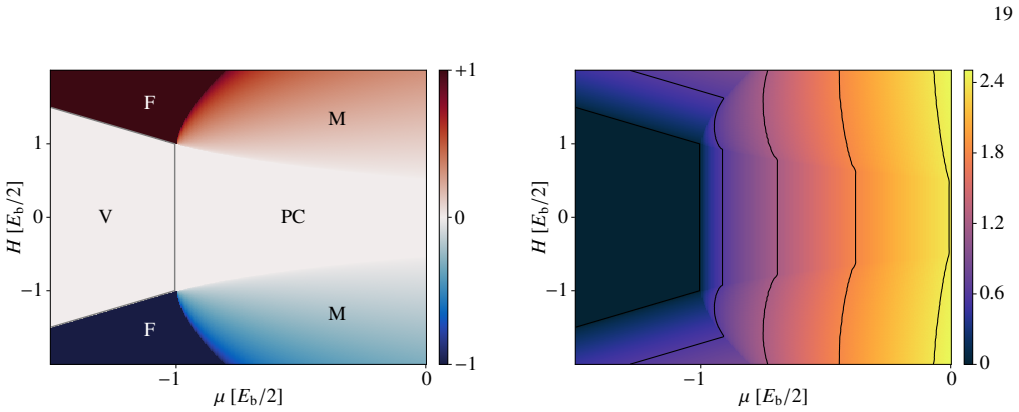
- The ground-state phase diagram is computed in the plane spanned by chemical potential and magnetic field.
- Bound states enforce that no two quasiparticle rapidities coincide when the Lieb parameter exceeds 4/3.
Where Pith is reading between the lines
- The exact solution could serve as a benchmark for numerical simulations of multicomponent quantum gases.
- Similar matrix constructions might apply to other tunable interaction regimes in one-dimensional systems if integrability can be established.
- The phase diagram and exclusion rule may guide experiments probing bound-state effects in spinor condensates.
Load-bearing premise
The interactions in the physical spinor Bose gas must correspond exactly to those in the matrix nonlinear Schrödinger Hamiltonian for all matrix sizes, without corrections from higher-order processes.
What would settle it
Observation of two coinciding quasiparticle rapidities in the spectrum of a one-dimensional spinor Bose gas with Lieb parameter greater than 4/3 would contradict the claimed modification of the exclusion principle.
Figures

read the original abstract
Degenerate spinor Bose gases with repulsive density-density interaction and anti-ferromagnetic spin-spin coupling in one spatial dimension are shown to be described by a quantum integrable matrix extension of the nonlinear Schr\"odinger model, whose fundamental fields are described by an $m\,\times\,n$ matrix of bosonic field operators. The eigenstates of this model are constructed for arbitrarily sized matrix field operators by means of algebraic Bethe-ansatz techniques, and the corresponding Bethe equations governing the spectra of conserved quantities are derived. The approach thus generalizes previously chosen techniques to account for arbitrary spin multiplets and their spin-spin interaction. Focusing on the specific case of the $2\times2$ model, which is shown to correspond to a spin-$1$ Bose gas, a set of integral equations is derived, which describe its equilibrium thermodynamic properties. From these, the ground state phase diagram is computed both, numerically and analytically in the parameter plane spanned by the chemical potential and an external magnetic field. Furthermore, the existence of paired bound states is shown to modify the Pauli exclusion principle for interacting bosons in one dimension. In particular, it is found that no two quasiparticle rapidities can coincide, provided that the Lieb parameter satisfies $\gamma>4/3$.
Editorial analysis
A structured set of objections, weighed in public.
Referee Report
Summary. The manuscript claims that degenerate spinor Bose gases in one dimension with repulsive density-density interactions and anti-ferromagnetic spin-spin couplings are exactly described by a quantum integrable m×n matrix extension of the nonlinear Schrödinger model. Eigenstates are constructed for arbitrary matrix size using algebraic Bethe-ansatz techniques, the corresponding Bethe equations are derived, and the 2×2 case (corresponding to spin-1 gases) is analyzed in detail via thermodynamic integral equations. From these, the ground-state phase diagram is computed numerically and analytically in the plane of chemical potential and external magnetic field, and a modification of the Pauli exclusion principle is reported: no two quasiparticle rapidities coincide when the Lieb parameter satisfies γ > 4/3.
Significance. If the exact mapping to the integrable matrix NLS Hamiltonian holds for the stated physical interactions, the work provides a valuable generalization of algebraic Bethe-ansatz methods to spinor gases with arbitrary spin multiplets. The explicit construction of eigenstates, derivation of Bethe equations, and the combined numerical-analytical treatment of the thermodynamic phase diagram constitute a concrete advance. The reported γ > 4/3 exclusion rule for bound states is a falsifiable prediction that could be tested in ultracold-atom experiments.
major comments (3)
- [Abstract and Introduction] Abstract and opening paragraphs of the introduction: the central claim that spinor Bose gases 'are shown to be described by' the quantum integrable matrix NLS model for arbitrary anti-ferromagnetic spin-spin coupling is not supported by the standard form of the microscopic Hamiltonian. The general 1D spinor interaction contains two independent couplings (c0 for density-density, c2 for the F·F term). The R-matrix of the matrix NLS satisfies the Yang-Baxter equation (and hence permits the algebraic Bethe ansatz) only for discrete ratios c2/c0 that close the scattering channels. The manuscript must explicitly state the required relation between c0 and c2 (or the corresponding model parameters) and restrict the validity of all subsequent results (Bethe equations, integral equations, phase diagram, and γ > 4/3 rule) to that tuned subspace. This issue is load-bearing for the claim of modeling
- [2×2 model and thermodynamic integral equations] Section deriving the 2×2 model and the thermodynamic integral equations: the Bethe equations and the subsequent thermodynamic Bethe-ansatz treatment assume that the Hamiltonian is precisely the integrable matrix NLS. If generic anti-ferromagnetic c2 introduces additional scattering channels or non-integrable perturbations, the string hypothesis and the resulting integral equations for the dressed energies and densities would receive corrections. The manuscript should either derive the precise condition under which the mapping is exact or demonstrate that the neglected terms are irrelevant in the low-energy, dilute limit relevant to the phase diagram.
- [Thermodynamic properties and exclusion rule] Discussion of the γ > 4/3 exclusion rule: the statement that 'no two quasiparticle rapidities can coincide' for γ > 4/3 is derived from the bound-state structure. This conclusion must be cross-checked against the full set of string solutions of the Bethe equations; it is not obvious a priori that the Pauli-like exclusion survives once all possible bound-state strings (including those involving the spin degrees of freedom) are included. A concrete example or numerical solution of the Bethe equations for small particle number would strengthen the claim.
minor comments (2)
- [Model definition] The notation for the m×n matrix field operators and the precise definition of the Lieb parameter γ in terms of the microscopic couplings should be stated once in a dedicated paragraph or table for clarity.
- [Phase diagram] In the phase-diagram figures, the boundaries separating the different phases (e.g., fully polarized, partially polarized, paired states) should be labeled with the corresponding analytic expressions or numerical criteria used to obtain them.
Simulated Author's Rebuttal
We thank the referee for the careful reading and constructive comments on our manuscript. We address each major point below and will revise the manuscript to clarify the conditions for integrability while preserving the core results for the integrable subspace.
read point-by-point responses
-
Referee: [Abstract and Introduction] Abstract and opening paragraphs of the introduction: the central claim that spinor Bose gases 'are shown to be described by' the quantum integrable matrix NLS model for arbitrary anti-ferromagnetic spin-spin coupling is not supported by the standard form of the microscopic Hamiltonian. The general 1D spinor interaction contains two independent couplings (c0 for density-density, c2 for the F·F term). The R-matrix of the matrix NLS satisfies the Yang-Baxter equation (and hence permits the algebraic Bethe ansatz) only for discrete ratios c2/c0 that close the scattering channels. The manuscript must explicitly state the required relation between c0 and c2 (or the corresponding model parameters) and restrict the validity of all subsequent results (Bethe equations, integral equations, phase diagram, and γ > 4/3 rule) to that tuned subspace. This issue is loadbearing
Authors: We agree that the mapping from the microscopic spinor Hamiltonian to the integrable matrix NLS holds only for specific discrete ratios c2/c0 that ensure the R-matrix satisfies the Yang-Baxter equation and closes the relevant scattering channels. The manuscript analyzes the integrable model itself (with arbitrary matrix size m×n corresponding to spin multiplets), which physically describes spinor gases precisely when the couplings are tuned to these integrable values in the anti-ferromagnetic regime. We will revise the abstract and introduction to explicitly state the required relation (e.g., the discrete value of c2/c0 for which the model is integrable) and restrict the validity of the Bethe equations, thermodynamic equations, phase diagram, and exclusion rule to this tuned subspace. This clarification will be added without altering the technical derivations. revision: yes
-
Referee: [2×2 model and thermodynamic integral equations] Section deriving the 2×2 model and the thermodynamic integral equations: the Bethe equations and the subsequent thermodynamic Bethe-ansatz treatment assume that the Hamiltonian is precisely the integrable matrix NLS. If generic anti-ferromagnetic c2 introduces additional scattering channels or non-integrable perturbations, the string hypothesis and the resulting integral equations for the dressed energies and densities would receive corrections. The manuscript should either derive the precise condition under which the mapping is exact or demonstrate that the neglected terms are irrelevant in the low-energy, dilute limit relevant to the phase diagram.
Authors: The Bethe equations and thermodynamic integral equations are derived exactly for the integrable matrix NLS Hamiltonian. For generic c2, non-integrable perturbations would indeed appear and could affect the string hypothesis. In the revised manuscript we will add an explicit statement of the precise integrability condition on c0 and c2 (the discrete ratios that close the channels) and note that the low-energy dilute limit relevant to the phase diagram is described by the integrable model once this tuning is imposed. We will also briefly discuss that away from these points the corrections are perturbatively small but outside the scope of the exact solution presented. revision: yes
-
Referee: [Thermodynamic properties and exclusion rule] Discussion of the γ > 4/3 exclusion rule: the statement that 'no two quasiparticle rapidities can coincide' for γ > 4/3 is derived from the bound-state structure. This conclusion must be cross-checked against the full set of string solutions of the Bethe equations; it is not obvious a priori that the Pauli-like exclusion survives once all possible bound-state strings (including those involving the spin degrees of freedom) are included. A concrete example or numerical solution of the Bethe equations for small particle number would strengthen the claim.
Authors: The γ > 4/3 exclusion rule follows from the complete set of string solutions to the Bethe equations in the 2×2 case, where the bound-state structure (including spin degrees of freedom) forbids coinciding rapidities for γ > 4/3 while satisfying the equations and the string hypothesis. To strengthen the claim, we will add to the revised manuscript a concrete numerical check: explicit solutions of the Bethe equations for small particle numbers (N=2 and N=3) in the relevant parameter regime, confirming that no two rapidities coincide when γ > 4/3 and that the exclusion is preserved across the allowed string configurations. revision: yes
Circularity Check
No circularity; derivation applies standard ABA to a postulated integrable matrix Hamiltonian
full rationale
The paper begins by positing that the spinor Bose gas Hamiltonian with repulsive density-density and anti-ferromagnetic spin-spin terms matches a quantum integrable m×n matrix NLS model. It then applies algebraic Bethe-ansatz techniques to construct eigenstates for arbitrary matrix size, derives the corresponding Bethe equations, and for the 2×2 (spin-1) case obtains thermodynamic integral equations whose solutions yield the ground-state phase diagram and the γ > 4/3 exclusion rule. These steps are direct, non-circular applications of known integrable-system methods to the chosen model; no fitted parameter is relabeled as a prediction, no self-citation chain is load-bearing, and no ansatz is smuggled via prior work. The requirement that the coupling ratio permit integrability is an explicit input assumption, not a tautological reduction of the output to the input.
Axiom & Free-Parameter Ledger
free parameters (1)
- Lieb parameter γ
axioms (2)
- domain assumption The physical Hamiltonian of the spinor Bose gas is exactly equivalent to the matrix nonlinear Schrödinger Hamiltonian for the chosen interaction signs.
- standard math Algebraic Bethe-ansatz techniques apply directly to the matrix operator algebra for arbitrary m and n.
Reference graph
Works this paper leans on
-
[1]
E. H. Lieb and W. Liniger, Phys. Rev.130, 1605 (1963)
1963
-
[2]
E. H. Lieb, Phys. Rev.130, 1616 (1963)
1963
-
[3]
E. K. Sklyanin and L. D. Faddeev, Dokl. Akad. Nauk SSSR 243, 1430 (1978)
1978
-
[4]
E. K. Sklyanin, L. A. Takhtadzhyan, and L. D. Faddeev, Theor. Math. Phys.40, 688 (1979)
1979
-
[5]
M. L. Kerr, G. D. Rosi, and K. V . Kheruntsyan, SciPost Phys. Core7, 047 (2024)
2024
-
[6]
M. T. Batchelor and A. Foerster, J. Phys. A49, 173001 (2016)
2016
-
[7]
Guan and P
X.-W. Guan and P. He, Rep. Prog. Phys.85, 114001 (2022)
2022
-
[8]
Rigol, V
M. Rigol, V . Dunjko, V . Yurovsky, and M. Olshanii, Phys. Rev. Lett.98(2007)
2007
-
[9]
Caux and F
J.-S. Caux and F. H. L. Essler, Phys. Rev. Lett.110, 257203 (2013)
2013
-
[10]
De Nardis, B
J. De Nardis, B. Wouters, M. Brockmann, and J.-S. Caux, Phys. Rev. A89, 033601 (2014)
2014
-
[11]
J.-S. Caux, J. Stat. Mech.: Theory Exp.2016(6), 064006
2016
-
[12]
Granet and F
E. Granet and F. Essler, SciPost Physics11(2021)
2021
-
[14]
Doyon, SciPost Phys
B. Doyon, SciPost Phys. Lect. Notes (2020)
2020
-
[15]
F. H. Essler, Physica A631, 127572 (2023)
2023
-
[16]
Doyon, S
B. Doyon, S. Gopalakrishnan, F. Møller, J. Schmiedmayer, and R. Vasseur, Phys. Rev. X15, 010501 (2025)
2025
-
[17]
Kawaguchi and M
Y . Kawaguchi and M. Ueda, Phys. Rep.520, 253 (2012)
2012
-
[18]
D. M. Stamper-Kurn and M. Ueda, Rev. Mod. Phys.85, 1191 (2013)
2013
-
[19]
M. A. Cazalilla, R. Citro, T. Giamarchi, E. Orignac, and M. Rigol, Rev. Mod. Phys.83, 1405 (2011)
2011
-
[20]
Michel, Phys
G. Michel, Phys. Lett. A24, 55 (1967)
1967
-
[21]
C. N. Yang, Phys. Rev. Lett.19, 1312 (1967)
1967
-
[22]
C. N. Yang, Phys. Rev.168, 1920 (1968)
1920
-
[23]
Sutherland, Phys
B. Sutherland, Phys. Rev. Lett.20, 98 (1968)
1968
-
[24]
S. V . Manakov, Zh. Eksp. Teor. Fiz.65, 505 (1973)
1973
-
[25]
J. Cao, Y . Jiang, and Y . Wang, EPL79, 30005 (2007)
2007
-
[26]
J. Y . Lee, X. W. Guan, M. T. Batchelor, and C. Lee, Phys. Rev. A80, 063625 (2009)
2009
-
[27]
C. C. N. Kuhn, X. W. Guan, A. Foerster, and M. T. Batchelor, Phys. Rev. A85, 043606 (2012)
2012
-
[28]
Guan, Int
X. Guan, Int. J. Mod. Phys. A B28, 1430015 (2014)
2014
-
[29]
C. C. N. Kuhn, X. W. Guan, A. Foerster, and M. T. Batchelor, Phys. Rev. A86, 011605 (2012)
2012
-
[30]
P. P. Kulish, Dokl. Akad. Nauk SSSR255, 323 (1980)
1980
-
[31]
P. P. Kulish, Phys. D: Nonlinear Phenom.3, 246 (1981)
1981
-
[32]
Kulish and E
P. Kulish and E. Sklyanin, Phys. Lett. A84, 349 (1981)
1981
-
[33]
P. P. Kulish, Lett. Math. Phys.5, 191 (1981)
1981
-
[34]
A. P. Fordy and P. P. Kulish, Commun. Math. Phys.89, 427 (1983)
1983
-
[35]
Zhou and B.-H
Y .-K. Zhou and B.-H. Zhao, Phys. Lett. A123, 382 (1987)
1987
-
[36]
Y . K. Zhou, J. Phys. A21, 2391 (1988)
1988
-
[37]
Essler, G
F. Essler, G. Shlyapnikov, and A. Tsvelik, J. Stat. Mech.: The- ory Exp.2009(02), P02027
2009
-
[38]
Koashi and M
M. Koashi and M. Ueda, Phys. Rev. Lett.84, 1066 (2000)
2000
-
[39]
A. G. Izergin and V . E. Korepin, Lett. Math. Phys.6, 283 (1982)
1982
-
[40]
C. N. Yang and C. P. Yang, J. Math. Phys.10, 1115 (1969)
1969
-
[41]
V . E. Korepin, N. M. Bogoliubov, and A. G. Izergin,Quantum Inverse Scattering Method and Correlation Functions, Cam- bridge Monographs on Mathematical Physics (Cambridge Uni- versity Press, 1993)
1993
- [42]
-
[43]
T. C. Dorlas, Commun. Math. Phys.154, 347 (1993)
1993
- [44]
-
[45]
N. A. Slavnov, SciPost Phys. Lect. Notes , 19 (2020)
2020
-
[46]
P. P. Kulish and N. Y . Reshetikhin, Zh. Eksp. Teor. Fiz.53, 108 (1981)
1981
-
[47]
Ogievetsky and P
E. Ogievetsky and P. Wiegmann, Phys. Lett. B168, 360 (1986)
1986
-
[48]
A. N. Kirillov and N. Y . Reshetikhin, J. Phys. A20, 1565 (1987)
1987
-
[49]
A. A. Vladimirov, Theor. Math. Phys.66, 102 (1986)
1986
-
[50]
Takahashi, Prog
M. Takahashi, Prog. Theor. Phys.46, 401 (1971)
1971
-
[51]
Köper, Ph.D
H. Köper, Ph.D. thesis, Heidelberg University (2027), unpub- lished
2027
-
[53]
Girardeau, J
M. Girardeau, J. Math. Phys.1, 516 (1960)
1960
-
[54]
Paredes, A
B. Paredes, A. Widera, V . Murg, O. Mandel, S. Fölling, I. Cirac, G. V . Shlyapnikov, T. W. Hänsch, and I. Bloch, Nature429, 277 (2004)
2004
-
[55]
X. W. Guan, M. T. Batchelor, C. Lee, and M. Bortz, Phys. Rev. B76, 085120 (2007)
2007
-
[56]
J.-S. He, A. Foerster, X. W. Guan, and M. T. Batchelor, New J. Phys.11, 073009 (2009)
2009
-
[57]
O. A. Castro-Alvaredo, B. Doyon, and T. Yoshimura, Phys. Rev. X6, 041065 (2016)
2016
-
[58]
Takahashi,Thermodynamics of One-Dimensional Solvable Models(Cambridge University Press, 1999)
M. Takahashi,Thermodynamics of One-Dimensional Solvable Models(Cambridge University Press, 1999)
1999
-
[59]
Deuretzbacher, K
F. Deuretzbacher, K. Fredenhagen, D. Becker, K. Bongs, K. Sengstock, and D. Pfannkuche, Phys. Rev. Lett.100, 160405 (2008)
2008
-
[60]
Ho and S
T.-L. Ho and S. K. Yip, Phys. Rev. Lett.84, 4031 (2000)
2000
-
[61]
Davies, Physica A167, 433 (1990)
B. Davies, Physica A167, 433 (1990)
1990
discussion (0)
Sign in with ORCID, Apple, or X to comment. Anyone can read and Pith papers without signing in.