Recognition: unknown
Adaptable Continuous Variable Quantum Network with Finite Size Security
Pith reviewed 2026-05-07 06:27 UTC · model grok-4.3
The pith
An active 1:4 continuous-variable quantum network generates secret keys at 0.19 bits per channel use over 11 km channels in the finite-size regime.
A machine-rendered reading of the paper's core claim, the machinery that carries it, and where it could break.
Core claim
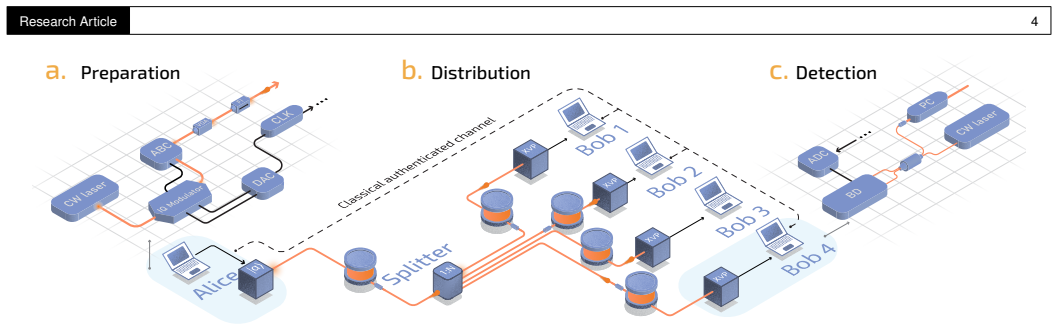
An active 1:4 multi-user CV quantum network is experimentally realized in the finite-size regime by exchanging 1.25·10^9 coherent states on each 11 km quantum channel, yielding secret key generation totaling 1.9·10^{-1} bits per channel use, with adaptable CV-QN protocols that allow operation under varying security and key rate requirements of individual users.
What carries the argument
The active 1:4 multi-user continuous-variable quantum network employing coherent-state modulation, reverse reconciliation, and finite-size security analysis on 11 km channels.
Load-bearing premise
The experimental setup has no unaccounted losses or side-channel vulnerabilities and the finite-size security analysis holds under standard CV-QKD assumptions of Gaussian modulation and trusted devices.
What would settle it
An independent test that measures the observed key rate under controlled side-channel or eavesdropping conditions and checks whether it stays within the reported finite-size security bounds would confirm or refute the result.
Figures


read the original abstract
In recent years, continuous-variable quantum key distribution (CV-QKD) has become a promising paradigm for enabling secure communication among multiple end users sharing the same telecommunication backbone. CV-QKD with reverse reconciliation naturally enables scalability from conventional point-to-point links to quantum access networks based on passive quantum broadcasting channels. Here, we report an experimental demonstration on an active $1:4$ multi-user CV quantum network (QN) in the finite-size regime. With $1.25\cdot10^9$ coherent states exchanged on each $11\text{km}$ quantum channel, the highest performance for secret key generation totaling $1.9\cdot10^{-1}$ bits/channel use. Furthermore, we investigate adaptable CV-QN protocols that comprehensively allow network operation in various security and key rates requirements of individual users. The results establish the practical security of CV-QN compatible with existing telecommunication for broad deployment, and allowing additional degree of freedom for connected end users in existing infrastructures.
Editorial analysis
A structured set of objections, weighed in public.
Referee Report
Summary. The manuscript reports an experimental demonstration of an active 1:4 multi-user continuous-variable quantum key distribution (CV-QKD) network operating in the finite-size regime. Using 1.25×10^9 coherent states exchanged over each of four 11 km channels, the authors achieve a secret key rate of 1.9×10^{-1} bits per channel use under reverse reconciliation. The work further develops adaptable CV-QN protocols that permit per-user tuning of security parameters and key rates while remaining compatible with existing telecommunication infrastructure.
Significance. If the finite-size security analysis is shown to be composably sound under the shared-transmitter architecture, the result would constitute a notable experimental milestone for scalable CV quantum networks. It supplies concrete, replicable parameters (block size, distance, modulation) and demonstrates practical adaptability, both of which are valuable for moving CV-QKD beyond point-to-point links. The experimental achievement itself is a strength; the central claim, however, hinges on whether multi-user correlations are properly bounded.
major comments (1)
- [Security analysis / finite-size key-rate calculation] The headline finite-size key rate of 1.9×10^{-1} bits/channel use is obtained by applying standard single-link CV-QKD bounds (Renner-style smoothing plus parameter-estimation penalty) separately to each of the four channels. In an active 1:4 network the four data sets share the same transmitter, modulation hardware, and possibly the same local oscillator; any common-mode fluctuation therefore correlates the quadrature estimates. The manuscript must specify, in the security-analysis section, whether a joint covariance-matrix estimation or an explicit union bound over the four channels was performed. If the four bounds were simply multiplied by the reported block size without this adjustment, the composable key rate is at risk of being overstated by an amount comparable to the finite-size correction itself.
minor comments (3)
- [Abstract and Experimental Results] The abstract states that the key rate is “totaling 1.9·10^{-1} bits/channel use” without clarifying whether this figure is per channel or an aggregate across the four users; the experimental-results section should state the per-user rates explicitly.
- [Experimental Results] No error bars, data-exclusion criteria, or channel-characterization statistics (e.g., excess noise, transmittance fluctuations) are mentioned in the abstract or summary tables. These must be supplied in the main text or supplementary material so that the reported key rate can be independently verified.
- [Adaptable Protocol Description] Notation for the adaptable protocol parameters (security thresholds, reconciliation efficiency per user) is introduced without a compact summary table; a single table listing the tunable parameters and the resulting key-rate/security trade-offs would improve readability.
Simulated Author's Rebuttal
We thank the referee for their thorough review and constructive comments. We address the single major comment on the finite-size security analysis below. We agree that additional rigor is warranted and will revise the manuscript accordingly.
read point-by-point responses
-
Referee: [Security analysis / finite-size key-rate calculation] The headline finite-size key rate of 1.9×10^{-1} bits/channel use is obtained by applying standard single-link CV-QKD bounds (Renner-style smoothing plus parameter-estimation penalty) separately to each of the four channels. In an active 1:4 network the four data sets share the same transmitter, modulation hardware, and possibly the same local oscillator; any common-mode fluctuation therefore correlates the quadrature estimates. The manuscript must specify, in the security-analysis section, whether a joint covariance-matrix estimation or an explicit union bound over the four channels was performed. If the four bounds were simply multiplied by the reported block size without this adjustment, the composable key rate is at risk of being overstated by an amount comparable to the finite-size correction itself.
Authors: We thank the referee for identifying this important point. Our original analysis applied the standard single-link finite-size bounds independently to each of the four channels. While each receiver employs an independent local oscillator and the modulation sequences for the four channels are generated and applied in temporally separated intervals with independent randomness, we acknowledge that a shared transmitter could in principle introduce weak correlations. To ensure composable security, we will revise the security-analysis section to explicitly apply a union bound over the four channels for the parameter-estimation failure probability (scaling ε_PE by a factor of 4). Given the block size of 1.25×10^9, this adjustment changes the reported key rate by less than 0.5 %. We will also add a short paragraph justifying why a full joint covariance-matrix estimation is unnecessary under our experimental conditions. This is a partial revision: the experimental data and core protocol remain unchanged, but the security proof will be strengthened and the key-rate number will be updated with the corrected bound. revision: partial
Circularity Check
No significant circularity in experimental key-rate reporting
full rationale
The manuscript reports measured secret-key rates from an experimental 1:4 active CV-QN setup using 1.25·10^9 exchanged coherent states per 11 km link. The finite-size analysis applies standard CV-QKD parameter estimation and Renner-style bounds to the observed quadrature data. No load-bearing equation or protocol step is shown to reduce, by the paper's own definitions or self-citations, to a fitted parameter that is then re-labeled as a prediction. The central performance figure (1.9·10^{-1} bits/channel use) is extracted directly from the experimental block statistics rather than derived tautologically from prior assumptions or author-specific uniqueness theorems. Any potential multi-user covariance correlations constitute a correctness or composability concern, not a circularity in the derivation chain itself.
Axiom & Free-Parameter Ledger
axioms (2)
- domain assumption Standard CV-QKD assumptions including Gaussian modulation, reverse reconciliation, and trusted devices hold for the network.
- domain assumption Finite-size effects are correctly accounted for in the secret key rate calculation.
Reference graph
Works this paper leans on
-
[1]
Continuous-variable quan- tum communication,
V. C. Usenko, A. Acín, R. Alléaume,et al., “Continuous-variable quan- tum communication,” Rev. Mod. Phys.98, 015003 (2026)
2026
-
[2]
Shor’s algorithm is possible with as few as 10,000 reconfigurable atomic qubits (2026)
M. Cain, Q. Xu, R. King,et al., “Shor’s algorithm is possible with as few as 10,000 reconfigurable atomic qubits,” arXiv preprint arXiv:2603.28627 (2026)
-
[3]
Continuous-variable quantum passive optical network,
A. A. Hajomer, I. Derkach, R. Filip,et al., “Continuous-variable quantum passive optical network,” Light. Sci. & Appl.13, 291 (2024)
2024
-
[4]
Experimental demonstration of a quantum downstream access network in continuous variable quantum key dis- tribution with a local local oscillator,
D. Qi, X. Wang, Z. Liet al., “Experimental demonstration of a quantum downstream access network in continuous variable quantum key dis- tribution with a local local oscillator,” Photonics Res.12, 1262–1273 (2024)
2024
-
[5]
High-rate point-to-multipoint quantum key distribution using coherent states,
Y . Bian, Y .-C. Zhang, C. Zhou,et al., “High-rate point-to-multipoint quantum key distribution using coherent states,” arXiv preprint arXiv:2302.02391 (2023)
-
[6]
Integrated quantum communication network and vibration sensing in optical fibers,
S. Liu, Y . Tian, Y . Zhang,et al., “Integrated quantum communication network and vibration sensing in optical fibers,” Optica11(2024)
2024
-
[7]
Long-distance continuous- variable quantum key distribution by controlling excess noise,
D. Huang, P . Huang, D. Lin, and G. Zeng, “Long-distance continuous- variable quantum key distribution by controlling excess noise,” Sci. Reports6, 19201 (2016)
2016
-
[8]
Continuous-variable quantum key distribution with 1 Mbps secure key rate,
D. Huang, D. Lin, C. Wang,et al., “Continuous-variable quantum key distribution with 1 Mbps secure key rate,” Opt. Express23, 17511– 17519 (2015)
2015
-
[9]
Long-distance continuous- variable quantum key distribution over 202.81 km of fiber,
Y .-C. Zhang, Z. Chen, S. Pirandola,et al., “Long-distance continuous- variable quantum key distribution over 202.81 km of fiber,” Phys. Rev. Lett.125, 010502 (2020)
2020
-
[10]
High-speed continuous-variable quantum key distribution without sending a local oscillator,
D. Huang, P . Huang, D. Lin,et al., “High-speed continuous-variable quantum key distribution without sending a local oscillator,” Opt. Lett. 40, 3695–3698 (2015)
2015
-
[11]
Continuous-variable Quantum Key Distri- bution protocols with a discrete modulation,
A. Leverrier and P . Grangier, “Continuous-variable Quantum Key Distri- bution protocols with a discrete modulation,” (2010). ArXiv:1002.4083 [quant-ph]
-
[12]
Coexistence of continuous- variable quantum key distribution and classical data over 120-km fiber,
A. Hajomer, I. Derkach, V. Usenko,et al., “Coexistence of continuous- variable quantum key distribution and classical data over 120-km fiber,” arXiv preprint arXiv:2502.17388 (2025)
-
[13]
Analysis of imperfections in practical continuous-variable quantum key distribution,
P . Jouguet, S. Kunz-Jacques, E. Diamanti, and A. Leverrier, “Analysis of imperfections in practical continuous-variable quantum key distribution,” Phys. Rev. A86, 032309 (2012)
2012
-
[14]
Feasibility of quantum key distribution through a dense wavelength division multiplexing network,
B. Qi, W. Zhu, L. Qian, and H.-K. Lo, “Feasibility of quantum key distribution through a dense wavelength division multiplexing network,” New J. Phys.12, 103042 (2010)
2010
-
[15]
Experimental demon- stration of long-distance continuous-variable quantum key distribution,
P . Jouguet, S. Kunz-Jacques, A. Leverrier,et al., “Experimental demon- stration of long-distance continuous-variable quantum key distribution,” Nat. photonics7, 378–381 (2013)
2013
-
[16]
Coexistence of continuous vari- able qkd with intense dwdm classical channels,
R. Kumar, H. Qin, and R. Alléaume, “Coexistence of continuous vari- able qkd with intense dwdm classical channels,” New J. Phys.17, 043027 (2015)
2015
-
[17]
Practical continuous-variable quan- tum key distribution with composable security,
N. Jain, H.-M. Chin, H. Mani,et al., “Practical continuous-variable quan- tum key distribution with composable security,” Nat. communications 13, 4740 (2022). Research Article 7 Table 3.Quantitative comparison with other reported Gaussian modulated 1-to-N CV network against collective attack. We take the maximum total SKR totaling all users supported by t...
2022
-
[18]
1 : 2 (2) 25+5 0.89×10 −2 No collaborative protocol
-
[19]
1 : 8 (8) 10+1 3.1×10 −2 No trust protocol
-
[20]
1 : 16 (4) 5+1 2×10 −3 No trust protocol
-
[21]
Digital synchronization for continuous-variable quantum key distribution,
H.-M. Chin, N. Jain, U. L. Andersen,et al., “Digital synchronization for continuous-variable quantum key distribution,” Quantum Sci. & Technol. 7, 045006 (2022)
2022
-
[22]
Finite-size security for discrete- modulated continuous-variable quantum key distribution protocols,
F . Kanitschar, I. George, J. Lin,et al., “Finite-size security for discrete- modulated continuous-variable quantum key distribution protocols,” PRX Quantum4, 040306 (2023)
2023
-
[23]
Experimental composable key distribution using discrete-modulated continuous variable quantum cryptography,
A. A. Hajomer, F . Kanitschar, N. Jain,et al., “Experimental composable key distribution using discrete-modulated continuous variable quantum cryptography,” Light. Sci. & Appl.14, 255 (2025)
2025
-
[24]
Quantum cryptography on multiuser optical fibre networks,
P . D. Townsend, “Quantum cryptography on multiuser optical fibre networks,” Nature385, 47–49 (1997)
1997
-
[25]
A quantum access network,
B. Fröhlich, J. F . Dynes, M. Lucamarini,et al., “A quantum access network,” Nature501, 69–72 (2013)
2013
-
[26]
Approaching the key rate limit in continuous-variable quantum key distribution network,
Y . Bian, Y . Zhang, S. Yu,et al., “Approaching the key rate limit in continuous-variable quantum key distribution network,” Phys. Rev. Lett. 136, 080801 (2026)
2026
-
[27]
Realizing a downstream-access network using continuous-variable quantum key distribution,
Y . Huang, T. Shen, X. Wang,et al., “Realizing a downstream-access network using continuous-variable quantum key distribution,” Phys. Rev. Appl.16, 064051 (2021)
2021
-
[28]
High-rate 16-node quantum access network based on a passive optical network,
Y . Pan, Y . Bian, Y . Li,et al., “High-rate 16-node quantum access network based on a passive optical network,” Optica12, 953–960 (2025)
2025
-
[29]
Multiuser quantum key distribution using quotient graph states derived from continuous-variable dual-rail cluster states,
A. n. Oruganti, “Multiuser quantum key distribution using quotient graph states derived from continuous-variable dual-rail cluster states,” Phys. Rev. Appl.24, 054049 (2025)
2025
-
[30]
Unconstrained capacities of quantum key distribution and entanglement distillation for pure-loss bosonic broadcast channels,
M. Takeoka, K. P . Seshadreesan, and M. M. Wilde, “Unconstrained capacities of quantum key distribution and entanglement distillation for pure-loss bosonic broadcast channels,” Phys. review letters119, 150501 (2017)
2017
-
[31]
Gaussian quan- tum information,
C. Weedbrook, S. Pirandola, R. García-Patrón,et al., “Gaussian quan- tum information,” Rev. modern physics84, 621–669 (2012)
2012
-
[32]
Finite-size analysis of a continuous-variable quantum key distribution,
A. Leverrier, F . Grosshans, and P . Grangier, “Finite-size analysis of a continuous-variable quantum key distribution,” Phys. Rev. A81, 062343 (2010)
2010
-
[33]
Machine learning aided carrier recovery in continuous-variable quantum key distribution,
H.-M. Chin, N. Jain, D. Zibar,et al., “Machine learning aided carrier recovery in continuous-variable quantum key distribution,” npj Quantum Inf7, 20 (2021)
2021
-
[34]
Long-distance continuous- variable quantum key distribution over 100-km fiber with local local oscillator,
A. A. E. Hajomer, I. Derkach, N. Jain,et al., “Long-distance continuous- variable quantum key distribution over 100-km fiber with local local oscillator,” Sci. Adv.10, eadi9474 (2024). Research Article 8 A. JOINT KEY RATE DECOMPOSITION Decomposition of the joint key rate into individual user contributions for all user orders. Each row corresponds to a dif...
2024
discussion (0)
Sign in with ORCID, Apple, or X to comment. Anyone can read and Pith papers without signing in.