Recognition: unknown
Axion dark matter from extended misalignment with a constant-ω_φ pre-oscillatory phase and dark radiation
Pith reviewed 2026-05-08 03:04 UTC · model grok-4.3
The pith
Cosmological data constrain an extended axion-like particle model to specific mass and scale ranges without easing H0 or S8 tensions.
A machine-rendered reading of the paper's core claim, the machinery that carries it, and where it could break.
Core claim
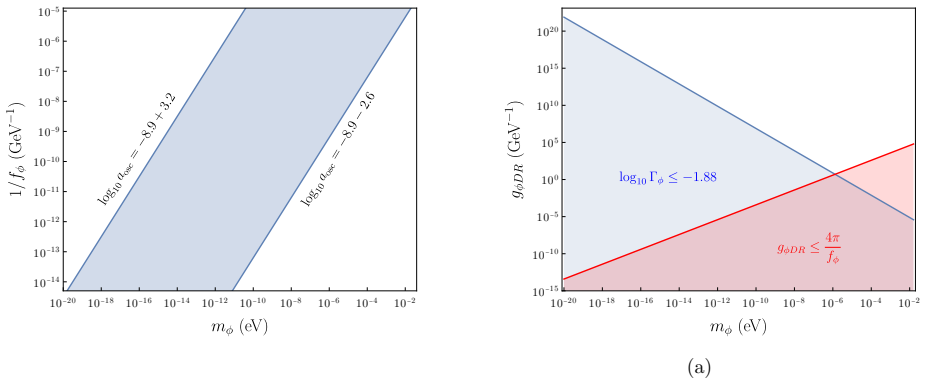
By introducing a constant-ω_ϕ pre-oscillatory phase via a tracking potential that transitions rapidly to the cosine form, and coupling the ALP to dark radiation, the model is subjected to Bayesian constraints from cosmological data. These constraints favor negative ω_ϕ and restrict the symmetry-breaking scale f_ϕ to [80, 1.5×10^{10}] TeV (m_ϕ ∈ [10^{-20}, 10^{-2}] eV), while showing that the resulting dark radiation does not resolve the H_0 or S_8 tensions.
What carries the argument
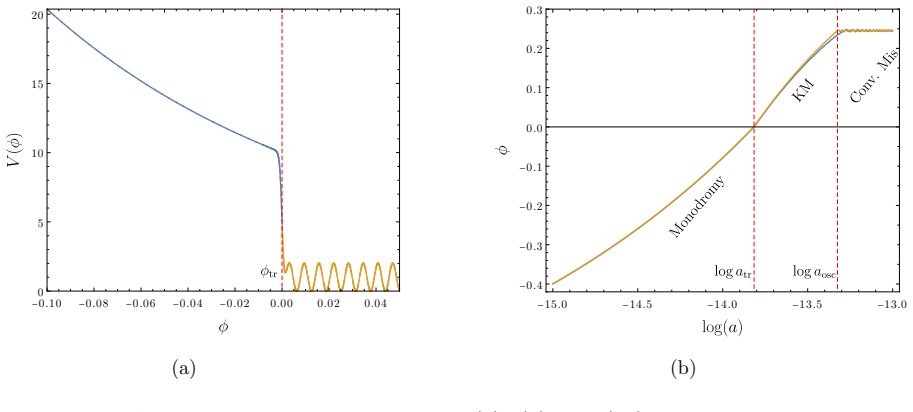
A tracking potential maintaining constant equation of state ω_ϕ before a rapid transition to the cosine potential, which drives the axion-like particle into kinetic misalignment and allows decay into dark radiation.
If this is right
- Negative values of the pre-oscillatory equation of state are preferred by the data.
- The symmetry-breaking scale is restricted to between 80 and 1.5×10^{10} TeV.
- Corresponding axion-like particle masses lie between 10^{-20} and 10^{-2} eV.
- The dark radiation produced does not alleviate cosmological tensions in the Hubble constant or S8 parameter.
Where Pith is reading between the lines
- This framework could be generalized to other scalar fields with similar tracking potentials in the early universe.
- The preference for negative ω_ϕ might point to a particular shape of the tracking potential that deserves further theoretical study.
- Constraints on ultra-light axion-like particles in this mass window have implications for structure formation that future galaxy surveys could test.
Load-bearing premise
The transition from the tracking potential to the cosine potential happens rapidly enough in the radiation-dominated era to produce kinetic misalignment without extra parameters or smooth-transition effects.
What would settle it
Future cosmological data that measure a dark radiation density or Hubble constant value incompatible with the allowed ranges for negative ω_ϕ and the stated f_ϕ interval would falsify the model's consistency with observations.
Figures




read the original abstract
In this work, we extend the standard pre-inflationary misalignment mechanism for axion-like particles (ALPs) by introducing a pre-oscillatory phase with constant equation of state $\omega_\phi\in[-1,1]$, generated by a tracking potential. During the radiation-dominated era, the potential undergoes a rapid transition to the conventional cosine potential. The resulting change in the potential energy across the transition can drive the ALP into a kinetic misalignment phase ($\omega_\phi=1$) prior to the onset of oscillations. Motivated by persistent cosmological tensions, such as those in $H_0$ and $S_8$, we also investigate an ALP coupling to a dark radiation sector (DR), allowing for its decay. Using a Bayesian analysis, we constrain the ALP parameter space with current cosmological data. Our analysis shows that ALP-induced DR does not resolve the existing tensions. Instead, the data place robust constraints on the model, favoring negative values of $\omega_\phi$ and constraining the symmetry-breaking scale to $f_\phi\in[80,1.5\times10^{10}]~\mathrm{TeV}$, corresponding to ALP masses in the range $m_\phi\in[10^{-20},10^{-2}]~\mathrm{eV}$.
Editorial analysis
A structured set of objections, weighed in public.
Referee Report
Summary. The manuscript extends the standard pre-inflationary misalignment mechanism for axion-like particles (ALPs) by introducing a pre-oscillatory phase with constant equation of state ω_ϕ ∈ [-1,1] generated by a tracking potential. During the radiation-dominated era, the potential undergoes a rapid transition to the conventional cosine potential, asserted to drive the ALP into a kinetic misalignment phase (ω_ϕ=1) before oscillations. The authors also consider an ALP coupling to dark radiation (DR) permitting decay, perform a Bayesian analysis with cosmological data, and conclude that ALP-induced DR does not resolve H_0/S_8 tensions; instead the data favor negative ω_ϕ and constrain f_ϕ ∈ [80, 1.5×10^{10}] TeV (corresponding to m_ϕ ∈ [10^{-20}, 10^{-2}] eV).
Significance. If the transition dynamics are rigorously specified and the Bayesian pipeline is fully documented, the work supplies a concrete extension of ALP dark-matter models together with falsifiable parameter ranges that can guide laboratory and astrophysical searches. The negative result on tension resolution via DR is useful, and the use of external cosmological datasets supplies independent grounding for the reported bounds. The parameter-free aspects of the constant-ω_ϕ tracking phase (prior to the switch) represent a strength that could be highlighted more clearly.
major comments (2)
- [Abstract and §2] Abstract and §2 (model description): The central claim that the rapid transition from tracking to cosine potential during radiation domination drives kinetic misalignment (ω_ϕ=1) and thereby sets the relic density and DR yield is load-bearing for the reported Bayesian constraints and the conclusion that DR does not resolve tensions. No timescale relative to H^{-1}, interpolating functional form (e.g., tanh or exponential switch), or extra parameter is specified; if the transition is not sufficiently abrupt the assumed field velocity at oscillation onset does not hold, altering the posteriors on ω_ϕ, f_ϕ and m_ϕ.
- [§4] §4 (Bayesian analysis): The abstract asserts that the analysis 'yields robust constraints' and that DR 'does not resolve the existing tensions,' yet the manuscript provides no explicit list of datasets (Planck, BAO, etc.), likelihood functions, priors on ω_ϕ/f_ϕ/m_ϕ, or systematic-error treatment. Without these the support for the quoted intervals f_ϕ ∈ [80, 1.5×10^{10}] TeV and the negative-ω_ϕ preference cannot be verified at the claimed robustness level.
minor comments (2)
- [Abstract] Notation: the symbol ω_ϕ is used both for the constant pre-oscillatory value and for the post-transition equation of state; a clarifying subscript or explicit statement at first use would avoid confusion.
- [Abstract] The abstract states the mass range m_ϕ ∈ [10^{-20}, 10^{-2}] eV but does not indicate whether this follows directly from the f_ϕ bounds via the standard ALP mass relation or requires additional assumptions; a one-line derivation or reference would help.
Simulated Author's Rebuttal
We thank the referee for the careful and constructive review of our manuscript. We address each major comment below and outline the revisions we intend to make to improve clarity and rigor.
read point-by-point responses
-
Referee: [Abstract and §2] Abstract and §2 (model description): The central claim that the rapid transition from tracking to cosine potential during radiation domination drives kinetic misalignment (ω_ϕ=1) and thereby sets the relic density and DR yield is load-bearing for the reported Bayesian constraints and the conclusion that DR does not resolve tensions. No timescale relative to H^{-1}, interpolating functional form (e.g., tanh or exponential switch), or extra parameter is specified; if the transition is not sufficiently abrupt the assumed field velocity at oscillation onset does not hold, altering the posteriors on ω_ϕ, f_ϕ and m_ϕ.
Authors: We agree that the transition must be specified more rigorously to justify the kinetic misalignment assumption. In the revised manuscript we will introduce an explicit interpolating form (a tanh switch with characteristic timescale τ ≪ H^{-1} at the transition epoch) and derive the resulting field velocity analytically. We will also add a brief parameter study showing that the posteriors on ω_ϕ, f_ϕ and m_ϕ remain stable provided the transition is sufficiently rapid (τ H ≪ 1). These additions will appear in §2 together with a short appendix on transition sensitivity. revision: yes
-
Referee: [§4] §4 (Bayesian analysis): The abstract asserts that the analysis 'yields robust constraints' and that DR 'does not resolve the existing tensions,' yet the manuscript provides no explicit list of datasets (Planck, BAO, etc.), likelihood functions, priors on ω_ϕ/f_ϕ/m_ϕ, or systematic-error treatment. Without these the support for the quoted intervals f_ϕ ∈ [80, 1.5×10^{10}] TeV and the negative-ω_ϕ preference cannot be verified at the claimed robustness level.
Authors: We acknowledge that the documentation of the Bayesian pipeline in §4 was insufficient for full reproducibility. Although the analysis employs standard datasets and likelihoods, we will expand §4 with a dedicated subsection that explicitly lists the datasets (Planck 2018 TT/TE/EE + lowE, BAO from BOSS/eBOSS, Pantheon+), the likelihood implementations, the priors (uniform on ω_ϕ ∈ [-1,1]; log-uniform on f_ϕ and m_ϕ), and the treatment of systematics via the published covariance matrices. This will allow independent verification of the reported constraints and the negative-ω_ϕ preference. revision: yes
Circularity Check
No significant circularity; constraints derived from external cosmological data.
full rationale
The paper extends the standard ALP misalignment mechanism by positing a constant-ω_ϕ tracking phase followed by a rapid transition to the cosine potential during radiation domination, then uses Bayesian inference on external cosmological datasets to obtain posterior constraints on ω_ϕ, f_ϕ, and m_ϕ. The central claims (non-resolution of H0/S8 tensions and the reported parameter ranges) are outputs of this data-driven fit rather than quantities that reduce by construction to the model's internal definitions or to self-citations. No load-bearing step equates a prediction to a fitted input, renames a known result, or imports uniqueness via author-overlapping citations; the derivation chain remains self-contained against external benchmarks.
Axiom & Free-Parameter Ledger
free parameters (3)
- ω_ϕ
- f_ϕ
- m_ϕ
axioms (2)
- domain assumption The universe is radiation-dominated during the relevant epochs
- ad hoc to paper The potential undergoes a rapid transition from tracking to cosine form
invented entities (2)
-
Tracking potential
no independent evidence
-
ALP-dark radiation coupling
no independent evidence
Reference graph
Works this paper leans on
-
[1]
CP Conservation in the Presence of Instantons
R. D. Peccei and Helen R. Quinn. “CP Conservation in the Presence of Instantons”. In:Phys. Rev. Lett.38 (1977), pp. 1440–1443.doi:10.1103/PhysRevLett.38.1440
-
[2]
Frank Wilczek. “Problem of StrongPandTInvariance in the Presence of Instantons”. In:Phys. Rev. Lett.40 (1978), pp. 279–282.doi:10.1103/PhysRevLett.40.279
-
[3]
Steven Weinberg. “A New Light Boson?” In:Phys. Rev. Lett.40 (1978), pp. 223–226. doi:10.1103/PhysRevLett.40.223
-
[4]
A simple solution to the strong CP problem with a harmless axion
Michael Dine, Willy Fischler, and Mark Srednicki. “A Simple Solution to the Strong CP Problem with a Harmless Axion”. In:Phys. Lett. B104 (1981), pp. 199–202.doi: 10.1016/0370-2693(81)90590-6. 45
-
[5]
2024.url:https://cajohare.github.io/AxionLimits/
Ciaran O’Hare.Axion Limits. 2024.url:https://cajohare.github.io/AxionLimits/
2024
- [6]
-
[7]
Inverse see-saw neutrino masses in the Littlest Higgs model with T-parity
Francisco Del Aguila et al. “Inverse see-saw neutrino masses in the Littlest Higgs model with T-parity”. In:JHEP12 (2019), p. 154.doi:10.1007/JHEP12(2019)154. arXiv:1910.09569 [hep-ph]
-
[8]
A new and gauge-invariant littlest Higgs model with T-parity
Jos´ e Ignacio Illana and Jos´ e Mar´ ıa P´ erez-Poyatos. “A new and gauge-invariant littlest Higgs model with T-parity”. In:Eur. Phys. J. Plus137.1 (2022), p. 42.doi:10.1140/ epjp/s13360-021-02222-0. arXiv:2103.17078 [hep-ph]
-
[9]
Phenomenological implications of the new Littlest Higgs model with T-parity
Jos´ e Ignacio Illana and Jos´ e Mar´ ıa P´ erez-Poyatos. “Phenomenological implications of the new Littlest Higgs model with T-parity”. In:JHEP11 (2022), p. 055.doi: 10.1007/JHEP11(2022)055. arXiv:2209.06195 [hep-ph]
-
[10]
Introduction to Extra Dimensions and Thick Braneworlds
Yu-Xiao Liu. “Introduction to Extra Dimensions and Thick Braneworlds”. In: 2018. doi:10.1142/9789813237278_0008. arXiv:1707.08541 [hep-th]
-
[11]
Cosmology of an axion-like majoron
Antonio J. Cuesta et al. “Cosmology of an axion-like majoron”. In:JCAP04.04 (2022), p. 009.doi:10.1088/1475-7516/2022/04/009. arXiv:2109.07336 [hep-ph]
-
[13]
Peter Svrcek and Edward Witten. “Axions In String Theory”. In:JHEP06 (2006), p. 051.doi:10.1088/1126-6708/2006/06/051. arXiv:hep-th/0605206
-
[14]
Katherine Freese, Joshua A. Frieman, and Angela V. Olinto. “Natural inflation with pseudo - Nambu-Goldstone bosons”. In:Phys. Rev. Lett.65 (1990), pp. 3233–3236. doi:10.1103/PhysRevLett.65.3233
-
[15]
Fred C. Adams et al. “Natural inflation: Particle physics models, power law spectra for large scale structure, and constraints from COBE”. In:Phys. Rev. D47 (1993), pp. 426–455.doi:10.1103/PhysRevD.47.426. arXiv:hep-ph/9207245
-
[18]
A. Maleknejad and M. M. Sheikh-Jabbari. “Gauge-flation: Inflation From Non-Abelian Gauge Fields”. In:Phys. Lett. B723 (2013), pp. 224–228.doi:10.1016/j.physletb. 2013.05.001. arXiv:1102.1513 [hep-ph]
-
[19]
Chromo-Natural Inflation: Natural inflation on a steep potential with classical non-Abelian gauge fields
Peter Adshead and Mark Wyman. “Chromo-Natural Inflation: Natural inflation on a steep potential with classical non-Abelian gauge fields”. In:Phys. Rev. Lett.108 (2012), p. 261302.doi:10 . 1103 / PhysRevLett . 108 . 261302. arXiv:1202 . 2366 [hep-th]. 46
2012
-
[20]
Trajectories with suppressed tensor-to-scalar ratio in Aligned Natural Inflation
Marco Peloso and Caner Unal. “Trajectories with suppressed tensor-to-scalar ratio in Aligned Natural Inflation”. In:JCAP06 (2015), p. 040.doi:10 . 1088 / 1475 - 7516/2015/06/040. arXiv:1504.02784 [astro-ph.CO]
-
[21]
Naturally inflating on steep potentials through electromagnetic dissipation
Mohamed M. Anber and Lorenzo Sorbo. “Naturally inflating on steep potentials through electromagnetic dissipation”. In:Phys. Rev. D81 (2010), p. 043534.doi: 10.1103/PhysRevD.81.043534. arXiv:0908.4089 [hep-th]
-
[22]
Physical Review D85(8), 083509 (2012) https://doi.org/10.1103/PhysRevD.85
Jessica L. Cook and Lorenzo Sorbo. “Particle production during inflation and gravita- tional waves detectable by ground-based interferometers”. In:Phys. Rev. D85 (2012). [Erratum: Phys.Rev.D 86, 069901 (2012)], p. 023534.doi:10.1103/PhysRevD.85. 023534. arXiv:1109.0022 [astro-ph.CO]
-
[23]
, archivePrefix = "arXiv", eprint =
Neil Barnaby, Enrico Pajer, and Marco Peloso. “Gauge Field Production in Axion Inflation: Consequences for Monodromy, non-Gaussianity in the CMB, and Grav- itational Waves at Interferometers”. In:Phys. Rev. D85 (2012), p. 023525.doi: 10.1103/PhysRevD.85.023525. arXiv:1110.3327 [astro-ph.CO]
-
[24]
Scale-dependent gravitational waves from a rolling axion
Ryo Namba et al. “Scale-dependent gravitational waves from a rolling axion”. In: JCAP01 (2016), p. 041.doi:10.1088/1475-7516/2016/01/041. arXiv:1509.07521 [astro-ph.CO]
-
[25]
Journal of Cosmology and Astroparticle Physics , author =
Emanuela Dimastrogiovanni, Matteo Fasiello, and Tomohiro Fujita. “Primordial Grav- itational Waves from Axion-Gauge Fields Dynamics”. In:JCAP01 (2017), p. 019.doi: 10.1088/1475-7516/2017/01/019. arXiv:1608.04216 [astro-ph.CO]
-
[27]
Gravitational waves at inter- ferometer scales and primordial black holes in axion inflation
Juan Garcia-Bellido, Marco Peloso, and Caner Unal. “Gravitational waves at inter- ferometer scales and primordial black holes in axion inflation”. In:JCAP12 (2016), p. 031.doi:10.1088/1475-7516/2016/12/031. arXiv:1610.03763 [astro-ph.CO]
-
[28]
Journal of Cosmology and Astroparticle Physics , author =
Valerie Domcke, Mauro Pieroni, and Pierre Bin´ etruy. “Primordial gravitational waves for universality classes of pseudoscalar inflation”. In:JCAP06 (2016), p. 031.doi: 10.1088/1475-7516/2016/06/031. arXiv:1603.01287 [astro-ph.CO]
-
[29]
Caner Unal, Alexandros Papageorgiou, and Ippei Obata. “Axion-Gauge Dynamics During Inflation as the Origin of Pulsar Timing Array Signals and Primordial Black Holes”. In: (July 2023). arXiv:2307.02322 [astro-ph.CO]
-
[30]
David J. E. Marsh. “Axion Cosmology”. In:Phys. Rept.643 (2016), pp. 1–79.doi: 10.1016/j.physrep.2016.06.005. arXiv:1510.07633 [astro-ph.CO]
-
[31]
V. K. Oikonomou. “Low-scale mirror standard model dark matter and its detection via gravitational waves and the Guitar Nebula”. In:Phys. Rev. D110.12 (2024), p. 123509.doi:10.1103/PhysRevD.110.123509. arXiv:2409.16095 [gr-qc]
-
[33]
Michael Dine and Willy Fischler. “The Not So Harmless Axion”. In:Phys. Lett. B120 (1983). Ed. by M. A. Srednicki, pp. 137–141.doi:10.1016/0370-2693(83)90639-1
-
[35]
Edward W. Kolb and Michael S. Turner.The Early Universe. Vol. 69. 1990.isbn: 978-0-201-62674-2.doi:10.1201/9780429492860
-
[36]
Development of Axion Perturbations in an Axion Dominated Universe
Minos Axenides, Robert H. Brandenberger, and Michael S. Turner. “Development of Axion Perturbations in an Axion Dominated Universe”. In:Phys. Lett. B126 (1983), pp. 178–182.doi:10.1016/0370-2693(83)90586-5
-
[37]
Paul J. Steinhardt and Michael S. Turner. “Saving the Invisible Axion”. In:Phys. Lett. B129 (1983), p. 51.doi:10.1016/0370-2693(83)90727-X
-
[38]
A Prescription for Successful New Inflation
P. J. Steinhardt and Michael S. Turner. “A Prescription for Successful New Inflation”. In:Phys. Rev. D29 (1984), pp. 2162–2171.doi:10.1103/PhysRevD.29.2162
-
[39]
Generation of Isothermal Density Perturbations in the Inflationary Universe
Andrei D. Linde. “Generation of Isothermal Density Perturbations in the Inflationary Universe”. In:Phys. Lett. B158 (1985), pp. 375–380.doi:10.1016/0370-2693(85) 90436-8
-
[40]
Isothermal Density Perturbations in an Axion Dominated Inflationary Universe
D. Seckel and Michael S. Turner. “Isothermal Density Perturbations in an Axion Dominated Inflationary Universe”. In:Phys. Rev. D32 (1985), p. 3178.doi:10 . 1103/PhysRevD.32.3178
1985
-
[41]
Fourth Order Gravity as General Relativity Plus Matter,
David H. Lyth. “A limit on the inflationary energy density from axion isocurva- ture fluctuations”. In:Physics Letters B236.4 (1990), pp. 408–410.issn: 0370-2693. doi:https://doi.org/10.1016/0370- 2693(90)90374- F.url:https://www. sciencedirect.com/science/article/pii/037026939090374F
-
[42]
Michael S. Turner and Frank Wilczek. “Inflationary axion cosmology”. In:Phys. Rev. Lett.66 (1991), pp. 5–8.doi:10.1103/PhysRevLett.66.5
-
[43]
The Search for dark matter axions
Pierre Sikivie. “The Search for dark matter axions”. In:41st Rencontres de Moriond on Electroweak Interactions and Unified Theories. June 2006, pp. 371–380. arXiv: hep-ph/0606014
-
[45]
Non-Gaussianity from isocurvature perturbations
Masahiro Kawasaki et al. “Non-Gaussianity from isocurvature perturbations”. In: JCAP11 (2008), p. 019.doi:10.1088/1475-7516/2008/11/019. arXiv:0808.0009 [astro-ph]
-
[46]
Relaxing Isocurva- ture Bounds on String Axion Dark Matter
Masahiro Kawasaki, Naoya Kitajima, and Fuminobu Takahashi. “Relaxing Isocurva- ture Bounds on String Axion Dark Matter”. In:Phys. Lett. B737 (2014), pp. 178–184. doi:10.1016/j.physletb.2014.08.017. arXiv:1406.0660 [hep-ph]
-
[47]
New inflationary probes of axion dark matter
Xingang Chen, JiJi Fan, and Lingfeng Li. “New inflationary probes of axion dark matter”. In:JHEP12 (2023), p. 197.doi:10.1007/JHEP12(2023)197. arXiv:2303. 03406 [hep-ph]. 48
-
[48]
Axion Kinetic Misalign- ment Mechanism
Raymond T. Co, Lawrence J. Hall, and Keisuke Harigaya. “Axion Kinetic Misalign- ment Mechanism”. In:Phys. Rev. Lett.124.25 (2020), p. 251802.doi:10 . 1103 / PhysRevLett.124.251802. arXiv:1910.14152 [hep-ph]
-
[49]
Tensions between the Early and the Late Universe
L. Verde, T. Treu, and A. G. Riess. “Tensions between the Early and the Late Uni- verse”. In:Nature Astron.3 (July 2019), p. 891.doi:10.1038/s41550-019-0902-0. arXiv:1907.10625 [astro-ph.CO]
work page internal anchor Pith review doi:10.1038/s41550-019-0902-0 2019
-
[50]
Lloyd Knox and Marius Millea. “Hubble constant hunter’s guide”. In:Phys. Rev. D 101.4 (2020), p. 043533.doi:10.1103/PhysRevD.101.043533. arXiv:1908.03663 [astro-ph.CO]
-
[51]
Eleonora Di Valentino et al. “In the realm of the Hubble tension—a review of so- lutions”. In:Class. Quant. Grav.38.15 (2021), p. 153001.doi:10 . 1088 / 1361 - 6382/ac086d. arXiv:2103.01183 [astro-ph.CO]
-
[52]
A buyer’s guide to the Hubble constant
Paul Shah, Pablo Lemos, and Ofer Lahav. “A buyer’s guide to the Hubble constant”. In:Astron. Astrophys. Rev.29.1 (2021), p. 9.doi:10.1007/s00159-021-00137-4. arXiv:2109.01161 [astro-ph.CO]
-
[53]
Tilman Tr¨ oster et al. “Cosmology from large-scale structure: Constraining ΛCDM with BOSS”. In:Astron. Astrophys.633 (2020), p. L10.doi:10.1051/0004-6361/ 201936772. arXiv:1909.11006 [astro-ph.CO]
-
[54]
and Simonovi\'c, Marko and Zaldarriaga, Matias
Mikhail M. Ivanov, Marko Simonovi´ c, and Matias Zaldarriaga. “Cosmological Param- eters from the BOSS Galaxy Power Spectrum”. In:JCAP05 (2020), p. 042.doi: 10.1088/1475-7516/2020/05/042. arXiv:1909.05277 [astro-ph.CO]
-
[55]
KiDS-1000 Cosmology: Cosmic shear constraints and comparison between two point statistics
Marika Asgari et al. “KiDS-1000 Cosmology: Cosmic shear constraints and comparison between two point statistics”. In:Astron. Astrophys.645 (2021), A104.doi:10.1051/ 0004-6361/202039070. arXiv:2007.15633 [astro-ph.CO]
-
[56]
H. Hildebrandt et al. “KiDS-1000 catalogue: Redshift distributions and their calibra- tion”. In:Astron. Astrophys.647 (2021), A124.doi:10.1051/0004-6361/202039018. arXiv:2007.15635 [astro-ph.CO]
-
[57]
Tilman Tr¨ oster et al. “KiDS-1000 Cosmology: Constraints beyond flat ΛCDM”. In: Astron. Astrophys.649 (2021), A88.doi:10.1051/0004- 6361/202039805. arXiv: 2010.16416 [astro-ph.CO]
-
[58]
T. M. C. Abbott et al. “Dark Energy Survey Year 3 results: Cosmological constraints from galaxy clustering and weak lensing”. In:Phys. Rev. D105.2 (2022), p. 023520. doi:10.1103/PhysRevD.105.023520. arXiv:2105.13549 [astro-ph.CO]
-
[59]
Oliver H. E. Philcox and Mikhail M. Ivanov. “BOSS DR12 full-shape cosmology: ΛCDM constraints from the large-scale galaxy power spectrum and bispectrum monopole”. In:Phys. Rev. D105.4 (2022), p. 043517.doi:10 . 1103 / PhysRevD . 105 . 043517. arXiv:2112.04515 [astro-ph.CO]
-
[60]
Cosmological constraints from unWISE and Planck CMB lensing tomography
Alex Krolewski, Simone Ferraro, and Martin White. “Cosmological constraints from unWISE and Planck CMB lensing tomography”. In:JCAP12.12 (2021), p. 028.doi: 10.1088/1475-7516/2021/12/028. arXiv:2105.03421 [astro-ph.CO]. 49
-
[61]
Cosmic shear with small scales: DES-Y3, KiDS-1000 and HSC-DR1
Carlos Garc´ ıa-Garc´ ıa et al. “Cosmic shear with small scales: DES-Y3, KiDS-1000 and HSC-DR1”. In: (Mar. 2024). arXiv:2403.13794 [astro-ph.CO]
-
[62]
Arbitrating the S8 discrepancy with growth rate measurements from redshift-space distortions
Rafael C. Nunes and Sunny Vagnozzi. “Arbitrating the S8 discrepancy with growth rate measurements from redshift-space distortions”. In:Mon. Not. Roy. Astron. Soc. 505.4 (2021), pp. 5427–5437.doi:10 . 1093 / mnras / stab1613. arXiv:2106 . 01208 [astro-ph.CO]
2021
-
[63]
Axion Misalignment Driven to the Bottom
Raymond T. Co, Eric Gonzalez, and Keisuke Harigaya. “Axion Misalignment Driven to the Bottom”. In:JHEP05 (2019), p. 162.doi:10.1007/JHEP05(2019)162. arXiv: 1812.11186 [hep-ph]
-
[64]
Axion Misalignment Driven to the Hilltop
Raymond T. Co, Eric Gonzalez, and Keisuke Harigaya. “Axion Misalignment Driven to the Hilltop”. In:JHEP05 (2019), p. 163.doi:10.1007/JHEP05(2019)163. arXiv: 1812.11192 [hep-ph]
-
[65]
QCD Axion Kinetic Misalignment without Prejudice
Basabendu Barman et al. “QCD Axion Kinetic Misalignment without Prejudice”. In: Universe8.12 (2022), p. 634.doi:10.3390/universe8120634. arXiv:2111.03677 [hep-ph]
-
[67]
Dark matter from an even lighter QCD axion: trapped misalign- ment
Luca Di Luzio et al. “Dark matter from an even lighter QCD axion: trapped misalign- ment”. In:JCAP10 (2021), p. 001.doi:10.1088/1475-7516/2021/10/001. arXiv: 2102.01082 [hep-ph]
-
[68]
Resonant production of dark photons from axions without a large coupling
Naoya Kitajima and Fuminobu Takahashi. “Resonant production of dark photons from axions without a large coupling”. In:Phys. Rev. D107.12 (2023), p. 123518. doi:10.1103/PhysRevD.107.123518. arXiv:2303.05492 [hep-ph]
-
[69]
Axion dark matter from frictional misalignment
Alexandros Papageorgiou, Pablo Qu´ ılez, and Kai Schmitz. “Axion dark matter from frictional misalignment”. In:JHEP01 (2023), p. 169.doi:10.1007/JHEP01(2023)
- [70]
-
[71]
Planck 2018 results. VI. Cosmological parameters
N. Aghanim et al. “Planck 2018 results. VI. Cosmological parameters”. In:Astron. Astrophys.641 (2020). [Erratum: Astron.Astrophys. 652, C4 (2021)], A6.doi:10 . 1051/0004-6361/201833910. arXiv:1807.06209 [astro-ph.CO]
work page internal anchor Pith review arXiv 2018
-
[72]
Adam G. Riess et al. “A Comprehensive Measurement of the Local Value of the Hubble Constant with 1 km s−1 Mpc−1 Uncertainty from the Hubble Space Telescope and the SH0ES Team”. In:Astrophys. J. Lett.934.1 (2022), p. L7.doi:10 . 3847 / 2041 - 8213/ac5c5b. arXiv:2112.04510 [astro-ph.CO]
work page internal anchor Pith review arXiv 2022
-
[73]
Spectrum of adiabatic perturbations in the universe when there are singularities in the inflation potential
Alexei A. Starobinsky. “Spectrum of adiabatic perturbations in the universe when there are singularities in the inflation potential”. In:JETP Lett.55 (1992), pp. 489– 494
1992
-
[74]
Inflationary perturbations from a potential with a step
Jennifer A. Adams, Bevan Cresswell, and Richard Easther. “Inflationary perturbations from a potential with a step”. In:Phys. Rev. D64 (2001), p. 123514.doi:10.1103/ PhysRevD.64.123514. arXiv:astro-ph/0102236. 50
-
[75]
Inflation and WMAP three year data: Features have a Future!
Laura Covi et al. “Inflation and WMAP three year data: Features have a Future!” In:Phys. Rev. D74 (2006), p. 083509.doi:10.1103/PhysRevD.74.083509. arXiv: astro-ph/0606452
-
[77]
A fresh look at linear cosmological constraints on a decaying dark matter component
Vivian Poulin, Pasquale D. Serpico, and Julien Lesgourgues. “A fresh look at linear cosmological constraints on a decaying dark matter component”. In:JCAP08 (2016), p. 036.doi:10.1088/1475-7516/2016/08/036. arXiv:1606.02073 [astro-ph.CO]
-
[78]
Dark matter component decaying after recombination: Lensing constraints with Planck data
A. Chudaykin, D. Gorbunov, and I. Tkachev. “Dark matter component decaying after recombination: Lensing constraints with Planck data”. In:Phys. Rev. D94 (2016), p. 023528.doi:10.1103/PhysRevD.94.023528. arXiv:1602.08121 [astro-ph.CO]
-
[79]
A. Chudaykin, D. Gorbunov, and I. Tkachev. “Dark matter component decaying after recombination: Sensitivity to baryon acoustic oscillation and redshift space distortion probes”. In:Phys. Rev. D97.8 (2018), p. 083508.doi:10.1103/PhysRevD.97.083508. arXiv:1711.06738 [astro-ph.CO]
-
[80]
Andreas Nygaard, Thomas Tram, and Steen Hannestad. “Updated constraints on decaying cold dark matter”. In:JCAP05 (2021), p. 017.doi:10.1088/1475-7516/ 2021/05/017. arXiv:2011.01632 [astro-ph.CO]
-
[81]
Converting nonrelativistic dark matter to radiation
Torsten Bringmann et al. “Converting nonrelativistic dark matter to radiation”. In: Phys. Rev. D98.2 (2018), p. 023543.doi:10.1103/PhysRevD.98.023543. arXiv: 1803.03644 [astro-ph.CO]
-
[82]
A. Chen et al. “Constraints on dark matter to dark radiation conversion in the late universe with DES-Y1 and external data”. In:Phys. Rev. D103.12 (2021), p. 123528. doi:10.1103/PhysRevD.103.123528. arXiv:2011.04606 [astro-ph.CO]
-
[83]
Converting dark matter to dark radiation does not solve cosmological tensions
Fiona McCarthy and J. Colin Hill. “Converting dark matter to dark radiation does not solve cosmological tensions”. In:Phys. Rev. D108.6 (2023), p. 063501.doi:10. 1103/PhysRevD.108.063501. arXiv:2210.14339 [astro-ph.CO]
-
[84]
Dynamics of Cosmological Scalar Fields Revisited†
Jan-Willem van Holten. “Dynamics of Cosmological Scalar Fields Revisited†”. In: Universe10.5 (2024), p. 197.doi:10.3390/universe10050197. arXiv:2305.17413 [gr-qc]
-
[85]
Bharat Ratra and P. J. E. Peebles. “Cosmological Consequences of a Rolling Homo- geneous Scalar Field”. In:Phys. Rev. D37 (1988), p. 3406.doi:10.1103/PhysRevD. 37.3406
-
[86]
Cosmological tracking solu- tions
Paul J. Steinhardt, Li-Min Wang, and Ivaylo Zlatev. “Cosmological tracking solu- tions”. In:Phys. Rev. D59 (1999), p. 123504.doi:10.1103/PhysRevD.59.123504. arXiv:astro-ph/9812313
-
[87]
https://doi.org/10.1142/S0218271800000542
Varun Sahni and Alexei A. Starobinsky. “The Case for a positive cosmological Lambda term”. In:Int. J. Mod. Phys. D9 (2000), pp. 373–444.doi:10.1142/S0218271800000542. arXiv:astro-ph/9904398. 51
-
[88]
Shinji Tsujikawa. “Quintessence: A Review”. In:Class. Quant. Grav.30 (2013), p. 214003. doi:10.1088/0264-9381/30/21/214003. arXiv:1304.1961 [gr-qc]
-
[89]
Cosmological perturbation theory in the synchronous and conformal Newtonian gauges
Chung-Pei Ma and Edmund Bertschinger. “Cosmological perturbation theory in the synchronous and conformal Newtonian gauges”. In:Astrophys. J.455 (1995), pp. 7– 25.doi:10.1086/176550. arXiv:astro-ph/9506072
discussion (0)
Sign in with ORCID, Apple, or X to comment. Anyone can read and Pith papers without signing in.