Recognition: unknown
Topological Susceptibility and QCD at Finite Theta Angle
Pith reviewed 2026-05-07 07:40 UTC · model grok-4.3
The pith
QCD theta dependence follows from chiral effective theories, large-N arguments, semiclassical methods, and lattice simulations.
A machine-rendered reading of the paper's core claim, the machinery that carries it, and where it could break.
Core claim
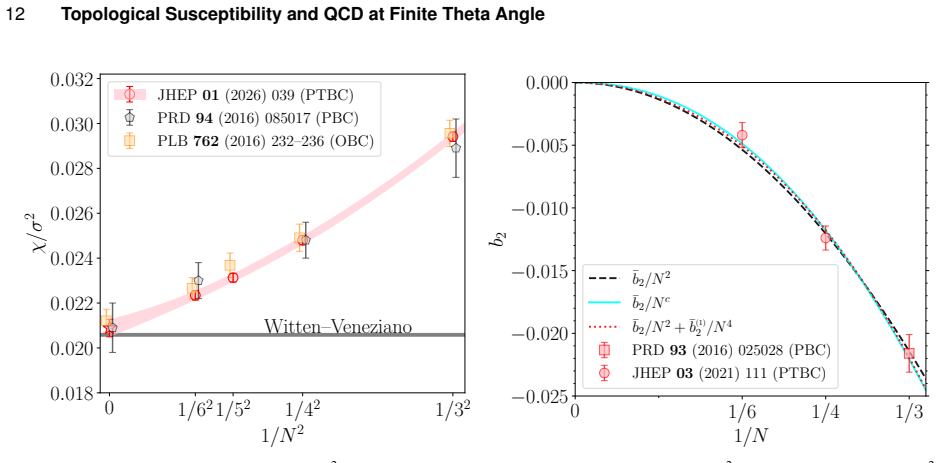
The theta dependence of the QCD vacuum energy is described by a set of analytic approaches whose regimes of validity are known, while lattice Monte Carlo simulations of the discretized theory supply direct numerical access to the topological susceptibility and its theta dependence.
What carries the argument
The topological susceptibility, obtained as the curvature of the vacuum free energy with respect to the theta angle at theta equals zero, which quantifies how the QCD vacuum responds to the topological charge term.
If this is right
- The neutron electric dipole moment is directly proportional to theta, yielding the experimental upper bound of order 10 to the minus 10.
- The eta prime mass arises from the topological susceptibility via the Witten-Veneziano relation in the large-N limit.
- Axion potentials are fixed by the shape of the QCD vacuum energy as a function of theta, controlling axion mass and couplings.
- Finite-temperature lattice studies of theta dependence can map changes across the QCD deconfinement transition.
Where Pith is reading between the lines
- Lattice computations performed directly at finite theta could expose higher-order terms in the vacuum energy that are invisible at theta equals zero.
- Precise values of the susceptibility and its derivatives supply input for axion dark-matter calculations that go beyond the simplest cosine potential.
- Systematic comparison of lattice and analytic results may quantify the size of finite-volume and discretization effects still present in current simulations.
Load-bearing premise
The selected analytic predictions and numerical results are representative of the current literature and accurately reflect the state of the field without significant selection bias or omission of key recent developments.
What would settle it
A new lattice calculation of the topological susceptibility and its leading theta corrections at small but nonzero theta that deviates from the quadratic or quartic behavior predicted by chiral effective theory in the overlapping regime of validity.
Figures


read the original abstract
In this chapter we provide a pedagogical introduction to the main theoretical aspects related to topology and $\theta$-dependence in Quantum Chromo-Dynamics (QCD), and to their phenomenological relevance in the Standard Model ($\eta^\prime$ physics, neutron electric dipole moment) and beyond (strong CP problem and the axion solution). We then provide an overview of the main analytic predictions for $\theta$-dependence obtained using several different approaches (chiral effective theories, large-$N$ arguments, semiclassical methods) and their regimes of validity, as well as a selection of the most recent numerical results about QCD topology obtained via Monte Carlo simulations of the lattice-discretized theory.
Editorial analysis
A structured set of objections, weighed in public.
Referee Report
Summary. This review chapter provides a pedagogical introduction to topology and θ-dependence in QCD. It covers the strong-CP problem and axion physics, derives leading θ-dependence from chiral effective theories (including the explicit form of the topological susceptibility χ(θ) at small θ), discusses large-N scaling arguments and semiclassical/instanton methods with their regimes of validity, and surveys recent lattice Monte Carlo results on QCD topology from both quenched and dynamical simulations.
Significance. If the selected analytic expressions and lattice results accurately reflect the literature without distortion or major omissions, the chapter would provide a compact, accessible entry point for researchers working on axion phenomenology or lattice QCD topology. It reproduces standard results such as the chiral-limit topological susceptibility χ = Σ m_u m_d / (m_u + m_d) and compiles independent lattice determinations, which is useful for cross-checking regimes of validity across methods.
minor comments (3)
- [Abstract] The abstract states that the chapter provides 'a selection of the most recent numerical results'; adding a brief statement in the introduction or lattice section on the cutoff date for included references (e.g., up to 2023 or 2024) would help readers assess completeness.
- [Chiral effective theories] In the chiral EFT section, the derivation of χ(θ) should explicitly reference the equation number when stating the small-θ expansion or the leading-order result in the two-flavor case to improve traceability.
- [Lattice results] Figure captions for lattice results should include the specific action, fermion discretization, and number of flavors for each data set shown, rather than relying solely on the main text.
Simulated Author's Rebuttal
We thank the referee for the positive assessment of our pedagogical review and for the recommendation of minor revision. No specific major comments were provided in the report.
Circularity Check
Review chapter: no original derivations or predictions present
full rationale
The manuscript is explicitly a pedagogical overview and survey of prior literature on θ-dependence in QCD. It summarizes known analytic results from chiral effective theories (e.g., standard χ = Σ m_u m_d / (m_u + m_d) in the chiral limit), large-N scaling, semiclassical instanton estimates, and lattice results from multiple independent collaborations. No new derivation chain, first-principles calculation, or prediction is claimed or performed; all expressions reproduce well-known external results. The central claim is to deliver an organized selection of existing work, with no internal steps that reduce by construction to fitted inputs, self-citations, or ansatzes introduced within the paper itself. This is the standard honest outcome for a review chapter.
Axiom & Free-Parameter Ledger
axioms (2)
- domain assumption QCD is the fundamental theory of the strong interaction
- domain assumption Lattice discretization provides a valid non-perturbative regularization of QCD
Reference graph
Works this paper leans on
-
[1]
E. Vicari, H. Panagopoulos,θdependence of SU(N)gauge theories in the presence of a topological term, Phys. Rept. 470 (2009) 93–150. arXiv:0803.1593,doi:10.1016/j.physrep.2008.10.001
-
[2]
C. Bonanno, C. Bonati, M. D’Elia, Strong CP problem, Theta term and QCD topological properties, in: Reference Module in Materials Science and Materials Engineering (to appear in the Encyclopedia of Particle Physics), Elsevier, 2026.arXiv:2510.03059,doi:https: //doi.org/10.1016/B978-0-443-26598-3.00082-1
-
[3]
A. A. Belavin, A. Polyakov, A. S. Schwartz, Y . S. Tyupkin, Pseudoparticle solutions of the Y ang-Mills equations, Phys. Lett. B 59 (1975) 85–87.doi:10.1016/0370-2693(75)90163-X
-
[4]
A. Actor, Classical solutions ofSU(2)yang–mills theories, Rev. Mod. Phys. 51 (1979) 461–525.doi:10.1103/RevModPhys.51.461
-
[5]
C. Vafa, E. Witten, Parity Conservation in QCD, Phys. Rev. Lett. 53 (1984) 535.doi:10.1103/PhysRevLett.53.535
-
[6]
S. L. Adler, Axial vector vertex in spinor electrodynamics, Phys. Rev. 177 (1969) 2426–2438.doi:10.1103/PhysRev.177.2426
-
[7]
J. S. Bell, R. Jackiw, A PCAC puzzle:π 0 →γγin theσmodel, Nuovo Cim. A 60 (1969) 47–61.doi:10.1007/BF02823296
-
[8]
’t Hooft, Symmetry Breaking Through Bell-Jackiw Anomalies, Phys
G. ’t Hooft, Symmetry Breaking Through Bell–Jackiw Anomalies, Phys. Rev. Lett. 37 (1976) 8–11.doi:10.1103/PhysRevLett.37.8
-
[9]
Weinberg, The U(1) Problem, Phys
S. Weinberg, The U(1) Problem, Phys. Rev. D 11 (1975) 3583–3593.doi:10.1103/PhysRevD.11.3583
-
[10]
’t Hooft, A Planar Diagram Theory for Strong Interactions, Nucl
G. ’t Hooft, A Planar Diagram Theory for Strong Interactions, Nucl. Phys. B 72 (1974) 461.doi:10.1016/0550-3213(74)90154-0
-
[11]
G. Veneziano,U(1)Without Instantons, Nucl. Phys. B 159 (1979) 213–224.doi:10.1016/0550-3213(79)90332-8
-
[12]
Witten, LargeNChiral Dynamics, Annals Phys
E. Witten, LargeNChiral Dynamics, Annals Phys. 128 (1980) 363.doi:10.1016/0003-4916(80)90325-5
-
[13]
P . Di Vecchia, G. Veneziano, Chiral Dynamics in the Large N Limit, Nucl. Phys. B 171 (1980) 253–272.doi:10.1016/0550-3213(80) 90370-3
-
[14]
A. Pich, E. de Rafael, Strong CP violation in an effective chiral Lagrangian approach, Nucl. Phys. B 367 (1991) 313–333.doi:10.1016/ 0550-3213(91)90019-T
1991
-
[15]
Borasoy, The Electric dipole moment of the neutron in chiral perturbation theory, Phys
B. Borasoy, The Electric dipole moment of the neutron in chiral perturbation theory, Phys. Rev. D 61 (2000) 114017.arXiv:hep-ph/ 0004011,doi:10.1103/PhysRevD.61.114017
-
[16]
W. H. Hockings, U. van Kolck, The Electric dipole form factor of the nucleon, Phys. Lett. B 605 (2005) 273–278.arXiv:nucl-th/0508012, doi:10.1016/j.physletb.2004.11.043
-
[17]
Narison, A Fresh Look into the Neutron EDM and Magnetic Susceptibility, Phys
S. Narison, A Fresh Look into the Neutron EDM and Magnetic Susceptibility, Phys. Lett. B 666 (2008) 455–461.arXiv:0806.2618, doi:10.1016/j.physletb.2008.07.083
-
[18]
K. Ottnad, B. Kubis, U. G. Meissner, F . K. Guo, New insights into the neutron electric dipole moment, Phys. Lett. B 687 (2010) 42–47. arXiv:0911.3981,doi:10.1016/j.physletb.2010.03.005
-
[19]
J. de Vries, R. G. E. Timmermans, E. Mereghetti, U. van Kolck, The Nucleon Electric Dipole Form Factor From Dimension-Six Time- Reversal Violation, Phys. Lett. B 695 (2011) 268–274.arXiv:1006.2304,doi:10.1016/j.physletb.2010.11.042
-
[20]
E. Mereghetti, J. de Vries, W. H. Hockings, C. M. Maekawa, U. van Kolck, The Electric Dipole Form Factor of the Nucleon in Chiral Perturbation Theory to Sub-leading Order, Phys. Lett. B 696 (2011) 97–102.arXiv:1010.4078,doi:10.1016/j.physletb.2010.12.018
-
[21]
F .-K. Guo, U.-G. Meissner, Baryon electric dipole moments from strong CP violation, JHEP 12 (2012) 097.arXiv:1210.5887,doi: 10.1007/JHEP12(2012)097
-
[22]
L. Bartolini, F . Bigazzi, S. Bolognesi, A. L. Cotrone, A. Manenti,θdependence in Holographic QCD, JHEP 02 (2017) 029.arXiv: 1611.00048,doi:10.1007/JHEP02(2017)029
-
[23]
Abel, et al., Measurement of the permanent electric dipole moment of the neutron, Phys
C. Abel, et al., Measurement of the Permanent Electric Dipole Moment of the Neutron, Phys. Rev. Lett. 124 (8) (2020) 081803.arXiv: 2001.11966,doi:10.1103/PhysRevLett.124.081803
-
[24]
W.-Y . Ai, J. S. Cruz, B. Garbrecht, C. Tamarit, Consequences of the order of the limit of infinite spacetime volume and the sum over topological sectors for CP violation in the strong interactions, Phys. Lett. B 822 (2021) 136616.arXiv:2001.07152,doi:10.1016/j. physletb.2021.136616
work page doi:10.1016/j 2021
-
[25]
W.-Y . Ai, B. Garbrecht, C. Tamarit, CP Conservation in the Strong Interactions, Universe 10 (5) (2024) 189.arXiv:2404.16026,doi: 10.3390/universe10050189
-
[26]
Y . Nakamura, G. Schierholz, The strong CP problem solved by itself due to long-distance vacuum effects, Nucl. Phys. B 986 (2023) 116063.arXiv:2106.11369,doi:10.1016/j.nuclphysb.2022.116063
-
[27]
Schierholz, Repercussions of the Peccei-Quinn axion on QCD, Mod
G. Schierholz, Repercussions of the Peccei-Quinn axion on QCD, Mod. Phys. Lett. A 40 (04) (2025) 2430009.arXiv:2307.08310, doi:10.1142/S021773232430009X
-
[28]
Schierholz, Absence of strong CP violation, J
G. Schierholz, Absence of strong CP violation, J. Phys. G 52 (4) (2025) 04LT01.arXiv:2403.13508,doi:10.1088/1361-6471/adc31d
-
[29]
D. Albandea, G. Catumba, A. Ramos, Strong CP problem in the quantum rotor, Phys. Rev. D 110 (9) (2024) 094512.arXiv:2402.17518, doi:10.1103/PhysRevD.110.094512
- [30]
- [31]
- [32]
- [33]
-
[34]
T. Bhattacharya, Comment on the claim of physical irrelevance of the topological term,preprint(2025).arXiv:2512.10127
- [35]
-
[36]
M. Aghaie, R. Sato, A particle on a ring or: how I learned to stop worrying and loveθ-vacua,preprint(2026).arXiv:2601.18248
work page internal anchor Pith review arXiv 2026
-
[37]
Ringwald, CP , or not CP , that is the question
A. Ringwald, CP , or not CP , that is the question. . ., PoS COSMICWISPers2025 (2026) 001.arXiv:2601.04718
-
[38]
F . Sannino, Strong CP and the QCD Axion: Lecture Notes via Effective Field Theory,preprint(2026).arXiv:2601.19735
-
[39]
F . Strocchi, The strong CP problem revisited and solved by the gauge group topology,preprint(2024).arXiv:2404.19400
-
[40]
D. B. Kaplan, Chiral Gauge Theory at the Boundary between Topological Phases, Phys. Rev. Lett. 132 (14) (2024) 141603.arXiv: 2312.01494,doi:10.1103/PhysRevLett.132.141603
- [41]
-
[42]
D. B. Kaplan, A. V. Manohar, Current Mass Ratios of the Light Quarks, Phys. Rev. Lett. 56 (1986) 2004.doi:10.1103/PhysRevLett.56. 2004
-
[43]
K. Choi, C. W. Kim, W. K. Sze, Mass Renormalization by Instantons and the Strong CP Problem, Phys. Rev. Lett. 61 (1988) 794. doi:10.1103/PhysRevLett.61.794. 20Topological Susceptibility and QCD at Finite Theta Angle
-
[44]
T. Banks, Y . Nir, N. Seiberg, Missing (up) mass, accidental anomalous symmetries, and the strong CP problem, in: 2nd IFT Workshop on Yukawa Couplings and the Origins of Mass, 1994, pp. 26–41.arXiv:hep-ph/9403203
work page internal anchor Pith review arXiv 1994
-
[45]
C. Alexandrou, J. Finkenrath, L. Funcke, K. Jansen, B. Kostrzewa, F . Pittler, C. Urbach, Ruling Out the Massless Up-Quark Solution to the StrongCPCPCPProblem by Computing the Topological Mass Contribution with Lattice QCD, Phys. Rev. Lett. 125 (23) (2020) 232001. arXiv:2002.07802,doi:10.1103/PhysRevLett.125.232001
-
[46]
Y . Aoki, et al., FLAG Review 2021, Eur. Phys. J. C 82 (10) (2022) 869.arXiv:2111.09849,doi:10.1140/epjc/s10052-022-10536-1
-
[47]
R. D. Peccei, H. R. Quinn, CP Conservation in the Presence of Instantons, Phys. Rev. Lett. 38 (1977) 1440–1443.doi:10.1103/ PhysRevLett.38.1440
1977
-
[48]
R. D. Peccei, H. R. Quinn, Constraints Imposed by CP Conservation in the Presence of Instantons, Phys. Rev. D 16 (1977) 1791–1797. doi:10.1103/PhysRevD.16.1791
-
[49]
Wilczek, Problem of Strong P and T Invariance in the Presence of Instantons, Phys
F . Wilczek, Problem of Strong P and T Invariance in the Presence of Instantons, Phys. Rev. Lett. 40 (1978) 279–282.doi:10.1103/ PhysRevLett.40.279
1978
-
[50]
S. Weinberg, A New Light Boson?, Phys. Rev. Lett. 40 (1978) 223–226.doi:10.1103/PhysRevLett.40.223
-
[52]
L. F . Abbott, P . Sikivie, A Cosmological Bound on the Invisible Axion, Phys. Lett. B 120 (1983) 133–136.doi:10.1016/0370-2693(83) 90638-X
-
[53]
M. Dine, W. Fischler, The Not So Harmless Axion, Phys. Lett. B 120 (1983) 137–141.doi:10.1016/0370-2693(83)90639-1
-
[54]
O. Wantz, E. P . S. Shellard, Axion Cosmology Revisited, Phys. Rev. D 82 (2010) 123508.arXiv:0910.1066,doi:10.1103/PhysRevD.82. 123508
-
[55]
Lattice QCD input for axion cosmology
E. Berkowitz, M. I. Buchoff, E. Rinaldi, Lattice QCD input for axion cosmology, Phys. Rev. D 92 (3) (2015) 034507.arXiv:1505.07455, doi:10.1103/PhysRevD.92.034507
-
[56]
The landscape of QCD axion models
L. Di Luzio, M. Giannotti, E. Nardi, L. Visinelli, The landscape of QCD axion models, Phys. Rept. 870 (2020) 1–117.arXiv:2003.01100, doi:10.1016/j.physrep.2020.06.002
-
[57]
N. H. Christ, Conservation Law Violation at High-Energy by Anomalies, Phys. Rev. D 21 (1980) 1591.doi:10.1103/PhysRevD.21.1591
-
[58]
F . R. Klinkhamer, N. S. Manton, A Saddle Point Solution in the Weinberg-Salam Theory, Phys. Rev. D 30 (1984) 2212.doi:10.1103/ PhysRevD.30.2212
1984
- [59]
-
[60]
Computation of the quantum effects due to a four-dimensional pseudoparticle
G. ’t Hooft, Computation of the Quantum Effects Due to a Four-Dimensional Pseudoparticle, Phys. Rev. D 14 (1976) 3432–3450, [Erratum: Phys. Rev. D 18, 2199 (1978)].doi:10.1103/PhysRevD.14.3432
-
[61]
Heavy Ion Collisions: The Big Picture, and the Big Ques- tions,
W. Busza, K. Rajagopal, W. van der Schee, Heavy Ion Collisions: The Big Picture, and the Big Questions, Ann. Rev. Nucl. Part. Sci. 68 (2018) 339–376.arXiv:1802.04801,doi:10.1146/annurev-nucl-101917-020852
-
[62]
D. E. Kharzeev, L. D. McLerran, H. J. Warringa, The Effects of topological charge change in heavy ion collisions: ’Event by event P and CP violation’, Nucl. Phys. A 803 (2008) 227–253.arXiv:0711.0950,doi:10.1016/j.nuclphysa.2008.02.298
-
[63]
K. Fukushima, D. E. Kharzeev, H. J. Warringa, The Chiral Magnetic Effect, Phys. Rev. D 78 (2008) 074033.arXiv:0808.3382,doi: 10.1103/PhysRevD.78.074033
-
[64]
K. Fukushima, D. E. Kharzeev, H. J. Warringa, Real-time dynamics of the Chiral Magnetic Effect, Phys. Rev. Lett. 104 (2010) 212001. arXiv:1002.2495,doi:10.1103/PhysRevLett.104.212001
-
[65]
D. E. Kharzeev, The Chiral Magnetic Effect and Anomaly-Induced Transport, Prog. Part. Nucl. Phys. 75 (2014) 133–151.arXiv:1312. 3348,doi:10.1016/j.ppnp.2014.01.002
- [66]
-
[67]
M. Barroso Mancha, G. D. Moore, The sphaleron rate from 4D Euclidean lattices, JHEP 01 (2023) 155.arXiv:2210.05507,doi: 10.1007/JHEP01(2023)155
-
[68]
Y . Feng, S. A. Voloshin, F . Wang, Experimental search for the chiral magnetic effect in relativistic heavy-ion collisions: A perspective, Phys. Rev. Res. 7 (3) (2025) 031001.arXiv:2502.09742,doi:10.1103/xk4f-wm9s
-
[69]
D. E. Kharzeev, J. Liao, P . Tribedy, Chiral magnetic effect in heavy ion collisions: The present and future, Int. J. Mod. Phys. E 33 (09) (2024) 2430007.arXiv:2405.05427,doi:10.1142/9789811294679_0006
-
[70]
A. Notari, F . Rompineve, G. Villadoro, Improved Hot Dark Matter Bound on the QCD Axion, Phys. Rev. Lett. 131 (1) (2023) 011004. arXiv:2211.03799,doi:10.1103/PhysRevLett.131.011004
-
[71]
F . Bianchini, G. G. di Cortona, M. Valli, QCD axion: Some like it hot, Phys. Rev. D 110 (12) (2024) 123527.arXiv:2310.08169,doi: 10.1103/PhysRevD.110.123527
-
[72]
C. A. J. O’Hare, Cosmology of axion dark matter, PoS COSMICWISPers (2024) 040.arXiv:2403.17697,doi:10.22323/1.454.0040
-
[73]
Energy and momentum dependence of the soft-axion interaction rate
K. Bouzoud, J. Ghiglieri, M. Laine, G. S. S. Sakoda, Energy and momentum dependence of the soft-axion interaction rate,preprint(2026). arXiv:2601.08221
work page internal anchor Pith review arXiv 2026
-
[74]
D. J. Gross, R. D. Pisarski, L. G. Y affe, QCD and Instantons at Finite Temperature, Rev. Mod. Phys. 53 (1981) 43.doi:10.1103/ RevModPhys.53.43
1981
-
[75]
R. D. Pisarski, L. G. Y affe, The density of instantons at finite temperature, Phys. Lett. B 97 (1980) 110–112.doi:10.1016/0370-2693(80) 90559-6
-
[76]
A. Boccaletti, D. Nogradi, The semi-classical approximation at high temperature revisited, JHEP 03 (2020) 045.arXiv:2001.03383, doi:10.1007/JHEP03(2020)045
-
[77]
Witten,θ-dependence in the large-Nlimit of four-dimensional gauge theories, Phys
E. Witten,θ-dependence in the large-Nlimit of four-dimensional gauge theories, Phys. Rev. Lett. 81 (1998) 2862–2865.arXiv:hep-th/ 9807109,doi:10.1103/PhysRevLett.81.2862
-
[78]
T. Vonk, F .-K. Guo, U.-G. Meißner, Aspects of the QCDθ-vacuum, JHEP 06 (2019) 106, [Erratum: JHEP 028 (2019) 028].arXiv: 1905.06141,doi:10.1007/JHEP06(2019)106
-
[79]
The QCD topological charge and its thermal dependence: the role of the η′
A. G ´omez Nicola, J. Ruiz De Elvira, A. Vioque-Rodr ´ıguez, The QCD topological charge and its thermal dependence: the role of theη ′, JHEP 11 (2019) 086.arXiv:1907.11734,doi:10.1007/JHEP11(2019)086
-
[80]
A. D’Adda, M. L ¨uscher, P . Di Vecchia, A1/NExpandable Series of Nonlinear Sigma Models with Instantons, Nucl. Phys. B 146 (1978) 63–76.doi:10.1016/0550-3213(78)90432-7
-
[81]
L ¨uscher, The Secret Long Range Force in Quantum Field Theories With Instantons, Phys
M. L ¨uscher, The Secret Long Range Force in Quantum Field Theories With Instantons, Phys. Lett. B 78 (1978) 465–467.doi:10.1016/ 0370-2693(78)90487-2. Topological Susceptibility and QCD at Finite Theta Angle21
1978
discussion (0)
Sign in with ORCID, Apple, or X to comment. Anyone can read and Pith papers without signing in.