Recognition: unknown
g-tensor Optimization in Ge/SiGe Quantum Dots
Pith reviewed 2026-05-07 05:32 UTC · model grok-4.3
The pith
Adjusting silicon concentration in a SiGe-Ge-SiGe quantum well reshapes the out-of-plane potential to suppress in-plane g-tensor components and realize gapless single-spin qubit encoding.
A machine-rendered reading of the paper's core claim, the machinery that carries it, and where it could break.
Core claim
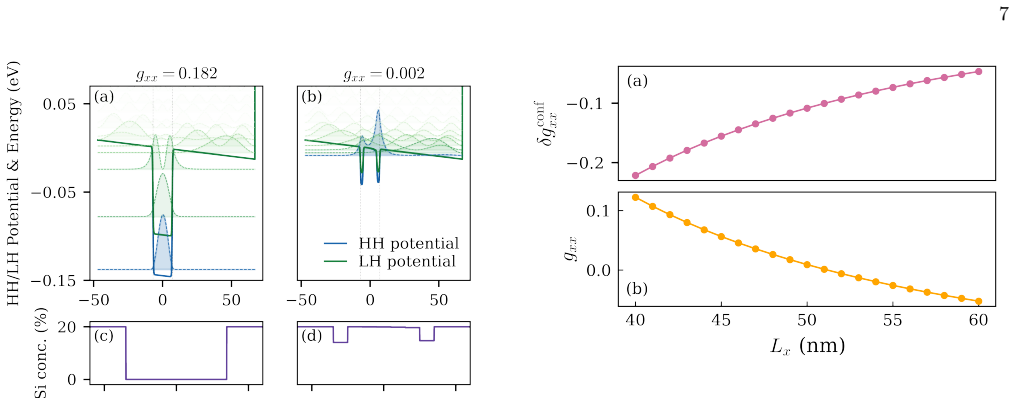
We introduce a flexible optimization framework for engineering g-tensor properties in planar germanium heterostructures hosting hole-spin qubits. As a benchmark, we numerically obtain the optimal reshaping of the out-of-plane potential in a SiGe-Ge-SiGe quantum well to suppress the in-plane g-tensor components and realize the recently proposed gapless single-spin qubit encoding. This reshaping is achieved through heterostructure engineering, specifically by adjusting the silicon concentration within the quantum well.
What carries the argument
A numerical optimization framework that engineers the g-tensor by varying the silicon concentration to reshape the quantum well potential profile.
Load-bearing premise
The numerical model of hole states and g-tensor calculation accurately reflects the physics in real fabricated devices, and silicon concentration variations achieve the target potential without introducing disorder that cancels the benefits.
What would settle it
An experiment fabricating SiGe-Ge-SiGe quantum dot devices with the optimized silicon concentration profile and measuring the g-tensor to verify suppression of the in-plane components.
Figures






read the original abstract
Planar germanium heterostructures hosting hole-spin qubits are among the leading platforms for scalable semiconductor-based quantum computing. Yet, device performance is hindered by significant quantum dot variability, which leads to uncertainty in qubit energy levels and random orientations of the spin quantization axis. Tailored control of the g-tensor offers a strategy to overcome these limitations and achieve more reliable qubit operations. Here, we introduce a flexible optimization framework for engineering g-tensor properties. As a benchmark, we numerically obtain the optimal reshaping of the out-of-plane potential in a SiGe-Ge-SiGe quantum well to suppress the in-plane g-tensor components and realize the recently proposed gapless single-spin qubit encoding. This reshaping is achieved through heterostructure engineering, specifically by adjusting the silicon concentration within the quantum well, though the framework remains readily adaptable to alternative design objectives. Our results provide practical design principles for improving the tunability of the spin response, paving the way towards large-scale germanium-based quantum computers.
Editorial analysis
A structured set of objections, weighed in public.
Referee Report
Summary. The manuscript introduces a flexible numerical optimization framework for engineering g-tensor properties in planar Ge/SiGe heterostructures hosting hole-spin qubits. As a benchmark, it claims to obtain an optimal reshaping of the out-of-plane potential profile in a SiGe-Ge-SiGe quantum well by varying the silicon concentration, thereby suppressing the in-plane g-tensor components to enable the gapless single-spin qubit encoding proposed in prior literature. The framework is presented as adaptable to other design goals.
Significance. If the numerical results are shown to be robust, the work offers practical heterostructure design guidelines that could improve g-tensor tunability and reduce qubit variability in Ge-based platforms, supporting scalability of semiconductor spin qubits. The optimization approach itself, if implemented with full material-parameter updating and validated against experiment, would constitute a useful engineering tool.
major comments (3)
- [§2 and §3] §2 (Numerical Model) and §3 (Optimization Results): The manuscript provides no explicit description of the Hamiltonian (k·p or envelope-function form), the method for computing the g-tensor from the hole wavefunctions, or any convergence tests with respect to basis size or discretization. Without these, the central claim that an optimal potential profile suppresses in-plane g-components cannot be evaluated.
- [§3] §3 (Heterostructure Engineering): When silicon concentration x is varied inside the Ge well to reshape the confining potential, the model must update the Luttinger parameters, hole effective mass, and band offsets self-consistently. If these quantities are instead held fixed at pure-Ge (x=0) values while only the electrostatic potential is altered, the reported g-tensor suppression is an artifact; the abstract presents concentration adjustment as the engineering knob without indicating parameter updating.
- [§4] §4 (Discussion): No comparison is made to existing experimental g-tensor measurements in Ge/SiGe quantum dots, nor is alloy scattering or interface disorder from Si incorporation quantified. These omissions leave open whether the predicted suppression survives realistic material imperfections.
minor comments (2)
- [Abstract] Abstract: The phrase 'numerically obtain the optimal reshaping' should be accompanied by a reference to the specific figure or table that displays the optimized profile and the resulting g-tensor values.
- [Throughout] Notation: Define all symbols appearing in the g-tensor expressions (e.g., g_xx, g_zz) at first use and ensure consistent use of subscripts throughout.
Simulated Author's Rebuttal
We thank the referee for the detailed and constructive report. The comments highlight important aspects of clarity, model completeness, and experimental context that we will address in a revised manuscript. Below we respond point by point to the major comments.
read point-by-point responses
-
Referee: [§2 and §3] §2 (Numerical Model) and §3 (Optimization Results): The manuscript provides no explicit description of the Hamiltonian (k·p or envelope-function form), the method for computing the g-tensor from the hole wavefunctions, or any convergence tests with respect to basis size or discretization. Without these, the central claim that an optimal potential profile suppresses in-plane g-components cannot be evaluated.
Authors: We agree that additional technical details are required for full reproducibility and evaluation. The model employs a 4-band Luttinger-Kohn k·p Hamiltonian for the heavy- and light-hole states, discretized on a finite-element mesh in the growth direction with envelope-function approximation. The g-tensor components are obtained by computing the Zeeman splitting under a small in-plane magnetic field via first-order perturbation theory on the hole envelope functions, incorporating the spin-orbit contributions. Convergence with respect to mesh density (typically 0.1 nm spacing) and basis truncation was verified internally but not reported. In the revised manuscript we will expand §2 with the explicit Hamiltonian form, the g-tensor extraction procedure, and a dedicated convergence subsection (or appendix) showing that the in-plane g-components stabilize to <1% variation beyond the chosen discretization. revision: yes
-
Referee: [§3] §3 (Heterostructure Engineering): When silicon concentration x is varied inside the Ge well to reshape the confining potential, the model must update the Luttinger parameters, hole effective mass, and band offsets self-consistently. If these quantities are instead held fixed at pure-Ge (x=0) values while only the electrostatic potential is altered, the reported g-tensor suppression is an artifact; the abstract presents concentration adjustment as the engineering knob without indicating parameter updating.
Authors: We confirm that all material parameters are updated with silicon concentration x. The Luttinger parameters (γ1, γ2, γ3), hole effective masses, and valence-band offsets are interpolated linearly (Vegard’s law) between pure-Ge and Si values using established literature parametrizations for Si1−xGex alloys. These x-dependent parameters enter both the k·p Hamiltonian and the self-consistent Poisson–Schrödinger solution that determines the confining potential. The optimization therefore accounts for both the electrostatic reshaping and the composition-induced changes in band structure. We will add an explicit statement and the interpolation formulas in the revised §2 and §3 to eliminate any ambiguity. revision: yes
-
Referee: [§4] §4 (Discussion): No comparison is made to existing experimental g-tensor measurements in Ge/SiGe quantum dots, nor is alloy scattering or interface disorder from Si incorporation quantified. These omissions leave open whether the predicted suppression survives realistic material imperfections.
Authors: We acknowledge the value of experimental anchoring. In the revised §4 we will include a direct comparison of our optimized in-plane g-components (targeting near-zero values) against published experimental g-tensor data for Ge/SiGe hole quantum dots, citing representative works on g-factor anisotropy in planar Ge heterostructures. Regarding alloy scattering and interface disorder, we will add a qualitative assessment noting that typical SiGe interface roughness (∼0.5–1 nm) and alloy fluctuations introduce a small residual in-plane g-component; however, the optimization still provides a useful target for heterostructure design. A quantitative disorder-averaged calculation lies beyond the present scope but will be flagged as future work. These additions will clarify the robustness of the predicted suppression under realistic conditions. revision: partial
Circularity Check
No circularity: numerical optimization uses external target and independent physical parameter
full rationale
The derivation consists of a numerical optimization framework that takes an externally defined target (gapless single-spin qubit encoding from prior literature) and varies silicon concentration as a growth parameter to reshape the confining potential. The g-tensor components are computed from the heterostructure model rather than fitted or defined in terms of the optimization objective. No self-definitional steps, fitted inputs renamed as predictions, or load-bearing self-citations appear in the chain. The approach remains self-contained against external benchmarks because the target encoding and the material parameter are independent of the computed result.
Axiom & Free-Parameter Ledger
free parameters (1)
- silicon concentration profile
axioms (1)
- domain assumption Effective-mass or k·p theory accurately computes the hole g-tensor from the electrostatic potential in planar Ge/SiGe heterostructures
Reference graph
Works this paper leans on
-
[1]
AssembleV (j) ⊥ (z;s, E z)forj∈ {HH,LH}
-
[2]
Solve the out-of-plane Schrödinger equation to ob- tainϕ (HH) 0 (z)and{ϕ (LH) n (z)}n
-
[3]
Evaluate the in-plane HH ground-state orbital mo- ments,⟨p 2 x⟩and⟨p 2 y⟩, for a 2D harmonic oscillator
-
[4]
double-well
Computeg xx(s), using Eq. (14). We then minimize the cost-function L(s) =g xx(s) + 3 max 0, P out(s)−0.4 ,(15) whereP out = 1− R Lz/2 −Lz/2 |ϕ(HH) 0 (z)|2 dzdenotes the prob- ability that the HH-component penetrates outside the nominal QW region. The thresholdPout = 0.4is chosen as a practical confinement tolerance. It allows the HH envelope to extend sli...
2021
-
[5]
We start by solving the out-of-plane (vertical) and in-plane (lateral) effective mass Schrödinger equa- tions
-
[6]
We then proceed to evaluategxx via the Schrieffer- Wolff transformation of the Luttinger–Kohn model, in the presence ofan applied in-plane magnetic field and a confinement potential
-
[7]
Numerical settings, such as spatial discretization grids, boundary conditions, potential smoothing settings, and material constants, are given in App
Finally, using CMA-ES, we optimize the segmented Si profile concentration inside the Ge QW. Numerical settings, such as spatial discretization grids, boundary conditions, potential smoothing settings, and material constants, are given in App. B
-
[8]
Inside the well, a piecewise-constant Si profile,s, reshapes the out-of-plane confinement poten- tial and, consequently, theHH/LHvalence-band edges
Modeling the out-of-plane subbands We consider a compressively strained Ge QW of thick- nessL z, grown along[001]≡ˆzand embedded between relaxed Si0.2Ge0.8 barriers with interfaces atzs =−L z/2 andz e = +Lz/2. Inside the well, a piecewise-constant Si profile,s, reshapes the out-of-plane confinement poten- tial and, consequently, theHH/LHvalence-band edges...
-
[9]
Since the har- monic potential in Eq
Modeling the in-plane wave functions We model the lateral confinement by a 2D harmonic potential, given by: V (j) ∥ (x, y) = 1 2 m(j) ∥ (ω(j) x )2x2 + (ω(j) y )2y2 ,(A7) with ω(j) x = ℏ m(j) ∥ (L(j) x )2 , ω (j) y = ℏ m(j) ∥ (L(j) y )2 ,(A8) m(HH) ∥ = m0 γ1 +γ 2 , m (LH) ∥ = m0 γ1 −γ 2 ,(A9) L(LH) x,y =L (HH) x,y γ1 −γ 2 γ1 +γ 2 1/4 .(A10) Note thatL (j) ...
-
[10]
Modeling the g-tensor response in hole qubits The kinetic energy of holes in planar germanium is well-described by the4×4Luttinger–Kohn (LK) Hamil- tonian defined in theJ= 3/2valence band manifold, neark=0[55]. In the absence of an applied mag- netic field, the full Hamiltonian describing the holes is given by the LK Hamiltonian and the confinement po- te...
-
[11]
ask–evaluate–tell
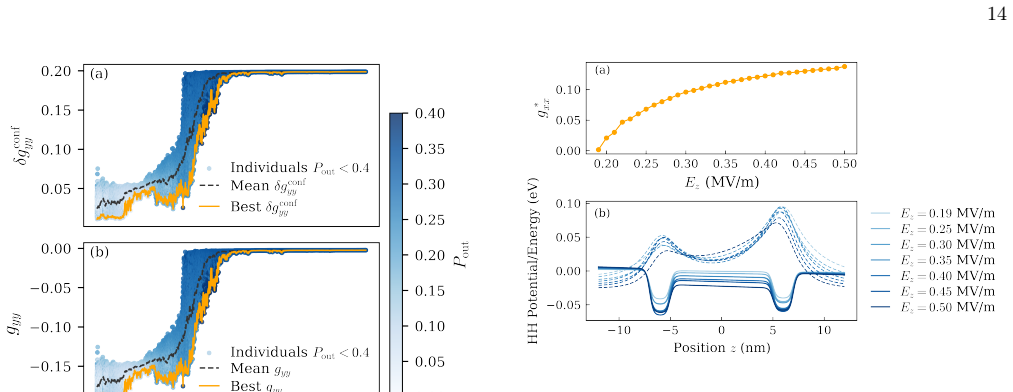
CMA-ES optimization We optimize the 7-segment Si concentrations= (s1, . . . , s7), s i ∈[5,20]%,to suppress the in-plane response, while ensuring adequate confinement of the dominantHHcomponent. For eachs, the simulation pipeline (see Secs. A1–A3) returnsgxx(s)and the prob- abilityP out(s). For clarity, we recall that the scalar cost- function is defined ...
-
[12]
We set the Si0.2Ge0.8 barrier to0 eV(outside the well)
Strain-shifted valence-band offset The strain-shifted valence-band offset is given as fol- lows:U (HH) 0 =P+Q−U 0 andU (LH) 0 =P−Q−U 0, withP=−a v(εxx +ε yy +ε zz)andQ=−(b v/2)(εxx + εyy −2ε zz)representing the hydrostatic and shear de- formation potentials, respectively. We set the Si0.2Ge0.8 barrier to0 eV(outside the well). The constant termU0 is the v...
-
[13]
1 in the main text), and discretized using a uniform grid spacing∆z= 0.02 nm
Simulation domain grid, boundary conditions and out-of-plane Schrödinger equation solver The simulation domain was defined asz∈[z s − 40 nm, ze + 60 nm](see Fig. 1 in the main text), and discretized using a uniform grid spacing∆z= 0.02 nm. The solutions to the out-of-plane Schrödinger equation, Eq. (A4), were constrained to obey the hard-wall bound- ary c...
-
[14]
For⟨p 2 y⟩, weproceedsimilarly, withy∈[−10L y,10L y]and∆y= ∆x
Evaluation of the in-plane moments For theHHground-state orbital, we compute ⟨p2 x⟩=ℏ 2 Z ψ(HH)∗ 0 (x) (−∂2 x)ψ (HH) 0 (x)dx ,(B2) using a uniform gridx∈[−10L x,10L x], discretized in equalsteps∆x= 0.05 nm. For⟨p 2 y⟩, weproceedsimilarly, withy∈[−10L y,10L y]and∆y= ∆x. The integrals are evaluated using Simpson’s rule via thesimpsonfunction from thescipy.i...
-
[15]
(A17) and Eq
Numerical evaluation of the in-plane g-tensor components Given the inputs{ϕ (HH) 0 , ϕ(LH) n , E(HH0), E(LHn)}, we computeη h(s),˜ηh(s), which subsequently determineλ(s) andλ ′(s)via Eq. (A17) and Eq. (A18), respectively. This procedure allows to fully determinegxx(s)through Eq. (A16). We note that the sums forηh,˜ηh converged forn LH z ≥50, as verified b...
-
[16]
How- ever, applying our method to a new scenario may re- quire preliminary numerical convergence studies to deter- mine optimal values for certain fixed parameters in our framework
Numerical convergence of simulation parameters In the main text, we highlighted several parameters that can be readily adjusted for different use cases. How- ever, applying our method to a new scenario may re- quire preliminary numerical convergence studies to deter- mine optimal values for certain fixed parameters in our framework. These entail the spati...
-
[17]
ask–evaluate-tell
CMA-ES configuration and parallelization We usecmaPython package in an "ask–evaluate-tell" loop with population sizeNpop = 200. The algorithm is initialized with a meanµ(0) = [5,10,10,10,10,10,5]%, a step sizeσ (0) = 5%, an identity covariance matrix, and a projection onto the bounds[5,20]%for each segment. The evaluation step is parallelized across candi...
-
[18]
Zwerver, S
A. Zwerver, S. Amitonov, S. de Snoo, M. Mądzik, M. Rimbach-Russ, A. Sammak, G. Scappucci, and L. Vandersypen, PRX Quantum4, 030303 (2023)
2023
-
[19]
Maurand, X
R. Maurand, X. Jehl, D. Kotekar-Patil, A. Corna, H. Bo- huslavskyi, R. Laviéville, L. Hutin, S. Barraud, M. Vinet, M. Sanquer, and S. De Franceschi, Nature Communica- tions7, 13575 (2016)
2016
-
[20]
M. F. Gonzalez-Zalba, S. de Franceschi, E. Charbon, T. Meunier, M. Vinet, and A. S. Dzurak, Nature Elec- tronics4, 872 (2021)
2021
-
[21]
Takeda, A
K. Takeda, A. Noiri, T. Nakajima, T. Kobayashi, and S. Tarucha, Nature608, 682 (2022)
2022
-
[22]
X. Xue, M. Russ, N. Samkharadze, B. Undseth, A. Sam- mak, G. Scappucci, and L. M. K. Vandersypen, Nature 17 601, 343 (2022)
2022
-
[23]
S. G. J. Philips, M. T. Mądzik, S. V. Amitonov, S. L. de Snoo, M. Russ, N. Kalhor, C. Volk, W. I. L. Lawrie, D. Brousse, L. Tryputen, B. Paquelet Wuetz, A. Sam- mak, M. Veldhorst, G. Scappucci, and L. M. K. Vander- sypen, Nature609, 919 (2022)
2022
-
[24]
Loss and D
D. Loss and D. P. DiVincenzo, Physical Review A57, 120 (1998)
1998
-
[25]
Burkard, T
G. Burkard, T. D. Ladd, A. Pan, J. M. Nichol, and J. R. Petta, Reviews of Modern Physics95, 025003 (2023)
2023
-
[26]
Kloeffel and D
C. Kloeffel and D. Loss, Annual Review of Condensed Matter Physics4, 51 (2013)
2013
-
[27]
L. M. K. Vandersypen, H. Bluhm, J. S. Clarke, A. S. Dzurak, R. Ishihara, A. Morello, D. J. Reilly, L. R. Schreiber, and M. Veldhorst, npj Quantum Information 3, 10.1038/s41534-017-0038-y (2017)
-
[28]
Jnane and S
H. Jnane and S. C. Benjamin, Phys. Rev. Appl.24, 044042 (2025)
2025
-
[29]
A. M. J. Zwerver, T. Krähenmann, T. F. Watson, L. Lampert, H. C. George, R. Pillarisetty, S. A. Bojarski, P. Amin, S. V. Amitonov, J. M. Boter,et al., Nature Electronics5, 184 (2022)
2022
-
[30]
I. Vorreiter, J. Y. Huang, S. D. Liles, J. Hillier, R. Li, B. Raes, S. Kubicek, J. Jussot, S. Beyne, C. Godfrin, S. Sharma, D. Wan, N. Dumoulin Stuyck, W. Gilbert, C. H. Yang, A. S. Dzurak, K. De Greve, and A. R. Hamilton, Precision high-speed quantum logic with holes on a natural silicon foundry platform (2025), arXiv:2508.00446 [cond-mat.mes-hall]
-
[31]
V. John, C. X. Yu, B. van Straaten, E. A. Rodríguez- Mena, M. Rodríguez, S. D. Oosterhout, L. E. A. Ste- houwer, G. Scappucci, M. Rimbach-Russ, S. Bosco, F. Borsoi, Y.-M. Niquet, and M. Veldhorst, Nature Com- munications16, 10560 (2025)
2025
-
[32]
E.A.Stehouwer, C.X
L. E.A.Stehouwer, C.X. Yu, B.vanStraaten, A.Tosato, V. John, D. Degli Esposti, A. Elsayed, D. Costa, S. D. Oosterhout, N. W. Hendrickx, M. Veldhorst, F. Borsoi, and G. Scappucci, Nature Materials24, 1906 (2025)
1906
-
[33]
Zhang, E
X. Zhang, E. Morozova, M. Rimbach-Russ, D. Jirovec, T.-K. Hsiao, P. Cova Fariña, C.-A. Wang, S. D. Oost- erhout, A. Sammak, G. Scappucci, M. Veldhorst, and L. M. K. Vandersypen, Nature Nanotechnology20, 209 (2025)
2025
-
[34]
W. I. L. Lawrie, M. Rimbach-Russ, F. van Riggelen, N. W. Hendrickx, S. L. de Snoo, A. Sammak, G. Scap- pucci, J. Helsen, and M. Veldhorst, Nature Communica- tions14, 3617 (2023)
2023
-
[35]
H. Liu, K. Wang, F. Gao, J. Leng, Y. Liu, Y.-C. Zhou, G. Cao, T. Wang, J. Zhang, P. Huang, H.-O. Li, and G.-P. Guo, Nano Letters23, 3810 (2023)
2023
-
[36]
K. Wang, G. Xu, F. Gao, H. Liu, R.-L. Ma, X. Zhang, Z. Wang, G. Cao, T. Wang, J.-J. Zhang,et al., Nature Communications13, 206 (2022)
2022
-
[37]
N. W. Hendrickx, W. I. L. Lawrie, M. Russ, F. van Rigge- len, S. L. de Snoo, R. N. Schouten, A. Sammak, G. Scap- pucci, and M. Veldhorst, Nature591, 580 (2021)
2021
-
[38]
Scappucci, C
G. Scappucci, C. Kloeffel, F. A. Zwanenburg, D. Loss, M. Myronov, J.-J. Zhang, S. De Franceschi, G. Kat- saros, and M. Veldhorst, Nature Reviews Materials6, 926 (2021)
2021
-
[39]
Watzinger, J
H. Watzinger, J. Kukučka, L. Vukušić, F. Gao, T. Wang, F. Schäffler, J.-J. Zhang, and G. Katsaros, Nature Com- munications9, 3902 (2018)
2018
-
[40]
N. W. Hendrickx, D. P. Franke, A. Sammak, G. Scap- pucci, and M. Veldhorst, Nature577, 487 (2020)
2020
-
[41]
Jirovec, A
D. Jirovec, A. Hofmann, A. Ballabio, P. M. Mutter, G. Tavani, M. Botifoll, A. Crippa, J. Kukucka, O. Sagi, F. Martins, J. Saez-Mollejo, I. Prieto, M. Borovkov, J. Arbiol, D. Chrastina, G. Isella, and G. Katsaros, Na- ture Materials20, 1106 (2021)
2021
-
[42]
F. N. M. Froning, L. C. Camenzind, O. A. van der Molen, A. Li, E. P. A. M. Bakkers, D. M. Zumbühl, and F. R. Braakman, Nature Nanotechnology16, 308 (2021)
2021
-
[43]
Y. Fang, P. Philippopoulos, D. Culcer, W. A. Coish, and S. Chesi, Materials for Quantum Technology3, 012003 (2023)
2023
-
[44]
L. A. Terrazos, E. Marcellina, Z. Wang, S. N. Copper- smith, M. Friesen, A. R. Hamilton, X. Hu, B. Koiller, A. L. Saraiva, D. Culcer, and R. B. Capaz, Physical Re- view B103, 125201 (2021)
2021
-
[45]
Mauro, M
L. Mauro, M. J. Rodríguez, E. A. Rodríguez-Mena, and Y.-M. Niquet, npj Quantum Information11, 167 (2025)
2025
-
[46]
N. W. Hendrickx, L. Massai, M. Mergenthaler, F. J. Schupp, S.Paredes, S.W.Bedell, G.Salis,andA.Fuhrer, Nature Materials23, 920 (2024)
2024
-
[47]
J. H. Qvist and J. Danon, Physical Review B106, 10.1103/physrevb.106.235312 (2022)
-
[48]
I. K. Jin, J. Hillier, S. D. Liles, Z. Wang, A. Shamim, I. Vorreiter, R. Li, C. Godfrin, S. Kubicek, K. D. Greve, D. Culcer, and A. R. Hamilton, Probing g-tensor re- producibility and spin-orbit effects in planar silicon hole quantum dots (2024), arXiv:2411.06016 [cond-mat.mes- hall]
-
[49]
Venitucci, L
B. Venitucci, L. Bourdet, D. Pouzada, and Y.-M. Niquet, Physical Review B98, 155319 (2018)
2018
-
[50]
C.-A. Wang, V. John, H. Tidjani, C. X. Yu, A. S. Ivlev, C.Déprez, F.vanRiggelen-Doelman, B.D.Woods, N. W. Hendrickx, W. I. L. Lawrie, L. E. A. Stehouwer, S. D. Oosterhout, A. Sammak, M. Friesen, G. Scappucci, S. L. de Snoo, M. Rimbach-Russ, F. Borsoi, and M. Veld- horst, Science385, 447 (2024)
2024
-
[51]
F. K. Unseld, B. Undseth, E. Raymenants, Y. Mat- sumoto, S. L. de Snoo, S. Karwal, O. Pietx-Casas, A. S. Ivlev, M. Meyer, A. Sammak, M. Veldhorst, G. Scap- pucci, and L. M. K. Vandersypen, Nature Communica- tions16, 5605 (2025)
2025
-
[52]
Rimbach-Russ, V
M. Rimbach-Russ, V. John, B. van Straaten, and S. Bosco, Phys. Rev. Lett.135, 197001 (2025)
2025
-
[53]
J. R. Petta, A. C. Johnson, J. M. Taylor, E. A. Laird, A. Yacoby, M. D. Lukin, C. M. Marcus, M. P. Hanson, and A. C. Gossard, Science309, 2180 (2005)
2005
-
[54]
D. P. DiVincenzo, D. Bacon, J. Kempe, G. Burkard, and K. B. Whaley, Nature408, 339 (2000)
2000
-
[55]
Russ and G
M. Russ and G. Burkard, Journal of Physics: Condensed Matter29, 393001 (2017)
2017
-
[56]
A. J. Weinstein, M. D. Reed, A. M. Jones, R. W. An- drews, D. Barnes, J. Z. Blumoff, L. E. Euliss, K. Eng, B. H. Fong, S. D. Ha, D. R. Hulbert, C. A. C. Jack- son, M. Jura, T. E. Keating, J. Kerckhoff, A. A. Kiselev, J. Matten, G. Sabbir, A. Smith, J. Wright, M. T. Rakher, T. D. Ladd, and M. G. Borselli, Nature615, 817 (2023)
2023
-
[57]
Bosco and M
S. Bosco and M. Rimbach-Russ, Phys. Rev. Appl.25, L021002 (2026)
2026
- [58]
-
[59]
S. R. Katiraee-Far, Y. Matsumoto, B. Undseth, 18 M. De Smet, V. Gualtieri, C. V. Meinersen, I. Fer- nandez de Fuentes, K. Capannelli, M. Rimbach-Russ, G. Scappucci, L. M. K. Vandersypen, and E. Greplova, Unified evolutionary optimization for high-fidelity spin qubit operations (2025), arXiv:2503.12256 [quant-ph]
-
[60]
T. A. Baart, P. T. Eendebak, C. Reichl, W. Wegscheider, and L. M. K. Vandersypen, Applied Physics Letters108, 213104 (2016)
2016
-
[61]
C. J. van Diepen, P. T. Eendebak, B. T. Buijtendorp, U. Mukhopadhyay, T. Fujita, C. Reichl, W. Wegscheider, and L. M. K. Vandersypen, Applied Physics Letters113, 033101 (2018)
2018
-
[62]
J. P. Zwolak, T. McJunkin, S. S. Kalantre, J. Dodson, E. MacQuarrie, D. Savage, M. Lagally, S. Coppersmith, M. A. Eriksson, and J. M. Taylor, Physical Review Ap- plied13, 034075 (2020)
2020
-
[63]
D. van Driel, R. Koch, V. P. M. Sietses, S. L. D. ten Haaf, C.-X. Liu, F. Zatelli, B. Roovers, A. Bor- din, N. van Loo, G. Wang, J. C. Wolff, G. P. Mazur, T. Dvir, I. Kulesh, Q. Wang, A. M. Bozkurt, S. Gaz- ibegovic, G. Badawy, E. P. A. M. Bakkers, M. Wimmer, S. Goswami, J. L. Lado, L. P. Kouwenhoven, and E. Gre- plova, Cross-platform autonomous control o...
-
[64]
R. Koch, D. van Driel, A. Bordin, J. L. Lado, and E. Gre- plova, Phys. Rev. Appl.20, 044081 (2023)
2023
-
[65]
Durrer, B
R. Durrer, B. Kratochwil, J. Koski, A. Landig, C. Reichl, W. Wegscheider, T. Ihn, and E. Greplova, Phys. Rev. Appl.13, 054019 (2020)
2020
-
[66]
N.Hansen,inTowards a New Evolutionary Computation: Advances in the Estimation of Distribution Algorithms, StudiesinFuzzinessandSoftComputing, Vol.192,edited byJ.A.Lozano, I.Inza, P.Larrañaga,andE.Bengoetxea (Springer, 2006) pp. 75–102
2006
-
[67]
cmaes : A simple yet practical python library for cma-es,
M. Nomura, M. Shibata, and R. Hamano, cmaes: A simple yet practical python library for cma-es (2024), arXiv:2402.01373 [cs.NE]
-
[68]
Mauro, E
L. Mauro, E. A. Rodríguez-Mena, B. Martinez, and Y.- M. Niquet, Phys. Rev. Appl.23, 024057 (2025)
2025
-
[69]
J. C. Abadillo-Uriel, E. A. Rodríguez-Mena, B. Martinez, and Y.-M. Niquet, Physical Review Letters131, 097002 (2023)
2023
-
[70]
Winkler,Spin-Orbit Coupling Effects in Two- Dimensional Electron and Hole Systems, Springer Tracts in Modern Physics (Springer, Berlin, 2003)
R. Winkler,Spin-Orbit Coupling Effects in Two- Dimensional Electron and Hole Systems, Springer Tracts in Modern Physics (Springer, Berlin, 2003)
2003
-
[71]
Martínez, J
B. Martínez, J. C. Abadillo-Uriel, E. A. Rodríguez- Mena, and Y.-M. Niquet, Physical Review B106, 235426 (2022)
2022
-
[72]
C.-A. Wang, H. E. Ercan, M. F. Gyure, G. Scappucci, M. Veldhorst, and M. Rimbach-Russ, npj Quantum In- formation10, 102 (2024)
2024
-
[73]
Crippa, R
A. Crippa, R. Maurand, L. Bourdet, D. Kotekar-Patil, A. Amisse, X. Jehl, M. Sanquer, R. Laviéville, H. Bo- huslavskyi, L. Hutin, S. Barraud, M. Vinet, Y.-M. Ni- quet, and S. De Franceschi, Phys. Rev. Lett.120, 137702 (2018)
2018
-
[74]
Löwdin, The Journal of Chemical Physics19, 1396 (1951)
P.-O. Löwdin, The Journal of Chemical Physics19, 1396 (1951)
1951
-
[75]
Sarkar, Z
A. Sarkar, Z. Wang, M. Rendell, N. W. Hendrickx, M. Veldhorst, G. Scappucci, M. Khalifa, J. Salfi, A. Saraiva, A. S. Dzurak, A. R. Hamilton, and D. Culcer, Phys. Rev. B108, 245301 (2023)
2023
-
[76]
Shimura, C
Y. Shimura, C. Godfrin, A. Hikavyy, R. Li, J. Aguilera, G. Katsaros, P. Favia, H. Han, D. Wan, K. De Greve, and R. Loo, Materials Science in Semiconductor Processing 174, 108231 (2024)
2024
-
[77]
Stano and D
P. Stano and D. Loss, Physical Review B111, 115301 (2025)
2025
-
[78]
V. P. Michal, B. Venitucci, and Y.-M. Niquet, Physical Review B103, 045305 (2021)
2021
-
[79]
C. H. Yang, A. Rossi, R. Ruskov, N. S. Lai, F. A. Mo- hiyaddin, S. Lee, C. Tahan, G. Klimeck, A. Morello, and A. S. Dzurak, Nature Communications4, 2069 (2013)
2069
-
[80]
Xiong, S
J.-X. Xiong, S. Guan, J.-W. Luo, and S.-S. Li, Physical Review B103, 085309 (2021)
2021
discussion (0)
Sign in with ORCID, Apple, or X to comment. Anyone can read and Pith papers without signing in.