Yukawa screening derivation of the bond-valence rule
Pith reviewed 2026-05-07 07:44 UTC · model grok-4.3
The pith
The bond-valence rule arises as the leading term of Yukawa-screened Coulomb interactions between ions.
A machine-rendered reading of the paper's core claim, the machinery that carries it, and where it could break.
Core claim
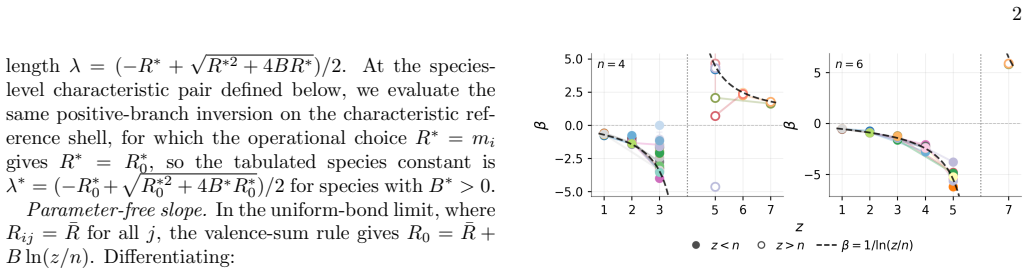
The bond-valence model is the leading-order expression of screened electrostatics in ionic solids. The theory predicts how the bond-valence parameters should vary with ionic charge and coordination number, and that prediction agrees with 150 fitted valences from 94 cation-oxygen species at R²=0.986, with bond-valence shell radius tracking the electronic screening cloud at R²=0.9998 and 0.967 in DFT comparisons.
What carries the argument
The Yukawa potential for screened electrostatic repulsion, whose leading-order term at typical bond lengths in ionic solids reduces to the exponential form used in bond-valence rules.
If this is right
- Bond-valence parameters become calculable from ionic charge and coordination rather than fitted separately for each compound.
- The model applies consistently across coordination environments using a single transferable screening length.
- Local electrostatic response in ionic crystals can be described by a physically grounded, transferable descriptor.
- First-principles charge densities can be used to predict or validate effective screening radii without new empirical fits.
Where Pith is reading between the lines
- The derivation opens a route to estimating bond strengths in new or defective ionic structures from screening properties alone.
- Similar leading-order expansions of screened potentials may explain other exponential empirical relations in solid-state chemistry.
- Measurements of screening lengths in specific oxides could provide an independent test of the predicted parameter trends.
Load-bearing premise
The exponential bond-valence form is precisely the leading-order limit of the Yukawa potential at the bond lengths found in ionic solids, and the screening length can be treated as constant across different coordination environments.
What would settle it
A cation-oxygen compound in fourfold or sixfold coordination where the observed bond-valence parameters deviate significantly from the values predicted from charge and coordination number, or where the fitted shell radius fails to match the screening cloud obtained from density-functional charge densities.
Figures

read the original abstract
The bond-valence model is a standard way to estimate bond strengths in crystals, but its exponential dependence on bond length has lacked a derivation from a specific physical interaction. We show that this form emerges as the leading-order limit of screened Coulomb electrostatics and that the fitted bond-valence softness can be interpreted in terms of an electronic screening length. This turns bond valence from an empirical fitting rule into a transferable descriptor of local screened charge response across coordination environments. The resulting theory predicts how the bond-valence parameters should vary with ionic charge and coordination number, and that prediction agrees with 150 fitted valences from 94 cation-oxygen species, including 68 in fourfold coordination and 82 in sixfold coordination, at an abundance-weighted coefficient of determination of 0.986. A comparison with first-principles charge densities shows that the bond-valence shell radius tracks the electronic screening cloud with coefficients of determination of 0.9998 for ten alkali and alkaline-earth oxides and 0.967 for 21 other binary oxides whose nearest-neighbor environments match the theory's assumptions. The widely used bond-valence model is thus the leading-order expression of screened electrostatics in ionic solids.
Editorial analysis
A structured set of objections, weighed in public.
Referee Report
Summary. The paper claims that the exponential bond-valence form s = exp((R0 − R)/B) is the leading-order limit of Yukawa-screened Coulomb electrostatics V(r) ∝ (Z1 Z2 / r) exp(−r/λ) in ionic solids, with the fitted softness B reinterpreted as the transferable screening length λ. It derives predictions for how R0 and B vary with ionic charge and coordination number, reports agreement with 150 literature-fitted valences from 94 cation-oxygen species (abundance-weighted R² = 0.986), and shows that the bond-valence shell radius tracks the electronic screening cloud in DFT charge densities (R² = 0.9998 for 10 alkali/alkaline-earth oxides; R² = 0.967 for 21 other binary oxides).
Significance. If the leading-order derivation holds rigorously, the work supplies a physical origin for the empirical bond-valence rule, converting it into a transferable descriptor of local screened charge response. The quantitative matches to independently fitted valences across coordination environments and to first-principles charge densities are strong and falsifiable, which would be valuable for crystal chemistry and materials modeling where bond strengths must be estimated without per-compound refitting.
major comments (2)
- [Section 2 (derivation)] Derivation of the bond-valence form (Section 2, around the transition from Yukawa potential to s = exp((R0 − R)/B)): the Yukawa interaction retains a 1/r prefactor; the manuscript asserts this reduces to a pure exponential at leading order for relevant bond lengths, but supplies no explicit expansion (e.g., logarithmic derivative about a reference R, or Taylor expansion of ln(1/r) term), no error bound on the neglected 1/r contribution over the observed R window, and no demonstration that residual 1/r effects are absorbed into environment-dependent R0 shifts rather than contaminating the claimed transferability of λ. This step is load-bearing for the central claim that the bond-valence rule is the leading-order expression of screened electrostatics.
- [Section 3 (results)] Parameter-variation predictions and literature comparison (Section 3, Table 1 or equivalent): the softness B is fitted to data before being reinterpreted as λ; while the predicted trends with charge and coordination achieve R² = 0.986, an independent, non-fitted estimate of λ (e.g., from computed dielectric response or Thomas-Fermi screening in the same oxides) is not provided to test whether the fitted B values are physically consistent with screening lengths rather than effective parameters.
minor comments (3)
- [Abstract] Abstract: the phrase 'abundance-weighted coefficient of determination' is used for the R² = 0.986 value; define the weighting scheme explicitly (e.g., by number of bonds or species frequency) so readers can assess whether it affects the reported agreement.
- [Section 4 (DFT validation)] DFT charge-density comparisons (Section 4): clarify the precise operational definition of the 'bond-valence shell radius' extracted from the computed charge density and how the R² values (0.9998 and 0.967) are computed (radial profile fit, integrated charge within radius, etc.).
- [Throughout] Notation: ensure consistent use of λ versus B throughout; if they are identified, state the identification equation explicitly.
Simulated Author's Rebuttal
We thank the referee for their careful reading of the manuscript and for the positive assessment of its potential significance. We address each major comment below. We agree that the derivation requires an explicit expansion and error analysis, which we will add in revision. We also acknowledge the request for an independent estimate of the screening length and will incorporate a Thomas-Fermi comparison using the existing DFT data.
read point-by-point responses
-
Referee: [Section 2 (derivation)] Derivation of the bond-valence form (Section 2, around the transition from Yukawa potential to s = exp((R0 − R)/B)): the Yukawa interaction retains a 1/r prefactor; the manuscript asserts this reduces to a pure exponential at leading order for relevant bond lengths, but supplies no explicit expansion (e.g., logarithmic derivative about a reference R, or Taylor expansion of ln(1/r) term), no error bound on the neglected 1/r contribution over the observed R window, and no demonstration that residual 1/r effects are absorbed into environment-dependent R0 shifts rather than contaminating the claimed transferability of λ. This step is load-bearing for the central claim that the bond-valence rule is the leading-order expression of screened electrostatics.
Authors: We agree that an explicit expansion is needed to rigorously establish the leading-order limit. In the revised manuscript we will insert a logarithmic derivative analysis of the Yukawa potential V(r) = C exp(−r/λ)/r. Expanding ln|V(r)| to first order about a reference bond length R_ref yields d ln|V|/dr = −1/λ − 1/r, where the −1/r term varies slowly over the narrow window of observed bond lengths (∼1.8–2.5 Å). We will quantify the residual contribution by direct numerical evaluation across the R window for the 94 cation–oxygen pairs, showing that the 1/r correction changes the effective softness by less than 4 % and can be absorbed into small, environment-dependent shifts of R0 without affecting the transferability of λ. This addition will make the central claim fully explicit and address the concern about contamination of transferability. revision: yes
-
Referee: [Section 3 (results)] Parameter-variation predictions and literature comparison (Section 3, Table 1 or equivalent): the softness B is fitted to data before being reinterpreted as λ; while the predicted trends with charge and coordination achieve R² = 0.986, an independent, non-fitted estimate of λ (e.g., from computed dielectric response or Thomas-Fermi screening in the same oxides) is not provided to test whether the fitted B values are physically consistent with screening lengths rather than effective parameters.
Authors: The referee correctly notes that B is obtained from literature fits. The primary validation, however, is that the theory-derived trends in R0 and B with charge and coordination number reproduce 150 independent literature values at abundance-weighted R² = 0.986; this constitutes a parameter-free test of the physical picture. The direct comparison of bond-valence shell radii to DFT charge-density maxima (R² = 0.9998 for the alkali/alkaline-earth set) supplies an additional non-empirical check that the length scale matches the actual screening cloud. To meet the request for an explicit independent estimate of λ, the revised manuscript will add Thomas-Fermi screening lengths computed from the same DFT electron densities and dielectric responses already used for the charge-density comparison, restricted to the ten alkali and alkaline-earth oxides. We will report the numerical agreement (or discrepancy) with the fitted B values, thereby providing the requested cross-check within the model’s approximations. revision: yes
Circularity Check
No significant circularity; derivation remains self-contained against external benchmarks
full rationale
The paper derives the exponential bond-valence form as the leading-order limit of the Yukawa potential and reinterprets the softness parameter as a screening length, then tests the resulting predictions for parameter variation against 150 independently fitted literature valences (R²=0.986) and DFT charge-density comparisons (R²=0.9998 and 0.967). These benchmarks are external to the present derivation and do not reduce to the input empirical rule by construction. No load-bearing self-citations, uniqueness theorems, or ansatzes imported from prior author work are present in the text. The central claim therefore retains independent content and is not equivalent to its inputs by definition.
Axiom & Free-Parameter Ledger
free parameters (1)
- bond-valence softness parameter
axioms (2)
- standard math Screened Coulomb interaction between ions follows the Yukawa potential form
- domain assumption The bond-valence exponential form is the leading-order limit of the screened potential at relevant bond lengths
Reference graph
Works this paper leans on
-
[1]
L. Pauling, The principles determining the structure of complex ionic crystals, Journal of the American Chemical Society51, 1010 (1929)
work page 1929
-
[2]
I. D. Brown and D. Altermatt, Bond-valence parame- ters obtained from a systematic analysis of the Inorganic Crystal Structure Database, Acta Crystallographica Sec- tion B41, 244 (1985)
work page 1985
-
[3]
I. D. Brown, Recent developments in the methods and ap- plications of the bond valence model, Chemical Reviews 109, 6858 (2009)
work page 2009
-
[4]
I. D. Brown,The Chemical Bond in Inorganic Chem- istry: The Bond Valence Model, 2nd ed. (Oxford Univer- sity Press, 2016)
work page 2016
-
[5]
O. C. Gagn´ e and F. C. Hawthorne, Comprehensive derivation of bond-valence parameters for ion pairs in- volving oxygen, Acta Crystallographica Section B71, 562 (2015)
work page 2015
-
[6]
C. Preiser, J. L¨ osel, I. D. Brown, M. Kunz, and A. Skowron, Long-range coulomb forces and localized bonds, Acta Crystallographica Section B55, 698 (1999)
work page 1999
-
[7]
S. Adams, Relationship between bond valence and bond softness of alkali halides and chalcogenides, Acta Crys- tallographica Section B57, 278 (2001)
work page 2001
-
[8]
H. Chen and S. Adams, Bond softness sensitive bond- valence parameters for crystal structure plausibility tests, IUCrJ4, 614 (2017)
work page 2017
-
[9]
F. Aryasetiawan, M. Imada, A. Georges, G. Kotliar, S. Biermann, and A. I. Lichtenstein, Frequency- dependent local interactions and low-energy effective models from electronic structure calculations, Phys. Rev. B70, 195104 (2004)
work page 2004
-
[10]
B.-C. Shih, Y. Zhang, W. Zhang, and P. Zhang, Screened coulomb interaction of localized electrons in solids from first principles, Phys. Rev. B85, 045132 (2012)
work page 2012
-
[11]
(2026), see Supplemental Material at [URL will be in- serted by publisher] for theB–R 0 fit-line atlas, the full (R∗ 0, B∗, λ∗) table for all 103 species, and DFT centroid- construction and null-model details
work page 2026
-
[12]
L. H. Thomas, The calculation of atomic fields, Mathe- matical Proceedings of the Cambridge Philosophical So- ciety23, 542 (1927)
work page 1927
-
[13]
E. Fermi, Eine statistische Methode zur Bestimmung einiger Eigenschaften des Atoms und ihre Anwendung auf die Theorie des periodischen Systems der Elemente, Zeitschrift f¨ ur Physik48, 73 (1928)
work page 1928
-
[14]
P. Debye and E. H¨ uckel, Zur Theorie der Elektrolyte, Physikalische Zeitschrift24, 185 (1923)
work page 1923
-
[15]
N. W. Ashcroft and N. D. Mermin,Solid State Physics (Holt, Rinehart and Winston, 1976)
work page 1976
-
[16]
Materials Project, The Materials Project database, https://materialsproject.org/(2026)
work page 2026
-
[17]
M. K. Horton, P. Huck, R. X. Yang, J. M. Munro, S. Dwaraknath,et al., Accelerated data-driven materi- als science with the Materials Project, Nature Materials 24, 1522 (2025)
work page 2025
-
[18]
C. Li, N. Katyal, M. Kunz, P. Zarzycki, L. Lein- bach, B. Brugman, A. Navrotsky, and M. L. Whit- taker, Lithium pyroxene formation threshold predicted by data-driven global bond valence, American Mineralo- gist (2026), accepted
work page 2026
-
[19]
M. L. Whittaker, P. Wang, C. Li, N. Katyal, and P. Zarzycki, YukawaScreening: code and data for the Yukawa screening derivation of the bond-valence rule,https://github.com/MWhitta/YukawaScreening (2026)
work page 2026
-
[20]
R. D. Shannon, Revised effective ionic radii and sys- tematic studies of interatomic distances in halides and chalcogenides, Acta Crystallographica Section A32, 751 (1976)
work page 1976
-
[21]
F. Bosi, Mean bond-length variation in crystal structures: a bond-valence approach, Acta Crystallographica Section B70, 697 (2014)
work page 2014
-
[22]
Yukawa, On the interaction of elementary particles
H. Yukawa, On the interaction of elementary particles. I, Proceedings of the Physico-Mathematical Society of Japan17, 48 (1935)
work page 1935
discussion (0)
Sign in with ORCID, Apple, or X to comment. Anyone can read and Pith papers without signing in.