Recognition: unknown
Quantum Lattice Boltzmann Solutions for Transport under 3D Spatially Varying Advection on Trapped Ion Hardware
Pith reviewed 2026-05-07 04:52 UTC · model grok-4.3
The pith
Quantum lattice Boltzmann methods on trapped-ion hardware simulate 3D transport with non-uniform advection.
A machine-rendered reading of the paper's core claim, the machinery that carries it, and where it could break.
Core claim
The dynamics is formulated in terms of mesoscopic particle distribution functions governed by a discrete Boltzmann transport equation, comprising local streaming and collision operations. In this work, the resulting macroscopic behavior corresponds to the advection-diffusion equation. Building upon recent progress in QLBM implementations, we advance towards more realistic problem settings that better reflect conventional CFD requirements. We address, for the first time, transport under the action of non uniform velocity fields on quantum hardware. We implement our demonstration using IonQ's trapped-ion systems including Forte generation systems and a 64-qubit Barium development system. We id
What carries the argument
The Quantum Lattice Boltzmann Method (QLBM), which encodes the discrete Boltzmann transport equation's local streaming and collision steps into quantum circuits, together with a position-dependent encoding of non-uniform velocity that produces the target advection-diffusion equation at the macroscopic level.
If this is right
- Quantum hardware can now simulate advection-diffusion transport with spatially varying velocities rather than only uniform flows.
- Density readout is established as a central bottleneck, addressable by methods such as MPS shadow tomography to support larger grids and complex distributions.
- A novel quantum circuit method for wall boundaries extends QLBM applicability to bounded domains.
- The demonstration indicates that QLBM can scale toward higher-complexity fluid transport problems on future quantum systems.
Where Pith is reading between the lines
- The same encoding strategy for non-uniform fields could be tested on other quantum hardware platforms to compare connectivity advantages for streaming steps.
- If readout improvements succeed, the approach may generalize to hybrid quantum-classical workflows for engineering design problems that require repeated transport solves.
- Extending the method to velocity fields that also vary in time would enable simulation of unsteady flows without changing the core circuit structure.
Load-bearing premise
The quantum circuit implementation of local streaming and collision steps, combined with the chosen encoding of non-uniform velocity, reproduces the target macroscopic advection-diffusion equation with acceptable error on current noisy trapped-ion hardware.
What would settle it
Running the quantum circuit on a test case with a known linear velocity gradient, extracting the evolved density field via measurement, and comparing it to the solution of the classical advection-diffusion equation for the same initial data and velocity field; large deviations beyond hardware noise levels would falsify the claim.
Figures




read the original abstract
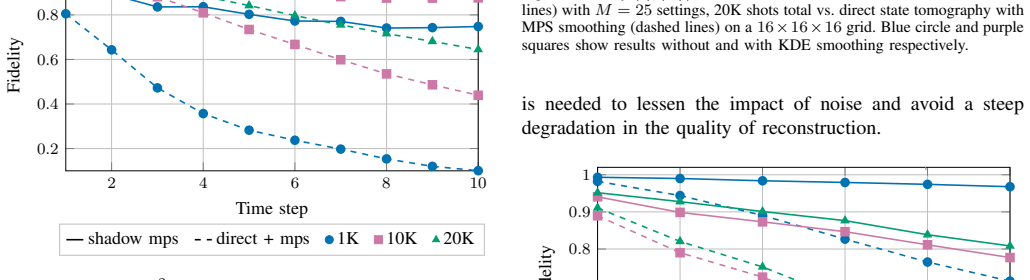
The Quantum Lattice Boltzmann Method (QLBM) has emerged as one of the most promising quantum computing approaches for the numerical simulation of problems in computational fluid dynamics (CFD). The dynamics is formulated in terms of mesoscopic particle distribution functions governed by a discrete Boltzmann transport equation, comprising local streaming and collision operations. In this work, the resulting macroscopic behavior corresponds to the advection-diffusion equation, which we adopt as a canonical model problem for transport phenomena. Building upon recent progress in QLBM implementations, we advance towards more realistic problem settings that better reflect conventional CFD requirements. We address, for the first time, transport under the action of non uniform velocity fields on quantum hardware. We implement our demonstration using IonQ's trapped-ion systems including Forte generation systems and a 64-qubit Barium development system similar to the forthcoming IonQ Tempo line. We identify the density readout and subsequent reloading of the fluid density as a potential bottleneck of the current algorithm and discuss several approaches to mitigate this bottleneck. We identify the use of MPS shadow tomography as a promising method to efficiently scale the readout to large system with complex density distributions. Lastly, we introduce and simulate a novel method to implement wall boundaries for advection-diffusion in QLBM, and discuss the prospects of scaling to higher-complexity problems.
Editorial analysis
A structured set of objections, weighed in public.
Referee Report
Summary. The paper claims to deliver the first experimental demonstration on trapped-ion quantum hardware of the Quantum Lattice Boltzmann Method (QLBM) for the advection-diffusion equation under spatially varying (non-uniform) 3D velocity fields. The approach encodes the velocity into local collision and streaming steps, is executed on IonQ Forte and a 64-qubit barium development system, identifies the density readout/reload step as a practical bottleneck, discusses mitigation via MPS shadow tomography, and introduces a novel wall-boundary implementation for QLBM.
Significance. If the hardware results are shown to recover the target macroscopic advection-diffusion equation with controlled error, the work would constitute a meaningful advance in quantum CFD by moving QLBM beyond uniform advection to more realistic non-uniform transport on actual NISQ devices. The explicit treatment of the readout bottleneck and the proposal of scalable tomography methods provide concrete engineering guidance for larger simulations. The boundary-condition innovation further broadens applicability. These elements, combined with real-hardware execution up to 64 qubits, position the manuscript as a useful reference for the community even if further validation is required.
major comments (3)
- [§4] §4 (Hardware Implementation and Results): The central claim that the chosen encoding of spatially varying velocity into the QLBM collision/streaming circuit reproduces the advection-diffusion PDE with acceptable error on noisy trapped-ion hardware is load-bearing, yet the manuscript supplies only qualitative statements and limited quantitative metrics (e.g., no L2 or L∞ error norms against classical reference solutions, no explicit mass-conservation residuals, and no Chapman-Enskog moment verification for the non-uniform cases). Without these data for the demonstrated system sizes, it is impossible to confirm that coherent errors, readout bias, or lattice artifacts remain below the threshold needed to validate the macroscopic equation.
- [§3.2] §3.2 (Velocity Encoding): The description of how the position-dependent velocity field v(x) is mapped into state-dependent gate parameters for the local collision operator does not include an explicit derivation or numerical test showing that the discrete-velocity moments recover the correct advection term after ensemble averaging. If the encoding inadvertently introduces effective non-local interactions or violates the required moment relations, the macroscopic limit would deviate from the target PDE; this must be demonstrated before the “first demonstration” claim can be accepted.
- [§5] §5 (Readout Mitigation): While the density readout/reload is correctly flagged as the dominant bottleneck, the discussion of MPS shadow tomography remains at the level of a promising direction without concrete circuit-depth estimates, shot-count scaling, or error-propagation analysis for the 3D non-uniform advection instances actually run on the 64-qubit device. This leaves open whether the proposed mitigation is sufficient to reach the system sizes advertised.
minor comments (3)
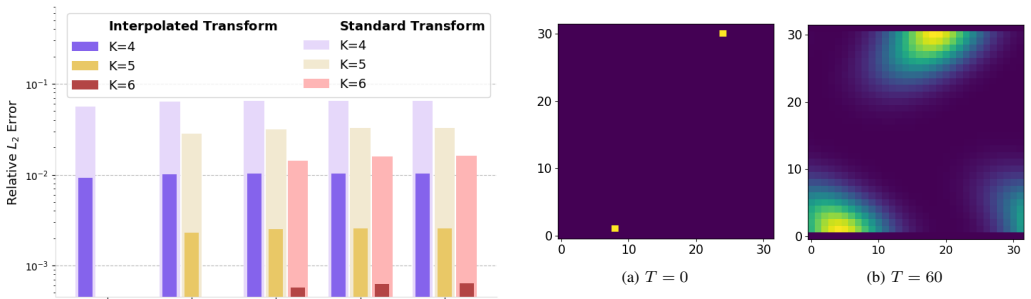
- [Figures 3–6] Several figure captions (e.g., those showing density evolution under non-uniform flow) lack explicit labels for the velocity-field parameters and lattice resolution used; this reduces reproducibility.
- [§2] The manuscript cites earlier QLBM works on uniform advection but does not compare circuit depths or gate counts against those baselines for the non-uniform extension; a short table would clarify the overhead introduced by the velocity encoding.
- [§3.1] Notation for the discrete-velocity set and the collision matrix in the presence of spatially varying v(x) is introduced without a compact summary table; readers must hunt through the text to reconstruct the full operator.
Simulated Author's Rebuttal
We thank the referee for their insightful and constructive comments. We appreciate the recognition of our work as the first hardware demonstration of QLBM for non-uniform 3D advection-diffusion on trapped-ion systems. We address each major comment below and will revise the manuscript to strengthen the quantitative validation, derivations, and analyses as requested.
read point-by-point responses
-
Referee: [§4] §4 (Hardware Implementation and Results): The central claim that the chosen encoding of spatially varying velocity into the QLBM collision/streaming circuit reproduces the advection-diffusion PDE with acceptable error on noisy trapped-ion hardware is load-bearing, yet the manuscript supplies only qualitative statements and limited quantitative metrics (e.g., no L2 or L∞ error norms against classical reference solutions, no explicit mass-conservation residuals, and no Chapman-Enskog moment verification for the non-uniform cases). Without these data for the demonstrated system sizes, it is impossible to confirm that coherent errors, readout bias, or lattice artifacts remain below the threshold needed to validate the macroscopic equation.
Authors: We agree that quantitative metrics are essential to rigorously validate the macroscopic PDE recovery on hardware. In the revised manuscript we will add L2 and L∞ error norms comparing quantum results to classical reference solutions for all demonstrated system sizes. We will also report explicit mass-conservation residuals and perform Chapman-Enskog moment verification for the non-uniform velocity cases. These additions will quantify error control and address concerns about coherent errors, readout bias, and lattice artifacts. revision: yes
-
Referee: [§3.2] §3.2 (Velocity Encoding): The description of how the position-dependent velocity field v(x) is mapped into state-dependent gate parameters for the local collision operator does not include an explicit derivation or numerical test showing that the discrete-velocity moments recover the correct advection term after ensemble averaging. If the encoding inadvertently introduces effective non-local interactions or violates the required moment relations, the macroscopic limit would deviate from the target PDE; this must be demonstrated before the “first demonstration” claim can be accepted.
Authors: We acknowledge the need for an explicit derivation and verification. In the revision we will expand §3.2 with a detailed derivation showing how the position-dependent velocity v(x) is encoded into state-dependent gate parameters while preserving the required discrete-velocity moments for the advection term. We will also include numerical tests on small lattices demonstrating moment recovery after ensemble averaging and confirming the absence of unintended non-local interactions or moment violations. revision: yes
-
Referee: [§5] §5 (Readout Mitigation): While the density readout/reload is correctly flagged as the dominant bottleneck, the discussion of MPS shadow tomography remains at the level of a promising direction without concrete circuit-depth estimates, shot-count scaling, or error-propagation analysis for the 3D non-uniform advection instances actually run on the 64-qubit device. This leaves open whether the proposed mitigation is sufficient to reach the system sizes advertised.
Authors: We agree that concrete scaling estimates are required. In the revised §5 we will provide circuit-depth estimates for the MPS shadow tomography, shot-count scaling with system size, and error-propagation analysis specifically for the 3D non-uniform advection instances executed on the 64-qubit device. These additions will clarify the feasibility of scaling to the advertised system sizes. revision: yes
Circularity Check
No significant circularity; central result is hardware demonstration of standard QLBM
full rationale
The paper presents an experimental implementation of the Quantum Lattice Boltzmann Method on trapped-ion hardware to simulate advection-diffusion transport with spatially varying velocity fields. The claimed recovery of the macroscopic advection-diffusion PDE follows from the standard discrete Boltzmann equation analysis (local streaming and collision steps followed by Chapman-Enskog expansion), which is a pre-existing mathematical result independent of the quantum circuit encoding or hardware execution. The non-uniform velocity is encoded as a design choice in the circuit parameters; its correctness is validated empirically by comparing hardware runs to classical reference solutions rather than being fitted or defined to match by construction. No load-bearing step reduces to a self-citation chain, ansatz smuggled via prior work, or a prediction that is statistically forced from fitted inputs. Self-citations to earlier QLBM literature (if present) support the baseline method but do not justify uniqueness or forbid alternatives. The readout/reload bottleneck is identified as an engineering limitation and discussed with mitigation proposals, but this does not create circularity in the derivation. The overall claim is therefore an empirical demonstration whose validity rests on external hardware data and classical benchmarks, not on internal redefinition of inputs as outputs.
Axiom & Free-Parameter Ledger
Reference graph
Works this paper leans on
-
[1]
J LeVeque.Numerical Methods for Conservation Laws, volume 54
Randall R.J. J LeVeque.Numerical Methods for Conservation Laws, volume 54. 2002
2002
-
[2]
Ren ´e Steijl and George N. Barakos. Parallel evaluation of quantum algorithms for computational fluid dynamics.Computers & Fluids, 173:22–28, 2018
2018
-
[3]
A quantum algorithm to solve nonlinear differential equations.arXiv preprint arXiv:0812.4423, 2008
Sarah K Leyton and Tobias J Osborne. A quantum algorithm to solve nonlinear differential equations.arXiv preprint arXiv:0812.4423, 2008
-
[4]
Quantum algorithm for nonhomogeneous linear partial differential equations.Physical Review A, 100(3):032306, 2019
Juan Miguel Arrazola, Timjan Kalajdzievski, Christian Weedbrook, and Seth Lloyd. Quantum algorithm for nonhomogeneous linear partial differential equations.Physical Review A, 100(3):032306, 2019
2019
-
[5]
Variational quantum algorithms for nonlinear problems.Physical Review A, 101(1):010301, 2020
Michael Lubasch, Jaewoo Joo, Pierre Moinier, Martin Kiffner, and Dieter Jaksch. Variational quantum algorithms for nonlinear problems.Physical Review A, 101(1):010301, 2020
2020
-
[6]
Quantum variational solving of nonlinear and multidimensional partial differential equations.Physical Review A, 109(6):062616, 2024
Abhijat Sarma, Thomas W Watts, Mudassir Moosa, Yilian Liu, and Peter L McMahon. Quantum variational solving of nonlinear and multidimensional partial differential equations.Physical Review A, 109(6):062616, 2024
2024
-
[7]
Quantum computing of fluid dynamics using the hydrodynamic schr ¨odinger equation.Physical Review Re- search, 5(3):033182, 2023
Zhaoyuan Meng and Yue Yang. Quantum computing of fluid dynamics using the hydrodynamic schr ¨odinger equation.Physical Review Re- search, 5(3):033182, 2023
2023
-
[8]
A. A. Mohamad.Lattice Boltzmann Method: Fundamentals and Engi- neering Applications with Computer Codes. Springer London, London, 2019
2019
-
[9]
Budinski Ljubomir. Quantum algorithm for the navier–stokes equa- tions by using the streamfunction-vorticity formulation and the lattice boltzmann method.International Journal of Quantum Information, 20(02):2150039, 2022
2022
-
[10]
Algorithmic advances towards a realizable quantum lattice boltzmann method, 2025
Apurva Tiwari, Jason Iaconis, Jezer Jojo, Sayonee Ray, Martin Roetteler, Chris Hill, and Jay Pathak. Algorithmic advances towards a realizable quantum lattice boltzmann method, 2025
2025
-
[11]
Quantum algorithm for the advection–diffusion equation simulated with the lattice Boltzmann method.Quantum Information Processing, 20(2):57, February 2021
Ljubomir Budinski. Quantum algorithm for the advection–diffusion equation simulated with the lattice Boltzmann method.Quantum Information Processing, 20(2):57, February 2021
2021
-
[12]
Potential quantum advantage for simulation of fluid dynamics.Physical Review Research, 7(1):013036, 2025
Xiangyu Li, Xiaolong Yin, Nathan Wiebe, Jaehun Chun, Gregory K Schenter, Margaret S Cheung, and Johannes M ¨ulmenst¨adt. Potential quantum advantage for simulation of fluid dynamics.Physical Review Research, 7(1):013036, 2025
2025
-
[13]
Quantum lattice boltzmann method for simulating nonlinear fluid dynamics.npj Quantum Information, 2025
Boyuan Wang, Zhaoyuan Meng, Yaomin Zhao, and Yue Yang. Quantum lattice boltzmann method for simulating nonlinear fluid dynamics.npj Quantum Information, 2025
2025
-
[14]
Dinesh Kumar and Steven H
E. Dinesh Kumar and Steven H. Frankel. Decomposition of nonlinear collision operator in quantum Lattice Boltzmann algorithm.Europhysics Letters, 148(3), November 2024
2024
-
[15]
Analysis of carleman linearization of lattice boltzmann.Fluids, 7(1):24, 2022
Wael Itani and Sauro Succi. Analysis of carleman linearization of lattice boltzmann.Fluids, 7(1):24, 2022
2022
-
[16]
Three carleman routes to the quantum simulation of classical fluids.Physics of Fluids, 36(5), 2024
Claudio Sanavio, Riccardo Scatamacchia, Carlo De Falco, and Sauro Succi. Three carleman routes to the quantum simulation of classical fluids.Physics of Fluids, 36(5), 2024
2024
-
[17]
Explicit quantum circuit for simulating the advection-diffusion-reaction dynamics.IEEE Transactions on Quantum Engineering, 2025
Claudio Sanavio, Enea Mauri, and Sauro Succi. Explicit quantum circuit for simulating the advection-diffusion-reaction dynamics.IEEE Transactions on Quantum Engineering, 2025
2025
-
[18]
P. L. Bhatnagar, E. P. Gross, and M. Krook. A model for collision processes in gases. i. small amplitude processes in charged and neutral one-component systems.Phys. Rev., 94:511–525, May 1954
1954
-
[19]
Tensor network based efficient quantum data loading of images, 2023
Jason Iaconis and Sonika Johri. Tensor network based efficient quantum data loading of images, 2023
2023
-
[20]
Quantum state preparation of normal distributions using matrix product states.npj Quantum Information, 10(1):15, 2024
Jason Iaconis, Sonika Johri, and Elton Yechao Zhu. Quantum state preparation of normal distributions using matrix product states.npj Quantum Information, 10(1):15, 2024
2024
-
[21]
Efficient quantum circuits for accurate state preparation of smooth, differentiable functions
Adam Holmes and Anne Y Matsuura. Efficient quantum circuits for accurate state preparation of smooth, differentiable functions. In2020 IEEE international conference on quantum computing and engineering (QCE), pages 169–179. IEEE, 2020
2020
-
[22]
Decomposition of matrix product states into shallow quantum circuits.Quantum Science and Technology, 9(1):015012, 2024
Manuel S Rudolph, Jing Chen, Jacob Miller, Atithi Acharya, and Alejan- dro Perdomo-Ortiz. Decomposition of matrix product states into shallow quantum circuits.Quantum Science and Technology, 9(1):015012, 2024
2024
-
[23]
Romero, Martin Roetteler, Enrique Solano, Marco Pistoia, and Narendra N
Alejandro Gomez Cadavid, Ananth Kaushik, Pranav Chandarana, Miguel Angel Lopez-Ruiz, Gaurav Dev, Willie Aboumrad, Qi Zhang, Claudio Girotto, Sebasti´an V . Romero, Martin Roetteler, Enrique Solano, Marco Pistoia, and Narendra N. Hegade. Large-scale portfolio optimiza- tion on a trapped-ion quantum computer, 2026
2026
-
[24]
Mcleod, M
Sangtaek Kim, Robert R. Mcleod, M. Saffman, and Kelvin H. Wagner. Doppler-free, multiwavelength acousto-optic deflector for two-photon addressing arrays of rb atoms in a quantum information processor.Appl. Opt., 47(11):1816–1831, Apr 2008
2008
-
[25]
Pogorelov, T
I. Pogorelov, T. Feldker, Ch. D. Marciniak, L. Postler, G. Jacob, O. Krieglsteiner, V . Podlesnic, M. Meth, V . Negnevitsky, M. Stadler, B. H ¨ofer, C. W ¨achter, K. Lakhmanskiy, R. Blatt, P. Schindler, and T. Monz. Compact ion-trap quantum computing demonstrator.PRX Quantum, 2:020343, Jun 2021
2021
-
[26]
Benchmarking a trapped-ion quantum computer with 30 qubits.Quantum, 8:1516, November 2024
Jwo-Sy Chen, Erik Nielsen, Matthew Ebert, V olkan Inlek, Kenneth Wright, Vandiver Chaplin, Andrii Maksymov, Eduardo P ´aez, Amrit Poudel, Peter Maunz, and John Gamble. Benchmarking a trapped-ion quantum computer with 30 qubits.Quantum, 8:1516, November 2024
2024
-
[27]
Entanglement barrier and its symmetry resolution: Theory and experimental observation.PRX Quantum, 4(1):010318, 2023
Aniket Rath, Vittorio Vitale, Sara Murciano, Matteo V otto, J ´erˆome Dubail, Richard Kueng, Cyril Branciard, Pasquale Calabrese, and Benoˆıt Vermersch. Entanglement barrier and its symmetry resolution: Theory and experimental observation.PRX Quantum, 4(1):010318, 2023
2023
-
[28]
Remarks on some nonparametric estimates of a density function.Ann
Murray Rosenblatt. Remarks on some nonparametric estimates of a density function.Ann. Math. Statist., 27(3):832–837, 1956
1956
-
[29]
On estimation of a probability density function and mode.The Annals of Mathematical Statistics, 33(3):1065 – 1076, 1962
Emanuel Parzen. On estimation of a probability density function and mode.The Annals of Mathematical Statistics, 33(3):1065 – 1076, 1962
1962
-
[30]
Learning the tensor network model of a quantum state using a few single-qubit measurements.Physical Review A, 109(5):052616, 2024
Sergei Kuzmin, Varvara Mikhailova, Ivan Dyakonov, and Stanislav Straupe. Learning the tensor network model of a quantum state using a few single-qubit measurements.Physical Review A, 109(5):052616, 2024
2024
-
[31]
B. W. Silverman.Density estimation for statistics and data analysis. Chapman & Hall/CRC, 1998
1998
-
[32]
Predicting many properties of a quantum system from very few measurements.Nature Physics, 16(10):1050–1057, 2020
Hsin-Yuan Huang, Richard Kueng, and John Preskill. Predicting many properties of a quantum system from very few measurements.Nature Physics, 16(10):1050–1057, 2020
2020
-
[33]
Sergei Kuzmin and Varvara Mikhailova. Qtensor
-
[34]
Nearest centroid classification on a trapped ion quantum computer.npj Quantum Information, 7(1):122, 2021
Sonika Johri, Shantanu Debnath, Avinash Mocherla, Alexandros Singk, Anupam Prakash, Jungsang Kim, and Iordanis Kerenidis. Nearest centroid classification on a trapped ion quantum computer.npj Quantum Information, 7(1):122, 2021
2021
-
[35]
Quantum pixel representations and compression for n-dimensional images.Scientific reports, 12(1):7712, 2022
Mercy G Amankwah, Daan Camps, E Wes Bethel, Roel Van Beeumen, and Talita Perciano. Quantum pixel representations and compression for n-dimensional images.Scientific reports, 12(1):7712, 2022
2022
discussion (0)
Sign in with ORCID, Apple, or X to comment. Anyone can read and Pith papers without signing in.