Recognition: unknown
The DAMSA Experiment
Pith reviewed 2026-05-07 06:33 UTC · model grok-4.3
The pith
DAMSA proposes an ultra-short baseline beam-dump experiment to catch fast-decaying dark sector particles missed by longer setups.
A machine-rendered reading of the paper's core claim, the machinery that carries it, and where it could break.
Core claim
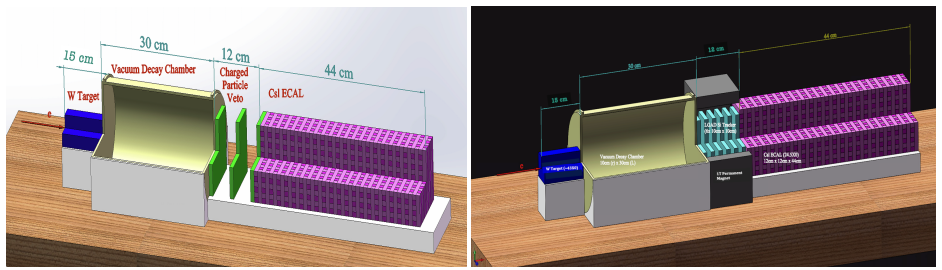
DAMSA employs an ultra-short baseline in a beam-dump production scheme combined with a compact detector optimized for rare decays. This configuration overcomes the beam-dump ceiling that limits sensitivity to fast decaying particles in longer-baseline experiments and enables searches for MeV-to-sub-GeV dark-sector messengers with feeble couplings produced in abundance at the target. The design also addresses intense neutron-induced backgrounds inherent to high-power proton beams. The DAMSA Path-Finder proof-of-concept at the SLAC LESA facility with 8 GeV electron beams will benchmark the strategy by searching for axion-like particles decaying to two photons and thereby establish feasibility.
What carries the argument
Ultra-short baseline beam-dump setup with a compact detector optimized for rare decays, which captures signals from rapidly decaying particles close to their production point while mitigating neutron backgrounds.
If this is right
- Reaches dark-sector messengers in the MeV-to-sub-GeV range with feeble couplings that are produced abundantly at beam dumps.
- Overcomes the sensitivity limit for fast-decaying particles that constrains conventional longer-baseline beam-dump experiments.
- Validates the experimental strategy through the DAMSA Path-Finder focusing on axion-like particle decays to two photons.
- Enables a broad program to explore short-lived new physics and precision Standard Model processes in a previously inaccessible regime.
Where Pith is reading between the lines
- The same short-baseline technique could be adapted at other high-intensity proton facilities to search for similar short-lived particles.
- By accessing rare processes, the approach may provide new handles on open questions in neutrino physics that motivated the experiment.
- Demonstrated background mitigation in a compact detector could serve as a template for future searches for short-lived particles at high-intensity beams.
Load-bearing premise
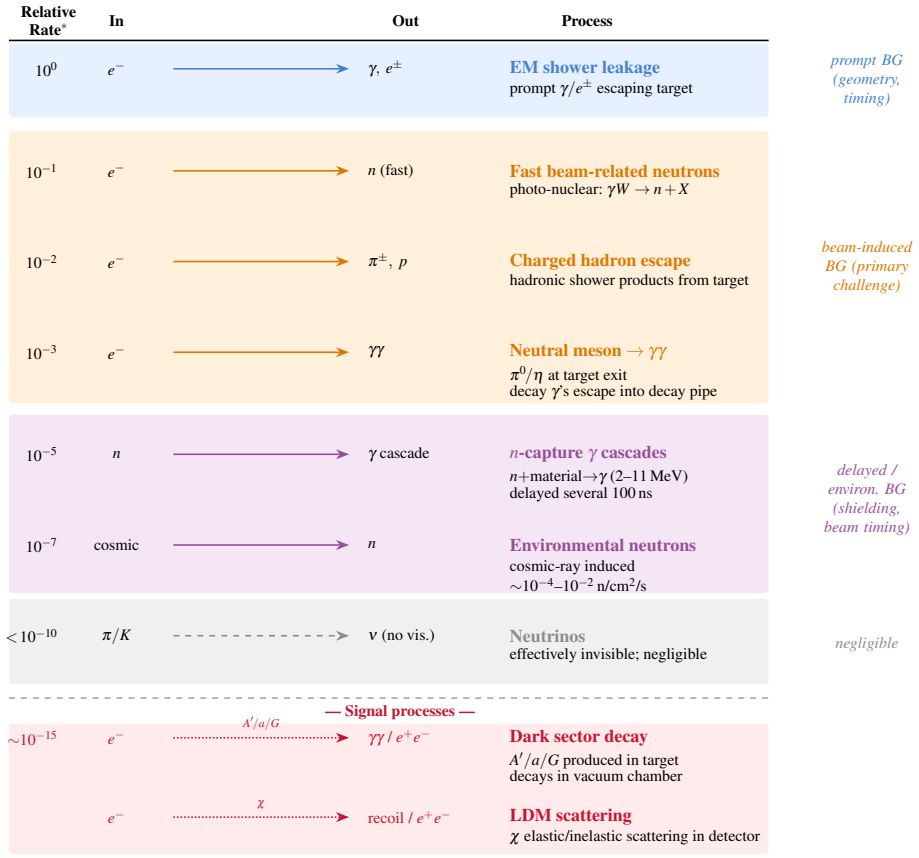
Intense neutron-induced backgrounds from high-power proton beams can be mitigated by the compact detector design while still preserving sensitivity to rare decay signals.
What would settle it
Measurements from the DAMSA Path-Finder experiment at SLAC showing neutron background rates too high to detect the expected two-photon decays from axion-like particles at the design sensitivity.
Figures









read the original abstract
DAMSA (DArk Messenger Searches at an Accelerator) is a novel short-baseline accelerator/beam dump experiment aimed at probing short-lived physics processes, including searches for evidence of a dark sector of particle physics and well-motivated rare Standard Model signals. Motivated by open questions in neutrino physics and the absence of conclusive evidence for conventional weakly interacting massive particles, DAMSA targets MeV-to-sub-GeV dark-sector messengers with feeble couplings that can be produced in abundance at a beam dump/target. By employing an ultra-short baseline, DAMSA is uniquely positioned to overcome the beam-dump "ceiling" that limits sensitivity to fast decaying particles in longer-baseline experiments. The conceptual design emphasizes a beam-dump production scheme combined with a compact detector optimized for rare decays while mitigating intense neutron-induced backgrounds, inherent to high-power proton beams. To validate the experimental strategy and detector technologies, the DAMSA Path-Finder (DPF) proof-of-concept experiment is also proposed, focusing on axion-like particles decaying to two photons, as the benchmark physics case and operating with 8 GeV electron beams at SLAC Linac-to-ESA (LESA) facility. Successful realization of DPF will establish the feasibility of the DAMSA approach, enabling a broad and powerful program to explore short-lived new physics and precision Standard Model processes in a previously inaccessible regime. This paper outlines the technical details of DAMSA's physics goals, key experimental challenges, and how to overcome them.
Editorial analysis
A structured set of objections, weighed in public.
Referee Report
Summary. The manuscript proposes DAMSA, a novel ultra-short-baseline beam-dump experiment at a high-power proton accelerator to search for short-lived MeV-to-sub-GeV dark-sector messengers and rare Standard Model processes. It claims that the short baseline overcomes the sensitivity ceiling for fast-decaying particles that limits longer-baseline experiments, with a compact detector optimized to mitigate intense neutron-induced backgrounds while preserving signal sensitivity. A DAMSA Path-Finder (DPF) proof-of-concept experiment using 8 GeV electron beams at SLAC LESA is proposed to validate the approach via axion-like particle decays to two photons.
Significance. If realized, DAMSA could access previously inaccessible parameter space for weakly coupled dark-sector states produced at beam dumps, complementing existing neutrino and dark-matter searches. The proposal clearly identifies the beam-dump ceiling problem and outlines a conceptual path forward. As a design study without quantitative background simulations, data, or detailed performance metrics, its significance rests on whether the neutron-mitigation strategy can be demonstrated.
major comments (1)
- [DAMSA Path-Finder (DPF) proposal] In the section describing the DAMSA Path-Finder (DPF): The DPF is specified to run with 8 GeV electron beams at SLAC LESA. Electron beams produce neutron yields orders of magnitude lower than those from multi-GeV proton beams on a dump. Consequently, successful DPF operation (e.g., observation of ALP → γγ decays) would not validate the neutron-background rejection performance required for the proton-based DAMSA configuration. No quantitative neutron-flux estimates, rejection factors, or simulations for the high-power proton case are provided to bridge this gap. This assumption is load-bearing for the central claim that a compact detector can mitigate intense neutron backgrounds while retaining sensitivity to rare decays.
minor comments (2)
- [Abstract] The abstract refers to 'the conceptual design section,' but the manuscript lacks numbered sections or a clear outline; adding explicit section headings and cross-references would improve readability.
- [Introduction or conceptual design] Consider adding references to existing proton beam-dump experiments (e.g., those at Fermilab or CERN) that quantify neutron backgrounds, to provide context for the claimed mitigation strategy.
Simulated Author's Rebuttal
We thank the referee for their careful and constructive review of our manuscript on the DAMSA experiment. We address the major comment point by point below, with a commitment to strengthen the presentation of the DAMSA Path-Finder validation strategy.
read point-by-point responses
-
Referee: In the section describing the DAMSA Path-Finder (DPF): The DPF is specified to run with 8 GeV electron beams at SLAC LESA. Electron beams produce neutron yields orders of magnitude lower than those from multi-GeV proton beams on a dump. Consequently, successful DPF operation (e.g., observation of ALP → γγ decays) would not validate the neutron-background rejection performance required for the proton-based DAMSA configuration. No quantitative neutron-flux estimates, rejection factors, or simulations for the high-power proton case are provided to bridge this gap. This assumption is load-bearing for the central claim that a compact detector can mitigate intense neutron backgrounds while retaining sensitivity to rare decays.
Authors: We agree that the DPF with 8 GeV electrons cannot directly replicate the neutron flux environment of the high-power proton DAMSA configuration. The DPF is designed as a proof-of-concept to demonstrate the compact detector's performance for rare ALP → γγ decays, including signal reconstruction, timing resolution, and general background suppression techniques under beam conditions at SLAC LESA. We acknowledge that this leaves a gap for validating neutron-specific mitigation in the proton case. In the revised manuscript we will add a new subsection with order-of-magnitude neutron flux estimates for the proton DAMSA, scaled from published simulations of comparable high-power proton beam dumps (e.g., referencing MiniBooNE and LSND data), together with projected rejection factors from the proposed shielding, veto layers, and timing cuts. We will also revise the text to clarify that successful DPF operation establishes key detector technologies and the overall short-baseline approach, while proton-specific neutron studies will require dedicated simulations and, ultimately, a proton-beam test. These changes will make the validation pathway more transparent without overstating the DPF's scope. revision: yes
Circularity Check
No circularity: conceptual design proposal with no derivations or fitted predictions
full rationale
The paper is a conceptual design proposal for the DAMSA experiment and its DPF pathfinder. It contains no equations, derivations, parameter fits, or quantitative predictions that could reduce to inputs by construction. The text outlines physics motivations, experimental challenges (including neutron backgrounds), and a proposed validation strategy using electron beams at SLAC, without any self-referential logic, self-citation load-bearing claims, or renaming of known results as new derivations. All load-bearing statements are forward-looking design assertions rather than tautological reductions. The skeptic concern about electron vs. proton neutron yields is a question of empirical support, not circularity in the paper's internal chain.
Axiom & Free-Parameter Ledger
axioms (2)
- standard math Standard Model particles and interactions are as currently understood at accelerator energies for calculating backgrounds and signals.
- domain assumption Dark sector particles with feeble couplings to SM particles can be produced in abundance at beam dumps and decay to detectable final states.
Reference graph
Works this paper leans on
-
[1]
DUNE Collaboration, B. Abi et al., Deep Underground Neutrino Experiment (DUNE), Far Detector technical design report, V olume I: Introduction to DUNE,JINST15(2020) T08008 [2002.02967]
-
[2]
Particle Dark Matter: Evidence, Candidates and Constraints
G. Bertone, D. Hooper and J. Silk, Particle dark matter: Evidence, candidates and constraints, Phys. Rept.405(2005) 279 [hep-ph/0404175]
work page Pith review arXiv 2005
-
[3]
Holdom, Two U(1)’s and Epsilon Charge Shifts,Phys
B. Holdom, Two U(1)’s and Epsilon Charge Shifts,Phys. Lett. B166(1986) 196
1986
-
[4]
B. Patt and F. Wilczek, Higgs-field portal into hidden sectors,hep-ph/0605188
-
[5]
M. Pospelov, A. Ritz and M. B. V oloshin,Secluded WIMP Dark Matter, Phys. Lett. B662(2008) 53 [0711.4866]
work page Pith review arXiv 2008
-
[6]
M. Pospelov and A. Ritz, Astrophysical Signatures of Secluded Dark Matter, Phys. Lett. B671 (2009) 391 [0810.1502]
-
[7]
Pospelov,Secluded U(1) below the weak scale,Phys
M. Pospelov, Secluded U(1) below the weak scale, Phys. Rev. D80(2009) 095002 [0811.1030]
-
[8]
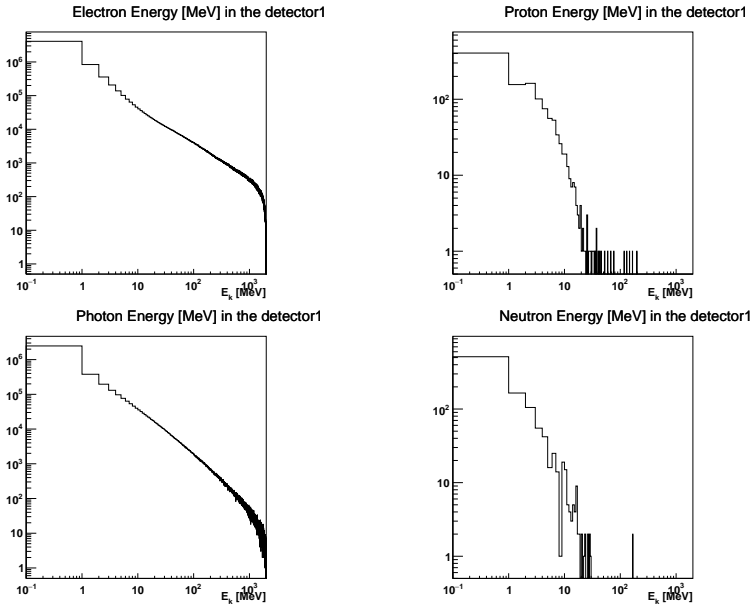
A. Falkowski, J. Juknevich and J. Shelton, Dark Matter Through the Neutrino Portal,0908.1790. 29 1 −101 10 2 103 10 [MeV]kE1 10 2 103 104 105 106 10Electron Energy [MeV] in the detector1 Electron Energy [MeV] in the detector1 1 −101 10 2 103 10 [MeV]kE1 10 2 10Proton Energy [MeV] in the detector1 Proton Energy [MeV] in the detector1 1 −101 10 2 103 10 [Me...
- [9]
-
[10]
Batell, et al., Dark Sector Studies with Neutrino Beams, in: Snowmass 2021, 2022.arXiv:2207.06898
B. Batell et al., Dark Sector Studies with Neutrino Beams, in Snowmass 2021, 7, 2022,2207.06898
- [11]
- [12]
- [13]
-
[14]
LSND Collaboration, A. Aguilar et al., Evidence for neutrino oscillations from the observation of ¯νe appearance in a ¯νµ beam, Phys. Rev. D 64(2001) 112007 [hep-ex/0104049]
- [15]
-
[16]
D. Kim, J. Yu, J.-C. Park and H. Kim, The Beam-Dump Ceiling and Its Experimental Implication: The Case of a Portable Experiment, 2401.09529
work page internal anchor Pith review arXiv
- [17]
-
[18]
Albanese et al., BDF/SHiP at the ECN3 high-intensity beam facility, tech
SHIP Collaboration, R. Albanese et al., BDF/SHiP at the ECN3 high-intensity beam facility, tech. rep., CERN, Geneva, 2023
2023
-
[19]
Bhattarai et al., DAMSA Experiment Conceptual Design White Paper, 2601.15255
DAMSA Collaboration, P. Bhattarai et al., DAMSA Experiment Conceptual Design White Paper, 2601.15255
-
[20]
R. D. Peccei and H. R. Quinn, CP Conservation in the Presence of Instantons, Phys. Rev. Lett.38 (1977) 1440
1977
-
[21]
Wilczek, Problem of StrongPandTInvariance in the Presence of Instantons, Phys
F. Wilczek, Problem of StrongPandTInvariance in the Presence of Instantons, Phys. Rev. Lett.40 (1978) 279
1978
-
[22]
Weinberg, A New Light Boson?, Phys
S. Weinberg, A New Light Boson?, Phys. Rev. Lett.40(1978) 223
1978
-
[23]
Dine and W
M. Dine and W. Fischler, The Not So Harmless Axion, Phys. Lett. B120(1983) 137
1983
-
[24]
A. R. Zhitnitsky, On Possible Suppression of the Axion Hadron Interactions. (In Russian), Sov. J. Nucl. Phys.31(1980) 260
1980
-
[25]
J. Sun and X.-G. He, DFSZ axion couplings revisited, Phys. Lett. B811(2020) 135881 [2006.16931]
-
[26]
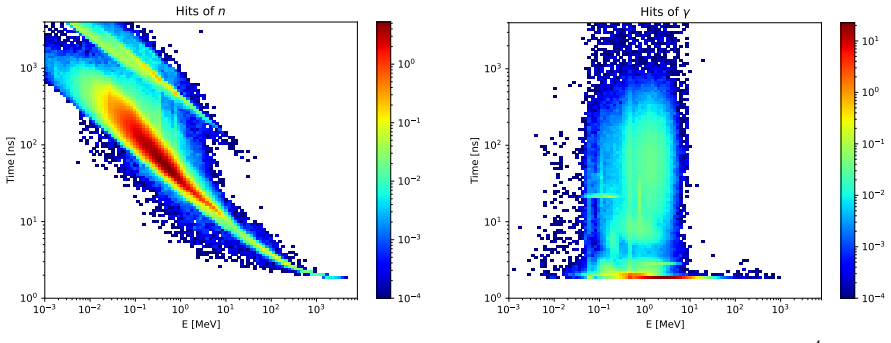
L. Di Luzio, M. Giannotti, E. Nardi and L. Visinelli, The landscape of QCD axion models, Phys. Rept.870(2020) 1 [2003.01100]. 31 10 3 10 2 10 1 100 101 102 103 E [MeV] 100 101 102 103 Time [ns] Hits of n 10 4 10 3 10 2 10 1 100 10 3 10 2 10 1 100 101 102 103 E [MeV] 100 101 102 103 Time [ns] Hits of 10 4 10 3 10 2 10 1 100 101 Figure 25: Energy–time distr...
- [27]
-
[28]
S. Ganguly, B. Mukhopadhyaya and S. Roy, Can leptophilic-ALP be a solution to the muon (g−2) anomaly?, Int. J. Mod. Phys. A40(2025) 2550054 [2204.07920]
- [29]
-
[30]
A. Eberhart, M. Fedele, F. Kahlhoefer, E. Ravensburg and R. Ziegler, Leptophilic ALPs in Laboratory Experiments,2504.05873
-
[31]
Alimenaet al., inLHCb FIP Physics Workshop 2025(2025) arXiv:2510.05257 [hep-ph]
J. Alimena et al., Feebly-Interacting Particles: FIPs at LHCb — Workshop Report 2025 Edition, in LHCb FIP Physics Workshop 2025, 10, 2025,2510.05257. 32
-
[32]
P. Schuster, N. Toro and K. Zhou, Probing invisible vector meson decays with the NA64 and LDMX experiments, Phys. Rev. D105 (2022) 035036 [2112.02104]
-
[33]
A Large Mass Hierarchy from a Small Extra Dimension
L. Randall and R. Sundrum, A Large mass hierarchy from a small extra dimension, Phys. Rev. Lett. 83(1999) 3370 [hep-ph/9905221]
work page internal anchor Pith review arXiv 1999
-
[34]
I. Antoniadis, S. Dimopoulos and A. Giveon, Little string theory at a TeV, JHEP05(2001) 055 [hep-th/0103033]
-
[35]
N. Arkani-Hamed, S. Dimopoulos and G. R. Dvali, The Hierarchy problem and new dimensions at a millimeter, Phys. Lett. B429(1998) 263 [hep-ph/9803315]
- [36]
-
[37]
Y .-J. Kang and H. M. Lee,Lightening Gravity-Mediated Dark Matter, Eur. Phys. J. C80(2020) 602 [2001.04868]
-
[38]
K. Hinterbichler, Theoretical Aspects of Massive Gravity, Rev. Mod. Phys.84(2012) 671 [1105.3735]
-
[39]
Jodłowski, Probing some photon portals to new physics at intensity frontier experiments, Phys
K. Jodłowski, Probing some photon portals to new physics at intensity frontier experiments, Phys. Rev. D108(2023) 115017 [2305.05710]
- [40]
- [41]
-
[42]
K. Choi et al., New Physics Opportunities at Neutrino Facilities: BSM Physics at Accelerator, Atmospheric, and Reactor Neutrino Experiments,2506.15306
-
[43]
D. Tucker-Smith and N. Weiner, Inelastic dark matter, Phys. Rev. D64(2001) 043502 [hep-ph/0101138]
-
[44]
E. Izaguirre, G. Krnjaic, P. Schuster and N. Toro, Physics motivation for a pilot dark matter search at Jefferson Laboratory, Phys. Rev. D90(2014) 014052 [1403.6826]
- [45]
-
[46]
B. Dutta, W.-C. Huang, D. Kim, J. L. Newstead, J.-C. Park and I. S. Ali, Prospects for Light Dark Matter Searches at Large-V olume Neutrino Detectors,Phys. Rev. Lett.133 (2024) 161801 [2402.04184]
-
[47]
K. Choi and J.-C. Park, New Search for Dark Matter with Neutrons at Neutrino Detectors, 2409.05646. 33
-
[48]
Dark matter signals from timing spectra at neutrino experiments,
B. Dutta, D. Kim, S. Liao, J.-C. Park, S. Shin and L. E. Strigari, Dark matter signals from timing spectra at neutrino experiments, Phys. Rev. Lett.124(2020) 121802 [1906.10745]
- [49]
-
[50]
B. D ¨obrich, J. Jaeckel and T. Spadaro, Light in the beam dump – ALP production from decay photons in proton beam-dumps, JHEP05(2019) 213 [1904.02091]
-
[51]
Poli Lener, G
M. Poli Lener, G. Bencivenni, R. de Olivera, G. Felici, S. Franchino, M. Gatta, M. Maggi, G. Morello and A. Sharma, The µ-rwell: A compact, spark protected, single amplification-stage mpgd, Nuclear Instruments and Methods in Physics Research Section A: Accelerators, Spectrometers, Detectors and Associated Equipment824(2016) 565. Frontier Detectors for Fro...
2016
-
[52]
Bencivenni, R
G. Bencivenni, R. de Oliveira, G. Felici, M. Gatta, M. Giovannetti, G. Morello, A. Ochi, M. P. Lener and E. Tskhadadze, The µ-rwell layouts for high particle rate, Journal of Instrumentation14(2019) P05014
2019
-
[53]
Gnanvo, N
K. Gnanvo, N. Liyanage, B. Mehl and R. de Oliveira, Performance of a resistive micro-well detector with capacitive-sharing strip anode readout, Nuclear Instruments and Methods in Physics Research Section A: Accelerators, Spectrometers, Detectors and Associated Equipment1047(2023) 167782
2023
-
[54]
Lupberger, L
M. Lupberger, L. Bartels, F. Brunbauer, M. Guth, S. Martoiu, H. M ¨uller, E. Oliveri, D. Pfeiffer, L. Ropelewski, A. Rusu and P. Thuiner,Implementation of the vmm asic in the scalable readout system, Nuclear Instruments and Methods in Physics Research Section A: Accelerators, Spectrometers, Detectors and Associated Equipment903(2018) 91
2018
-
[55]
A. Blondel et al., A fully active fine grained detector with three readout views, JINST13(2018) P02006 [1707.01785]
- [56]
- [57]
-
[58]
M. Yeh, S. Hans, W. Beriguete et al., A new water-based liquid scintillator and potential applications, Nucl. Instrum. Meth. A660(2011) 51
2011
- [59]
- [60]
-
[61]
B. Li et al., A 3D segmented water-based liquid scintillator for high-precision detection of neutrinos in water,2508.11355
-
[62]
V . C and H. R,Study of the environmental neutron spectrum at Zacatecas city, . 34
-
[63]
Korun, R
M. Korun, R. Martincic, B. Pucelj and M. Ravnik, Measurement of the ambient neutron background with a high-resolution {gamma}-ray spectrometer,
-
[64]
FTBF, Fermilab test beam facility,https://ftbf.fnal.gov
-
[65]
Accessed: Aug
Eljen Technology, EJ-301, EJ-309 - neutron/Gamma PSD liquid scintillators, https://eljentechnology.com/products/liquid-scintillators/ej-301-ej-309, 2021. Accessed: Aug. 31. 2024
2021
-
[66]
S. Das, V . Kashyap and B. Mohanty,Energy calibration of ej-301 scintillation detector using unfolding methods for fast neutron measurement, Nuclear Instruments and Methods in Physics Research Section A: Accelerators, Spectrometers, Detectors and Associated Equipment1042(2022) 167405
2022
-
[67]
R. Lang, D. Masson, J. Pienaar and S. R ¨ottger, Improved pulse shape discrimination in ej-301 liquid scintillators, Nuclear Instruments and Methods in Physics Research Section A: Accelerators, Spectrometers, Detectors and Associated Equipment856(2017) 26
2017
-
[68]
K. G. Kim Chanho, Yeom Jung-Yeol, Digital neutron-gamma pulse shape discrimination in organic scintillators with a high-speed digitizer, J. Radiat. Prot. Res44(2019) 53
2019
-
[69]
S. S. Westerdale, A Study of Nuclear Recoil Backgrounds in Dark Matter Detectors, . Accepted: 2016-11-22T21:32:40Z
2016
-
[70]
Westerdale, E
S. Westerdale, E. Shields and F. Calaprice, A prototype neutron veto for dark matter detectors, Astropart Phys79(2016) 10
2016
-
[71]
Westerdale, J
S. Westerdale, J. Xu, E. Shields, F. Froborg, F. Calaprice, T. Alexander, A. Aprahamian, H. O. Back, C. Casarella, X. Fang, Y . K. Gupta, E. Lamere, Q. Liu, S. Lyons, M. Smith and W. Tan,Quenching measurements and modeling of a boron-loaded organic liquid scintillator, J Instrum12(2017) P08002
2017
-
[72]
Agnes et al., The veto system of the DarkSide-50 experiment, J Instrum11(2016) P03016
DARKSIDECOLLABORATIONCollaboration, P. Agnes et al., The veto system of the DarkSide-50 experiment, J Instrum11(2016) P03016
2016
-
[73]
Mukhopadhyay, N
S. Mukhopadhyay, N. J. Cherepy, M. Fiederle and R. B. James, Review of direct neutron conversion and detection processes, SPIE (2022) 23
2022
-
[74]
Westerdale and P
S. Westerdale and P. D. Meyers, Radiogenic neutron yield calculations for low-background experiments, Nucl Instrum Methods Phys Res A875(2017) 57
2017
-
[75]
M. B. Gromov, S. Westerdale, I. A. Goncharenko and A. S. Chepurnov, Calculation of Neutron and Gamma Yields of (α, n) and (α, nγ) Reactions by Means of a New Versionof the NeuCBOT Program for low background Experiments, Phys At Nucl86(2023) 181
2023
-
[76]
G4CASCADE: A data-driven imple- mentation of (n,γ) cascades in Geant4,
L. Weimer, M. Lai, E. Ellingwood and S. Westerdale, G4CASCADE: A data-driven implementation of (n, γ) cascades in Geant4, Aug., 2024. 10.48550/arXiv.2408.02774
-
[77]
D. Cano-Ott, S. Cebri ´an, M. Gromov, M. Hara´nczyk, A. Kish, H. Kluck, V . A. Kudryavtsev, I. Lazanu, V . Lozza, G. Luz´on, E. Mendoza, M. Parvu, V . Pesudo, A. Pocar, R. Santorelli, M. Selvi, S. Westerdale and G. Zuzel, White paper on (α, n) neutron yield calculations, arXiv:2405.07952 (2024) [2405.07952]. 35
work page internal anchor Pith review arXiv 2024
discussion (0)
Sign in with ORCID, Apple, or X to comment. Anyone can read and Pith papers without signing in.