Recognition: unknown
The Influences of Hydrogen-Silicate-Iron Miscibility on the Demographics of Sub-Neptunes and Super-Earths
Pith reviewed 2026-05-07 06:12 UTC · model grok-4.3
The pith
Variable miscibility among hydrogen, silicate, and iron explains the mass-radius distribution of sub-Neptunes and super-Earths.
A machine-rendered reading of the paper's core claim, the machinery that carries it, and where it could break.
Core claim
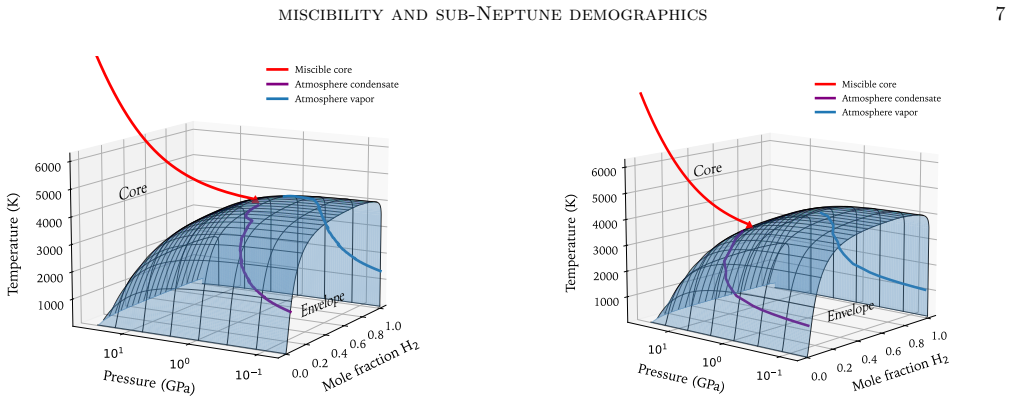
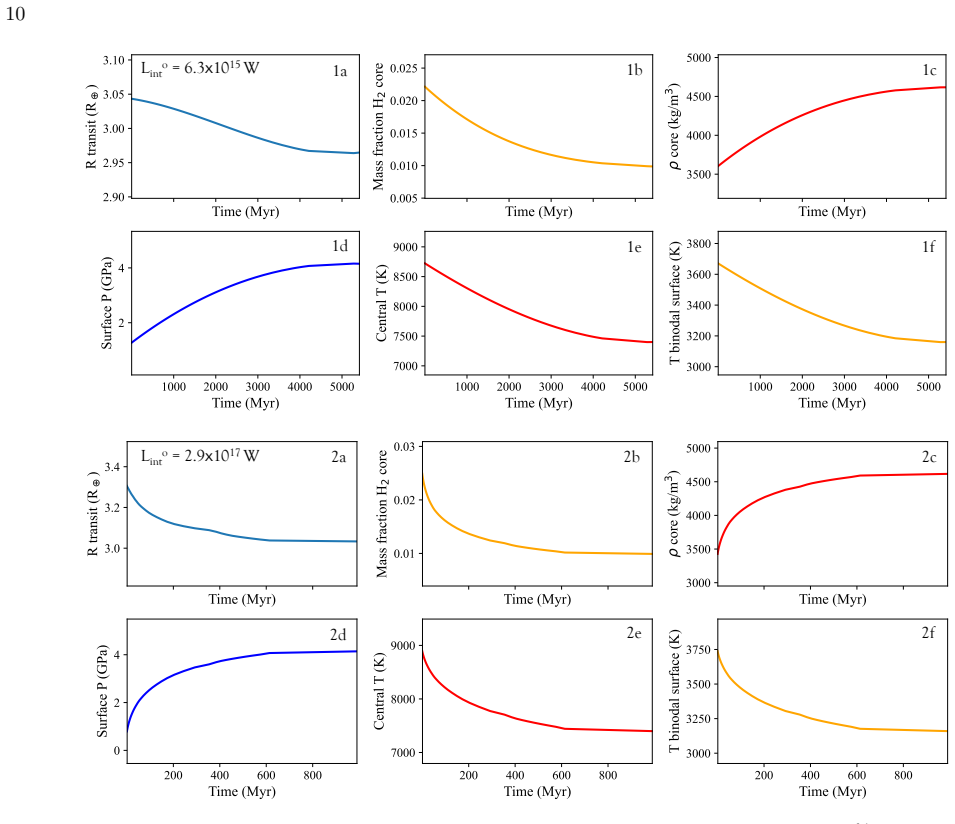
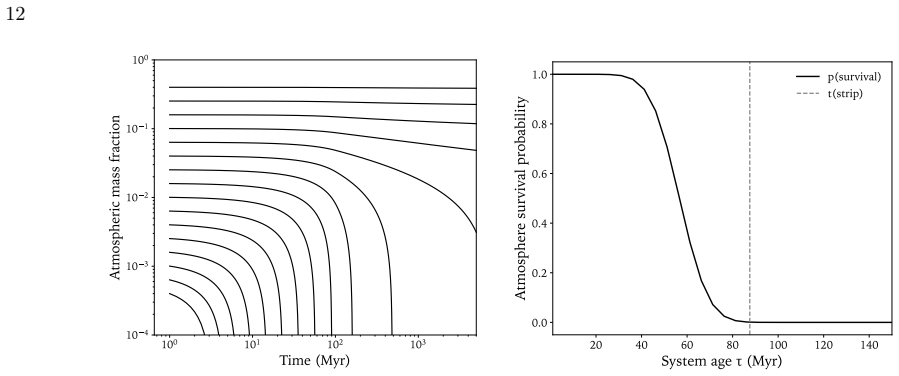
Models based on variable miscibility among hydrogen, molten silicate, and molten iron, coupled with atmospheric escape, can reproduce the observed occurrence density structure of sub-Neptunes and super-Earths in mass-radius space. The models are also consistent with the radius gap and the observed radius-period relationship exhibited by these planets. Planets formed with less than ~1 % hydrogen by mass develop discrete, terrestrial-like metallic cores, while those accreting greater hydrogen concentrations are predicted to have fully miscible interiors and no discrete metal cores. Hydrogen-silicate-iron miscibility provides an overarching explanation for the full range of sub-Neptune and sub-
What carries the argument
Hydrogen-silicate-iron miscibility determined by phase equilibria at the interface between a supercritical magma ocean and the overlying hydrogen-rich envelope, which controls whether a planet develops a discrete metallic core or a fully mixed interior depending on the accreted hydrogen fraction.
Load-bearing premise
The specific miscibility parameters and equilibrium conditions at the magma ocean-hydrogen envelope boundary can be chosen to reproduce the observed planet populations without needing separate adjustments for each system.
What would settle it
Detection of a distinct iron core in a planet with high inferred hydrogen content, or the absence of such a core in a low-hydrogen planet, through precise interior structure measurements would falsify the central claim.
Figures


read the original abstract
Models based on variable miscibility among hydrogen, molten silicate, and molten iron, coupled with atmospheric escape, can reproduce the observed occurrence density structure of sub-Neptunes and super-Earths in mass-radius space. The models are also consistent with the radius gap and the observed radius-period relationship exhibited by these planets. The degree of overlap between predicted and observed planetary occurrences suggests that hydrogen-silicate-iron miscibility may serve as a unifying concept for the formation and evolution of these planet classes. The well-defined equilibrium conditions at the boundary between supercritical magma oceans and the overlying hydrogen-rich envelopes are important features of the models. Planets formed with less than ~1 % hydrogen by mass develop discrete, terrestrial-like metallic cores, while those accreting greater hydrogen concentrations are predicted to have fully miscible interiors and no discrete metal cores. Hydrogen-silicate-iron miscibility provides an overarching explanation for the full range of sub-Neptune and super-Earth architectures based on the accreted hydrogen mass fraction and the phase equilibria governing silicate, iron metal, and H$_2$ miscibility.
Editorial analysis
A structured set of objections, weighed in public.
Referee Report
Summary. The manuscript claims that models incorporating variable miscibility among hydrogen, molten silicate, and molten iron, together with atmospheric escape, reproduce the observed occurrence density structure of sub-Neptunes and super-Earths in mass-radius space. Planets accreting less than ~1% hydrogen by mass are predicted to form discrete, terrestrial-like metallic cores, while those with higher hydrogen fractions develop fully miscible interiors lacking discrete metal cores. The models are also stated to be consistent with the radius gap and the observed radius-period relation, with well-defined equilibrium conditions at the supercritical magma-ocean / hydrogen-envelope boundary playing a central role. Hydrogen-silicate-iron miscibility is presented as a unifying concept for the full range of sub-Neptune and super-Earth architectures.
Significance. If the miscibility parameters and the ~1% hydrogen threshold can be independently constrained by experiment or first-principles calculations, the framework could offer a coherent explanation linking accreted composition, interior phase equilibria, and atmospheric evolution to multiple demographic features. The emphasis on boundary equilibrium conditions between magma oceans and envelopes is a potentially valuable element. At present, however, the absence of explicit model equations, parameter values, and direct data comparisons substantially reduces the immediate significance of the result.
major comments (3)
- Abstract: The central assertion that the models 'reproduce' the observed occurrence densities, radius gap, and radius-period relations is unsupported by any equations, simulation details, parameter values, error analysis, or direct comparisons to data. Without these elements it is impossible to determine whether the underlying math or data actually support the claim.
- Model description (throughout): The ~1% accreted hydrogen mass fraction threshold separating discrete-core from fully miscible interiors is introduced without derivation from equations of state or from experimental constraints at the relevant pressures and temperatures (10–100 GPa, 2000–5000 K). The threshold and the associated miscibility parameters (solubility limits, critical mixing temperatures/pressures) function as adjustable inputs selected to match Kepler occurrence rates, rendering the explanation circular.
- Results section: No sensitivity analysis is presented showing how variations in the miscibility parameters or the escape prescription shift the predicted transition between discrete-core and miscible regimes, nor are independent benchmarks or falsifiable predictions provided that would allow the reader to test the model if the true high-P/T miscibility behavior differs from the adopted values.
minor comments (2)
- Abstract: The phrase 'the degree of overlap between predicted and observed planetary occurrences' is used without any quantitative measure (e.g., Kolmogorov-Smirnov statistic, overlap integral, or binned residual plot) to support the statement.
- Notation: The manuscript refers to 'miscibility parameters' and 'equilibrium conditions' without defining symbols or providing the functional forms used for the phase boundaries, which hinders reproducibility.
Simulated Author's Rebuttal
We thank the referee for their constructive and detailed review of our manuscript. Their comments highlight important areas for clarification and strengthening, particularly regarding model transparency and robustness. We address each major comment point by point below, indicating the revisions we will make to the next version of the manuscript.
read point-by-point responses
-
Referee: Abstract: The central assertion that the models 'reproduce' the observed occurrence densities, radius gap, and radius-period relations is unsupported by any equations, simulation details, parameter values, error analysis, or direct comparisons to data. Without these elements it is impossible to determine whether the underlying math or data actually support the claim.
Authors: We agree that the abstract, being concise by nature, does not convey the supporting details present in the full manuscript. The main text describes the variable miscibility framework, the atmospheric escape model, and includes direct comparisons of predicted occurrence densities to Kepler data in the results section, along with figures illustrating the radius gap and radius-period trends. To address this, we will revise the abstract to briefly reference the key model parameters (including the ~1% hydrogen threshold and escape prescription), note the use of phase-equilibrium calculations, and point to the specific data comparisons. We will also add a short error analysis discussion in the results to quantify the overlap with observations. revision: yes
-
Referee: Model description (throughout): The ~1% accreted hydrogen mass fraction threshold separating discrete-core from fully miscible interiors is introduced without derivation from equations of state or from experimental constraints at the relevant pressures and temperatures (10–100 GPa, 2000–5000 K). The threshold and the associated miscibility parameters (solubility limits, critical mixing temperatures/pressures) function as adjustable inputs selected to match Kepler occurrence rates, rendering the explanation circular.
Authors: The ~1% threshold is grounded in the phase equilibria of H2-silicate-iron systems, informed by existing high-pressure experimental data on hydrogen solubility in molten silicates and metals as well as theoretical mixing models at 10–100 GPa and 2000–5000 K. We will add a dedicated subsection to the model description that explicitly outlines the relevant equations of state, solubility limits, and critical mixing conditions, with citations to the experimental and ab initio literature. While the overall demographic reproduction involves calibration to occurrence rates, the threshold itself is not an arbitrary fit but a physically motivated value; we will clarify this distinction and separate the physical constraints from the demographic matching to eliminate any appearance of circularity. revision: yes
-
Referee: Results section: No sensitivity analysis is presented showing how variations in the miscibility parameters or the escape prescription shift the predicted transition between discrete-core and miscible regimes, nor are independent benchmarks or falsifiable predictions provided that would allow the reader to test the model if the true high-P/T miscibility behavior differs from the adopted values.
Authors: We concur that sensitivity analysis and explicit falsifiable predictions would enhance the paper's rigor and testability. In the revised manuscript we will add a new subsection and accompanying figure in the results that explores variations in miscibility parameters (e.g., critical mixing temperatures and pressures) and escape rates, showing their impact on the core-miscibility transition and the resulting mass-radius distribution. We will also articulate independent benchmarks, such as predicted core structures for specific planet classes that could be tested by future interior modeling or observations, and list falsifiable predictions (e.g., changes in the radius-period slope under altered miscibility assumptions) to allow readers to evaluate the framework against new experimental or observational data. revision: yes
Circularity Check
Miscibility parameters and ~1% H threshold tuned to reproduce observed demographics and radius gap
specific steps
-
fitted input called prediction
[Abstract]
"Models based on variable miscibility among hydrogen, molten silicate, and molten iron, coupled with atmospheric escape, can reproduce the observed occurrence density structure of sub-Neptunes and super-Earths in mass-radius space. The models are also consistent with the radius gap and the observed radius-period relationship exhibited by these planets. [...] Planets formed with less than ~1 % hydrogen by mass develop discrete, terrestrial-like metallic cores, while those accreting greater hydrogen concentrations are predicted to have fully miscible interiors and no discrete metal cores."
The miscibility parameters (variable solubility limits, critical mixing temperatures/pressures, and the specific ~1% H threshold separating discrete-core vs. fully miscible regimes) are stated to be adjustable and are chosen such that the resulting interior structures plus atmospheric escape reproduce the observed occurrence densities, radius gap, and radius-period relation. The claimed 'reproduction' and 'prediction' of the demographic features are therefore the direct output of fitting those inputs to the data rather than an a priori derivation.
full rationale
The paper's central claim is that variable H-silicate-Fe miscibility plus escape reproduces the observed occurrence densities, radius gap, and radius-period relation. However, the model description presents the miscibility degrees, solubility limits, critical mixing conditions, and the ~1% H mass-fraction threshold as variable inputs selected to achieve that reproduction. No first-principles derivation or independent high-P/T experimental constraint is shown for these specific values; they function as adjustable parameters whose choice forces overlap with Kepler data. This reduces the 'prediction' of the demographic structure to a fit by construction rather than an independent derivation. The chain is therefore partially circular at the load-bearing step where inputs are chosen to match outputs.
Axiom & Free-Parameter Ledger
free parameters (2)
- Accreted hydrogen mass fraction threshold =
~1 %
- Miscibility parameters =
variable
axioms (2)
- domain assumption Well-defined equilibrium conditions exist at the boundary between supercritical magma oceans and overlying hydrogen-rich envelopes
- domain assumption Phase equilibria govern the miscibility of silicate, iron metal, and H2
Forward citations
Cited by 1 Pith paper
-
A New Global Chemical Equilibrium Code: Refractory Element Signatures in Super-Earths and Sub-Neptunes
An open-source GCE code with a 100x faster solver demonstrates that refractory ratios Mg/Si and Fe/Si control carbon partitioning and atmospheric properties in water-accreting sub-Neptunes.
Reference graph
Works this paper leans on
-
[1]
Aguichine, A., Mousis, O., Deleuil, M., & Marcq, E. 2021, The Astrophysical Journal, 914, 84, doi: 10.3847/1538-4357/abfa99
-
[2]
Ahlers, G., Grossmann, S., & Lohse, D. 2009, Rev. Mod. Phys., 81, 503, doi: 10.1103/RevModPhys.81.503
-
[3]
T., Gupta, A., Burrows, A., et al
Arevalo, R. T., Gupta, A., Burrows, A., et al. 2025, Sub-Neptune Memories I: Implications of Inefficient Mantle Cooling and Silicate Rain, arXiv, doi: 10.48550/arXiv.2601.00059
-
[4]
Aurnou, J. M., Horn, S., & Julien, K. 2020, Phys. Rev. Res., 2, 043115, doi: 10.1103/PhysRevResearch.2.043115
-
[5]
Journal of Geophysical Research (Planets) , keywords =
Bean, J. L., Raymond, S. N., Owen, J. E., et al. 2021, Journal of Geophysical Research: Planets, 126, doi: 10.1029/2020JE006639
-
[6]
Benneke, B., Roy, P.-A., Coulombe, L.-P., et al. 2024, JWST Reveals CH4, CO2, and H2O in a Metal-rich Miscible Atmosphere on a Two-Earth-Radius Exoplanet, arXiv, doi: 10.48550/arXiv.2403.03325
-
[7]
2018, Applied Sciences, 8, doi: 10.3390/app8060893
Braun, J., Sousa, J., & Paniagua, G. 2018, Applied Sciences, 8, doi: 10.3390/app8060893
-
[8]
Burke, C. J., Christiansen, J. L., Mullally, F., et al. 2015, ApJ, 809, 8, doi: 10.1088/0004-637X/809/1/8
-
[9]
Cadieux, C., Doyon, R., MacDonald, R. J., et al. 2024, The Astrophysical Journal Letters, 970, L2, doi: 10.3847/2041-8213/ad5afa
-
[10]
Carter, J. A., Agol, E., Chaplin, W. J., et al. 2012, Science, 337, 556, doi: 10.1126/science.1223269
-
[11]
arXiv , author =:1902.01852 , journal =
Chabrier, G., Mazevet, S., & Soubiran, F. 2019, The Astrophysical Journal, 872, 51, doi: 10.3847/1538-4357/aaf99f 24
-
[12]
Chachan, Y., & Stevenson, D. J. 2018, The Astrophysical Journal, 854, 21, doi: 10.3847/1538-4357/aaa459
-
[13]
1961, Hydrodynamic and Hydromagnetic Stability, International Series of Monographs on Physics (Oxford: Clarendon Press), 652
Chandrasekhar, S. 1961, Hydrodynamic and Hydromagnetic Stability, International Series of Monographs on Physics (Oxford: Clarendon Press), 652
1961
-
[14]
Charnoz, S., Falco, A., Tremblin, P., et al. 2023, Astronomy & Astrophysics, 674, A224, doi: 10.1051/0004-6361/202245763
-
[15]
Christiansen, J. L., Jenkins, J. M., Caldwell, D. A., et al. 2012, PASP, 124, 1279, doi: 10.1086/668847 de Koker, N., & Stixrude, L. 2009, Geophysical Journal International, 178, 162, doi: 10.1111/j.1365-246X.2009.04142.x
-
[16]
2017, Astronomy & Astrophysics, 597, A37, doi: 10.1051/0004-6361/201628708
Dorn, C., Venturini, J., Khan, A., et al. 2017, Astronomy & Astrophysics, 597, A37, doi: 10.1051/0004-6361/201628708
-
[17]
Dou, J., Carter, P. J., Lock, S., & Leinhardt, Z. M. 2024, Monthly Notices of the Royal Astronomical Society, 534, 758, doi: 10.1093/mnras/stae2134
-
[18]
Eidous, O. M., & Ananbeh, E. A. 2024, Applied Mathematics and Computation, 462, 128339, doi: https://doi.org/10.1016/j.amc.2023.128339
-
[19]
Felix, L., Kitzmann, D., Demory, B.-O., & Mordasini, C. 2025, Astronomy & Astrophysics, 701, A296, doi: 10.1051/0004-6361/202555194
-
[20]
Fortney, J. J., Marley, M. S., & Barnes, J. W. 2007, The Astrophysical Journal, 659, 1661, doi: 10.1086/512120
-
[21]
S., Lustig-Yaeger, J., Fortney, J
Freedman, R. S., Lustig-Yaeger, J., Fortney, J. J., et al. 2014, The Astrophysical Journal Supplement Series, 214, 25, doi: 10.1088/0067-0049/214/2/25
-
[23]
Fressin, F., Torres, G., Charbonneau, D., et al. 2013, ApJ, 766, 81, doi: 10.1088/0004-637X/766/2/81
-
[24]
Fulton, B. J., Petigura, E. A., Howard, A. W., et al. 2017, The Astronomical Journal, 154, 109, doi: 10.3847/1538-3881/aa80eb
-
[25]
Gao, P., et al. 2023, The Astrophysical Journal, 951, 96, doi: 10.3847/1538-4357/acd16f
-
[26]
1931, Les in´ egalit´ es ´ economiques (Paris: Librairie du Recueil Sirey)
Gibrat, R. 1931, Les in´ egalit´ es ´ economiques (Paris: Librairie du Recueil Sirey)
1931
-
[27]
2026, Nature, 650, 60, doi: 10.1038/s41586-025-09970-4
Gilmore, T., & Stixrude, L. 2026, Nature, 650, 60, doi: 10.1038/s41586-025-09970-4
-
[28]
Ginzburg, S., Schlichting, H. E., & Sari, R. 2016, The Astrophysical Journal, 825, 29, doi: 10.3847/0004-637X/825/1/29 —. 2018, MNRAS, 476, 759, doi: 10.1093/mnras/sty290
-
[29]
Pierrehumbert, R. T. 2021, The Planetary Science Journal, 2, 207, doi: 10.3847/PSJ/ac214c
-
[30]
2000, Journal of Fluid Mechanics, 407, 27–56, doi: 10.1017/S0022112099007545
Grossmann, S., & Lohse, D. 2000, Journal of Fluid Mechanics, 407, 27–56, doi: 10.1017/S0022112099007545
-
[31]
arXiv , author =:1006.4702 , journal =
Guillot, T. 2010, A&A, 520, A27, doi: 10.1051/0004-6361/200913396
-
[32]
Gupta, A., & Schlichting, H. E. 2019, Monthly Notices Royal Astronomical Society, 487, 24, doi: 10.1093/mnras/stz1230
-
[33]
Holmberg, M., & Madhusudhan, N. 2024, Astronomy & Astrophysics, 683, L2, doi: 10.1051/0004-6361/202348238
-
[34]
W., Vazan, A., Chariton, S., Prakapenka, V
Horn, H. W., Vazan, A., Chariton, S., Prakapenka, V. B., & Shim, S.-H. 2025, Nature, 646, 1069, doi: 10.1038/s41586-025-09630-7
-
[35]
Howard, A. W., Marcy, G. W., Bryson, S. T., et al. 2012, ApJS, 201, 15, doi: 10.1088/0067-0049/201/2/15
-
[36]
2024, Nature, 10.1038/s41586-024-07432-x
Hu, R., Bello-Arufe, A., Zhang, M., et al. 2024, Nature, 630, 609, doi: 10.1038/s41586-024-07432-x
-
[37]
Hu, R., Bello-Arufe, A., Tokadjian, A., et al. 2025, A water-rich interior in the temperate sub-Neptune K2-18 b revealed by JWST, arXiv, doi: 10.48550/arXiv.2507.12622
-
[38]
2006, The Astrophysical Journal, 648, 696
Ikoma, M., & Genda, H. 2006, The Astrophysical Journal, 648, 696
2006
-
[39]
2025, Earth and Planetary Science Letters, 654, 119242, doi: 10.1016/j.epsl.2025.119242
Insixiengmay, L., & Stixrude, L. 2025, Earth and Planetary Science Letters, 654, 119242, doi: 10.1016/j.epsl.2025.119242
-
[40]
Jenkins, J. M. 2002, ApJ, 575, 493, doi: 10.1086/341136
-
[41]
Jenkins, J. M., Caldwell, D. A., Chandrasekaran, H., et al. 2010, ApJL, 713, L87, doi: 10.1088/2041-8205/713/2/L87
-
[42]
Kempton, E. M.-R., Zhang, M., Bean, J. L., et al. 2023, Nature, 620, 67, doi: 10.1038/s41586-023-06159-5
-
[43]
2021, The Astrophysical Journal Letters, 909:L22, 6 pp
Kite, E., & Schaefer, L. 2021, The Astrophysical Journal Letters, 909:L22, 6 pp
2021
-
[44]
Kite, E. S., Fegley, B., Schaefer, L., & Ford, E. B. 2019, The Astrophysical Journal Letters, 887, L33, doi: 10.3847/2041-8213/ab59d9
-
[45]
Kite, E. S., Fegley, Bruce, J., Schaefer, L., & Ford, E. B. 2020, The Astrophysical Journal, 891, 111, doi: 10.3847/1538-4357/ab6ffb
-
[46]
Kuwayama, Y., Morard, G., Nakajima, Y., et al. 2020, Phys. Rev. Lett., 124, 165701, doi: 10.1103/PhysRevLett.124.165701
-
[47]
Lee, E. J., & Connors, N. J. 2021, The Astrophysical Journal, 908, 32, doi: 10.3847/1538-4357/abd6c7
-
[48]
Long, R. S., Mound, J. E., Davies, C. J., & Tobias, S. M. 2020, Phys. Rev. Fluids, 5, 113502, doi: 10.1103/PhysRevFluids.5.113502 miscibility and sub-Neptune demographics25
-
[49]
Lopez, E. D., & Fortney, J. J. 2014, The Astrophysical Journal, 792, 1, doi: 10.1088/0004-637X/792/1/1
-
[50]
Madhusudhan, N., Piette, A. A. A., & Constantinou, S. 2021, The Astrophysical Journal, 918, 1, doi: 10.3847/1538-4357/abfd9c
-
[51]
Madhusudhan, N., Sarkar, S., Constantinou, S., et al. 2023, The Astrophysical Journal Letters, 956, L13, doi: 10.3847/2041-8213/acf577
-
[52]
2022, A&A, 665, A12, doi: 10.1051/0004-6361/202243359
Markham, S., Guillot, T., & Stevenson, D. 2022, A&A, 665, A12, doi: 10.1051/0004-6361/202243359
-
[53]
Miozzi, F., Shahar, A., Young, E. D., et al. 2025, Nature, 648, 551, doi: 10.1038/s41586-025-09816-z
-
[54]
Misener, W., & Schlichting, H. E. 2022, Monthly Notices of the Royal Astronomical Society, 514, 6025, doi: 10.1093/mnras/stac1732
-
[55]
Misener, W., Schlichting, H. E., & Young, E. D. 2023, Monthly Notices of the Royal Astronomical Society, 524, 981, doi: 10.1093/mnras/stad1910
-
[56]
Nixon, M. C., & Madhusudhan, N. 2021, Monthly Notices of the Royal Astronomical Society, 505, 3414, doi: 10.1093/mnras/stab1500
-
[57]
Nixon, M. C., Somers, R. S., Savel, A. B., et al. 2025, The Astrophysical Journal, 995, 95, doi: 10.3847/1538-4357/ae17c8
-
[58]
Owen, J. E., & Wu, Y. 2013, The Astrophysical Journal, 775, 105, doi: 10.1088/0004-637X/775/2/105 —. 2017, The Astrophysical Journal, 847, 29, doi: 10.3847/1538-4357/aa890a
-
[59]
Phipson, B., & Smyth, G. K. 2010, Statistical Applications in Genetics and Molecular Biology, 9, Article 39, doi: 10.2202/1544-6115.1585
-
[60]
Piaulet-Ghorayeb, C., Benneke, B., Radica, M., et al. 2024, The Astrophysical Journal Letters, 974, L10, doi: 10.3847/2041-8213/ad6f00
-
[61]
Rigby, F. E., & Madhusudhan, N. 2025, The Surface and Interior Conditions of Temperate Sub-Neptune TOI-270 d, arXiv, doi: 10.48550/arXiv.2511.16722
-
[62]
Rizzo, M. L., & Sz´ ekely, G. J. 2016, WIREs Computational Statistics, 8, 27, doi: 10.1002/wics.1375
-
[63]
G., Dorn, C., Aditya Raj, V., Schlichting, H
Rogers, J. G., Dorn, C., Aditya Raj, V., Schlichting, H. E., & Young, E. D. 2025a, The Astrophysical Journal, 979, 79, doi: 10.3847/1538-4357/ad9f61
-
[64]
Rogers, J. G., & Owen, J. E. 2021, Monthly Notices of the Royal Astronomical Society, 503, 1526, doi: 10.1093/mnras/stab529
-
[65]
Rogers, J. G., Young, E. D., & Schlichting, H. E. 2025b, Monthly Notices of the Royal Astronomical Society, 544, 3496, doi: 10.1093/mnras/staf1940
-
[66]
Rogers, L. A., & Seager, S. 2010, The Astrophysical Journal, 712, 974, doi: 10.1088/0004-637X/712/2/974
-
[67]
Salz, M., Schneider, P. C., Czesla, S., & Schmitt, J. H. M. M. 2016, Astronomy & Astrophysics, 585, L2, doi: 10.1051/0004-6361/201527042
-
[68]
Schlichting, H. E., & Young, E. D. 2022, PSJ, 3, 127, doi: 10.3847/PSJ/ac68e6
-
[69]
Seager, S., Kuchner, M., Hier-Majumder, C. A., & Militzer, B. 2007, The Astrophysical Journal, 669, 1279, doi: 10.1086/521346
-
[70]
Shannon, R. D. 1976, Acta Crystallographica Section A, 32, 751, doi: https://doi.org/10.1107/S0567739476001551
-
[71]
Bower, D. J. 2024, The Astrophysical Journal Letters, 962, L8, doi: 10.3847/2041-8213/ad206e
-
[72]
, year = 2007, month = nov, volume = 191, pages =
Sotin, C., Grasset, O., & Mocquet, A. 2007, Icarus, 191, 337, doi: 10.1016/j.icarus.2007.04.006
-
[73]
Valencia, D., O’Connell, R. J., & Sasselov, D. 2006, Icarus, 181, 545, doi: 10.1016/j.icarus.2005.11.021 Van Eylen, V., Agentoft, C., Lundkvist, M. S., et al. 2018, MNRAS, 479, 4786, doi: 10.1093/mnras/sty1783
-
[74]
Vazan, A., Sari, R., & Kessel, R. 2022, The Astrophysical Journal, 926, 150, doi: 10.3847/1538-4357/ac458c
-
[75]
2025a, The Astrophysical Journal Letters, 991, L16, doi: 10.3847/2041-8213/adff73
Werlen, A., Dorn, C., Burn, R., et al. 2025a, The Astrophysical Journal Letters, 991, L16, doi: 10.3847/2041-8213/adff73
-
[76]
Young, E. D. 2025b, The Astrophysical Journal Letters, 988, L55, doi: 10.3847/2041-8213/adf185
-
[77]
Wolf, A. S., & Bower, D. J. 2018, Physics of the Earth and Planetary Interiors, 278, 59, doi: 10.1016/j.pepi.2018.02.00410.31223/osf.io/4c2s5
work page doi:10.1016/j.pepi.2018.02.00410.31223/osf.io/4c2s5 2018
-
[78]
2015, The Astrophysical Journal, 806, 183, doi: 10.1088/0004-637X/806/2/183
Wolfgang, A., & Lopez, E. 2015, The Astrophysical Journal, 806, 183, doi: 10.1088/0004-637X/806/2/183
-
[79]
D., Shahar, A., & Schlichting, H
Young, E. D., Shahar, A., & Schlichting, H. E. 2023, Nature, 616, 306
2023
-
[80]
Young, E. D., Stixrude, L., Rogers, J. G., Schlichting, H. E., & Marcum, S. P. 2024, The Planetary Science Journal, 5, 268, doi: 10.3847/PSJ/ad8c40
-
[81]
Dullemond, C. P. 2025, The Planetary Science Journal, doi: 10.3847/PSJ/ae1012
discussion (0)
Sign in with ORCID, Apple, or X to comment. Anyone can read and Pith papers without signing in.