Recognition: unknown
Determination of turbulent heating rate and relaxed states in finite Larmor radius magnetohydrodynamic turbulence with helicity barrier
Pith reviewed 2026-05-07 05:51 UTC · model grok-4.3
The pith
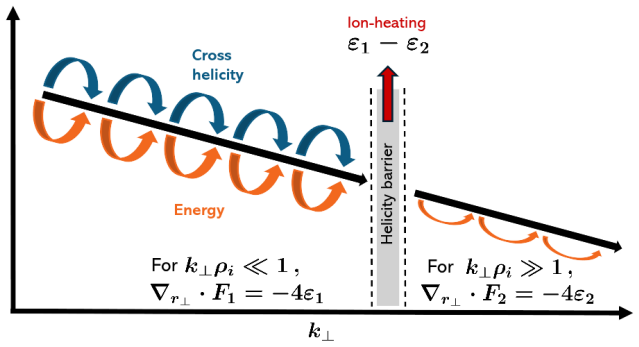
Exact laws for FLR-MHD turbulence show two energy cascade rates separated by a helicity barrier, with their difference giving the ion heating rate.
A machine-rendered reading of the paper's core claim, the machinery that carries it, and where it could break.
Core claim
In fully developed FLR-MHD turbulence with strong imbalance between the Elsasser variables, the helicity barrier leads to two separate stationary energy cascades with different rates. The derived exact laws for energy and generalized helicity cascades enable calculation of these rates, so that their difference provides the ion heating rate. In the large-scale limit the laws reduce to those of reduced MHD, and in the small-scale limit to electron reduced MHD. Using the principle of vanishing nonlinear transfer, the relaxed states are found to exhibit alignment between velocity and magnetic field fluctuations, but strong anisotropy precludes Beltrami alignment.
What carries the argument
The exact laws for the cascades of energy and generalized helicity in the presence of the helicity barrier, which split the turbulent transfer into two distinct stationary states.
Load-bearing premise
The turbulence is fully developed with a strong imbalance between Elsasser variables that sustains the helicity barrier and prevents a single stationary state.
What would settle it
A direct measurement in a simulation or observation of strongly imbalanced FLR-MHD turbulence showing that the difference between the two energy cascade rates does not equal the ion heating rate would falsify the central claim.
Figures
read the original abstract
Finite Larmor radius magnetohydrodynamics (FLR-MHD) provides a hybrid model of plasma that explains how turbulent energy cascade extends to sufficiently small parallel length scales, potentially leading to perpendicular heating of the ions in the solar corona and the solar wind. In this work, we derive exact laws for the cascades of energy and generalized helicity in fully developed FLR-MHD turbulence. In large and small scale limits, we obtain the exact laws for reduced MHD and electron reduced MHD turbulence respectively. Unlike ordinary or reduced MHD turbulence, a global stationary state is shown to be absent in the case of a strong imbalance between the Elsasser variables. This is due to the so-called helicity barrier, which leads to two separate stationary energy cascades with different cascade rates. Our derived exact laws enable us to calculate these two cascade rates and therefore their difference, which effectively provides the heating rate of the ions. In addition, we also derive alternative Banerjee-Galtier forms for the exact laws and hence obtain the relaxed states of FLR-MHD turbulence using the framework of recently proposed principle of vanishing nonlinear transfer. The relaxed states show alignment between the velocity and magnetic field fluctuations. However, due to strong anisotropy, no Beltrami alignment is possible for velocity and magnetic fields. Similarly to the exact laws, the relaxed states of reduced and electron reduced MHD emerge in the large and small scale limits, respectively.
Editorial analysis
A structured set of objections, weighed in public.
Referee Report
Summary. The manuscript derives exact laws for the cascades of energy and generalized helicity in fully developed finite Larmor radius magnetohydrodynamic (FLR-MHD) turbulence. Under strong imbalance between Elsasser variables, it shows that the helicity barrier precludes a single global stationary state, resulting in two separate stationary cascades whose rate difference is identified as the ion heating rate. In the large-scale and small-scale limits the laws reduce to those of reduced MHD and electron reduced MHD, respectively. The paper additionally obtains alternative Banerjee-Galtier forms of the exact laws and uses the principle of vanishing nonlinear transfer to determine relaxed states, which exhibit velocity-magnetic field alignment but no Beltrami alignment owing to strong anisotropy.
Significance. If the derivations hold, the work supplies a parameter-free route to the turbulent ion heating rate in FLR-MHD plasmas relevant to the solar wind and corona. The recovery of the known RMHD and ERMHD limits and the explicit construction of relaxed states provide internal consistency checks. The extension of the exact-law technique to include the helicity barrier mechanism is a natural and potentially useful advance for plasma turbulence theory.
major comments (2)
- [Energy balance and heating-rate identification (around the discussion following the exact laws)] The central claim that the difference of the two cascade rates equals the ion heating rate rests on the helicity barrier producing independent stationary fluxes. The manuscript should explicitly demonstrate (in the section deriving the energy balance) that no residual cross-scale transfer term survives after the large- and small-scale limits are taken; otherwise the subtraction step is not justified by the exact laws alone.
- [Derivation of the generalized-helicity exact law] The generalized helicity is asserted to be conserved in the ideal FLR-MHD system and therefore to furnish a second exact law. The derivation must show, term by term, that the finite-Larmor-radius contributions to the two-point correlation either cancel or are absorbed into the flux without introducing non-conservative source terms; any overlooked commutator would invalidate the subsequent cascade-rate difference.
minor comments (3)
- [Relaxed states via vanishing nonlinear transfer] The abstract states that the relaxed states show alignment between velocity and magnetic field fluctuations but no Beltrami alignment; the main text should quantify the alignment angle or cross-helicity value that is attained under the strong-anisotropy assumption.
- [Alternative forms of the exact laws] The Banerjee-Galtier forms are introduced as alternatives; a brief comparison table or paragraph clarifying which terms differ from the standard exact laws and why they are needed for the relaxed-state analysis would improve readability.
- [Introduction or conclusions] A short paragraph summarizing the assumptions (homogeneity, stationarity, strong imbalance threshold) under which the two independent cascades are valid would help readers assess the domain of applicability.
Simulated Author's Rebuttal
We thank the referee for the positive evaluation and the recommendation for minor revision. The two major comments identify areas where additional explicit demonstrations will strengthen the manuscript. We address each point below and will revise the text accordingly.
read point-by-point responses
-
Referee: The central claim that the difference of the two cascade rates equals the ion heating rate rests on the helicity barrier producing independent stationary fluxes. The manuscript should explicitly demonstrate (in the section deriving the energy balance) that no residual cross-scale transfer term survives after the large- and small-scale limits are taken; otherwise the subtraction step is not justified by the exact laws alone.
Authors: We agree that an explicit demonstration of the absence of residual cross-scale transfer is needed to fully justify the subtraction. In the present derivation the exact laws are obtained separately after taking the large-scale (RMHD) and small-scale (ERMHD) limits, and the helicity barrier is used to establish that the two cascades are stationary and independent under strong imbalance. Nevertheless, to make the vanishing of any cross-scale terms fully transparent, we will insert a short paragraph immediately after the energy-balance discussion (following the statement of the two cascade rates) that explicitly shows, using the scale separation and the conservation properties of the generalized helicity, that the averaged cross terms integrate to zero in the stationary state. This addition will be placed in the main text rather than an appendix so that the justification for identifying the rate difference as the ion heating rate is self-contained. revision: yes
-
Referee: The generalized helicity is asserted to be conserved in the ideal FLR-MHD system and therefore to furnish a second exact law. The derivation must show, term by term, that the finite-Larmor-radius contributions to the two-point correlation either cancel or are absorbed into the flux without introducing non-conservative source terms; any overlooked commutator would invalidate the subsequent cascade-rate difference.
Authors: We accept the request for a term-by-term verification. The derivation of the generalized-helicity law begins from the ideal FLR-MHD equations and employs standard vector identities and integration by parts; the FLR contributions are shown to enter only the flux terms. To satisfy the referee’s requirement, we will add a new appendix (Appendix C) that expands the two-point correlation function and lists every FLR term, demonstrating explicitly that non-conservative commutators cancel identically and that the remaining pieces are absorbed into the divergence of the flux. This appendix will also confirm that the same cancellation holds in the RMHD and ERMHD limits, thereby preserving the validity of the cascade-rate difference. revision: yes
Circularity Check
No significant circularity in the derivation chain
full rationale
The paper derives exact laws for energy and generalized helicity cascades in FLR-MHD turbulence via the standard technique of correlating the governing equations under assumptions of homogeneity, isotropy in the perpendicular plane, and stationarity. Absence of a global stationary state is shown directly from the strong Elsasser imbalance producing the helicity barrier, permitting two independent constant-flux cascades whose difference is identified as the ion heating rate by global energy balance. This identification follows from the derived equations without parameter fitting or self-definition. Large- and small-scale limits recover the known RMHD and ERMHD exact laws as consistency checks rather than inputs. Relaxed states are obtained by applying the principle of vanishing nonlinear transfer to the FLR-MHD equations, yielding alignment properties that reduce to the known RMHD/ERMHD cases in the respective limits; the cited principle is used as an external framework rather than a self-referential load-bearing step. No step reduces by construction to its own inputs, fitted data, or unverified self-citation chain.
Axiom & Free-Parameter Ledger
axioms (3)
- domain assumption Incompressible finite Larmor radius magnetohydrodynamic equations hold
- domain assumption Turbulence is fully developed and stationary in the presence of a strong Elsasser imbalance
- domain assumption Principle of vanishing nonlinear transfer determines relaxed states
Reference graph
Works this paper leans on
-
[1]
Kadomtsev, O
B. Kadomtsev, O. Pogutse, Nonlinear helical perturbations of a plasma in the tokamak, Sov. Phys. JETP 5 (1973) 575–590
1973
-
[2]
H. R. Strauss, Nonlinear, three-dimensional magnetohydrodynamics of noncircular tokamaks, The Physics of Fluids 19 (1) (1976) 134–140. doi:10.1063/1.861310
-
[3]
L. J. Milano, P. Dmitruk, C. H. Mandrini, D. O. Gómez, P. Démoulin, Quasi-separatrix layers in a reduced magnetohydrodynamic model of a coronal loop, The Astrophysical Journal 521 (2) (1999) 889.doi:10.1086/307563
-
[4]
S.Oughton,W.H.Matthaeus,P.Dmitruk,L.J.Milano,G.P.Zank,D.J.Mullan,Areducedmagnetohydrodynamicmodelofcoronalheatingin openmagneticregionsdrivenbyreflectedlow-frequencyalfvénwaves,TheAstrophysicalJournal551(1)(2001)565.doi:10.1086/320069
-
[5]
A. F. Rappazzo, M. Velli, G. Einaudi, R. B. Dahlburg, Coronal heating, weak mhd turbulence, and scaling laws, The Astrophysical Journal 657 (1) (2007) L47.doi:10.1086/512975
-
[6]
S. Dalena, A. F. Rappazzo, P. Dmitruk, A. Greco, W. H. Matthaeus, Test-particle acceleration in a hierarchical three-dimensional turbulence model, The Astrophysical Journal 783 (2) (2014) 143.doi:10.1088/0004-637X/783/2/143
-
[7]
V. H. Hansteen, E. Leer, Coronal heating, densities, and temperatures and solar wind acceleration, Journal of Geophysical Research: Space Physics 100 (A11) (1995) 21577–21593.doi:https://doi.org/10.1029/95JA02300
-
[8]
P. J. Coleman, Jr., Turbulence, Viscosity, and Dissipation in the Solar-Wind Plasma, The Astrophysical Journal 153 (1968) 371.doi: 10.1086/149674
-
[9]
S. R. Cranmer, G. B. Field, J. L. Kohl, Spectroscopic constraints on models of ion cyclotron resonance heating in the polar solar corona and high-speed solar wind, The Astrophysical Journal 518 (2) (1999) 937.doi:10.1086/307330
-
[10]
A. A. Schekochihin, S. C. Cowley, W. Dorland, G. W. Hammett, G. G. Howes, E. Quataert, T. Tatsuno, Astrophysical gyrokinetics: Kinetic and fluid turbulent cascades in magnetized weakly collisional plasmas, The Astrophysical Journal Supplement Series 182 (1) (2009) 310. doi:10.1088/0067-0049/182/1/310
-
[11]
Dobrowolny, G
M. Dobrowolny, G. Torricelli-Ciamponi, Alfven wave dissipation in the solar wind, A & A 142 (2) (1985) 404–410
1985
-
[12]
R. J. Leamon, C. W. Smith, N. F. Ness, H. K. Wong, Dissipation range dynamics: Kinetic alfvén waves and the importance of electron beta, Journal of Geophysical Research: Space Physics 104 (A10) (1999) 22331–22344.doi:https://doi.org/10.1029/1999JA900158
-
[13]
E.Marsch,C.K.Goertz,K.Richter,Waveheatingandaccelerationofsolarwindionsbycyclotronresonance,JournalofGeophysicalResearch: Space Physics 87 (A7) (1982) 5030–5044.doi:https://doi.org/10.1029/JA087iA07p05030
-
[14]
J. C. Kasper, B. A. Maruca, M. L. Stevens, A. Zaslavsky, Sensitive test for ion-cyclotron resonant heating in the solar wind, Phys. Rev. Lett. 110 (2013) 091102.doi:10.1103/PhysRevLett.110.091102
-
[15]
S.D.Bale,S.T.Badman,J.W.Bonnell,T.A.Bowen,D.Burgess,A.W.Case,C.A.Cattell,B.D.G.Chandran,C.C.Chaston,C.H.K.Chen, J. F. Drake, T. D. de Wit, J. P. Eastwood, R. E. Ergun, W. M. Farrell, C. Fong, K. Goetz, M. Goldstein, K. A. Goodrich, P. R. Harvey, T. S. Horbury, G. G. Howes, J. C. Kasper, P. J. Kellogg, J. A. Klimchuk, K. E. Korreck, V. V. Krasnoselskikh, S...
-
[16]
C. F. Kennel, F. Engelmann, Velocity space diffusion from weak plasma turbulence in a magnetic field, The Physics of Fluids 9 (12) (1966) 2377–2388.doi:10.1063/1.1761629
-
[17]
P. A. Isenberg, B. J. Vasquez, A kinetic model of solar wind generation by oblique ion-cyclotron waves, The Astrophysical Journal 731 (2) (2011) 88.doi:10.1088/0004-637X/731/2/88
-
[18]
T. S. Horbury, R. T. Wicks, C. H. K. Chen, Anisotropy in space plasma turbulence: Solar wind observations, Space Science Reviews 172 (1) (2012) 325–342.doi:10.1007/s11214-011-9821-9. URLhttps://doi.org/10.1007/s11214-011-9821-9
-
[19]
S. Banerjee, S. Galtier, Exact relation with two-point correlation functions and phenomenological approach for compressible magnetohydro- dynamic turbulence, Phys. Rev. E 87 (2013) 013019.doi:10.1103/PhysRevE.87.013019
-
[20]
S. Banerjee, L. Z. Hadid, F. Sahraoui, S. Galtier, Scaling of compressible magnetohydrodynamic turbulence in the fast solar wind, The Astrophysical Journal Letters 829 (2) (2016) L27.doi:10.3847/2041-8205/829/2/L27
-
[21]
R. Meyrand, J. Squire, A. Schekochihin, W. Dorland, On the violation of the zeroth law of turbulence in space plasmas, Journal of Plasma Physics 87 (3) (2021) 535870301.doi:10.1017/S0022377821000489
-
[22]
J. Squire, R. Meyrand, M. Kunz, L. Arzamasskiy, A. Schekochihin, E. Quataert, High-frequency heating of the solar wind triggered by low- frequency turbulence, Nature Astronomy 6 (6) (2022) 715–723, publisher Copyright:©2022, The Author(s), under exclusive licence to Springer Nature Limited.doi:10.1038/s41550-022-01624-z
-
[23]
T.Adkins,R.Meyrand,J.Squire,Theeffectsoffiniteelectroninertiaonhelicity-barrier-mediatedturbulence,JournalofPlasmaPhysics90(4) (2024) 905900403.doi:10.1017/S0022377824000771
-
[24]
J. R. McIntyre, C. H. K. Chen, J. Squire, R. Meyrand, P. A. Simon, Evidence for the helicity barrier from measurements of the turbulence transition range in the solar wind, Phys. Rev. X 15 (2025) 031008.doi:10.1103/PhysRevX.15.031008
-
[25]
H.Politano,A.Pouquet,vonkármán–howarthequationformagnetohydrodynamicsanditsconsequencesonthird-orderlongitudinalstructure and correlation functions, Phys. Rev. E 57 (1998) R21–R24.doi:10.1103/PhysRevE.57.R21
-
[26]
:Preprint submitted to Elsevier Page 14 of 15
S.Banerjee,S.Galtier,Analternativeformulationforexactscalingrelationsinhydrodynamicandmagnetohydrodynamicturbulence,Journal of Physics A: Mathematical and Theoretical 50 (1) (2016) 015501.doi:10.1088/1751-8113/50/1/015501. :Preprint submitted to Elsevier Page 14 of 15
-
[27]
R. Sasmal, S. Banerjee, Universal cascade and relaxation of strong anisotropic turbulence in plasma fluids, Physics of Fluids 37 (2) (2025) 025197.doi:10.1063/5.0250255
-
[28]
S. Banerjee, A. Halder, N. Pan, Universal turbulent relaxation of fluids and plasmas by the principle of vanishing nonlinear transfers, Phys. Rev. E 107 (2023) L043201.doi:10.1103/PhysRevE.107.L043201
-
[29]
N. Pan, S. Banerjee, A. Halder, Universal relaxation of turbulent binary fluids, Communications Physics 7 (1) (2024) 4.doi:10.1038/ s42005-023-01498-1
2024
-
[30]
A. Zocco, A. A. Schekochihin, Reduced fluid-kinetic equations for low-frequency dynamics, magnetic reconnection, and electron heating in low-beta plasmas, Physics of Plasmas 18 (10) (2011) 102309.doi:10.1063/1.3628639
-
[31]
J. J. Podesta, Laws for third-order moments in homogeneous anisotropic incompressible magnetohydrodynamic turbulence, Journal of Fluid Mechanics 609 (2008) 171–194.doi:10.1017/S0022112008002280
-
[32]
S. Galtier, A. Pouquet, A. Mangeney, On spectral scaling laws for incompressible anisotropic magnetohydrodynamic turbulence, Physics of Plasmas 12 (9) (2005) 092310.doi:10.1063/1.2052507
-
[33]
R. Sasmal, S. Banerjee, Universal relations between parallel and perpendicular spectral power-law exponents in nonaxisymmetric magneto- hydrodynamic turbulence, Phys. Rev. E 112 (2025) 035208.doi:10.1103/xsm2-52pd
-
[34]
S. Boldyrev, On the spectrum of magnetohydrodynamic turbulence, The Astrophysical Journal 626 (1) (2005) L37.doi:10.1086/431649
-
[35]
S.Boldyrev,Spectrumofmagnetohydrodynamicturbulence,Phys.Rev.Lett.96(2006)115002.doi:10.1103/PhysRevLett.96.115002
-
[36]
S.Boldyrev,J.Mason,F.Cattaneo,Dynamicalignmentandexactscalinglawsinmagnetohydrodynamicturbulence,TheAstrophysicalJournal 699 (1) (2009) L39.doi:10.1088/0004-637X/699/1/L39
-
[37]
A. Mallet, A. A. Schekochihin, A statistical model of three-dimensional anisotropy and intermittency in strong alfvénic turbulence, Monthly Notices of the Royal Astronomical Society 466 (4) (2016) 3918–3927.doi:10.1093/mnras/stw3251
-
[38]
A. A. Schekochihin, Mhd turbulence: a biased review, Journal of Plasma Physics 88 (5) (2022) 155880501.doi:10.1017/ S0022377822000721. :Preprint submitted to Elsevier Page 15 of 15
2022
discussion (0)
Sign in with ORCID, Apple, or X to comment. Anyone can read and Pith papers without signing in.