Recognition: 8 theorem links
· Lean TheoremA Noble-Gas-Centered Coordinate for Within-Period Atomic Property Trends
Pith reviewed 2026-05-05 22:54 UTC · model claude-opus-4-7
video Unifying the Periodic Table - The Noble-Gas-Centered Coordinate
The pith
A single golden-ratio cosh function on a noble-gas-centered coordinate reproduces within-period trends in ionization energy, electron affinity, electronegativity, and chemical hardness across periods 2–6.
A machine-rendered reading of the paper's core claim, the machinery that carries it, and where it could break.
Core claim
The authors claim that one dimensionless function on a single periodic-table coordinate — distance to the nearest noble gas, normalized by row length — organizes four central within-period observables at once. The function is J(ρ) = cosh(ρ ln φ) − 1 with φ the golden ratio. Its outward one-electron step serves as the ionization-energy proxy; its inward gap to ρ=1 serves simultaneously as the electron-affinity proxy and the chemical-hardness proxy; Mulliken electronegativity is half their sum. With one fitted energy scale per period, this single shape reproduces noble-gas-to-alkali ordering across periods 2–6, localizes upward bumps exactly at the textbook half-filled and closed-subshell site
What carries the argument
The dimensionless landscape J_chem(ρ) = cosh(ρ ln φ) − 1, evaluated on ρ = (G_p − Z)/L_p ∈ [0,1). Two derived quantities do all the work: an outward step ΔJ⁺ between consecutive ρ values (ionization energy proxy) and an inward gap ΔJ⁻ = J_chem(1) − J_chem(ρ) (shared kernel for both electron affinity and Pearson hardness). One per-period energy scale E_p converts the dimensionless shape to eV; the dimensionless ordering and the EA/η ratio are independent of E_p.
If this is right
- Cross-period comparison of IE1, EA, electronegativity, and hardness can be done on a single dimensionless axis, with the per-period scale E_p as the only adjustable energy.
- The shared kernel forces EA/η to be a period-only constant on regular-Aufbau interior atoms, giving a parameter-free benchmark (period-4 mean predicted 0.182, observed 0.180).
- Deviations from the smooth landscape become diagnostic: anomalies localize at {p³, d⁵, f⁷, s², d¹⁰}, and relativistic shifts (Og, Cn, Ts, Fr) appear as quantified offsets against a defined nonrelativistic reference.
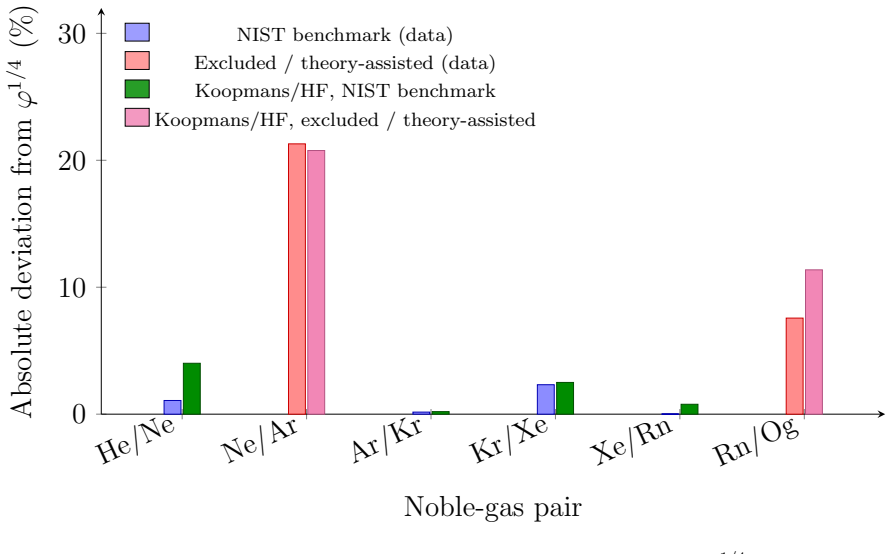
- Future derivation of E_p from first principles would promote the empirical φ^(1/4) heavy-noble-gas and φ² halogen/alkali ratios from regularities to parameter-free predictions.
- The single-coordinate kernel currently fails to recover the within-class halogen ordering F > Cl > Br > I, identifying a class-dependent mixing of ΔJ⁺ and ΔJ⁻ as the next refinement.
Where Pith is reading between the lines
- Because Eq. (14) reduces the φ^(1/4) noble-gas identity to a statement about the ratio E_p/L_p² between consecutive heavy periods, the golden-ratio content is effectively a smoothness condition on the fitted period scales rather than a property of the cosh form itself.
- The shared EA/η kernel makes a sharper testable claim than the paper foregrounds: the period-mean EA/η should be a fixed function of L_p alone, so periods 5 and 6 ought to reproduce a similar 1%-level agreement if the picture is right.
- The post-hoc exclusion list (period 1, period 7, halogens in EA, anomaly sites, first-row screening pairs) is doing real work; a principled within-model criterion that predicts which atoms are 'regular-Aufbau interior' would convert the framework from a fit baseline into a selection rule.
- The φ^(1/4) prediction sets a clean nonrelativistic zeroth-order target for IE1(Og); a future high-precision Og measurement would either confirm the ~7.6% spin-orbit shift assignment or refute the heavy-noble-gas identity.
Load-bearing premise
The choice of the golden ratio φ as the argument-rescaling factor and the cosh form of the landscape is a modeling ansatz rather than something derived from chemistry, so the central identities depend on a kernel selection the authors acknowledge is not unique.
What would settle it
Refit the same observables with alternative smooth kernels — ρ², or cosh(cρ) − 1 with a freely fitted c — on the same period 2–6 NIST data set. If those alternatives match or beat the φ-cosh form on within-period ordering, the φ^(1/4) and φ² ratio identities, and the shared-kernel period-4 EA/η ≈ 0.182 prediction, then the golden-ratio content is empirically unsupported and the central claim collapses.
Figures




read the original abstract
We introduce a single dimensionless landscape function $J_{\rm chem}(\rho) = \cosh(\rho \ln \varphi) - 1$, $\varphi = (1+\sqrt{5})/2$, on the noble-gas-centred coordinate $\rho = d/L_p \in [0,1)$, and show that it organizes four central atomic observables: first ionization energy \IE$_1$, electron affinity EA, Mulliken electronegativity $\chi_M$, and Pearson chemical hardness $\eta$, on one periodic-table axis. The outward step $\Delta J_{\rm chem}^{+}$ delivers IE$_1$; the inward gap $\Delta J_{\rm chem}^{-} = J_{\rm chem}(1) - J_{\rm chem}(\rho)$ delivers EA and $\eta$; $\chi_M$ follows by Mulliken's identity. Three results establish the empirical content. (i) The within-period IE$_1$ envelope reproduces the full noble-gas-to-alkali ordering across periods 2--6: of 34 atoms compiled across periods 2-4, 26 lie on the predicted monotone descent and the 8 upward deviations occur exactly at the textbook anomaly sites $\{p^3, d^5, f^7, s^2, d^{10}\}$. (ii) Two golden-ratio identities, ${\rm IE}_1(G_p)/{\rm IE}_1(G_{p+1}) \approx \varphi^{1/4}$ on three heavy noble-gas pairs and ${\rm IE}_1(\text{halogen})/{\rm IE}_1(\text{alkali}) \approx \varphi^2$ on four within-period pairs, agree with NIST data to MAD $\approx 1\%$ and $\approx 5\%$, respectively. (iii) The shared kernel $\Delta J_{\rm chem}^{-}$ provides single-parameter analytical fits to EA across periods 4--6 (MAE $0.3$--$0.4$~eV), to Pearson hardness $\eta$ across periods 2--4 (MAE $\sim 1$~eV on noble-gas maxima up to $10.8$~eV), and to Mulliken $\chi_M$ across a 15-atom four-class benchmark ($R^2 = 0.73$). \edit{At the period-averaged scale level, the shared-kernel relation ${\rm EA}/\eta \approx C^{(p)}_{\mathrm{EA}}/C^{(p)}_{\eta}$ is supported on period-4 NIST data: the empirical nine-atom mean $\overline{{\rm EA}/\eta} = 0.180$ agrees with the predicted constant $0.182$ to better than $1\%$, although individual-atom scatter ($\sigma \approx 0.13$) is much larger.
Editorial analysis
A structured set of objections, weighed in public.
Referee Report
Summary. The manuscript proposes a one-parameter analytical framework for within-period atomic property trends. A dimensionless landscape J_chem(ρ) = cosh(ρ ln φ) − 1 is defined on the noble-gas-centred coordinate ρ = d/L_p, with φ = (1+√5)/2. The outward step ΔJ⁺ is assigned to IE₁ and the inward gap ΔJ⁻ is reused as a shared kernel for EA and Pearson η; χ_M follows by Mulliken's identity. Three IE₁ "predictions" (heavy noble-gas ratio φ^(1/4), halogen/alkali ratio φ², and a within-period monotone-with-anomaly envelope across periods 2–6) and three single-parameter fits (EA on periods 4–6, η on periods 2–4, and a 15-atom Mulliken χ_M benchmark with R²=0.73) are reported. A "shared-kernel" benchmark EA/η ≈ C_EA^(p)/C_η^(p) is tested on period-4 data, with predicted ratio 0.182 vs empirical mean 0.180.
Significance. If accepted on its stated phenomenological terms, the paper provides a compact analytical baseline for organizing four standard within-period trends on a single coordinate, with the smooth landscape acting as a backdrop against which textbook anomaly sites and relativistic shifts can be quantified. The within-period IE₁ envelope (Prediction 3) — 26/34 atoms on the predicted monotone descent across periods 2–4 with all 8 upward deviations on the textbook anomaly set {p³,d⁵,f⁷,s²,d¹⁰} — is a non-trivial coordinate-level statement that does not require a fitted scale. The acknowledgement that φ is a modeling ansatz, the explicit per-period exclusion lists, and the auxiliary mathematical uniqueness results (with reported Lean 4 formalization) are strengths. The contribution is presentational/organizational rather than predictive in the strict parameter-free sense; the abstract should reflect this more cleanly.
major comments (5)
- [§5.7, Eq. (21) and Table 6] The headline claim that the empirical period-4 mean EA/η = 0.180 matches the 'predicted constant' C_EA/C_η = 0.182 is close to a regression identity rather than an independent test. For OLS-through-origin slopes on overlapping atoms, C_EA/C_η = (Σ EA_i κ_i)/(Σ η_i κ_i) is a κ-weighted mean of EA_i/η_i, while Table 6 reports the unweighted mean of the same nine ratios. Agreement at the ~1% level between a weighted and unweighted mean of nine numbers is largely automatic. The genuine per-atom test of the shared-kernel hypothesis (constancy of EA_i/η_i) fails: σ ≈ 0.13, CV ≈ 70%, range 0.022–0.370. This is acknowledged in the body but the abstract leads with the <1% framing. Please reframe the abstract, and present the per-atom scatter as the primary diagnostic. A more informative test would compare a joint shared-kernel fit (one κ scale) to two independent fits via likelihood ratio or AIC.
- [§5.1, Eq. (14)] The paper itself shows that the φ^(1/4) heavy-noble-gas identity reduces, after the cosh small-argument expansion, to (E_p/L_p²)/(E_{p+1}/L_{p+1}²) ≈ φ^(1/4), where E_p is the per-period scale fitted from data (Appendix B). The empirical content is therefore a regularity in fitted scale ratios on three retained pairs (Ar/Kr, Kr/Xe, Xe/Rn) after excluding He/Ne and Ne/Ar. This is stated honestly in §5.1, but the abstract continues to call it a 'golden-ratio identity ... agreeing with NIST data to MAD ≈ 1%.' Please harmonize the abstract and conclusion language with the §5.1 caveat: this is an empirical regularity in E_p/L_p², not a parameter-free derivation.
- [§3 (kernel choice)] The choice of φ as the argument-rescaling factor and cosh as the kernel is load-bearing for the title and the framing, yet the paper notes (§3) that ρ² or cosh(cρ)−1 with free c would produce qualitatively similar shapes, and provides no quantitative robustness comparison. Given that the EA, η, and χ_M fits each have a free per-period (or global) scale, alternative kernels are likely to fit nearly as well. Please include a quantitative comparison — e.g., refit EA on periods 4–6 with cosh(cρ)−1 letting c vary, and report MAE/RMSE/R² alongside the φ-fixed fit — so readers can judge how much of the empirical content is specifically 'golden-ratio.'
- [§5.4, Eq. (18)] The period-5 EA fit reports R² = 0.07 on n = 8, i.e. the kernel explains essentially none of the variance after exclusions; period 6 has R² undefined and σ_EA comparable to MAE. Aggregating these as 'MAE 0.3–0.4 eV across periods 4–6' in the abstract masks that two of three periods are not actually discriminated from a constant. Please separate the period-4 result (where R²=0.29 is at least non-trivial) from the period-5/6 results in the abstract and conclusion, and state explicitly that the period-5 fit is not better than the period mean.
- [§5 (Benchmarking philosophy) and Tables 2, 3, 8] The exclusion set is substantial and is justified kernel-by-kernel (period 1; Ne/Ar; F/Li; period 7; halogens in the EA fit; the anomaly classes {p³,d⁵,f⁷,s²,d¹⁰s²}; relativistic/borderline-Aufbau atoms in period 6). Each exclusion is physically motivated, but the rules differ across observables, and most are introduced in the same section that reports the metrics. Please provide a single, pre-stated exclusion table applied uniformly where possible, and report the metrics on (a) the retained subset and (b) the full data without exclusions, so readers can assess sensitivity. The leave-one-out check in §5.7 is a good model; please extend it to Predictions 1–2 (the φ^(1/4) MAD is computed on three pairs only, so it is sensitive to inclusion of Rn/Og and Ne/Ar).
minor comments (9)
- [Abstract] 'golden-ratio cosh coordinate' overstates the parameter-free content given the §3 caveat and Eq. (14). Consider 'one-parameter cosh-form coordinate (golden-ratio rescaling)' or similar.
- [Eq. (14)] State explicitly that the φ does not appear on the right-hand side; the empirical claim is (E_p/L_p²)/(E_{p+1}/L_{p+1}²) ≈ φ^(1/4). A one-line remark would prevent the reader from over-reading the identity.
- [Table 6] The column 'EA/η − 0.182' with mean −0.002 numerically demonstrates the regression-identity point. Please add a column for the κ-weighted mean of EA_i/η_i so readers can see directly that this equals C_EA/C_η.
- [Appendix B, Eq. (25)] Exponents 2.1 and 0.72 are fitted on five noble-gas anchors. State the residual statistics and uncertainties of the fit, and clarify that the pilot has 2 free parameters fit to 5 points.
- [Figure 5] The period-7 panel shows Cn above the Og reference (IE_norm > 1). Consider drawing the IE_norm = 1 line explicitly and labelling the violation, since this is discussed in the text as the lone counterexample.
- [References / dating] Several references are dated 2026 with future arXiv identifiers (e.g. arXiv:2603.13553, Refs. [5–8]). Please confirm dates and make the supporting-paper status (preprint vs. accepted) clear, since the uniqueness claim used in §3 and Appendix A leans on Refs. [5,6].
- [§4.4, Eq. (11)] κ_RS is defined as algebraically identical to ΔJ⁻ from Eq. (7). Two distinct symbols for the same object risk confusing readers; consider unifying or stating the equality at the point of definition.
- [§5.5, Table 5 / Figure 7] The χ_struct values for halogens collapse to ~0.060 across F/Cl/Br/I, so the within-class ordering F>Cl>Br>I is not recovered. This limitation is acknowledged, but Figure 7 risks reading as four nearly-coincident points; consider annotating which halogens lie on top of each other.
- [§2.1 / Eq. (1)] δ(Z) is introduced for visual purposes and then unused; the body uses ρ(Z)=d(Z)/L_p. Consider deferring δ to a footnote or removing Figure 1, which currently advertises a quantity that does not enter the analysis.
Simulated Author's Rebuttal
We thank the referee for a careful and constructive report that engages substantively with the empirical content of the manuscript. We agree with the referee's overall framing — that the contribution is presentational/organizational rather than parameter-free predictive — and with the specific diagnosis that several abstract phrases overstate this. We will revise accordingly. The five major comments fall into three classes: (1) abstract/wording corrections that we accept (Comments 1, 2, 4); (2) a substantive request for a quantitative kernel-robustness comparison, which we will add (Comment 3); and (3) a request for a unified, pre-stated exclusion table with full-data sensitivity metrics, which we will add as a new appendix table and extend the leave-one-out analysis to Predictions 1–2 (Comment 5). None of the requested revisions undermine the empirical claims that survive the referee's scrutiny — Prediction 3 (the within-period IE₁ envelope) and the period-4 EA fit (R²=0.29) — but they do require us to reframe the abstract and conclusion in line with §5.1, §5.4, and §5.7 of the body, where these caveats already appear.
read point-by-point responses
-
Referee: [§5.7, Eq. (21)] The 0.180 vs 0.182 agreement is close to a regression identity (κ-weighted vs unweighted mean of the same nine ratios). The genuine per-atom test (constancy of EA_i/η_i) fails: σ≈0.13, CV≈70%. Reframe the abstract; present per-atom scatter as primary diagnostic; add joint-vs-independent fit comparison (LRT/AIC).
Authors: We accept this point. The referee's algebraic observation is correct: with OLS-through-origin slopes, C_EA/C_η is a κ-weighted mean of the same ratios that Table 6 averages unweighted, so ~1% agreement on nine numbers is largely structural rather than an independent test. The body of §5.7 already states σ≈0.13 and gives the IQR and leave-one-out range, but the abstract leads with the <1% framing, which we agree is misleading. Revisions: (i) The abstract sentence on EA/η will be rewritten to lead with the per-atom scatter (σ≈0.13, CV≈70%, range 0.022–0.370) and present the period-mean agreement as a secondary, structural observation rather than a test. (ii) The conclusion paragraph will be harmonized. (iii) We will add a model-comparison subsection to §5.7 reporting AIC and a likelihood-ratio test comparing a joint shared-kernel fit (one κ scale shared between EA and η on period 4) against two independent fits, so readers can judge whether the shared-kernel constraint is statistically supported relative to the unconstrained alternative. revision: yes
-
Referee: [§5.1, Eq. (14)] The φ^(1/4) identity reduces (after cosh expansion) to (E_p/L_p²)/(E_{p+1}/L_{p+1}²) ≈ φ^(1/4), with E_p fitted from data. This is honestly stated in §5.1 but the abstract still calls it a 'golden-ratio identity ... MAD ≈1%.' Harmonize abstract with §5.1 caveat.
Authors: Accepted. The referee correctly identifies that the empirical content of Prediction 1 — once the small-step expansion of cosh is applied — is the regularity (E_p/L_p²)/(E_{p+1}/L_{p+1}²) ≈ φ^(1/4) on the three retained heavy noble-gas pairs, and that E_p is a per-period scale fitted from data (Appendix B). This is stated in §5.1 but, as the referee notes, the abstract and conclusion phrasing is inconsistent with that caveat. Revision: We will rewrite the relevant abstract sentence to read approximately: 'On the three heavy noble-gas pairs Ar/Kr, Kr/Xe, Xe/Rn, the consecutive IE₁ ratio takes the value φ^(1/4) to MAD≈1%; this is an empirical regularity in the fitted per-period scale ratio E_p/L_p², not a parameter-free derivation.' The conclusion will be amended in parallel. We will retain the language 'golden-ratio identity' only in contexts where the per-period-scale caveat is adjacent. revision: yes
-
Referee: [§3 (kernel choice)] The choice of φ and cosh is load-bearing for the title and framing, but the paper notes ρ² or cosh(cρ)−1 with free c would give similar shapes, with no quantitative comparison. Refit EA on periods 4–6 with cosh(cρ)−1 letting c vary; report MAE/RMSE/R² alongside the φ-fixed fit.
Authors: Accepted, and we agree the missing comparison is a substantive gap rather than only a presentational one. We will add a new subsection (§5.4.1, 'Kernel robustness') reporting refits of the EA data on periods 4–6 under three kernels: (a) the present cosh(ρ ln φ)−1 with fixed φ; (b) cosh(cρ)−1 with c a free parameter alongside the per-period scale (i.e., a two-parameter fit per period); and (c) a pure ρ² kernel with one per-period scale. We will report MAE, RMSE, and R² for each, together with AIC penalising the extra parameter in (b). We will also report the best-fit c and assess whether c is consistent across periods and whether c=ln φ is preferred or merely admissible. We expect — consistent with the referee's intuition — that (b) and (c) will perform comparably to the φ-fixed kernel on EA, and we will state this honestly in the revised text. The empirical case for φ specifically rests primarily on the ratio-level Predictions 1–2, not on the EA fit quality, and we will sharpen this attribution in the conclusion. revision: yes
-
Referee: [§5.4, Eq. (18)] Period-5 EA fit has R²=0.07 (n=8); period-6 R² is undefined. Aggregating as 'MAE 0.3–0.4 eV across periods 4–6' in the abstract masks that two of three periods are not discriminated from a constant. Separate period-4 from period-5/6 in abstract and conclusion; state explicitly that period-5 is no better than the period mean.
Authors: Accepted. The body of §5.4 already notes 'the period-5 fit is the weakest of the three: R²=0.07 ... comparable to fitting the period mean,' but the abstract and conclusion aggregate the three periods under a single MAE band, which we agree is misleading. Revision: The abstract will distinguish period 4 (R²=0.29, MAE 0.28 eV; the only period where the kernel discriminates from a constant) from periods 5–6, where we will state explicitly that the fit reproduces sign and trend but does not improve on the period mean in R². The conclusion will be amended to match. We will also tabulate period-5 and period-6 'fit vs. constant' MAE side-by-side in the §5.4 diagnostics block so readers can read off the comparison directly. revision: yes
-
Referee: [§5, Tables 2,3,8] Exclusions are physically motivated but kernel-by-kernel and introduced alongside the metrics. Provide a single pre-stated exclusion table applied uniformly where possible; report metrics on (a) retained subset and (b) full data without exclusions. Extend the leave-one-out check to Predictions 1–2.
Authors: Accepted. We will add a new appendix table ('Exclusion protocol') listing every excluded atom or pair, the kernel/observable affected, and the physical justification (period 1; first-row screening Ne/Ar and F/Li; period 7 throughout; halogens in the EA fit; anomaly classes {p³,d⁵,f⁷,s²,d¹⁰s²}; relativistic borderline-Aufbau atoms in period 6). The table will be referenced from the start of §5, before the metrics, so the protocol is pre-stated rather than co-introduced with the results. For each fit (EA periods 4–6, η periods 2–4, χ_M 15-atom, EA/η period-4) we will report metrics on both (a) the retained subset and (b) the full unexcluded data, so the sensitivity to the exclusion set is visible. We will also extend the leave-one-out analysis (currently only in §5.7) to Predictions 1 and 2: for Prediction 1 we will report the MAD when Rn/Og is added back and when each of Ar/Kr, Kr/Xe, Xe/Rn is dropped in turn (the φ^(1/4) MAD is computed on three pairs and is, as the referee notes, sensitive); for Prediction 2 we will do the same on the four retained periods. revision: yes
- The referee's central methodological concern in Comment 1 — that the EA/η <1% agreement is essentially a regression identity — is correct as stated, and no rewriting can convert it into an independent per-atom test. We can add the AIC/LRT model comparison the referee requests, but if it disfavors the shared-kernel constraint we will need to weaken the §5.7 claim accordingly; the outcome of that comparison cannot be guaranteed in advance.
- The referee's Comment 3 anticipates that cosh(cρ)−1 with free c will fit EA as well as the φ-fixed kernel. If this turns out to be the case quantitatively (which we consider likely), the empirical case for φ specifically will rest entirely on the ratio-level Predictions 1–2, not on the fit-quality results. We accept this consequence and will state it plainly, but it does narrow the load-bearing empirical content of the 'golden-ratio' framing relative to the current manuscript.
Circularity Check
Two of three headline "predictions" reduce by the paper's own algebra (Eq. 14) or by overlapping-fit construction (§5.7) to relabelings of fitted per-period scales; the kernel/φ ansatz is imported from same-author work.
specific steps
-
self definitional
[Section 5.1, Eq. (14)]
"Equation (14) contains no factor of φ explicitly; rather, the cosh expansion reduces the IE ratio to the ratio of Ep/L²_p between consecutive heavy periods. The empirical content of Prediction 1 is the observation that this ratio takes the golden-ratio value... Ep enters here as a per-period scale fitted from data (Appendix B); a closed-form derivation of Ep that would promote this empirical regularity to a parameter-free derivation is left to future work."
The headline 'φ^{1/4} prediction' for heavy noble-gas IE ratios is shown by the paper's own derivation to be algebraically equivalent to a statement about ratios of fitted per-period scales Ep/L²_p. By Appendix B Eq. (24), E^(G)_p = IE1(Gp)/[cosh((lnφ)/Lp)−1], so Ep is anchored to IE1(Gp) itself. The ratio IE1(Gp)/IE1(Gp+1) reproduces a golden-ratio number iff the data already do. φ has no causal role in P1; the paper itself admits this is empirical, not derived.
-
fitted input called prediction
[Section 5.7, Eq. (21) and Table 6]
"For period 4 the fitted constants give C^(p=4)_EA/C^(p=4)_η ≈ 7.49/41 ≈ 0.182. ... The empirical period-4 mean EA/η = 0.180 agrees with the predicted shared-kernel constant C^(p=4)_EA/C^(p=4)_η = 0.182 to within ∼1%. This is a period-mean benchmark, not a per-atom proportionality law: the per-atom standard deviation σ ≈ 0.13 (CV ≈ 70%) is much larger."
C_EA = 7.49 eV (Eq. 17) and C_η = 41 eV (Eq. 20) are linear least-squares slopes of EA and η on the same κ_RS coordinate over essentially the same period-4 atoms. Their ratio equals Σ EA_iκ_i / Σ η_iκ_i, a κ²-weighted mean of EA_i/η_i; 0.180 is the unweighted mean of the same nine ratios. Agreement at 1% between weighted and unweighted means of identical samples is a near-identity of the fitting procedure, not a falsifiable test. The genuine per-atom shared-kernel test is refuted by the paper's own σ ≈ 0.13.
-
ansatz smuggled in via citation
[Section 1, Section 3, Appendix A]
"The function is the cosh form J_chem(ρ) = cosh(ρ ln φ) − 1, with φ = (1+√5)/2, established in Refs. [5,6] as the unique reciprocal cost on positive ratios under standard smoothness conditions ... (ii) The argument-rescaling factor φ = (1+√5)/2 is presently a modeling ansatz, not a derived chemical constant."
Refs. [5,6,7,8] are all by the same author group (Washburn, Zlatanović, Allahyarov, Simons, Pardo-Guerra). The cosh kernel's 'uniqueness' is imported from these self-citations to license the chemistry application. The Lean 4 formalization (footnote 1) legitimately certifies the math uniqueness of J on positive ratios but cannot certify that x = φ^ρ is the correct chemical substitution. The paper itself concedes φ is an ansatz and that ρ² or cosh(cρ)−1 with free c would yield similar shapes — so the load-bearing chemical premise rests on a same-author choice.
-
uniqueness imported from authors
[Section 1 footnote 1; Appendix A]
"The mathematical uniqueness of J is established in Refs. [5,6] and has no chemistry input: it is the unique reciprocal cost on positive ratios under standard smoothness conditions (Appendix A). ¹The uniqueness statement and the φ-power identities used below are also formalized in Lean 4 in the Recognition Science library."
Mild instance, partially mitigated by Lean 4 formalization. 'Uniqueness' is invoked to forbid alternative kernel forms but is only uniqueness of J on R>0 under chosen regularity conditions, not uniqueness of the chemical embedding ρ ↦ φ^ρ. The paper elsewhere admits alternatives (ρ², cosh(cρ)−1) would 'produce qualitatively similar within-period shapes,' undermining the implied forced-choice rhetoric. Score impact small because machine-checked math is genuine evidence for what it covers.
-
renaming known result
[Section 5.3, Prediction 3]
"the only upward departures from that monotone sequence sit at the textbook half-filled or completed-subshell sites {p³, d⁵, f⁷, s², d¹⁰}. ... The physics behind the five anomaly sites is textbook and we do not re-derive it here."
Prediction 3's content is within-period IE descent plus anomaly localization at textbook sites. Both are standard inorganic chemistry; the paper acknowledges this. Novel content is the ρ = d/Lp coordinate organization. Not strongly circular — the ordering test against NIST data is genuinely falsifiable — but the 'predicted' anomaly sites are imported from textbooks rather than derived from J_chem, making the headline closer to organized restatement than derivation.
full rationale
The paper's empirical content rests on three pillars: (P1) heavy-noble-gas IE ratio ≈ φ^(1/4); (P2) halogen/alkali IE ratio ≈ φ^2; (P3) within-period IE ordering with anomaly localization; plus single-parameter EA/η/χ fits and the EA/η ≈ 0.182 "shared-kernel" benchmark. Two distinct circularities are visible in the paper's own equations: (a) Self-definitional via Eq. (14). The paper derives IE1(Gp)/IE1(Gp+1) ≈ (Ep/Lp²)/(Ep+1/Lp+1²); it then states "Equation (14) contains no factor of φ explicitly... The empirical content of Prediction 1 is the observation that this ratio takes the golden-ratio value... Ep enters here as a per-period scale fitted from data." Combined with Appendix B Eq. (24), Ep is anchored to IE1(Gp) itself, so the φ^(1/4) "prediction" is a relabeling of fitted quantities. (b) Fitted-input-called-prediction in §5.7. The "shared-kernel constant" 0.182 is C_EA/C_η = 7.49/41 from two LSQ slopes on the same period-4 atoms; comparing to the unweighted mean EA/η = 0.180 of the same nine atoms is approximately a κ²-weighted vs unweighted average — a regression near-identity. The paper itself reports σ ≈ 0.13 (CV ≈ 70%), undercutting the headline 1% match. (c) Ansatz/uniqueness imported via self-citation. The cosh form and golden-ratio rescaling are licensed by Refs. [5–8], all same author group. A footnote claims Lean 4 formalization, which partially mitigates the math-uniqueness claim but cannot certify x = φ^ρ is the correct chemical substitution; the paper concedes φ is "a modeling ansatz." Mitigating factors: the paper is unusually candid about each of these — explicitly acknowledging Eq. (14) drains φ-content from P1, that φ is an ansatz, that period-5 EA fits explain only 7% of variance, and that EA/η scatter is huge. Prediction 3 (ordering + anomaly sites across 34 atoms vs NIST) is independent of the per-period fits and is genuine empirical content, even though the anomaly sites themselves are textbook. Net: the parameter-free headline claims (φ^(1/4), EA/η ≈ 0.182) reduce to fitted-scale relabelings; one prediction has real independent content. Score 5–6.
Axiom & Free-Parameter Ledger
free parameters (5)
- Per-period IE scale E_p =
Ne 1.19e4, Ar 8.71e3, Kr 3.92e4, Xe 3.39e4, Rn 9.51e4 eV (Table 7)
- Pilot fit exponents in E_p^pilot = E_0 L_p^2.1 p^(-0.72) =
2.1, 0.72, E_0 ≈ 2.49e2 eV
- Per-period EA scale C^(p=4,5,6) =
7.49, 9.64, 6.15 eV
- Per-period hardness scale C^(p=2,3,4) =
≈68, 48, 41 eV
- Per-class and global χ_M scale C =
Global 117.4 eV; per-class 92–138 eV
axioms (3)
- ad hoc to paper Reciprocal cost J(x) = cosh(ln x)−1 is the unique solution to a functional equation under stated regularity.
- ad hoc to paper Argument-rescaling factor on the chemical landscape is φ.
- domain assumption Anomaly atoms can be excluded from smooth-landscape fits.
invented entities (1)
-
Recognition Science reciprocal-cost framework as a chemistry input
no independent evidence
Lean theorems connected to this paper
-
IndisputableMonolith.CostCost.Jcost; Cost.Jlog_as_cosh (Jlog t = cosh t − 1) matchesWe introduce a single dimensionless landscape function J_chem(ρ) = cosh(ρ ln φ) − 1, φ = (1+√5)/2, on the noble-gas-centred coordinate ρ = d/L_p ∈ [0,1)
-
IndisputableMonolith.Cost.FunctionalEquationwashburn_uniqueness_aczel; SatisfiesCompositionLaw; IsCalibrated matchesThe model's input cost function J is the unique solution on R_>0 of the functional equation J(xy) + J(x/y) = 2 J(x) J(y) + 2 J(x) + 2 J(y), under the regularity conditions of continuity, normalization J(1)=0, stationarity J'(1)=0, and positive curvature J''(1)>0 ... The unique solution is J(x) = ½(x + x⁻¹) − 1 = cosh(ln x) − 1.
-
IndisputableMonolith.Foundation.DAlembert.Inevitabilitybilinear_family_forced; axiom_bundle_necessary matchesestablished in Refs. [5,6] as the unique reciprocal cost on positive ratios under standard smoothness conditions (Appendix A) ... [5] Washburn & Zlatanović, 'Uniqueness of the Canonical Reciprocal Cost,' Mathematics 14 (2026) 935; [6] Washburn, Zlatanović, Allahyarov, 'The D'Alembert Inevitability Theorem,' Mathematics 14 (2026) 1386.
-
IndisputableMonolith.Cost / IndisputableMonolith.Cost.Convexityderiv2_Jcost_one (J''(1)=1); Jcost_small_strain_bound matchesNear ρ = 0, J_chem(ρ) ≈ ½(ln φ)² ρ² ≈ 0.116 ρ²; this small-step expansion is used in the noble-gas ratio derivation
-
IndisputableMonolith.Constantsphi_sq_eq (φ² = φ+1); phi_cubed_eq through phi_eleventh_eq (Fibonacci ladder) echoesTwo golden-ratio identities, IE_1(G_p)/IE_1(G_{p+1}) ≈ φ^{1/4} on three heavy noble-gas pairs and IE_1(halogen)/IE_1(alkali) ≈ φ^2 on four within-period pairs
-
IndisputableMonolith.Foundation.PhiForcingphi_forced; golden_constraint_unique; closed_ratio_is_phi refinesthe argument-rescaling factor φ = (1+√5)/2 is presently a modeling ansatz, not a derived chemical constant. We retain it because it produces the ratio identities ... but a first-principles derivation of φ in this chemical context is left to future work.
-
IndisputableMonolith.Foundation.ConstantDerivationsall_constants_from_phi (RS predicts constants as φ-powers, parameter-free) refinesThe dimensionless landscape J_chem is converted to eV-scale ionization energies via a per-period scale E_p ... the values of E_p^(G) for Ne, Ar, Kr, Xe, Rn are matched to within ~5% by the two-parameter empirical pilot fit E_p^pilot = E_0 L_p^{2.1} p^{−0.72}
-
IndisputableMonolith.Foundation.AlphaCoordinateFixationalpha_pin_under_high_calibration; J_uniquely_calibrated_via_higher_derivative refinesthe unique closed-form J at the geometric scale φ^ρ; alternative smooth monotone kernels (e.g. ρ², or cosh(cρ)−1 with free c) would produce qualitatively similar within-period shapes
discussion (0)
Sign in with ORCID, Apple, or X to comment. Anyone can read and Pith papers without signing in.