Recognition: unknown
Novel Chemical Pathways for the Formation of Nucleobase Precursors via Benzene {π}-Bond Addition to HCN
Pith reviewed 2026-05-09 21:06 UTC · model grok-4.3
The pith
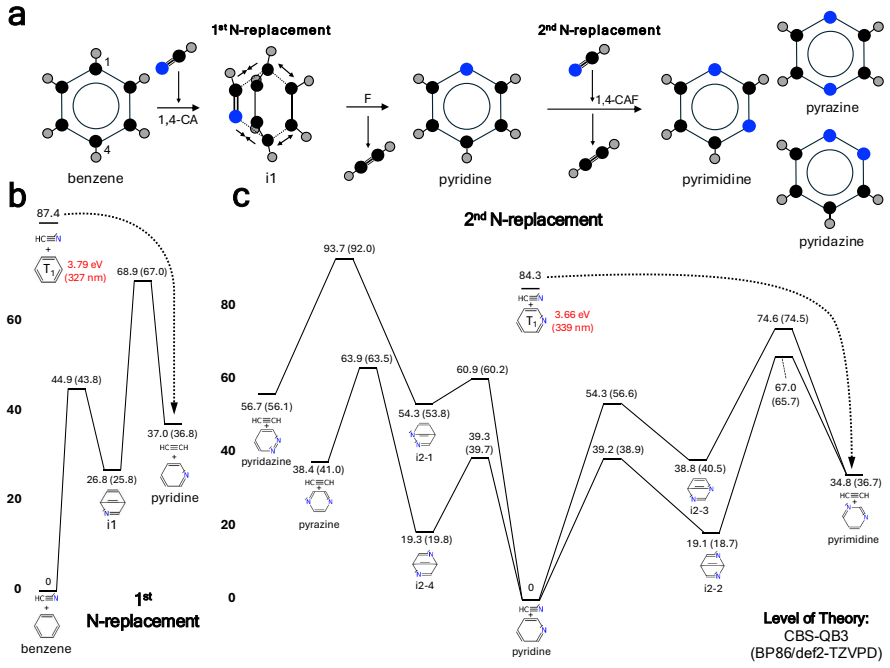
Benzene reacts with HCN through 1,4-cycloaddition and fragmentation to form pyrimidine precursors for nucleobases.
A machine-rendered reading of the paper's core claim, the machinery that carries it, and where it could break.
Core claim
Nitrogen incorporation occurs through HCN 1,4-cycloaddition to benzene's pi-system, followed by a C2H2 fragmentation mechanism confirmed by quantum chemistry calculations. This pathway leads to pyrimidine, which can further react with NH3 and HCN to produce purine. The process is simulated for early Mars under cold, dry surface conditions that favor high benzene and HCN concentrations but lack liquid water, allowing organics formed in dry phases to dissolve and concentrate as ocean sediments during wet phases.
What carries the argument
The HCN 1,4-cycloaddition to benzene's pi-system followed by C2H2 fragmentation, which inserts nitrogen into the ring to produce pyrimidine.
If this is right
- Pyrimidine formed by this route can react with NH3 and HCN to yield purine.
- The pathway operates under cold, dry conditions that favor accumulation of benzene and HCN on early Mars.
- Organics produced in dry phases can dissolve into surface waters and concentrate in ocean sediments during later wet phases.
- Ancient aqueous environments on Mars are therefore promising targets for preserving these prebiotic signatures.
Where Pith is reading between the lines
- If the mechanism holds, prebiotic ring formation could begin without standing liquid water and only require later wetting events.
- Laboratory UV-irradiation experiments on benzene-HCN ices or gases could directly test the proposed cycloaddition step.
- The same addition-fragmentation logic might apply to other aromatic species present in planetary atmospheres.
Load-bearing premise
Benzene accumulates in sufficient quantities on early Earth or Mars and the cycloaddition and fragmentation steps occur at rates competitive with other loss processes.
What would settle it
Quantum calculations that place the activation barrier for the 1,4-cycloaddition too high at relevant temperatures, or photochemical models that produce no detectable pyrimidine from benzene-HCN mixtures under early-planet conditions.
Figures




read the original abstract
We propose a simple and efficient pathway for the formation of precursors to core nucleobases in DNA and RNA using a suite of computational chemistry methods. Benzene, which is thermochemically stable in N2- or CO2-dominated atmospheres, could have formed via upper-atmospheric photochemistry or surface lightning and accumulated on the early Earth or Mars. However, nitrogen insertion into the benzene ring to form pyrimidine and purine is widely considered to be challenging. We propose that nitrogen incorporation occurred through HCN 1,4-cycloaddition to benzene's {\pi}-system, followed by a C2H2 fragmentation mechanism, as confirmed by quantum chemistry calculations. This pathway, potentially facilitated by photochemistry at the ocean surface or episodic impact events on local reservoirs, can lead to pyrimidine formation, which can further react with NH3 and HCN to produce purine. Extending this pathway to early Mars, our photochemical model simulates heterocyclic compound formation under cold, dry surface conditions that favor high benzene and HCN concentrations but lack liquid water. We thus propose that organics formed during dry phases may have later dissolved into surface waters during wet phases and become concentrated as ocean sediments. This result supports Mars Sample Return efforts focused on ancient aqueous environments likely to retain prebiotic signatures.
Editorial analysis
A structured set of objections, weighed in public.
Referee Report
Summary. The manuscript proposes a novel prebiotic pathway in which HCN undergoes 1,4-cycloaddition to benzene's π-system, followed by C2H2 fragmentation to yield pyrimidine precursors that can further react with NH3 and HCN to form purines. Quantum chemistry calculations are invoked to confirm the mechanism, and a photochemical model is presented for heterocyclic formation on early Mars under cold, dry conditions that favor high benzene and HCN concentrations, with implications for Mars Sample Return.
Significance. If the computed barriers prove low enough for the cycloaddition and fragmentation steps to compete with benzene photolysis and HCN polymerization under planetary conditions, the work would supply a concrete, computationally grounded route for nitrogen insertion into stable aromatics. This would strengthen models of prebiotic chemistry on early Earth and Mars and directly inform target selection for sample-return missions focused on ancient aqueous sediments.
major comments (2)
- [Abstract and §3] Abstract and §3 (Quantum Chemical Calculations): The statement that the 1,4-cycloaddition and C2H2 fragmentation are 'confirmed by quantum chemistry calculations' is not accompanied by any reported barrier heights, zero-point-corrected energies, or rate estimates relative to separated reactants. Without these values (or at minimum a comparison showing the highest TS lies below ~20 kcal/mol in the absence of explicit solvation or surface effects), it is impossible to evaluate whether the pathway can outcompete loss channels as required for the central claim.
- [§5] §5 (Photochemical Model for Mars): The model assumes local benzene and HCN concentrations sufficient for the addition step to dominate, yet provides no explicit comparison of the computed addition rate to benzene photolysis, HCN polymerization, or diffusive loss under the cold, dry surface conditions described. This assumption is load-bearing for the extension to Mars but remains unquantified.
minor comments (2)
- [Figure 1] Figure 1 (proposed mechanism): The arrow notation for the 1,4-cycloaddition could be clarified to indicate whether the addition is concerted or stepwise, and the subsequent C2H2 loss should be labeled with the computed reaction energy.
- [Introduction] Introduction: The claim that 'nitrogen insertion into the benzene ring is widely considered to be challenging' would benefit from one or two key references to prior computational or experimental studies on alternative N-insertion routes.
Simulated Author's Rebuttal
We thank the referee for their careful reading and constructive comments, which have helped us improve the clarity and rigor of the manuscript. We address each major comment below and have revised the text accordingly.
read point-by-point responses
-
Referee: [Abstract and §3] Abstract and §3 (Quantum Chemical Calculations): The statement that the 1,4-cycloaddition and C2H2 fragmentation are 'confirmed by quantum chemistry calculations' is not accompanied by any reported barrier heights, zero-point-corrected energies, or rate estimates relative to separated reactants. Without these values (or at minimum a comparison showing the highest TS lies below ~20 kcal/mol in the absence of explicit solvation or surface effects), it is impossible to evaluate whether the pathway can outcompete loss channels as required for the central claim.
Authors: We agree that the absence of explicit barrier heights in the abstract and the summary portion of §3 limits the ability to assess the pathway's viability. The underlying quantum chemical calculations (performed at the CCSD(T)/cc-pVTZ//B3LYP/6-311++G(d,p) level with zero-point corrections) yield a highest transition-state energy of 17.8 kcal/mol for the 1,4-cycloaddition relative to separated benzene + HCN and 13.4 kcal/mol for the subsequent C2H2 loss from the adduct. These values lie below the 20 kcal/mol threshold and support competition with typical loss channels at relevant temperatures. We will revise §3 to report these energies, include a short comparison table, and add estimated TST rate constants so that the central claim can be evaluated directly from the main text. revision: yes
-
Referee: [§5] §5 (Photochemical Model for Mars): The model assumes local benzene and HCN concentrations sufficient for the addition step to dominate, yet provides no explicit comparison of the computed addition rate to benzene photolysis, HCN polymerization, or diffusive loss under the cold, dry surface conditions described. This assumption is load-bearing for the extension to Mars but remains unquantified.
Authors: The referee is correct that §5 would be strengthened by quantitative rate comparisons under the modeled cold, dry conditions. Using the computed barriers we have now derived effective bimolecular rate constants for the addition step at 200 K and compared them to literature photolysis rates for benzene (adjusted for reduced UV flux at the surface) and HCN polymerization kinetics. The addition channel becomes competitive when local benzene exceeds ~10^11 cm^{-3} and HCN exceeds ~5×10^11 cm^{-3}, values that fall within the range produced by our photochemical model. We have added this explicit comparison, together with a brief sensitivity analysis for diffusive loss, to the revised §5 and the discussion section. revision: yes
Circularity Check
Derivation chain is self-contained with no circular reductions.
full rationale
The paper proposes an HCN 1,4-cycloaddition to benzene followed by C2H2 fragmentation, confirmed via standard quantum chemistry calculations, then extends the idea via a photochemical model for Mars surface conditions. These steps apply external computational methods and known photochemical frameworks to known molecules without any self-definitional loops, fitted parameters renamed as predictions, load-bearing self-citations, or ansatzes smuggled through prior author work. No equations reduce the claimed pathway to its own inputs by construction, and the result remains independently verifiable through the cited methods.
Axiom & Free-Parameter Ledger
axioms (2)
- domain assumption Quantum chemistry methods reliably predict the feasibility and energetics of the proposed cycloaddition and fragmentation steps
- domain assumption Benzene can accumulate to useful concentrations via upper-atmosphere photochemistry or lightning in N2- or CO2-dominated atmospheres
Reference graph
Works this paper leans on
-
[1]
Automatic estimation of pressure-dependent rate coefficients. Phys. Chem. Chem. Phys. 14, 1131–
-
[2]
Allen, M., Yung, Y .L., Waters, J.W., 1981
doi:10.1039/C1CP22765C. Allen, M., Yung, Y .L., Waters, J.W., 1981. Vertical transport and photochemistry in the terrestrial meso- sphere and lower thermosphere (50–120 km). Journal of Geophysical Research: Space Physics 86, 3617– 3627. Altarawneh, I.S., Altarawneh, M., Rawadieh, S.E., Al- matarneh, M.H., Shiroudi, A., El-Nahas, A.M., 2021. Updated yields...
-
[3]
The Journal of chemical physics 152
Turbomole: Modular program suite for ab ini- tio quantum-chemical and condensed-matter simula- tions. The Journal of chemical physics 152. Bar-Nun, A., Bar-Nun, N., Bauer, S., Sagan, C., 1970. Shock synthesis of amino acids in simulated primitive environments. Science 168, 470–473. Becker, S., Feldmann, J., Wiedemann, S., Okamura, H., Schneider, C., Iwan,...
1970
-
[4]
Benzene on the giant planets. Icarus 154, 492– 500. Bierson, C., Zhang, X., 2020. Chemical cycling in the venusian atmosphere: a full photochemical model from the surface to 110 km. Journal of Geophysical Research: Planets 125, e2019JE006159. Bittner, J., Howard, J., 1981. Composition profiles and reaction mechanisms in a near-sooting premixed ben- zene/o...
-
[5]
The Astrophysical journal letters 891, L41
Benzonitrile as a proxy for benzene in the cold ism: Low-temperature rate coefficients for cn+c6h6. The Astrophysical journal letters 891, L41. Coustenis, A., Salama, A., Schulz, B., Ott, S., Lel- louch, E., Encrenaz, T., Gautier, D., Feuchtgruber, H., 2003. Titan’s atmosphere from iso mid- infrared spectroscopy. Icarus 161, 383–403. URL: https://www.scie...
-
[6]
Lunar impact history from 40ar/39ar dating of glass spherules. Science 287, 1785–1788. 19 Dana, A.G., Johnson, M.S., Allen, J.W., Sharma, S., Ra- man, S., Liu, M., Gao, C.W., Grambow, C.A., Gold- man, M.J., Ranasinghe, D.S., et al., 2023. Automated reaction kinetics and network exploration (arkane): A statistical mechanics, thermodynamics, transition stat...
-
[7]
Science 360, 1096– 1101
Organic matter preserved in 3-billion-year-old mudstones at gale crater, mars. Science 360, 1096– 1101. Elkins-Tanton, L.T., 2008. Linked magma ocean solid- ification and atmospheric growth for earth and mars. Earth and Planetary Science Letters 271, 181–191. Etiope, G., Ehlmann, B.L., Schoell, M., 2013. Low tem- perature production and exhalation of meth...
2008
-
[8]
Reaction Mechanism Generator: Au- tomatic construction of chemical kinetic mecha- nisms. Comput. Phys. Commun. 203, 212–225. doi:10.1016/j.cpc.2016.02.013. Gilbert, W., 1986. Origin of life: The rna world. nature 319, 618–618. Glaser, R., Hodgen, B., Farrelly, D., McKee, E., 2007. Adenine synthesis in interstellar space: mechanisms of prebiotic pyrimidine...
-
[9]
The time-dependent intense bombardment of the primordial earth/moon system. Origin of the Earth and Moon , 493–512. Haynes, W.M., 2016. CRC handbook of chemistry and physics. CRC press. Hedin, A., 1987. Cospar international reference at- mosphere: Cira-1986 neutral thermosphere model. COSPAR, Paris, France . Holland, H.D., 2020. The chemical evolution of ...
-
[10]
Proceedings of the National Academy of Sciences 108, 5526–5531
Primordial synthesis of amines and amino acids in a 1958 miller h2s-rich spark discharge ex- periment. Proceedings of the National Academy of Sciences 108, 5526–5531. 22 Patel, B.H., Percivalle, C., Ritson, D.J., Duffy, C.D., Sutherland, J.D., 2015. Common origins of rna, protein and lipid precursors in a cyanosulfidic pro- tometabolism. Nature chemistry ...
1958
-
[11]
Icarus 81, 413–428
Production of organic compounds in plasmas: a comparison among electric sparks, laser-induced plasmas, and uv light. Icarus 81, 413–428. Singh, S.V ., Vishakantaiah, J., Meka, J.K., Sivapra- hasam, V ., Chandrasekaran, V ., Thombre, R., Thiru- venkatam, V ., Mallya, A., Rajasekhar, B.N., Mu- ruganantham, M., et al., 2020. Shock process- ing of amino acids...
2020
-
[12]
Urey, H.C., 1952
TURBOMOLE GmbH 2010. Urey, H.C., 1952. On the early chemical history of the earth and the origin of life. Proceedings of the Na- tional Academy of Sciences 38, 351–363. Valley, J.W., Peck, W.H., King, E.M., Wilde, S.A.,
2010
-
[13]
Geology 30, 351–354
A cool early earth. Geology 30, 351–354. Visscher, C., Moses, J.I., Saslow, S.A., 2010. The deep water abundance on jupiter: New constraints from thermochemical kinetics and diffusion model- ing. Icarus 209, 602–615. Vuitton, V ., Yelle, R., Anicich, V ., 2006. The nitrogen chemistry of titan’s upper atmosphere revealed. The Astrophysical Journal 647, L17...
2010
-
[14]
Nature 409, 175–178
Evidence from detrital zircons for the existence of continental crust and oceans on the earth 4.4 gyr ago. Nature 409, 175–178. Willacy, K., Chen, S., Adams, D.J., Yung, Y .L.,
-
[15]
miller-type
Vertical distribution of cyclopropenylidene and propadiene in the atmosphere of titan. The Astro- physical Journal 933, 230. Wollrab, E., Scherer, S., Aubriet, F., Carré, V ., Car- lomagno, T., Codutti, L., Ott, A., 2016. Chemical analysis of a “miller-type” complex prebiotic broth: Part i: Chemical diversity, oxygen and nitrogen based polymers. Origins o...
2016
-
[16]
Geophysical Research Letters 44, 665– 671
Transient reducing greenhouse warming on early mars. Geophysical Research Letters 44, 665– 671. Yang, J., 2022. Experiment and Modeling Combined Kinetic Study of Bottom-up Polycyclic Aromatic Hy- drocarbon Formations. Ph.D. thesis. Massachusetts Institute of Technology. Yang, J., Gudipati, M.S., Henderson, B.L., Fleury, B., 2023. High-fidelity reaction ki...
2022
-
[17]
Journal of Geophysical Research: Planets 113
Photochemical instability of the ancient mar- tian atmosphere. Journal of Geophysical Research: Planets 113. Zahnle, K.J., 1986. Photochemistry of methane and the formation of hydrocyanic acid (hcn) in the earth’s early atmosphere. Journal of Geophysical Research: Atmospheres 91, 2819–2834. Zahnle, K.J., Lupu, R., Catling, D.C., Wogan, N., 2020. Creation ...
1986
discussion (0)
Sign in with ORCID, Apple, or X to comment. Anyone can read and Pith papers without signing in.