Recognition: unknown
A Model of Annihilogenesis
Pith reviewed 2026-05-09 20:24 UTC · model grok-4.3
The pith
Right-handed neutrinos confined in shrinking false-vacuum pockets generate the observed baryon asymmetry through CP-violating 2-to-4 annihilations.
A machine-rendered reading of the paper's core claim, the machinery that carries it, and where it could break.
Core claim
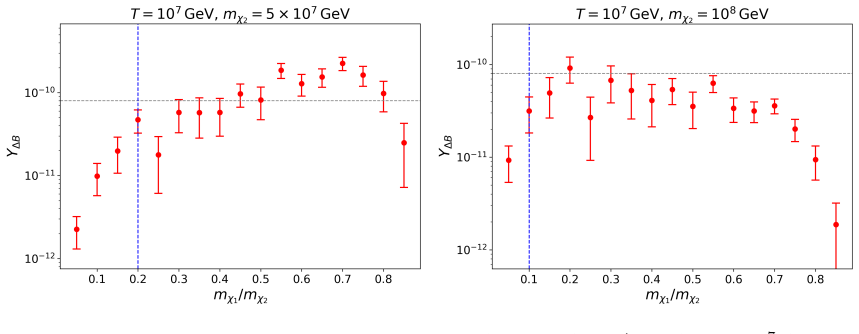
In this annihilogenesis scenario two right-handed Majorana neutrinos χ1 and χ2 couple to Standard Model lepton doublets and the Higgs. During a strong first-order phase transition of a singlet scalar they experience a large mass shift. The lighter neutrino χ1 is reflected off expanding bubble walls and trapped in false-vacuum pockets whose volume shrinks, increasing its density. The dominant CP-violating reaction is the 2→4 annihilation χ1χ1 → L1L1Φ*Φ*. Interference between tree-level W/B exchange and one-loop diagrams containing χ2 yields a numerical CP asymmetry |ε| ∼ 10^{-9}–10^{-7} for O(1) Yukawas. Sphalerons then convert the lepton asymmetry into a baryon asymmetry Y_ΔB that reproduces
What carries the argument
The 2→4 annihilation χ1 χ1 → L1 L1 Φ* Φ* inside collapsing false-vacuum pockets, with CP asymmetry generated by interference between tree-level gauge exchange and one-loop diagrams involving the heavier χ2.
If this is right
- The observed baryon asymmetry is reproduced across a broad region of parameter space with little dependence on bubble-wall velocity or initial pocket size.
- The Majorana mass controlling the CP asymmetry is the residual value inside the pockets, decoupling it from the post-transition mass and from the light neutrino masses.
- The upper bound on |ε| that arises in thermal leptogenesis from the largest light neutrino mass does not apply.
- Lower limits on the right-handed neutrino mass scale and on the reheating temperature are relaxed relative to standard leptogenesis.
- The mechanism works for O(1) Yukawa couplings and produces |ε| in the 10^{-9}–10^{-7} range.
Where Pith is reading between the lines
- The model could be compatible with right-handed neutrino masses low enough to be probed at future colliders or in neutrino experiments.
- Signatures of the required strong first-order phase transition might appear in gravitational-wave detectors or in precision Higgs studies.
- Similar pocket-confinement dynamics could be applied to other asymmetry-generating processes that rely on out-of-equilibrium annihilations.
Load-bearing premise
That the 2-to-4 annihilation supplies the dominant source of CP violation and that the resulting lepton asymmetry survives without being erased by other processes inside the pockets before sphalerons act.
What would settle it
A detailed calculation showing that additional scatterings or decays inside the pockets wash out the asymmetry to far below the value needed for the observed baryon density, or a measurement of the light neutrino masses that forces the residual pocket mass of χ1 below the range where |ε| reaches 10^{-9}.
Figures


read the original abstract
We present an explicit model of leptogenesis via annihilogenesis in which two right-handed Majorana neutrinos couple to the Standard Model lepton doublets and Higgs, and acquire a large mass shift during a strong first-order phase transition of an additional scalar singlet. As bubbles of true vacuum expand, the $\chi_a$ are reflected off the walls and confined to shrinking pockets of false vacuum, where the density grows and the dominant CP-violating process is the $2 \to 4$ annihilation $\chi_1 \chi_1 \to L_1 L_1 \Phi^* \Phi^*$. Interference between tree-level $W$ and $B$ exchange and one-loop diagrams containing the heavier $\chi_2$ produces a CP asymmetry $\epsilon$, which we evaluate numerically and find to lie in the range $|\epsilon| \sim 10^{-9}$--$10^{-7}$ for $\mathcal{O}(1)$ Yukawa couplings. Electroweak sphalerons convert the resulting lepton asymmetry into a baryon asymmetry $Y_{\Delta B}$ that reproduces the observed value across a broad region of parameter space, with little sensitivity to the bubble-wall velocity or initial pocket size. The Majorana mass that controls $\epsilon$ is the residual mass of $\chi_1$ inside the collapsing pockets rather than its post-transition value, so the usual relation between the singlet mass and the Standard Model active neutrino masses is relaxed. As a result, the upper bound on $|\epsilon|$ from the largest light-neutrino mass that constrains standard thermal leptogenesis does not apply, and the lower limits on the right-handed-neutrino scale and the reheating temperature are relaxed.
Editorial analysis
A structured set of objections, weighed in public.
Referee Report
Summary. The paper proposes an explicit model of leptogenesis via annihilogenesis. Two right-handed Majorana neutrinos χ1, χ2 couple to SM leptons and Higgs, acquiring a mass shift during a strong first-order phase transition of an additional scalar singlet. As true-vacuum bubbles expand, χ1 particles are confined to shrinking false-vacuum pockets where their density rises; the dominant CP-violating process is the 2→4 annihilation χ1 χ1 → L1 L1 Φ* Φ*. Interference between tree-level W/B exchange and one-loop diagrams with χ2 yields |ε| ∼ 10^{-9}–10^{-7} for O(1) Yukawas (evaluated numerically). Electroweak sphalerons convert the resulting lepton asymmetry into a baryon asymmetry Y_ΔB that matches observations across broad parameter space, with little sensitivity to bubble-wall velocity or initial pocket size. The controlling Majorana mass is the residual value inside the pockets, relaxing the usual link to active neutrino masses and associated bounds on the RH-neutrino scale.
Significance. If the numerical evaluation of ε and the survival of the asymmetry against washout are confirmed by explicit rate comparisons and Boltzmann evolution, the model offers a concrete realization of annihilogenesis that generates the observed Y_ΔB while relaxing the upper bound on |ε| from the largest light-neutrino mass that constrains standard thermal leptogenesis. This would provide a viable alternative pathway with lower requirements on the reheating temperature and RH-neutrino masses.
major comments (2)
- [§4] §4 (CP asymmetry and numerical evaluation): The manuscript states that ε is evaluated numerically and lies in the range 10^{-9}–10^{-7}, yet supplies neither the explicit expression for the interference term between the tree-level W/B diagrams and the one-loop χ2 diagrams, nor the definition of the residual mass shift inside the pockets, nor any error analysis or parameter scan details. This is load-bearing because the central claim that |ε| falls in the required window for broad parameter space rests on this unverified numerical result.
- [§5] §5 (Baryon asymmetry and sphaleron conversion): The claim that sphalerons convert the lepton asymmetry to the observed Y_ΔB with little sensitivity to wall velocity or pocket size assumes the CP asymmetry survives without significant washout. No comparison of the 2→4 annihilation rate to inverse 4→2 processes, 2→2 lepton-number-violating scatterings, or other channels inside the pockets is presented, nor is the Boltzmann equation for the asymmetry evolution solved. This is load-bearing for the reproduction of Y_ΔB across broad parameter space.
minor comments (2)
- [§2] The Lagrangian for the additional scalar singlet and its coupling to the phase transition is introduced without an explicit potential or vacuum expectation value expression; adding these would improve clarity of the mass-shift mechanism.
- [§3] Notation for the Yukawa couplings and the two Majorana neutrinos (χ1 vs. χ2) is used consistently but would benefit from a summary table of all free parameters and their ranges.
Simulated Author's Rebuttal
We thank the referee for the careful reading of our manuscript and the constructive comments. We address each major comment below and will incorporate revisions to provide the requested details and strengthen the presentation of our results.
read point-by-point responses
-
Referee: [§4] §4 (CP asymmetry and numerical evaluation): The manuscript states that ε is evaluated numerically and lies in the range 10^{-9}–10^{-7}, yet supplies neither the explicit expression for the interference term between the tree-level W/B diagrams and the one-loop χ2 diagrams, nor the definition of the residual mass shift inside the pockets, nor any error analysis or parameter scan details. This is load-bearing because the central claim that |ε| falls in the required window for broad parameter space rests on this unverified numerical result.
Authors: We agree that the explicit details of the numerical evaluation are necessary to support the central claim. The manuscript reports the range |ε| ∼ 10^{-9}–10^{-7} obtained from the interference between tree-level W/B exchange and one-loop χ2 diagrams but does not display the full analytic expression or the scan methodology. In the revised manuscript we will add the explicit formula for the CP-violating interference term in §4, define the residual mass shift inside the false-vacuum pockets as the effective Majorana mass of χ1 in the unbroken phase (distinct from its post-transition value), and include a new appendix with the numerical integration procedure, convergence checks, error estimates, and the full parameter scan over O(1) Yukawa couplings that produces the quoted range. revision: yes
-
Referee: [§5] §5 (Baryon asymmetry and sphaleron conversion): The claim that sphalerons convert the lepton asymmetry to the observed Y_ΔB with little sensitivity to wall velocity or pocket size assumes the CP asymmetry survives without significant washout. No comparison of the 2→4 annihilation rate to inverse 4→2 processes, 2→2 lepton-number-violating scatterings, or other channels inside the pockets is presented, nor is the Boltzmann equation for the asymmetry evolution solved. This is load-bearing for the reproduction of Y_ΔB across broad parameter space.
Authors: We acknowledge that explicit verification of washout suppression is required to substantiate the robustness of Y_ΔB. The manuscript argues that the 2→4 process dominates inside the high-density pockets and that the asymmetry survives with little sensitivity to wall velocity or pocket size, but does not present rate comparisons or a Boltzmann solution. In the revision we will add to §5 a direct comparison of the 2→4 annihilation rate against the inverse 4→2 and 2→2 lepton-number-violating channels inside the pockets, together with a numerical solution of the Boltzmann equation for the asymmetry evolution. This will demonstrate that washout remains negligible and that the observed Y_ΔB is reproduced across the broad parameter space with the stated insensitivity. revision: yes
Circularity Check
No circularity: explicit diagram calculation and parameter-independent conversion claim
full rationale
The paper computes the CP asymmetry ε numerically from interference between tree-level W/B exchange and one-loop χ2 diagrams, treating Yukawa couplings and the residual Majorana mass inside pockets as independent inputs; the resulting |ε| range is an output, not a fit. Sphaleron conversion to Y_ΔB matching observation is asserted across broad parameter space with stated insensitivity to wall velocity and pocket size, but this follows from the model dynamics rather than reducing to a definitional equivalence or self-citation. No load-bearing self-citations, ansatze smuggled via prior work, or uniqueness theorems appear in the provided text. The skeptic concern about missing Boltzmann washout equations addresses verification and completeness, not circularity in the derivation chain itself.
Axiom & Free-Parameter Ledger
free parameters (3)
- Yukawa couplings
- bubble-wall velocity
- initial pocket size
axioms (3)
- domain assumption A strong first-order phase transition occurs for the additional scalar singlet
- domain assumption Electroweak sphalerons efficiently convert lepton asymmetry to baryon asymmetry
- ad hoc to paper No other washout processes dominate inside the false-vacuum pockets
invented entities (2)
-
Additional scalar singlet
no independent evidence
-
Two right-handed Majorana neutrinos χ1 and χ2
no independent evidence
Reference graph
Works this paper leans on
-
[1]
D. Bodeker and W. Buchmuller,Baryogenesis from the weak scale to the grand unification scale,Rev. Mod. Phys.93(2021) 035004 [2009.07294]
-
[2]
J.M. Cline,Baryogenesis, inLes Houches Summer School - Session 86: Particle Physics and Cosmology: The Fabric of Spacetime, 9, 2006 [hep-ph/0609145]
-
[3]
D.E. Morrissey and M.J. Ramsey-Musolf,Electroweak baryogenesis,New J. Phys.14(2012) 125003 [1206.2942]
work page Pith review arXiv 2012
-
[4]
Sakharov,Violation of CP Invariance, C asymmetry, and baryon asymmetry of the universe,Pisma Zh
A.D. Sakharov,Violation of CP Invariance, C asymmetry, and baryon asymmetry of the universe,Pisma Zh. Eksp. Teor. Fiz.5(1967) 32
1967
- [5]
- [6]
-
[7]
S. Profumo, M.J. Ramsey-Musolf, C.L. Wainwright and P. Winslow,Singlet-catalyzed electroweak phase transitions and precision Higgs boson studies,Phys. Rev. D91(2015) 035018 [1407.5342]
-
[8]
J. Kozaczuk, S. Profumo, L.S. Haskins and C.L. Wainwright,Cosmological Phase Transitions and their Properties in the NMSSM,JHEP01(2015) 144 [1407.4134]
-
[9]
Vaskonen,Electroweak baryogenesis and gravitational waves from a real scalar singlet,Phys
V. Vaskonen,Electroweak baryogenesis and gravitational waves from a real scalar singlet,Phys. Rev. D95(2017) 123515 [1611.02073]
-
[10]
G.C. Dorsch, S.J. Huber, T. Konstandin and J.M. No,A Second Higgs Doublet in the Early Universe: Baryogenesis and Gravitational Waves,JCAP05(2017) 052 [1611.05874]
- [11]
-
[12]
A. Beniwal, M. Lewicki, M. White and A.G. Williams,Gravitational waves and electroweak baryogenesis in a global study of the extended scalar singlet model,JHEP02(2019) 183 [1810.02380]
work page Pith review arXiv 2019
-
[13]
Electroweak phase transition and baryogenesis in composite higgs models,
S. Bruggisser, B. Von Harling, O. Matsedonskyi and G. Servant,Electroweak Phase Transition and Baryogenesis in Composite Higgs Models,JHEP12(2018) 099 [1804.07314]
- [14]
-
[15]
K. Kainulainen, V. Keus, L. Niemi, K. Rummukainen, T.V.I. Tenkanen and V. Vaskonen,On the validity of perturbative studies of the electroweak phase transition in the Two Higgs Doublet model,JHEP06(2019) 075 [1904.01329]
work page Pith review arXiv 2019
-
[16]
Linde,Fate of the False Vacuum at Finite Temperature: Theory and Applications,Phys
A.D. Linde,Fate of the False Vacuum at Finite Temperature: Theory and Applications,Phys. Lett. B100(1981) 37
1981
-
[17]
Langer,Statistical theory of the decay of metastable states,Annals Phys.54(1969) 258
J.S. Langer,Statistical theory of the decay of metastable states,Annals Phys.54(1969) 258
1969
-
[18]
Minkowski,µ→eγat a Rate of One Out of109 Muon Decays?,Phys
P. Minkowski,µ→eγat a Rate of One Out of109 Muon Decays?,Phys. Lett. B67(1977) 421
1977
-
[19]
Yanagida,Horizontal gauge symmetry and masses of neutrinos,Conf
T. Yanagida,Horizontal gauge symmetry and masses of neutrinos,Conf. Proc. C7902131 (1979) 95
1979
-
[20]
Glashow,The Future of Elementary Particle Physics,NATO Sci
S.L. Glashow,The Future of Elementary Particle Physics,NATO Sci. Ser. B61(1980) 687
1980
-
[21]
Complex Spinors and Unified Theories
M. Gell-Mann, P. Ramond and R. Slansky,Complex Spinors and Unified Theories,Conf. Proc. C790927(1979) 315 [1306.4669]
work page Pith review arXiv 1979
-
[22]
Mohapatra and G
R.N. Mohapatra and G. Senjanovic,Neutrino Masses and Mixings in Gauge Models with Spontaneous Parity Violation,Phys. Rev. D23(1981) 165
1981
-
[23]
Fukugita and T
M. Fukugita and T. Yanagida,Baryogenesis Without Grand Unification,Phys. Lett. B174 (1986) 45
1986
- [24]
-
[25]
W. Buchmuller and M. Plumacher,Matter antimatter asymmetry and neutrino properties, Phys. Rept.320(1999) 329 [hep-ph/9904310]
-
[26]
Luty,Baryogenesis via leptogenesis,Phys
M.A. Luty,Baryogenesis via leptogenesis,Phys. Rev. D45(1992) 455
1992
-
[27]
T. Gherghetta and G. Jungman,Cosmological consequences of spontaneous lepton number violation in SO(10) grand unification,Phys. Rev. D48(1993) 1546 [hep-ph/9302212]
-
[28]
Plumacher,Baryogenesis and lepton number violation,Z
M. Plumacher,Baryogenesis and lepton number violation,Z. Phys. C74(1997) 549 [hep-ph/9604229]
work page internal anchor Pith review arXiv 1997
-
[29]
Plumacher,Baryon asymmetry, neutrino mixing and supersymmetric SO(10) unification, Nucl
M. Plumacher,Baryon asymmetry, neutrino mixing and supersymmetric SO(10) unification, Nucl. Phys. B530(1998) 207 [hep-ph/9704231]
- [30]
-
[31]
W. Buchmuller and M. Plumacher,Neutrino masses and the baryon asymmetry,Int. J. Mod. Phys. A15(2000) 5047 [hep-ph/0007176]
-
[32]
W. Buchmuller, P. Di Bari and M. Plumacher,Leptogenesis for pedestrians,Annals Phys.315 (2005) 305 [hep-ph/0401240]. – 17 –
work page Pith review arXiv 2005
-
[33]
Towards a complete theory of thermal leptogenesis in the SM and MSSM
G.F. Giudice, A. Notari, M. Raidal, A. Riotto and A. Strumia,Towards a complete theory of thermal leptogenesis in the SM and MSSM,Nucl. Phys. B685(2004) 89 [hep-ph/0310123]
work page internal anchor Pith review Pith/arXiv arXiv 2004
-
[34]
A. Pilaftsis and T.E.J. Underwood,Electroweak-scale resonant leptogenesis,Phys. Rev. D72 (2005) 113001 [hep-ph/0506107]
- [35]
-
[36]
The importance of flavor in leptogenesis
E. Nardi, Y. Nir, E. Roulet and J. Racker,The Importance of flavor in leptogenesis,JHEP01 (2006) 164 [hep-ph/0601084]
work page Pith review arXiv 2006
- [37]
-
[38]
R. Barbieri, P. Creminelli, A. Strumia and N. Tetradis,Baryogenesis through leptogenesis, Nucl. Phys. B575(2000) 61 [hep-ph/9911315]
-
[39]
M.-C. Chen,TASI 2006 Lectures on Leptogenesis, inTheoretical Advanced Study Institute in Elementary Particle Physics: Exploring New Frontiers Using Colliders and Neutrinos, pp. 123–176, 3, 2007 [hep-ph/0703087]
-
[40]
S. Davidson,Flavoured Leptogenesis, in12th International Workshop on Neutrinos Telescopes: Twenty Years after the Supernova 1987A Neutrino Bursts Discovery, pp. 531–545, 5, 2007 [0705.1590]
-
[41]
E. Nardi,Recent issues in leptogenesis, in42nd Rencontres de Moriond on Electroweak Interactions and Unified Theories, pp. 349–356, 6, 2007 [0706.0487]
-
[42]
Nardi,Topics in Leptogenesis,AIP Conf
E. Nardi,Topics in Leptogenesis,AIP Conf. Proc.917(2007) 82 [hep-ph/0702033]
-
[43]
A. Strumia and F. Vissani,Neutrino masses and mixings and...,hep-ph/0606054
-
[44]
A. Strumia,Baryogenesis via leptogenesis, inLes Houches Summer School on Theoretical Physics: Session 84: Particle Physics Beyond the Standard Model, pp. 655–680, 8, 2006 [hep-ph/0608347]
-
[45]
K. Hamaguchi, H. Murayama and T. Yanagida,Leptogenesis from N dominated early universe, Phys. Rev. D65(2002) 043512 [hep-ph/0109030]
-
[46]
A lower bound on the right-handed neutrino mass from leptogenesis
S. Davidson and A. Ibarra,A Lower bound on the right-handed neutrino mass from leptogenesis,Phys. Lett. B535(2002) 25 [hep-ph/0202239]
work page Pith review arXiv 2002
-
[47]
Weinberg,Cosmological Constraints on the Scale of Supersymmetry Breaking,Phys
S. Weinberg,Cosmological Constraints on the Scale of Supersymmetry Breaking,Phys. Rev. Lett.48(1982) 1303
1982
-
[48]
Khlopov and A.D
M.Y. Khlopov and A.D. Linde,Is It Easy to Save the Gravitino?,Phys. Lett. B138(1984) 265
1984
-
[49]
Big-Bang Nucleosynthesis and Gravitino
M. Kawasaki, K. Kohri, T. Moroi and A. Yotsuyanagi,Big-Bang Nucleosynthesis and Gravitino,Phys. Rev. D78(2008) 065011 [0804.3745]
work page Pith review arXiv 2008
-
[50]
H. Eberl, I.D. Gialamas and V.C. Spanos,Gravitino thermal production, dark matter, and reheating of the Universe,JCAP01(2025) 079 [2408.16043]
- [51]
- [52]
-
[53]
Pilaftsis,Heavy Majorana neutrinos and baryogenesis,Int
A. Pilaftsis,Heavy Majorana neutrinos and baryogenesis,Int. J. Mod. Phys. A14(1999) 1811 [hep-ph/9812256]
-
[54]
M. Flanz, E.A. Paschos, U. Sarkar and J. Weiss,Baryogenesis through mixing of heavy Majorana neutrinos,Phys. Lett. B389(1996) 693 [hep-ph/9607310]
-
[55]
A. Pilaftsis and T.E.J. Underwood,Resonant leptogenesis,Nucl. Phys. B692(2004) 303 [hep-ph/0309342]
work page Pith review arXiv 2004
-
[56]
J. Arakawa, P. Lu and V. Takhistov,Phase Separation Unlocks Resonant Leptogenesis, 2409.12228
-
[57]
J. Arakawa, A. Rajaraman and T.M.P. Tait,Annihilogenesis,JHEP08(2022) 078 [2109.13941]
- [58]
- [59]
- [60]
-
[61]
Arnold,Phase transition temperatures at next-to-leading order,Phys
P.B. Arnold,Phase transition temperatures at next-to-leading order,Phys. Rev. D46(1992) 2628 [hep-ph/9204228]
-
[62]
S. Davidson, E. Nardi and Y. Nir,Leptogenesis,Phys. Rept.466(2008) 105 [0802.2962]
work page Pith review arXiv 2008
-
[63]
Schwartz,Quantum Field Theory and the Standard Model, Cambridge University Press (3, 2014)
M.D. Schwartz,Quantum Field Theory and the Standard Model, Cambridge University Press (3, 2014)
2014
-
[64]
Peter Lepage,A new algorithm for adaptive multidimensional integration,Journal of Computational Physics27(1978) 192
G. Peter Lepage,A new algorithm for adaptive multidimensional integration,Journal of Computational Physics27(1978) 192
1978
-
[65]
Kleiss, W
R. Kleiss, W. Stirling and S. Ellis,A new monte carlo treatment of multiparticle phase space at high energies,Computer Physics Communications40(1986) 359
1986
-
[66]
D. Marfatia and P.-Y. Tseng,Gravitational wave signals of dark matter freeze-out,JHEP02 (2021) 022 [2006.07313]
-
[67]
A. Mégevand and S. Ramírez,Bubble nucleation and growth in slow cosmological phase transitions,Nucl. Phys. B928(2018) 38 [1710.06279]
-
[68]
Witten,Cosmic Separation of Phases,Phys
E. Witten,Cosmic Separation of Phases,Phys. Rev. D30(1984) 272
1984
- [69]
-
[70]
D. Marfatia and P.-Y. Tseng,Correlated gravitational wave and microlensing signals of macroscopic dark matter,JHEP11(2021) 068 [2107.00859]
-
[71]
Denner, H
A. Denner, H. Eck, O. Hahn and J. Kublbeck,Compact Feynman rules for Majorana fermions, Phys. Lett. B291(1992) 278. – 19 –
1992
discussion (0)
Sign in with ORCID, Apple, or X to comment. Anyone can read and Pith papers without signing in.