Recognition: unknown
Pre-inflationary QCD axion stars after moduli domination
Pith reviewed 2026-05-09 20:42 UTC · model grok-4.3
The pith
Early matter domination grows QCD axion perturbations that collapse into stars containing up to half of dark matter.
A machine-rendered reading of the paper's core claim, the machinery that carries it, and where it could break.
Core claim
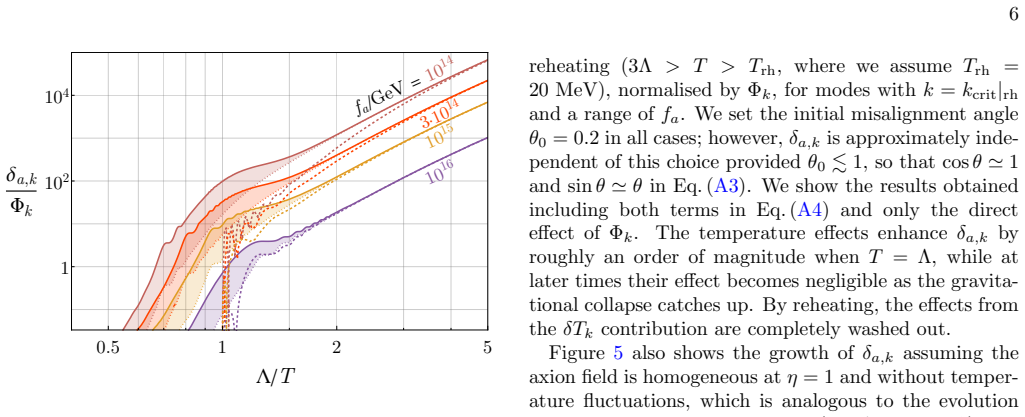
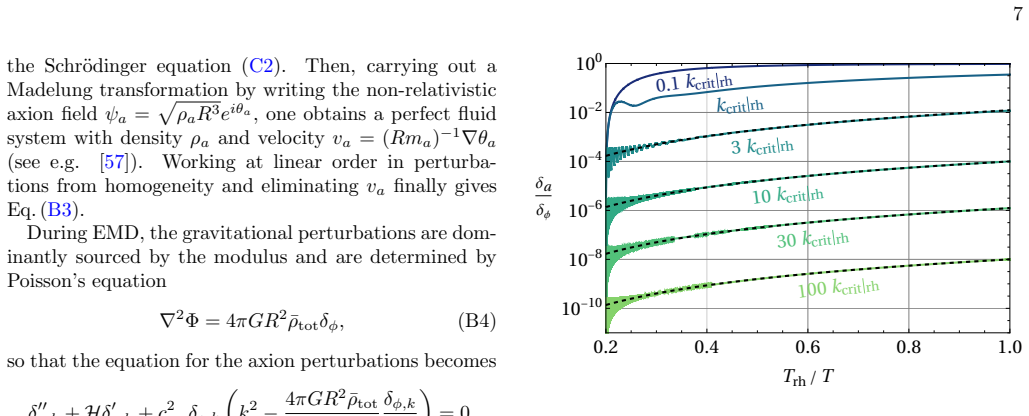
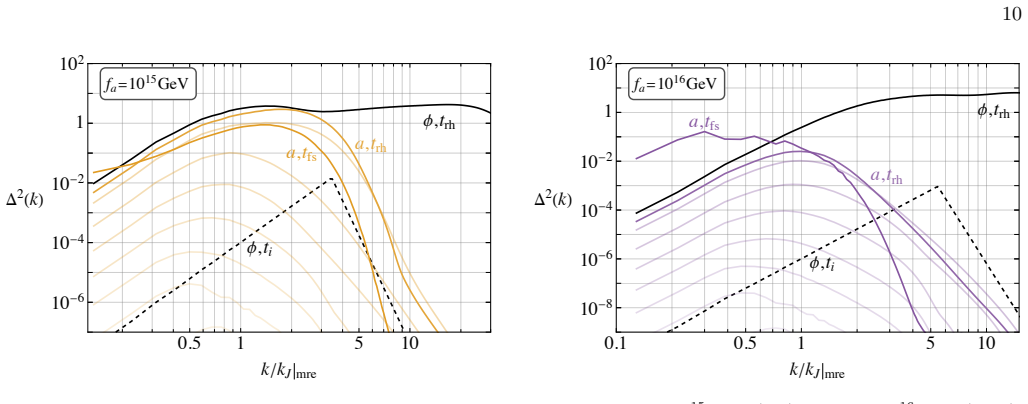
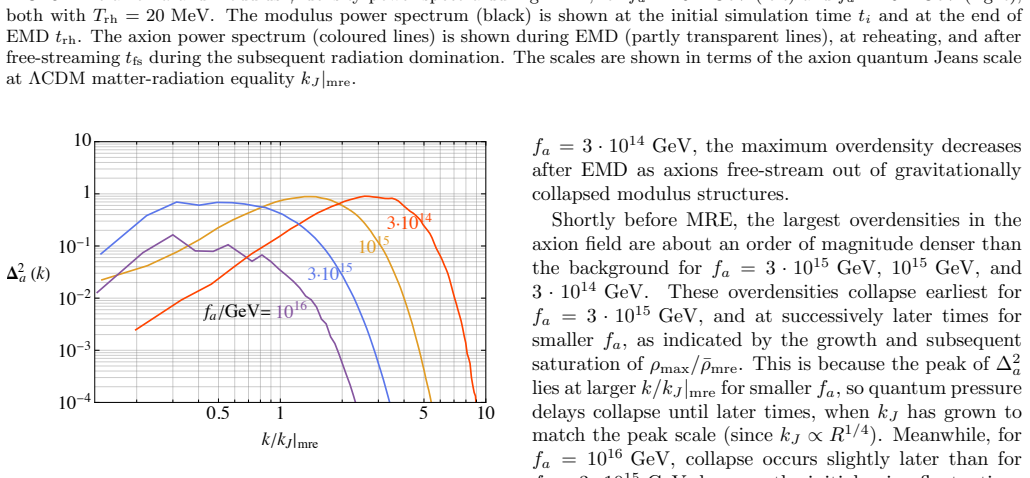
The growth of adiabatic density perturbations during an era of early matter domination induces O(1) fluctuations in pre-inflationary QCD axion dark matter across a broad, string-theory-motivated parameter space. Remarkably, at ΛCDM matter-radiation equality the scale of these perturbations coincides with the quantum Jeans scale, so they collapse to solitonic axion stars. These axion stars have densities up to 10^4 eV^4, and, including their surrounding halos, they contain as much as 50% of dark matter.
What carries the argument
The coincidence of adiabatically grown axion perturbation scales with the quantum Jeans scale at matter-radiation equality, which triggers collapse into solitonic axion stars.
If this is right
- Direct searches for a smooth axion background can be suppressed.
- Transient enhancements or indirect astrophysical signals become possible at axion masses below 10^{-5} eV.
- Axion stars and halos can contain as much as 50% of dark matter with densities up to 10^4 eV^4.
- The scenario requires and signals a non-standard cosmological history with early moduli domination.
Where Pith is reading between the lines
- Clumpy axion distributions from this process could produce distinct small-scale gravitational effects or alter structure formation compared to smooth dark matter.
- Axion searches must interpret results accounting for possible density variations rather than assuming uniformity.
- The mechanism ties axion observations to the duration of moduli domination, providing a potential window into pre-inflationary string cosmology.
Load-bearing premise
A sufficiently long era of moduli domination before inflation allowed axion perturbations to reach order-one amplitudes.
What would settle it
Detection of QCD axions as a perfectly smooth dark matter background with no clustered components or indirect signals at masses below 10^{-5} eV would rule out the predicted collapse and density enhancements.
Figures




read the original abstract
The growth of adiabatic density perturbations during an era of early matter domination induces $\mathcal{O}(1)$ fluctuations in pre-inflationary QCD axion dark matter across a broad, string-theory-motivated parameter space. Remarkably, at $\Lambda$CDM matter-radiation equality the scale of these perturbations coincides with the quantum Jeans scale, so they collapse to solitonic ``axion stars''. These axion stars have densities up to $10^4\,\mathrm{eV}^4$, and, including their surrounding halos, they contain as much as $50\%$ of dark matter. Direct searches for a smooth axion background can be suppressed, but transient enhancements or indirect astrophysical signals at axion masses $m_a\lesssim 10^{-5}\,{\rm eV}$ would point to a non-standard cosmological history.
Editorial analysis
A structured set of objections, weighed in public.
Referee Report
Summary. The manuscript claims that adiabatic density perturbations in pre-inflationary QCD axion dark matter grow to O(1) amplitude during an early moduli-dominated era over a broad string-theory-motivated parameter space. At ΛCDM matter-radiation equality the comoving scale of these perturbations coincides with the axion quantum Jeans scale, causing collapse into solitonic axion stars. These stars reach densities up to 10^4 eV^4 and, together with surrounding halos, comprise up to 50% of the dark matter. The scenario suppresses direct searches for a smooth axion background while predicting transient enhancements or indirect astrophysical signals for m_a ≲ 10^{-5} eV, indicating a non-standard cosmological history.
Significance. If substantiated, the result would be significant for linking early moduli domination to the formation of dense axion stars in a cosmologically motivated setting. It supplies a concrete mechanism that can account for a substantial dark-matter fraction in solitonic objects, yields falsifiable predictions for indirect signals, and illustrates how pre-inflationary dynamics can alter direct-detection prospects. The broad-parameter-space claim, if shown to be robust without additional tuning, would strengthen the connection between string-inspired cosmology and observable axion phenomenology.
major comments (2)
- [Abstract and the section deriving the perturbation amplitude and axion-star densities] The central numerical claims (O(1) fluctuations, densities of 10^4 eV^4, and 50% dark-matter fraction) are asserted in the abstract without accompanying derivation steps, error estimates, or explicit parameter ranges. The full text must demonstrate how the linear growth factor during moduli domination, the onset of axion oscillations, and the subsequent nonlinear collapse produce these specific values.
- [The section on the scale coincidence and parameter-space exploration] The assertion that the perturbation scale 'remarkably' coincides with the quantum Jeans scale at equality across a broad parameter space requires an explicit relation or scan showing that the moduli lifetime is not tuned relative to m_a and the axion oscillation epoch. Without this, the coincidence risks being non-generic, as the growth factor scales with the duration of moduli domination while the Jeans scale depends on m_a and the background density at equality.
Simulated Author's Rebuttal
We thank the referee for the careful reading of our manuscript and the constructive comments. We appreciate the positive assessment of the potential significance of linking early moduli domination to axion star formation. We have revised the manuscript to provide more explicit derivations, error estimates, and a parameter scan as requested. Our responses to the major comments are given below.
read point-by-point responses
-
Referee: [Abstract and the section deriving the perturbation amplitude and axion-star densities] The central numerical claims (O(1) fluctuations, densities of 10^4 eV^4, and 50% dark-matter fraction) are asserted in the abstract without accompanying derivation steps, error estimates, or explicit parameter ranges. The full text must demonstrate how the linear growth factor during moduli domination, the onset of axion oscillations, and the subsequent nonlinear collapse produce these specific values.
Authors: We agree that the abstract presents the main results concisely and that additional clarity in the derivations would strengthen the manuscript. The full text already contains the underlying calculations in the sections on perturbation evolution and collapse, but we have now expanded these to include a step-by-step outline of the linear growth factor during moduli domination, the condition for axion oscillation onset, and the mapping to nonlinear collapse. We have added explicit error estimates arising from the linear approximation and the range of validity, along with the specific parameter intervals (moduli lifetime and axion decay constant) over which O(1) amplitudes are reached. The quoted density of 10^4 eV^4 follows from the Jeans-scale collapse condition at equality, and the 50% dark-matter fraction is obtained by integrating the collapsed mass fraction over the perturbation spectrum. These revisions make the origin of the numerical values fully transparent. revision: yes
-
Referee: [The section on the scale coincidence and parameter-space exploration] The assertion that the perturbation scale 'remarkably' coincides with the quantum Jeans scale at equality across a broad parameter space requires an explicit relation or scan showing that the moduli lifetime is not tuned relative to m_a and the axion oscillation epoch. Without this, the coincidence risks being non-generic, as the growth factor scales with the duration of moduli domination while the Jeans scale depends on m_a and the background density at equality.
Authors: We thank the referee for this important observation. In the revised manuscript we now derive an explicit analytical relation connecting the moduli lifetime, m_a, and the axion oscillation epoch, demonstrating that the scale coincidence holds generically for string-theory-motivated moduli lifetimes without additional tuning. The growth factor during moduli domination naturally aligns the perturbation scale with the Jeans scale for m_a ≲ 10^{-5} eV. We have added a parameter scan (new figure) over the relevant ranges of moduli mass and axion parameters, showing that the coincidence occurs over a broad fraction of the motivated parameter space. This confirms the result is robust rather than tuned. revision: yes
Circularity Check
No circularity: standard perturbation growth and scale comparison are independent of the claimed outcome
full rationale
The derivation begins from the standard linear growth of adiabatic perturbations during an early moduli-dominated matter era (δ ∝ a), which is external cosmology, then evolves those modes to ΛCDM equality and compares their comoving scale to the independently computed axion quantum Jeans wavenumber k_J(m_a, ρ_eq). The abstract presents the resulting coincidence as a non-generic but observed feature across a broad parameter space rather than a definitional identity or a fitted parameter renamed as a prediction. No self-definitional steps, no fitted inputs called predictions, and no load-bearing self-citations are visible; the central result remains falsifiable against external benchmarks for perturbation evolution and Jeans instability.
Axiom & Free-Parameter Ledger
free parameters (1)
- duration of moduli domination
axioms (3)
- domain assumption QCD axions exist as dark matter and are produced before inflation
- domain assumption An era of moduli domination precedes inflation
- standard math Linear cosmological perturbation theory applies during matter domination
Reference graph
Works this paper leans on
-
[1]
We begin simulations during EMD when the temper- ature of the Universe isT= 100 MeV
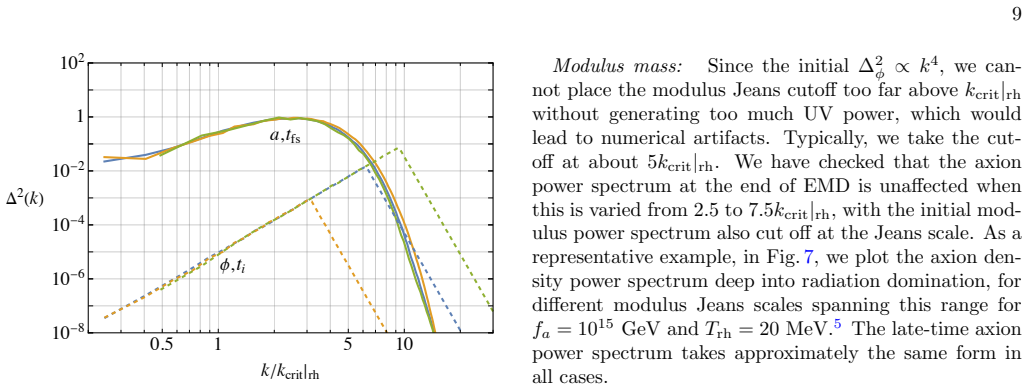
The dimensionlessϕpower spectrum ∆ 2 ϕ is given by Pδ,ϕ = 2π2 k3 ∆2 ϕ(k).(C6) The axion density power spectra are defined analogously. We begin simulations during EMD when the temper- ature of the Universe isT= 100 MeV. At this time, the modulus power spectrum is ∆2 ϕ(k) = 0.0023 k Rma 4 Trh 10 MeV 8 1014 GeV fa 4 , (C7) corresponding to the growth of sub...
-
[2]
and post-inflationary axions [58], which have similar spectra and dynamics around MRE. Lattice spacing:Increasing the resolution by a factor of two does not affect the axion spectrum at the end of EMD, provided not too much modulus power accumu- lates at the lattice scale. Around MRE, finite lattice- spacing effects are not significant while the densest s...
-
[3]
R. D. Peccei and H. R. Quinn, CP Conservation in the Presence of Instantons, Phys. Rev. Lett.38, 1440 (1977)
1977
-
[4]
Wilczek, Problem of StrongPandTInvariance in the Presence of Instantons, Phys
F. Wilczek, Problem of StrongPandTInvariance in the Presence of Instantons, Phys. Rev. Lett.40, 279 (1978)
1978
-
[5]
Weinberg, A New Light Boson?, Phys
S. Weinberg, A New Light Boson?, Phys. Rev. Lett.40, 223 (1978)
1978
-
[6]
P. Svrcek and E. Witten, Axions In String Theory, JHEP06, 051, arXiv:hep-th/0605206
-
[7]
J. P. Conlon, The QCD axion and moduli stabilisation, JHEP05, 078, arXiv:hep-th/0602233
-
[8]
A. Arvanitaki, S. Dimopoulos, S. Dubovsky, N. Kaloper, and J. March-Russell, String Axiverse, Phys. Rev. D81, 123530 (2010), arXiv:0905.4720 [hep-th]
work page internal anchor Pith review arXiv 2010
-
[9]
The type IIB string axiverse and its low-energy phenomenology
M. Cicoli, M. Goodsell, and A. Ringwald, The type IIB string axiverse and its low-energy phenomenology, JHEP10, 146, arXiv:1206.0819 [hep-th]
-
[10]
P. Sikivie, Axion Cosmology, Lect. Notes Phys.741, 19 (2008), arXiv:astro-ph/0610440
-
[11]
J. March-Russell and H. Tillim, Axiverse strings, (2021), arXiv:2109.14637 [hep-th]
- [12]
- [13]
-
[14]
R. Petrossian-Byrne and G. Villadoro, Open string ax- iverse, JHEP07, 049, arXiv:2503.16387 [hep-ph]
-
[15]
V. Loladze, A. Platschorre, and M. Reig, Higher axion strings, JHEP08, 182, arXiv:2503.18707 [hep-ph]
-
[16]
Preskill, M
J. Preskill, M. B. Wise, and F. Wilczek, Cosmology of the Invisible Axion, Phys. Lett. B120, 127 (1983)
1983
-
[17]
L. F. Abbott and P. Sikivie, A Cosmological Bound on the Invisible Axion, Phys. Lett. B120, 133 (1983)
1983
-
[18]
Dine and W
M. Dine and W. Fischler, The Not So Harmless Axion, Phys. Lett. B120, 137 (1983)
1983
-
[19]
G. Grilli di Cortona, E. Hardy, J. Pardo Vega, and G. Villadoro, The QCD axion, precisely, JHEP01, 034, arXiv:1511.02867 [hep-ph]
-
[20]
S. Borsanyiet al., Calculation of the axion mass based on high-temperature lattice quantum chromodynamics, Nature539, 69 (2016), arXiv:1606.07494 [hep-lat]
- [21]
-
[22]
T. Hasegawa, N. Hiroshima, K. Kohri, R. S. L. Hansen, T. Tram, and S. Hannestad, MeV-scale reheating tem- perature and thermalization of oscillating neutrinos by radiative and hadronic decays of massive particles, JCAP12, 012, arXiv:1908.10189 [hep-ph]
-
[23]
J. R. Ellis, D. V. Nanopoulos, and M. Quiros, On the Axion, Dilaton, Polonyi, Gravitino and Shadow Mat- ter Problems in Supergravity and Superstring Models, Phys. Lett. B174, 176 (1986)
1986
- [24]
- [25]
- [26]
-
[27]
Lazarides, R
G. Lazarides, R. K. Schaefer, D. Seckel, and Q. Shafi, Dilution of Cosmological Axions by Entropy Produc- tion, Nucl. Phys. B346, 193 (1990)
1990
-
[28]
M. Kawasaki, T. Moroi, and T. Yanagida, Can de- caying particles raise the upper bound on the Peccei- Quinn scale?, Phys. Lett. B383, 313 (1996), arXiv:hep- ph/9510461
- [29]
-
[30]
L. Visinelli and P. Gondolo, Axion cold dark matter in non-standard cosmologies, Phys. Rev. D81, 063508 (2010), arXiv:0912.0015 [astro-ph.CO]
- [31]
-
[32]
T. Banks and M. Dine, The Cosmology of string theo- retic axions, Nucl. Phys. B505, 445 (1997), arXiv:hep- th/9608197
-
[33]
B. S. Acharya, K. Bobkov, and P. Kumar, An M Theory Solution to the Strong CP Problem and Constraints on the Axiverse, JHEP11, 105, arXiv:1004.5138 [hep-th]
-
[34]
I. Broeckel, M. Cicoli, A. Maharana, K. Singh, and K. Sinha, Moduli stabilisation and the statistics of axion physics in the landscape, JHEP08, 059, [Addendum: JHEP 01, 191 (2022)], arXiv:2105.02889 [hep-th]
- [35]
-
[36]
L. Visinelli and J. Redondo, Axion Miniclusters in Mod- ified Cosmological Histories, Phys. Rev. D101, 023008 (2020), arXiv:1808.01879 [astro-ph.CO]
- [37]
-
[38]
R. Wiley Deal, K. Sankharva, K. Sinha, and S. Watson, Multi-component Dark Matter and small scale structure formation, JHEP02, 085, arXiv:2308.16242 [hep-ph]
- [39]
- [40]
- [41]
-
[42]
J. Bramante, C. V. Cappiello, M. Diamond, J. L. Kim, Q. Liu, and A. C. Vincent, Dissipative dark cosmology: From early matter dominance to delayed compact objects, Phys. Rev. D110, 043041 (2024), arXiv:2405.04575 [hep-ph]
- [43]
-
[44]
G. Barenboim and J. Rasero, Structure Formation dur- ing an early period of matter domination, JHEP04, 138, arXiv:1311.4034 [hep-ph]
- [45]
-
[46]
G. Barenboim, N. Blinov, and A. Stebbins, Smallest remnants of early matter domination, JCAP12(12), 026, arXiv:2107.10293 [astro-ph.CO]
-
[47]
H. Ganjoo and M. S. Delos, Simulations of gravitational heating due to early matter domination, JCAP04, 015, arXiv:2306.14961 [astro-ph.CO]
-
[48]
Systematics of Moduli Stabilisation in Calabi-Yau Flux Compactifications
V. Balasubramanian, P. Berglund, J. P. Conlon, and F. Quevedo, Systematics of moduli stabilisation in Calabi-Yau flux compactifications, JHEP03, 007, arXiv:hep-th/0502058
-
[49]
J. P. Conlon, F. Quevedo, and K. Suruliz, Large- volume flux compactifications: Moduli spectrum and D3/D7 soft supersymmetry breaking, JHEP08, 007, arXiv:hep-th/0505076
- [50]
-
[51]
R. J. Scherrer and M. S. Turner, Decaying Particles Do Not Heat Up the Universe, Phys. Rev. D31, 681 (1985)
1985
-
[52]
D. J. Gross, R. D. Pisarski, and L. G. Yaffe, QCD and Instantons at Finite Temperature, Rev. Mod. Phys.53, 43 (1981)
1981
-
[53]
Planck 2018 results. VI. Cosmological parameters
N. Aghanimet al.(Planck), Planck 2018 results. VI. Cosmological parameters, Astron. Astrophys.641, A6 (2020), [Erratum: Astron.Astrophys. 652, C4 (2021)], arXiv:1807.06209 [astro-ph.CO]
work page internal anchor Pith review arXiv 2018
-
[54]
A. Arvanitaki, S. Dimopoulos, M. Galanis, L. Lehner, J. O. Thompson, and K. Van Tilburg, Large- misalignment mechanism for the formation of compact axion structures: Signatures from the QCD axion to fuzzy dark matter, Phys. Rev. D101, 083014 (2020), arXiv:1909.11665 [astro-ph.CO]
-
[55]
Ruffini and S
R. Ruffini and S. Bonazzola, Systems of selfgravitat- ing particles in general relativity and the concept of an equation of state, Phys. Rev.187, 1767 (1969)
1969
-
[56]
Membrado, A
M. Membrado, A. F. Pacheco, and J. Sa˜ nudo, Hartree solutions for the self-Yukawian boson sphere, Phys. Rev. A39, 4207 (1989)
1989
- [57]
-
[58]
L. Visinelli, S. Baum, J. Redondo, K. Freese, and F. Wilczek, Dilute and dense axion stars, Phys. Lett. B777, 64 (2018), arXiv:1710.08910 [astro-ph.CO]
-
[59]
M. Gorghetto, E. Hardy, J. March-Russell, N. Song, and S. M. West, Dark photon stars: formation and role as dark matter substructure, JCAP08(08), 018, arXiv:2203.10100 [hep-ph]
-
[60]
M. Gorghetto, E. Hardy, and G. Villadoro, More ax- ion stars from strings, JHEP08, 126, arXiv:2405.19389 [hep-ph]
- [61]
-
[62]
P.-H. Chavanis, Maximum mass of relativistic self- gravitating Bose-Einstein condensates with repulsive or attractive —φ—4 self-interaction, Phys. Rev. D107, 103503 (2023), arXiv:2211.13237 [gr-qc]
- [63]
- [64]
- [65]
- [66]
- [67]
- [68]
-
[69]
DMRadio-Core: A new approach for GUT-scale axion searches
V. Ankelet al., DMRadio-Core: A new approach for GUT-scale axion searches, (2026), arXiv:2604.16602 [hep-ex]
work page internal anchor Pith review Pith/arXiv arXiv 2026
-
[70]
P. Tinyakov, I. Tkachev, and K. Zioutas, Tidal streams from axion miniclusters and direct axion searches, JCAP01, 035, arXiv:1512.02884 [astro-ph.CO]
- [71]
- [72]
-
[73]
E. Braaten, A. Mohapatra, and H. Zhang, Emission of Photons and Relativistic Axions from Axion Stars, Phys. Rev. D96, 031901 (2017), arXiv:1609.05182 [hep- ph]
-
[74]
M. Fairbairn, D. J. E. Marsh, J. Quevillon, and S. Rozier, Structure formation and microlensing with axion miniclusters, Phys. Rev. D97, 083502 (2018), arXiv:1707.03310 [astro-ph.CO]
-
[75]
M. Fairbairn, D. J. E. Marsh, and J. Quevillon, Search- ing for the QCD Axion with Gravitational Microlensing, Phys. Rev. Lett.119, 021101 (2017), arXiv:1701.04787 [astro-ph.CO]
- [76]
- [77]
-
[78]
M. Escudero, C. K. Pooni, M. Fairbairn, D. Blas, X. Du, and D. J. E. Marsh, Axion star explosions: A new source for axion indirect detection, Phys. Rev. D109, 043018 (2024), arXiv:2302.10206 [hep-ph]
- [79]
- [80]
discussion (0)
Sign in with ORCID, Apple, or X to comment. Anyone can read and Pith papers without signing in.