Recognition: unknown
Efficient Mutation Testing of Quantum Machine Learning Models
Pith reviewed 2026-05-09 20:23 UTC · model grok-4.3
The pith
New mutation operations for quantum neural networks produce a more diverse set of test faults than prior methods.
A machine-rendered reading of the paper's core claim, the machinery that carries it, and where it could break.
Core claim
The work defines new mutation operations for efficient fault insertion into quantum neural network circuits compared to state-of-the-art approaches and presents a directed mutation generation technique to reduce redundant mutant circuits. Extensive experimental evaluation shows that the approach generates a more diverse and representative set of mutants, addressing faults that traditional techniques fail to expose.
What carries the argument
New mutation operations for quantum circuits in neural network models together with a directed mutant generation process that prioritizes diversity over redundancy.
Load-bearing premise
The newly defined mutation operations correspond to realistic faults that occur in actual implementations of quantum neural networks.
What would settle it
A controlled test in which quantum neural networks containing known implementation bugs are evaluated with both the new mutants and traditional mutants, and the new set fails to detect the bugs at a meaningfully higher rate.
Figures



read the original abstract
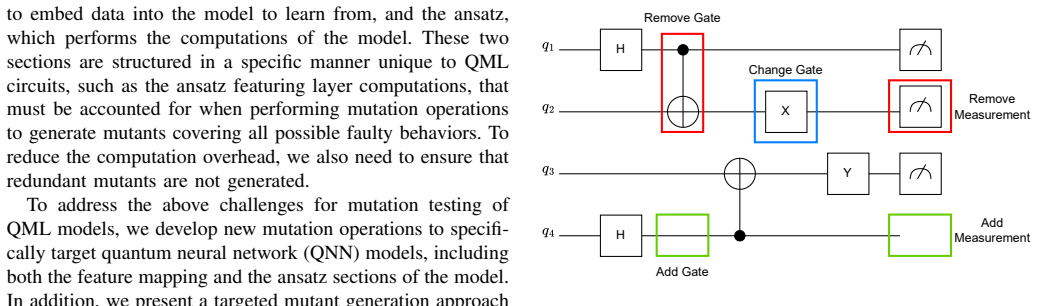
Quantum machine learning integrates the strengths of quantum computing and machine learning, enabling models to learn complex features using fewer parameters than their classical counterparts. Due to the increasing complexity of quantum machine learning models, it is necessary to verify that the implementation of these models satisfy the design specification and be free of bugs and faults. Mutation testing is a promising avenue to identify faulty quantum circuits that do not meet design specifications or contain defects by intentionally inserting faults into the quantum circuit. It is necessary to define mutation operations to inject faults into quantum circuits to ensure that a test suite is robust enough to evaluate an implementation against its design specification. In this paper, we extend mutation testing to quantum machine learning applications, primarily quantum neural network models. Specifically, this paper makes two important contributions. We define new mutation operations for efficient fault insertion compared to state-of-the-art approaches. We also present a directed mutation generation technique to reduce redundant mutant circuits. Extensive experimental evaluation demonstrates that our approach generates a more diverse and representative set of mutants, effectively addressing faults that traditional techniques fail to expose.
Editorial analysis
A structured set of objections, weighed in public.
Referee Report
Summary. The paper extends mutation testing to quantum neural networks (QNNs) by defining new mutation operators for more efficient fault insertion than prior approaches and introducing a directed mutation generation method to reduce redundant mutants. It claims that extensive experiments show the resulting mutants are more diverse and representative, exposing faults that traditional mutation techniques miss.
Significance. If the proposed operators and generation method can be shown to correspond to plausible real-world defects, the work would offer a practical advance in verifying QML implementations, an area of growing importance. The efficiency and diversity claims could reduce the cost of mutation testing for quantum circuits. However, without grounding in documented hardware or compilation errors, the significance remains conditional on future validation against actual faulty QNNs.
major comments (3)
- [§3/§4 (mutation operator definitions)] Section defining the mutation operators (likely §3 or §4): The new operators are introduced as extensions for efficiency, yet the manuscript supplies no explicit mapping or citation to documented real-world QNN faults, gate miscalibrations, compilation errors, or NISQ error models (e.g., from IBM or Rigetti hardware reports). This makes the central claim that the mutants 'address faults that traditional techniques fail to expose' rest on an unverified assumption rather than demonstrated correspondence.
- [§5 (experimental evaluation)] Experimental evaluation section (likely §5): The abstract states that the approach generates 'a more diverse and representative set of mutants,' but the provided description gives no quantitative definition of diversity (e.g., mutant coverage metrics, entropy measures, or distance to traditional mutants), no statistical significance tests, and no clear baselines or oracle of real faulty circuits. Without these, the experimental demonstration cannot substantiate superiority over state-of-the-art.
- [§4 (directed generation)] Directed mutation generation technique (likely §4): The method is claimed to reduce redundancy, but the manuscript does not report how redundancy is measured (e.g., equivalence checking, output distribution distance) or provide ablation results isolating its contribution from the new operators alone.
minor comments (2)
- [Abstract] The abstract mentions 'quantum machine learning models, primarily quantum neural network models' but does not clarify whether results generalize beyond QNNs or specify the circuit depths and qubit counts used in experiments.
- [Throughout] Notation for quantum gates and mutation effects should be standardized with explicit circuit diagrams or pseudocode to aid reproducibility.
Simulated Author's Rebuttal
We thank the referee for the constructive and detailed feedback. We address each major comment below, providing clarifications based on the manuscript content and indicating planned revisions where appropriate to improve grounding and experimental rigor.
read point-by-point responses
-
Referee: [§3/§4 (mutation operator definitions)] Section defining the mutation operators (likely §3 or §4): The new operators are introduced as extensions for efficiency, yet the manuscript supplies no explicit mapping or citation to documented real-world QNN faults, gate miscalibrations, compilation errors, or NISQ error models (e.g., from IBM or Rigetti hardware reports). This makes the central claim that the mutants 'address faults that traditional techniques fail to expose' rest on an unverified assumption rather than demonstrated correspondence.
Authors: We acknowledge that the manuscript does not include an explicit per-operator mapping or direct citations to specific IBM/Rigetti hardware reports. The operators were designed to target faults common in QNNs, such as parameter miscalibrations in variational layers and multi-qubit gate errors arising during compilation, which extend beyond single-gate replacements in prior work. These are motivated by general NISQ characteristics discussed in the introduction. The claim of addressing faults missed by traditional techniques is supported by the experimental results showing higher fault exposure rates. In revision, we will add a dedicated paragraph with citations to established NISQ error models (e.g., on gate infidelity and decoherence) and discuss how each operator aligns with them, while noting that full empirical validation against hardware faults remains future work. revision: partial
-
Referee: [§5 (experimental evaluation)] Experimental evaluation section (likely §5): The abstract states that the approach generates 'a more diverse and representative set of mutants,' but the provided description gives no quantitative definition of diversity (e.g., mutant coverage metrics, entropy measures, or distance to traditional mutants), no statistical significance tests, and no clear baselines or oracle of real faulty circuits. Without these, the experimental demonstration cannot substantiate superiority over state-of-the-art.
Authors: In Section 5, diversity is quantified via the count of distinct output probability distributions across mutants and the fraction of mutants exposing fault types not covered by baseline operators from prior quantum mutation testing literature. Baselines are explicitly the standard single-gate and gate-replacement operators. We report comparative metrics showing increased coverage. However, we agree that entropy measures, statistical tests, and an explicit oracle are absent. The lack of a public oracle of real faulty QNN circuits limits direct comparison, but synthetic faults were constructed to reflect realistic QNN defects. In the revised version, we will incorporate entropy-based diversity metrics, add statistical significance testing (e.g., paired t-tests), and clarify the baseline definitions with additional tables. revision: yes
-
Referee: [§4 (directed generation)] Directed mutation generation technique (likely §4): The method is claimed to reduce redundancy, but the manuscript does not report how redundancy is measured (e.g., equivalence checking, output distribution distance) or provide ablation results isolating its contribution from the new operators alone.
Authors: Redundancy in the directed generation is measured by computing the total variation distance between the output probability distributions of the original circuit and each mutant on a fixed set of input states; mutants below a threshold are pruned as equivalent. This is described in the method but without explicit formulas or ablation. We agree that isolating the contribution via ablation would strengthen the claims. In revision, we will add the precise distance formula, report the reduction in mutant count, and include ablation experiments comparing results with and without the directed pruning step. revision: yes
- Direct empirical validation against a dataset of actual hardware-induced faulty QNN circuits, as no such comprehensive public oracle or benchmark dataset currently exists.
Circularity Check
No circularity: definitions and empirical evaluation are self-contained
full rationale
The paper introduces new mutation operators for quantum neural networks and a directed generation method, then reports experimental results on mutant diversity. No equations, predictions, or first-principles derivations are present that could reduce to fitted parameters, self-definitions, or self-citations. The contributions rest on explicit new definitions plus external experimental comparison, with no load-bearing step that collapses to the authors' own inputs by construction.
Axiom & Free-Parameter Ledger
axioms (1)
- domain assumption Newly defined mutation operations model realistic faults in quantum circuits for machine learning models
Reference graph
Works this paper leans on
-
[1]
An introduction to quantum machine learning,
M. Schuld, I. Sinayskiy, and F. Petruccione, “An introduction to quantum machine learning,”Contemporary Physics, vol. 56, no. 2, pp. 172–185, Apr. 2015
2015
-
[2]
An Analysis and Survey of the Development of Mutation Testing,
Y . Jia and M. Harman, “An Analysis and Survey of the Development of Mutation Testing,”IEEE Transactions on Software Engineering, vol. 37, no. 5, pp. 649–678, Sep. 2011
2011
-
[3]
Muskit: A Mutation Analysis Tool for Quantum Software Testing,
E. Mendiluze, S. Ali, P. Arcaini, and T. Yue, “Muskit: A Mutation Analysis Tool for Quantum Software Testing,” in2021 36th IEEE/ACM International Conference on Automated Software Engineering (ASE), Nov. 2021, pp. 1266–1270
2021
-
[4]
Mutation Testing of Quantum Programs: A Case Study With Qiskit,
D. Fortunato, J. Campos, and R. Abreu, “Mutation Testing of Quantum Programs: A Case Study With Qiskit,”IEEE Transactions on Quantum Engineering, vol. 3, pp. 1–17, 2022
2022
-
[5]
Quantum circuit mutants: Empirical analysis and recommendations,
E. Mendiluze Usandizaga, S. Ali, T. Yue, and P. Arcaini, “Quantum circuit mutants: Empirical analysis and recommendations,”Empirical Software Engineering, vol. 30, no. 4, p. 100, Apr. 2025
2025
-
[6]
DeepMutation: Mutation Testing of Deep Learning Systems,
L. Ma, F. Zhang, J. Sun, M. Xue, B. Li, F. Juefei-Xu, C. Xie, L. Li, Y . Liu, J. Zhao, and Y . Wang, “DeepMutation: Mutation Testing of Deep Learning Systems,” in2018 IEEE 29th International Symposium on Software Reliability Engineering (ISSRE), Oct. 2018, pp. 100–111
2018
-
[7]
Detecting Adversar- ial Samples for Deep Neural Networks through Mutation Testing,
J. Wang, J. Sun, P. Zhang, and X. Wang, “Detecting Adversar- ial Samples for Deep Neural Networks through Mutation Testing,” arXiv:1805.05010, May 2018
-
[8]
Quantum convolutional neural networks,
I. Cong, S. Choi, and M. D. Lukin, “Quantum convolutional neural networks,”Nature Physics, vol. 15, no. 12, pp. 1273–1278, Dec. 2019
2019
-
[9]
Assessing the Effectiveness of Input and Output Coverage Criteria for Testing Quantum Programs,
S. Ali, P. Arcaini, X. Wang, and T. Yue, “Assessing the Effectiveness of Input and Output Coverage Criteria for Testing Quantum Programs,” in2021 14th IEEE Conference on Software Testing, Verification and Validation (ICST), Apr. 2021, pp. 13–23
2021
-
[10]
Quito: A Coverage-Guided Test Generator for Quantum Programs,
X. Wang, P. Arcaini, T. Yue, and S. Ali, “Quito: A Coverage-Guided Test Generator for Quantum Programs,” in2021 36th IEEE/ACM Inter- national Conference on Automated Software Engineering (ASE), Nov. 2021, pp. 1237–1241
2021
-
[11]
Mutation-based test generation for quantum programs with multi-objective search,
X. Wang, T. Yu, P. Arcaini, T. Yue, and S. Ali, “Mutation-based test generation for quantum programs with multi-objective search,” in Proceedings of the Genetic and Evolutionary Computation Conference, ser. GECCO ’22. New York, NY , USA: Association for Computing Machinery, Jul. 2022, pp. 1345–1353
2022
-
[12]
A. Javadi-Abhari, M. Treinish, K. Krsulich, C. J. Wood, J. Lishman, J. Gacon, S. Martiel, P. D. Nation, L. S. Bishop, A. W. Cross, B. R. Johnson, and J. M. Gambetta, “Quantum computing with Qiskit,” arXiv:2405.08810, Jun. 2024
work page internal anchor Pith review arXiv 2024
-
[13]
M. E. Sahin, E. Altamura, O. Wallis, S. P. Wood, A. Dekusar, D. A. Millar, T. Imamichi, A. Matsuo, and S. Mensa, “Qiskit Machine Learn- ing: An open-source library for quantum machine learning tasks at scale on quantum hardware and classical simulators,”arXiv:2505.17756, May 2025
-
[14]
OpenQASM 3: A broader and deeper quantum assembly language,
A. W. Cross, A. Javadi-Abhari, T. Alexander, N. de Beaudrap, L. S. Bishop, S. Heidel, C. A. Ryan, P. Sivarajah, J. Smolin, J. M. Gambetta, and B. R. Johnson, “OpenQASM 3: A broader and deeper quantum assembly language,”ACM Transactions on Quantum Computing, vol. 3, no. 3, pp. 1–50, Sep. 2022
2022
-
[15]
R. A. Fisher, “Iris,” UCI Machine Learning Repository, 1936
1936
-
[16]
Wine Quality,
P. Cortez, A. Cerdeira, F. Almeida, T. Matos, and J. Reis, “Wine Quality,” UCI Machine Learning Repository, 2009
2009
-
[17]
Breast Cancer Wisconsin (Diagnostic),
W. Wolberg, O. Mangasarian, N. Street, and W. Street, “Breast Cancer Wisconsin (Diagnostic),” UCI Machine Learning Repository, 1993
1993
-
[18]
The MNIST database of handwritten digits,
Y . LeCun, “The MNIST database of handwritten digits,” 1998
1998
-
[19]
Fashion-MNIST: a Novel Image Dataset for Benchmarking Machine Learning Algorithms
H. Xiao, K. Rasul, and R. V ollgraf, “Fashion-MNIST: A Novel Image Dataset for Benchmarking Machine Learning Algorithms,” arXiv:1708.07747, Sep. 2017
work page internal anchor Pith review arXiv 2017
-
[20]
Deep Learning for Classical Japanese Literature
T. Clanuwat, M. Bober-Irizar, A. Kitamoto, A. Lamb, K. Yamamoto, and D. Ha, “Deep Learning for Classical Japanese Literature,” arXiv:1812.01718, Nov. 2018
work page Pith review arXiv 2018
-
[21]
Visualizing Data using t-SNE,
L. van der Maaten and G. Hinton, “Visualizing Data using t-SNE,” Journal of Machine Learning Research, vol. 9, no. 86, pp. 2579–2605, 2008
2008
discussion (0)
Sign in with ORCID, Apple, or X to comment. Anyone can read and Pith papers without signing in.