Recognition: unknown
Radiation Total Dose for PRIMA: Cold Exposure with Alpha Particles
Pith reviewed 2026-05-09 20:28 UTC · model grok-4.3
The pith
Cryogenic alpha exposure tests KIDs at 62% of expected L2 dose
A machine-rendered reading of the paper's core claim, the machinery that carries it, and where it could break.
Core claim
A fully cryogenic irradiation experiment uses a stepper motor to control exposure of aluminum kinetic inductance detector arrays to alpha particles, delivering a controlled dose while the detectors remain at operating temperatures. The damage dose expected from a five-year mission at the Sun-Earth L2 point is calculated, and an array is exposed to approximately 62 percent of this level. Pre- and post-irradiation measurements of quasiparticle lifetimes, resonant frequencies, and quality factors assess the effects.
What carries the argument
The cryogenic stepper-motor controlled screen that blocks or reveals an alpha particle emitter to deliver precise radiation doses to the detectors at sub-Kelvin temperatures.
If this is right
- Future tests can apply the full calculated dose using the same setup.
- Any observed shifts in resonant frequency or quality factor would signal material changes from radiation.
- The data helps set requirements for shielding or detector robustness in the PRIMA design.
- Similar methods could evaluate other far-infrared detector technologies for space.
Where Pith is reading between the lines
- Extending the irradiation to 100% or more of the mission dose would reveal the margin of safety in detector performance.
- Connecting these results to models of quasiparticle generation from particle hits could improve predictions for other orbits.
- The cryogenic control might allow studying annealing effects if the detectors are warmed after exposure.
Load-bearing premise
That alpha particle bombardment at cold temperatures causes the same kind of damage to the detectors as the mixed particle flux at L2.
What would settle it
Observation of no significant change in quasiparticle lifetimes after exposure to 62% of the calculated dose would indicate either less damage than expected or that the method does not fully replicate orbital conditions.
Figures


read the original abstract
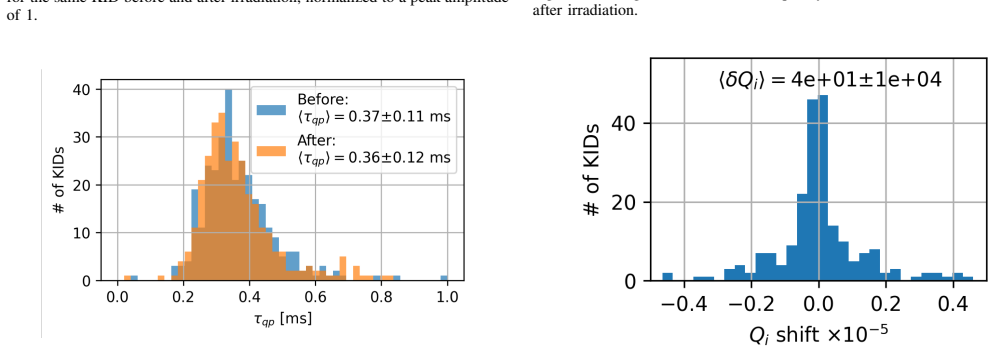
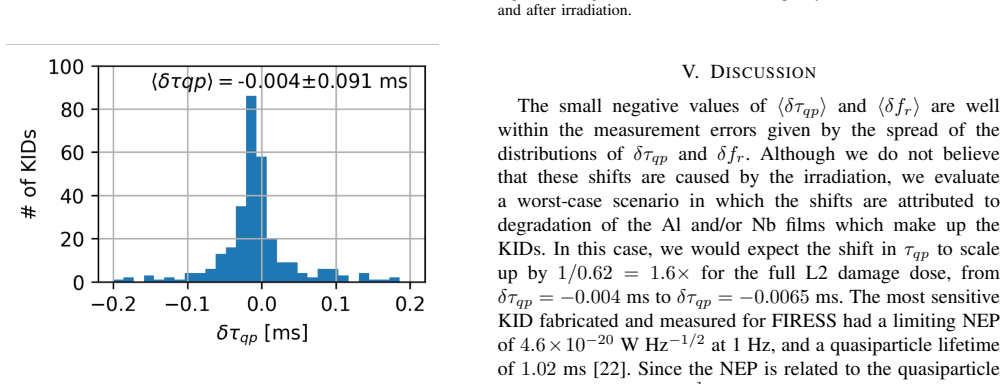
The Probe far-Infrared Mission for Astrophysics (PRIMA) is a far-infrared (24-261 micron wavelengths) probe-class space observatory currently under Phase A study, which promises orders-of-magnitude improvement in mapping speed over its predecessors. PRIMA will field exquisitely sensitive kilopixel arrays of kinetic inductance detectors (KIDs) for the Far-Infrared Enhanced Survey Spectrometer (FIRESS) instrument. PRIMA will orbit in space at the Sun-Earth L2 point, where Planck found the energetic particle flux to be about 300/min/cm2. Thus, the possible effect of a high fluence of energetic particles on the detector sensitivity must be characterized. Previous work has suggested that bombardment of KIDs by ions can reduce the quasiparticle lifetime (Barends et. al. 2009), but the conditions of the experiment were not representative of a detector which is continuously held at sub-Kelvin temperatures in the energetic particle environment of L2 orbit. To better replicate the damage which would be produced by energetic particles in this environment, we developed a fully cryogenic irradiation experiment in which a stepper motor controls a screen which can block or reveal an alpha particle emitter. This setup can be used to irradiate aluminum KID arrays fabricated for FIRESS to well-controlled dose levels. In this work, we calculate the damage dose expected for a 5-year mission in L2 orbit, and we irradiate an array to approximately 62 percent of this level. Before and after irradiation, we measure the quasiparticle lifetimes, resonant frequencies, and quality factors of the detectors.
Editorial analysis
A structured set of objections, weighed in public.
Referee Report
Summary. The manuscript calculates the expected radiation damage dose for PRIMA's kinetic inductance detectors (KIDs) over a 5-year L2 mission using Planck's ~300/min/cm² energetic particle flux, develops a fully cryogenic alpha-particle irradiation apparatus with stepper-motor control to expose arrays at sub-Kelvin temperatures, irradiates one array to ~62% of the calculated mission dose, and states that quasiparticle lifetimes, resonant frequencies, and quality factors were measured before and after to characterize radiation effects.
Significance. If the pre- and post-irradiation data were to show quantifiable (or negligible) shifts in detector parameters under conditions closer to continuous L2 exposure than prior non-cryogenic work, the result would directly inform radiation-hardness requirements for the FIRESS KID arrays and reduce mission risk for PRIMA.
major comments (2)
- [Abstract] Abstract: the central claim is that the effect of radiation on detector sensitivity is characterized via pre- and post-irradiation measurements of quasiparticle lifetimes, resonant frequencies, and quality factors, yet no numerical values, error bars, statistical tests, or figures/tables presenting these data appear in the manuscript. This is load-bearing because the characterization itself is the stated purpose of the irradiation.
- [Experimental setup and dose calculation] Description of irradiation protocol and dose calculation: no scaling via non-ionizing energy loss (NIEL), SRIM, or GEANT4 is provided to demonstrate that the controlled alpha-particle fluence at sub-Kelvin temperature produces damage equivalent to the mixed proton/electron flux at L2 (~300/min/cm²). The assumption is load-bearing for any claim that the 62% dose exposure is representative of the 5-year mission environment.
minor comments (1)
- [Abstract] Abstract: the 62% figure is stated without reference to the specific equation, table, or fluence-to-dose conversion used to arrive at it.
Simulated Author's Rebuttal
We thank the referee for their detailed and constructive review. The comments correctly identify areas where the manuscript's claims and supporting details require clarification and expansion. We address each major comment below and have prepared revisions to the manuscript.
read point-by-point responses
-
Referee: [Abstract] Abstract: the central claim is that the effect of radiation on detector sensitivity is characterized via pre- and post-irradiation measurements of quasiparticle lifetimes, resonant frequencies, and quality factors, yet no numerical values, error bars, statistical tests, or figures/tables presenting these data appear in the manuscript. This is load-bearing because the characterization itself is the stated purpose of the irradiation.
Authors: We agree that the abstract overstates the scope by implying a full characterization with presented results. The current manuscript focuses on the development of the fully cryogenic alpha-particle irradiation apparatus, the calculation of the 5-year L2 mission dose based on Planck flux, and the execution of an exposure to ~62% of that dose on an aluminum KID array. Pre- and post-irradiation measurements of quasiparticle lifetime, resonant frequency, and quality factor were performed, but the detailed numerical values, uncertainties, and analysis are reserved for a companion paper on radiation effects. We have revised the abstract to accurately describe the present work's contributions and added a summary table of the measured parameters (with error bars) plus a brief discussion of observed shifts in the main text. revision: yes
-
Referee: [Experimental setup and dose calculation] Description of irradiation protocol and dose calculation: no scaling via non-ionizing energy loss (NIEL), SRIM, or GEANT4 is provided to demonstrate that the controlled alpha-particle fluence at sub-Kelvin temperature produces damage equivalent to the mixed proton/electron flux at L2 (~300/min/cm²). The assumption is load-bearing for any claim that the 62% dose exposure is representative of the 5-year mission environment.
Authors: The referee is correct that the manuscript does not include explicit NIEL scaling or Monte Carlo simulations (SRIM/GEANT4) to equate alpha-particle damage to the L2 proton/electron spectrum. The dose calculation uses the observed ~300/min/cm² flux and estimated energy deposition for the alpha source in the aluminum film. In the revision, we have added a dedicated subsection comparing NIEL values for 5 MeV alphas versus typical L2 protons in aluminum, with references to prior work on displacement damage in thin-film superconductors. We explain that the cryogenic alpha exposure provides a conservative proxy for total non-ionizing dose under continuous sub-Kelvin conditions, while acknowledging that a full GEANT4 model of the mixed radiation field is beyond the scope of this instrumentation paper. This addition clarifies the assumptions and supports the representativeness of the 62% dose level. revision: yes
Circularity Check
No circularity; experimental characterization uses external Planck flux data
full rationale
The paper calculates the expected 5-year L2 mission damage dose from the Planck-reported energetic particle flux (~300/min/cm²) and performs controlled alpha-particle irradiation to ~62% of that level, followed by direct measurements of quasiparticle lifetime, resonant frequency, and quality factor shifts. No equations, predictions, or first-principles results are derived that reduce to the paper's own fitted inputs or self-citations by construction. The cited Barends et al. (2009) reference is independent prior work with no author overlap. The dose estimate is externally anchored rather than internally fitted, and the equivalence of alpha exposure to mixed L2 particle flux is an explicit modeling assumption, not a self-referential step. The derivation chain is self-contained against external benchmarks.
Axiom & Free-Parameter Ledger
axioms (1)
- domain assumption Energetic particle flux at L2 is approximately 300/min/cm2 (Planck measurement)
Reference graph
Works this paper leans on
-
[1]
Ade, P. A. R., Aghanim, N., Armitage-Caplan, C., Arnaud, M., Ashdown, M., Atrio-Barandela, F., Aumont, J., Baccigalupi, C., Banday, A. J., Barreiro, R. B., Battaner, E., Benabed, K., Beno ˆıt, A., Benoit-L ´evy, A., Bernard, J.-P., Bersanelli, M., Bielewicz, P., Bobin, J., Bock, J. J., . . . Zonca, A. Planck2013 results. X. HFI energetic particle effects:...
2014
-
[2]
Barends, R., van Vliet, S., Baselmans, J. J. A., Yates, S. J. C., Gao, J. R., and Klapwijk, T. M. Enhancement of quasiparticle recombination in Ta and Al superconductors by implantation of magnetic and nonmagnetic atoms.Physical Review B, 79(2). Januaey 2009
2009
-
[3]
Glenn, Jason, et. al. “PRIMA Mission Concept.” Journal of Astronomical Telescopes, Instruments, and Systems, vol. 11, no. 03, SPIE-Intl Soc Optical Eng, July 2025, doi:10.1117/1.jatis.11.3.031628
-
[4]
The Far-Infrared Enhanced Survey Spectrometer for PRIMA: Approach and Estimated Performance
Bradford, C. M. (Matt), et. al. “The Far-Infrared Enhanced Survey Spectrometer for PRIMA: Approach and Estimated Performance.” Journal of Astronomical Telescopes, Instruments, and Systems, vol. 11, no. 03, SPIE-Intl Soc Optical Eng, Oct. 2025, doi:10.1117/1.jatis.11.3.031627
-
[5]
J., Barends, R., Thoen, D
Karatsu, K., Endo, A., Bueno, J., de Visser, P. J., Barends, R., Thoen, D. J., Murugesan, V ., Tomita, N., and Baselmans, J. J. A. Mitigation of cosmic ray effect on microwave kinetic inductance detector arrays. Applied Physics Letters, 114(3), January 2019
2019
-
[6]
Modeling of cosmic rays and near- ir photons in aluminum kids.Journal of Low Temperature Physics, 214(3–4):238–246, February 2024
Elijah Kane, Chris Albert, Jochem Baselmans, Ritoban Basu Thakur, Charles Bradford, Nicholas Cothard, Peter Day, Logan Foote, Steven Hailey-Dunsheath, Reinier Janssen, Henry LeDuc, Lun-Jun Liu, Hien Nguyen, and Jonas Zmuidzinas. Modeling of cosmic rays and near- ir photons in aluminum kids.Journal of Low Temperature Physics, 214(3–4):238–246, February 2024
2024
-
[7]
Interplanetary Proton Fluence Model: JPL 1991
Feynman, J., et. al. “Interplanetary Proton Fluence Model: JPL 1991.” Journal of Geophysical Research: Space Physics, vol. 98, no. A8, American Geophysical Union (AGU), Aug. 1993, pp. 13281–94, doi:10.1029/92ja02670
-
[8]
Tylka, J
A.J. Tylka, J. H. Adams, Jr., P. R. Boberg, B. Brownstein, W. F. Dietrich, E. O. Flueckiger, E. L. Petersen, M. A. Shea, D. F. Smart, and E. C. Smith, CREME96: A Revision of the Cosmic Ray Effects on Micro- Electronics Code IEEE Trans. Nucl. Sci., vol. 44, no. 6, pp. 2150-2160, Dec. 1997
1997
-
[9]
Allison et
Recent Developments in Geant4, J. Allison et. al., Nucl. Instrum. Meth. A 835 (2016) 186-225
2016
-
[10]
Proton Nonionizing Energy Loss (NIEL) for Device Applications
Jun, Insoo, et. al. “Proton Nonionizing Energy Loss (NIEL) for Device Applications.” IEEE Transactions on Nuclear Science, vol. 50, no. 6, Institute of Electrical, Dec. 2003, pp. 1924–28, doi:10.1109/tns.2003.820760
-
[11]
www.osmtec.com
OTC Ltd. www.osmtec.com
-
[12]
https://device.report/manuals/cnc-stepper-motor-driver-zk-smc02
-
[13]
B. S. Melcher and P. T. Timbie. Note: Cryogenic heat switch with step- per motor actuator.Review of Scientific Instruments, 86(12), December 2015
2015
-
[14]
https://bluefors.com/products/dilution-refrigerator-measurement- systems/ld-dilution-refrigerator-measurement-system/
-
[15]
https://bluefors.com/products/pulse-tube-cryocoolers/pt415-pulse-tube- cryocooler/
- [16]
-
[17]
https://next.henkel- adhesives.com/us/en/products/compounds-for-electronics/central- pdp.html/loctite-stycast-2850-ft-blk/369598AE.html
Henkel Adhesive Technologies. https://next.henkel- adhesives.com/us/en/products/compounds-for-electronics/central- pdp.html/loctite-stycast-2850-ft-blk/369598AE.html
-
[18]
https://isotopeproducts.com/
-
[19]
https://www.sr-niel.org/
SR-NIEL-7. https://www.sr-niel.org/
-
[20]
Joshua Montgomery, Wellington Avelino, Matt Dobbs, Joseph Letang, Maclean Rouble, Sofiia Savchyn, and Graeme M. Smecher. The crs: a scalable full-stack control system for microwave kinetic inductance detectors. In Jonas Zmuidzinas and Jian-Rong Gao, editors,Millime- ter, Submillimeter, and Far-Infrared Detectors and Instrumentation for Astronomy XII, page...
2024
-
[21]
L. J. Swenson, P. K. Day, B. H. Eom, H. G. Leduc, N. Llombart, C. M. McKenney, O. Noroozian, and J. Zmuidzinas. Operation of a titanium nitride superconducting microresonator detector in the nonlinear regime. Journal of Applied Physics, 113(10), March 2013
2013
-
[22]
Peter K. Day et. al. A 25-micrometer single-photon-sensitive kinetic inductance detector.Physical Review X, 14(4), October 2024
2024
discussion (0)
Sign in with ORCID, Apple, or X to comment. Anyone can read and Pith papers without signing in.