Recognition: unknown
Characterization of ELM Pacing via Vertical Jogs on DIII-D
Pith reviewed 2026-05-09 19:52 UTC · model grok-4.3
The pith
Vertical plasma jogging at 20 Hz raises ELM frequency from 5 Hz to 20 Hz and halves peak divertor heat flux on DIII-D.
A machine-rendered reading of the paper's core claim, the machinery that carries it, and where it could break.
Core claim
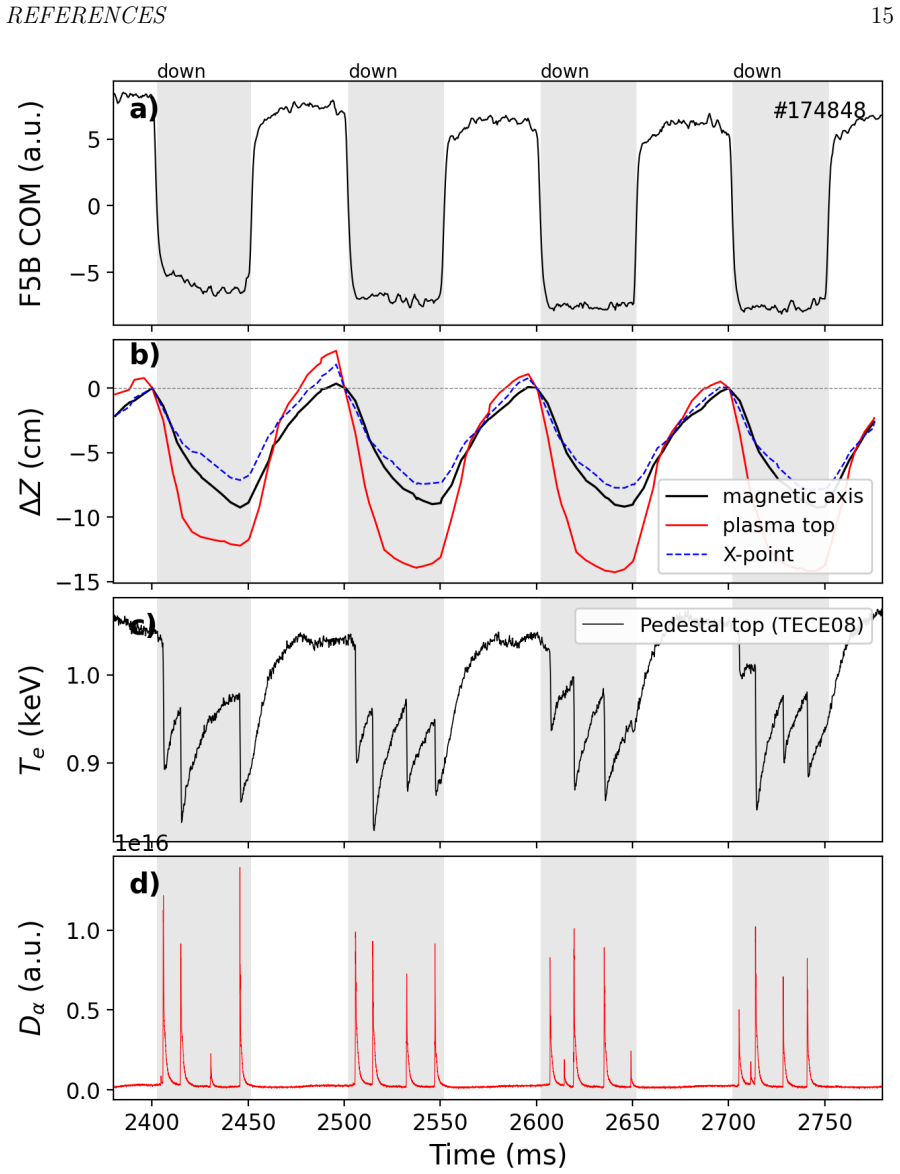
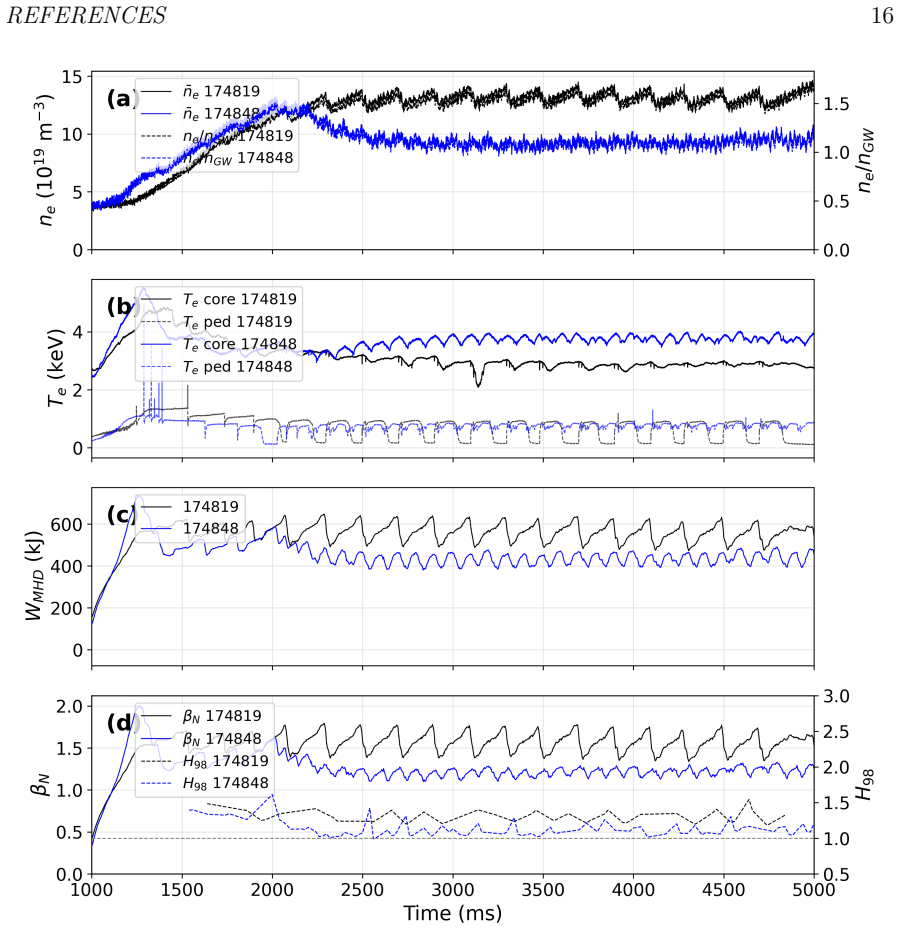
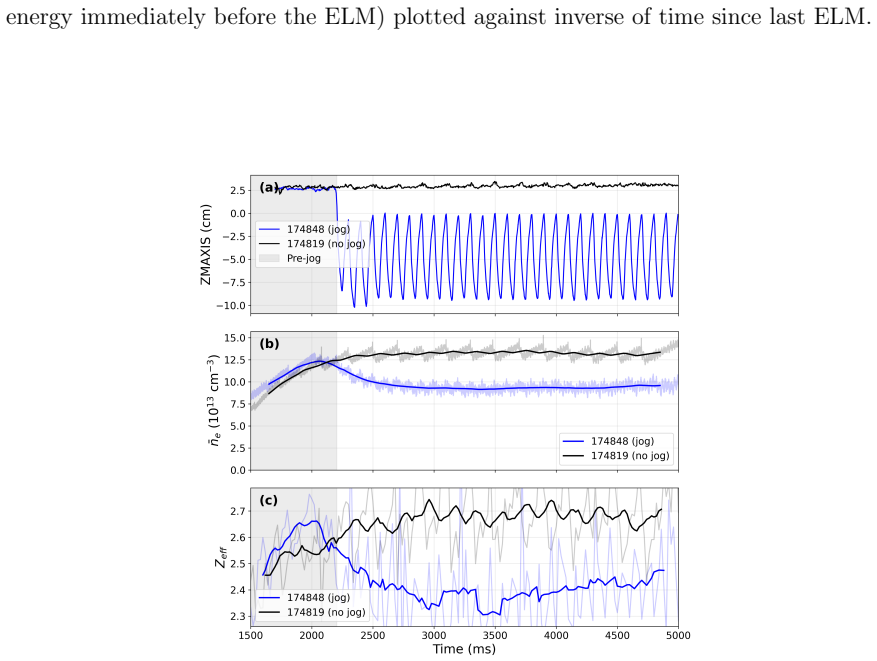
By vertically oscillating the plasma at a rate of 20 Hz, the ELM frequency increased from ∼5 Hz, the natural ELM frequency in similar DIII-D discharges, to 20 Hz. Downward jogs have been observed to trigger multiple ELMs in one cycle. ELMs triggered at higher than natural frequencies lead to smaller decreases in stored energy, from ~10% to as little as below 1%. As a consequence, the peak heat flux to the divertor has been observed to be reduced by a factor of ∼2. In addition, a reduction in the carbon impurity concentration has been observed. The experimental data and model suggest that when the plasma moves down towards the X-point, a net positive toroidal current is locally induced in the
What carries the argument
Vertical jogging that induces a net positive toroidal current in the edge region, which a toy model links to crossing the peeling-ballooning stability boundary.
Load-bearing premise
The vertical movement triggers ELMs mainly by inducing net positive toroidal current in the edge rather than by altering plasma shape or position at the same time.
What would settle it
Direct measurement showing zero or negative net edge toroidal current during jogging while ELMs still occur at the jog frequency.
Figures





read the original abstract
Edge localized mode (ELM) pacing via vertical plasma oscillations or jogging has been successfully demonstrated on DIII-D. Rapid vertical movement of the plasma toward the X-point has been shown to effectively trigger ELMs. By vertically oscillating the plasma at a rate of 20 Hz, the ELM frequency increased from $\sim$5~Hz, the natural ELM frequency in similar DIII-D discharges, to 20~Hz. Downward jogs have been observed to trigger multiple ELMs in one cycle. ELMs triggered at higher than natural frequencies lead to smaller decreases in stored energy, from ~10\% to as little as below 1\%. As a consequence, the peak heat flux to the divertor has been observed to be reduced by a factor of $\sim$2. In addition, a reduction in the carbon impurity concentration has been observed. During downward jogs in the lower single null (LSN) configuration, the X-point movement is slower and smaller than the top of the plasma. As a result, a reduction in the plasma cross section and hence volume has been observed. To understand the mechanism of ELM triggering by jogging, a toy model of the edge toroidal current has been built and tested with DIII-D experiment data. The experimental data and model suggest that when the plasma moves down towards the X-point, a net positive toroidal current is locally induced in the edge region. ELITE stability analysis suggests that this current pushes the plasma state across the peeling side of the peeling-ballooning stability boundary into the unstable region triggering ELMs.
Editorial analysis
A structured set of objections, weighed in public.
Referee Report
Summary. The manuscript reports successful experimental demonstration on DIII-D of ELM pacing by vertical plasma jogging at 20 Hz, raising ELM frequency from the natural ~5 Hz to 20 Hz in lower single-null discharges. Downward jogs are shown to trigger multiple ELMs per cycle, reducing stored-energy losses from ~10% to below 1% and peak divertor heat flux by a factor of ~2, with an accompanying drop in carbon impurity levels. A toy model of edge toroidal current induction is introduced and tested against the data; it predicts a net positive edge current during downward motion toward the X-point. ELITE peeling-ballooning stability calculations are then used to argue that this current shifts the plasma across the stability boundary, providing the trigger mechanism.
Significance. If the experimental pacing result holds, the work supplies a concrete, actuator-based technique for ELM frequency control that could reduce transient heat loads and impurity influx in future devices. The combination of direct DIII-D measurements with a simple inductive toy model and ELITE analysis is a positive feature; the paper also notes the practical benefit of smaller ELMs. The significance would increase if the proposed current-induction mechanism can be cleanly separated from concurrent geometric changes.
major comments (2)
- [mechanism analysis / toy model and ELITE] The central mechanistic claim (abstract and mechanism section) attributes ELM triggering to the toy-model-predicted net positive toroidal current that crosses the peeling side of the ELITE boundary. However, the reported ELITE runs do not hold plasma shape, volume, and q-profile fixed while toggling only the added edge current; the manuscript simultaneously records a measurable reduction in plasma cross-section during downward jogs. Because geometric changes alter edge pressure gradient, connection length, and q independently of the induced current, the attribution remains under-determined without an isolating comparison.
- [experimental results] The experimental claim of reliable 20 Hz pacing (results section) is presented without reported uncertainties, number of cycles or discharges analyzed, or baseline comparison discharges that isolate the jog from other control parameters. This weakens quantitative assessment of how consistently the frequency is raised and how much the heat-flux reduction is attributable to pacing versus other changes.
minor comments (2)
- [ELITE analysis] The abstract and text refer to 'ELITE stability analysis' without specifying the code version, input equilibrium reconstruction method, or the precise definition of the stability boundary used; adding these details would improve reproducibility.
- [figures and results] Figure captions and text should explicitly state whether the plotted heat-flux and stored-energy traces are from single representative cycles or averages, and whether the ~2 reduction factor includes error estimates.
Simulated Author's Rebuttal
We thank the referee for the careful and constructive review of our manuscript on ELM pacing via vertical jogging on DIII-D. The comments identify key areas for clarification in the mechanism analysis and improvements in experimental reporting. We address each point below and indicate the revisions planned for the next version of the manuscript.
read point-by-point responses
-
Referee: The central mechanistic claim (abstract and mechanism section) attributes ELM triggering to the toy-model-predicted net positive toroidal current that crosses the peeling side of the ELITE boundary. However, the reported ELITE runs do not hold plasma shape, volume, and q-profile fixed while toggling only the added edge current; the manuscript simultaneously records a measurable reduction in plasma cross-section during downward jogs. Because geometric changes alter edge pressure gradient, connection length, and q independently of the induced current, the attribution remains under-determined without an isolating comparison.
Authors: We thank the referee for highlighting the need to better isolate the role of induced edge current from concurrent geometric changes. The manuscript already notes the observed reduction in plasma cross-section during downward jogs in LSN configuration. The ELITE calculations use experimentally reconstructed equilibria at the ELM trigger times, which include the measured geometry, pressure profiles, and q-profile. The toy model estimates the additional edge toroidal current induced by the vertical motion toward the X-point. To strengthen the mechanistic attribution, we will add a new subsection with ELITE stability scans that hold the pre-jog geometry and q-profile fixed while varying only the edge current according to the toy-model prediction. This will quantify the current's contribution relative to geometry. We note that in the experiment the jog couples both effects, but the additional analysis will address the under-determination concern. revision: partial
-
Referee: The experimental claim of reliable 20 Hz pacing (results section) is presented without reported uncertainties, number of cycles or discharges analyzed, or baseline comparison discharges that isolate the jog from other control parameters. This weakens quantitative assessment of how consistently the frequency is raised and how much the heat-flux reduction is attributable to pacing versus other changes.
Authors: We agree that additional statistical details and baseline comparisons would strengthen the quantitative claims. In the revised manuscript we will report the number of discharges analyzed (typically 4–6 similar LSN discharges) and the total number of jog cycles (exceeding 100), together with uncertainties or standard deviations on the ELM frequency, stored-energy loss, and peak divertor heat flux. We will also include data from reference discharges without vertical jogging but with matched plasma current, density, and heating power to isolate the pacing effect. These additions will allow a clearer assessment of pacing reliability and the attribution of heat-flux and impurity reductions. revision: yes
Circularity Check
No significant circularity; experimental results and toy model are self-contained
full rationale
The paper's core claims rest on direct DIII-D experimental observations of ELM frequency increase from ~5 Hz to 20 Hz under 20 Hz vertical jogging, with measured reductions in stored energy loss and divertor heat flux. The toy model of induced edge toroidal current is introduced as an interpretive tool built and tested against the same dataset, then combined with standard ELITE peeling-ballooning analysis to suggest a triggering mechanism. No equations, parameter fits, or derivation steps are quoted that reduce any prediction to its inputs by construction (e.g., no fitted parameter renamed as an independent forecast, no self-definitional loop, and no load-bearing self-citation chain). The experimental pacing results stand independently of the model, and the model is presented as explanatory rather than a closed deductive system. This satisfies the default expectation of a non-circular experimental study.
Axiom & Free-Parameter Ledger
axioms (1)
- domain assumption Peeling-ballooning stability boundary governs ELM onset in the edge plasma.
Reference graph
Works this paper leans on
-
[1]
Wagner F, Becker G, Behringer K, Campbell D, Eberhagen A, Engelhardt W, Fussmann G, Gehre O, Gernhardt J, v Gierke G, Haas G, Huang M, Karger F, Keilhacker M, Kl¨ uber O, Kornherr M, Lackner K, Lisitano G, Lister G G, Mayer H M, Meisel D, M¨ uller E R, Murmann H, Niedermeyer H, Poschenrieder W, Rapp H, R¨ ohr H, Schneider F, Siller G, Speth E, St¨ abler A...
-
[2]
Zohm H 1996Plasma Physics and Controlled Fusion38105–128 ISSN 0741-3335
-
[3]
Connor J W 1998Plasma Physics and Controlled Fusion40191–213 URLhttps: //dx.doi.org/10.1088/0741-3335/40/2/003
-
[4]
Plasmas9 2037
Snyder P B, Wilson H R, Ferron J R, Lao L L, Leonard A W, Osborne T H, Turnbull A D, Mossessian D, Murakami M and Xu X Q 2002Phys. Plasmas9 2037
2037
-
[5]
Nelson A O, Laggner F M, Diallo A, Smith D, Xing Z A, Shousha R and Kolemen E 2021Nuclear Fusion61116038
-
[6]
Fusion54033007
Loarte A, Huijsmans G, Futatani S, Baylor L R, Evans T E, Orlov D M, Schmitz O, Becoulet M, Cahyna P, Gribov Y, Kavin A, Naik A S, Campbell D J, Casper T, Daly E, Frerichs H, Kischner A, Laengner R, Lisgo S, Pitts R A, Saibene G and Wingen A 2014Nucl. Fusion54033007
-
[7]
Kuang A Q, Ballinger S, Brunner D, Canik J, Creely A J, Gray T, Greenwald M, Hughes J W, Irby J, LaBombard B, Lipschultz B, Lore J D, Reinke M L, Terry J L, Umansky M, Whyte D G and Wukitch S 2020Journal of Plasma Physics86 URLhttps://doi.org/10.1017/s0022377820001117
-
[8]
Philipps V 2011Journal of Nuclear Materials415S2–S9 URLhttps://doi.org/ 10.1016/j.jnucmat.2011.01.110
-
[9]
Fusion45595
Evans T E, Moyer R A, Watkins J G, Osborne T H, Thomas P R, Becoulet M, Boedo J A, Doyle E J, Fenstermacher M E, Finken K H, Groebner R J, Groth M, Harris J H, Jackson G L, Haye R J L, Lasnier C J, Masuzaki S, Ohyabu N, Pretty D G, Reimerdes H, Rhodes T L, Rudakov D L, Schaffer M J, Wade M R, Wang G, West W P and Zeng L 2005Nucl. Fusion45595
-
[10]
Whyte D, Hubbard A, Hughes J, Lipschultz B, Rice J, Marmar E, Greenwald M, Cziegler I, Dominguez A, Golfinopoulos T, Howard N, Lin L, McDermott R, Porkolab M, Reinke M, Terry J, Tsujii N, Wolfe S, Wukitch S, Lin Y and the Alcator C-Mod Team 2010Nuclear Fusion50105005 ISSN 0029-5515, 1741-4326
-
[11]
Rossel J, Moret J M, Coda S, Sauter O, Goodman T, Felici F, Testa D, Martin Y and the TCV Team 2012Nuclear Fusion52032004 ISSN 0029-5515, 1741-4326 REFERENCES13
-
[12]
Lang P T, Conway G D, Eich T, Fattorini L, Gruber O, G¨ unter S, Horton L D, Kalvin S, Kallenbach A, Kaufmann M, Kocsis G, Lorenz A, Manso M E, Maraschek M, Mertens V, Neuhauser J, Nunes I, Schneider W, Suttrop W and Urano H 2004 Nuclear Fusion44665 ISSN 00295515
2004
-
[13]
Bortolon A, Maingi R, Mansfield D K, Nagy A, Roquemore A L, Baylor L R, Commaux N, Jackson G L, Gilson E P, Lunsford R, Parks P B, Chrystal C, Grierson B A, Groebner R, Haskey S R, Makowski M J, Lasnier C J, Nazikian R, Osborne T, Shiraki D and Van Zeeland M A 2016Nuclear Fusion56056008 ISSN 17414326
-
[14]
Solomon W M, Burrell K H, Garofalo A M, Groebner R J, Lasnier C J, Makowski M A, Osborne T H, Reimerdes H, Degrassie J S, Doyle E J, Evans T E, Fenstermacher M E, Jackson G L and Schaffer M J 2012Nuclear Fusion52ISSN 00295515
-
[15]
De La Luna E, Chapman I T, Rimini F, Lomas P J, Saibene G, Koechl F, Sartori R, Saarelma S, Albanese R, Flanagan J, Maviglia F, Parail V, Sips A C and Solano E R 2016Nuclear Fusion56026001 ISSN 17414326
-
[16]
Gerhardt S P, Ahn J W, Canik J M, Maingi R, Bell R, Gates D, Goldston R, Hawryluk R, Le Blanc B P, Menard J, Sontag A C, Sabbagh S and Tritz K 2010 Nuclear Fusion50ISSN 00295515
2010
-
[17]
Degeling A W, Martin Y R, Lister J B, Villard L, Dokouka V N, Lukash V E and Khayrutdinov R R 2003Plasma Physics and Controlled Fusion451637
-
[18]
Cruz N, Martin Y, Moret J M, Coda S, Duval B, Rodrigues A P, Correia C M and Gon¸ calves B 2018Fusion Engineering and Design129247–252 ISSN 09203796
-
[19]
Kim J, Jeon Y M, Xiao W, Yoon S W, Park J K, Yun G, Ahn J W, Kim H, Yang H L, Kim H, Park S, Jeong J, Jung M, Choe G, Ko W, Lee S G, Nam Y, Bak J, Lee K, Na H, Hahn S H, Diamond P, Rhee T, Kwon J, Sabbagh S, Park Y, Park H, Na Y, Kim W, Kwak J and the KSTAR contributors 2012Nuclear Fusion52 114011 ISSN 0029-5515, 1741-4326
-
[20]
Wu N, Chen S Y, Song X M, Mou M L, Huang J, Wang Z T, Tang C J, Song X, Xia F, Jiang M and HL-2A Team 2017Physics of Plasmas24092507 ISSN 1070-664X, 1089-7674
-
[21]
Wu N, Chen S Y, Mou M L, Tang C J, Song X M, Yang Z C, Yu D L, Xu J Q, Jiang M, Ji X Q, Wang S, Li B, Liu L and HL-2A Team 2018Physics of Plasmas 25102505 ISSN 1070-664X, 1089-7674
-
[22]
Artola F, Huijsmans G, Hoelzl M, Beyer P, Loarte A and Gribov Y 2018Nuclear Fusion58096018 ISSN 0029-5515, 1741-4326
-
[23]
Lang P T, Degeling A W, Lister J B, Martin Y R, Carthy P J M, Sips A C C, Suttrop W, Conway G D, Fattorini L, Gruber O, Horton L D, Herrmann A, Manso M E, Maraschek M, Mertens V, M¨ uck A, Schneider W, Sihler C, Treutterer W, REFERENCES14 Zohm H and Team A U 2004Plasma Physics and Controlled Fusion46L31–L39 ISSN 0741-3335, 1361-6587
-
[24]
Hansen C, Endrizzi D, Levesque J and Kim B 2024Computer Physics Communications298109111
-
[25]
Hansen C, Nelson O, Burgess D, Wang Tet al.2026 OpenFUSION- Toolkit/OpenFUSIONToolkit: Release v1.0.0-beta7
2026
-
[26]
Wilson H R, Snyder P B, Huysmans G T A and Miller R L 2002Physics of Plasmas 91277–1286
-
[27]
Snyder P B, Wilson H R, Ferron J R, Lao L L, Leonard A W, Mossessian D, Murakami M, Osborne T H, Turnbull A D and Xu X Q 2004Nuclear Fusion44 320–328
-
[28]
Meneghini O, Smith S P, Lao L L, Izacard O, Ren Q, Park J M, Candy J, Wang Z, Luna C J, Izzo V A, Grierson B A, Snyder P B, Holland C, Penna J, Lu G, Raghunathan P, McClenaghan J, Parks V, Liu S X, Dudding A and Kolemen E 2015Nuclear Fusion55083008
-
[29]
Gribov Y, Kavin A, Lukash V, Khayrutdinov R, Huijsmans G, Loarte A, Snipes J and Zabeo L 2015Nuclear Fusion55073021 ISSN 0029-5515, 1741-4326
-
[30]
Note that the movement of the X-point is smaller than the movement of the plasma top
Lang P, Loarte A, Saibene G, Baylor L, Becoulet M, Cavinato M, Clement-Lorenzo S, Daly E, Evans T, Fenstermacher M, Gribov Y, Horton L, Lowry C, Martin Y, Neubauer O, Oyama N, Schaffer M, Stork D, Suttrop W, Thomas P, Tran M, Wilson H, Kavin A and Schmitz O 2013Nuclear Fusion53043004 ISSN 0029- 5515, 1741-4326 REFERENCES15 Figure 2: Plasma parameters duri...
discussion (0)
Sign in with ORCID, Apple, or X to comment. Anyone can read and Pith papers without signing in.