Recognition: unknown
Curvature-corrected sloshing spectra for cylindrical tanks in microgravity
Pith reviewed 2026-05-09 20:17 UTC · model grok-4.3
The pith
Curved menisci must be modeled as leading order for accurate cylindrical microgravity sloshing frequencies.
A machine-rendered reading of the paper's core claim, the machinery that carries it, and where it could break.
Core claim
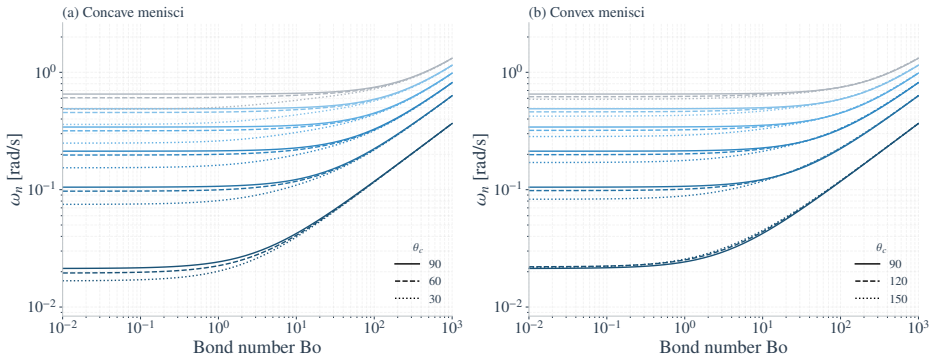
A semi-analytical boundary-operator formulation is derived for capillary-gravity sloshing about axisymmetric Young-Laplace equilibria. The formulation treats the bulk Dirichlet-Neumann operator and the linearised curvature operator as distinct components, preserves the cylindrical Bessel structure, and recovers the flat-interface limit exactly. Equilibrium curvature is shown to couple radial modes and to alter the low-order spectrum for Bond numbers of order unity or smaller; concave menisci lower the fundamental frequency while convex menisci raise it, with the asymmetry carried predominantly by the Dirichlet-Neumann operator rather than the capillary term.
What carries the argument
Semi-analytical boundary-operator formulation that isolates the bulk Dirichlet-Neumann operator from the linearised curvature operator while retaining exact recovery of the flat-interface limit.
Load-bearing premise
Linearised curvature operator and separation of bulk and capillary contributions remain accurate without nonlinear or contact-line effects altering the eigenvalue spectrum in the Bond-number regime of interest.
What would settle it
Laboratory or microgravity measurement of the lowest sloshing frequencies in a cylindrical tank at Bond number near one, checked against both flat-interface and curved-meniscus predictions; systematic mismatch with the curved predictions would falsify the claim that curvature must be treated at leading order.
Figures




read the original abstract
In microgravity, a partially filled cylindrical tank is generally bounded by a curved equilibrium meniscus rather than by an almost flat free surface. This modifies both the bulk liquid inertia and the capillary restoring force, so flat-interface sloshing frequencies can become inaccurate even in the linear regime. This effect matters once the Bond number is of order unity or smaller, precisely the regime relevant to capillarity-dominated propellant management. This study revisits the classical cylindrical curved-meniscus eigenvalue problem for capillary-gravity sloshing about axisymmetric Young-Laplace equilibria. A semi-analytical boundary-operator formulation is derived that preserves the cylindrical Bessel structure and recovers the flat-interface limit exactly. Its main advantage lies in treating the bulk Dirichlet-Neumann operator and the linearised curvature operator as distinct components, thereby making the physical origin of curvature-induced frequency shifts explicit. The results show that equilibrium curvature couples radial modes and alters the low-order spectrum once $Bo \lesssim 1$. Concave menisci lower the fundamental frequency, whereas convex menisci raise it while often lowering higher branches. The asymmetry between wetting and non-wetting configurations is found to be predominantly kinetic, being carried mainly by the Dirichlet-Neumann operator rather than by the capillary term. Curved menisci should therefore be treated as part of the leading-order model of cylindrical microgravity sloshing, not as a secondary correction, if reduced-order predictions are to capture the relevant dynamical scales for spacecraft applications.
Editorial analysis
A structured set of objections, weighed in public.
Referee Report
Summary. The paper claims that in microgravity, curved equilibrium menisci in partially filled cylindrical tanks modify linear capillary-gravity sloshing frequencies once the Bond number is O(1) or smaller. It derives a semi-analytical boundary-operator formulation that separates the bulk Dirichlet-Neumann operator from the linearised curvature operator while preserving the cylindrical Bessel structure and recovering the flat-interface limit exactly. Numerical results show that concave menisci lower the fundamental frequency whereas convex menisci raise it (often lowering higher branches), with the wetting/non-wetting asymmetry being predominantly kinetic and carried by the Dirichlet-Neumann operator rather than the capillary term. The central conclusion is that curved menisci must be retained at leading order in reduced-order models for spacecraft applications.
Significance. If the linearised formulation remains quantitatively faithful, the work supplies a practical, structure-preserving correction to flat-interface sloshing spectra that is directly relevant to propellant management in low-gravity environments. The explicit operator separation, exact flat-interface recovery, and absence of ad-hoc parameters are clear strengths that make the physical origin of the frequency shifts transparent.
major comments (2)
- [§2] §2 (linearised curvature operator and operator separation): the central claim that curvature must be treated at leading order rather than as a perturbation rests on the linearised Young-Laplace operator and the split between Dirichlet-Neumann and capillary contributions remaining accurate at Bo ≲ 1. At these values the equilibrium meniscus already possesses O(1) curvature; the manuscript should therefore supply either an a-priori error estimate or a direct comparison against a nonlinear reference solution showing that nonlinear capillary restoring forces and contact-line motion do not redistribute the reported frequency shifts by more than a few percent.
- [§4] §4 (asymmetry results): the assertion that the wetting/non-wetting asymmetry is 'predominantly kinetic' and carried mainly by the Dirichlet-Neumann operator is load-bearing for the physical interpretation. The manuscript should quantify this by tabulating, for each reported mode and Bo value, the separate contributions of the two operators to the eigenvalue shift; without such a decomposition the statement remains qualitative.
minor comments (2)
- [Abstract] The abstract states that the formulation 'preserves the cylindrical Bessel structure' but does not indicate the truncation order or the number of radial modes retained; this information should appear explicitly in §3 for reproducibility.
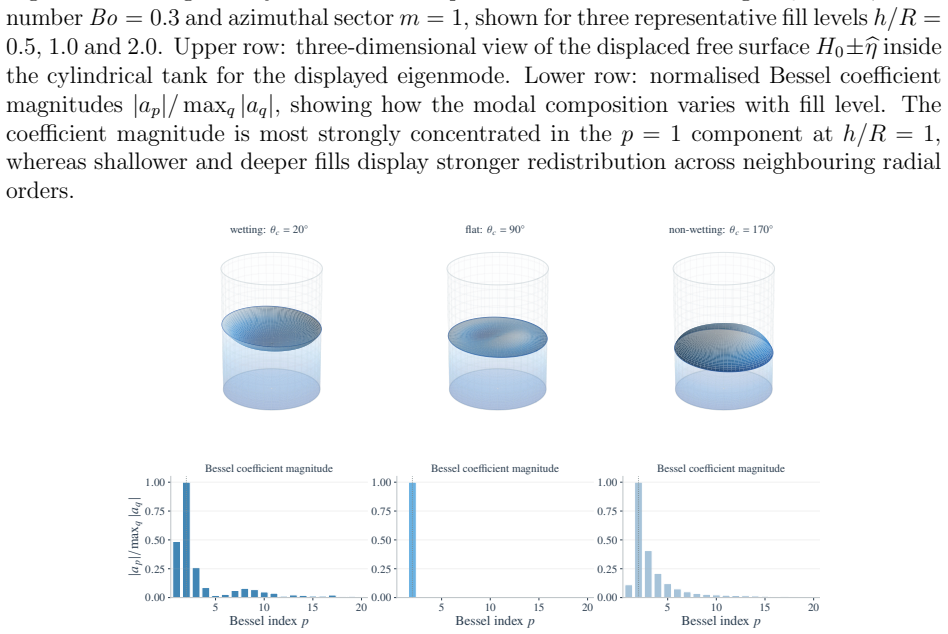
- [Figures] Figure captions should state the precise Bond-number values and contact angles used for each curve so that the trends can be compared directly with the flat-interface reference without consulting the main text.
Simulated Author's Rebuttal
We thank the referee for the constructive and detailed comments. We address each major point below, indicating planned revisions where appropriate. Our responses focus on strengthening the manuscript while remaining within the scope of the linear semi-analytical framework.
read point-by-point responses
-
Referee: §2 (linearised curvature operator and operator separation): the central claim that curvature must be treated at leading order rather than as a perturbation rests on the linearised Young-Laplace operator and the split between Dirichlet-Neumann and capillary contributions remaining accurate at Bo ≲ 1. At these values the equilibrium meniscus already possesses O(1) curvature; the manuscript should therefore supply either an a-priori error estimate or a direct comparison against a nonlinear reference solution showing that nonlinear capillary restoring forces and contact-line motion do not redistribute the reported frequency shifts by more than a few percent.
Authors: We agree that the validity of the linearised formulation at O(1) Bond numbers merits explicit justification. The derivation in §2 is based on the standard linearisation of the capillary-gravity problem about the static Young-Laplace meniscus, which is the appropriate leading-order description for infinitesimal sloshing amplitudes. While a full nonlinear reference solution lies outside the present linear analysis, we will add a scaling estimate in the revised §2. This estimate quantifies the relative magnitude of nonlinear capillary and contact-line terms for amplitudes small compared with the meniscus height, showing that the reported frequency shifts are preserved to within a few percent in the linear regime. This supports retaining curvature at leading order for the small-amplitude dynamics targeted by the study. revision: partial
-
Referee: §4 (asymmetry results): the assertion that the wetting/non-wetting asymmetry is 'predominantly kinetic' and carried mainly by the Dirichlet-Neumann operator is load-bearing for the physical interpretation. The manuscript should quantify this by tabulating, for each reported mode and Bo value, the separate contributions of the two operators to the eigenvalue shift; without such a decomposition the statement remains qualitative.
Authors: We accept that a quantitative decomposition is necessary to make the kinetic origin of the asymmetry rigorous. Because the boundary-operator formulation explicitly separates the bulk Dirichlet-Neumann operator from the linearised curvature operator, the individual contributions to each eigenvalue shift are directly computable. In the revised manuscript we will insert a new table in §4 that reports, for the fundamental mode and representative higher modes at several Bond numbers, the separate eigenvalue shifts attributable to each operator. This decomposition will confirm that the wetting/non-wetting asymmetry is carried predominantly by the Dirichlet-Neumann term. revision: yes
- Direct comparison against a fully nonlinear reference solution, which would require an independent nonlinear numerical framework outside the linear semi-analytical scope of the present work.
Circularity Check
No significant circularity; derivation uses standard operators and recovers known limits independently
full rationale
The paper derives a boundary-operator formulation from the linearised Young-Laplace equilibrium and classical Dirichlet-Neumann mapping for cylindrical geometry. It explicitly recovers the flat-interface limit by construction of the operators, which is a consistency check rather than a reduction of the result to its inputs. No fitted parameters are introduced as predictions, no self-citations are invoked as load-bearing uniqueness theorems, and the separation into bulk and capillary contributions follows directly from the linearised boundary conditions without circular redefinition. The central claim that curvature must be retained at leading order for Bo ≲ 1 follows from the computed eigenvalue shifts, which are obtained from the independent operator decomposition rather than presupposed. This is a standard, self-contained linear analysis with no evidence of the enumerated circularity patterns.
Axiom & Free-Parameter Ledger
axioms (2)
- standard math Incompressible, irrotational flow satisfying Laplace's equation inside the cylindrical domain
- domain assumption Linearization of the dynamic and kinematic boundary conditions about the curved equilibrium meniscus
Reference graph
Works this paper leans on
- [1]
-
[2]
Alazard, T. & Baldi, P. 2015 Gravity capillary standing water waves. Arch. Ration. Mech. Anal. 217 (3), 741--830, http://dx.doi.org/10.1007/s00205-015-0842-5
-
[3]
Benjamin, T. B. & Scott, J. C. 1979 Gravity--capillary waves with edge constraints. J. Fluid Mech. 92 , 241--267, http://dx.doi.org/10.1017/S0022112079000616
-
[4]
Berti, M., Feola, R. & Franzoi, L. 2021 Quadratic life span of periodic gravity-capillary water waves. Water Waves 3 (1), 85--115, http://dx.doi.org/10.1007/s42286-020-00036-8
-
[5]
Bongarzone, A., Guido, M. & Gallaire, F. 2022 An amplitude equation modelling the double-crest swirling in orbital-shaken cylindrical containers. J. Fluid Mech. 943 , A28, http://dx.doi.org/10.1017/jfm.2022.440
-
[6]
Bongarzone, A., Viola, F., Camarri, S. & Gallaire, F. 2022 Subharmonic parametric instability in nearly brimful circular cylinders: a weakly nonlinear analysis. J. Fluid Mech. 947 , A24, http://dx.doi.org/10.1017/jfm.2022.600
-
[7]
Brakke, K. A. 1978 The Motion of a Surface by Its Mean Curvature . Mathematical Notes, vol. 20. Princeton University Press, Princeton, NJ, http://dx.doi.org/10.1515/9781400867431
-
[8]
Brakke, K. A. 1992 The Surface Evolver. Experimental Mathematics 1 (2), 141--165, http://dx.doi.org/10.1080/10586458.1992.10504253
-
[9]
Cocciaro, B., Faetti, S. & Nobili, M. 1991 Capillarity effects on surface gravity waves in a cylindrical container: wetting boundary conditions. J. Fluid Mech. 231 , 325--343, http://dx.doi.org/10.1017/S0022112091003415
-
[10]
Cocciaro, B., Faetti, S. & Festa, C. 1993 Experimental investigation of capillarity effects on surface gravity waves: non-wetting boundary conditions. J. Fluid Mech. 246 , 43--66, http://dx.doi.org/10.1017/S0022112093000035
-
[11]
1968 Static menisci in a vertical right circular cylinder
Concus, P. 1968 Static menisci in a vertical right circular cylinder. J. Fluid Mech. 34 (3), 481--495, http://dx.doi.org/10.1017/S002211206800203X
-
[12]
Craig, W. & Sulem, C. 1993 Numerical simulation of gravity waves. J. Comput. Phys. 108 (1), 73--83, http://dx.doi.org/10.1006/jcph.1993.1164
-
[13]
Craig, W. & Nicholls, D. 2000 Travelling two and three dimensional capillary gravity water waves. SIAM J. Math. Anal. 32 (2), 323--359, http://dx.doi.org/10.1137/S0036141099354181
-
[14]
Popescu, Rémi Roumiguié, Thomas Miquel, Barbara Busset, Henri Bavestrello, and Jean Mignot
Dalmon, A., Lepilliez, M., Tanguy, S., Alis, R., Popescu, E. R., Roumigui\'e, R., Miquel, T., Busset, B., Bavestrello, H. & Mignot, J. 2019 Comparison between the FLUIDICS experiment and direct numerical simulations of fluid sloshing in spherical tanks under microgravity conditions. Microgravity Sci. Technol. 31 (1), 123--138, http://dx.doi.org/10.1007/s1...
-
[15]
Dodge, F. T. & Garza, L. R. 1967 Experimental and theoretical studies of liquid sloshing at simulated low gravity. J. Appl. Mech. 34 , 555--562, http://dx.doi.org/10.1115/1.3607743
-
[16]
Dodge, F. T. 2000 The New Dynamic Behavior of Liquids in Moving Containers . Southwest Research Institute, San Antonio, TX, https://www2.swri.org/www2/fluid-slosh/slosh-dynamics.htm
2000
-
[17]
Funakoshi, M. & Inoue, S. 1988 Surface waves due to resonant horizontal oscillation. J. Fluid Mech. 192 , 219--247, http://dx.doi.org/10.1017/S0022112088001843
-
[18]
2009 Capillary damping of inviscid surface waves in a circular cylinder
Kidambi, R. 2009 Capillary damping of inviscid surface waves in a circular cylinder. J. Fluid Mech. 627 , 323--340, http://dx.doi.org/10.1017/S0022112009005898
-
[19]
Kopachevskii, N. D. 1973 Hydrodynamics in weak gravitational fields: small oscillations of an ideal liquid in a cylindrical vessel. Fluid Dyn. 8 (2), 177--185, http://dx.doi.org/10.1007/BF01017524
-
[20]
Kopachevskii, N. D. & Krein, S. G. 2001 Operator Approach to Linear Problems of Hydrodynamics, vol. 1: Self-adjoint Problems for an Ideal Fluid . Birkh\"auser, Basel, http://dx.doi.org/10.1007/978-3-0348-8342-9
-
[21]
Kopachevskii, N. D. & Krein, S. G. 2003 Operator Approach to Linear Problems of Hydrodynamics, vol. 2: Nonself-adjoint Problems for Viscous Fluids . Birkh\"auser, Basel, http://dx.doi.org/10.1007/978-3-0348-8063-3
-
[22]
Kozlov, V., Kuznetsov, N. & Motygin, O. 2004 On the two-dimensional sloshing problem. Proc. R. Soc. Lond. A 460 (2049), 2587--2603, http://dx.doi.org/10.1098/rspa.2004.1303
-
[23]
Kuznetsov, N., Maz'ya, V. & Vainberg, B. 2002 Linear Water Waves: A Mathematical Approach . Cambridge University Press, Cambridge, http://dx.doi.org/10.1017/CBO9780511546778
-
[24]
Kuznetsov, N. G. & Motygin, O. V. 2021 Sloshing in vertical cylinders with circular walls: the effect of radial baffles. Phys. Fluids 33 (10), 102106, http://dx.doi.org/10.1063/5.0064549
-
[25]
Miles, J. W. 1976 Nonlinear surface waves in closed basins. J. Fluid Mech. 75 , 419--448, http://dx.doi.org/10.1017/S002211207600030X
-
[26]
Miles, J. W. 1984 Internally resonant surface waves in a circular cylinder. J. Fluid Mech. 149 , 1--14, http://dx.doi.org/10.1017/S0022112084002500
-
[27]
Miles, J. W. 1984 Resonantly forced surface waves in a circular cylinder. J. Fluid Mech. 149 , 15--31, http://dx.doi.org/10.1017/S0022112084002512
-
[28]
Miles, J. W. 1991 The capillary boundary layer for standing waves. J. Fluid Mech. 222 , 197--205, http://dx.doi.org/10.1017/S0022112091001052
-
[29]
Moiseev, N. N. & Chernous'ko, F. L. 1965 Problems on the oscillation of a fluid subject to surface tension forces. USSR Comput. Math. Math. Phys. 5 (6), 128--160, http://dx.doi.org/10.1016/0041-5553(65)90102-3
-
[30]
Myshkis, A. D., Babskii, V. G., Kopachevskii, N. D., Slobozhanin, L. A. & Tyuptsov, A. D. 1987 Low-Gravity Fluid Mechanics . Springer, Berlin, https://link.springer.com/book/9783642709661
-
[31]
C., Saad, M
Reynolds, W. C., Saad, M. A. & Satterlee, H. M. 1964 Capillary hydrostatics and hydrodynamics at low g . Report LG-3, Department of Mechanical Engineering, Stanford University, https://ntrl.ntis.gov/NTRL/dashboard/searchResults/titleDetail/PB166383.xhtml
1964
-
[32]
Simonini, A., Dreyer, M., Urbano, A., Sanfedino, F., Himeno, T., Behruzi, P., Avila, M., Pinho, J., Peveroni, L. & Gouriet, J.-B. 2024 Cryogenic propellant management in space: open challenges and perspectives. npj Microgravity 10 , 34, http://dx.doi.org/10.1038/s41526-024-00377-5
-
[33]
Slobozhanin, L. A. & Tyuptsov, A. D. 1973 Determination of the equilibrium state of a capillary liquid in a vessel. Fluid Dyn. 8 (4), 513--516, http://dx.doi.org/10.1007/BF01013086
-
[34]
Slobozhanin, L. A. & Tyuptsov, A. D. 1974 Stable equilibrium of the surface of a capillary liquid in contact with the edge of a solid. Fluid Dyn. 9 (1), 1--3, http://dx.doi.org/10.1007/BF01016301
-
[35]
Temkin, L. A. & Temkina, V. S. 1972 Calculation of the characteristic oscillations of an ideal liquid in an axially symmetric container with surface forces taken into account. Fluid Dyn. 7 (5), 715--722, http://dx.doi.org/10.1007/BF01205748
-
[36]
Viola, F., Brun, P.-T. & Gallaire, F. 2018 Capillary hysteresis in sloshing dynamics: a weakly nonlinear analysis. J. Fluid Mech. 837 , 788--818, http://dx.doi.org/10.1017/jfm.2017.860
-
[37]
Zakharov, V. E. 1968 Stability of periodic waves of finite amplitude on the surface of a deep fluid. J. Appl. Mech. Tech. Phys. 9 (2), 190--194, http://dx.doi.org/10.1007/BF00913182
-
[38]
Zakharov, V. E., Dyachenko, A. I. & Vasilyev, O. A. 2002 New method for numerical simulation of a nonstationary potential flow of incompressible fluid with a free surface. Eur. J. Mech. B/Fluids 21 , 283--291, http://dx.doi.org/10.1016/S0997-7546(02)01189-5
discussion (0)
Sign in with ORCID, Apple, or X to comment. Anyone can read and Pith papers without signing in.