Recognition: unknown
Smaller Than Earth Habitability Model (STEHM): The Lower Size Limit for Atmosphere Retention in the Habitable Zone
Pith reviewed 2026-05-09 20:11 UTC · model grok-4.3
The pith
Planets must reach at least 0.8 Earth radii to retain atmospheres long-term around sun-like stars under typical conditions.
A machine-rendered reading of the paper's core claim, the machinery that carries it, and where it could break.
Core claim
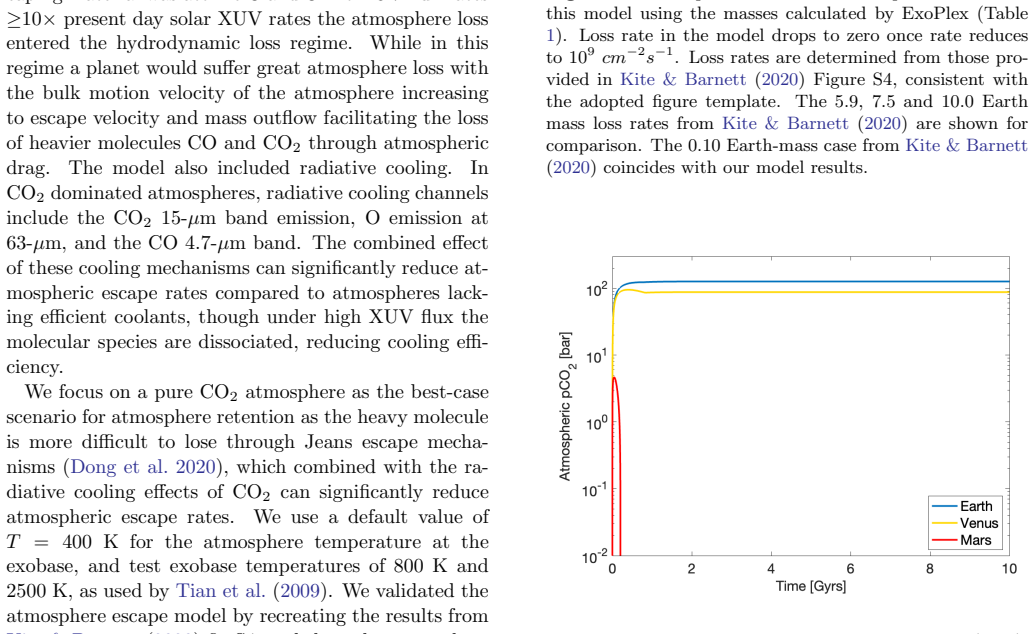
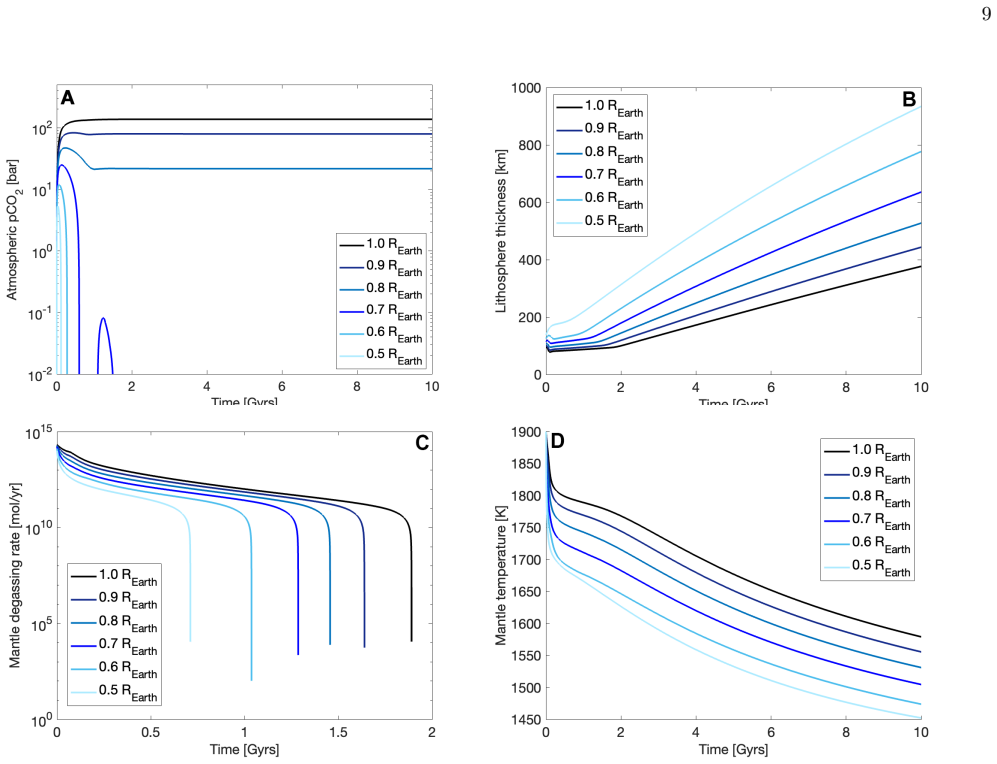
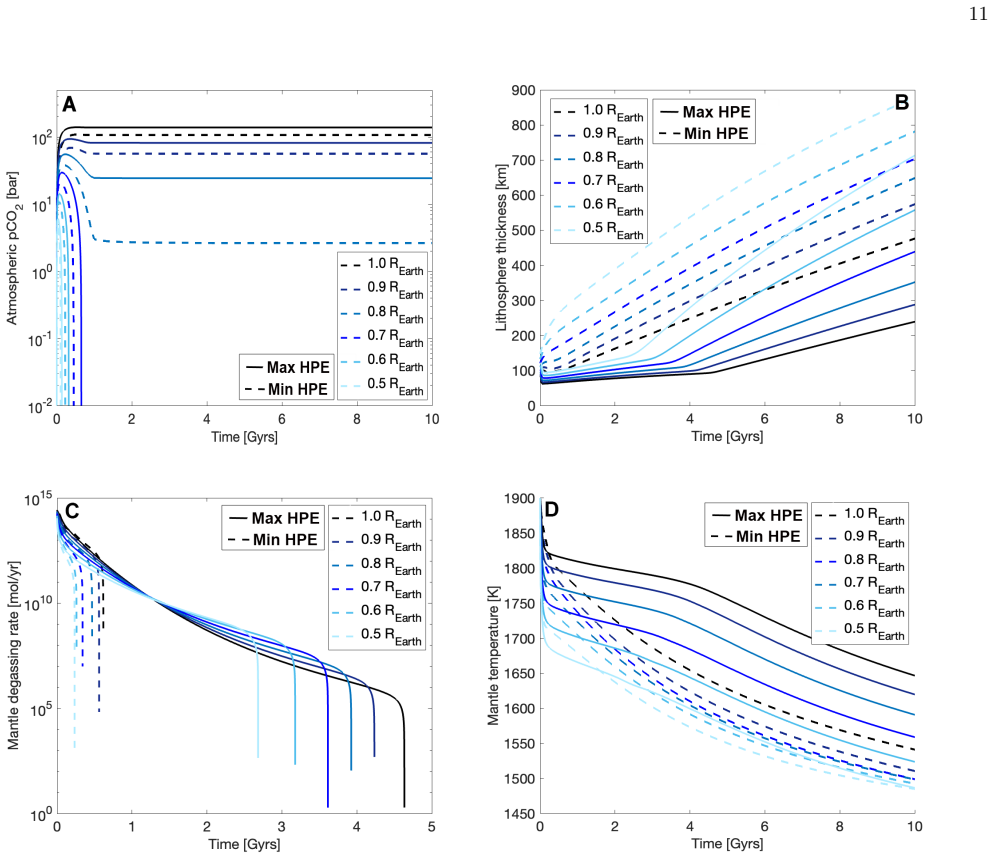
The STEHM model demonstrates that planets with radii of 0.8 Earth radii and larger maintain atmospheres over multi-gigayear timescales under default Earth-like outgassing rates, initial volatile inventories, and escape processes for a solar analog star in a stagnant lid regime, whereas planets smaller than this threshold lose their atmospheres.
What carries the argument
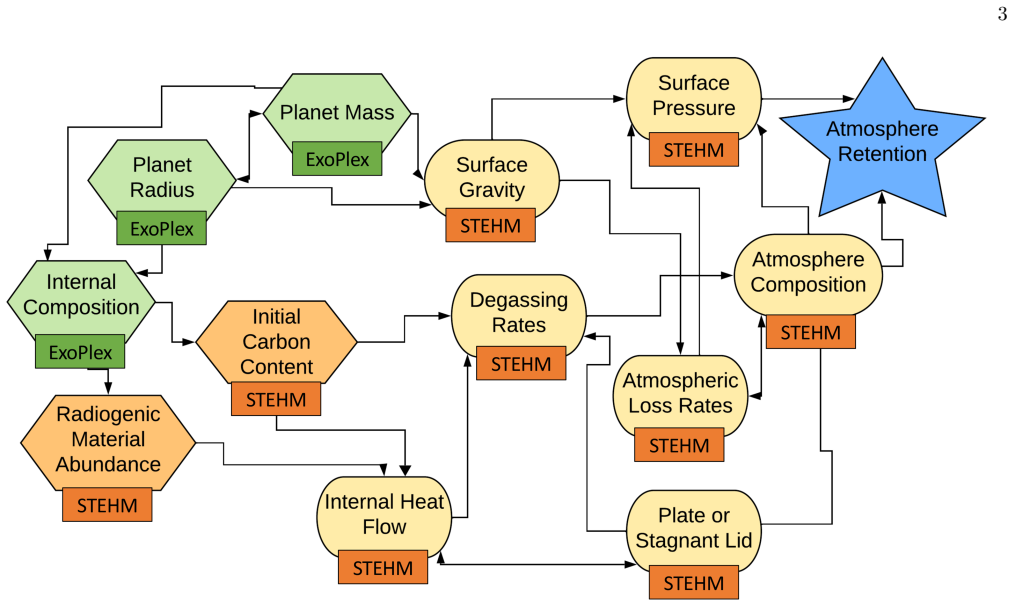
The STEHM numerical model, which couples time-dependent volatile cycling, atmospheric escape, mantle convection, and surface temperature for planets ranging from 0.5 to 1.0 Earth radii.
If this is right
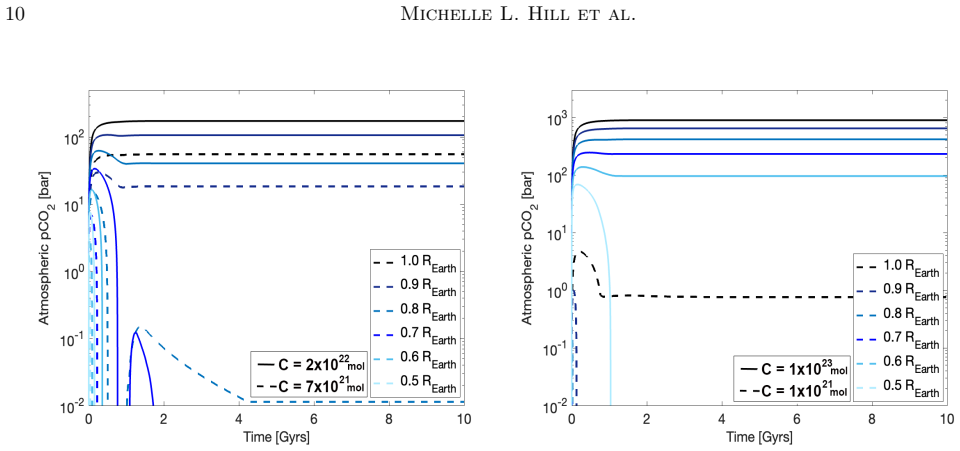
- Planets with substantially higher initial carbon inventories than Earth can retain atmospheres down to 0.7 Earth radii.
- Larger quantities of heat-producing elements, cooler initial mantle temperatures, and smaller core radius fractions each improve the chance of long-term atmospheric retention.
- Atmospheric longevity on small planets is set mainly by formation-time volatile budgets rather than present-day size alone.
Where Pith is reading between the lines
- Many currently detected sub-Earth exoplanets are likely airless today, narrowing the pool of worlds worth detailed atmospheric follow-up.
- The strong sensitivity to early conditions means that two planets of identical size and orbit could have very different habitability outcomes depending on their accretion history.
- Extending the same framework to M-dwarf stars would likely produce a different size cutoff because closer-in habitable zones change escape rates.
Load-bearing premise
That the same stagnant-lid outgassing rates, initial volatile amounts, and escape physics measured or assumed for Earth also hold for planets down to half its size.
What would settle it
Spectroscopic detection of a stable atmosphere on a confirmed 0.6 Earth-radius planet inside the habitable zone of a sun-like star, or the absence of atmospheres on multiple planets confirmed to be 0.85 Earth radii or larger in similar orbits.
Figures




read the original abstract
With recent advances in exoplanet observational techniques enabling the discovery of increasingly smaller planets, a crucial question emerges in the search for habitable planets: how small can a planet be and still maintain an atmosphere? We present results from the Smaller Than Earth Habitability Model (STEHM) which examines how small a planet can be and still maintain a long-term (multi-gigayear) atmosphere for planets from 1.0$R_\oplus$ down to 0.5$R_\oplus$. The model is based on a stagnant lid planet orbiting within the habitable zone of a sun-like star. Our model demonstrates that planets $\geq$0.8$R_\oplus$ can maintain their atmospheres under our Earth-like default conditions for a solar analog star, while smaller planets lose their atmospheres. Variations from the default Earth-like values cause mostly minor variations to the planet size boundary results, with some changes allowing $\geq$0.7$R_\oplus$ planets to maintain their atmosphere. Initial carbon inventory emerges as the most influential parameter for atmospheric retention, though orders of magnitude difference to Earth values are required to make a significant difference to longevity of atmospheric retention. Planets with substantial initial carbon content, large amounts of heat producing elements, cool initial mantle temperatures and low core radius fractions show the best atmospheric retention capabilities. Our results indicate that atmospheric retention on small planets depends strongly on their formation conditions and early evolution, providing important constraints for future observations of rocky exoplanets and their potential habitability.
Editorial analysis
A structured set of objections, weighed in public.
Referee Report
Summary. The manuscript presents the Smaller Than Earth Habitability Model (STEHM), a numerical model for the long-term evolution of atmospheres on stagnant-lid planets in the habitable zone of a solar analog star. The model integrates outgassing from the interior and atmospheric escape processes for planet radii from 0.5 to 1.0 R_earth. Under default Earth-like parameters for initial volatile inventories, heat-producing elements, mantle temperature, and core radius fraction, the results indicate that planets with radii of at least 0.8 R_earth can retain their atmospheres over multi-Gyr timescales, whereas smaller planets lose them. Parameter variations, especially higher initial carbon inventory, can allow retention down to 0.7 R_earth in some cases.
Significance. If the model's assumptions hold, this provides a physically motivated lower size limit for atmospheric retention on rocky exoplanets, offering constraints for future observations and habitability assessments. The approach of deriving the size boundary from integrated rates rather than imposing it is a strength, as is the exploration of parameter sensitivities showing initial carbon as most influential.
major comments (2)
- [Abstract and Model Description] Abstract and model description: The central claim that planets ≥0.8 R_earth retain atmospheres (while <0.8 R_earth lose them) under default conditions requires that outgassing rates, initial volatile inventories, and escape fluxes remain Earth-like even as radius drops. The paper must clarify whether the STEHM equations already embed radius-dependent gravity, heat flux, or mantle convection scalings for escape (e.g., Jeans/hydrodynamic efficiency ∝1/g or stronger) and outgassing (surface area or convective vigor). If size-independent Earth defaults are used without such scalings, the reported boundary is vulnerable to being an artifact of that choice rather than a robust physical limit.
- [Results] Results (where the 0.8 R_earth boundary and parameter variations are presented): The abstract states that parameter variations produce 'mostly minor' changes and that initial carbon inventory is most influential, but provides no error bars, full sensitivity tests on key rates (outgassing, escape), or direct comparison to observed small-planet atmospheres. This leaves the quantitative boundary vulnerable to model choice, especially given the stagnant-lid assumption and Earth-calibrated values not independently verified for sub-Earth sizes.
minor comments (2)
- [Abstract] The abstract could include a short statement of the key governing equations or the numerical integration method to give readers immediate context for how the size boundary emerges.
- [Model Description] Ensure all free parameters (initial carbon inventory, heat-producing elements, initial mantle temperature, core radius fraction) and their Earth-like default values are explicitly listed with units and justification in a dedicated table or section.
Simulated Author's Rebuttal
We thank the referee for their constructive review and positive assessment of the STEHM model's approach to deriving a size boundary from integrated processes. We address the two major comments below, providing clarifications on the model implementation and committing to revisions that strengthen the presentation of results and assumptions.
read point-by-point responses
-
Referee: [Abstract and Model Description] Abstract and model description: The central claim that planets ≥0.8 R_earth retain atmospheres (while <0.8 R_earth lose them) under default conditions requires that outgassing rates, initial volatile inventories, and escape fluxes remain Earth-like even as radius drops. The paper must clarify whether the STEHM equations already embed radius-dependent gravity, heat flux, or mantle convection scalings for escape (e.g., Jeans/hydrodynamic efficiency ∝1/g or stronger) and outgassing (surface area or convective vigor). If size-independent Earth defaults are used without such scalings, the reported boundary is vulnerable to being an artifact of that choice rather than a robust physical limit.
Authors: We appreciate the referee's emphasis on this clarification. The STEHM model does incorporate several radius-dependent scalings in its core equations. Planetary gravity is computed as g = GM/r² (with mass M derived from radius assuming a density scaling consistent with rocky planets), which directly modulates both Jeans and hydrodynamic escape efficiencies. Outgassing rates scale with surface area (4πr²) and convective heat flux, where mantle convection vigor is parameterized using radius-dependent mantle thickness and Rayleigh number scalings. Initial volatile inventories and heat-producing element abundances are held at Earth-like defaults as a baseline (as stated in the abstract), but these are varied in the sensitivity analysis. We agree that the manuscript text does not explicitly list these scalings in one place, which could lead to misinterpretation. In the revised manuscript we will add a dedicated subsection under Model Description that enumerates each radius-dependent term with the relevant equations. revision: yes
-
Referee: [Results] Results (where the 0.8 R_earth boundary and parameter variations are presented): The abstract states that parameter variations produce 'mostly minor' changes and that initial carbon inventory is most influential, but provides no error bars, full sensitivity tests on key rates (outgassing, escape), or direct comparison to observed small-planet atmospheres. This leaves the quantitative boundary vulnerable to model choice, especially given the stagnant-lid assumption and Earth-calibrated values not independently verified for sub-Earth sizes.
Authors: We agree that the results section would benefit from more quantitative support. The existing parameter sweeps already demonstrate that the 0.8 R_earth threshold is stable across most variations, with only extreme (orders-of-magnitude) changes in initial carbon inventory shifting the boundary to 0.7 R_earth. In revision we will (i) add uncertainty envelopes or shaded ranges to the key figures based on the explored parameter space, (ii) expand the sensitivity discussion to include explicit tests on outgassing and escape rate multipliers, and (iii) include a brief comparison to solar-system analogs (e.g., Mars' atmospheric loss history) to contextualize the stagnant-lid assumption. We retain the stagnant-lid framework as a conservative baseline for long-term retention; we will state this limitation more explicitly and note that mobile-lid cases would likely favor retention at smaller sizes. Full Monte-Carlo error propagation on all rates is beyond the current scope but can be flagged as future work. revision: partial
Circularity Check
No significant circularity in STEHM model derivation
full rationale
The STEHM model integrates independent physical equations for volatile cycling, outgassing, and atmospheric escape on stagnant-lid planets orbiting in the habitable zone. The 0.8 R_earth threshold is reported as an emergent numerical result from integrating those equations under Earth-calibrated default parameters, with explicit exploration of parameter variations showing mostly minor effects. No load-bearing step reduces by construction to a self-definition, fitted input renamed as prediction, or self-citation chain; the central claim remains an output of the forward simulation rather than an input imposed by definition or prior author work.
Axiom & Free-Parameter Ledger
free parameters (4)
- initial carbon inventory
- heat producing elements abundance
- initial mantle temperature
- core radius fraction
axioms (2)
- domain assumption Stagnant lid tectonic regime applies to all modeled planets
- domain assumption Outgassing and escape rates scale with planet size and interior heat in the same manner as Earth
Reference graph
Works this paper leans on
-
[1]
Anderson, D. L. 1981, Geophysical Research Letters, 8, 309 Brain, D. A., Leblanc, F., Luhmann, J. G., Moore, T. E., &
1981
-
[2]
2013, Planetary Magnetic Fields and Climate Evolution (University of Arizona Press), 487 17
Tian, F. 2013, Planetary Magnetic Fields and Climate Evolution (University of Arizona Press), 487 17
2013
-
[3]
K., et al
Bryson, S., Kunimoto, M., Kopparapu, R. K., et al. 2021, AJ, 161, 36
2021
-
[4]
C., & Kasting, J
Catling, D. C., & Kasting, J. F. 2017, Escape of Atmospheres to Space (Cambridge University Press), 129–168
2017
-
[5]
2016, The Astrophysical Journal, 834, 17
Chen, J., & Kipping, D. 2016, The Astrophysical Journal, 834, 17
2016
-
[6]
Dasgupta, R., & Hirschmann, M. M. 2010, Earth and Planetary Science Letters, 298, 1
2010
-
[7]
2020, ApJL, 896, L24
Dong, C., Jin, M., & Lingam, M. 2020, ApJL, 896, L24
2020
-
[8]
2018, ApJL, 859, L14
Dong, C., Lee, Y., Ma, Y., et al. 2018, ApJL, 859, L14
2018
-
[9]
D., & Charbonneau, D
Dressing, C. D., & Charbonneau, D. 2013, ApJ, 767, 95 —. 2015, The Astrophysical Journal, 807, 45
2013
-
[10]
2014, Physics of the Earth and Planetary Interiors, 236, 36
Driscoll, P., & Bercovici, D. 2014, Physics of the Earth and Planetary Interiors, 236, 36
2014
-
[11]
E., & Barnes, R
Driscoll, P. E., & Barnes, R. 2015, Astrobiology, 15, 739
2015
-
[12]
2017, Journal of Geophysical Research (Planets), 122, 1338
Rambaux, N. 2017, Journal of Geophysical Research (Planets), 122, 1338
2017
-
[13]
S., & Ehlmann, B
Edwards, C. S., & Ehlmann, B. L. 2015, Geology, 43, 863
2015
-
[14]
Elkins-Tanton, L. T. 2012, Annual Review of Earth and Planetary Sciences, 40, 113
2012
-
[15]
2021, A&A, 656, A70
Emsenhuber, A., Mordasini, C., Burn, R., et al. 2021, A&A, 656, A70
2021
-
[16]
2025, A&A, 701, A64
Emsenhuber, A., Mordasini, C., Mayor, M., et al. 2025, A&A, 701, A64
2025
-
[17]
Foley, B. J. 2015, ApJ, 812, 36
2015
-
[18]
Foley, B. J. 2019, The Astrophysical Journal, 875, 72
2019
-
[19]
Foley, B. J. 2019, ApJ, 875, 72
2019
-
[20]
J., & Driscoll, P
Foley, B. J., & Driscoll, P. E. 2016, Geochemistry,
2016
-
[21]
J., Houser, C., Noack, L., & Tosi, N
Foley, B. J., Houser, C., Noack, L., & Tosi, N. 2020, in Planetary Diversity, 2514-3433 (IOP Publishing), 4–1 to 4–60
2020
-
[22]
J., & Smye, A
Foley, B. J., & Smye, A. J. 2018, Astrobiology, 18, 873
2018
-
[23]
2015, A&A, 577, A98
Gallet, F., & Bouvier, J. 2015, A&A, 577, A98
2015
-
[24]
2013, Nature, 497, 607
Hamano, K., Abe, Y., & Genda, H. 2013, Nature, 497, 607
2013
-
[25]
Hier-Majumder, S., & Hirschmann, M. M. 2017,
2017
-
[26]
L., Bott, K., Dalba, P
Hill, M. L., Bott, K., Dalba, P. A., et al. 2023, The Astronomical Journal, 165, 34
2023
-
[27]
2024, Monthly Notices of the Royal Astronomical Society, 533, 3999
Ramstad, R. 2024, Monthly Notices of the Royal Astronomical Society, 533, 3999
2024
-
[28]
W., & et al
Howard, A. W., & et al. 2012, The Astrophysical Journal, 201, 15
2012
-
[29]
2018, Icarus, 315, 146
Jakosky, B., Brain, D., Chaffin, M., et al. 2018, Icarus, 315, 146
2018
-
[30]
M., & Treiman, A
Jakosky, B. M., & Treiman, A. H. 2023, Icarus, 402, 115627
2023
-
[31]
1925, The dynamical theory of gases (University Press)
Jeans, J. 1925, The dynamical theory of gases (University Press)
1925
-
[32]
P., G¨ udel, M., Brott, I., & L¨ uftinger, T
Johnstone, C. P., G¨ udel, M., Brott, I., & L¨ uftinger, T. 2015, A&A, 577, A28
2015
-
[33]
R., Hill, M
Kane, S. R., Hill, M. L., Kasting, J. F., et al. 2016, The Astrophysical Journal, 830, 1
2016
-
[34]
R., Arney, G
Kane, S. R., Arney, G. N., Byrne, P. K., et al. 2021, Journal of Geophysical Research (Planets), 126, e06643
2021
-
[35]
F., Whitmire, D
Kasting, J. F., Whitmire, D. P., & Reynolds, R. T. 1993, ICARUS, 101, 108
1993
- [36]
-
[37]
S., & Barnett, M
Kite, E. S., & Barnett, M. N. 2020, Proceedings of the National Academy of Science, 117, 18264
2020
-
[38]
S., Williams, J.-P., Lucas, A., & Aharonson, O
Kite, E. S., Williams, J.-P., Lucas, A., & Aharonson, O. 2014, Nature Geoscience, 7, 335
2014
-
[39]
Kopparapu, R. K. 2013, The Astrophysical Journal, 767, L8
2013
-
[40]
K., Ramirez, R
Kopparapu, R. K., Ramirez, R. M., SchottelKotte, J., et al. 2014, The Astrophysical Journal, 787, L29
2014
-
[41]
K., Ramirez, R
Kopparapu, R. K., Ramirez, R. M., SchottelKotte, J., et al. 2014, ApJ, 787, L29
2014
-
[42]
K., Ramirez, R., Kasting, J
Kopparapu, R. K., Ramirez, R., Kasting, J. F., et al. 2013, The Astrophysical Journal, 765, 131
2013
-
[43]
K., Ramirez, R., Kasting, J
Kopparapu, R. K., Ramirez, R., Kasting, J. F., et al. 2013, ApJ, 765, 131
2013
-
[44]
2013, Journal of Geophysical Research: Planets, 118, 1155
Lebrun, T., Massol, H., Chassefi` ere, E., et al. 2013, Journal of Geophysical Research: Planets, 118, 1155
2013
-
[45]
2022, Icarus, 382, 115009
Lichtenegger, H., Dyadechkin, S., & Scherf, M. 2022, Icarus, 382, 115009
2022
-
[46]
Lichtenegger, H. I. M., Lammer, H., Grießmeier, J.-M., et al. 2010, Icarus, 210, 1
2010
-
[47]
2022, Science, 377, 1211
Luque, R., & Pall´ e, E. 2022, Science, 377, 1211
2022
-
[48]
2012, Earth and Planetary Science Letters, 313-314, 56
Marty, B. 2012, Earth and Planetary Science Letters, 313-314, 56
2012
-
[49]
2002, Geology, 30, 987
Nimmo, F. 2002, Geology, 30, 987
2002
-
[50]
2020, A&A, 638, A129
Noack, L., & Lasbleis, M. 2020, A&A, 638, A129
2020
-
[51]
2017, Physics of the Earth and Planetary Interiors, 269, 40
Noack, L., Rivoldini, A., & Van Hoolst, T. 2017, Physics of the Earth and Planetary Interiors, 269, 40
2017
-
[52]
Oosterloo, M., H¨ oning, D., Kamp, I. E. E., & van der Tak, F. F. S. 2021, A&A, 649, A15
2021
-
[53]
F., Bouchy, F., & Helled, R
Otegi, J. F., Bouchy, F., & Helled, R. 2020, A&A, 634, A43
2020
-
[54]
Palme, H., & O’Neill, H. S. C. 2003, Treatise on Geochemistry, 2, 568
2003
-
[55]
2014, Experimental Astronomy, 38, 249
Rauer, H., Catala, C., Aerts, C., et al. 2014, Experimental Astronomy, 38, 249
2014
-
[56]
F., G¨ udel, M., & Audard, M
Ribas, I., Guinan, E. F., G¨ udel, M., & Audard, M. 2005, ApJ, 622, 680
2005
-
[57]
Rogers, L. A. 2015, The Astrophysical Journal, 801, 41
2015
-
[58]
2018, Monthly Notices of the Royal Astronomical Society, 475, 1274 18Michelle L
Saito, H., & Kuramoto, K. 2018, Monthly Notices of the Royal Astronomical Society, 475, 1274 18Michelle L. Hill et al
2018
-
[59]
2018, Geophysical Research Letters, 45, 9336
Sakai, S., Seki, K., Terada, N., et al. 2018, Geophysical Research Letters, 45, 9336
2018
-
[60]
2017, Journal of Geophysical Research: Planets, 122, 1458
Salvador, A., Massol, H., Davaille, A., et al. 2017, Journal of Geophysical Research: Planets, 122, 1458
2017
-
[61]
2020, Space Science Reviews, 217, 2
Scherf, M., & Lammer, H. 2020, Space Science Reviews, 217, 2
2020
-
[62]
L., & Olson, P
Schubert, G., Turcotte, D. L., & Olson, P. 2001, Mantle Convection in the Earth and Planets (Cambridge University Press)
2001
-
[63]
E., & Lyons, T
Harman, C. E., & Lyons, T. W. 2019, The Astrophysical Journal, 878, 19
2019
-
[64]
J., Hirschmann, M
Sim, S. J., Hirschmann, M. M., & Hier-Majumder, S. 2024, Journal of Geophysical Research: Planets, 129, e2024JE008346
2024
-
[65]
H., & Zahnle, K
Sleep, N. H., & Zahnle, K. 2001, J. Geophys. Res., 106, 1373
2001
-
[66]
B., Hu, R., & Lo, D
Thomas, T. B., Hu, R., & Lo, D. Y. 2023, The Planetary Science Journal, 4, 41
2023
-
[67]
F., & Solomon, S
Tian, F., Kasting, J. F., & Solomon, S. C. 2009, Geophys. Res. Lett., 36, L02205
2009
-
[68]
2015, A&A, 577, L3
Tu, Lin, Johnstone, Colin P., G¨ udel, Manuel, & Lammer, Helmut. 2015, A&A, 577, L3
2015
-
[69]
2021, Nature, 598, 276
Turbet, M., Bolmont, E., Chaverot, G., et al. 2021, Nature, 598, 276
2021
-
[70]
T., Desch, S
Unterborn, C. T., Desch, S. J., Haldemann, J., et al. 2023, The Astrophysical Journal, 944, 42
2023
-
[71]
T., & Panero, W
Unterborn, C. T., & Panero, W. R. 2019, Journal of Geophysical Research (Planets), 124, 1704
2019
-
[72]
J., & Sasselov, D
Valencia, D., O’Connell, R. J., & Sasselov, D. 2006, Icarus, 181, 545
2006
-
[73]
M., & Marcy, G
Weiss, L. M., & Marcy, G. W. 2014, ApJL, 783, L6
2014
-
[74]
B., Evans, A
Weller, M. B., Evans, A. J., Ibarra, D. E., & Johnson, A. V. 2023, Nature Astronomy, 7, 1436
2023
-
[75]
B., & Kiefer, W
Weller, M. B., & Kiefer, W. S. 2020, Journal of Geophysical Research: Planets, 125, e2019JE005960, e2019JE005960 2019JE005960
2020
-
[76]
A., & Ford, E
Wolfgang, A., Rogers, L. A., & Ford, E. B. 2016, The Astrophysical Journal, 825, 19
2016
-
[77]
D., & Pierrehumbert, R
Wordsworth, R. D., & Pierrehumbert, R. T. 2013, ApJ, 778, 154
2013
-
[78]
Yoshizaki, T., & McDonough, W. F. 2020, Geochimica et Cosmochimica Acta, 273, 137
2020
-
[79]
2010, Cold Spring Harbor perspectives in biology, 2, a004895
Zahnle, K., Schaefer, L., & Fegley, B. 2010, Cold Spring Harbor perspectives in biology, 2, a004895
2010
-
[80]
D., & Jacobsen, S
Zeng, L., Sasselov, D. D., & Jacobsen, S. B. 2016, ApJ, 819, 127
2016
discussion (0)
Sign in with ORCID, Apple, or X to comment. Anyone can read and Pith papers without signing in.