Recognition: unknown
Insights into the electrorheological and electrohydrodynamic regimes in electrically driven emulsion
Pith reviewed 2026-05-09 19:58 UTC · model grok-4.3
The pith
Electrically driven oil-in-oil emulsions show a yield-stress response scaling as E squared in the high-frequency regime and lose structural memory on the one-second convection timescale in the low-frequency regime.
A machine-rendered reading of the paper's core claim, the machinery that carries it, and where it could break.
Core claim
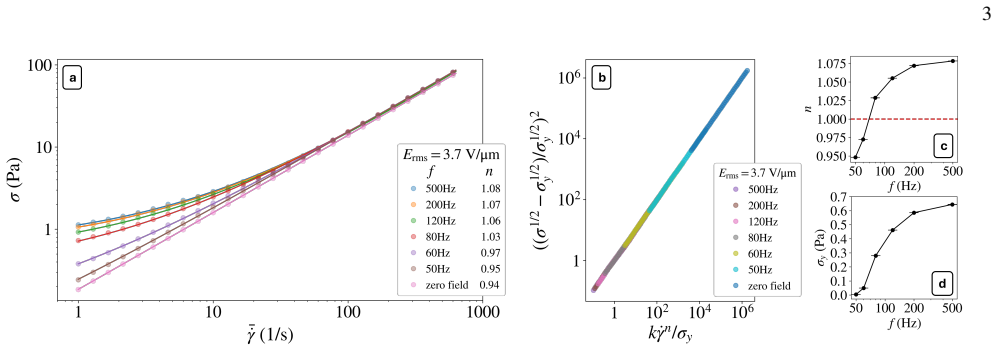
In the electrorheological regime the storage and loss moduli measured under small-amplitude oscillatory shear fit a classic yield-stress fluid model; after rescaling the data from different field strengths fall onto a master curve whose characteristic stress grows approximately as E squared. The same scaling and master curve are recovered by differential dynamic microscopy, showing that the response is scale-independent. In the electrohydrodynamic regime, radial intensity profiles of the banded structures yield Jensen-Shannon divergences that rise to a plateau on a one-second timescale, demonstrating that the driven pattern loses memory at the same rate as the underlying convective rolls.
What carries the argument
Phenomenological yield-stress fluid fit combined with master-curve rescaling by E squared for the ER regime, and Jensen-Shannon divergence of radial intensity profiles to quantify memory loss in the EHD banded state.
If this is right
- The yield stress in the electrorheological regime can be predicted for arbitrary field strengths once the master curve is known.
- Small-amplitude oscillatory shear leaves the droplet arrangement intact and therefore reports intrinsic material properties rather than flow-induced structure.
- Banded patterns in the electrohydrodynamic regime appear within seconds of field application and disappear rapidly when the field is removed.
- For field-off intervals much longer than one second, successive banding events are statistically independent.
Where Pith is reading between the lines
- Frequency can serve as a rapid switch between a solid-like electrorheological state and a fluid-like electrohydrodynamic state in the same emulsion.
- Differential dynamic microscopy offers a non-invasive way to monitor yield-stress behavior in situ without the restructuring that steady shear produces.
- The one-second memory-loss time suggests that continuum fluid-dynamics models of electrohydrodynamic rolls should be able to predict the statistical independence of successive banding events.
Load-bearing premise
That agreement between macroscopic oscillatory rheology and passive microrheology implies the electrorheological response is truly scale-independent and unaffected by any undetected restructuring.
What would settle it
A direct imaging experiment showing that small-amplitude oscillatory shear changes droplet positions or pair correlations differently from the passive case, or a measurement in which the rescaled yield stress deviates systematically from E squared scaling.
Figures



read the original abstract
Recently, we reported the electrorheoimaging (ERI) technique (Bahraminasr et al, 2026), and found that frequency-dependent electric field of an oil-in-oil emulsion yields two distinct regimes: a high-frequency dipolar, electrorheological (ER) regime and a low-frequency electrohydrodynamic (EHD) regime. In this work, we identify a phenomenological model to fit the results in the ER regime to a classic yield-stress fluid, and find collapse onto a master curve upon rescaling, consistent with a yield stress that grows approximately as $E^2$. Macroscopic small-amplitude oscillatory shear (SAOS) rheology is compared with passive microrheology employing differential dynamic microscopy (DDM), with the close agreement implying scale independence of the ER behaviour, and indicating that, unlike steady shear, SAOS measurements do not restructure these samples and probe underlying material properties. Finally, under the presence of both steady shear and electric fields in the EHD regime, the emulsion forms banded structures composed of alternating droplet-rich and droplet-depleted regions. We explore recurrence and divergence in the location of these bands: they emerge within seconds of field application and decay rapidly after the field is switched off. Using the Jensen--Shannon divergence between radial intensity profiles, we show that the driven structure loses memory on timescales of order $1~s$ commensurate with the timescale of the EHD convection roll. For much longer field-off intervals successive banding events become statistically independent.
Editorial analysis
A structured set of objections, weighed in public.
Referee Report
Summary. The manuscript investigates frequency-dependent electric fields applied to oil-in-oil emulsions using the electrorheoimaging technique. It distinguishes a high-frequency electrorheological (ER) regime, where rheological data are fitted to a phenomenological yield-stress fluid model yielding master-curve collapse consistent with yield stress scaling approximately as E², from a low-frequency electrohydrodynamic (EHD) regime. Macroscopic SAOS rheology is compared to passive DDM microrheology, with their agreement taken to indicate scale-independent ER behavior and that SAOS does not restructure the samples. In the EHD regime, banded droplet-rich/depleted structures are analyzed via Jensen-Shannon divergence of radial intensity profiles, showing memory loss on ~1 s timescales matching EHD convection rolls, with longer field-off intervals yielding statistically independent events.
Significance. If the master-curve collapse, quantitative SAOS-DDM agreement, and timescale matching are robust, the work offers useful experimental insights into distinct ER and EHD regimes in driven emulsions, including cross-scale validation and a quantitative metric for structural memory loss. The combination of macroscopic rheology with DDM and information-theoretic analysis of banding dynamics strengthens the observational contribution to soft-matter electrohydrodynamics, though the phenomenological character of the yield-stress fit limits deeper mechanistic claims.
major comments (2)
- ER regime analysis: the central claim of master-curve collapse consistent with yield stress growing approximately as E² relies on a phenomenological fit, yet no error bars, goodness-of-fit metrics (e.g., R² or reduced chi-squared), or details on data averaging/exclusion are provided; this directly affects assessment of the scaling robustness.
- SAOS versus DDM comparison: the close agreement is used to conclude scale independence of ER behavior and that SAOS probes underlying properties without restructuring; however, without explicit quantitative matching of specific parameters (such as extracted yield stresses or frequency-dependent moduli) the implication remains qualitative and load-bearing for the scale-independence assertion.
minor comments (3)
- The exact functional form of the 'classic yield-stress fluid' model employed for fitting should be stated explicitly, including any assumptions about the pre-yield or post-yield regimes.
- In the EHD regime, the precise definition and implementation of the Jensen-Shannon divergence on radial intensity profiles (including binning, normalization, and handling of multiple realizations) would improve reproducibility.
- Frequency and field-strength ranges that demarcate the ER and EHD regimes should be stated quantitatively, along with any criteria used to classify individual data sets.
Simulated Author's Rebuttal
We thank the referee for their careful reading of the manuscript and for the constructive comments. We address each major point below and have revised the manuscript accordingly to strengthen the presentation of the ER regime analysis and the SAOS-DDM comparison.
read point-by-point responses
-
Referee: ER regime analysis: the central claim of master-curve collapse consistent with yield stress growing approximately as E² relies on a phenomenological fit, yet no error bars, goodness-of-fit metrics (e.g., R² or reduced chi-squared), or details on data averaging/exclusion are provided; this directly affects assessment of the scaling robustness.
Authors: We agree that the absence of these details limits the ability to fully assess the robustness of the reported scaling. In the revised manuscript we have added error bars to all data points in the relevant figures (including the master curves), reported R² and reduced chi-squared values for the phenomenological yield-stress fits, and expanded the Methods section to describe the averaging procedure across replicate measurements together with the criteria used for data exclusion. These additions confirm that the master-curve collapse and the approximate E² dependence remain statistically supported. revision: yes
-
Referee: SAOS versus DDM comparison: the close agreement is used to conclude scale independence of ER behavior and that SAOS probes underlying properties without restructuring; however, without explicit quantitative matching of specific parameters (such as extracted yield stresses or frequency-dependent moduli) the implication remains qualitative and load-bearing for the scale-independence assertion.
Authors: We acknowledge that the original comparison was primarily visual. In the revision we have added a quantitative comparison: yield stresses extracted independently from SAOS and from DDM are now tabulated for each field strength, together with the relative difference between the two techniques. Frequency-dependent moduli at selected frequencies are likewise compared directly. The resulting agreement (within ~10 % for yield stress across the measured range) provides a quantitative basis for the claim of scale-independent ER behavior and for the statement that SAOS does not restructure the samples. revision: yes
Circularity Check
No significant circularity in the derivation chain
full rationale
The paper reports experimental electrorheoimaging results on an oil-in-oil emulsion under electric fields. In the ER regime it applies a phenomenological fit to a classic yield-stress fluid model, observes data collapse onto a master curve after rescaling, and states consistency with E² scaling (a known feature of standard ER theory, not derived here). SAOS and DDM microrheology are directly compared, with agreement used to infer scale independence. In the EHD regime, Jensen-Shannon divergence on radial intensity profiles quantifies memory loss on ~1 s timescales. No equation or claim reduces a reported prediction or result to a fitted parameter or prior self-citation by construction. The single self-citation is to the authors' prior report of the ERI technique itself and is not load-bearing for the present quantitative claims or interpretations. All steps are measurements, standard model comparisons, or statistical analyses of new data, making the work self-contained against external benchmarks.
Axiom & Free-Parameter Ledger
free parameters (1)
- yield-stress prefactor
axioms (2)
- domain assumption The emulsion can be described as a yield-stress fluid in the high-frequency regime
- standard math Jensen-Shannon divergence between radial intensity profiles quantifies structural memory loss
Reference graph
Works this paper leans on
-
[1]
2014 , pages=
Philippe Coussot , title =. 2014 , pages=
2014
-
[2]
Differential dynamic microscopy microrheology of soft materials: A tracking-free determination of the frequency-dependent loss and storage moduli , author=. Phys. Rev. , volume=. 2017 , publisher=
2017
-
[3]
Shear thickening in colloidal dispersions , author=. Phys. Today , volume=. 2009 , publisher=
2009
-
[4]
H. M. Wyss , title =. Fluids, colloids and soft materials: an introduction to soft matter physics , editor =. 2016 , pages =. doi:10.1002/9781119220510.ch9 , isbn =
-
[5]
Dielectrophoretic manipulation of drops for high-speed microfluidic sorting devices , author=. Appl. Phys. Lett. , volume=. 2006 , publisher=
2006
-
[6]
A stress-controlled shear cell for small-angle light scattering and microscopy , author=. Rev. Sci. Instrum. , volume=. 2016 , publisher=
2016
-
[7]
Collective rearrangement at the onset of flow of a polycrystalline hexagonal columnar phase , author=. Phys. Rev. Lett. , volume=. 2006 , publisher=
2006
-
[8]
Three-dimensional imaging of colloidal glasses under steady shear , author=. Phys. Rev. Lett. , volume=. 2007 , publisher=
2007
-
[9]
Rheo-NMR: nuclear magnetic resonance and the rheology of complex fluids , author=. Rep. Prog. Phys. , volume=. 1999 , publisher=
1999
-
[10]
Differential dynamic microscopy: probing wave vector dependent dynamics with a microscope , author=. Phys. Rev. Lett. , volume=. 2008 , publisher=
2008
-
[11]
Note: Quasi-real-time analysis of dynamic near field scattering data using a graphics processing unit , author=. Rev. Sci. Instrum. , volume=. 2012 , publisher=
2012
-
[12]
Rheology of soft materials , author=. Annu. Rev. Condens. Matter Phys. , volume=. 2010 , publisher=
2010
-
[13]
Shear banding of colloidal glasses: Observation of a dynamic first-order transition , author=. Phys. Rev. Lett. , volume=. 2014 , publisher=
2014
-
[14]
Shear instabilities in granular mixtures , author=. Phys. Rev. Lett. , volume=. 2005 , publisher=
2005
-
[15]
Effect of Gravity on the Dynamics of Nonequilibrium Fluctuations in a Free-Diffusion Experiment , author=. Ann. N. Y. Acad. Sci. , volume=. 2006 , publisher=
2006
-
[16]
Resolving structural modifications of colloidal glasses by combining x-ray scattering and rheology , author=. Sci. Rep. , volume=. 2013 , publisher=
2013
-
[17]
Macromolecules , volume=
Steady shear flow alignment and rheology of lamellae-forming abc triblock copolymer solutions: Orientation, defects, and disorder , author=. Macromolecules , volume=. 2008 , publisher=
2008
-
[18]
Soft Matter , volume=
Recent development of electro-responsive smart electrorheological fluids , author=. Soft Matter , volume=. 2019 , publisher=
2019
-
[19]
Electrostatic enhancement of coalescence of water droplets in oil: a review of the current understanding , author=. Chem. Eng. J. , volume=. 2001 , publisher=
2001
-
[20]
2015 , pages=
Complex Fluids in Biological Systems: Experiment, Theory, and Computation , publisher =. 2015 , pages=
2015
-
[21]
Ultrafast ultrasonic imaging coupled to rheometry: Principle and illustration , author=. Rev. Sci. Instrum. , volume=. 2013 , publisher=
2013
-
[22]
Differential dynamic microscopy to characterize Brownian motion and bacteria motility , author=. Am. J. Phys. , volume=. 2016 , publisher=
2016
-
[23]
Nonlinear bubble dynamics in a slowly driven foam , author=. Phys. Rev. Lett. , volume=. 1995 , publisher=
1995
-
[24]
Rheological responses of oil-in-oil emulsions in an electric field , author=. J. Rheol. , volume=. 2000 , publisher=
2000
-
[25]
Electrorheological fluids , author=. Adv. Mater. , volume=. 2001 , publisher=
2001
-
[26]
Apparatus to measure small-angle light scattering profiles of polymers under shear flow , author=. Polym. J. , volume=. 1986 , publisher=
1986
-
[27]
Yielding and rearrangements in disordered emulsions , author=. Phys. Rev. Lett. , volume=. 1997 , publisher=
1997
-
[28]
Rheology and spatially resolved structure of cetyltrimethylammonium bromide wormlike micelles through the shear banding transition , author=. J. Rheol. , volume=. 2009 , publisher=
2009
-
[29]
Nature , volume=
Particle migration in cone-plate viscometry of suspensions , author=. Nature , volume=. 1966 , publisher=
1966
-
[30]
Periodic nonlinear bubble motion in aqueous foam under oscillating shear strain , author=. Phys. Rev. Lett. , volume=. 1997 , publisher=
1997
-
[31]
Vorticity banding in rodlike virus suspensions , author=. Phys. Rev. E , volume=. 2006 , publisher=
2006
-
[32]
Rheological characterisation of polymer gels , author=. Prog. Polym. Sci. , volume=. 1998 , publisher=
1998
-
[33]
Characteristics of Electrorheological Fluids , editor =
Zbigniew Kesy and Grzegorz Medrek and Karol Osowski and Artur Olszak and Marcin Migus and Ireneusz Musiałek and Karol Musiałek and Andrzej Kesy , keywords =. Characteristics of Electrorheological Fluids , editor =. Encyclopedia of Smart Materials , publisher =. 2022 , isbn =. doi:https://doi.org/10.1016/B978-0-12-815732-9.00012-7 , url =
-
[34]
Soft Matter , volume=
A microscopic view of the yielding transition in concentrated emulsions , author=. Soft Matter , volume=. 2014 , publisher=
2014
-
[35]
Smart Structures and Materials 2000: Damping and Isolation , volume=
Thermophysical properties and rheological behavior of electro-rheological fluids at different temperatures , author=. Smart Structures and Materials 2000: Damping and Isolation , volume=. 2000 , organization=
2000
-
[36]
Yielding of hard-sphere glasses during start-up shear , author=. Phys. Rev. Lett. , volume=. 2012 , publisher=
2012
-
[37]
Far-from-equilibrium sheared colloidal liquids: Disentangling relaxation, advection, and shear-induced diffusion , author=. Phys. Rev. E , volume=. 2013 , publisher=
2013
-
[38]
Electric control of droplets in microfluidic devices , author=. Angew. Chem. , volume=. 2006 , publisher=
2006
-
[39]
Effect of uniform electric field on the drop deformation in simple shear flow and emulsion shear rheology , author=. Phys. Fluids , volume=. 2017 , publisher=
2017
-
[40]
Drop deformation and emulsion rheology under the combined influence of uniform electric field and linear flow , author=. J. Fluid Mech. , volume=. 2018 , publisher=
2018
-
[41]
Recent experimental probes of shear banding , author=. Rheol. Acta , volume=. 2008 , publisher=
2008
-
[42]
Optical measurements of frequency-dependent linear viscoelastic moduli of complex fluids , author=. Phys. Rev. Lett. , volume=. 1995 , publisher=
1995
-
[43]
Rheology of complex fluids measured by dynamic light scattering , author=. J. Mol. Struct. , volume=. 1996 , publisher=
1996
-
[44]
Electrostatic phase separation: A review , author=. Chem. Eng. Res. Des. , volume=. 2015 , publisher=
2015
-
[45]
Vorticity alignment and negative normal stresses in sheared attractive emulsions , author=. Phys. Rev. Lett. , volume=. 2004 , publisher=
2004
-
[46]
arXiv preprint arXiv:2012.05695 , year=
Increased performance in DDM analysis by calculating structure functions through Fourier transform in time , author=. arXiv preprint arXiv:2012.05695 , year=
-
[47]
Characteristics of electrorheological responses in an emulsion system , author=. J. Colloid Interface Sci. , volume=. 1997 , publisher=
1997
-
[48]
Rearrangements in hard-sphere glasses under oscillatory shear strain , author=. Phys. Rev. E , volume=. 2002 , publisher=
2002
-
[49]
Shear-induced yielding and ordering in concentrated particle suspensions , author=. Phys. A , volume=. 2002 , publisher=
2002
-
[50]
Langmuir , volume=
Microrheology with fluorescence correlation spectroscopy , author=. Langmuir , volume=. 2009 , publisher=
2009
-
[51]
Science , volume=
Structural rearrangements that govern flow in colloidal glasses , author=. Science , volume=. 2007 , publisher=
2007
-
[52]
Fundamentals and applications in the petroleum Industry , author=. Adv. Chem , volume=
-
[53]
Creep and flow of glasses: strain response linked to the spatial distribution of dynamical heterogeneities , author=. Sci. Rep. , volume=. 2015 , publisher=
2015
-
[54]
Electrorheological fluids: mechanisms, dynamics, and microfluidics applications , author=. Annu. Rev. Fluid Mech. , volume=. 2012 , publisher=
2012
-
[55]
Shear-induced clustering of gelling droplets in aqueous biphasic mixtures of gelatin and dextran , author=. J. Rheol. , volume=. 2002 , publisher=
2002
-
[56]
Yielding and crystallization of colloidal gels under oscillatory shear , author=. Phys. Rev. E , volume=. 2007 , publisher=
2007
-
[57]
Nonlinear rheology of wormlike micelles , author=. Phys. Rev. Lett. , volume=. 1993 , publisher=
1993
-
[58]
Fluid mechanics of microrheology , author=. Annu. Rev. Fluid Mech. , volume=. 2010 , publisher=
2010
-
[59]
The formation of emulsions in definable fields of flow , author=. Proc. R. Soc. Lond. A , volume=. 1934 , publisher=
1934
-
[60]
Colloid Polym
Deformation of emulsion droplets in flow , author=. Colloid Polym. Sci. , volume=. 1974 , publisher=
1974
-
[61]
Time-dependent small-angle light scattering of shear-induced concentration fluctuations in polymer solutions , author=. J. Chem. Phys. , volume=. 1992 , publisher=
1992
-
[62]
Multiple shear-banding transitions in a supramolecular polymer solution , author=. Phys. Rev. Lett. , volume=. 2006 , publisher=
2006
-
[63]
Quantitative rheo-microscopy of soft matter , author=. Front. Phys. , volume=. 2022 , publisher=
2022
-
[64]
On the rheology of a dilute emulsion in a uniform electric field , author=. J. Fluid Mech. , volume=. 2011 , publisher=
2011
-
[65]
Droplet deformation and manipulation in an electrified microfluidic channel , author=. Appl. Phys. Lett. , volume=. 2013 , publisher=
2013
-
[66]
Studying solutions at high shear rates: a dedicated microfluidics setup , author=. J. Synchrotron Radiat. , volume=. 2016 , publisher=
2016
-
[67]
Vorticity banding during the lamellar-to-onion transition in a lyotropic surfactant solution in shear flow , author=. Eur. Phys. J. E , volume=. 2006 , publisher=
2006
-
[68]
Induced fibration of suspensions , author=. J. Appl. Phys. , volume=. 1949 , publisher=
1949
-
[69]
Electrohydrodynamic atomization: a versatile process for preparing materials for biomedical applications , author=. J. Biomater. Sci. Polym. Ed. , volume=. 2008 , publisher=
2008
-
[70]
Research progress of field-induced soft smart materials , author=. Int. J. Mod. Phys. B , volume=. 2018 , publisher=
2018
-
[71]
From equilibrium to steady state: the transient dynamics of colloidal liquids under shear , author=. J. Phys. Condens. Matter , volume=. 2008 , publisher=
2008
-
[72]
ACS Appl
Electrorheological fluids based on porous carboxyl-functionalized polytriphenylamines , author=. ACS Appl. Polym. Mater. , volume=. 2025 , publisher=
2025
-
[73]
Engineering , volume=
Efficient electrorheological technology for materials, energy, and mechanical engineering: from mechanisms to applications , author=. Engineering , volume=. 2023 , publisher=
2023
-
[74]
Dynamic simulation of an electrorheological fluid , author=. J. Chem. Phys. , volume=. 1992 , publisher=
1992
-
[75]
Shear motion characteristics analysis of electrorheological fluids between flat disk and corrugated disk , author=. Front. Mater. , volume=. 2022 , publisher=
2022
-
[76]
Entropy , volume=
On the Jensen--Shannon symmetrization of distances relying on abstract means , author=. Entropy , volume=. 2019 , publisher=
2019
-
[77]
Macosko , title =
Christopher W. Macosko , title =
-
[78]
Electrorheoimaging of a nonequilibrium emulsion: Microstructures and multistate switchable viscosities , author=. Phys. Rev. Res. , volume=. 2026 , publisher=
2026
-
[79]
Soft Matter , volume=
The effect of confinement on the electrohydrodynamic behavior of droplets in a microfluidic oil-in-oil emulsion , author=. Soft Matter , volume=. 2016 , publisher=
2016
-
[80]
Electrohydrodynamic deformation and bursts of liquid drops , author=. Philos. Trans. A, Math. Phys. Eng. Sci. , volume=. 1971 , publisher=
1971
discussion (0)
Sign in with ORCID, Apple, or X to comment. Anyone can read and Pith papers without signing in.