Exploring the Geometric and Dynamical Properties of Spin Systems and Their Interplay with Quantum Entanglement
Pith reviewed 2026-05-09 20:01 UTC · model grok-4.3
The pith
The projective geometry of Hilbert space links evolution speed, entanglement, and phase in spin systems under XXZ and Ising interactions.
A machine-rendered reading of the paper's core claim, the machinery that carries it, and where it could break.
Core claim
By equipping the projective Hilbert space with the Fubini-Study metric and its associated symplectic form, the dynamical properties of spin systems—including the minimal time for state transfer, the growth of entanglement, and the geometric phase—become visible as geometric quantities rather than purely algebraic ones. For the XXZ model the metric distance directly constrains the brachistochrone time; for the all-range Ising case the curvature of state-space paths tracks the onset of multipartite entanglement.
What carries the argument
The Fubini-Study metric on projective Hilbert space, which defines the distance between quantum states and supplies the symplectic structure governing their unitary evolution.
If this is right
- Evolution speed in these spin models is bounded from below by the Fubini-Study distance between initial and target states.
- Entanglement measures acquire a geometric interpretation as the length or area swept in projective space.
- Geometric phase accumulated along optimal paths distinguishes different entanglement classes in the many-body Ising case.
- The quantum brachistochrone problem for XXZ interactions reduces to a geodesic problem on the Fubini-Study manifold.
Where Pith is reading between the lines
- The same metric could be used to design pulse sequences that reach high entanglement with minimal energy cost in experimental spin arrays.
- Numerical checks of the predicted speed-entanglement correlation are feasible on small trapped-ion or superconducting-qubit devices.
- If the geometric bound holds, it supplies a model-independent limit on how quickly multipartite entanglement can form under local interactions.
Load-bearing premise
The formal parallel between classical symplectic phase space and the Fubini-Study geometry on quantum states yields concrete new relations among speed, entanglement, and phase that are not already visible in the usual Schrödinger-picture calculations.
What would settle it
A direct computation for the two-spin XXZ chain showing that the Fubini-Study distance between initial and maximally entangled states does not bound the shortest evolution time under the given Hamiltonian.
Figures





read the original abstract
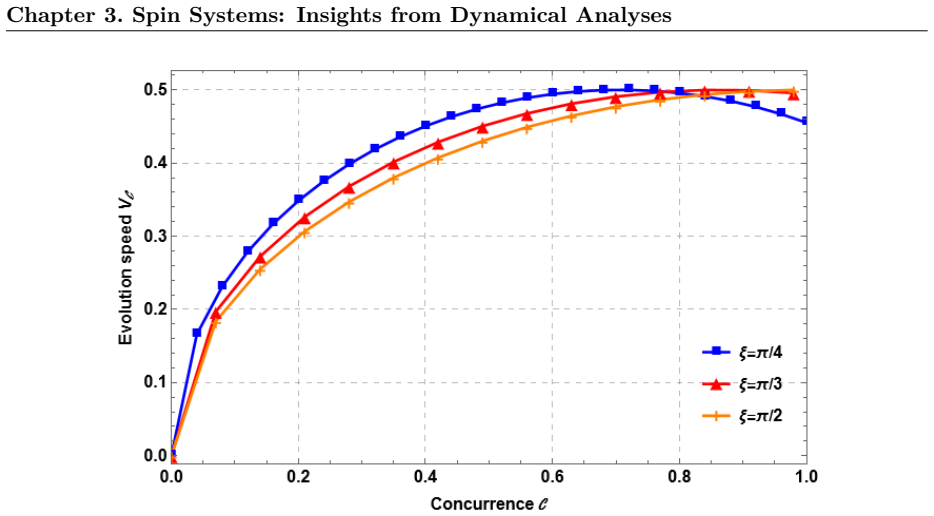
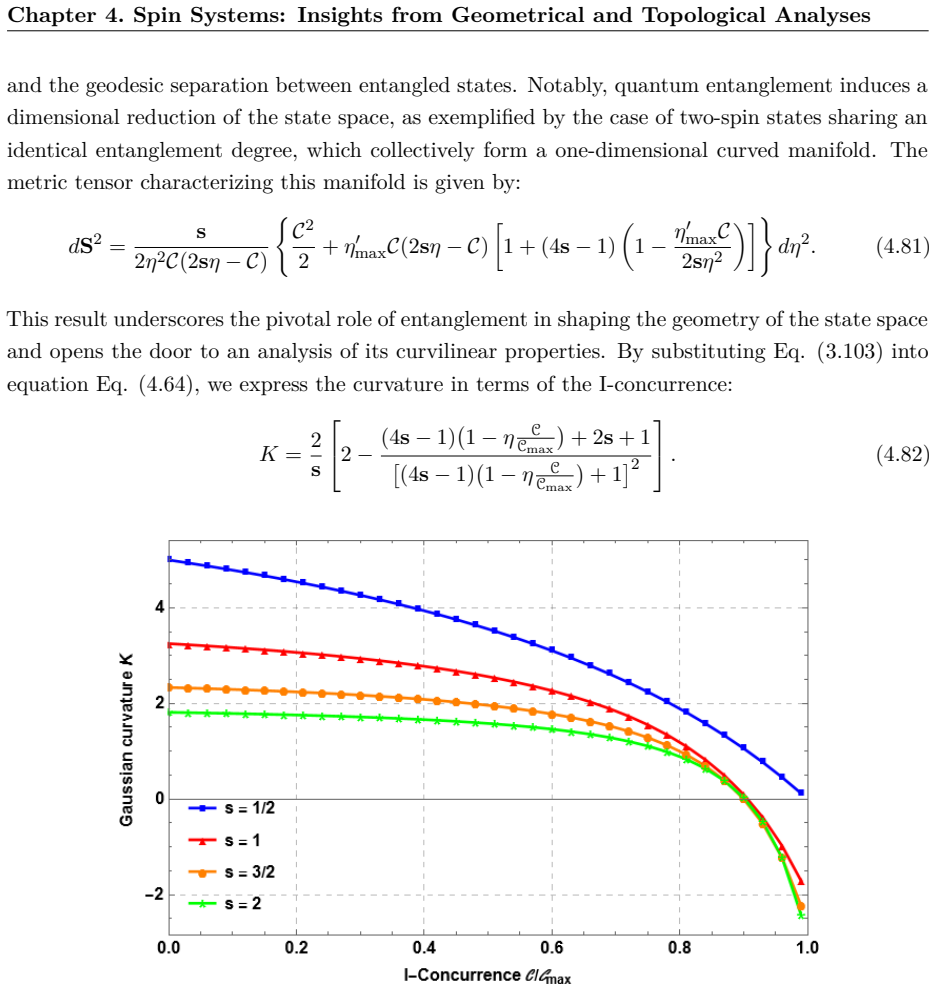
This thesis, explores the quantum entanglement and evolution through both a geometric and dynamical perspective. The first part focuses on classical phase space and its central role in Hamiltonian mechanics, emphasizing the importance of symplectic structures in describing mechanical states. The study highlights the formal analogy between classical phase space and the Hilbert space used in quantum mechanics. The second part is devoted to the geometric description of quantum states through the projective structure of Hilbert space. Emphasis is placed on the geometric interpretation of quantum evolution, particularly via the Fubini-Study metric, associated symplectic structures, and the geometric phase acquired during unitary evolutions. The final two parts are dedicated to the study of spin systems (both two-body and many-body) under different interaction models (XXZ Heisenberg and all-range Ising). Both the dynamical aspects (evolution speed, entanglement, and the quantum brachistochrone problem) and the geometric and topological structures of the corresponding quantum states are analyzed.
Editorial analysis
A structured set of objections, weighed in public.
Referee Report
Summary. This thesis explores quantum entanglement and evolution through geometric and dynamical lenses. It opens with classical phase space, Hamiltonian mechanics, and symplectic structures, then draws a formal analogy to quantum Hilbert space. The central geometric treatment covers the projective structure of Hilbert space, the Fubini-Study metric, associated symplectic forms, and the geometric phase acquired under unitary evolution. The final sections apply these tools to two-body and many-body spin systems governed by XXZ Heisenberg and all-range Ising interactions, examining dynamical quantities (evolution speed, entanglement, quantum brachistochrone problem) together with the geometric and topological properties of the corresponding states.
Significance. If the claimed connections hold, the work supplies a unified geometric language for relating Fubini-Study distance, symplectic invariants, and geometric phase to entanglement and speed limits in concrete spin models. This could illuminate the quantum brachistochrone problem and geometric-phase effects in interacting systems. The systematic coverage of both two-body and many-body cases is a positive feature. Significance is limited, however, by the fact that the geometric structures invoked are standard elements of quantum mechanics; the advance therefore rests on whether the application produces quantitative relations or predictions not already obtainable from the Schrödinger equation, concurrence, or von Neumann entropy.
major comments (2)
- Final two parts (spin-system analysis): the central claim that projective Hilbert-space geometry reveals new connections among evolution speed, entanglement, and geometric phase must be supported by explicit comparisons to prior results on geometric phases and speed limits in XXZ and Ising chains. Without such comparisons or new quantitative bounds, the geometric treatment risks restating known solutions in different language rather than advancing the field.
- Sections on the quantum brachistochrone problem for the XXZ and all-range Ising models: the manuscript should state whether the Fubini-Study-based bound is tighter, parameter-free, or otherwise distinct from bounds derived directly from the time-dependent Schrödinger equation or from existing literature on optimal control in spin systems.
Simulated Author's Rebuttal
We thank the referee for the careful reading and constructive feedback on our thesis. We address each major comment below and indicate the revisions planned to strengthen the manuscript.
read point-by-point responses
-
Referee: Final two parts (spin-system analysis): the central claim that projective Hilbert-space geometry reveals new connections among evolution speed, entanglement, and geometric phase must be supported by explicit comparisons to prior results on geometric phases and speed limits in XXZ and Ising chains. Without such comparisons or new quantitative bounds, the geometric treatment risks restating known solutions in different language rather than advancing the field.
Authors: We agree that explicit comparisons to prior literature are necessary to clearly delineate the contributions of the geometric approach. Our analysis applies the Fubini-Study metric and associated structures to two- and many-body spin systems under XXZ and Ising interactions, yielding specific relations linking evolution speed, entanglement measures, and geometric phase that are not immediately apparent from the Schrödinger equation alone. To address the concern, we will add a new subsection in the spin-system chapters that reviews representative prior results on geometric phases in Heisenberg and Ising models as well as quantum speed limits in spin chains. This subsection will contrast those findings with our results, emphasizing the novel quantitative connections to entanglement dynamics that arise from the projective geometry. We believe this addition will demonstrate the advancement without altering the core derivations. revision: yes
-
Referee: Sections on the quantum brachistochrone problem for the XXZ and all-range Ising models: the manuscript should state whether the Fubini-Study-based bound is tighter, parameter-free, or otherwise distinct from bounds derived directly from the time-dependent Schrödinger equation or from existing literature on optimal control in spin systems.
Authors: We thank the referee for highlighting the need for explicit clarification here. The Fubini-Study bound is derived directly from the projective metric on Hilbert space and is parameter-free with respect to the distance between initial and target states; it is mathematically equivalent to the Mandelstam-Tamm bound in certain regimes but provides a distinct geometric and symplectic interpretation that directly incorporates entanglement evolution in the XXZ and Ising cases. In the revised manuscript we will insert a dedicated paragraph in the brachistochrone sections that states these properties, notes that the bound is not uniformly tighter than Schrödinger-equation or optimal-control bounds, and references relevant literature on spin-system control. This will make the relation to existing results transparent while preserving the geometric perspective that is the focus of the thesis. revision: yes
Circularity Check
No significant circularity; geometric formalism applied to spin models without self-referential reduction
full rationale
The derivation chain relies on standard definitions of the Fubini-Study metric, symplectic forms on projective Hilbert space, and geometric phase, which are textbook elements of quantum mechanics independent of the specific XXZ or Ising Hamiltonians. No equations reduce a claimed prediction or insight to a fitted parameter or prior self-citation by construction. The analysis of evolution speed, entanglement, and brachistochrone bounds for the spin systems proceeds from the Schrödinger equation and concurrence/von Neumann entropy without tautological redefinition. Self-contained against external benchmarks.
Axiom & Free-Parameter Ledger
axioms (2)
- standard math Quantum states are represented by rays in Hilbert space equipped with the Fubini-Study metric.
- domain assumption Unitary evolution corresponds to geodesics or paths in the projective Hilbert space.
Reference graph
Works this paper leans on
-
[1]
The present status of quantum mechanics
Erwin Schrödinger. The present status of quantum mechanics. Die Naturwissenschaften , 23(48):1–26, 1935
1935
-
[2]
Observations on light and colours
Thomas Melvill. Observations on light and colours. Journal of the Royal Astronomical Society of Canada, Vol. 8, p. 231 , 8:231, 1914
1914
-
[3]
Ueber einen einfluss des ultravioletten lichtes auf die electrische entladung
Heinrich Hertz. Ueber einen einfluss des ultravioletten lichtes auf die electrische entladung. Annalen der Physik , 267(8):983–1000, 1887
-
[4]
The quantum theory of light
Rodney Loudon. The quantum theory of light . OUP Oxford, 2000
2000
-
[5]
Uncertainty principle, hilbert bases and algebras of operators
Yves Meyer. Uncertainty principle, hilbert bases and algebras of operators. Fundamental Papers in Wavelet Theory , page 216, 2006
2006
-
[6]
Lagrangian and Hamiltonian mechanics
Melvin G Calkin. Lagrangian and Hamiltonian mechanics . World Scientific, 1996
1996
-
[7]
The structures of hamiltonian mechanics
Alexandre Michailovich Vinogradov and Boris Abramovich Kupershmidt. The structures of hamiltonian mechanics. Russian Mathematical Surveys , 32(4):177, 1977
1977
-
[8]
Gregory L. Naber. 6 The postulates of quantum mechanics , pages 189–230. De Gruyter, Berlin, Boston, 2021
2021
-
[9]
Die grundlage der allgemeinen relativitätstheorie
HA Lorentz, A Einstein, H Minkowski, and A Einstein. Die grundlage der allgemeinen relativitätstheorie. Das Relativitätsprinzip: Eine Sammlung von Abhandlungen , pages 81– 124, 1923
1923
-
[10]
A geometric basis for thestandard-model gauge group
Greg Trayling and William E Baylis. A geometric basis for thestandard-model gauge group. Journal of Physics A: Mathematical and General , 34(15):3309, 2001
2001
-
[11]
Quantal phase factors accompanying adiabatic changes
Michael Victor Berry. Quantal phase factors accompanying adiabatic changes. Proceedings of the Royal Society of London. A. Mathematical and Physical Sciences , 392(1802):45–57, 1984
1984
-
[12]
The geometric phase
Michael Berry. The geometric phase. Scientific American, 259(6):46–55, 1988
1988
-
[13]
Mathematical methods of classical mechanics
VI Arnold. Mathematical methods of classical mechanics. Ann Arbor, 1001:48109, 1978. Bibliographie 116
1978
-
[14]
Symplectic geometry
Alan Weinstein. Symplectic geometry. Bulletin of the American mathematical society , 5(1):1–13, 1981
1981
-
[15]
Quantum computation and quantum information
Michael A Nielsen and Isaac L Chuang. Quantum computation and quantum information . Cambridge university press, 2010
2010
-
[16]
Geometry of projective hilbert space
AN Grigorenko. Geometry of projective hilbert space. Physical Review A , 46(11):7292, 1992
1992
-
[17]
Quantum Geometric Tensor (Fubini-Study Metric) in Simple Quantum System: A pedagogical Introduction
Ran Cheng. Quantum geometric tensor (fubini-study metric) in simple quantum system: A pedagogical introduction. arXiv preprint arXiv:1012.1337 , 2010
work page Pith review arXiv 2010
-
[18]
Characterizations of projective space and applications to complex symplectic manifolds
Koji Cho, Yoichi Miyaoka, and Nicholas I Shepherd-Barron. Characterizations of projective space and applications to complex symplectic manifolds. Higher dimensional birational geometry (Kyoto, 1997) , 35:1–88, 2002
1997
-
[19]
Quantum phase gates with geometric phases of spin-orbit modes
GTC Cruz, SA Carvalho, CER de Souza, and JAO Huguenin. Quantum phase gates with geometric phases of spin-orbit modes. Quantum Information Processing , 23(5):160, 2024
2024
-
[20]
Geometric phases and topological quantum computation
Vlatko Vedral. Geometric phases and topological quantum computation. International Journal of Quantum Information , 1(01):1–23, 2003
2003
-
[21]
Geometric and holonomic quantum computation
Jiang Zhang, Thi Ha Kyaw, Stefan Filipp, Leong-Chuan Kwek, Erik Sjöqvist, and Dianmin Tong. Geometric and holonomic quantum computation. Physics Reports, 1027:1–53, 2023
2023
-
[22]
Quantum computing in the nisq era and beyond
John Preskill. Quantum computing in the nisq era and beyond. Quantum, 2:79, 2018
2018
-
[23]
Fault-tolerant quantum computation by anyons
A Yu Kitaev. Fault-tolerant quantum computation by anyons. Annals of Physics , 303(1):2– 30, 2003
2003
-
[24]
Quantum error correction and orthogonal geometry
A Robert Calderbank, Eric M Rains, Peter W Shor, and Neil JA Sloane. Quantum error correction and orthogonal geometry. Physical Review Letters , 78(3):405, 1997
1997
-
[25]
Variational principles and lagranges equations
H Goldstein, CP Poole, and JL Safko. Variational principles and lagranges equations. Clas- sical Dynamics, 3rd ed. Addison-Wesley , pages 45–51, 2001
2001
-
[26]
Nonlinear dynamics and chaos: with applications to physics, biology, chemistry, and engineering
Steven H Strogatz. Nonlinear dynamics and chaos: with applications to physics, biology, chemistry, and engineering . Chapman and Hall/CRC, 2024
2024
-
[27]
Classical dynamics: a contemporary approach
Jorge V José and Eugene J Saletan. Classical dynamics: a contemporary approach . Cam- bridge university press, 1998
1998
-
[28]
Invariante variationsprobleme
E Noether. Invariante variationsprobleme. Nachrichten von der Gesellschaft der Wis- senschaften zu Göttingen, Mathematisch-Physikalische Klasse , 1918:235–257, 1918. Bibliographie 117
1918
-
[29]
Strongly coupled overdamped pendulums
Roberto De Luca. Strongly coupled overdamped pendulums. Revista Brasileira de Ensino de Física , 30:4304–1, 2008
2008
-
[30]
Proof of heisenbergs error-disturbance relation
Paul Busch, Pekka Lahti, and Reinhard F Werner. Proof of heisenbergs error-disturbance relation. Physical review letters , 111(16):160405, 2013
2013
-
[31]
The meaning of the wave function: In search of the ontology of quantum me- chanics
Shan Gao. The meaning of the wave function: In search of the ontology of quantum me- chanics. Cambridge University Press, 2017
2017
-
[32]
Hilbert space quantum mechanics
Robert B Griffiths. Hilbert space quantum mechanics. Available: ht tps://quantum. phys. cmu. edu/QCQI/qitd114. pdf , page 13, 2012
2012
-
[33]
Systems with infinite-dimensional state space: the hilbert space approach
J William Helton. Systems with infinite-dimensional state space: the hilbert space approach. Proceedings of the IEEE , 64(1):145–160, 2005
2005
-
[34]
Quantum mechanics, volume 1
Claude Cohen-Tannoudji, Bernard Diu, and Frank Laloe. Quantum mechanics, volume 1. Quantum Mechanics , 1:898, 1986
1986
-
[35]
Quantum mechanics and path integrals, 1966
RP Feynman, AR Hibbs, and George H Weiss. Quantum mechanics and path integrals, 1966
1966
-
[36]
Techniques and applications of path integration
Lawrence S Schulman. Techniques and applications of path integration. Courier Corporation, 2012
2012
-
[37]
Saddle-point method in path integrals
AL Koshkarov. Saddle-point method in path integrals. Technical report, Joint Inst. for Nuclear Research, 1993
1993
-
[38]
Springer, 1980
Christian Okonek, Michael Schneider, Heinz Spindler, and Serge ˘ ı Izrailevich Gelfand.Vector bundles on complex projective spaces , volume 3. Springer, 1980
1980
-
[39]
Felix kleins projective representations of the groups s6 anda7
Henning Heller. Felix kleins projective representations of the groups s6 anda7. Archive for History of Exact Sciences , 76(5):431–470, 2022
2022
-
[40]
Differential analysis on complex manifolds , volume 21980
Raymond O’Neil Wells and Oscar García-Prada. Differential analysis on complex manifolds , volume 21980. Springer New York, 1980
1980
-
[41]
Chebyshev potentials, fubini–study metrics, and geom- etry of the space of kähler metrics
Chenzi Jin and Yanir A Rubinstein. Chebyshev potentials, fubini–study metrics, and geom- etry of the space of kähler metrics. Bulletin of the London Mathematical Society , 56(3):881– 906, 2024
2024
-
[42]
Information-theoretic differential geome- try of quantum phase transitions
Paolo Zanardi, Paolo Giorda, and Marco Cozzini. Information-theoretic differential geome- try of quantum phase transitions. Physical review letters , 99(10):100603, 2007
2007
-
[43]
Information ge- ometry in time dependent quantum systems and the geometric phase
Anshuman Dey, Suvankar Paul, Pratim Roy, and Tapobrata Sarkar. Information ge- ometry in time dependent quantum systems and the geometric phase. arXiv preprint arXiv:1605.01358, 2016. Bibliographie 118
-
[44]
Geometric phase and modulus relations for probability amplitudes as func- tions on complex parameter spaces
Alonso Botero. Geometric phase and modulus relations for probability amplitudes as func- tions on complex parameter spaces. Journal of Mathematical Physics , 44(11):5279–5295, 2003
2003
-
[45]
Geometry of Quantum States: An Introduction to Quantum Entanglement
Ingemar Bengtsson and Karol Zyczkowski. Geometry of Quantum States: An Introduction to Quantum Entanglement . Cambridge University Press, 2006
2006
-
[46]
Geometric quan- tum computation using nuclear magnetic resonance
Jonathan A Jones, Vlatko Vedral, Artur Ekert, and Giuseppe Castagnoli. Geometric quan- tum computation using nuclear magnetic resonance. Nature, 403(6772):869–871, 2000
2000
-
[47]
The quantum brachistochrone problem for an arbitrary spin in a magnetic field
AR Kuzmak and VM Tkachuk. The quantum brachistochrone problem for an arbitrary spin in a magnetic field. Physics Letters A , 379(18-19):1233–1239, 2015
2015
-
[48]
Quantum brachistochrone problem for a spin-1 system in a magnetic field
AM Frydryszak and VM Tkachuk. Quantum brachistochrone problem for a spin-1 system in a magnetic field. Physical Review AAtomic, Molecular, and Optical Physics , 77(1):014103, 2008
2008
-
[49]
Implementation of universal quantum gates based on nona- diabatic geometric phases
Shi-Liang Zhu and ZD Wang. Implementation of universal quantum gates based on nona- diabatic geometric phases. Physical review letters , 89(9):097902, 2002
2002
-
[50]
Quantum state geometry and entanglement of two spins with anisotropic interaction in evolution
AR Kuzmak. Quantum state geometry and entanglement of two spins with anisotropic interaction in evolution. Journal of Geometry and Physics , 116:81–89, 2017
2017
-
[51]
Localsymmetry properties of pure three-qubit states
HA Carteret and A Sudbery. Localsymmetry properties of pure three-qubit states. Journal of Physics A: Mathematical and General , 33(28):4981, 2000
2000
-
[52]
Geometric formulation of quantum mechanics
Hoshang Heydari. Geometric formulation of quantum mechanics. arXiv preprint arXiv:1503.00238, 2015
-
[53]
The Geometric phase in quantum systems: foundations, mathematical concepts, and applications in molecular and condensed matter physics
Arno Bohm, Ali Mostafazadeh, Hiroyasu Koizumi, Qian Niu, and Josef Zwanziger. The Geometric phase in quantum systems: foundations, mathematical concepts, and applications in molecular and condensed matter physics . Springer Science & Business Media, 2013
2013
-
[54]
Phase change during a cyclic quantum evolution
Yakir Aharonov and J Anandan. Phase change during a cyclic quantum evolution. Physical Review Letters, 58(16):1593, 1987
1987
-
[55]
Geometric aspects of noncyclic quantum evolutions
Arun Kumar Pati. Geometric aspects of noncyclic quantum evolutions. Physical Review A , 52(4):2576, 1995
1995
-
[56]
New derivation of the geometric phase
Arun Kumar Pati. New derivation of the geometric phase. Physics Letters A , 202(1):40–45, 1995
1995
-
[57]
Riemannian structures of prescribed gaussian curvature for compact 2-manifolds
Melvyn S Berger. Riemannian structures of prescribed gaussian curvature for compact 2-manifolds. Journal of Differential Geometry , 5(3-4):325–332, 1971. Bibliographie 119
1971
-
[58]
Riemannian manifolds: an introduction to curvature , volume 176
John M Lee. Riemannian manifolds: an introduction to curvature , volume 176. Springer Science & Business Media, 2006
2006
-
[59]
Gauss’ Theorema Egregium , pages 247–268
Andrew Pressley. Gauss’ Theorema Egregium , pages 247–268. Springer London, London, 2010
2010
-
[60]
The gauss-bonnet theorem for riemannian polyhedra
Carl B Allendoerfer and André Weil. The gauss-bonnet theorem for riemannian polyhedra. Transactions of the American Mathematical Society , 53(1):101–129, 1943
1943
-
[61]
Classifying and measur- ing geometry of a quantum ground state manifold
Michael Kolodrubetz, Vladimir Gritsev, and Anatoli Polkovnikov. Classifying and measur- ing geometry of a quantum ground state manifold. Physical Review BCondensed Matter and Materials Physics , 88(6):064304, 2013
2013
-
[62]
Experimental observation of fractional topological phases with photonic qudits
AA Matoso, X Sánchez-Lozano, WM Pimenta, P Machado, B Marques, Fabio Sciarrino, LE Oxman, AZ Khoury, and S Pádua. Experimental observation of fractional topological phases with photonic qudits. Physical Review A , 94(5):052305, 2016
2016
-
[63]
Quantum state manifold and geometric, dynamic and topological phases for an interacting two-spin system
B Amghar and M Daoud. Quantum state manifold and geometric, dynamic and topological phases for an interacting two-spin system. International Journal of Geometric Methods in Modern Physics , 17(02):2050030, 2020
2020
-
[64]
Majorana zero modes and topological quantum computation
Sankar Das Sarma, Michael Freedman, and Chetan Nayak. Majorana zero modes and topological quantum computation. npj Quantum Information , 1(1):1–13, 2015
2015
-
[65]
Majorana qubits for topological quantum com- puting
Ramón Aguado and Leo P Kouwenhoven. Majorana qubits for topological quantum com- puting. Physics today , 73(6):44–50, 2020
2020
-
[66]
Non-abelian statistics of half-quantum vortices in p-wave superconductors
Dmitri A Ivanov. Non-abelian statistics of half-quantum vortices in p-wave superconductors. Physical review letters , 86(2):268, 2001
2001
-
[67]
Non-abelian vortices and non-abelian statistics
Hoi-Kwong Lo and John Preskill. Non-abelian vortices and non-abelian statistics. Physical Review D , 48(10):4821, 1993
1993
-
[68]
Quantum entanglement and topological entan- glement
Louis H Kauffman and Samuel J Lomonaco. Quantum entanglement and topological entan- glement. New Journal of Physics , 4(1):73, 2002
2002
-
[69]
Topological protection of perturbed edge states
Guillaume Bal. Topological protection of perturbed edge states. arXiv preprint arXiv:1709.00605, 2017
-
[70]
Introduction to topological quantum computation with non-abelian anyons
Bernard Field and Tapio Simula. Introduction to topological quantum computation with non-abelian anyons. Quantum Science and Technology , 3(4):045004, 2018
2018
-
[71]
Topologically protected gates for quantum computation with non- abelian anyons in the pfaffian quantum hall state
Lachezar S Georgiev. Topologically protected gates for quantum computation with non- abelian anyons in the pfaffian quantum hall state. Physical Review BCondensed Matter and Materials Physics , 74(23):235112, 2006. Bibliographie 120
2006
-
[72]
Fault-tolerant quantum error correction for non- abelian anyons
Guillaume Dauphinais and David Poulin. Fault-tolerant quantum error correction for non- abelian anyons. Communications in Mathematical Physics , 355:519–560, 2017
2017
-
[73]
Quantum brachistochrone problem and the geometry of the state space<? format?> in pseudo-hermitian quantum mechanics
Ali Mostafazadeh. Quantum brachistochrone problem and the geometry of the state space<? format?> in pseudo-hermitian quantum mechanics. Physical review letters , 99(13):130502, 2007
2007
-
[74]
Entanglement of formation of an arbitrary state of two qubits
William K Wootters. Entanglement of formation of an arbitrary state of two qubits. Physical Review Letters, 80(10):2245, 1998
1998
-
[75]
Geometrical and dynamical de- scription of two interacting spins under the xxz-type heisenberg model
Jamal Elfakir, Brahim Amghar, and Mohammed Daoud. Geometrical and dynamical de- scription of two interacting spins under the xxz-type heisenberg model. International Jour- nal of Geometric Methods in Modern Physics , 20(01):2350006, 2023
2023
-
[76]
Complementarity between quantum entanglement and geometric and dynamical appearances in n spin-1/2 system under all-range ising model
Jamal Elfakir, Brahim Amghar, Abdallah Slaoui, and Mohammed Daoud. Complementarity between quantum entanglement and geometric and dynamical appearances in n spin-1/2 system under all-range ising model. The European Physical Journal Plus , 139(8):1–17, 2024
2024
-
[77]
Geometrical, topological, and dynamical description of n interacting spin-s particles in a long-range ising model and their interplay with quantum entanglement
Brahim Amghar, Abdallah Slaoui, Jamal Elfakir, and Mohammed Daoud. Geometrical, topological, and dynamical description of n interacting spin-s particles in a long-range ising model and their interplay with quantum entanglement. Physical Review A , 107(3):032402, 2023
2023
-
[78]
Aspects géométriques des corrélations quantiques dans des systèmes multiqudits
Brahim AMGHAR. Aspects géométriques des corrélations quantiques dans des systèmes multiqudits. 2021
2021
-
[79]
On optimum hamiltonians for state transformations
Dorje C Brody and Daniel W Hook. On optimum hamiltonians for state transformations. Journal of Physics A: Mathematical and General , 39(11):L167, 2006
2006
-
[80]
The brachistochrone problem
Nils P Johnson. The brachistochrone problem. The College Mathematics Journal , 35(3):192– 197, 2004
2004
discussion (0)
Sign in with ORCID, Apple, or X to comment. Anyone can read and Pith papers without signing in.