Recognition: unknown
Polaris: Coupled Orbital Polar Embeddings for Hierarchical Concept Learning
Pith reviewed 2026-05-09 20:01 UTC · model grok-4.3
The pith
Polaris embeds concepts on a hypersphere where angle encodes semantic meaning and radius encodes hierarchical position.
A machine-rendered reading of the paper's core claim, the machinery that carries it, and where it could break.
Core claim
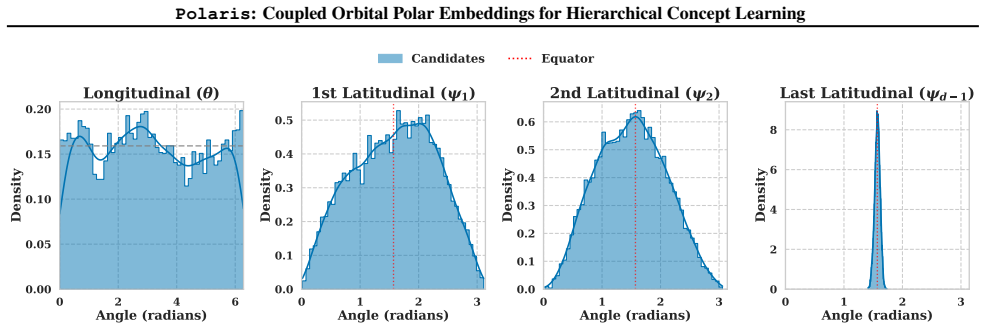
Polaris is a polar hyperspherical embedding framework that separates semanticity from hierarchy using angular geometry and radius, enabling the learning of meaning and structure without interference. Latent representations are mapped to the sphere by projection to the tangent space at the north pole, followed by the exponential map and spherical linear layers that enforce unit-norm outputs. Training combines robust local constraints, global regularization that prevents geometric collapse, and uncertainty-aware asymmetric objectives that encourage directional containment. At inference, structure-guided retrieval efficiently narrows candidate parents before final ranking.
What carries the argument
Coupled orbital polar embeddings on the hypersphere, with angular coordinates capturing semantic similarity and radial distance capturing hierarchical containment.
Load-bearing premise
Angular position and radial distance on the sphere can be made to carry semantic and hierarchical information independently, and the chosen local, global, and asymmetric objectives will produce stable directional containment without needing dataset-specific adjustments.
What would settle it
On a held-out taxonomy expansion benchmark the method would show no gain in top-K parent retrieval accuracy or mean rank over the strongest baseline, or the learned embeddings would exhibit strong correlation between angle and radius instead of separation.
Figures


read the original abstract
Real-world knowledge is often organized as hierarchies such as product taxonomies, medical ontologies, and label trees, yet learning hierarchical representations is challenging due to asymmetric structure and noisy semantics. We introduce Polaris, a polar hyperspherical embedding framework that separates semanticity from hierarchy using angular geometry and radius, enabling the learning of meaning and structure without interference. To map latent representation onto the sphere, we project it to the tangent space at the north pole, apply the exponential map, and learn unit-norm representations using spherical linear layers. Polaris then combines robust local constraints, global regularization that prevents geometric collapse, and uncertainty-aware asymmetric objectives that encourage directional containment. At inference time, Polaris uses structure-guided retrieval to efficiently narrow down candidate parents before final ranking. We evaluate Polaris on different settings of taxonomy expansion - spanning trees, multi-parent DAGs, and multimodal hierarchies, showing consistent improvements of up to ~19 points in top-K retrieval and up to ~60% reduction in mean rank over fourteen strong baselines.
Editorial analysis
A structured set of objections, weighed in public.
Referee Report
Summary. The paper introduces Polaris, a polar hyperspherical embedding framework for hierarchical concept learning in structures such as taxonomies and ontologies. It separates semanticity from hierarchy by encoding meaning in angular geometry and structure in radius on the sphere. The approach projects latent vectors to the tangent space at the north pole, applies the exponential map, and employs spherical linear layers to obtain unit-norm representations. Training combines local constraints, global regularization against geometric collapse, and uncertainty-aware asymmetric objectives to enforce directional containment. Inference uses structure-guided retrieval to prune candidates before ranking. Experiments across taxonomy expansion settings (trees, multi-parent DAGs, multimodal hierarchies) report gains of up to ~19 points in top-K retrieval and ~60% reduction in mean rank versus fourteen baselines.
Significance. If the geometric separation of semantics and hierarchy proves stable and the reported gains are robust, Polaris could advance representation learning for asymmetric and noisy hierarchies by providing an explicit polar mechanism that avoids interference between meaning and structure. The combination of tangent-space projection, spherical layers, and uncertainty-aware objectives offers a concrete alternative to standard hyperbolic or Euclidean hierarchical embeddings. Credit is due for evaluating across multiple hierarchy types and for including structure-guided retrieval at inference. However, the absence of derivation details, error bars, baseline descriptions, and data-exclusion rules in the available materials limits assessment of whether the central claims are supported.
major comments (2)
- Abstract: the reported improvements (up to 19 points top-K, 60% mean-rank reduction) are presented without reference to specific baselines, statistical tests, error bars, or data splits; this prevents verification that the gains are not due to post-hoc selection or implementation differences and directly affects the strength of the empirical claim.
- Abstract (weakest assumption): the claim that angular geometry and radius can separate semanticity from hierarchy without interference is asserted but not accompanied by a derivation or ablation showing that the local constraints, global regularization, and asymmetric objectives produce stable directional containment; without such analysis the central geometric premise remains untested.
minor comments (2)
- Abstract: the description of the projection step ('project it to the tangent space at the north pole, apply the exponential map') would benefit from an explicit equation or diagram to clarify the mapping from latent space to the sphere.
- Abstract: 'fourteen strong baselines' is stated without naming them or indicating whether they include recent hyperspherical or hyperbolic methods; adding this list would improve reproducibility.
Simulated Author's Rebuttal
We thank the referee for the constructive review and the opportunity to address the concerns regarding empirical reporting and the geometric foundations of Polaris. We respond to each major comment below and indicate planned revisions to the manuscript.
read point-by-point responses
-
Referee: Abstract: the reported improvements (up to 19 points top-K, 60% mean-rank reduction) are presented without reference to specific baselines, statistical tests, error bars, or data splits; this prevents verification that the gains are not due to post-hoc selection or implementation differences and directly affects the strength of the empirical claim.
Authors: We agree that greater specificity in the abstract would aid verification. In the revised manuscript we will name the primary baselines (e.g., the hyperbolic and Euclidean hierarchical models among the fourteen) and explicitly direct readers to Section 4 for per-baseline tables, error bars computed over multiple random seeds, statistical significance tests, and the exact train/validation/test splits used. The reported aggregate gains are computed across all baselines with full breakdowns already present in the experimental tables; we will ensure the abstract references these details without exceeding length constraints. revision: yes
-
Referee: Abstract (weakest assumption): the claim that angular geometry and radius can separate semanticity from hierarchy without interference is asserted but not accompanied by a derivation or ablation showing that the local constraints, global regularization, and asymmetric objectives produce stable directional containment; without such analysis the central geometric premise remains untested.
Authors: The separation mechanism is derived in Section 3 via the tangent-space projection at the north pole, the exponential map, and the uncertainty-aware asymmetric loss (Equation 5) that enforces directional containment. We acknowledge that an explicit ablation isolating each component's contribution to stability would strengthen the presentation. We will add a targeted ablation study in the revised manuscript (new subsection in Section 4) quantifying directional containment metrics with and without each term, and we will expand the derivation sketch currently in Appendix A into the main text for clarity. revision: yes
Circularity Check
No significant circularity detected
full rationale
The paper presents Polaris as a new polar hyperspherical embedding method that separates semanticity from hierarchy via angular geometry and radius, using explicit constructions such as tangent-space projection, exponential map, spherical linear layers, local constraints, global regularization, and uncertainty-aware asymmetric objectives. These elements are introduced as independent design choices rather than reductions to previously fitted quantities or self-citations. No equations are shown that equate a claimed prediction back to its own inputs by construction, and the evaluation reports empirical gains over external baselines without load-bearing reliance on author-prior uniqueness theorems or ansatzes smuggled via citation. The derivation chain remains self-contained against the described components and external comparisons.
Axiom & Free-Parameter Ledger
axioms (1)
- domain assumption Projecting latent representations to the tangent space at the north pole and applying the exponential map produces unit-norm representations usable by spherical linear layers.
invented entities (1)
-
Polaris polar hyperspherical embedding framework
no independent evidence
Reference graph
Works this paper leans on
-
[1]
Wu, Wentao and Li, Hongsong and Wang, Haixun and Zhu, Kenny Q. , title =. Proceedings of the 2012 ACM SIGMOD International Conference on Management of Data , pages =. 2012 , isbn =. doi:10.1145/2213836.2213891 , abstract =
-
[2]
HyperMiner: Topic Taxonomy Mining with Hyperbolic Embedding , volume =
Xu, Yi.shi and Wang, Dongsheng and Chen, Bo and Lu, Ruiying and Duan, Zhibin and Zhou, Mingyuan , booktitle =. HyperMiner: Topic Taxonomy Mining with Hyperbolic Embedding , volume =
-
[3]
2026 , eprint=
TaxoBell: Gaussian Box Embeddings for Self-Supervised Taxonomy Expansion , author=. 2026 , eprint=
2026
-
[4]
Jiang, Song and Yao, Qiyue and Wang, Qifan and Sun, Yizhou , title =. 2023 , isbn =. doi:10.1145/3543507.3583310 , booktitle =
-
[5]
Probabilistic embedding of knowledge graphs with box lattice measures
Vilnis, Luke and Li, Xiang and Murty, Shikhar and McCallum, Andrew. Probabilistic Embedding of Knowledge Graphs with Box Lattice Measures. Proceedings of the 56th Annual Meeting of the Association for Computational Linguistics (Volume 1: Long Papers). 2018. doi:10.18653/v1/P18-1025
-
[7]
International Conference on Learning Representations , year=
Smoothing the Geometry of Probabilistic Box Embeddings , author=. International Conference on Learning Representations , year=
-
[8]
Proceedings of the 26th International Conference on Knowledge Discovery & Data Mining , pages =
Yu, Yue and Li, Yinghao and Shen, Jiaming and Feng, Hao and Sun, Jimeng and Zhang, Chao , title =. 2020 , isbn =. doi:10.1145/3394486.3403145 , booktitle =
-
[9]
Proceedings of the ACM Web Conference 2022 , pages =
Jiang, Minhao and Song, Xiangchen and Zhang, Jieyu and Han, Jiawei , title =. Proceedings of the ACM Web Conference 2022 , pages =. 2022 , isbn =. doi:10.1145/3485447.3511935 , abstract =
-
[10]
Shen, Jiaming and Shen, Zhihong and Xiong, Chenyan and Wang, Chi and Wang, Kuansan and Han, Jiawei , title =. 2020 , isbn =. doi:10.1145/3366423.3380132 , booktitle =
-
[11]
H yper E xpan: Taxonomy Expansion with Hyperbolic Representation Learning
Ma, Mingyu Derek and Chen, Muhao and Wu, Te-Lin and Peng, Nanyun. H yper E xpan: Taxonomy Expansion with Hyperbolic Representation Learning. Findings of the Association for Computational Linguistics: EMNLP 2021. 2021. doi:10.18653/v1/2021.findings-emnlp.353
-
[12]
Poincar\'
Nickel, Maximillian and Kiela, Douwe , booktitle =. Poincar\'
-
[13]
Medical subject headings (MeSH) , volume =
Lipscomb, Carolyn , year =. Medical subject headings (MeSH) , volume =
-
[14]
Wikidata: a free collaborative knowledgebase
Vrande. Wikidata: a free collaborative knowledgebase , year =. Commun. ACM , month = sep, pages =. doi:10.1145/2629489 , abstract =
-
[15]
Improving Web Search Ranking by Incorporating Structured Annotation of Queries
Ding, Xiao and Dou, Zhicheng and Qin, Bing and Liu, Ting and Wen, Ji-Rong. Improving Web Search Ranking by Incorporating Structured Annotation of Queries. Proceedings of the 2013 Conference on Empirical Methods in Natural Language Processing. 2013
2013
-
[16]
Gabrilovich, Evgeniy and Broder, Andrei and Fontoura, Marcus and Joshi, Amruta and Josifovski, Vanja and Riedel, Lance and Zhang, Tong , title =. ACM Trans. Web , month = apr, articleno =. 2009 , issue_date =. doi:10.1145/1513876.1513877 , abstract =
-
[17]
ArXiv , volume =
Producing Usable Taxonomies Cheaply and Rapidly at Pinterest Using Discovered Dynamic -Topics , author =. ArXiv , volume =
-
[18]
International Conference on Learning Representations , year=
RotatE: Knowledge Graph Embedding by Relational Rotation in Complex Space , author=. International Conference on Learning Representations , year=
-
[19]
Translating Embeddings for Modeling Multi-relational Data , volume =
Bordes, Antoine and Usunier, Nicolas and Garcia-Duran, Alberto and Weston, Jason and Yakhnenko, Oksana , booktitle =. Translating Embeddings for Modeling Multi-relational Data , volume =
-
[20]
Shen, Dan and Ruvini, Jean-David and Sarwar, Badrul , title =. 2012 , isbn =. doi:10.1145/2396761.2396838 , booktitle =
-
[21]
BoxE: A Box Embedding Model for Knowledge Base Completion , volume =
Abboud, Ralph and Ceylan, Ismail and Lukasiewicz, Thomas and Salvatori, Tommaso , booktitle =. BoxE: A Box Embedding Model for Knowledge Base Completion , volume =
-
[22]
Improving Local Identifiability in Probabilistic Box Embeddings , volume =
Dasgupta, Shib and Boratko, Michael and Zhang, Dongxu and Vilnis, Luke and Li, Xiang and McCallum, Andrew , booktitle =. Improving Local Identifiability in Probabilistic Box Embeddings , volume =
-
[23]
S em E val-2015 Task 17: Taxonomy Extraction Evaluation ( TE x E val)
Bordea, Georgeta and Buitelaar, Paul and Faralli, Stefano and Navigli, Roberto. S em E val-2015 Task 17: Taxonomy Extraction Evaluation ( TE x E val). Proceedings of the 9th International Workshop on Semantic Evaluation ( S em E val 2015). 2015. doi:10.18653/v1/S15-2151
-
[24]
Proceedings of the 38th International Conference on Machine Learning , pages =
Learning Transferable Visual Models From Natural Language Supervision , author =. Proceedings of the 38th International Conference on Machine Learning , pages =. 2021 , editor =
2021
-
[25]
Proceedings of the IEEE/CVF Conference on Computer Vision and Pattern Recognition (CVPR) , month =
Daroya, Rangel and Sun, Aaron and Maji, Subhransu , title =. Proceedings of the IEEE/CVF Conference on Computer Vision and Pattern Recognition (CVPR) , month =. 2024 , pages =
2024
-
[26]
S em E val-2016 Task 14: Semantic Taxonomy Enrichment
Jurgens, David and Pilehvar, Mohammad Taher. S em E val-2016 Task 14: Semantic Taxonomy Enrichment. Proceedings of the 10th International Workshop on Semantic Evaluation ( S em E val-2016). 2016. doi:10.18653/v1/S16-1169
-
[27]
Structured Learning for Taxonomy Induction with Belief Propagation
Bansal, Mohit and Burkett, David and de Melo, Gerard and Klein, Dan. Structured Learning for Taxonomy Induction with Belief Propagation. Proceedings of the 52nd Annual Meeting of the Association for Computational Linguistics (Volume 1: Long Papers). 2014. doi:10.3115/v1/P14-1098
-
[28]
Proceedings of AAAI , volume = 35, pages =
Taxonomy completion via triplet matching network , author =. Proceedings of AAAI , volume = 35, pages =
-
[29]
Proceedings of the AAAI Conference on Artificial Intelligence , author=
Learning Hierarchy-Aware Knowledge Graph Embeddings for Link Prediction , volume=. Proceedings of the AAAI Conference on Artificial Intelligence , author=. 2020 , month=. doi:10.1609/aaai.v34i03.5701 , abstractNote=
-
[30]
E -Commerce Product Categorization with LLM -based Dual-Expert Classification Paradigm
Cheng, Zhu and Zhang, Wen and Chou, Chih-Chi and Jau, You-Yi and Pathak, Archita and Gao, Peng and Batur, Umit. E -Commerce Product Categorization with LLM -based Dual-Expert Classification Paradigm. Proceedings of the 1st Workshop on Customizable NLP: Progress and Challenges in Customizing NLP for a Domain, Application, Group, or Individual (CustomNLP4U)...
-
[31]
Proceedings of KDD , pages =
Steam: Self-supervised taxonomy expansion with mini-paths , author =. Proceedings of KDD , pages =
-
[32]
Proceedings of WWW , pages =
Taxoenrich: Self-supervised taxonomy completion via structure-semantic representations , author =. Proceedings of WWW , pages =
-
[33]
Proceedings of WWW , pages =
Expanding taxonomies with implicit edge semantics , author =. Proceedings of WWW , pages =
-
[34]
TEMP : Taxonomy Expansion with Dynamic Margin Loss through Taxonomy-Paths
Liu, Zichen and Xu, Hongyuan and Wen, Yanlong and Jiang, Ning and Wu, HaiYing and Yuan, Xiaojie. TEMP : Taxonomy Expansion with Dynamic Margin Loss through Taxonomy-Paths. Proceedings of the 2021 Conference on Empirical Methods in Natural Language Processing. 2021. doi:10.18653/v1/2021.emnlp-main.313
-
[35]
S em E val-2016 Task 13: Taxonomy Extraction Evaluation ( TE x E val-2)
Bordea, Georgeta and Lefever, Els and Buitelaar, Paul. S em E val-2016 Task 13: Taxonomy Extraction Evaluation ( TE x E val-2). Proceedings of the 10th International Workshop on Semantic Evaluation ( S em E val-2016). 2016. doi:10.18653/v1/S16-1168
-
[36]
Rank, Chunk and Expand: Lineage-Oriented Reasoning for Taxonomy Expansion
Mishra, Sahil and Arjun, Kumar and Chakraborty, Tanmoy. Rank, Chunk and Expand: Lineage-Oriented Reasoning for Taxonomy Expansion. Findings of the Association for Computational Linguistics: ACL 2025. 2025. doi:10.18653/v1/2025.findings-acl.671
-
[37]
Proceedings of KDD , pages =
Octet: Online catalog taxonomy enrichment with self-supervision , author =. Proceedings of KDD , pages =
-
[38]
Zhang, Yuchen and Ahmed, Amr and Josifovski, Vanja and Smola, Alexander , title =. 2014 , isbn =. doi:10.1145/2556195.2556236 , booktitle =
-
[39]
Enhancing Recommendation with Automated Tag Taxonomy Construction in Hyperbolic Space , year=
Tan, Yanchao and Yang, Carl and Wei, Xiangyu and Chen, Chaochao and Li, Longfei and Zheng, Xiaolin , booktitle=. Enhancing Recommendation with Automated Tag Taxonomy Construction in Hyperbolic Space , year=
-
[40]
Constructing Task-Specific Taxonomies for Document Collection Browsing
Yang, Hui. Constructing Task-Specific Taxonomies for Document Collection Browsing. Proceedings of the 2012 Joint Conference on Empirical Methods in Natural Language Processing and Computational Natural Language Learning. 2012
2012
-
[41]
Proceedings of the 25th Conference on Computational Natural Language Learning , pages=
Polar embedding , author=. Proceedings of the 25th Conference on Computational Natural Language Learning , pages=
-
[42]
arXiv preprint arXiv:2506.21476 , year=
Global and Local Entailment Learning for Natural World Imagery , author=. arXiv preprint arXiv:2506.21476 , year=
-
[43]
arXiv preprint arXiv:2109.10500 , year=
HyperExpan: Taxonomy expansion with hyperbolic representation learning , author=. arXiv preprint arXiv:2109.10500 , year=
-
[44]
arXiv preprint arXiv:2406.02772 , year=
Hyperbolic Benchmarking Unveils Network Topology-Feature Relationship in GNN Performance , author=. arXiv preprint arXiv:2406.02772 , year=
-
[45]
Proceedings of the 35th International Conference on Machine Learning , pages =
Hyperbolic Entailment Cones for Learning Hierarchical Embeddings , author =. Proceedings of the 35th International Conference on Machine Learning , pages =. 2018 , editor =
2018
-
[46]
Zhu, Huiling and Zeng, Yingqi , title =. 2025 , isbn =. doi:10.1007/978-981-95-3459-3_36 , booktitle =
-
[47]
Proceedings of the ACM web conference 2023 , pages=
Link prediction with attention applied on multiple knowledge graph embedding models , author=. Proceedings of the ACM web conference 2023 , pages=
2023
-
[48]
Advances in neural information processing systems , volume=
Translating embeddings for modeling multi-relational data , author=. Advances in neural information processing systems , volume=
-
[49]
International conference on machine learning , pages=
Learning transferable visual models from natural language supervision , author=. International conference on machine learning , pages=. 2021 , organization=
2021
-
[50]
Advances in Neural Information Processing Systems , volume=
Cone: Cone embeddings for multi-hop reasoning over knowledge graphs , author=. Advances in Neural Information Processing Systems , volume=
-
[51]
Advances in neural information processing systems , volume=
Hyperspherical prototype networks , author=. Advances in neural information processing systems , volume=
-
[52]
Bert: Pre-training of deep bidirectional transformers for language understanding , author=. Proceedings of the 2019 conference of the North American chapter of the association for computational linguistics: human language technologies, volume 1 (long and short papers) , pages=
2019
-
[53]
Proceedings of the 26th ACM SIGKDD International Conference on Knowledge Discovery & Data Mining , pages=
Steam: Self-supervised taxonomy expansion with mini-paths , author=. Proceedings of the 26th ACM SIGKDD International Conference on Knowledge Discovery & Data Mining , pages=
-
[54]
Proceedings of the AAAI Conference on Artificial Intelligence , volume=
Taxonomy completion via triplet matching network , author=. Proceedings of the AAAI Conference on Artificial Intelligence , volume=
-
[55]
Proceedings of the web conference 2020 , pages=
TaxoExpan: Self-supervised taxonomy expansion with position-enhanced graph neural network , author=. Proceedings of the web conference 2020 , pages=
2020
-
[56]
Rotate: Knowledge graph embedding by relational rotation in complex space,
Rotate: Knowledge graph embedding by relational rotation in complex space , author=. arXiv preprint arXiv:1902.10197 , year=
-
[57]
International conference on machine learning , pages=
Complex embeddings for simple link prediction , author=. International conference on machine learning , pages=. 2016 , organization=
2016
-
[58]
arXiv preprint arXiv:1502.07104 , year=
A note on the kullback-leibler divergence for the von mises-fisher distribution , author=. arXiv preprint arXiv:1502.07104 , year=
-
[59]
arXiv preprint arXiv:2510.06907 , year=
Angular Constraint Embedding via SpherePair Loss for Constrained Clustering , author=. arXiv preprint arXiv:2510.06907 , year=
-
[60]
Atzeni, Mattia and Plekhanov, Mikhail and Dreyer, Frederic and Kassner, Nora and Merello, Simone and Martin, Louis and Cancedda, Nicola. Polar Ducks and Where to Find Them: Enhancing Entity Linking with Duck Typing and Polar Box Embeddings. Proceedings of the 2023 Conference on Empirical Methods in Natural Language Processing. 2023. doi:10.18653/v1/2023.e...
-
[61]
ngpt: Normalized transformer with representation learning on the hypersphere , author=. arXiv preprint arXiv:2410.01131 , year=
-
[62]
arXiv preprint arXiv:2507.00518 , year=
Exploring Large Action Sets with Hyperspherical Embeddings using von Mises-Fisher Sampling , author=. arXiv preprint arXiv:2507.00518 , year=
-
[63]
Proceedings of the IEEE/CVF conference on computer vision and pattern recognition , pages=
Hubs and hyperspheres: Reducing hubness and improving transductive few-shot learning with hyperspherical embeddings , author=. Proceedings of the IEEE/CVF conference on computer vision and pattern recognition , pages=
-
[64]
Normalization in Attention Dynamics , author=. arXiv preprint arXiv:2510.22026 , year=
-
[65]
Image and video tokenization with binary spherical quantization , author=. arXiv preprint arXiv:2406.07548 , year=
discussion (0)
Sign in with ORCID, Apple, or X to comment. Anyone can read and Pith papers without signing in.