Recognition: unknown
Low-temperature Depletion of Superfluid Density in the Absence of Galilean Symmetry
Pith reviewed 2026-05-09 19:21 UTC · model grok-4.3
The pith
Superfluid stiffness at low temperatures follows a general hydrodynamic law even without Galilean invariance.
A machine-rendered reading of the paper's core claim, the machinery that carries it, and where it could break.
Core claim
Based on Popov's hydrodynamic action with anharmonic terms, a general theory for the low-temperature dependence of the superfluid stiffness is presented. This reproduces the Landau result as a special case when parameters are fixed by Galilean invariance. It is validated with numerical simulations of interacting lattice bosons. The approach reveals universal low-temperature thermodynamics of superfluids, with an intrinsic connection between finite-T and finite-size effects leading to T^{d+1} and 1/L^{d+1} scaling for a large class of thermodynamic quantities.
What carries the argument
Popov's hydrodynamic action with anharmonic terms, which describes the depletion of superfluid stiffness through contributions beyond the phonon wind when Galilean invariance does not constrain all parameters.
If this is right
- Low-temperature depletion of superfluid density occurs according to a modified law in non-Galilean invariant systems.
- Finite-temperature effects scale universally as T to the power of dimension plus one.
- Finite-size effects scale as one over L to the power of dimension plus one, linking them to temperature effects.
- The theory applies to superfluids in lattices, disorder, or porous media.
- Experimental tests can detect the predicted scaling in suitable superfluid setups.
Where Pith is reading between the lines
- The scaling relation allows finite-size numerical results to predict infinite-system temperature behavior directly.
- This framework may apply to other condensed matter systems with broken Galilean symmetry, such as in superconductors with lattice effects.
- Universal thermodynamics could influence how phase transitions or excitations are analyzed in these superfluids.
Load-bearing premise
Popov's hydrodynamic action with anharmonic terms captures the essential low-temperature physics for superfluids without Galilean invariance.
What would settle it
A measurement of superfluid stiffness versus temperature in an optical lattice of interacting bosons that deviates from the general hydrodynamic prediction but matches the pure Landau phonon-wind form.
Figures

read the original abstract
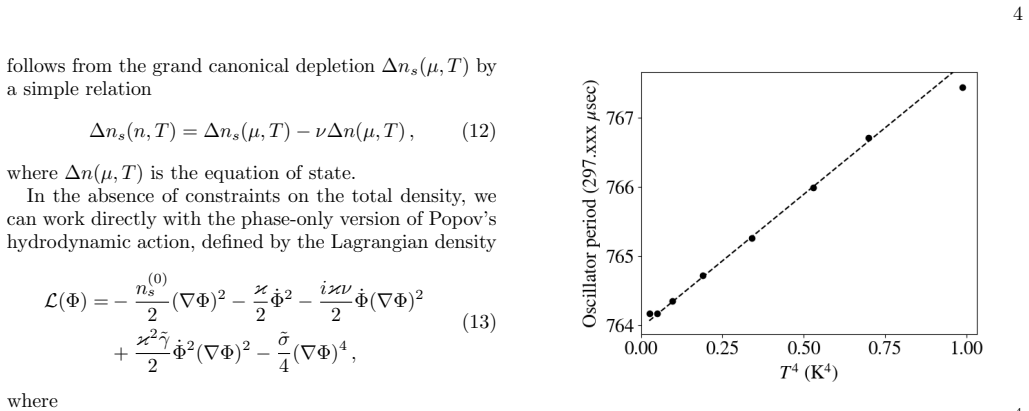
Landau theory of superfluidity associates low-temperature flow of the normal component with the phonon wind. This picture does not apply to superfluids in which Galilean invariance is broken either by disorder, porous media, or lattice potential, and the phonon wind is no longer solely responsible for depletion of the superfluid component. Based on Popov's hydrodynamic action with anharmonic terms, we present a general theory for low-temperature ($T$) dependence of the superfluid stiffness, which reproduces Landau result as a special case when several parameters of the hydrodynamic action are fixed by Galilean invariance, and validate it with numerical simulations of interacting lattice bosons. In a broader context, our approach reveals universal low-temperature thermodynamics of superfluids with an intrinsic connection between finite-$T$ and finite-size ($L$) effects implying universal scaling, $T^{d+1}$ and $1/L^{d+1}$, respectively, for a large class of thermodynamic quantities. We discuss the experimental detection of this law, and compare our prediction to the existing literature.
Editorial analysis
A structured set of objections, weighed in public.
Referee Report
Summary. The manuscript develops a general theory for the low-temperature depletion of superfluid density using Popov's hydrodynamic action including anharmonic terms. This framework reproduces the standard Landau result when Galilean invariance fixes the relevant parameters, and is tested against quantum Monte Carlo simulations of interacting bosons on a lattice. It also proposes universal scaling relations linking finite-temperature and finite-size effects in superfluid thermodynamics.
Significance. If the parameters of the hydrodynamic action can be fixed independently of the stiffness data, the work offers a valuable extension of superfluid hydrodynamics to systems without Galilean invariance, such as lattice or disordered superfluids. The connection to universal T^{d+1} and 1/L^{d+1} scaling for various thermodynamic quantities is potentially impactful for both theory and experiment. The inclusion of numerical simulations of lattice bosons is a strength that grounds the general theory in a concrete microscopic model.
major comments (1)
- The validation with lattice boson simulations hinges on whether the anharmonic coefficients in Popov's action are computed independently from the microscopic lattice Hamiltonian or adjusted to reproduce the measured superfluid stiffness. The abstract states that these parameters become free when Galilean invariance is absent, but without an explicit statement that they are fixed ab initio (rather than by fitting the depletion law), the numerical agreement risks circularity and does not yet confirm that the effective theory captures the correct physics.
Simulated Author's Rebuttal
We thank the referee for the careful reading of our manuscript and for the constructive feedback. The positive assessment of the general theory, its connection to universal scaling, and the value of the lattice simulations is appreciated. We address the single major comment below and will revise the manuscript to remove any ambiguity regarding parameter determination.
read point-by-point responses
-
Referee: The validation with lattice boson simulations hinges on whether the anharmonic coefficients in Popov's action are computed independently from the microscopic lattice Hamiltonian or adjusted to reproduce the measured superfluid stiffness. The abstract states that these parameters become free when Galilean invariance is absent, but without an explicit statement that they are fixed ab initio (rather than by fitting the depletion law), the numerical agreement risks circularity and does not yet confirm that the effective theory captures the correct physics.
Authors: We agree that an explicit statement is needed to eliminate any perception of circularity. In the lattice-boson application, the anharmonic coefficients (and all other parameters of the hydrodynamic action) are fixed entirely from independent microscopic data: the ground-state equation of state, compressibility, and sound velocity obtained from separate QMC runs at T=0, without any reference to the finite-temperature superfluid stiffness depletion curves that are later compared. These microscopic quantities determine the coefficients via the standard relations between the hydrodynamic action and the microscopic thermodynamics; the stiffness data are used only for validation after the parameters are set. We will add a new subsection (or expanded paragraph in Sec. III) that tabulates each coefficient, shows its microscopic origin, and states that no fitting to the depletion law was performed. This revision will make the ab-initio character of the validation unambiguous. revision: yes
Circularity Check
No significant circularity; derivation from Popov action is independent of validation data
full rationale
The paper starts from Popov's established hydrodynamic action (external reference, not self-citation) and derives the low-T superfluid stiffness expansion, recovering Landau's result when Galilean invariance fixes coefficients. For the non-Galilean lattice case, the anharmonic coefficients are treated as model-specific inputs. Numerical validation on interacting lattice bosons is presented as an independent check rather than a fit; no quoted step shows parameters being adjusted to the stiffness depletion data itself. The universal T^{d+1} and 1/L^{d+1} scaling follows directly from the hydrodynamic framework without reducing to a tautology. This satisfies the default expectation of a self-contained derivation.
Axiom & Free-Parameter Ledger
free parameters (1)
- parameters of the hydrodynamic action
axioms (1)
- domain assumption Popov's hydrodynamic action with anharmonic terms describes the low-temperature physics of the superfluid systems considered
Reference graph
Works this paper leans on
-
[1]
Unless stated otherwise, we will work in units where Planck’s constant is set equal to unity
(as a func- tion ofnand the square of the superflow wavevectork 0), and its derivatives: superfluid stiffnessn s ≡n s(T= 0) = 2∂E(n, k 2 0)/∂(k 2 0),ν,γ, andσ. Unless stated otherwise, we will work in units where Planck’s constant is set equal to unity. [The superfluid stiffness and superflow wavevec- tor are the most convenient quantities to discuss the ...
-
[2]
inηand k2 0, with subsequent replacementk 2 0 →(∇Φ) 2. For the purpose of computing the leading contribution to ∆n s, 3 the relevant terms in the hydrodynamic Hamiltonian are H(η,∇Φ) = n(0) s 2 (∇Φ)2 + η2 2κ + νη 2 (∇Φ)2 + γη 2 2 (∇Φ)2 + σ 4 (∇Φ)4 . (7) At this point it becomes clear why we must haveσ= 0 in the Galilean system: The transformation law for ...
-
[3]
P. W. Anderson, Considerations on the flow of superfluid helium, Rev. Mod. Phys.38, 298 (1966)
1966
-
[4]
Onsager, Statistical hydrodynamics, Il Nuovo Cimento (1943-1954)6, 279 (1949)
L. Onsager, Statistical hydrodynamics, Il Nuovo Cimento (1943-1954)6, 279 (1949)
1943
-
[5]
Feynman, Chapter II Application of quantum mechan- ics to liquid helium (Elsevier, 1955) pp
R. Feynman, Chapter II Application of quantum mechan- ics to liquid helium (Elsevier, 1955) pp. 17–53
1955
-
[6]
E. L. Andronikashvili and Y. G. Mamaladze, Quantiza- tion of macroscopic motions and hydrodynamics of ro- tating helium ii, Rev. Mod. Phys.38, 567 (1966)
1966
-
[7]
Josephson, Possible new effects in superconductive tunnelling, Physics Letters1, 251 (1962)
B. Josephson, Possible new effects in superconductive tunnelling, Physics Letters1, 251 (1962)
1962
-
[8]
Svistunov, E
B. Svistunov, E. Babaev, and N. Prokof’ev,Superfluid States of Matter(Taylor & Francis, 2015)
2015
-
[9]
Landau, Theory of the superfluidity of helium II, Phys
L. Landau, Theory of the superfluidity of helium II, Phys. Rev.60, 356 (1941)
1941
-
[10]
J. B. Mehl and W. Zimmermann, Flow of superfluid he- lium in a porous medium, Phys. Rev.167, 214 (1968)
1968
-
[11]
Boninsegni, Thin helium film on a glass substrate, Journal of Low Temperature Physics159, 441 (2010)
M. Boninsegni, Thin helium film on a glass substrate, Journal of Low Temperature Physics159, 441 (2010)
2010
-
[12]
Conti, A
S. Conti, A. Perali, A. R. Hamilton, M. V. Miloˇ sevi´ c, F. M. Peeters, and D. Neilson, Chester supersolid of spa- tially indirect excitons in double-layer semiconductor het- erostructures, Phys. Rev. Lett.130, 057001 (2023)
2023
-
[13]
L´ opez R´ ıos, A
P. L´ opez R´ ıos, A. Perali, R. J. Needs, and D. Neil- son, Evidence from quantum monte carlo simulations of large-gap superfluidity and bcs-bec crossover in double electron-hole layers, Phys. Rev. Lett.120, 177701 (2018)
2018
-
[14]
Khalatnikov,An Introduction To The Theory Of Su- perfluidity(CRC Press, 2018)
I. Khalatnikov,An Introduction To The Theory Of Su- perfluidity(CRC Press, 2018)
2018
-
[15]
Popov,Functional Integrals in Quantum Field Theory and Statistical Physics(Springer Dordrecht, 1983)
V. Popov,Functional Integrals in Quantum Field Theory and Statistical Physics(Springer Dordrecht, 1983)
1983
-
[16]
Berger, N
V. Berger, N. Prokof’ev, and B. Svistunov, Depletion of superfluid density: Universal low-temperature thermody- namics of superfluids, Phys. Rev. B113, 144512 (2026)
2026
-
[17]
N. V. Prokof’ev, B. V. Svistunov, and I. S. Tupitsyn, Ex- act, complete, and universal continuous-time worldline monte carlo approach to the statistics of discrete quan- tum systems, Journal of Experimental and Theoretical Physics87, 310 (1998)
1998
-
[18]
Boninsegni, N
M. Boninsegni, N. V. Prokof’ev, and B. V. Svistunov, Worm algorithm and diagrammatic monte carlo: A new approach to continuous-space path integral monte carlo simulations, Phys. Rev. E74, 036701 (2006)
2006
-
[19]
F. D. M. Pobell, H. W. Chan, L. R. Corruccini, R. P. Henkel, S. W. Schwenterly, and J. D. Reppy, Low- temperature superfluid density in a restricted geometry, Phys. Rev. Lett.28, 542 (1972)
1972
-
[20]
C. W. Kiewiet, H. E. Hall, and J. D. Reppy, Superfluid density in porous vycor glass, Phys. Rev. Lett.35, 1286 (1975)
1975
-
[21]
Lie-zhao, D
C. Lie-zhao, D. F. Brewer, C. Girit, E. N. Smith, and J. D. Reppy, Flow and torsional oscillator measurements on liquid helium in restricted geometries under pressure, Phys. Rev. B33, 106 (1986)
1986
-
[22]
W. P. Halperin, J. M. Parpia, and J. A. Sauls, Super- fluid helium-3 in confined quarters, Physics Today71, 30 (2018), https://pubs.aip.org/physicstoday/article- pdf/71/11/30/10119900/30 1 online.pdf
2018
-
[23]
A. Hegg, R. Jiang, J. Wang, J. Hou, T. Zeng, Y. Yildirim, and W. Ku, Universal low-temperature fluctuation of un- conventional superconductors revealed: “smoking gun” leaves proper bosonic superfluidity the last theory standing, arXiv:2402.08730 [cond-mat.supr-con] (2024), arXiv:2402.08730 [cond-mat.supr-con]
discussion (0)
Sign in with ORCID, Apple, or X to comment. Anyone can read and Pith papers without signing in.